WELCOME TO
General Packet Radio System
                    (GPRS)


           PRESENTED
KINGSHUK BANERJEE       BY-
SRIMOYEE MUKHOPADHYAY

         1. KINGSHUK BANERJEE (35)
         2.SRIMOYEE MUKHOPADHYAY (24)
         3. AVISHEK PAL (02)
         4.JAYITA MAITI (12)
WHAT IS GPRS?

GPRS (General Packet Radio Service) is a
packet based communication service for
mobile devices that allows data to be sent and
received across a mobile telephone network.
TO USE GPRS USERS SPECIFICALLY
             NEED:

1.   Mobile phone or terminal that supports GPRS.
2.   Subscription to a mobile operator that supports GPRS.
3.   Use of GPRS must be enabled for that user.
4.   GPRS is designed to make the internet fully available to the user.
5.
PROTOCOLS SUPPORTED

GPRS supports the following protocols:

INTERNET PROTOCOL(IP). In practice, built-in mobile
browsers generally use IPv4.
POINT TO POINT PROTOCOL(PPP). In this mode PPP
is often not supported by the mobile phone
operator,but if the mobile is used as a modem to the
connected computer, PPP is used to tunnel IP to the
phone.
When TCP/IP is used, each phone can have one or
more IP addrsses allocated. GPRS will store and
forward the IP packets to the phone.
SPEED OF GPRS

The upload and download speeds that can be achieved in
GPRS depend on a number of
 factors such as:
The number of TDMA time slots assigned by the
 operator.
 The channel encoding used.
Using the CS-4 it is possible to achieve a user speed of
20.0 kbit/s per time slot.
CS-1 can achieve a user speed of only 8.0 kbit/s per time
slot.
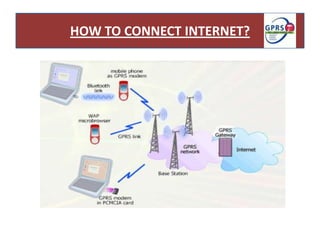
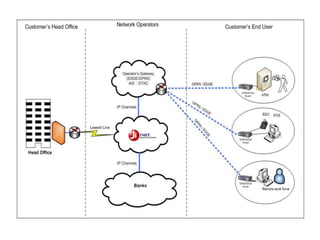
HOW TO CONNECT INTERNET?
KEY FEATURES OF GPRS

Speed:-
GPRS is packet switched. Higher connection speeds are
attainable at around 56–118 kbps, a vast improvement
on circuit switched networks of 9.6 kbps .

Always on connectivity:-
GPRS is an always-on service.

Spectrum Efficiency:-
Large number of GPRS users can share the same
bandwidth and be served from a single cell.
KEY FEATURES OF GPRS

 New and Better applications:-
  Users are able to explore the Internet or their own
  corporate networks more efficiently than they
  could when using GSM.


GSM operator Costs:-

 GPRS allows GSM providers to add value to
their business at relatively small costs.
HARDWARE

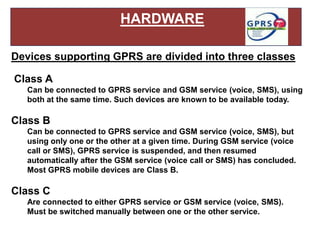
Devices supporting GPRS are divided into three classes

Class A
   Can be connected to GPRS service and GSM service (voice, SMS), using
   both at the same time. Such devices are known to be available today.

Class B
   Can be connected to GPRS service and GSM service (voice, SMS), but
   using only one or the other at a given time. During GSM service (voice
   call or SMS), GPRS service is suspended, and then resumed
   automatically after the GSM service (voice call or SMS) has concluded.
   Most GPRS mobile devices are Class B.

Class C
   Are connected to either GPRS service or GSM service (voice, SMS).
   Must be switched manually between one or the other service.
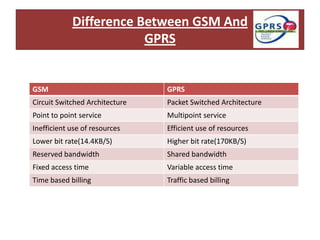
Difference Between GSM And
                        GPRS


GSM                             GPRS
Circuit Switched Architecture   Packet Switched Architecture
Point to point service          Multipoint service
Inefficient use of resources    Efficient use of resources
Lower bit rate(14.4KB/S)        Higher bit rate(170KB/S)
Reserved bandwidth              Shared bandwidth
Fixed access time               Variable access time
Time based billing              Traffic based billing
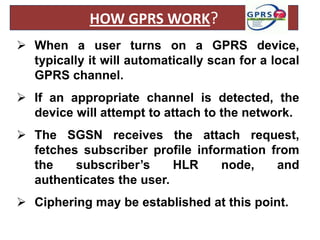
HOW GPRS WORK?
 When a user turns on a GPRS device,
  typically it will automatically scan for a local
  GPRS channel.
 If an appropriate channel is detected, the
  device will attempt to attach to the network.
 The SGSN receives the attach request,
  fetches subscriber profile information from
  the    subscriber’s     HLR    node,    and
  authenticates the user.
 Ciphering may be established at this point.
Sending and Receiving Packets

 When the mobile user sends data, the SGSN routes
  the packets to the appropriate GGSN.
 The GGSN then routes the data according to the
  current "context" established for the session.
 Conversely, packets destined for the user are routed
  to the GGSN associated with the user's IP address.
 The GGSN checks the received packets against the
 current context, identifies the SGSN that is serving the
 user, and routes the traffic accordingly.
 The SGSN then forwards the packets to the BSS where
  the subscriber is located.
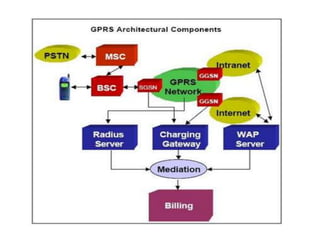
 MSC(MOBILE SWITCHING CENTRE)-SWITCHING CENTRE
  WHICH COORDINATES THE ROUTING OF CALLS IN A LARGE SERVICE
  AREA.MSC CONNECTS THE CELLULAR BASE STATIONS AND THE
  MOBILES TO THE PSTN.


 BSC(BASE STATION CONTROLLER)-A base station
  subsystem (BSS) which typically includes one or more base
  station controllers and a plurality of base stations, provides
  all of the radio-related functions


 PSTN(PUBLIC SWITCHED TELEPHONE NETWORK)-                 IT
  UTILISES STANDARDS CREATED BY ITU-T. THIS STANDARDS ALLOWS
  DIFFERENT NETWORK IN DIFFERENT COUNTRIES TO INTERCONNECT
  SEAMLESSLY.
GGSN(GATE GPRS SUPPORT NODE)- IT IS USED
AS INTERFACES TO EXTERNAL IP NETWORKS SUCH AS PUBLIC
INTERNET.OTHER FUNCTION INCLUDES SUBSCIBES SCREENING AND
ADDRESS MAPPING.IT MAINTAINS ROUTING INFORMATION.


CHARGING GATEWAY- MAIN FUNCTION IS COLLECTION
OF GPRS DATA RECORDS FROM GPRS NODES,INTERMEDIATE DATA
RECORD STORAGE,BUFFERING AND TRANSFER OF DATA RECORDS TO
THE MEDIATION OR BILLING SYSTEM.


SGSN(SERVING GPRS SUPPORT NODE)-IT
SENDS QUERIES TO HOME LOCATION REGISTER (HLR) TO OBTAIN
PROFILE DATA OF GPRS SUBSCRIBER.
APPLICATIONS
CHAT
INFORMATION SERVICES AS TEXT OR GRAPHICS
STILL IMAGES
MOVING IMAGES
WEB BROWSING
AUDIO REPORTS
DOCUMENT SHARING
JOB DISPATCH
CORPORATE MAIL
LAN APPLICATIONS
VEHICLE POSITIONING
FILE TRANSFER
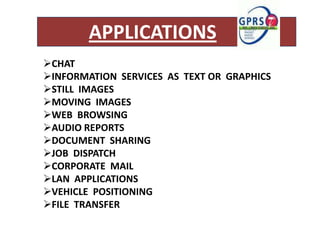
CURRENT TECHNOLOGY
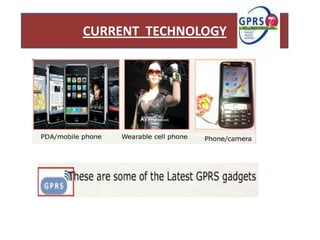
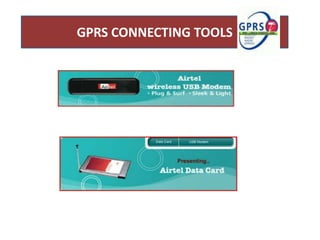
GPRS CONNECTING TOOLS
SECURITY ISSUES

 IDENTITY CONFIDENTIALITY
 IDENTITY AUTHENTICITY
 USER AND SIGNALING DATA CONFIDENTIALITY
 THE ALGORITHMS
CONCLUSION

   1. In theory, GPRS packet-based services cost users less than
circuit-switched services since communication channels are being
used on a shared-use, as-packets-are-needed basis rather than
dedicated to only one user at a time.

   2. It is also easier to make applications available to mobile
users because the faster data rate means that middleware
currently needed to adapt applications to the slower speed
of wireless systems are no longer be needed.

  3. GPRS also complements Bluetooth, a standard for replacing
wired connections between devices with wireless radio connec-
tions. In addition to the Internet Protocol (IP), GPRS supports X.25,
 a packet-based protocol that is used mainly in Europe.
BIBLIOGRAPHY

www.en.wikipedia.org/wiki/wimax
www.enchantedlearning.com
www.science.howstuffworks.com/wimax
http://www.comsoc.org/pubs/surveys/3q99i
 ssue/bettstetter.html
http://www.wsdmag.com/2000/aug2200/38-
 45.html
Gprs

Gprs

  • 1.
  • 2.
    General Packet RadioSystem (GPRS) PRESENTED KINGSHUK BANERJEE BY- SRIMOYEE MUKHOPADHYAY 1. KINGSHUK BANERJEE (35) 2.SRIMOYEE MUKHOPADHYAY (24) 3. AVISHEK PAL (02) 4.JAYITA MAITI (12)
  • 3.
    WHAT IS GPRS? GPRS(General Packet Radio Service) is a packet based communication service for mobile devices that allows data to be sent and received across a mobile telephone network.
  • 4.
    TO USE GPRSUSERS SPECIFICALLY NEED: 1. Mobile phone or terminal that supports GPRS. 2. Subscription to a mobile operator that supports GPRS. 3. Use of GPRS must be enabled for that user. 4. GPRS is designed to make the internet fully available to the user. 5.
  • 5.
    PROTOCOLS SUPPORTED GPRS supportsthe following protocols: INTERNET PROTOCOL(IP). In practice, built-in mobile browsers generally use IPv4. POINT TO POINT PROTOCOL(PPP). In this mode PPP is often not supported by the mobile phone operator,but if the mobile is used as a modem to the connected computer, PPP is used to tunnel IP to the phone. When TCP/IP is used, each phone can have one or more IP addrsses allocated. GPRS will store and forward the IP packets to the phone.
  • 6.
    SPEED OF GPRS Theupload and download speeds that can be achieved in GPRS depend on a number of factors such as: The number of TDMA time slots assigned by the operator.  The channel encoding used. Using the CS-4 it is possible to achieve a user speed of 20.0 kbit/s per time slot. CS-1 can achieve a user speed of only 8.0 kbit/s per time slot.
  • 7.
    HOW TO CONNECTINTERNET?
  • 8.
    KEY FEATURES OFGPRS Speed:- GPRS is packet switched. Higher connection speeds are attainable at around 56–118 kbps, a vast improvement on circuit switched networks of 9.6 kbps . Always on connectivity:- GPRS is an always-on service. Spectrum Efficiency:- Large number of GPRS users can share the same bandwidth and be served from a single cell.
  • 9.
    KEY FEATURES OFGPRS  New and Better applications:- Users are able to explore the Internet or their own corporate networks more efficiently than they could when using GSM. GSM operator Costs:- GPRS allows GSM providers to add value to their business at relatively small costs.
  • 10.
    HARDWARE Devices supporting GPRSare divided into three classes Class A Can be connected to GPRS service and GSM service (voice, SMS), using both at the same time. Such devices are known to be available today. Class B Can be connected to GPRS service and GSM service (voice, SMS), but using only one or the other at a given time. During GSM service (voice call or SMS), GPRS service is suspended, and then resumed automatically after the GSM service (voice call or SMS) has concluded. Most GPRS mobile devices are Class B. Class C Are connected to either GPRS service or GSM service (voice, SMS). Must be switched manually between one or the other service.
  • 11.
    Difference Between GSMAnd GPRS GSM GPRS Circuit Switched Architecture Packet Switched Architecture Point to point service Multipoint service Inefficient use of resources Efficient use of resources Lower bit rate(14.4KB/S) Higher bit rate(170KB/S) Reserved bandwidth Shared bandwidth Fixed access time Variable access time Time based billing Traffic based billing
  • 12.
    HOW GPRS WORK? When a user turns on a GPRS device, typically it will automatically scan for a local GPRS channel.  If an appropriate channel is detected, the device will attempt to attach to the network.  The SGSN receives the attach request, fetches subscriber profile information from the subscriber’s HLR node, and authenticates the user.  Ciphering may be established at this point.
  • 14.
    Sending and ReceivingPackets  When the mobile user sends data, the SGSN routes the packets to the appropriate GGSN.  The GGSN then routes the data according to the current "context" established for the session.  Conversely, packets destined for the user are routed to the GGSN associated with the user's IP address.  The GGSN checks the received packets against the current context, identifies the SGSN that is serving the user, and routes the traffic accordingly.  The SGSN then forwards the packets to the BSS where the subscriber is located.
  • 16.
     MSC(MOBILE SWITCHINGCENTRE)-SWITCHING CENTRE WHICH COORDINATES THE ROUTING OF CALLS IN A LARGE SERVICE AREA.MSC CONNECTS THE CELLULAR BASE STATIONS AND THE MOBILES TO THE PSTN.  BSC(BASE STATION CONTROLLER)-A base station subsystem (BSS) which typically includes one or more base station controllers and a plurality of base stations, provides all of the radio-related functions  PSTN(PUBLIC SWITCHED TELEPHONE NETWORK)- IT UTILISES STANDARDS CREATED BY ITU-T. THIS STANDARDS ALLOWS DIFFERENT NETWORK IN DIFFERENT COUNTRIES TO INTERCONNECT SEAMLESSLY.
  • 17.
    GGSN(GATE GPRS SUPPORTNODE)- IT IS USED AS INTERFACES TO EXTERNAL IP NETWORKS SUCH AS PUBLIC INTERNET.OTHER FUNCTION INCLUDES SUBSCIBES SCREENING AND ADDRESS MAPPING.IT MAINTAINS ROUTING INFORMATION. CHARGING GATEWAY- MAIN FUNCTION IS COLLECTION OF GPRS DATA RECORDS FROM GPRS NODES,INTERMEDIATE DATA RECORD STORAGE,BUFFERING AND TRANSFER OF DATA RECORDS TO THE MEDIATION OR BILLING SYSTEM. SGSN(SERVING GPRS SUPPORT NODE)-IT SENDS QUERIES TO HOME LOCATION REGISTER (HLR) TO OBTAIN PROFILE DATA OF GPRS SUBSCRIBER.
  • 18.
    APPLICATIONS CHAT INFORMATION SERVICES ASTEXT OR GRAPHICS STILL IMAGES MOVING IMAGES WEB BROWSING AUDIO REPORTS DOCUMENT SHARING JOB DISPATCH CORPORATE MAIL LAN APPLICATIONS VEHICLE POSITIONING FILE TRANSFER
  • 19.
  • 20.
  • 21.
    SECURITY ISSUES  IDENTITYCONFIDENTIALITY  IDENTITY AUTHENTICITY  USER AND SIGNALING DATA CONFIDENTIALITY  THE ALGORITHMS
  • 22.
    CONCLUSION 1. In theory, GPRS packet-based services cost users less than circuit-switched services since communication channels are being used on a shared-use, as-packets-are-needed basis rather than dedicated to only one user at a time. 2. It is also easier to make applications available to mobile users because the faster data rate means that middleware currently needed to adapt applications to the slower speed of wireless systems are no longer be needed. 3. GPRS also complements Bluetooth, a standard for replacing wired connections between devices with wireless radio connec- tions. In addition to the Internet Protocol (IP), GPRS supports X.25, a packet-based protocol that is used mainly in Europe.
  • 23.