







GOVERNMENT POLICY
SINCE- 2000
Industrial Policy
Education
policy
Population
policy
INDUSTRIAL POLICY
Introduction
 The World Bank (1992) has provided a
working definition of industrial policy as
“government efforts to alter industrial structure
to promote productivity based growth.”
 Industrial policy is probably the most
important document , which indicates the
relationship between government and
business.
4
1)1. RISE IN INTERNATIONAL COMPETITION :-
Removal of quantitative restrictions on imports.
2)DECLINE IN ROLE OF PUBLIC SECTOR:-
Disinvestment process converted many of the
existing public sector enterprises into non-
governmental enterprises.
TWO MAJOR REFORMS THAT TOOK PLACE
FROM THE YEAR 2002 WERE:
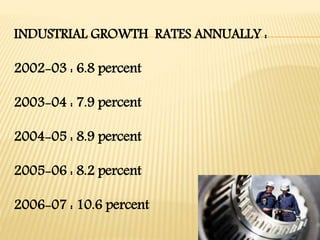
INDUSTRIAL GROWTH RATES ANNUALLY :
2002-03 : 6.8 percent
2003-04 : 7.9 percent
2004-05 : 8.9 percent
2005-06 : 8.2 percent
2006-07 : 10.6 percent
 1. Accelerate development of the
backward areas of the State.
 2. Creation of large scale employment
opportunities to absorb the swelling ranks
of unemployed.
 3. Increase the total flow of investment to
industrial sector.
4. Increase the development of
infrastructure and human resources to
sustain the long term growth.
5. Achieving sustainable development.
6. Encouraging entrepreneurship and
developing technology to promote
Swedishi Spirit.
APPROACH
 In the present climate of economic
liberalisation and globalisation, the State
approach needs to be radically different
from what it has been till now. The licence
regime imposed certain limitations in the
approach and this resulted in each State
competing with other States in the country
for attracting more investment to that
State.
 Multinationals are trying to set up their
production facilities in the country and
the Indian companies are trying to
upgrade their processes and products
to become internationally competitive.
 Gujarat should try to benchmark itself vis-a-
vis those regions and not merely be content
in competing with the other States in the
country in attracting investments. With this
approach, Gujarat should be able to take the
lead in rapid economic change in the country
Strategy
INFRASTRUCTURE DEVELOPMENT:-
 Government will give specific emphasis on
infrastructure development, particularly in
backward areas. The State has already set
up Gujarat Infrastructure Development Board
under the chairmanship of Hon. Chief
Minister to allow single point quick
permission of infrastructure development
projects with private sector participation.
 Easy availability of the right type of land is
a crucial factor in the location of an
industrial unit. The State Government will
introduce suitable amendments in the
present land laws to make land available
for setting up industry without protracted
paper work and delay.
 With rapid industrialisation and
urbanisation of Gujarat, in order to ensure
easy availability of land. Government
intends to introduce the concept of land
use planning to ensure optimum utilisation
of land. Government will try to ensure that
rich agricultural land is not diverted for the
purpose of industry.
 Gujarat has been fortunate enough to be in a
reasonably comfortable position as far as availability
of power is concerned. Demand for power has been
growing at a rate of 8% to 10% per annum. Apart
from requirement of power in the industrial sector,
consumption of energy has been growing at a rapid
rate in domestic, commercial and agricultural sectors.
The State Government has taken the initiatives of
promoting new generating capacities with projects
totalling 3000 MW in various stages of
implementation.
NATIONAL POPULATION POLICY-
2000
 In common parlance, population refers to the
total number of people living in a place.
 thus, population of india means the total
number of people living in india.
 There was a time when growth in population
was considered desirable.
 There are still certain countries (example,
Australia),which give incentives to people to
have large families and hence have big
population of the country.foe the, more numbers
of persons is desirable as.....
MEANING OF POPULATION:-
 Its provides work forces to produce.
 It provides market for the product produced.
 It may promote innovation ideas.
 It may promote division of labour and
specialisation .
 However, there are countries (example, india)
for whom more number of person id not desirable
as.....
CONT......
 There may not be adequate jobs to absorb
additional people.
 They put pressure on means of
subsistence.
 They put pressure on social overheads
(hospitals, schools, roads etc....)
CONT.......
 They may result in increased consumption
and reduced saving and hence slow down
capital formation.
 Actually, whether a big and growing
population is an asset or a liability for the
economy depends upon economy to
economy.
CONT......
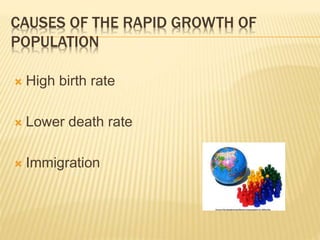
 High birth rate
 Lower death rate
 Immigration
CAUSES OF THE RAPID GROWTH OF
POPULATION
 Measures formulated by a range of social institutions
including Government which may influence the size,
distribution or composition of human population
(Driver,1972).
 A deliberate effort by a national government to
influence the demographic variables like richness,
humanity and migration (Organski & Organski,1961)
 A set of Coordinated laws aimed at reaching some
demographic goal (Biurgeois-Pichat,1974)
WHAT IS POPULATION POLICY?
 On 11th May, 2000, India had 1 billion (100 crores)
people, i.e., 16 percent of the world’s population on
2.4 percent of the globe’s land area.
 If current trends continue, India may overtake China
by 2045, to become the most populous country in the
world.
 Global population : ↑ 3 folds during this century
(from 2 to 6 billion)
NEED FOR POPULATION POLICY IN INDIA
 Population of India : ↑ nearly 5 times (from
238 million to 1 billion), during the same
period.
 Stabilizing population is an essential
requirement for promoting sustainable
development with more equitable distribution .
 With a view to encourage two-child norm and
stabilizing population by 2046 A.D. the
Government adopted the National Population
Policy (NPP-2000). The following are the main
features of the NPP.
 Address the unmet needs for Indian citizens.
 Make school education up to age 14 free and
compulsory, and reduce dropouts at primary and
secondary school levels to below 20 per cent for
both boys and girls.
 Reduced infant mortality rate to below 30 per cent 1000
live births.
 Reduce maternal mortality ratio to below 100 per
1,00,000 live births.
 Another important feature of the policy is to attain
universal immunisation of all children against preventable
diseases.
 Promote delayed marriage for girls, not earlier than age
18 and preferably after 20 years of age.
CONT......
 Achieve 80 per cent institutional deliveries and 100 per cent
deliveries by trained persons.
 NPP 2000 also emphasizes the role of Ayurveda, Yoga, Unani,
Siddh and Homeopathy (AYUSH) medicine system to serve the
goals of public health.
 The NPP 2000 strived to change the mindsets of people from
base level. Its intense focus on women empowerment has led to
improvement in many national statistics.
 Prevent and control communicable diseases.
CONT......
 Education in its general sense is a form of
learning in which the knowledge, skills,
and habits of a group of people are
transferred from one generation to the
next through teaching, training, or
research.
 Education is “ Preparing a person to face
everyday life”.
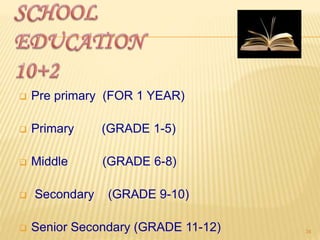
 Pre primary (FOR 1 YEAR)
 Primary (GRADE 1-5)
 Middle (GRADE 6-8)
 Secondary (GRADE 9-10)
 Senior Secondary (GRADE 11-12) 34
EDUCATION TODAY
 Today’s education system in India is challenging
but needs some changes.
 The education system in India puts more
emphasis on the theoretical knowledge than
the practical.
 The Quality of the Education must be improved
rather than the Quantity
PROBLEMS OF INDIA'S EDUCATION
SYSTEM
 Unplanned expansion of higher education.
 Neglect of primary education.
 Low standard of education.
 Large number of unemployed educated
people.
CONT.....
 Lack of infrastructure in many rural schools –
absence of rooms, blackboard, teachers, water
etc.
 Inadequate number of institutions which can
impart education through correspondence or in
the evening.
 Large -scale migration of educated people to
the developed western countries.
NATIONAL POLICY ON EDUCATION
 The National Policy on Education (NPE) is
a policy formulated by the Government of
India to promote education amongst India's
people. The policy covers elementary
education to colleges in both rural and urban
India. The first NPE was promulgated in 1968
by the government of Prime Minister Indira
Gandhi, and the second by Prime Minister
Rajiv Gandhi in 1986.
HISTORY OF NPE
 Since the country's independence in 1947,
the Indian government sponsored a variety of
programmes to address the problems of
illiteracy in both rural and urban India.
Maulana Abul Kalam Azad, India's first
Minister of Education, envisaged strong
central government control over education
throughout the country,
 The Union government established the
University Education Commission (1948–
1949) and the Secondary Education
Commission (1952–1953) to develop
proposals to modernise India's education
system. The Resolution on Scientific Policy
was adopted by the government of
Jawaharlal Nehru, India's first Prime Minister.
VISION & MISSION
 The National Education Policy (NEP), 2016
envisions a credible and high-performing
education system capable of ensuring inclusive
quality education and lifelong learning
opportunities for all and producing
students/graduates equipped with the
knowledge, skills, attitudes and values that are
required to lead a productive life.
 Ensure equitable, inclusive and quality
education and lifelong learning opportunities
for all – children, youth and adults – and to
promote the realisation the nation’s human
potential to its fullest, with equity and
excellence.
NPE OF INDIAN EDUCATION - 2000
Expanding early childhood education services to
ensure that all pre-school age children aged 4-5
years attain the learning and developmental
readiness required for smooth transition to primary
education, with particular attention to children
belonging to disadvantaged population groups;
 Ensuring that young people (15-24 years)
and adults (15 years and above) who are
outside the formal education system,
including those working in the informal sector
of the economy, are provided with
opportunities to attain skills for employability;
Ensuring that social, regional and gender gaps in
education are eliminated and gender equality and
girls’ and women’s empowerment are promoted
throughout the education system;
 Ensuring increased and well-targeted financing for
educational development programmes
WHAT WE HAVE TO DO:
 If the government takes action at least against
some of the challenges mentioned above than
the future of student can be improved to a better
successful person. As everyone know India has
major population as youth, if there is a
revolution in present educational system than
every student of today may become a
successful person in life. If this becomes than
no one can stop the future of India, as a
developed country from developing country(for
past many years).
RECENT DEVELOPMENTS FOR
EDUCATION
 Sarva Shiksha Abhiyan (SSA)/Right to Education
(RTE)
 National Programme for Education of Girls at
Elementary Level (NPEGEL)
 Rashtriya Madhyamik Shiksha Abhiyan (RMSA) for
development of secondary education, launched in
2009.
 Inclusive Education for the Disabled at Secondary
Stage (IEDSS IEDSS)
 Saakshar Bharat (Saakshar Bharat)/Adult Education
 Rashtriya Uchchatar Shiksha Abhiyan (RUSA) for
development of higher education, launched in 2013.
Government  policy 2000

Government policy 2000

  • 1.
    GOVERNMENT POLICY SINCE- 2000 IndustrialPolicy Education policy Population policy
  • 2.
  • 3.
  • 4.
     The WorldBank (1992) has provided a working definition of industrial policy as “government efforts to alter industrial structure to promote productivity based growth.”  Industrial policy is probably the most important document , which indicates the relationship between government and business. 4
  • 5.
    1)1. RISE ININTERNATIONAL COMPETITION :- Removal of quantitative restrictions on imports. 2)DECLINE IN ROLE OF PUBLIC SECTOR:- Disinvestment process converted many of the existing public sector enterprises into non- governmental enterprises. TWO MAJOR REFORMS THAT TOOK PLACE FROM THE YEAR 2002 WERE:
  • 6.
    INDUSTRIAL GROWTH RATESANNUALLY : 2002-03 : 6.8 percent 2003-04 : 7.9 percent 2004-05 : 8.9 percent 2005-06 : 8.2 percent 2006-07 : 10.6 percent
  • 7.
     1. Acceleratedevelopment of the backward areas of the State.  2. Creation of large scale employment opportunities to absorb the swelling ranks of unemployed.  3. Increase the total flow of investment to industrial sector.
  • 8.
    4. Increase thedevelopment of infrastructure and human resources to sustain the long term growth. 5. Achieving sustainable development. 6. Encouraging entrepreneurship and developing technology to promote Swedishi Spirit.
  • 9.
    APPROACH  In thepresent climate of economic liberalisation and globalisation, the State approach needs to be radically different from what it has been till now. The licence regime imposed certain limitations in the approach and this resulted in each State competing with other States in the country for attracting more investment to that State.
  • 10.
     Multinationals aretrying to set up their production facilities in the country and the Indian companies are trying to upgrade their processes and products to become internationally competitive.
  • 11.
     Gujarat shouldtry to benchmark itself vis-a- vis those regions and not merely be content in competing with the other States in the country in attracting investments. With this approach, Gujarat should be able to take the lead in rapid economic change in the country Strategy
  • 12.
    INFRASTRUCTURE DEVELOPMENT:-  Governmentwill give specific emphasis on infrastructure development, particularly in backward areas. The State has already set up Gujarat Infrastructure Development Board under the chairmanship of Hon. Chief Minister to allow single point quick permission of infrastructure development projects with private sector participation.
  • 13.
     Easy availabilityof the right type of land is a crucial factor in the location of an industrial unit. The State Government will introduce suitable amendments in the present land laws to make land available for setting up industry without protracted paper work and delay.
  • 14.
     With rapidindustrialisation and urbanisation of Gujarat, in order to ensure easy availability of land. Government intends to introduce the concept of land use planning to ensure optimum utilisation of land. Government will try to ensure that rich agricultural land is not diverted for the purpose of industry.
  • 15.
     Gujarat hasbeen fortunate enough to be in a reasonably comfortable position as far as availability of power is concerned. Demand for power has been growing at a rate of 8% to 10% per annum. Apart from requirement of power in the industrial sector, consumption of energy has been growing at a rapid rate in domestic, commercial and agricultural sectors. The State Government has taken the initiatives of promoting new generating capacities with projects totalling 3000 MW in various stages of implementation.
  • 17.
  • 19.
     In commonparlance, population refers to the total number of people living in a place.  thus, population of india means the total number of people living in india.  There was a time when growth in population was considered desirable.  There are still certain countries (example, Australia),which give incentives to people to have large families and hence have big population of the country.foe the, more numbers of persons is desirable as..... MEANING OF POPULATION:-
  • 20.
     Its provideswork forces to produce.  It provides market for the product produced.  It may promote innovation ideas.  It may promote division of labour and specialisation .  However, there are countries (example, india) for whom more number of person id not desirable as..... CONT......
  • 21.
     There maynot be adequate jobs to absorb additional people.  They put pressure on means of subsistence.  They put pressure on social overheads (hospitals, schools, roads etc....) CONT.......
  • 22.
     They mayresult in increased consumption and reduced saving and hence slow down capital formation.  Actually, whether a big and growing population is an asset or a liability for the economy depends upon economy to economy. CONT......
  • 23.
     High birthrate  Lower death rate  Immigration CAUSES OF THE RAPID GROWTH OF POPULATION
  • 24.
     Measures formulatedby a range of social institutions including Government which may influence the size, distribution or composition of human population (Driver,1972).  A deliberate effort by a national government to influence the demographic variables like richness, humanity and migration (Organski & Organski,1961)  A set of Coordinated laws aimed at reaching some demographic goal (Biurgeois-Pichat,1974) WHAT IS POPULATION POLICY?
  • 25.
     On 11thMay, 2000, India had 1 billion (100 crores) people, i.e., 16 percent of the world’s population on 2.4 percent of the globe’s land area.  If current trends continue, India may overtake China by 2045, to become the most populous country in the world.  Global population : ↑ 3 folds during this century (from 2 to 6 billion) NEED FOR POPULATION POLICY IN INDIA
  • 26.
     Population ofIndia : ↑ nearly 5 times (from 238 million to 1 billion), during the same period.  Stabilizing population is an essential requirement for promoting sustainable development with more equitable distribution .
  • 27.
     With aview to encourage two-child norm and stabilizing population by 2046 A.D. the Government adopted the National Population Policy (NPP-2000). The following are the main features of the NPP.  Address the unmet needs for Indian citizens.  Make school education up to age 14 free and compulsory, and reduce dropouts at primary and secondary school levels to below 20 per cent for both boys and girls.
  • 28.
     Reduced infantmortality rate to below 30 per cent 1000 live births.  Reduce maternal mortality ratio to below 100 per 1,00,000 live births.  Another important feature of the policy is to attain universal immunisation of all children against preventable diseases.  Promote delayed marriage for girls, not earlier than age 18 and preferably after 20 years of age. CONT......
  • 29.
     Achieve 80per cent institutional deliveries and 100 per cent deliveries by trained persons.  NPP 2000 also emphasizes the role of Ayurveda, Yoga, Unani, Siddh and Homeopathy (AYUSH) medicine system to serve the goals of public health.  The NPP 2000 strived to change the mindsets of people from base level. Its intense focus on women empowerment has led to improvement in many national statistics.  Prevent and control communicable diseases. CONT......
  • 33.
     Education inits general sense is a form of learning in which the knowledge, skills, and habits of a group of people are transferred from one generation to the next through teaching, training, or research.  Education is “ Preparing a person to face everyday life”.
  • 34.
     Pre primary(FOR 1 YEAR)  Primary (GRADE 1-5)  Middle (GRADE 6-8)  Secondary (GRADE 9-10)  Senior Secondary (GRADE 11-12) 34
  • 35.
    EDUCATION TODAY  Today’seducation system in India is challenging but needs some changes.  The education system in India puts more emphasis on the theoretical knowledge than the practical.  The Quality of the Education must be improved rather than the Quantity
  • 36.
    PROBLEMS OF INDIA'SEDUCATION SYSTEM  Unplanned expansion of higher education.  Neglect of primary education.  Low standard of education.  Large number of unemployed educated people.
  • 37.
    CONT.....  Lack ofinfrastructure in many rural schools – absence of rooms, blackboard, teachers, water etc.  Inadequate number of institutions which can impart education through correspondence or in the evening.  Large -scale migration of educated people to the developed western countries.
  • 38.
    NATIONAL POLICY ONEDUCATION  The National Policy on Education (NPE) is a policy formulated by the Government of India to promote education amongst India's people. The policy covers elementary education to colleges in both rural and urban India. The first NPE was promulgated in 1968 by the government of Prime Minister Indira Gandhi, and the second by Prime Minister Rajiv Gandhi in 1986.
  • 39.
    HISTORY OF NPE Since the country's independence in 1947, the Indian government sponsored a variety of programmes to address the problems of illiteracy in both rural and urban India. Maulana Abul Kalam Azad, India's first Minister of Education, envisaged strong central government control over education throughout the country,
  • 40.
     The Uniongovernment established the University Education Commission (1948– 1949) and the Secondary Education Commission (1952–1953) to develop proposals to modernise India's education system. The Resolution on Scientific Policy was adopted by the government of Jawaharlal Nehru, India's first Prime Minister.
  • 41.
    VISION & MISSION The National Education Policy (NEP), 2016 envisions a credible and high-performing education system capable of ensuring inclusive quality education and lifelong learning opportunities for all and producing students/graduates equipped with the knowledge, skills, attitudes and values that are required to lead a productive life.
  • 42.
     Ensure equitable,inclusive and quality education and lifelong learning opportunities for all – children, youth and adults – and to promote the realisation the nation’s human potential to its fullest, with equity and excellence.
  • 43.
    NPE OF INDIANEDUCATION - 2000 Expanding early childhood education services to ensure that all pre-school age children aged 4-5 years attain the learning and developmental readiness required for smooth transition to primary education, with particular attention to children belonging to disadvantaged population groups;
  • 44.
     Ensuring thatyoung people (15-24 years) and adults (15 years and above) who are outside the formal education system, including those working in the informal sector of the economy, are provided with opportunities to attain skills for employability;
  • 45.
    Ensuring that social,regional and gender gaps in education are eliminated and gender equality and girls’ and women’s empowerment are promoted throughout the education system;  Ensuring increased and well-targeted financing for educational development programmes
  • 46.
    WHAT WE HAVETO DO:  If the government takes action at least against some of the challenges mentioned above than the future of student can be improved to a better successful person. As everyone know India has major population as youth, if there is a revolution in present educational system than every student of today may become a successful person in life. If this becomes than no one can stop the future of India, as a developed country from developing country(for past many years).
  • 47.
    RECENT DEVELOPMENTS FOR EDUCATION Sarva Shiksha Abhiyan (SSA)/Right to Education (RTE)  National Programme for Education of Girls at Elementary Level (NPEGEL)  Rashtriya Madhyamik Shiksha Abhiyan (RMSA) for development of secondary education, launched in 2009.  Inclusive Education for the Disabled at Secondary Stage (IEDSS IEDSS)  Saakshar Bharat (Saakshar Bharat)/Adult Education  Rashtriya Uchchatar Shiksha Abhiyan (RUSA) for development of higher education, launched in 2013.