MAKE IN INDIA
• PRESENTED
TO : DR VIJAY PITHADIA
BY : HINAL MEHTA
• STD : SY.IMBA
• ENRL NO : 19
• COLLEGE NAME : SMT S.H. GAJERA
MBA MAHILA COLLEGE.
Job Creation and
Economic
Development and
to give the Indian
economy global
recognition
INDIA
– India is one of the world's fastest-growing economies.
– The tenth-largest in the world by nominal GDP and
the third-largest by purchasing power parity (PPP).
Where Are We?
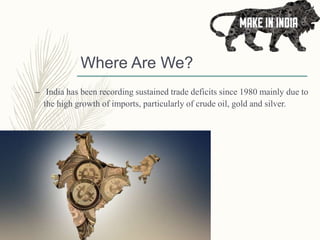
– India has been recording sustained trade deficits since 1980 mainly due to
the high growth of imports, particularly of crude oil, gold and silver.
IMPORTS
– India is heavily dependent on crude oil imports, with
petroleum crude accounting for about 34 percent of the total
imports.
– The country also imports: gold and silver (12 percent of the
total imports), machinery (10 percent), electronic goods (7
percent) and pearls, precious and semi-precious stones (5
percent).
– India’s main import partners are China (10.7 percent of the
total shipments), United Arab Emirates (8 percent), Saudi
Arabia (7 percent), Switzerland (7 percent) and the United
States (5 percent).
IMPORTS & EXPORTS
A. EXPORTS (Receipts)
Exports during October, 2014 were valued at US $ 12146
Million (Rs. 74505.99 Crore).
B. IMPORTS (Payments)
Imports during October, 2014 were valued at US $ 5942
Million (Rs. 36449.42 Crore).
C. TRADE BALANCE
The trade balance in Services (i.e. net exports of Services) for
October, 2014 was estimated at US $6204 Million.
ON INDEPENDENCE DAY
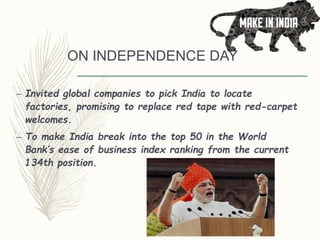
– Invited global companies to pick India to locate
factories, promising to replace red tape with red-carpet
welcomes.
– To make India break into the top 50 in the World
Bank’s ease of business index ranking from the current
134th position.
Zero defect,
zero effect
– "Our manufacturing should have zero defect so that our
products should not be rejected in the global market.
Besides, we should also keep in mind that manufacturing
should not have any negative impact on our environment."
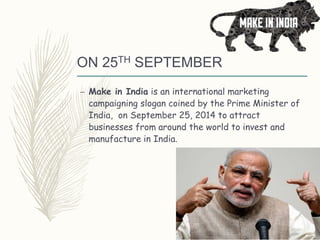
ON 25TH SEPTEMBER
– Make in India is an international marketing
campaigning slogan coined by the Prime Minister of
India, on September 25, 2014 to attract
businesses from around the world to invest and
manufacture in India.
Major objective
– The major objective behind this initiative is to
focus upon the heavy industries and public
enterprises while generating employment in
India.
– To facilitate
– Investment
– Foster innovation
– Enhance skills development
– Protect intellectual property
– To built best-in-class manufacturing
infrastructure
The highlights
and purpose of
Come, Make in
India are-
– The campaign, 'Make in India' is aimed at
making India a manufacturing hub and
economic transformation in India while
eliminating the unnecessary laws and
regulations, making bureaucratic processes
easier and shorter, and make government
more transparent, responsive and
accountable.
– The government emphasized upon the
framework which include the time-bound
project clearances through a single online
portal which will be further aided by the
eight-members team dedicated to
answering investor queries within 48 hours
and addressing key issues including labor
laws, skill development and infrastructure.
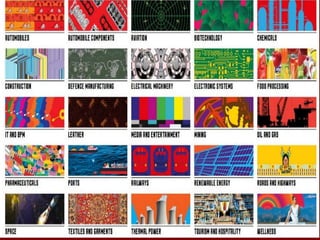
Following
sectors have
been included
by the
Government in
this campaign.
5 things ‘Make In India’ will do
– 1 Guide Foreign Investors
– 2 Assistance to Foreign Investors
– 3 Prompt Response
– 4 Provide Relevant Information
– 5 Proactive Approach
List of challenges
 India’s chronic infrastructure and logistics deficit
with inefficient transport networks makes it tough for
manufacturing companies to achieve just-in-time
production.
 A large chunk of manufacturers in India even believe
that globalization is a myth for them and they consider
global opportunities as threat for their domestic
business
– For example,
– increasing raw material cost,
– ever growing prices of industrial land,
– non-availability of labour and
– Currently, it takes 12 procedures and 27
days to start business, 35 procedures and
168 days to get construction permits and
1420 days to enforce contracts in India.
Land Acquisition in India
– Land Acquisition in India refers to the
process of land acquisition by the central
or state government of India for various
infrastructure and economic growth
initiatives.
– Several controversies have arisen with
claims that land owners have not been
adequately compensated.
Tata Motors
– When companies such as Tata Motors
choose where to locate a new factory, they
consider a range of factors.
– But India fares badly on most of the
counts. For instance, contract
enforcement takes 1,420 days and going
through the 12 procedures for starting
business typically takes 27 days.
Decade of manufacturing in
India
– This is not the first time India is
focusing on its manufacturing sector.
– In 2006, the UPA government put out
a national strategy for manufacturing.
It even dubbed 2006-15 as the “decade
of manufacturing in India.”
Electronic manufacturing still
emains a pipe dream
•India has huge
potential, but not much
has been achieved so
far.
•Nokia has just closed
its manufacturing
operation.
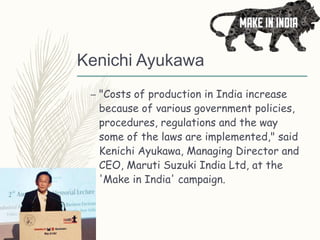
Kenichi Ayukawa
– "Costs of production in India increase
because of various government policies,
procedures, regulations and the way
some of the laws are implemented," said
Kenichi Ayukawa, Managing Director and
CEO, Maruti Suzuki India Ltd, at the
'Make in India' campaign.
Ambani
– Ambani said in order to succeed in this campaign, it
was important to be open to capital and expertise
from all over the globe, and implementation
of GST will make India one market and strengthen
overall Make in India program.
GST
– The Goods and Services
Tax (GST) is a Value
Added Tax (VAT) to be
implemented in India, the
decision on which is
pending.
– It will replace all indirect
taxes levied on goods and
services by the
Indian Central and State
governments.
– Indirect tax:
customs duty,
central excise duty,
service tax,
sales tax,
value added tax (VAT),
securities transaction tax
‘Made in China’ campaign
launched with ‘Make in India’
– Coinciding with Prime Minister Narendra Modi’s ‘Make in
India’ pitch, the Chinese government has launched a ‘Made
in China’ campaign with a host of tax concessions in an
effort to retain its manufacturing expertise.
– China will encourage high-tech imports, research and
development (R&D) to upgrade ‘Made in China’, a decision
by the Chinese central government said.
THANK YOU
!!!

Make in india

  • 1.
    MAKE IN INDIA •PRESENTED TO : DR VIJAY PITHADIA BY : HINAL MEHTA • STD : SY.IMBA • ENRL NO : 19 • COLLEGE NAME : SMT S.H. GAJERA MBA MAHILA COLLEGE.
  • 2.
    Job Creation and Economic Developmentand to give the Indian economy global recognition
  • 3.
    INDIA – India isone of the world's fastest-growing economies. – The tenth-largest in the world by nominal GDP and the third-largest by purchasing power parity (PPP).
  • 4.
    Where Are We? –India has been recording sustained trade deficits since 1980 mainly due to the high growth of imports, particularly of crude oil, gold and silver.
  • 5.
    IMPORTS – India isheavily dependent on crude oil imports, with petroleum crude accounting for about 34 percent of the total imports. – The country also imports: gold and silver (12 percent of the total imports), machinery (10 percent), electronic goods (7 percent) and pearls, precious and semi-precious stones (5 percent). – India’s main import partners are China (10.7 percent of the total shipments), United Arab Emirates (8 percent), Saudi Arabia (7 percent), Switzerland (7 percent) and the United States (5 percent).
  • 6.
    IMPORTS & EXPORTS A.EXPORTS (Receipts) Exports during October, 2014 were valued at US $ 12146 Million (Rs. 74505.99 Crore). B. IMPORTS (Payments) Imports during October, 2014 were valued at US $ 5942 Million (Rs. 36449.42 Crore). C. TRADE BALANCE The trade balance in Services (i.e. net exports of Services) for October, 2014 was estimated at US $6204 Million.
  • 7.
    ON INDEPENDENCE DAY –Invited global companies to pick India to locate factories, promising to replace red tape with red-carpet welcomes. – To make India break into the top 50 in the World Bank’s ease of business index ranking from the current 134th position.
  • 8.
    Zero defect, zero effect –"Our manufacturing should have zero defect so that our products should not be rejected in the global market. Besides, we should also keep in mind that manufacturing should not have any negative impact on our environment."
  • 9.
    ON 25TH SEPTEMBER –Make in India is an international marketing campaigning slogan coined by the Prime Minister of India, on September 25, 2014 to attract businesses from around the world to invest and manufacture in India.
  • 11.
    Major objective – Themajor objective behind this initiative is to focus upon the heavy industries and public enterprises while generating employment in India. – To facilitate – Investment – Foster innovation – Enhance skills development – Protect intellectual property – To built best-in-class manufacturing infrastructure
  • 12.
    The highlights and purposeof Come, Make in India are-
  • 13.
    – The campaign,'Make in India' is aimed at making India a manufacturing hub and economic transformation in India while eliminating the unnecessary laws and regulations, making bureaucratic processes easier and shorter, and make government more transparent, responsive and accountable.
  • 14.
    – The governmentemphasized upon the framework which include the time-bound project clearances through a single online portal which will be further aided by the eight-members team dedicated to answering investor queries within 48 hours and addressing key issues including labor laws, skill development and infrastructure.
  • 15.
    Following sectors have been included bythe Government in this campaign.
  • 17.
    5 things ‘MakeIn India’ will do – 1 Guide Foreign Investors – 2 Assistance to Foreign Investors – 3 Prompt Response – 4 Provide Relevant Information – 5 Proactive Approach
  • 18.
    List of challenges India’s chronic infrastructure and logistics deficit with inefficient transport networks makes it tough for manufacturing companies to achieve just-in-time production.  A large chunk of manufacturers in India even believe that globalization is a myth for them and they consider global opportunities as threat for their domestic business
  • 19.
    – For example, –increasing raw material cost, – ever growing prices of industrial land, – non-availability of labour and – Currently, it takes 12 procedures and 27 days to start business, 35 procedures and 168 days to get construction permits and 1420 days to enforce contracts in India.
  • 20.
    Land Acquisition inIndia – Land Acquisition in India refers to the process of land acquisition by the central or state government of India for various infrastructure and economic growth initiatives. – Several controversies have arisen with claims that land owners have not been adequately compensated.
  • 21.
    Tata Motors – Whencompanies such as Tata Motors choose where to locate a new factory, they consider a range of factors. – But India fares badly on most of the counts. For instance, contract enforcement takes 1,420 days and going through the 12 procedures for starting business typically takes 27 days.
  • 22.
    Decade of manufacturingin India – This is not the first time India is focusing on its manufacturing sector. – In 2006, the UPA government put out a national strategy for manufacturing. It even dubbed 2006-15 as the “decade of manufacturing in India.”
  • 23.
    Electronic manufacturing still emainsa pipe dream •India has huge potential, but not much has been achieved so far. •Nokia has just closed its manufacturing operation.
  • 24.
    Kenichi Ayukawa – "Costsof production in India increase because of various government policies, procedures, regulations and the way some of the laws are implemented," said Kenichi Ayukawa, Managing Director and CEO, Maruti Suzuki India Ltd, at the 'Make in India' campaign.
  • 25.
    Ambani – Ambani saidin order to succeed in this campaign, it was important to be open to capital and expertise from all over the globe, and implementation of GST will make India one market and strengthen overall Make in India program.
  • 26.
    GST – The Goodsand Services Tax (GST) is a Value Added Tax (VAT) to be implemented in India, the decision on which is pending. – It will replace all indirect taxes levied on goods and services by the Indian Central and State governments. – Indirect tax: customs duty, central excise duty, service tax, sales tax, value added tax (VAT), securities transaction tax
  • 27.
    ‘Made in China’campaign launched with ‘Make in India’ – Coinciding with Prime Minister Narendra Modi’s ‘Make in India’ pitch, the Chinese government has launched a ‘Made in China’ campaign with a host of tax concessions in an effort to retain its manufacturing expertise. – China will encourage high-tech imports, research and development (R&D) to upgrade ‘Made in China’, a decision by the Chinese central government said.
  • 28.