DONE BY
BENCY PRISCA.
 MEANING OF PUBLIC EXPENDITURE -
 Public expenditure is the expenditure
incurred by the public authorities to satisfy
those common wants which the people in
their individual capacity are unable to
satisfy efficiently.
 Public expenditure can define as, “The
expenditure incurred by public authorities
like central, state and local governments to
satisfy the collective social wants of the
people is known as public expenditure.”
 1) Maximize social and economic welfare

(2) Control on depressionary tendency

(3) Accelerate the economic development
(4) Better distribution of income
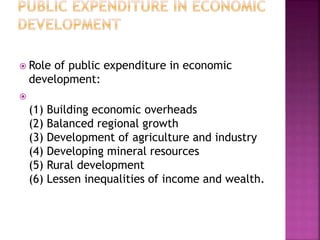
 Role of public expenditure in economic
development:

(1) Building economic overheads
(2) Balanced regional growth
(3) Development of agriculture and industry
(4) Developing mineral resources
(5) Rural development
(6) Lessen inequalities of income and wealth.
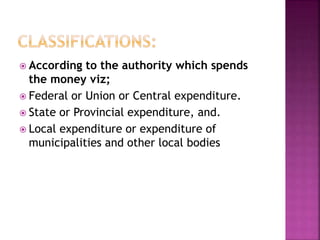
 According to the authority which spends
the money viz;
 Federal or Union or Central expenditure.
 State or Provincial expenditure, and.
 Local expenditure or expenditure of
municipalities and other local bodies
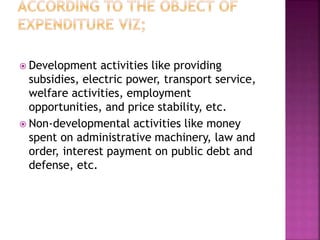
 Development activities like providing
subsidies, electric power, transport service,
welfare activities, employment
opportunities, and price stability, etc.
 Non-developmental activities like money
spent on administrative machinery, law and
order, interest payment on public debt and
defense, etc.
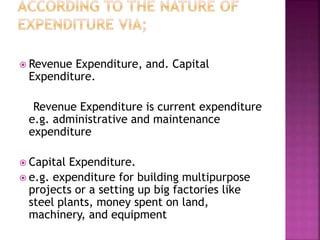
 Revenue Expenditure, and. Capital
Expenditure.
Revenue Expenditure is current expenditure
e.g. administrative and maintenance
expenditure
 Capital Expenditure.
 e.g. expenditure for building multipurpose
projects or a setting up big factories like
steel plants, money spent on land,
machinery, and equipment
 Capital Expenditure of the government
refers to that expenditure which results in
the creation of fixed assets. They are in the
form of investment. They add to the net
productive assets of the economy
 For example; Expenditure, on agricultural
and industrial development, irrigation dams,
public -enterprises, etc, are all capital
expenditures.
 Revenue expenditures are current or
 consumption expenditures incurred on
 civil administration, defense forces,
 public health and, education,
 maintenance of government machinery, etc.
 Expenditure on infrastructure development,
public enterprises or development of
agriculture increase productive capacity in
the economy and bring income to the
government. Thus they are classified as a
productive expenditure. All expenditures
that promote economic growth development
are termed as development expenditure.
 Unproductive expenditure refers to those
expenditures which do not yield any income.
Expenditure such as interest payments,
expenditure on law and order, public
administration, do not create any productive
asset which brings income to the government
such expenses are classified as unproductive
expenditures.
 Transfer expenditure refers to those kinds of
expenditures against there is no corresponding
transfer of real resources i.e., goods or services.
 Such expenditure includes public expenditure
on; National Old pension Scheme, Interest
payments, subsidies, unemployment allowances,
welfare benefits to weaker sections, etc.
 By incurring such expenditure, the government
does not get anything in return, but it adds to
the welfare of the people, especially to weaker
sections of society.
 The Non-transfer expenditure relates to that
expenditure which results in the creation of
income or output.
 Economic infrastructure (Power, Transport,
Irrigation, etc.), Social infrastructure
(Education, Health and Family Welfare),
Internal law and order and defense, public
administration, etc.
 By incurring such expenditure, the
government creates a healthy environment
for economic activities.
 The plan expenditure incurs on development
activities outlined in the ongoing five-year
plan.
 In 2009-10, the plan expenditure of the
Central Government was 5.3% of GDP. Plan
expenditure incurs on Transport, rural
development, communication, agriculture,
energy, social services, etc.
 The non-plan expenditure incurs on those
activities, which are not included in the five-
year plan.
 It includes development and Non-
development expenditure. It includes;
Defence, subsidies, interest payments,
maintenance, etc.
 1. The New Concept of Welfare State:
 The 19th century state was mainly and
basically a ‘police state’ primarily interested
in the protection of the citizens from foreign
aggression and in maintaining law and order
within the country.
 Modern states are not police states, but
welfare states. The belief of the classical
economists, in the efficacy of Laissez-fair
capitalism in maintaining full employment
and economic stability has been falsified
 In most countries the heaviest increase in
public expenditure has been on account of
cost of war and preparedness for war. The
larger the country, the greater the
percentage of resources allocated to national
defence. War and rumors of war between
countries have forced them to be armed at
all time and to get prepared to face a war
situation
 Along with growth in numbers, the
responsibilities of government relating to the
provision of basic services have increased
considerably. The state will have to bear
additional responsibility of solving problems
like food, unemployment, housing,
sanitation, street lighting, drinking water,
drainage etc.
 Today almost majority of nations have
accepted the principle of democracy.
Democratic institutions exert structural
compulsions on public expenditure. The
growth of democracy in the political system
of any country requires maintenance of
political institutions like periodic elections,
at different layers of government, the
legislatures, advisory council, local boards
etc. and other grass root level administrative
units.
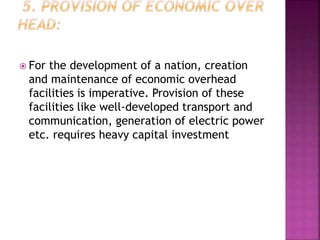
 For the development of a nation, creation
and maintenance of economic overhead
facilities is imperative. Provision of these
facilities like well-developed transport and
communication, generation of electric power
etc. requires heavy capital investment
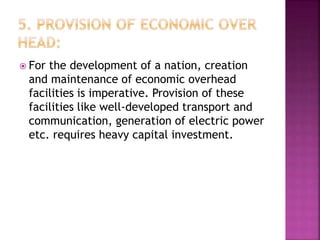
 For the development of a nation, creation
and maintenance of economic overhead
facilities is imperative. Provision of these
facilities like well-developed transport and
communication, generation of electric power
etc. requires heavy capital investment.
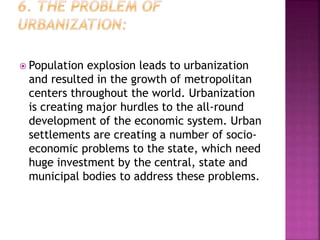
 Population explosion leads to urbanization
and resulted in the growth of metropolitan
centers throughout the world. Urbanization
is creating major hurdles to the all-round
development of the economic system. Urban
settlements are creating a number of socio-
economic problems to the state, which need
huge investment by the central, state and
municipal bodies to address these problems.
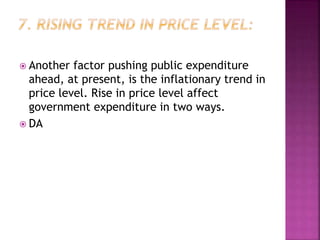
 Another factor pushing public expenditure
ahead, at present, is the inflationary trend in
price level. Rise in price level affect
government expenditure in two ways.
 DA
 Almost all countries have now basically
accepted the principle of planned economic
development. Economic planning is
considered as a panacea for all economic
evils like poverty, deprivation, unem-
ployment etc. planning is considered as an
instrument to achieve certain socio-economic
objectives.
 The overall development of a country
depends on the quality of human capital. In
developing countries, responsibilities of
human capital formation are primarily on the
government. This is due to the widespread
poverty of the people.
 Most of the developing countries are
basically agrarian economics. Growth of
agriculture is necessary, not only to achieve
self-sufficiency in food production, but also
to provide adequate support to agro-based
industries by providing required raw-
materials
 Industrialization leads to increase in national
income and promotes the standard of living
of the people. However for rapid
industrialization, the involvement of the
public sector is crucial. To industrialize the
country the government has to develop basic
and key industries.
 Public goods are those, the consumption of
which is externalized. It is consumed equally
by all. These goods have no private market.
Defence, and police service, justice, roads,
irrigation, flood control projects, public
parks etc. are all examples of public goods
 Public debt constitutes a substantial part of
the government revenue; a major part of
mounting government expenditure is met
from public borrowing.
 In all welfare states, government is the
ultimate custodian of public welfare. It is
bound to keep a constant vigil on the abuses
of free market mechanism like malpractices
by dishonest traders, black marketing,
hoarding, monopoly practices and consumer
exploitation
 In tune with the growth of population
urbanization and complexities of modern
economic and socio-political life, law and
order problem became more complex.
Terrorism has become an international and
national phenomenon threatening the law
and order situations of nations across the
world.

Public expenditure

  • 1.
  • 2.
     MEANING OFPUBLIC EXPENDITURE -  Public expenditure is the expenditure incurred by the public authorities to satisfy those common wants which the people in their individual capacity are unable to satisfy efficiently.
  • 3.
     Public expenditurecan define as, “The expenditure incurred by public authorities like central, state and local governments to satisfy the collective social wants of the people is known as public expenditure.”
  • 4.
     1) Maximizesocial and economic welfare  (2) Control on depressionary tendency  (3) Accelerate the economic development (4) Better distribution of income
  • 5.
     Role ofpublic expenditure in economic development:  (1) Building economic overheads (2) Balanced regional growth (3) Development of agriculture and industry (4) Developing mineral resources (5) Rural development (6) Lessen inequalities of income and wealth.
  • 6.
     According tothe authority which spends the money viz;  Federal or Union or Central expenditure.  State or Provincial expenditure, and.  Local expenditure or expenditure of municipalities and other local bodies
  • 7.
     Development activitieslike providing subsidies, electric power, transport service, welfare activities, employment opportunities, and price stability, etc.  Non-developmental activities like money spent on administrative machinery, law and order, interest payment on public debt and defense, etc.
  • 8.
     Revenue Expenditure,and. Capital Expenditure. Revenue Expenditure is current expenditure e.g. administrative and maintenance expenditure  Capital Expenditure.  e.g. expenditure for building multipurpose projects or a setting up big factories like steel plants, money spent on land, machinery, and equipment
  • 9.
     Capital Expenditureof the government refers to that expenditure which results in the creation of fixed assets. They are in the form of investment. They add to the net productive assets of the economy  For example; Expenditure, on agricultural and industrial development, irrigation dams, public -enterprises, etc, are all capital expenditures.
  • 10.
     Revenue expendituresare current or  consumption expenditures incurred on  civil administration, defense forces,  public health and, education,  maintenance of government machinery, etc.
  • 11.
     Expenditure oninfrastructure development, public enterprises or development of agriculture increase productive capacity in the economy and bring income to the government. Thus they are classified as a productive expenditure. All expenditures that promote economic growth development are termed as development expenditure.
  • 12.
     Unproductive expenditurerefers to those expenditures which do not yield any income. Expenditure such as interest payments, expenditure on law and order, public administration, do not create any productive asset which brings income to the government such expenses are classified as unproductive expenditures.
  • 13.
     Transfer expenditurerefers to those kinds of expenditures against there is no corresponding transfer of real resources i.e., goods or services.  Such expenditure includes public expenditure on; National Old pension Scheme, Interest payments, subsidies, unemployment allowances, welfare benefits to weaker sections, etc.  By incurring such expenditure, the government does not get anything in return, but it adds to the welfare of the people, especially to weaker sections of society.
  • 14.
     The Non-transferexpenditure relates to that expenditure which results in the creation of income or output.  Economic infrastructure (Power, Transport, Irrigation, etc.), Social infrastructure (Education, Health and Family Welfare), Internal law and order and defense, public administration, etc.  By incurring such expenditure, the government creates a healthy environment for economic activities.
  • 15.
     The planexpenditure incurs on development activities outlined in the ongoing five-year plan.  In 2009-10, the plan expenditure of the Central Government was 5.3% of GDP. Plan expenditure incurs on Transport, rural development, communication, agriculture, energy, social services, etc.
  • 16.
     The non-planexpenditure incurs on those activities, which are not included in the five- year plan.  It includes development and Non- development expenditure. It includes; Defence, subsidies, interest payments, maintenance, etc.
  • 17.
     1. TheNew Concept of Welfare State:  The 19th century state was mainly and basically a ‘police state’ primarily interested in the protection of the citizens from foreign aggression and in maintaining law and order within the country.  Modern states are not police states, but welfare states. The belief of the classical economists, in the efficacy of Laissez-fair capitalism in maintaining full employment and economic stability has been falsified
  • 18.
     In mostcountries the heaviest increase in public expenditure has been on account of cost of war and preparedness for war. The larger the country, the greater the percentage of resources allocated to national defence. War and rumors of war between countries have forced them to be armed at all time and to get prepared to face a war situation
  • 19.
     Along withgrowth in numbers, the responsibilities of government relating to the provision of basic services have increased considerably. The state will have to bear additional responsibility of solving problems like food, unemployment, housing, sanitation, street lighting, drinking water, drainage etc.
  • 20.
     Today almostmajority of nations have accepted the principle of democracy. Democratic institutions exert structural compulsions on public expenditure. The growth of democracy in the political system of any country requires maintenance of political institutions like periodic elections, at different layers of government, the legislatures, advisory council, local boards etc. and other grass root level administrative units.
  • 21.
     For thedevelopment of a nation, creation and maintenance of economic overhead facilities is imperative. Provision of these facilities like well-developed transport and communication, generation of electric power etc. requires heavy capital investment
  • 22.
     For thedevelopment of a nation, creation and maintenance of economic overhead facilities is imperative. Provision of these facilities like well-developed transport and communication, generation of electric power etc. requires heavy capital investment.
  • 23.
     Population explosionleads to urbanization and resulted in the growth of metropolitan centers throughout the world. Urbanization is creating major hurdles to the all-round development of the economic system. Urban settlements are creating a number of socio- economic problems to the state, which need huge investment by the central, state and municipal bodies to address these problems.
  • 24.
     Another factorpushing public expenditure ahead, at present, is the inflationary trend in price level. Rise in price level affect government expenditure in two ways.  DA
  • 25.
     Almost allcountries have now basically accepted the principle of planned economic development. Economic planning is considered as a panacea for all economic evils like poverty, deprivation, unem- ployment etc. planning is considered as an instrument to achieve certain socio-economic objectives.
  • 26.
     The overalldevelopment of a country depends on the quality of human capital. In developing countries, responsibilities of human capital formation are primarily on the government. This is due to the widespread poverty of the people.
  • 27.
     Most ofthe developing countries are basically agrarian economics. Growth of agriculture is necessary, not only to achieve self-sufficiency in food production, but also to provide adequate support to agro-based industries by providing required raw- materials
  • 28.
     Industrialization leadsto increase in national income and promotes the standard of living of the people. However for rapid industrialization, the involvement of the public sector is crucial. To industrialize the country the government has to develop basic and key industries.
  • 29.
     Public goodsare those, the consumption of which is externalized. It is consumed equally by all. These goods have no private market. Defence, and police service, justice, roads, irrigation, flood control projects, public parks etc. are all examples of public goods
  • 30.
     Public debtconstitutes a substantial part of the government revenue; a major part of mounting government expenditure is met from public borrowing.
  • 31.
     In allwelfare states, government is the ultimate custodian of public welfare. It is bound to keep a constant vigil on the abuses of free market mechanism like malpractices by dishonest traders, black marketing, hoarding, monopoly practices and consumer exploitation
  • 32.
     In tunewith the growth of population urbanization and complexities of modern economic and socio-political life, law and order problem became more complex. Terrorism has become an international and national phenomenon threatening the law and order situations of nations across the world.