POPULATION POLICY
INTRODUCTION
Rapid population growth and rising levels of consumption per capita are
depleting natural resources and degrading the environment.
High fertility rate is causing rapid growth in population rates leading to
increased stress in existing natural resources.
Increasing stress on natural resources leads to increase in the number of
people under poverty levels.
Eventually it makes poverty alleviation even difficult.
BACKGROUND
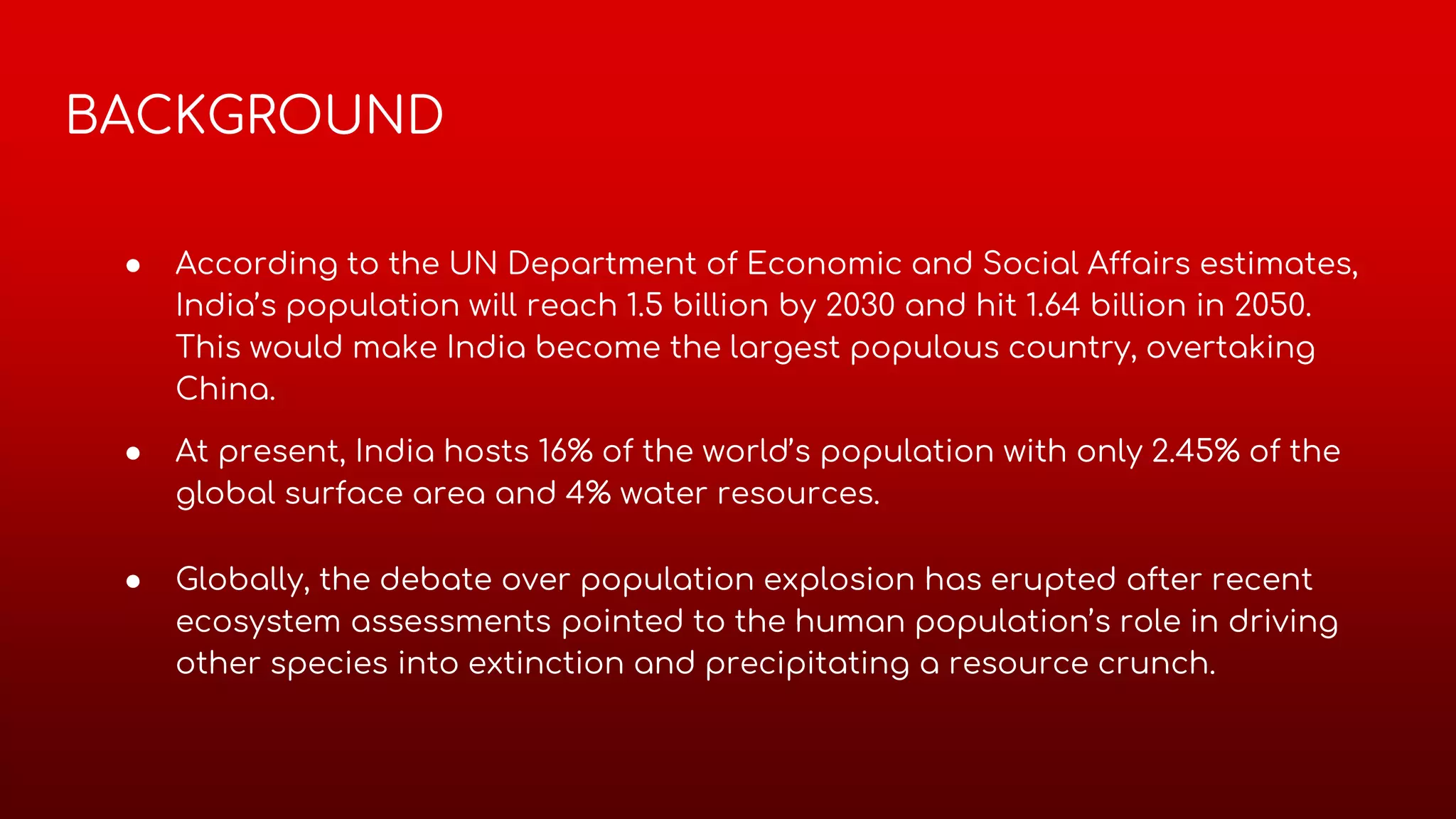
● According to the UN Department of Economic and Social Affairs estimates,
India’s population will reach 1.5 billion by 2030 and hit 1.64 billion in 2050.
This would make India become the largest populous country, overtaking
China.
● At present, India hosts 16% of the world’s population with only 2.45% of the
global surface area and 4% water resources.
● Globally, the debate over population explosion has erupted after recent
ecosystem assessments pointed to the human population’s role in driving
other species into extinction and precipitating a resource crunch.
NATIONAL POPULATION POLICY 2000
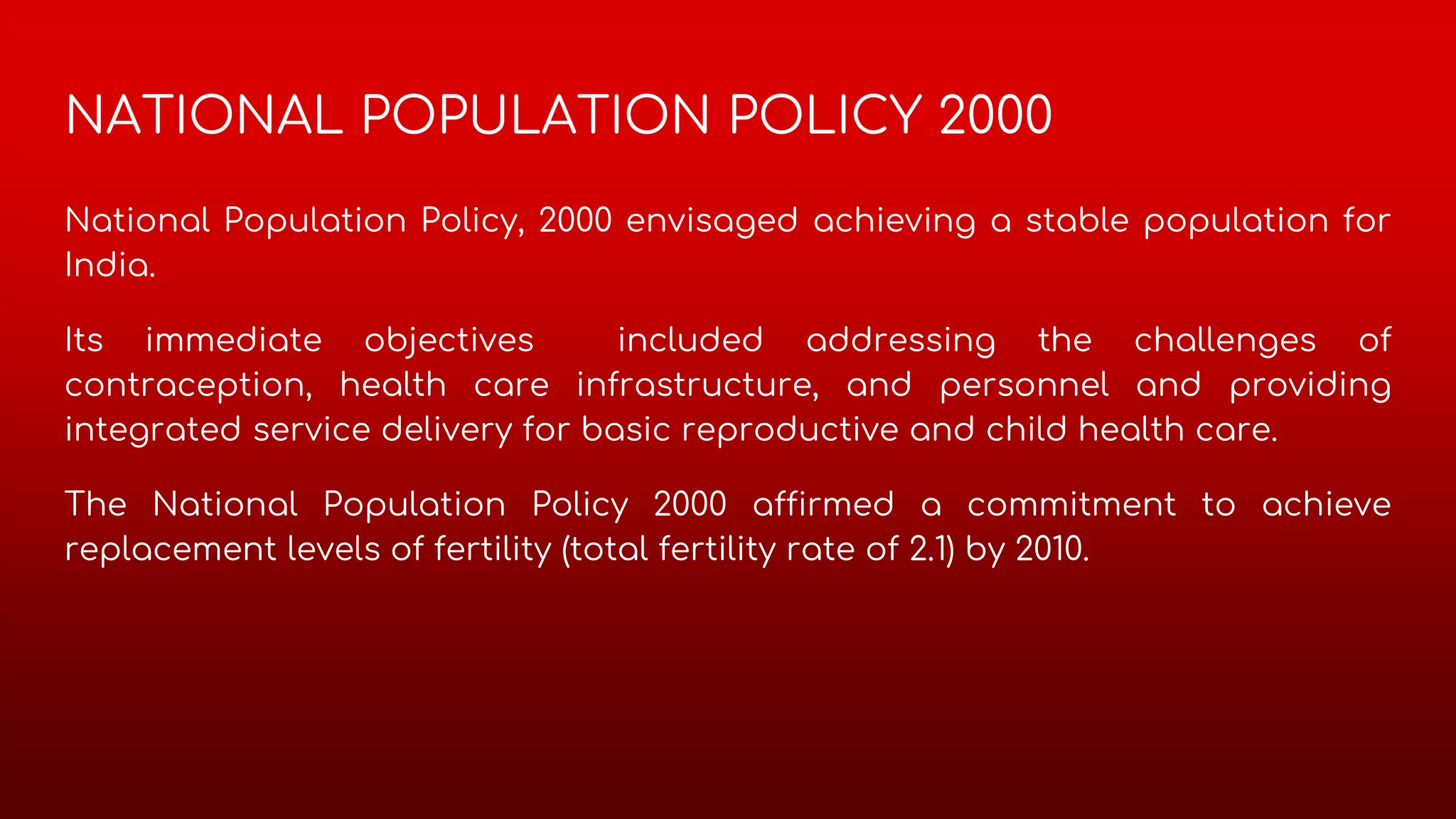
National Population Policy, 2000 envisaged achieving a stable population for
India.
Its immediate objectives included addressing the challenges of
contraception, health care infrastructure, and personnel and providing
integrated service delivery for basic reproductive and child health care.
The National Population Policy 2000 affirmed a commitment to achieve
replacement levels of fertility (total fertility rate of 2.1) by 2010.
OBJECTIVES
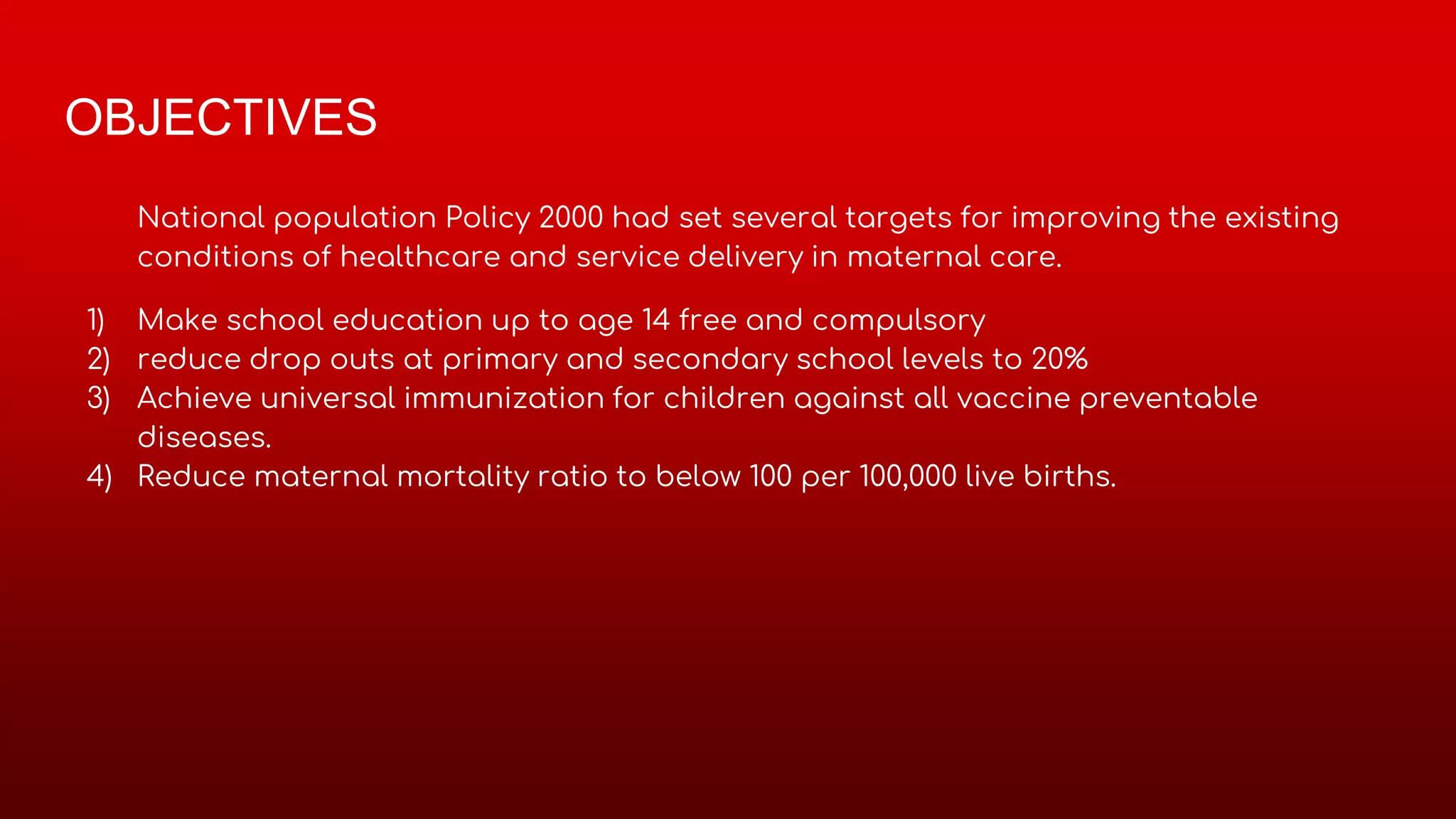
National population Policy 2000 had set several targets for improving the existing
conditions of healthcare and service delivery in maternal care.
1) Make school education up to age 14 free and compulsory
2) reduce drop outs at primary and secondary school levels to 20%
3) Achieve universal immunization for children against all vaccine preventable
diseases.
4) Reduce maternal mortality ratio to below 100 per 100,000 live births.
CHALLENGES
1) Lack of education in women results in their early marriages. It increases pressure
for multiple pregnancies and jeopardizes their health.
2) Socio-economic Factors: Preference for a male child, also leads to higher birth
rates. One of the reasons for this son-preference is the inheritance law favoring
women’s rights to ancestral property is far from being implemented.
3) China is already facing a demographic catastrophe because its nearly four-
decade-long one-child policy resulted in a strong son preference.
4) Inadequate Use of Contraceptive: Women in rural areas of northern states like UP,
Bihar are still giving birth to four or more children. This is because the
contraceptive prevalence rate is less than 10%.
Politics of Population Stabilization
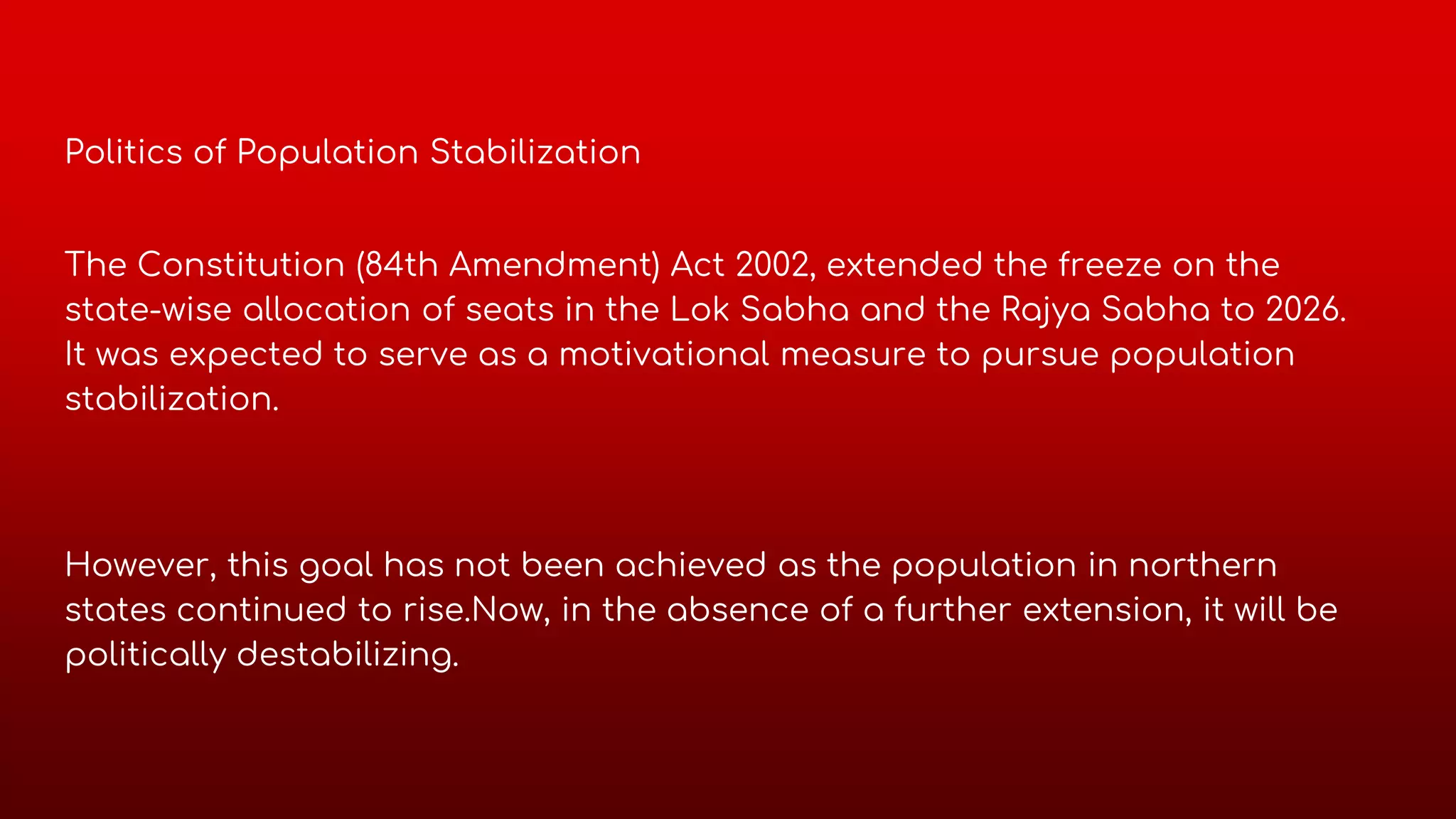
The Constitution (84th Amendment) Act 2002, extended the freeze on the
state-wise allocation of seats in the Lok Sabha and the Rajya Sabha to 2026.
It was expected to serve as a motivational measure to pursue population
stabilization.
However, this goal has not been achieved as the population in northern
states continued to rise.Now, in the absence of a further extension, it will be
politically destabilizing.
WAY FORWARD
Programmes relating to education especially female education,
maternal and natal care should be given significant.
Encourage research and development in social science related to the
factors involved in this issue.
Improved awareness will help in reducing the population growth
levels.

POPULATION POLICY.pptx

  • 1.
  • 2.
    INTRODUCTION Rapid population growthand rising levels of consumption per capita are depleting natural resources and degrading the environment. High fertility rate is causing rapid growth in population rates leading to increased stress in existing natural resources. Increasing stress on natural resources leads to increase in the number of people under poverty levels. Eventually it makes poverty alleviation even difficult.
  • 3.
    BACKGROUND ● According tothe UN Department of Economic and Social Affairs estimates, India’s population will reach 1.5 billion by 2030 and hit 1.64 billion in 2050. This would make India become the largest populous country, overtaking China. ● At present, India hosts 16% of the world’s population with only 2.45% of the global surface area and 4% water resources. ● Globally, the debate over population explosion has erupted after recent ecosystem assessments pointed to the human population’s role in driving other species into extinction and precipitating a resource crunch.
  • 4.
    NATIONAL POPULATION POLICY2000 National Population Policy, 2000 envisaged achieving a stable population for India. Its immediate objectives included addressing the challenges of contraception, health care infrastructure, and personnel and providing integrated service delivery for basic reproductive and child health care. The National Population Policy 2000 affirmed a commitment to achieve replacement levels of fertility (total fertility rate of 2.1) by 2010.
  • 5.
    OBJECTIVES National population Policy2000 had set several targets for improving the existing conditions of healthcare and service delivery in maternal care. 1) Make school education up to age 14 free and compulsory 2) reduce drop outs at primary and secondary school levels to 20% 3) Achieve universal immunization for children against all vaccine preventable diseases. 4) Reduce maternal mortality ratio to below 100 per 100,000 live births.
  • 6.
    CHALLENGES 1) Lack ofeducation in women results in their early marriages. It increases pressure for multiple pregnancies and jeopardizes their health. 2) Socio-economic Factors: Preference for a male child, also leads to higher birth rates. One of the reasons for this son-preference is the inheritance law favoring women’s rights to ancestral property is far from being implemented. 3) China is already facing a demographic catastrophe because its nearly four- decade-long one-child policy resulted in a strong son preference. 4) Inadequate Use of Contraceptive: Women in rural areas of northern states like UP, Bihar are still giving birth to four or more children. This is because the contraceptive prevalence rate is less than 10%.
  • 7.
    Politics of PopulationStabilization The Constitution (84th Amendment) Act 2002, extended the freeze on the state-wise allocation of seats in the Lok Sabha and the Rajya Sabha to 2026. It was expected to serve as a motivational measure to pursue population stabilization. However, this goal has not been achieved as the population in northern states continued to rise.Now, in the absence of a further extension, it will be politically destabilizing.
  • 8.
    WAY FORWARD Programmes relatingto education especially female education, maternal and natal care should be given significant. Encourage research and development in social science related to the factors involved in this issue. Improved awareness will help in reducing the population growth levels.