Hypothesis in
Research
By V
Introduction
A hypothesis is a formal tentative statement
of the expected relationship between two are
more variable under study.
By V
Definition
• ‘Hypothesis is a tentative prediction or
explanation of the relationship between two
variables’. It implies that there is a systematic
relationship between an independent and a
dependent variable.
• For example dietary compliance will be greater
in diabetic patients receiving diet instruction in
small groups than in diabetic patients receiving
individualized diet instructions.
By V
Definition
Good and hatt define hypothesis as
shrewd guess or inference that is
formulated and provisionally adopted to
explain observed facts or conditions and to
guide in further investigation.
By V
Importance of
hypothesis in research
• Hypotheses enables the researcher to
objectively investigate new areas of discovery.
Thus, it provides powerful tool for the
advancement of knowledge.
• Hypotheses provides objectivity to the research
activity.
• It also provides directions to conduct research
such as defining the sources & relevance of
data.
By V
• Hypotheses provides clear & specific goals to
the researchers. These clear & specific goals
provide the investigator with a basis for selecting
sample &research procedures to meet these
goals
• Hypotheses provides link between theories &
actual practical research.
• It provides a bridge between theory & reality
By V
• A hypothesis suggests which type of research is
likely to be most appropriate.
• As it is a tentative statement of anticipated
results, it guides the researcher towards the
direction in which the research should proceed.
• It stimulates the thinking process of researchers
the researcher forms the hypothesis by
anticipating the outcome
By V
• It also determines the most appropriate research
designs & techniques of data analysis.
• Hypotheses provides understanding to the
researchers about what expect from the results
of the research study.
• It serves as framework for drawing conclusions
of a research study.
• Without hypotheses, research would be like
aimless wandering.
By V
Characteristics of a
good hypothesis
Conceptual clarity: Hypothesis should consist of
clearly defined & understandable concepts. It
should be stated in very terms, the meaning &
implication of which cannot be doubted. To
facilitate the conceptual clarity, hypothesis can be
stated in declarative statement, in present tense.
Empirical referents: Research must have an
ultimate empirical referent. No usable hypothesis
can embody moral judgments. A good hypothesis
must have empirical basis from the area of enquiry.
By V
Objectivity: Hypothesis must be objective,
which facilitates objectivity in data collection &
keeps the research activity freeform researcher
value - judgment.
Specificity: It should be specific, not general,
& should explain the expected relations
between variables.
For example, regular yoga reduces stress
By V
Relevant: The hypothesis should be relevant to the
problem being studied as well as the objectives of the study.
Hypothesis must have relevance with theory under test in a
research process.
Testability: Hypothesis should be testable &should not
be a moral judgment. It must be directly/indirectly
observable & measurable. The researcher can set up a
situation that permits one to assess if it is true or false. It
must be verifiable.
For example, a statement such as ‘bad partners produce
bad children’. This sort of hypothesis cannot be tested
By V
Consistency: A hypothesis should be consistent
with an existing body of theories, research
findings, & other hypotheses. It should correspond
with existing knowledge.
Simplicity: A hypothesis should be formulated in
simple & understandable terms. It should require
fewer conditions & assumptions
Availability of techniques: The researchers
must make sure that methods are available for
testing their proposed hypotheses.
By V
Purposiveness: The researcher must formulate only purposeful
hypotheses, which has relevance with research problem &
objectives.
Verifiability: A good hypothesis can be actually verified in
practical terms.
Profundity of effect: A good hypothesis should have profound
effect upon a variety of research variables.
Economical: The expenditure of money & the time can be
controlled if the hypotheses underlying the research undertaken is
good
By V
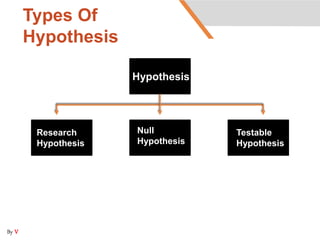
Types Of
Hypothesis
Research
Hypothesis
Null
Hypothesis
Testable
Hypothesis
Hypothesis
By V
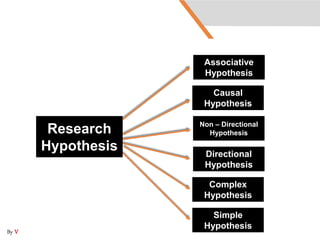
Research
Hypothesis
Simple
Hypothesis
Complex
Hypothesis
Directional
Hypothesis
Non – Directional
Hypothesis
Causal
Hypothesis
Associative
Hypothesis
By V
Research
Hypothesis
 Simple Hypothesis
simple hypothesis predicts that, there exist a relationship between the
independent variable and dependent variable.
• Example - two hourly positions- changing of a fully bedridden
patient will prevent bedsore.
In the above example 2 hourly position changing is independent
variable and bedsore prevention is dependent variable. The
statement shows that there exists a relationship between 2 hourly
positioning and bedsore prevention
By V
 Complex Hypothesis complex hypothesis predicts that there
exists relationship between two or more independent and dependent
variable.
• Example for a fully bed ridden patent 2 hourly position changing, 2 hourly
back care and a high protein diet will build up body resistance, will promote
blood circulation and will prevent bedsore.
In the above example, three independent variable are:- A) 2 hourly position
changing, B) 2 hourly back care, C) high protein diet. – And three dependent
variable are:- a) promotion of blood circulation, B) building up of body
resistance, C) prevention of bed sore.
By V
 Directional Hypothesis Directional Hypothesis predicts
the direction of the relationship between the independent and
dependent variable.
• Example High quality of nursing education will lead to high
quality of nursing practice skills.
 Non directional Hypothesis Non -directional Hypothesis
predicts the relationship between the independent variable and
the dependent variable but does not specific the directional of
the relationship
• Example teacher student relationship influence student’s
learning.
By V
 Causal Hypothesis Causal Hypothesis predicts a cause and effects
relationship or interaction between the independent variable and
dependent variable. This hypothesis predicts the effect of the
independent variable on the dependent variable.
• in this the independent variable is the experimental or treatment variable.
The dependent variable is the outcome variable
• Example – early postoperative ambulation will lead to prompt recovery.
 Associative hypothesis Associative Hypothesis predicts an associative
relationship between the independent variable and the dependent
variable
• When there is a change in any one of the variables, changes also occurs
in the other variable.
• The associative relationship between the independent and dependent
variables may have either
 Positive association
 Negative association
By V
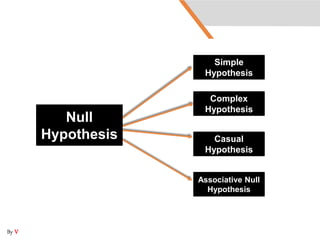
Null
Hypothesis
Simple
Hypothesis
Complex
Hypothesis
Casual
Hypothesis
Associative Null
Hypothesis
By V
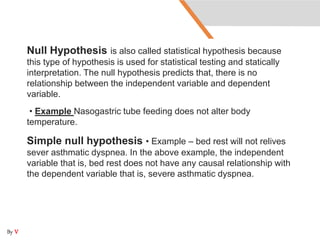
Null Hypothesis is also called statistical hypothesis because
this type of hypothesis is used for statistical testing and statically
interpretation. The null hypothesis predicts that, there is no
relationship between the independent variable and dependent
variable.
• Example Nasogastric tube feeding does not alter body
temperature.
Simple null hypothesis • Example – bed rest will not relives
sever asthmatic dyspnea. In the above example, the independent
variable that is, bed rest does not have any causal relationship with
the dependent variable that is, severe asthmatic dyspnea.
By V
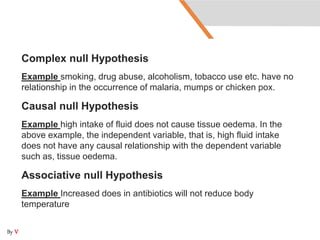
Complex null Hypothesis
Example smoking, drug abuse, alcoholism, tobacco use etc. have no
relationship in the occurrence of malaria, mumps or chicken pox.
Causal null Hypothesis
Example high intake of fluid does not cause tissue oedema. In the
above example, the independent variable, that is, high fluid intake
does not have any causal relationship with the dependent variable
such as, tissue oedema.
Associative null Hypothesis
Example Increased does in antibiotics will not reduce body
temperature
By V
Testable Hypothesis The testable hypothesis predicts
relationship between the independent variable and the dependent
variable and theses variable are testable or measurable.
Example Increase in patient’s body temperature causes increase
in patient’s pulse rate.
Testable
Hypothesis
By V
Formulation of
Hypothesis
•Hypotheses are guesses or tentative generalization, but these
guesses are not merely accidents. Collection of factual information
alone does not lead to successful formulation of hypotheses.
•There are no precise rules for formulating hypotheses and
deductive consequences from them that can be Empirically
verified. There are certain necessary conditions that are conducive
of their formulation. Some of them are
By V
Richness of
background
knowledge:-
A researcher may deduce hypotheses inductively after making
observation of behaviour, noticing trends or probable relationships.
For Example-
Background knowledge is essential for perceiving relationships
among the variables.
Relevant to a particular problem, various researchers may have
different hypotheses, but the soundness of the hypotheses will
depend upon the quantum of knowledge that one possesses of the
area of investigation.
Hypotheses may be formulated correctly by person who has rich
experiences and academic background, but they can never be
formulated by those who have poor background knowledge.
By V
Versatility of
intellect
Hypotheses are also derived through deductive reasoning from a
theory. Such hypotheses are called “deductive hypotheses”.
A researcher may being a study by selecting one of the theories in his
own area of interest, after selecting the particular theory, the researcher
proceeds to deduce a hypothesis from this theory through symbolic
logic or mathematics.
This is possible only when the researcher has a versatile intellect and
can make use of it for restructuring his experiences. The essential
criteria for formulating hypothesis are creative imagination, sound
attitude and agile intellect.
By V
Analogy and other
practices
Analogies also lead the researcher to clues that he may find useful
in the formulation of hypotheses and for findings solutions to
problems.
The researcher should use analogies with caution as they are not
fool proof tools for findings solutions to problems.
By V
THANK YOU
By V

Hypothesis in research by v

  • 1.
  • 2.
    Introduction A hypothesis isa formal tentative statement of the expected relationship between two are more variable under study. By V
  • 3.
    Definition • ‘Hypothesis isa tentative prediction or explanation of the relationship between two variables’. It implies that there is a systematic relationship between an independent and a dependent variable. • For example dietary compliance will be greater in diabetic patients receiving diet instruction in small groups than in diabetic patients receiving individualized diet instructions. By V
  • 4.
    Definition Good and hattdefine hypothesis as shrewd guess or inference that is formulated and provisionally adopted to explain observed facts or conditions and to guide in further investigation. By V
  • 5.
    Importance of hypothesis inresearch • Hypotheses enables the researcher to objectively investigate new areas of discovery. Thus, it provides powerful tool for the advancement of knowledge. • Hypotheses provides objectivity to the research activity. • It also provides directions to conduct research such as defining the sources & relevance of data. By V
  • 6.
    • Hypotheses providesclear & specific goals to the researchers. These clear & specific goals provide the investigator with a basis for selecting sample &research procedures to meet these goals • Hypotheses provides link between theories & actual practical research. • It provides a bridge between theory & reality By V
  • 7.
    • A hypothesissuggests which type of research is likely to be most appropriate. • As it is a tentative statement of anticipated results, it guides the researcher towards the direction in which the research should proceed. • It stimulates the thinking process of researchers the researcher forms the hypothesis by anticipating the outcome By V
  • 8.
    • It alsodetermines the most appropriate research designs & techniques of data analysis. • Hypotheses provides understanding to the researchers about what expect from the results of the research study. • It serves as framework for drawing conclusions of a research study. • Without hypotheses, research would be like aimless wandering. By V
  • 9.
    Characteristics of a goodhypothesis Conceptual clarity: Hypothesis should consist of clearly defined & understandable concepts. It should be stated in very terms, the meaning & implication of which cannot be doubted. To facilitate the conceptual clarity, hypothesis can be stated in declarative statement, in present tense. Empirical referents: Research must have an ultimate empirical referent. No usable hypothesis can embody moral judgments. A good hypothesis must have empirical basis from the area of enquiry. By V
  • 10.
    Objectivity: Hypothesis mustbe objective, which facilitates objectivity in data collection & keeps the research activity freeform researcher value - judgment. Specificity: It should be specific, not general, & should explain the expected relations between variables. For example, regular yoga reduces stress By V
  • 11.
    Relevant: The hypothesisshould be relevant to the problem being studied as well as the objectives of the study. Hypothesis must have relevance with theory under test in a research process. Testability: Hypothesis should be testable &should not be a moral judgment. It must be directly/indirectly observable & measurable. The researcher can set up a situation that permits one to assess if it is true or false. It must be verifiable. For example, a statement such as ‘bad partners produce bad children’. This sort of hypothesis cannot be tested By V
  • 12.
    Consistency: A hypothesisshould be consistent with an existing body of theories, research findings, & other hypotheses. It should correspond with existing knowledge. Simplicity: A hypothesis should be formulated in simple & understandable terms. It should require fewer conditions & assumptions Availability of techniques: The researchers must make sure that methods are available for testing their proposed hypotheses. By V
  • 13.
    Purposiveness: The researchermust formulate only purposeful hypotheses, which has relevance with research problem & objectives. Verifiability: A good hypothesis can be actually verified in practical terms. Profundity of effect: A good hypothesis should have profound effect upon a variety of research variables. Economical: The expenditure of money & the time can be controlled if the hypotheses underlying the research undertaken is good By V
  • 14.
  • 15.
  • 16.
    Research Hypothesis  Simple Hypothesis simplehypothesis predicts that, there exist a relationship between the independent variable and dependent variable. • Example - two hourly positions- changing of a fully bedridden patient will prevent bedsore. In the above example 2 hourly position changing is independent variable and bedsore prevention is dependent variable. The statement shows that there exists a relationship between 2 hourly positioning and bedsore prevention By V
  • 17.
     Complex Hypothesiscomplex hypothesis predicts that there exists relationship between two or more independent and dependent variable. • Example for a fully bed ridden patent 2 hourly position changing, 2 hourly back care and a high protein diet will build up body resistance, will promote blood circulation and will prevent bedsore. In the above example, three independent variable are:- A) 2 hourly position changing, B) 2 hourly back care, C) high protein diet. – And three dependent variable are:- a) promotion of blood circulation, B) building up of body resistance, C) prevention of bed sore. By V
  • 18.
     Directional HypothesisDirectional Hypothesis predicts the direction of the relationship between the independent and dependent variable. • Example High quality of nursing education will lead to high quality of nursing practice skills.  Non directional Hypothesis Non -directional Hypothesis predicts the relationship between the independent variable and the dependent variable but does not specific the directional of the relationship • Example teacher student relationship influence student’s learning. By V
  • 19.
     Causal HypothesisCausal Hypothesis predicts a cause and effects relationship or interaction between the independent variable and dependent variable. This hypothesis predicts the effect of the independent variable on the dependent variable. • in this the independent variable is the experimental or treatment variable. The dependent variable is the outcome variable • Example – early postoperative ambulation will lead to prompt recovery.  Associative hypothesis Associative Hypothesis predicts an associative relationship between the independent variable and the dependent variable • When there is a change in any one of the variables, changes also occurs in the other variable. • The associative relationship between the independent and dependent variables may have either  Positive association  Negative association By V
  • 20.
  • 21.
    Null Hypothesis isalso called statistical hypothesis because this type of hypothesis is used for statistical testing and statically interpretation. The null hypothesis predicts that, there is no relationship between the independent variable and dependent variable. • Example Nasogastric tube feeding does not alter body temperature. Simple null hypothesis • Example – bed rest will not relives sever asthmatic dyspnea. In the above example, the independent variable that is, bed rest does not have any causal relationship with the dependent variable that is, severe asthmatic dyspnea. By V
  • 22.
    Complex null Hypothesis Examplesmoking, drug abuse, alcoholism, tobacco use etc. have no relationship in the occurrence of malaria, mumps or chicken pox. Causal null Hypothesis Example high intake of fluid does not cause tissue oedema. In the above example, the independent variable, that is, high fluid intake does not have any causal relationship with the dependent variable such as, tissue oedema. Associative null Hypothesis Example Increased does in antibiotics will not reduce body temperature By V
  • 23.
    Testable Hypothesis Thetestable hypothesis predicts relationship between the independent variable and the dependent variable and theses variable are testable or measurable. Example Increase in patient’s body temperature causes increase in patient’s pulse rate. Testable Hypothesis By V
  • 24.
    Formulation of Hypothesis •Hypotheses areguesses or tentative generalization, but these guesses are not merely accidents. Collection of factual information alone does not lead to successful formulation of hypotheses. •There are no precise rules for formulating hypotheses and deductive consequences from them that can be Empirically verified. There are certain necessary conditions that are conducive of their formulation. Some of them are By V
  • 25.
    Richness of background knowledge:- A researchermay deduce hypotheses inductively after making observation of behaviour, noticing trends or probable relationships. For Example- Background knowledge is essential for perceiving relationships among the variables. Relevant to a particular problem, various researchers may have different hypotheses, but the soundness of the hypotheses will depend upon the quantum of knowledge that one possesses of the area of investigation. Hypotheses may be formulated correctly by person who has rich experiences and academic background, but they can never be formulated by those who have poor background knowledge. By V
  • 26.
    Versatility of intellect Hypotheses arealso derived through deductive reasoning from a theory. Such hypotheses are called “deductive hypotheses”. A researcher may being a study by selecting one of the theories in his own area of interest, after selecting the particular theory, the researcher proceeds to deduce a hypothesis from this theory through symbolic logic or mathematics. This is possible only when the researcher has a versatile intellect and can make use of it for restructuring his experiences. The essential criteria for formulating hypothesis are creative imagination, sound attitude and agile intellect. By V
  • 27.
    Analogy and other practices Analogiesalso lead the researcher to clues that he may find useful in the formulation of hypotheses and for findings solutions to problems. The researcher should use analogies with caution as they are not fool proof tools for findings solutions to problems. By V
  • 28.