Global Trends in Online Learning
the Big Picture, Threats, Opportunities and Change
Next Generation Learning Conference 2014
Dalarna, 20 March 2014
Gard Titlestad
Secretary General
International Council For Open and Distance
Education, ICDE
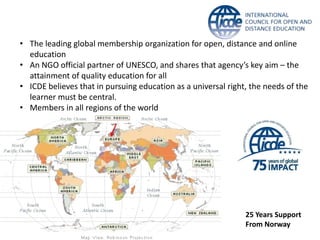
• The leading global membership organization for open, distance and online
education
• An NGO official partner of UNESCO, and shares that agency’s key aim – the
attainment of quality education for all
• ICDE believes that in pursuing education as a universal right, the needs of the
learner must be central.
• Members in all regions of the world
25 Years Support
From Norway
What do we want to achieve?
Re-imaging Higher Education: Taking a Broader View of Diversity
Professor Ellen Hazelkorn
Vice President of Research and Enterprise, and Dean of the
Graduate Research School
Higher Education Policy Research Unit (HEPRU)
Dublin Institute of Technology
5th Global Meeting of Associations (GMA V), Manchester, April
2013
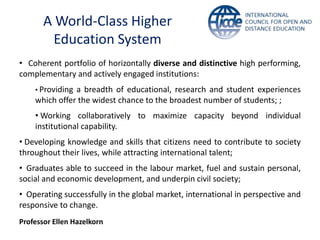
A World-Class Higher
Education System
• Coherent portfolio of horizontally diverse and distinctive high performing,
complementary and actively engaged institutions:
• Providing a breadth of educational, research and student experiences
which offer the widest chance to the broadest number of students; ;
• Working collaboratively to maximize capacity beyond individual
institutional capability.
• Developing knowledge and skills that citizens need to contribute to society
throughout their lives, while attracting international talent;
• Graduates able to succeed in the labour market, fuel and sustain personal,
social and economic development, and underpin civil society;
• Operating successfully in the global market, international in perspective and
responsive to change.
Professor Ellen Hazelkorn
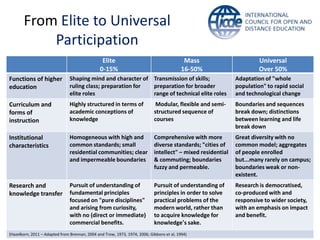
From Elite to Universal
Participation
Elite
0-15%
Mass
16-50%
Universal
Over 50%
Functions of higher
education
Shaping mind and character of
ruling class; preparation for
elite roles
Transmission of skills;
preparation for broader
range of technical elite roles
Adaptation of "whole
population" to rapid social
and technological change
Curriculum and
forms of
instruction
Highly structured in terms of
academic conceptions of
knowledge
Modular, flexible and semi-
structured sequence of
courses
Boundaries and sequences
break down; distinctions
between learning and life
break down
Institutional
characteristics
Homogeneous with high and
common standards; small
residential communities; clear
and impermeable boundaries
Comprehensive with more
diverse standards; "cities of
intellect" – mixed residential
& commuting; boundaries
fuzzy and permeable.
Great diversity with no
common model; aggregates
of people enrolled
but...many rarely on campus;
boundaries weak or non-
existent.
Research and
knowledge transfer
Pursuit of understanding of
fundamental principles
focused on "pure disciplines"
and arising from curiosity,
with no (direct or immediate)
commercial benefits.
Pursuit of understanding of
principles in order to solve
practical problems of the
modern world, rather than
to acquire knowledge for
knowledge’s sake.
Research is democratised,
co-produced with and
responsive to wider society,
with an emphasis on impact
and benefit.
(Hazelkorn, 2011 – Adapted from Brennan, 2004 and Trow, 1973, 1974, 2006; Gibbons et al, 1994)
The picture
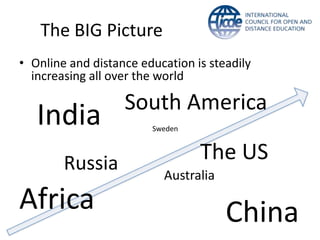
The BIG Picture
• Online and distance education is steadily
increasing all over the world
India Sweden
Russia
South America
The US
Africa
Australia
China
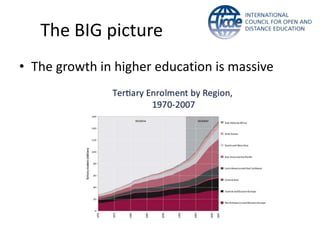
The BIG picture
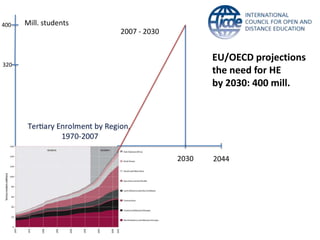
• The growth in higher education is massive
20442030
320
400
2007 - 2030
Mill. students
EU/OECD projections
the need for HE
by 2030: 400 mill.
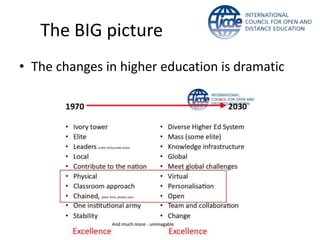
The BIG picture
• The changes in higher education is dramatic
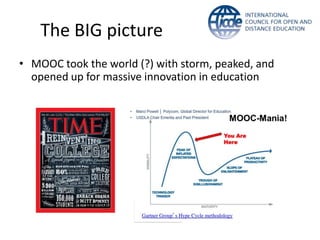
The BIG picture
• MOOC took the world (?) with storm, peaked, and
opened up for massive innovation in education
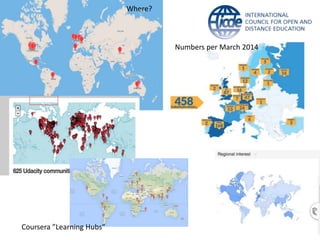
Wie bieden ze aan?
Coursera ”Learning Hubs”
Where?
Numbers per March 2014
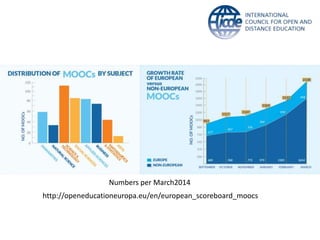
http://openeducationeuropa.eu/en/european_scoreboard_moocs
Numbers per March2014
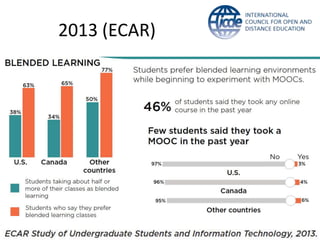
2013 (ECAR)
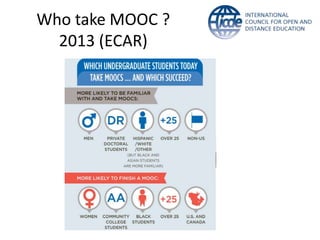
Who take MOOC ?
2013 (ECAR)
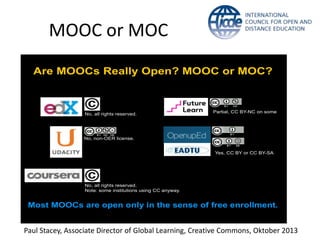
Are MOOCs Really Open? MOOC or MOC?
No, all rights reserved.
No, non-OER license.
No, all rights reserved.
Note: some institutions using CC anyway.
Yes, CC BY or CC BY-SA
Partial, CC BY-NC on some
Most MOOCs are open only in the sense of free enrollment.
Paul Stacey, Associate Director of Global Learning, Creative Commons, Oktober 2013
MOOC or MOC
• ”LORD knows there’s a lot of bad news in the world today to
get you down, but there is one big thing happening that
leaves me incredibly hopeful about the future, and that is the
budding revolution in global online higher education. Nothing
has more potential to lift more people out of poverty — by
providing them an affordable education to get a job or
improve in the job they have. Nothing has more potential to
unlock a billion more brains to solve the world’s biggest
problems.”
Thomas Friedman, columnist and author
Karl Aberer
Pierre Dillenbourg
http://moocs.epfl.ch/eu-mooc-summit
Mind to MOOCs
Overview, reflections and brainstorming in whitening water
Think tank 20 October 2013, Open
Universitty of China, Beijing, China
To be reported to the ICDE Standing Conference of Presidents meeting and
Policy Forum
Excerpts from ICDE Mind to MOOCs report
A few of the issues and recommendations
Equity.
• Consider this initiative as an opportunity to rethink our role as universities and take
up MOOCs. .
• Integrate open MOOCs in our respective institutions
• National, regional and transnational cooperation is a great opportunity in developing
MOOC and MOOC-alike concepts.
Diversity.
• Undertake contextualized strategies when implementing MOOCs
• Be aware of cultural and language aspects → anglo-centric core, colonialism
• OER and OCW as the basis for MOOC will ease contextual, cultural and language
adaptation
Innovation and Quality.
• Improve and innovate on pedagogical aspects: methodologies, content formats,
assessment.
• Provide learning analytics as a tool for improving the courses. Connect the learning
process and research for new knowledge and improvements.
• Promote research about MOOCs.
• Keep moving towards quality. Beyond quantity of MOOCs and users, the focus on
quality is essential for sustainability.
The BIG picture
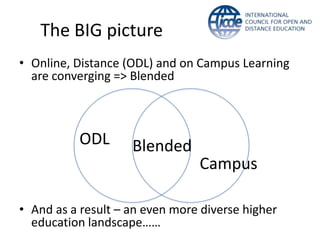
• Online, Distance (ODL) and on Campus Learning
are converging => Blended
BlendedODL
Campus
• And as a result – an even more diverse higher
education landscape……
The BIG picture
• Three streams work in parallel:
– Online becomes mature – and Internet/mobile:
freedom from distance, mobile broadband:
freedom from location
– New methodologies, content and pedagogy – new
opportunities for student supportive teaching
– New knowledge about the brain and learning, new
knowledge in neurosciences
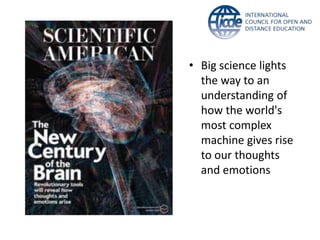
• Big science lights
the way to an
understanding of
how the world's
most complex
machine gives rise
to our thoughts
and emotions
The BIG picture
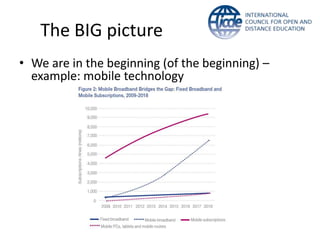
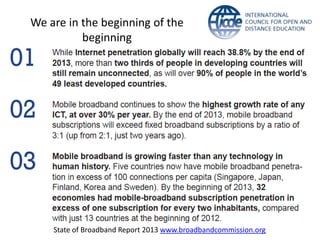
• We are in the beginning (of the beginning) –
example: mobile technology
We are in the beginning of the
beginning
State of Broadband Report 2013 www.broadbandcommission.org
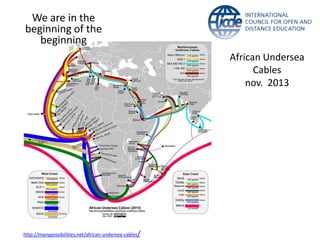
African Undersea
Cables
nov. 2013
http://manypossibilities.net/african-undersea-cables/
We are in the
beginning of the
beginning
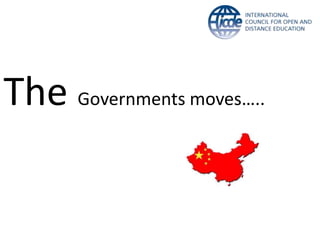
The Governments moves…..
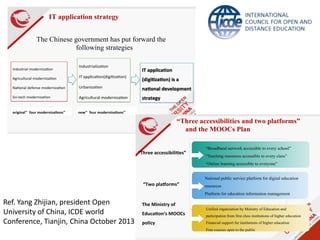
IT application strategy
The Chinese government has put forward the
following strategies
Industrial moderniza on
Agricultural moderniza on
Na onal defense moderniza on
Sci-tech moderniza on
IT applica on
(digi za on) is a
na onal development
strategy
Industrializa on
IT applica on(digi za on)
Urbaniza on
Agricultural moderniza on
original“ four moderniza ons” new“ four moderniza ons”
Ref. Yang Zhijian, president Open
University of China, ICDE world
Conference, Tianjin, China October 2013
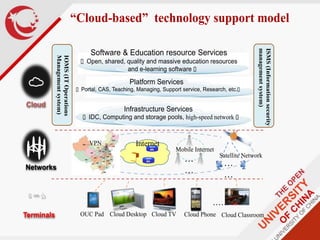
IOMS(ITOperations
Managementsystem)
ISMS(Informationsecurity
managementsystem)
……
Software & Education resource Services
(Open, shared, quality and massive education resources
and e-learning software (
Platform Services
(Portal, CAS, Teaching, Managing, Support service, Research, etc.(
Infrastructure Services
(IDC, Computing and storage pools, high-speed network (
…
…
…
…
Mobile Internet
Satellite Network
VPN Internet
Networks
Terminals
Cloud
OUC Pad Cloud Desktop Cloud TV Cloud Phone Cloud Classroom
“Cloud-based” technology support model
The Governments moves…..
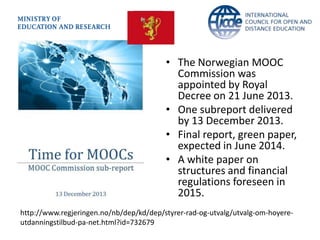
http://www.regjeringen.no/nb/dep/kd/dep/styrer-rad-og-utvalg/utvalg-om-hoyere-
utdanningstilbud-pa-net.html?id=732679
• The Norwegian MOOC
Commission was
appointed by Royal
Decree on 21 June 2013.
• One subreport delivered
by 13 December 2013.
• Final report, green paper,
expected in June 2014.
• A white paper on
structures and financial
regulations foreseen in
2015.
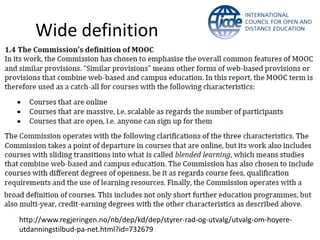
Wide definition
http://www.regjeringen.no/nb/dep/kd/dep/styrer-rad-og-utvalg/utvalg-om-hoyere-
utdanningstilbud-pa-net.html?id=732679
The Commission’s
recommendations
• Ch. 6.2 Innovative education science and quality development
– research-based knowledge, learning analytics
– Incentives
– skills for faculty and staff
– assess skills developed through MOOCs without exams and credits
• Ch. 6.3 Infrastructure for MOOCs and other digital learning
• Ch. 6.4 Skills needed by business and the labour market
• Ch. 6.5 MOOCs as part of the Norwegian degree system:
accreditation and recognition of MOOCs
• Ch. 6.6 Student fees and the free principle in higher education
• Ch. 6.7 Educational support
• Ch. 6.8 Financing higher education
http://www.regjeringen.no/nb/dep/kd/dep/styrer-rad-og-utvalg/utvalg-om-hoyere-
utdanningstilbud-pa-net.html?id=732679
The CONCRETE example
January 2014
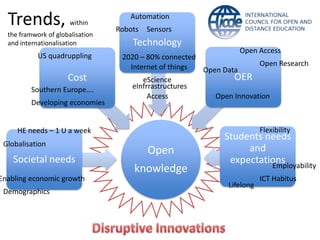
The BIGtrends
Open
knowledge
Societal needs
Technology
Students needs
and
expectations
OERCost
Trends, within
the framwork of globalisation
and internationalisation
HE needs – 1 U a week
Demographics
Globalisation
Enabling economic growth
Access
Open Access
eInfrrastructures
eScience
Automation
Robots Sensors
2020 – 80% connected
Internet of things Open Research
Open Data
Open Innovation
US quadruppling
Southern Europe….
Developing economies
ICT Habitus
Flexibility
Employability
Lifelong
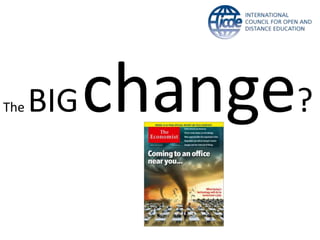
The BIGchange?
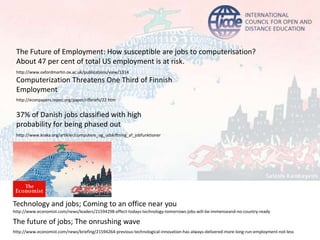
Computerization Threatens One Third of Finnish
Employment
37% of Danish jobs classified with high
probability for being phased out
http://www.economist.com/news/briefing/21594264-previous-technological-innovation-has-always-delivered-more-long-run-employment-not-less
The future of jobs; The onrushing wave
Technology and jobs; Coming to an office near you
http://www.economist.com/news/leaders/21594298-effect-todays-technology-tomorrows-jobs-will-be-immenseand-no-country-ready
http://www.kraka.org/artikler/computere_og_udskiftning_af_jobfunktioner
http://econpapers.repec.org/paper/rifbriefs/22.htm
The Future of Employment: How susceptible are jobs to computerisation?
About 47 per cent of total US employment is at risk.
http://www.oxfordmartin.ox.ac.uk/publications/view/1314
The BIGGERopportunities
”For the first time in human history we
have the tools to enable everyone to
attain all the education they desire.”
(Wiley, Green, & Soares, 2012)
Dramatically bringing down the cost of education with
OER: How open education resources unlock the door
to free learning.
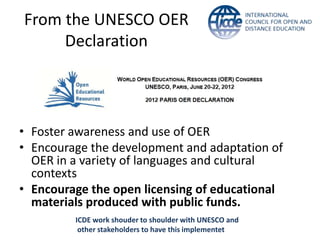
From the UNESCO OER
Declaration
• Foster awareness and use of OER
• Encourage the development and adaptation of
OER in a variety of languages and cultural
contexts
• Encourage the open licensing of educational
materials produced with public funds.
ICDE work shouder to shoulder with UNESCO and
other stakeholders to have this implementet
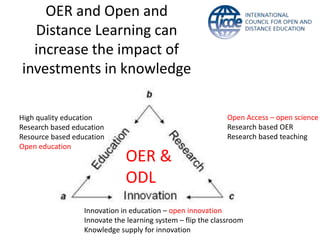
OER and Open and
Distance Learning can
increase the impact of
investments in knowledge
OER &
ODL
Open Access – open science
Research based OER
Research based teaching
Innovation in education – open innovation
Innovate the learning system – flip the classroom
Knowledge supply for innovation
High quality education
Research based education
Resource based education
Open education
The next years
• Open, distance, online and eLearning – enables:
• Equal, easy and affordable access
• Quality Higher education
• Better learning outcome
• Student success
• And the threats? The other way around…..
The small TEXT
MOOC in an international perspective:
New global agenda for innovation
in higher education
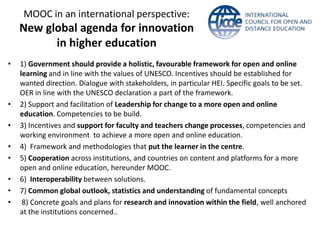
• 1) Government should provide a holistic, favourable framework for open and online
learning and in line with the values of UNESCO. Incentives should be established for
wanted direction. Dialogue with stakeholders, in particular HEI. Specific goals to be set.
OER in line with the UNESCO declaration a part of the framework.
• 2) Support and facilitation of Leadership for change to a more open and online
education. Competencies to be build.
• 3) Incentives and support for faculty and teachers change processes, competencies and
working environment to achieve a more open and online education.
• 4) Framework and methodologies that put the learner in the centre.
• 5) Cooperation across institutions, and countries on content and platforms for a more
open and online education, hereunder MOOC.
• 6) Interoperability between solutions.
• 7) Common global outlook, statistics and understanding of fundamental concepts
• 8) Concrete goals and plans for research and innovation within the field, well anchored
at the institutions concerned..
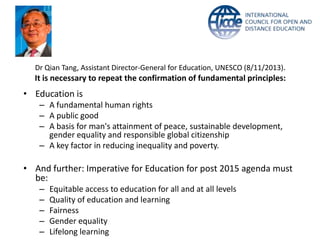
Dr Qian Tang, Assistant Director-General for Education, UNESCO (8/11/2013).
It is necessary to repeat the confirmation of fundamental principles:
• Education is
– A fundamental human rights
– A public good
– A basis for man's attainment of peace, sustainable development,
gender equality and responsible global citizenship
– A key factor in reducing inequality and poverty.
• And further: Imperative for Education for post 2015 agenda must
be:
– Equitable access to education for all and at all levels
– Quality of education and learning
– Fairness
– Gender equality
– Lifelong learning
Thank you!
titlestad@icde.org
www.icde.org

Global Trends in Online Learning

  • 1.
    Global Trends inOnline Learning the Big Picture, Threats, Opportunities and Change Next Generation Learning Conference 2014 Dalarna, 20 March 2014 Gard Titlestad Secretary General International Council For Open and Distance Education, ICDE
  • 2.
    • The leadingglobal membership organization for open, distance and online education • An NGO official partner of UNESCO, and shares that agency’s key aim – the attainment of quality education for all • ICDE believes that in pursuing education as a universal right, the needs of the learner must be central. • Members in all regions of the world 25 Years Support From Norway
  • 3.
    What do wewant to achieve? Re-imaging Higher Education: Taking a Broader View of Diversity Professor Ellen Hazelkorn Vice President of Research and Enterprise, and Dean of the Graduate Research School Higher Education Policy Research Unit (HEPRU) Dublin Institute of Technology 5th Global Meeting of Associations (GMA V), Manchester, April 2013
  • 4.
    A World-Class Higher EducationSystem • Coherent portfolio of horizontally diverse and distinctive high performing, complementary and actively engaged institutions: • Providing a breadth of educational, research and student experiences which offer the widest chance to the broadest number of students; ; • Working collaboratively to maximize capacity beyond individual institutional capability. • Developing knowledge and skills that citizens need to contribute to society throughout their lives, while attracting international talent; • Graduates able to succeed in the labour market, fuel and sustain personal, social and economic development, and underpin civil society; • Operating successfully in the global market, international in perspective and responsive to change. Professor Ellen Hazelkorn
  • 5.
    From Elite toUniversal Participation Elite 0-15% Mass 16-50% Universal Over 50% Functions of higher education Shaping mind and character of ruling class; preparation for elite roles Transmission of skills; preparation for broader range of technical elite roles Adaptation of "whole population" to rapid social and technological change Curriculum and forms of instruction Highly structured in terms of academic conceptions of knowledge Modular, flexible and semi- structured sequence of courses Boundaries and sequences break down; distinctions between learning and life break down Institutional characteristics Homogeneous with high and common standards; small residential communities; clear and impermeable boundaries Comprehensive with more diverse standards; "cities of intellect" – mixed residential & commuting; boundaries fuzzy and permeable. Great diversity with no common model; aggregates of people enrolled but...many rarely on campus; boundaries weak or non- existent. Research and knowledge transfer Pursuit of understanding of fundamental principles focused on "pure disciplines" and arising from curiosity, with no (direct or immediate) commercial benefits. Pursuit of understanding of principles in order to solve practical problems of the modern world, rather than to acquire knowledge for knowledge’s sake. Research is democratised, co-produced with and responsive to wider society, with an emphasis on impact and benefit. (Hazelkorn, 2011 – Adapted from Brennan, 2004 and Trow, 1973, 1974, 2006; Gibbons et al, 1994)
  • 6.
  • 7.
    The BIG Picture •Online and distance education is steadily increasing all over the world India Sweden Russia South America The US Africa Australia China
  • 8.
    The BIG picture •The growth in higher education is massive
  • 9.
    20442030 320 400 2007 - 2030 Mill.students EU/OECD projections the need for HE by 2030: 400 mill.
  • 10.
    The BIG picture •The changes in higher education is dramatic
  • 11.
    The BIG picture •MOOC took the world (?) with storm, peaked, and opened up for massive innovation in education
  • 12.
    Wie bieden zeaan? Coursera ”Learning Hubs” Where? Numbers per March 2014
  • 13.
  • 14.
  • 15.
    Who take MOOC? 2013 (ECAR)
  • 16.
    Are MOOCs ReallyOpen? MOOC or MOC? No, all rights reserved. No, non-OER license. No, all rights reserved. Note: some institutions using CC anyway. Yes, CC BY or CC BY-SA Partial, CC BY-NC on some Most MOOCs are open only in the sense of free enrollment. Paul Stacey, Associate Director of Global Learning, Creative Commons, Oktober 2013 MOOC or MOC
  • 17.
    • ”LORD knowsthere’s a lot of bad news in the world today to get you down, but there is one big thing happening that leaves me incredibly hopeful about the future, and that is the budding revolution in global online higher education. Nothing has more potential to lift more people out of poverty — by providing them an affordable education to get a job or improve in the job they have. Nothing has more potential to unlock a billion more brains to solve the world’s biggest problems.” Thomas Friedman, columnist and author
  • 18.
  • 19.
    Mind to MOOCs Overview,reflections and brainstorming in whitening water Think tank 20 October 2013, Open Universitty of China, Beijing, China To be reported to the ICDE Standing Conference of Presidents meeting and Policy Forum
  • 20.
    Excerpts from ICDEMind to MOOCs report A few of the issues and recommendations Equity. • Consider this initiative as an opportunity to rethink our role as universities and take up MOOCs. . • Integrate open MOOCs in our respective institutions • National, regional and transnational cooperation is a great opportunity in developing MOOC and MOOC-alike concepts. Diversity. • Undertake contextualized strategies when implementing MOOCs • Be aware of cultural and language aspects → anglo-centric core, colonialism • OER and OCW as the basis for MOOC will ease contextual, cultural and language adaptation Innovation and Quality. • Improve and innovate on pedagogical aspects: methodologies, content formats, assessment. • Provide learning analytics as a tool for improving the courses. Connect the learning process and research for new knowledge and improvements. • Promote research about MOOCs. • Keep moving towards quality. Beyond quantity of MOOCs and users, the focus on quality is essential for sustainability.
  • 21.
    The BIG picture •Online, Distance (ODL) and on Campus Learning are converging => Blended BlendedODL Campus • And as a result – an even more diverse higher education landscape……
  • 22.
    The BIG picture •Three streams work in parallel: – Online becomes mature – and Internet/mobile: freedom from distance, mobile broadband: freedom from location – New methodologies, content and pedagogy – new opportunities for student supportive teaching – New knowledge about the brain and learning, new knowledge in neurosciences
  • 23.
    • Big sciencelights the way to an understanding of how the world's most complex machine gives rise to our thoughts and emotions
  • 24.
    The BIG picture •We are in the beginning (of the beginning) – example: mobile technology
  • 25.
    We are inthe beginning of the beginning State of Broadband Report 2013 www.broadbandcommission.org
  • 26.
  • 27.
  • 28.
    IT application strategy TheChinese government has put forward the following strategies Industrial moderniza on Agricultural moderniza on Na onal defense moderniza on Sci-tech moderniza on IT applica on (digi za on) is a na onal development strategy Industrializa on IT applica on(digi za on) Urbaniza on Agricultural moderniza on original“ four moderniza ons” new“ four moderniza ons” Ref. Yang Zhijian, president Open University of China, ICDE world Conference, Tianjin, China October 2013
  • 29.
    IOMS(ITOperations Managementsystem) ISMS(Informationsecurity managementsystem) …… Software & Educationresource Services (Open, shared, quality and massive education resources and e-learning software ( Platform Services (Portal, CAS, Teaching, Managing, Support service, Research, etc.( Infrastructure Services (IDC, Computing and storage pools, high-speed network ( … … … … Mobile Internet Satellite Network VPN Internet Networks Terminals Cloud OUC Pad Cloud Desktop Cloud TV Cloud Phone Cloud Classroom “Cloud-based” technology support model
  • 30.
  • 31.
    http://www.regjeringen.no/nb/dep/kd/dep/styrer-rad-og-utvalg/utvalg-om-hoyere- utdanningstilbud-pa-net.html?id=732679 • The NorwegianMOOC Commission was appointed by Royal Decree on 21 June 2013. • One subreport delivered by 13 December 2013. • Final report, green paper, expected in June 2014. • A white paper on structures and financial regulations foreseen in 2015.
  • 32.
  • 33.
    The Commission’s recommendations • Ch.6.2 Innovative education science and quality development – research-based knowledge, learning analytics – Incentives – skills for faculty and staff – assess skills developed through MOOCs without exams and credits • Ch. 6.3 Infrastructure for MOOCs and other digital learning • Ch. 6.4 Skills needed by business and the labour market • Ch. 6.5 MOOCs as part of the Norwegian degree system: accreditation and recognition of MOOCs • Ch. 6.6 Student fees and the free principle in higher education • Ch. 6.7 Educational support • Ch. 6.8 Financing higher education http://www.regjeringen.no/nb/dep/kd/dep/styrer-rad-og-utvalg/utvalg-om-hoyere- utdanningstilbud-pa-net.html?id=732679
  • 34.
  • 35.
  • 42.
  • 43.
    Open knowledge Societal needs Technology Students needs and expectations OERCost Trends,within the framwork of globalisation and internationalisation HE needs – 1 U a week Demographics Globalisation Enabling economic growth Access Open Access eInfrrastructures eScience Automation Robots Sensors 2020 – 80% connected Internet of things Open Research Open Data Open Innovation US quadruppling Southern Europe…. Developing economies ICT Habitus Flexibility Employability Lifelong
  • 44.
  • 45.
    Computerization Threatens OneThird of Finnish Employment 37% of Danish jobs classified with high probability for being phased out http://www.economist.com/news/briefing/21594264-previous-technological-innovation-has-always-delivered-more-long-run-employment-not-less The future of jobs; The onrushing wave Technology and jobs; Coming to an office near you http://www.economist.com/news/leaders/21594298-effect-todays-technology-tomorrows-jobs-will-be-immenseand-no-country-ready http://www.kraka.org/artikler/computere_og_udskiftning_af_jobfunktioner http://econpapers.repec.org/paper/rifbriefs/22.htm The Future of Employment: How susceptible are jobs to computerisation? About 47 per cent of total US employment is at risk. http://www.oxfordmartin.ox.ac.uk/publications/view/1314
  • 46.
  • 47.
    ”For the firsttime in human history we have the tools to enable everyone to attain all the education they desire.” (Wiley, Green, & Soares, 2012) Dramatically bringing down the cost of education with OER: How open education resources unlock the door to free learning.
  • 48.
    From the UNESCOOER Declaration • Foster awareness and use of OER • Encourage the development and adaptation of OER in a variety of languages and cultural contexts • Encourage the open licensing of educational materials produced with public funds. ICDE work shouder to shoulder with UNESCO and other stakeholders to have this implementet
  • 49.
    OER and Openand Distance Learning can increase the impact of investments in knowledge OER & ODL Open Access – open science Research based OER Research based teaching Innovation in education – open innovation Innovate the learning system – flip the classroom Knowledge supply for innovation High quality education Research based education Resource based education Open education
  • 50.
    The next years •Open, distance, online and eLearning – enables: • Equal, easy and affordable access • Quality Higher education • Better learning outcome • Student success • And the threats? The other way around…..
  • 51.
  • 52.
    MOOC in aninternational perspective: New global agenda for innovation in higher education • 1) Government should provide a holistic, favourable framework for open and online learning and in line with the values of UNESCO. Incentives should be established for wanted direction. Dialogue with stakeholders, in particular HEI. Specific goals to be set. OER in line with the UNESCO declaration a part of the framework. • 2) Support and facilitation of Leadership for change to a more open and online education. Competencies to be build. • 3) Incentives and support for faculty and teachers change processes, competencies and working environment to achieve a more open and online education. • 4) Framework and methodologies that put the learner in the centre. • 5) Cooperation across institutions, and countries on content and platforms for a more open and online education, hereunder MOOC. • 6) Interoperability between solutions. • 7) Common global outlook, statistics and understanding of fundamental concepts • 8) Concrete goals and plans for research and innovation within the field, well anchored at the institutions concerned..
  • 53.
    Dr Qian Tang,Assistant Director-General for Education, UNESCO (8/11/2013). It is necessary to repeat the confirmation of fundamental principles: • Education is – A fundamental human rights – A public good – A basis for man's attainment of peace, sustainable development, gender equality and responsible global citizenship – A key factor in reducing inequality and poverty. • And further: Imperative for Education for post 2015 agenda must be: – Equitable access to education for all and at all levels – Quality of education and learning – Fairness – Gender equality – Lifelong learning
  • 54.

Editor's Notes

  • #5 Rather than simply being “a mechanism for churning out a handful of elites and perpetuating social inequality” (Ederer, 2008, 2) – we should be interested in “how well a nation’s higher education system educates all its students, possessing different interests, abilities and backgrounds” (U21, 2012, 8)