Challenges and opportunities from
  a more open and online world
   The 4th Smart E-Learning Russia Conference
            9-10 October 2012, Moscow
                Gard Titlestad
               Secretary General
                     ICDE
Paradox
• While governments world wide celebrate
  the success of higher education,
  governmental policies are outdated and
  are not capable of grasping the benefits
  from the most constructive and
  disruptive factor in the higher education
  sector: open and online education
Higher Education – a goldmine
for the individual and the society
• For the individual – the
  employment prospects
  increase
• For the individual – the
  net value is good
  business
• For the public – cost
  benefit is success!
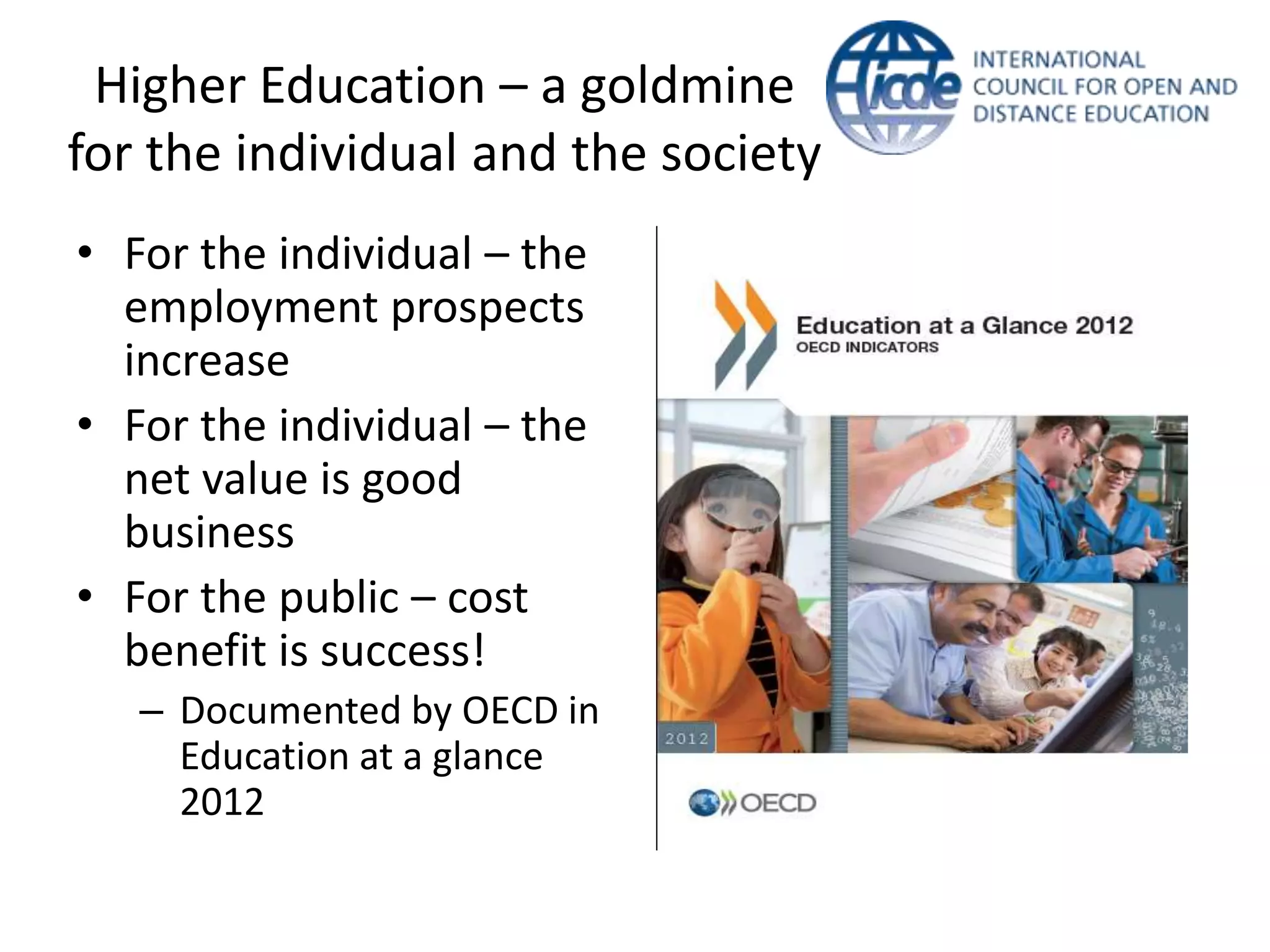
   – Documented by OECD in
     Education at a glance
     2012
The crisis reinforces the
importance of good education
• Over the past decade, more than two-thirds of
  GDP growth in EU21 countries was driven by
  labour income growth among tertiary-
  educated individuals, compared with just 51%
  in the United States.
• Even in the midst of the recession in 2009,
  labour income growth among tertiary
  graduates increased in the majority of EU
  countries with available data.
          Education at a Glance: OECD Indicators 2012
Global need for barrier-free
 access to higher education


• Irina Bokova, Director-General of UNESCO
  “Higher education: In less than 40 years,
  enrolments have increased fivefold. Globally it
  is estimated that demand will expand from
  less than 100 million students in 2000 to over
  250 million students in 2025.”
        ”Four universities a week”

  Open and distance elearning is needed!
World Development
     Report 2013
• “The youth challenge alone is staggering.
  More than 620 million young people are
  neither working nor studying. Just to keep
  employment rates constant, the worldwide
  number of jobs will have to increase by
  around 600 million over a 15-year period”


 October 1, 2012
ODL in rapid growth
• The world’s 18 largest mega-universities are open
  universities serving more than 14.3 million students. Most
  of these universities were founded after the 1970s.
• China: 1 of every 10 registered students in higher education
  is a student at The Open University of China.
• Africa: African Virtual University has signed up with 21
  countries and 28 Universities to provide Open and Distance
  eLearning, based on OER and the Internet.
• Almost one-third of enrolments in HE in the autumn of
  2010 in the USA were online enrolments, with more than
  30% of the students taking at least one course online.
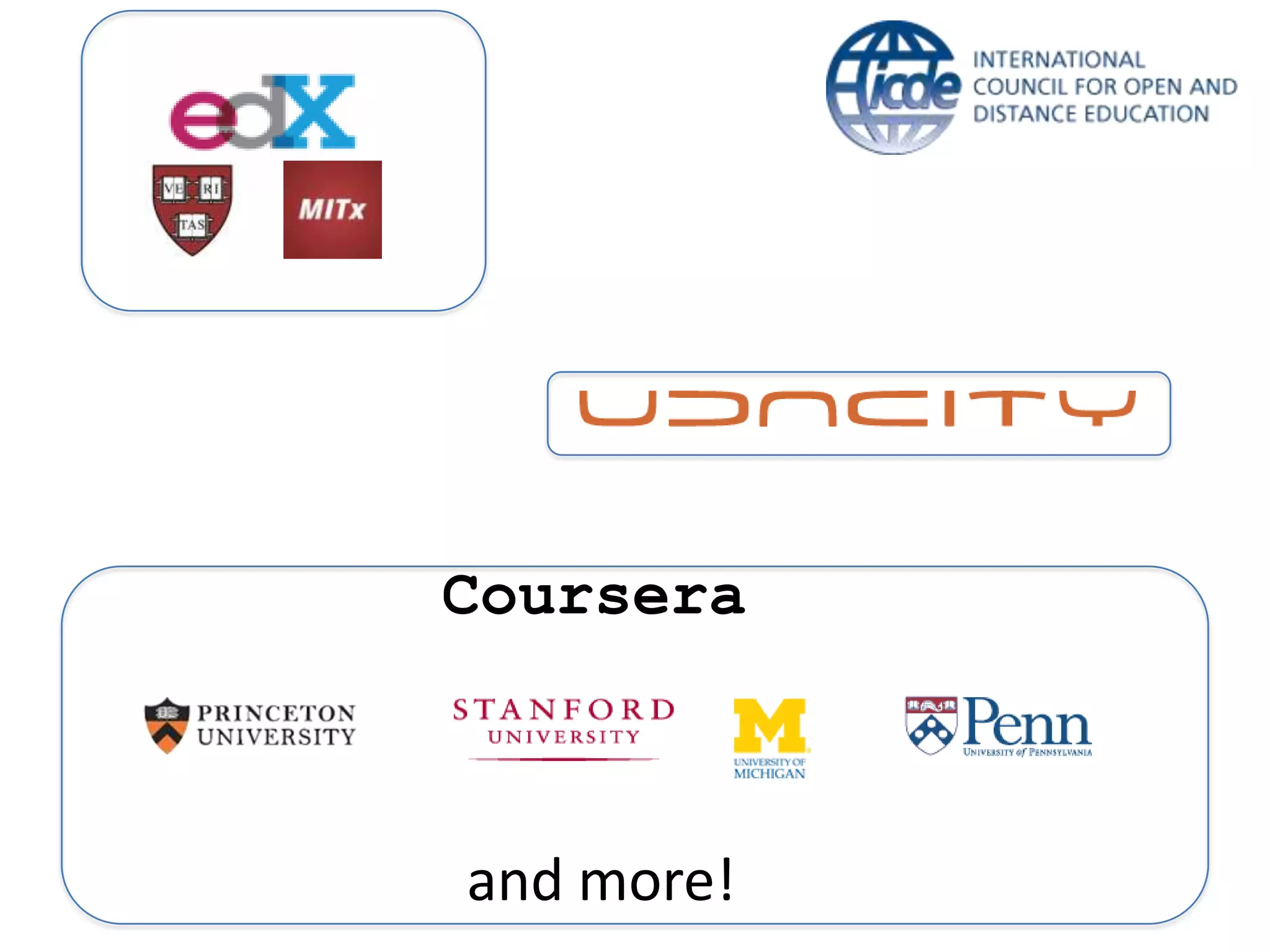
Coursera


and more!
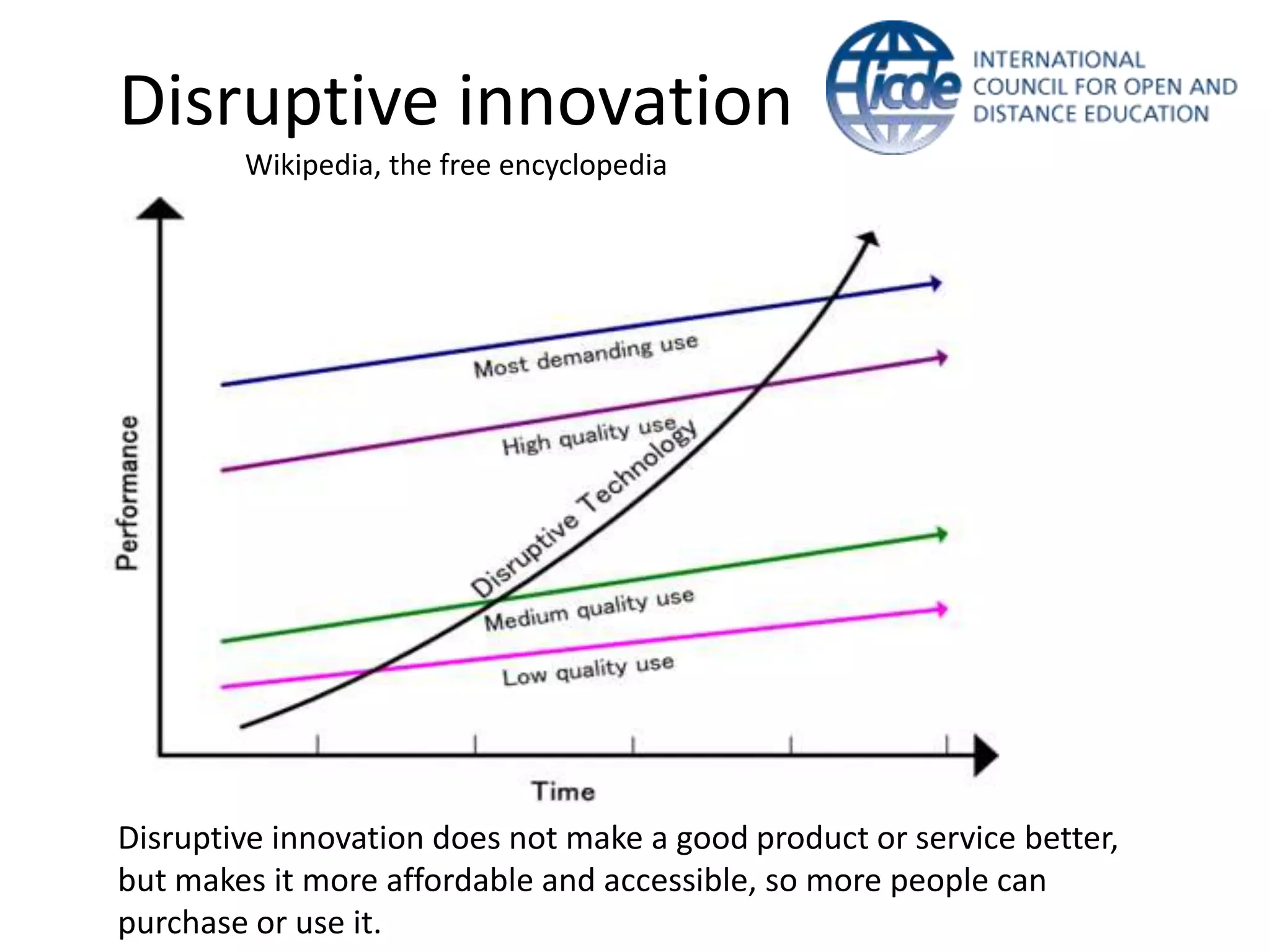
Disruptive innovation
        Wikipedia, the free encyclopedia


Disruptive innovation does not make a good product or service better,
but makes it more affordable and accessible, so more people can
purchase or use it.
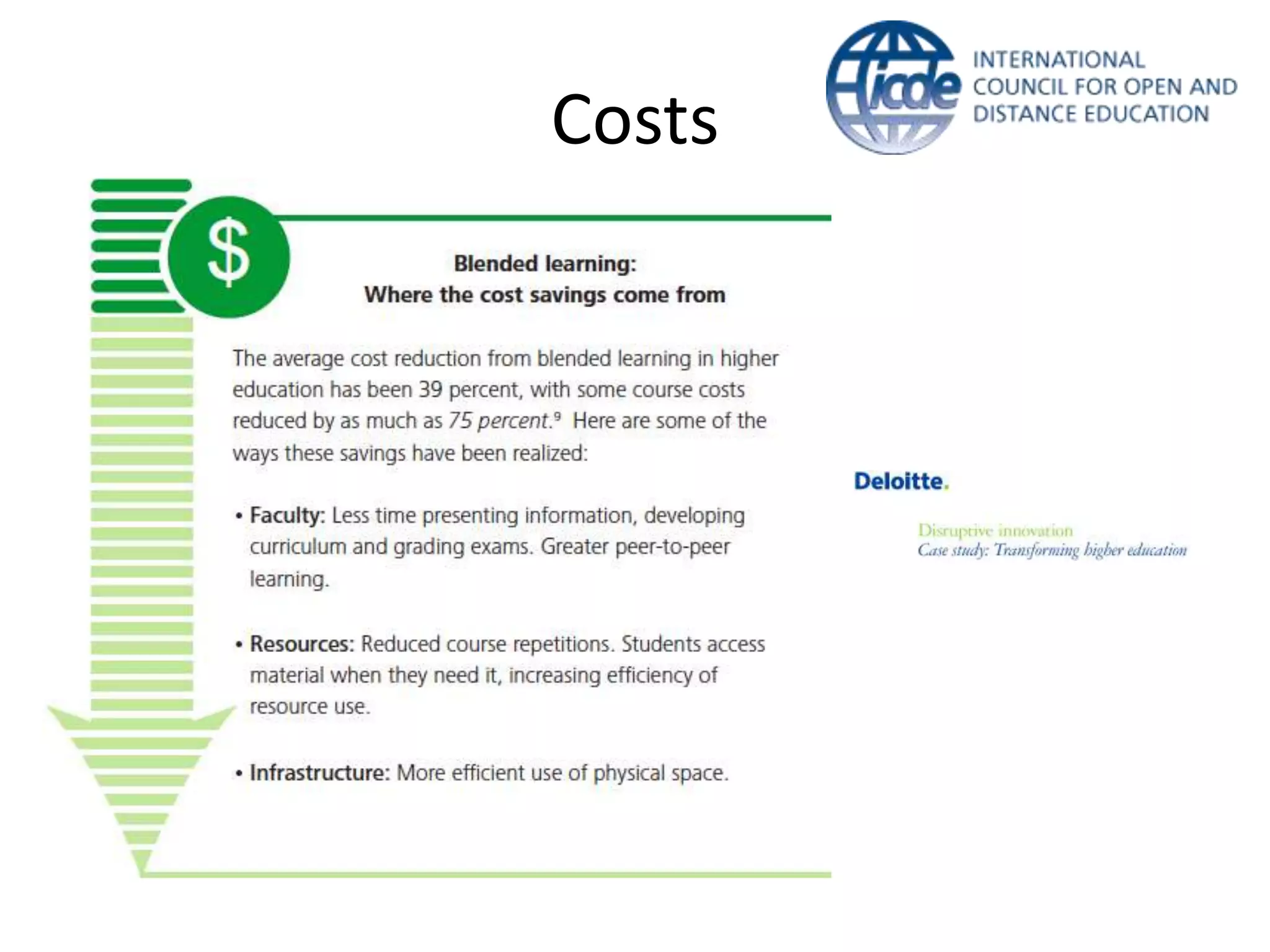
Costs
Many questions
• Motivation for MOOCs? Money, Branding or
  doing the Good things?
• Sustainable?
• Business models?
• The cost savings – for quality or profit?
• Pedagogic quality? Flip the classroom?
• Lot of criticism
  –Criticism can be the mother of
   progress
What about
the users?
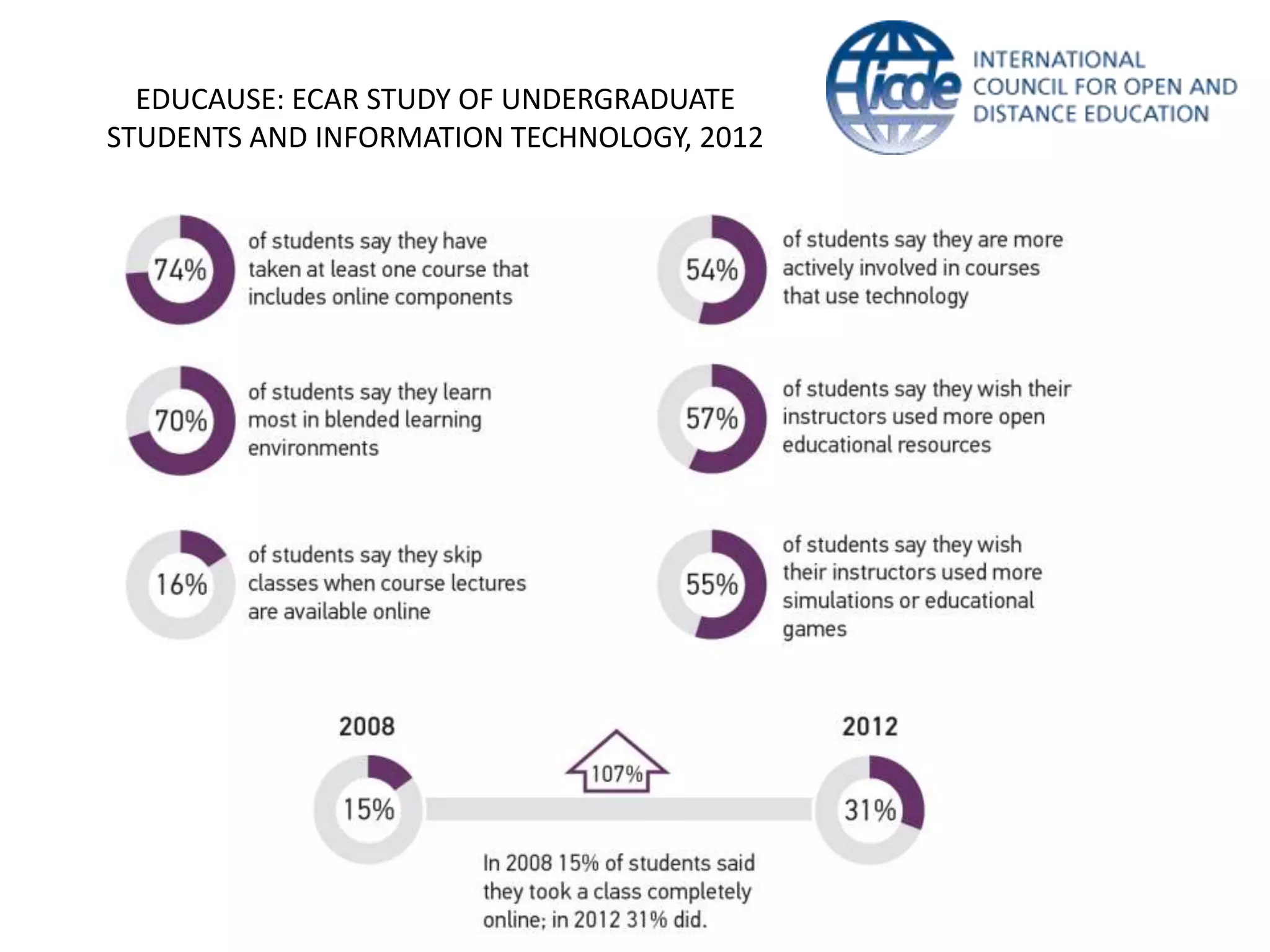
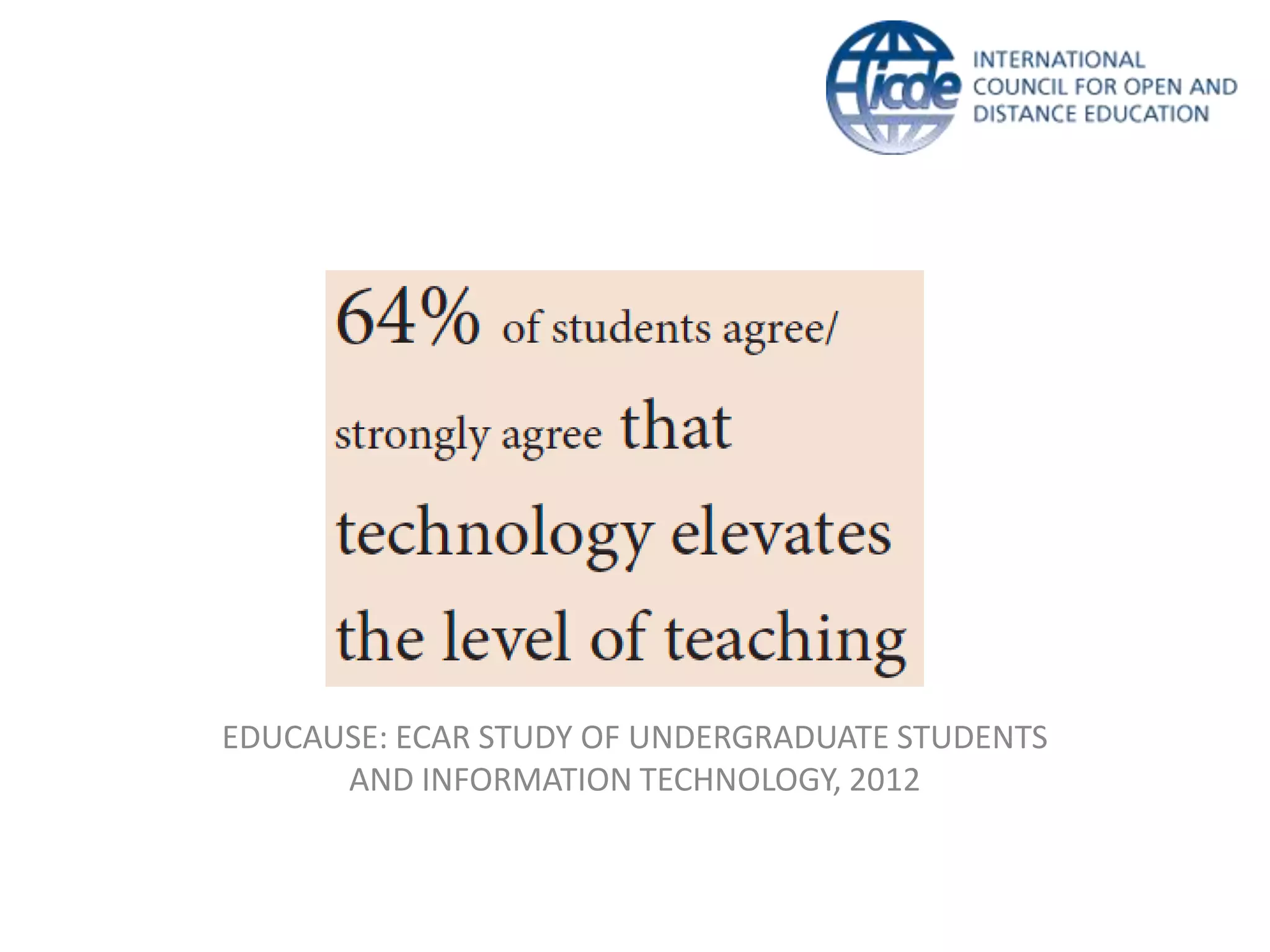
EDUCAUSE: ECAR STUDY OF UNDERGRADUATE
STUDENTS AND INFORMATION TECHNOLOGY, 2012
EDUCAUSE: ECAR STUDY OF UNDERGRADUATE
STUDENTS AND INFORMATION TECHNOLOGY, 2012
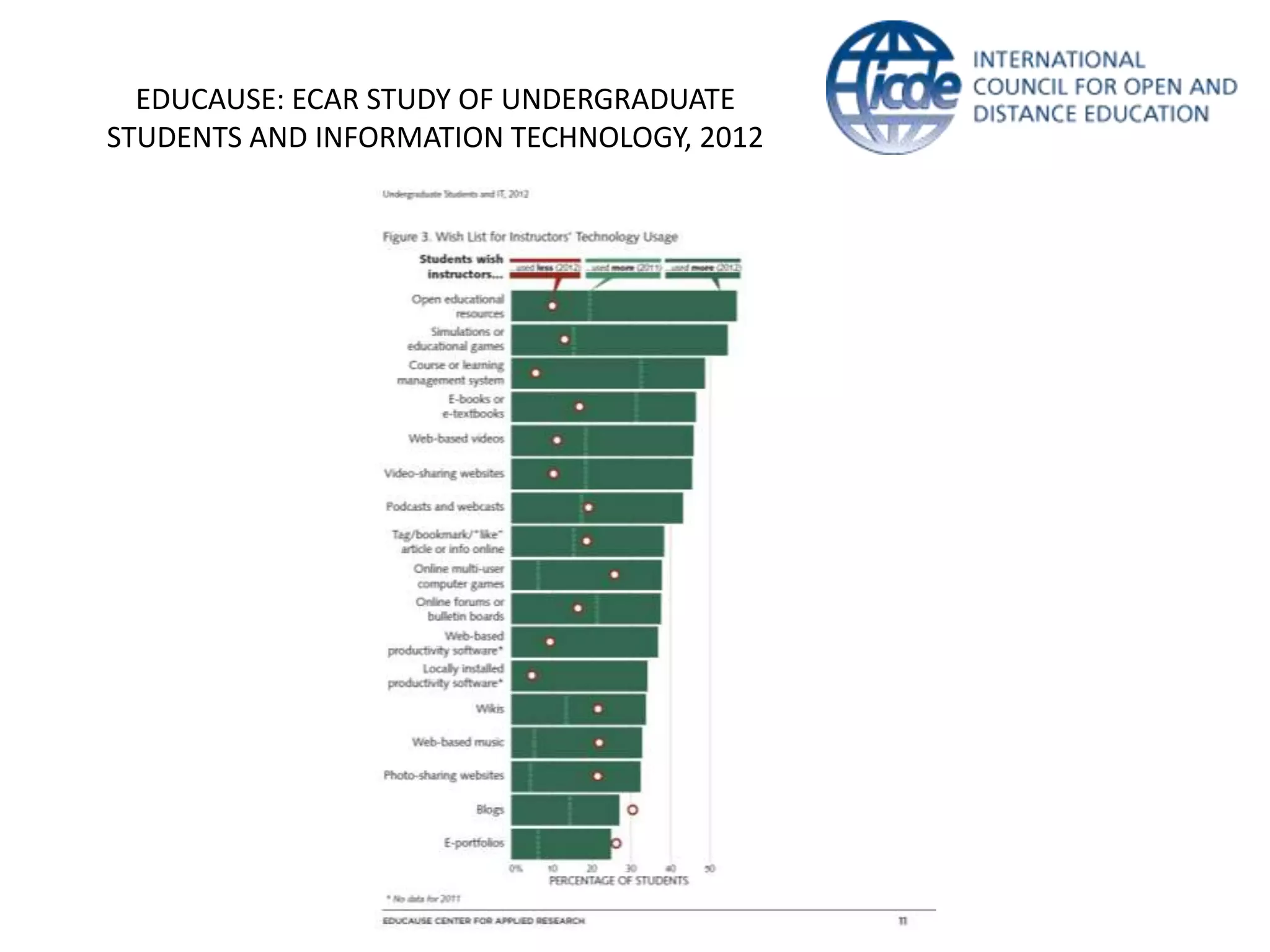
EDUCAUSE: ECAR STUDY OF UNDERGRADUATE
STUDENTS AND INFORMATION TECHNOLOGY, 2012


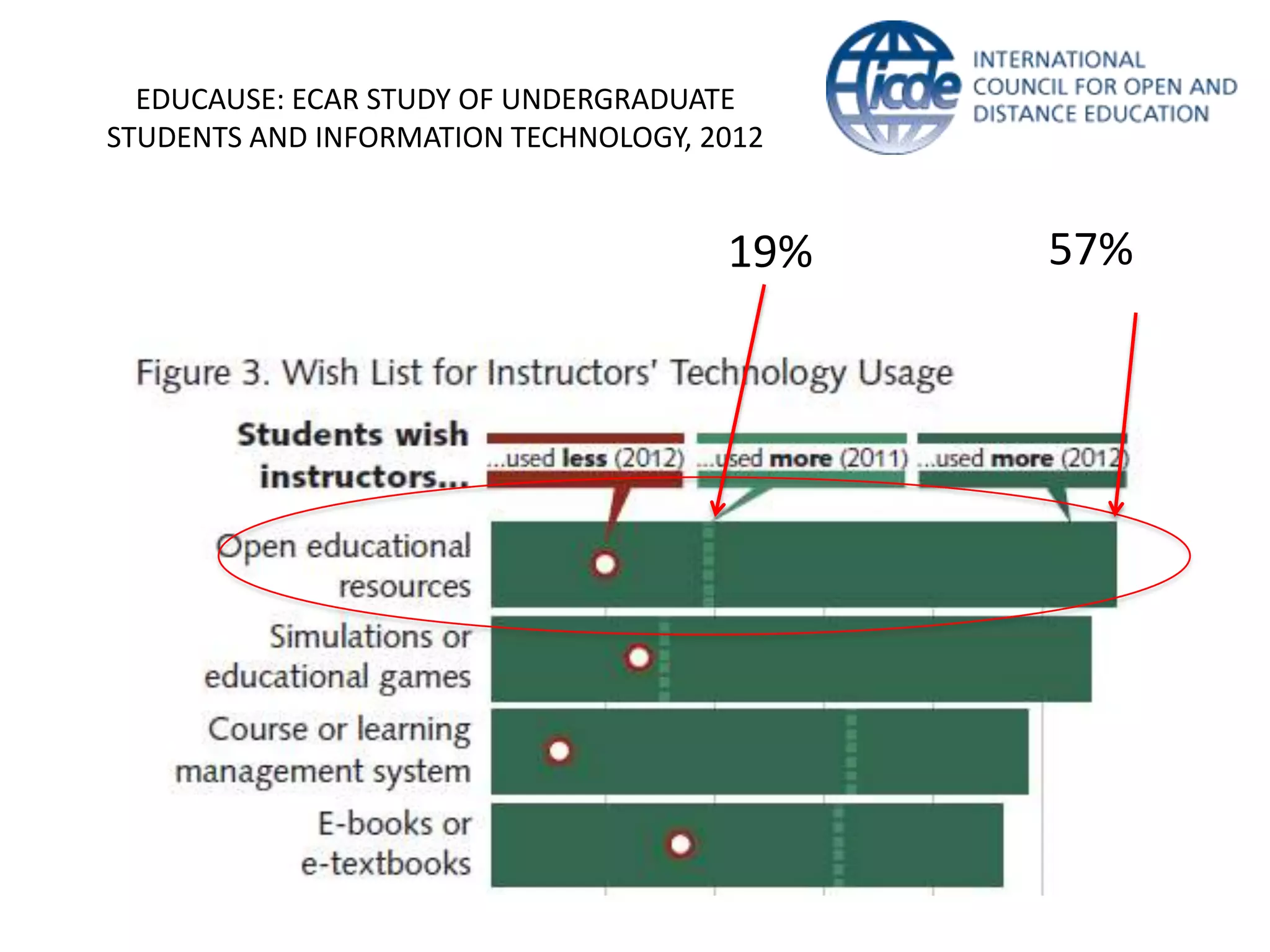
                                      19%   57%
EDUCAUSE: ECAR STUDY OF UNDERGRADUATE STUDENTS
      AND INFORMATION TECHNOLOGY, 2012
System failure
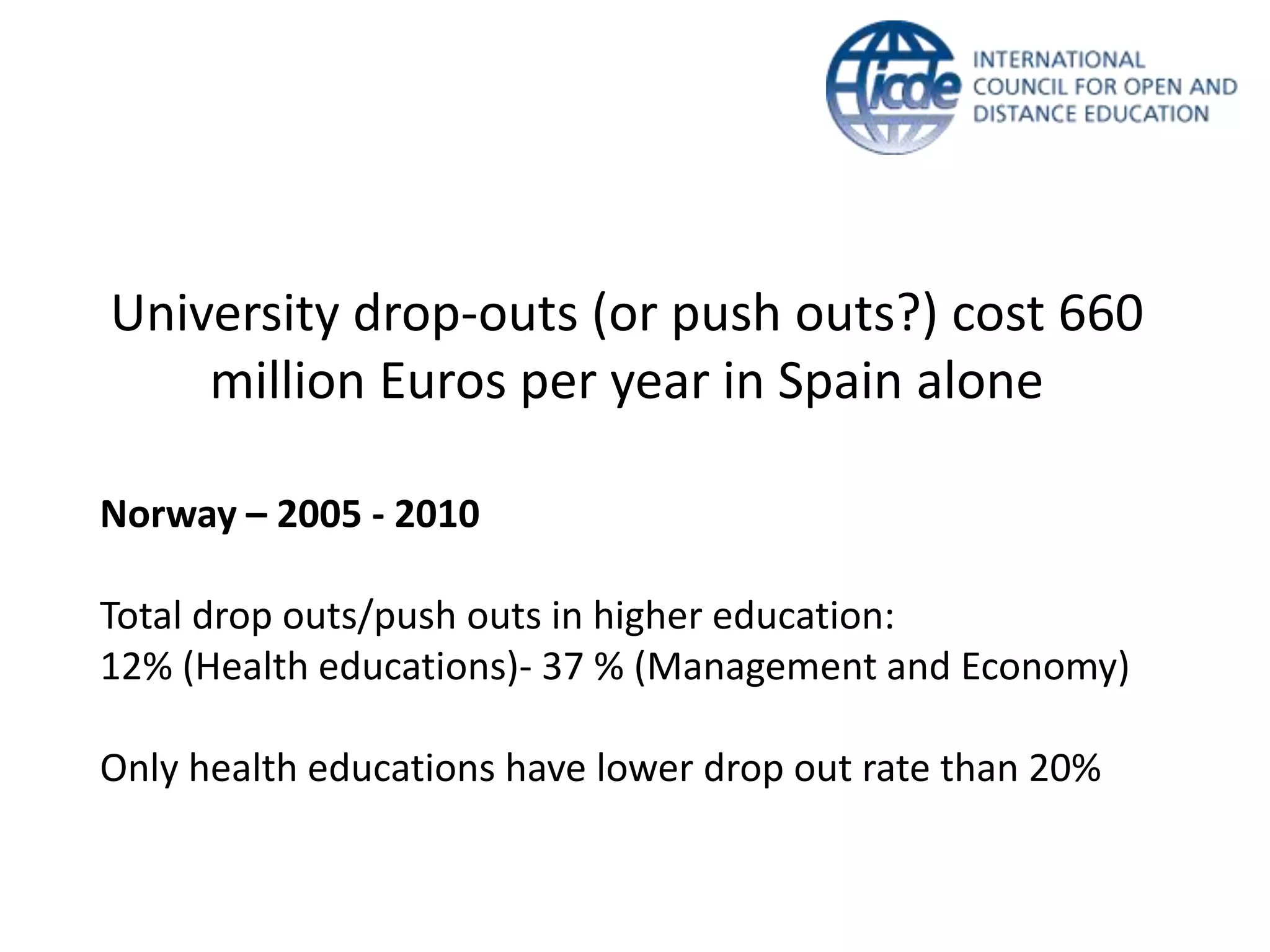
University drop-outs (or push outs?) cost 660
    million Euros per year in Spain alone

Norway – 2005 - 2010

Total drop outs/push outs in higher education:
12% (Health educations)- 37 % (Management and Economy)

Only health educations have lower drop out rate than 20%
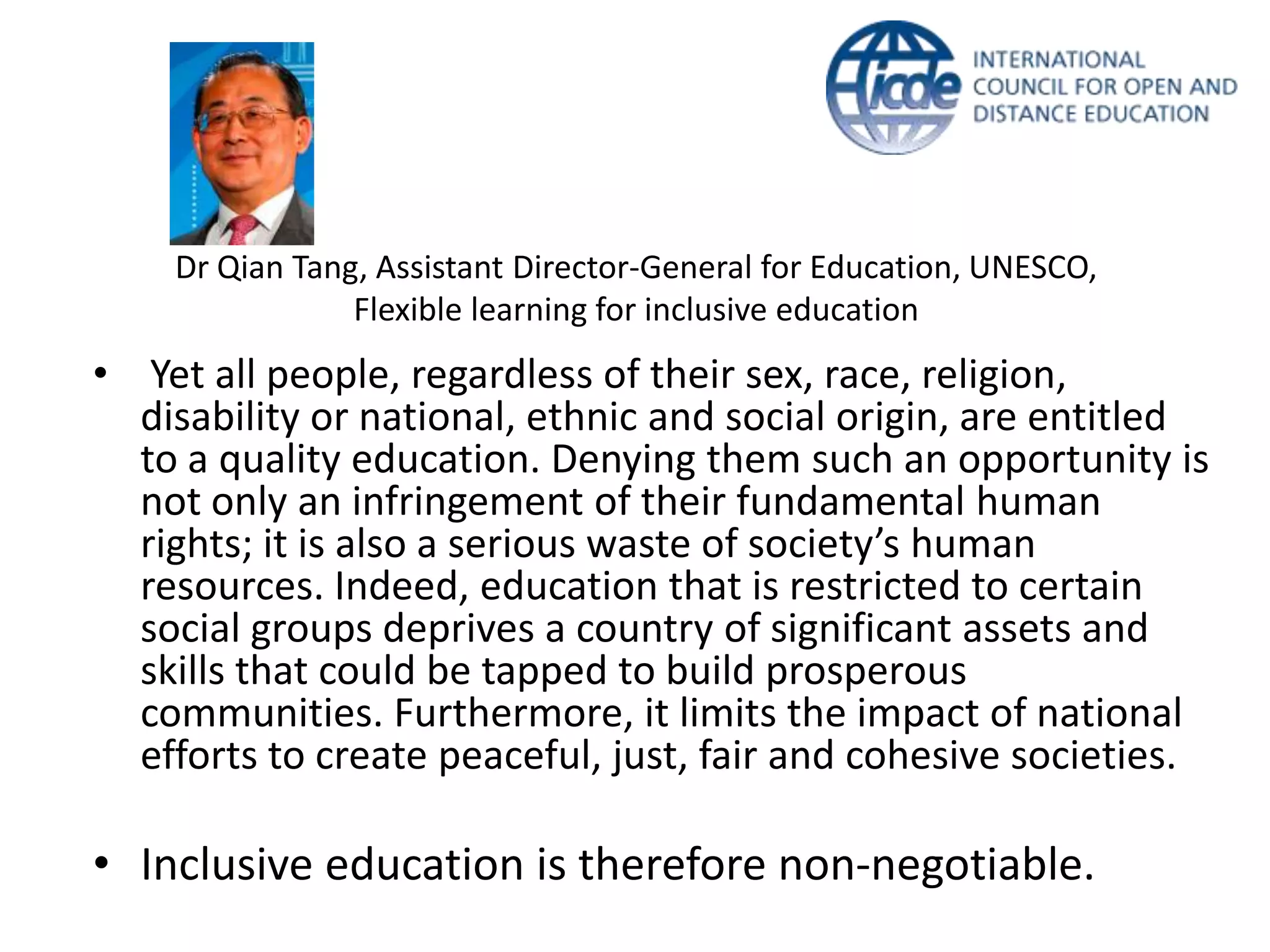
Dr Qian Tang, Assistant Director-General for Education, UNESCO,
                Flexible learning for inclusive education
• Yet all people, regardless of their sex, race, religion,
  disability or national, ethnic and social origin, are entitled
  to a quality education. Denying them such an opportunity is
  not only an infringement of their fundamental human
  rights; it is also a serious waste of society’s human
  resources. Indeed, education that is restricted to certain
  social groups deprives a country of significant assets and
  skills that could be tapped to build prosperous
  communities. Furthermore, it limits the impact of national
  efforts to create peaceful, just, fair and cohesive societies.

• Inclusive education is therefore non-negotiable.
A wake up call is needed!
To harvest the benefits from a more
      Open and Online world
        To be adressed:
Governments (wake up):            Universities (shake up):
• Optimal regulatory and          • Strategies and leadership
  policy framework for ODL,       • Partnership Open and
  incentives for OER                Conventional universities
• Sector overarching policies     • Build competencies
  for mobilising the workforce    • Faculty training, student
• Initiatives for research, new     training for ODL
  knowledge on effect and         • Flip the classroom for
  impact of ODL on delivering       student-oriented and
  high quality ODL                  personalised learning
   HEI, private and public sector: Build partnerships and
   agreements for knowledge supply, mobilising the workforce
Conclusion
• I believe we are at the beginning of a big debate
  about the future learning system.
• We need a professional, policy-oriented
  debate, in Europe, and throughout the world, on
  the opportunities and challenges coming from a
  more open and online world.
• Educational systems will be decided
  nationally, but the direction will also be a global
  issue.
• ICDE will be a visible and eager player in this
  debate.
• And: You are welcome to join!
Thank you!
 titlestad@icde.org

   www.icde.org

Challenges and opportunities from a more open and online world

  • 1.
    Challenges and opportunitiesfrom a more open and online world The 4th Smart E-Learning Russia Conference 9-10 October 2012, Moscow Gard Titlestad Secretary General ICDE
  • 2.
    Paradox • While governmentsworld wide celebrate the success of higher education, governmental policies are outdated and are not capable of grasping the benefits from the most constructive and disruptive factor in the higher education sector: open and online education
  • 3.
    Higher Education –a goldmine for the individual and the society • For the individual – the employment prospects increase • For the individual – the net value is good business • For the public – cost benefit is success! – Documented by OECD in Education at a glance 2012
  • 4.
    The crisis reinforcesthe importance of good education • Over the past decade, more than two-thirds of GDP growth in EU21 countries was driven by labour income growth among tertiary- educated individuals, compared with just 51% in the United States. • Even in the midst of the recession in 2009, labour income growth among tertiary graduates increased in the majority of EU countries with available data. Education at a Glance: OECD Indicators 2012
  • 5.
    Global need forbarrier-free access to higher education • Irina Bokova, Director-General of UNESCO “Higher education: In less than 40 years, enrolments have increased fivefold. Globally it is estimated that demand will expand from less than 100 million students in 2000 to over 250 million students in 2025.” ”Four universities a week” Open and distance elearning is needed!
  • 7.
    World Development Report 2013 • “The youth challenge alone is staggering. More than 620 million young people are neither working nor studying. Just to keep employment rates constant, the worldwide number of jobs will have to increase by around 600 million over a 15-year period” October 1, 2012
  • 8.
    ODL in rapidgrowth • The world’s 18 largest mega-universities are open universities serving more than 14.3 million students. Most of these universities were founded after the 1970s. • China: 1 of every 10 registered students in higher education is a student at The Open University of China. • Africa: African Virtual University has signed up with 21 countries and 28 Universities to provide Open and Distance eLearning, based on OER and the Internet. • Almost one-third of enrolments in HE in the autumn of 2010 in the USA were online enrolments, with more than 30% of the students taking at least one course online.
  • 9.
  • 10.
    Disruptive innovation Wikipedia, the free encyclopedia Disruptive innovation does not make a good product or service better, but makes it more affordable and accessible, so more people can purchase or use it.
  • 11.
  • 12.
    Many questions • Motivationfor MOOCs? Money, Branding or doing the Good things? • Sustainable? • Business models? • The cost savings – for quality or profit? • Pedagogic quality? Flip the classroom? • Lot of criticism –Criticism can be the mother of progress
  • 13.
  • 14.
    EDUCAUSE: ECAR STUDYOF UNDERGRADUATE STUDENTS AND INFORMATION TECHNOLOGY, 2012
  • 15.
    EDUCAUSE: ECAR STUDYOF UNDERGRADUATE STUDENTS AND INFORMATION TECHNOLOGY, 2012
  • 16.
    EDUCAUSE: ECAR STUDYOF UNDERGRADUATE STUDENTS AND INFORMATION TECHNOLOGY, 2012 19% 57%
  • 17.
    EDUCAUSE: ECAR STUDYOF UNDERGRADUATE STUDENTS AND INFORMATION TECHNOLOGY, 2012
  • 18.
  • 19.
    University drop-outs (orpush outs?) cost 660 million Euros per year in Spain alone Norway – 2005 - 2010 Total drop outs/push outs in higher education: 12% (Health educations)- 37 % (Management and Economy) Only health educations have lower drop out rate than 20%
  • 20.
    Dr Qian Tang,Assistant Director-General for Education, UNESCO, Flexible learning for inclusive education • Yet all people, regardless of their sex, race, religion, disability or national, ethnic and social origin, are entitled to a quality education. Denying them such an opportunity is not only an infringement of their fundamental human rights; it is also a serious waste of society’s human resources. Indeed, education that is restricted to certain social groups deprives a country of significant assets and skills that could be tapped to build prosperous communities. Furthermore, it limits the impact of national efforts to create peaceful, just, fair and cohesive societies. • Inclusive education is therefore non-negotiable.
  • 21.
    A wake upcall is needed!
  • 22.
    To harvest thebenefits from a more Open and Online world To be adressed: Governments (wake up): Universities (shake up): • Optimal regulatory and • Strategies and leadership policy framework for ODL, • Partnership Open and incentives for OER Conventional universities • Sector overarching policies • Build competencies for mobilising the workforce • Faculty training, student • Initiatives for research, new training for ODL knowledge on effect and • Flip the classroom for impact of ODL on delivering student-oriented and high quality ODL personalised learning HEI, private and public sector: Build partnerships and agreements for knowledge supply, mobilising the workforce
  • 23.
    Conclusion • I believewe are at the beginning of a big debate about the future learning system. • We need a professional, policy-oriented debate, in Europe, and throughout the world, on the opportunities and challenges coming from a more open and online world. • Educational systems will be decided nationally, but the direction will also be a global issue. • ICDE will be a visible and eager player in this debate. • And: You are welcome to join!
  • 24.