GLOBAL MEETS AND CONFERENCES
ON ENVIRONMENT
Submitted by
T.TAMILSELVAN
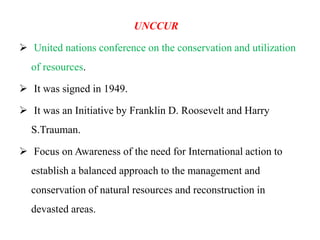
UNCCUR
 United nations conference on the conservation and utilization
of resources.
 It was signed in 1949.
 It was an Initiative by Franklin D. Roosevelt and Harry
S.Trauman.
 Focus on Awareness of the need for International action to
establish a balanced approach to the management and
conservation of natural resources and reconstruction in
devasted areas.
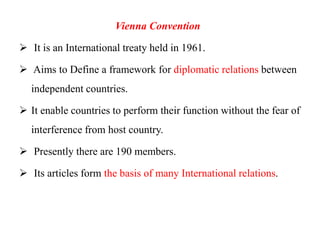
Vienna Convention
 It is an International treaty held in 1961.
 Aims to Define a framework for diplomatic relations between
independent countries.
 It enable countries to perform their function without the fear of
interference from host country.
 Presently there are 190 members.
 Its articles form the basis of many International relations.
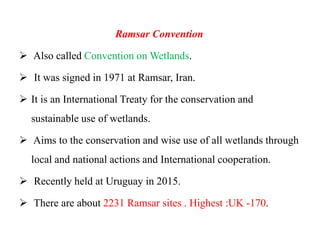
Ramsar Convention
 Also called Convention on Wetlands.
 It was signed in 1971 at Ramsar, Iran.
 It is an International Treaty for the conservation and
sustainable use of wetlands.
 Aims to the conservation and wise use of all wetlands through
local and national actions and International cooperation.
 Recently held at Uruguay in 2015.
 There are about 2231 Ramsar sites . Highest :UK -170.
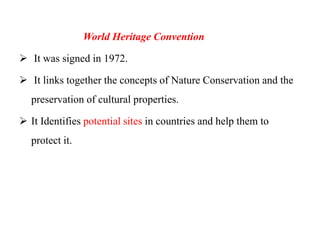
World Heritage Convention
 It was signed in 1972.
 It links together the concepts of Nature Conservation and the
preservation of cultural properties.
 It Identifies potential sites in countries and help them to
protect it.
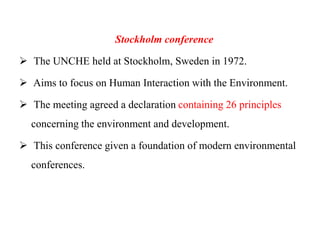
Stockholm conference
 The UNCHE held at Stockholm, Sweden in 1972.
 Aims to focus on Human Interaction with the Environment.
 The meeting agreed a declaration containing 26 principles
concerning the environment and development.
 This conference given a foundation of modern environmental
conferences.
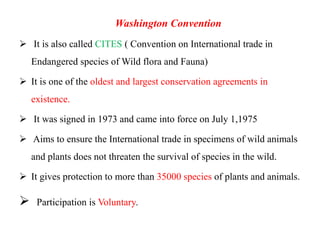
Washington Convention
 It is also called CITES ( Convention on International trade in
Endangered species of Wild flora and Fauna)
 It is one of the oldest and largest conservation agreements in
existence.
 It was signed in 1973 and came into force on July 1,1975
 Aims to ensure the International trade in specimens of wild animals
and plants does not threaten the survival of species in the wild.
 It gives protection to more than 35000 species of plants and animals.
 Participation is Voluntary.
Brundtland Commission
 Also called as world commission on Environment and
development(WCED).
 It was commissioned on 1983.
 Aims to Unite countries to pursue sustainable development
Together.
Three pillars are
 Economic Growth
 Environmental protection
 Social equality.
Bonn convention
Also called Convention on migratory species (CMS).
 It was signed in UN campus in Bonn , Germany.
 It was under UNEP.
 It aims to conserve terrestrial, Marine and avian migratory
species on global scale.
 The convention signed in 1979 but come into force in 1983
Montreal Protocol
 Agreed on September 1987 and into force on January 1989.
 It is an International treaty aims to protect the OZONE layer
by phasing out the production of numerous substances that are
responsible for the depletion of ozone.
 It have 197 members.
 from 1989 onwards it undergoes eight revisions on 10 meets.
 It is the Most successful International agreement till date.
Kyoto Protocol
 It is an International treaty extends from 1992 – UNFCCC.
 Signed at Kyoto, Japan on December 1997 and came into
force on February 2005.
 Currently there are 192 members.
 Aims to fight Global warming by reducing greenhouse gas
concentrations in the atmosphere.
 First commitment 2008 – 2012
 second commitment agreed on 2012 at Doha Amendment.
Earth Summit
 Also called Rio conference or Rio summit or UNCED.
 It was held in 1992.
 In 2012 , second summit called Rio+20 held.
 There are about 172 members.
 Aims to Prevent the destruction of nature eco-regions .
Find alternative sources of energy to replace fossil fuels.
Systematic patterns of production.(toxic gases)
Prevents pollution and growing usage and limited supply of
water.
Biodiversity convention
 It is also called as Convention on Biological Diversity.
 It was signed in Earth summit ,1992 and came into force in
December, 1993
 Its aim is to conservation efforts to the economic goal of using
biological resources sustainably.
 This conservation will bring us Environmental, Economic, and
Social benefits in return.
Biosafety protocol
 Also called Cartagena protocol on Biosafety.
 It was signed in Cartagena ,Colombia.
 It was adopted in January 2000 effective since 2003.
 It aims to protect Biological diversity from the potential risks
posed by the Genetically modified Organisms resulting from
modern Bio-technology.
 It have 170 members.
Nagoya protocol
 It was signed at Nagoya, Japan
 It was signed in 2010 but came into force in October 2014.
 It was a supplementary agreement to the convention on
Biological Diversity. (Second of CBD)
 Aim of this protocol was the Fair and equitable sharing of
benefits arising out of the utilization of genetic resources,
thereby contributing to the sustainable use and conservation of
biodiversity.
Paris Conference
 In 2015,United Nations climate change conference held.
 It is also called COP 21 or CMP 11.
 Members – 196.
 It is an Global agreement on the reduction on climate change.
 An agreement to sat a goal of limiting global warming to less
than 2 degree Celsius compared to pre-industrial levels.
References:
1). www.unep.org
2). A Textbook Ecology and Environmental science.
Authors: M.Prasanthrajan and P.P.Mahendran.(pg.no:247-261)
3).Essential Environmental studies.
Authors: S.P.Mishra, S.N.Pandey (pg.no:379-389)
THANK U…

Global meets and conferences on Environment

  • 1.
    GLOBAL MEETS ANDCONFERENCES ON ENVIRONMENT Submitted by T.TAMILSELVAN
  • 2.
    UNCCUR  United nationsconference on the conservation and utilization of resources.  It was signed in 1949.  It was an Initiative by Franklin D. Roosevelt and Harry S.Trauman.  Focus on Awareness of the need for International action to establish a balanced approach to the management and conservation of natural resources and reconstruction in devasted areas.
  • 3.
    Vienna Convention  Itis an International treaty held in 1961.  Aims to Define a framework for diplomatic relations between independent countries.  It enable countries to perform their function without the fear of interference from host country.  Presently there are 190 members.  Its articles form the basis of many International relations.
  • 4.
    Ramsar Convention  Alsocalled Convention on Wetlands.  It was signed in 1971 at Ramsar, Iran.  It is an International Treaty for the conservation and sustainable use of wetlands.  Aims to the conservation and wise use of all wetlands through local and national actions and International cooperation.  Recently held at Uruguay in 2015.  There are about 2231 Ramsar sites . Highest :UK -170.
  • 5.
    World Heritage Convention It was signed in 1972.  It links together the concepts of Nature Conservation and the preservation of cultural properties.  It Identifies potential sites in countries and help them to protect it.
  • 6.
    Stockholm conference  TheUNCHE held at Stockholm, Sweden in 1972.  Aims to focus on Human Interaction with the Environment.  The meeting agreed a declaration containing 26 principles concerning the environment and development.  This conference given a foundation of modern environmental conferences.
  • 7.
    Washington Convention  Itis also called CITES ( Convention on International trade in Endangered species of Wild flora and Fauna)  It is one of the oldest and largest conservation agreements in existence.  It was signed in 1973 and came into force on July 1,1975  Aims to ensure the International trade in specimens of wild animals and plants does not threaten the survival of species in the wild.  It gives protection to more than 35000 species of plants and animals.  Participation is Voluntary.
  • 8.
    Brundtland Commission  Alsocalled as world commission on Environment and development(WCED).  It was commissioned on 1983.  Aims to Unite countries to pursue sustainable development Together. Three pillars are  Economic Growth  Environmental protection  Social equality.
  • 9.
    Bonn convention Also calledConvention on migratory species (CMS).  It was signed in UN campus in Bonn , Germany.  It was under UNEP.  It aims to conserve terrestrial, Marine and avian migratory species on global scale.  The convention signed in 1979 but come into force in 1983
  • 10.
    Montreal Protocol  Agreedon September 1987 and into force on January 1989.  It is an International treaty aims to protect the OZONE layer by phasing out the production of numerous substances that are responsible for the depletion of ozone.  It have 197 members.  from 1989 onwards it undergoes eight revisions on 10 meets.  It is the Most successful International agreement till date.
  • 11.
    Kyoto Protocol  Itis an International treaty extends from 1992 – UNFCCC.  Signed at Kyoto, Japan on December 1997 and came into force on February 2005.  Currently there are 192 members.  Aims to fight Global warming by reducing greenhouse gas concentrations in the atmosphere.  First commitment 2008 – 2012  second commitment agreed on 2012 at Doha Amendment.
  • 12.
    Earth Summit  Alsocalled Rio conference or Rio summit or UNCED.  It was held in 1992.  In 2012 , second summit called Rio+20 held.  There are about 172 members.  Aims to Prevent the destruction of nature eco-regions . Find alternative sources of energy to replace fossil fuels. Systematic patterns of production.(toxic gases) Prevents pollution and growing usage and limited supply of water.
  • 13.
    Biodiversity convention  Itis also called as Convention on Biological Diversity.  It was signed in Earth summit ,1992 and came into force in December, 1993  Its aim is to conservation efforts to the economic goal of using biological resources sustainably.  This conservation will bring us Environmental, Economic, and Social benefits in return.
  • 14.
    Biosafety protocol  Alsocalled Cartagena protocol on Biosafety.  It was signed in Cartagena ,Colombia.  It was adopted in January 2000 effective since 2003.  It aims to protect Biological diversity from the potential risks posed by the Genetically modified Organisms resulting from modern Bio-technology.  It have 170 members.
  • 15.
    Nagoya protocol  Itwas signed at Nagoya, Japan  It was signed in 2010 but came into force in October 2014.  It was a supplementary agreement to the convention on Biological Diversity. (Second of CBD)  Aim of this protocol was the Fair and equitable sharing of benefits arising out of the utilization of genetic resources, thereby contributing to the sustainable use and conservation of biodiversity.
  • 16.
    Paris Conference  In2015,United Nations climate change conference held.  It is also called COP 21 or CMP 11.  Members – 196.  It is an Global agreement on the reduction on climate change.  An agreement to sat a goal of limiting global warming to less than 2 degree Celsius compared to pre-industrial levels.
  • 17.
    References: 1). www.unep.org 2). ATextbook Ecology and Environmental science. Authors: M.Prasanthrajan and P.P.Mahendran.(pg.no:247-261) 3).Essential Environmental studies. Authors: S.P.Mishra, S.N.Pandey (pg.no:379-389)
  • 18.