RIO de JANEIRO EARTH SUMMIT 1992
UNITED NATION CONFERENCE ON ENVIRONMENTAND
DEVELOPMENT [UNCED]
MOURISH .. VIGNESH
Introduction
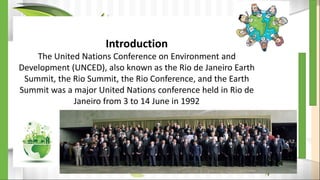
The United Nations Conference on Environment and
Development (UNCED), also known as the Rio de Janeiro Earth
Summit, the Rio Summit, the Rio Conference, and the Earth
Summit was a major United Nations conference held in Rio de
Janeiro from 3 to 14 June in 1992
The Earth Summit was the largest gathering of world leaders as
of 1992, with 117 heads of state and representatives of 178
nations in all attending. By means of treaties and other
documents signed at the conference, most of the world's nations
nominally committed themselves to the pursuit of economic
development in ways that would protect the Earth's environment
and nonrenewable resources.
Why Earth Summit?
Earth Summit was created as a response for Member States to
cooperate together internationally on development issues after the
Cold War. Due to issues relating to sustainability being too big for
individual member states to handle, Earth Summit was held as a
platform for other Member States to collaborate. Since the creation,
many others in the field of sustainability show a similar development to
the issues discussed in these conferences, including non-governmental
organizations (NGOs)
Earth Summit 1992 produced several long-range reports and
implementation plans that continue to serve as blueprints for
international action on environmental issues, including the World
Summit on Sustainable Development (Earth Summit 2002) and the
Kyoto Protocol. Earth Summit 1992 produced the Rio Declaration on
Environment and Development, the Statement of Forest Principles, and
Agenda 21. The Earth Summit also led to the establishment of the
Convention on Biological Diversity, and the United Nations Framework
Convention on Climate Change (UNFCCC)
Impacts of Rio de Janeiro Earth summit
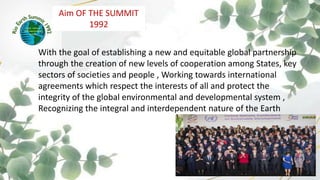
Aim OF THE SUMMIT
1992
With the goal of establishing a new and equitable global partnership
through the creation of new levels of cooperation among States, key
sectors of societies and people , Working towards international
agreements which respect the interests of all and protect the
integrity of the global environmental and developmental system ,
Recognizing the integral and interdependent nature of the Earth
There are a number of principles to the Rio Declaration.People are
entitled to a healthy and productive life in harmony with
nature.Development today must not threaten the needs of present and
future generations
Principles
The main aspects discussed were convention of climatic change and
adoption of convention on biological diversity
Agenda 21
The agenda - 21 is divided into four parts . The
agenda has various provisions for the management
of toxic chemicals, hazardous wastes and
biotechnology . One of the conventions, which
Earth Summit adopted was the convention of
climate change.
Agenda 21
The most important and significant aspect of this
Conference was Agenda 21, a vast work programme for the
21st Century, represents the Consensus reached by several
states present at Rio.This historic document runs into 700
pages and embraces practically all areas of sustainable
development
THANK YOU.

RIO SUMMIT1992.ppt

  • 1.
    RIO de JANEIROEARTH SUMMIT 1992 UNITED NATION CONFERENCE ON ENVIRONMENTAND DEVELOPMENT [UNCED] MOURISH .. VIGNESH
  • 3.
    Introduction The United NationsConference on Environment and Development (UNCED), also known as the Rio de Janeiro Earth Summit, the Rio Summit, the Rio Conference, and the Earth Summit was a major United Nations conference held in Rio de Janeiro from 3 to 14 June in 1992
  • 4.
    The Earth Summitwas the largest gathering of world leaders as of 1992, with 117 heads of state and representatives of 178 nations in all attending. By means of treaties and other documents signed at the conference, most of the world's nations nominally committed themselves to the pursuit of economic development in ways that would protect the Earth's environment and nonrenewable resources.
  • 5.
    Why Earth Summit? EarthSummit was created as a response for Member States to cooperate together internationally on development issues after the Cold War. Due to issues relating to sustainability being too big for individual member states to handle, Earth Summit was held as a platform for other Member States to collaborate. Since the creation, many others in the field of sustainability show a similar development to the issues discussed in these conferences, including non-governmental organizations (NGOs)
  • 6.
    Earth Summit 1992produced several long-range reports and implementation plans that continue to serve as blueprints for international action on environmental issues, including the World Summit on Sustainable Development (Earth Summit 2002) and the Kyoto Protocol. Earth Summit 1992 produced the Rio Declaration on Environment and Development, the Statement of Forest Principles, and Agenda 21. The Earth Summit also led to the establishment of the Convention on Biological Diversity, and the United Nations Framework Convention on Climate Change (UNFCCC) Impacts of Rio de Janeiro Earth summit
  • 7.
    Aim OF THESUMMIT 1992 With the goal of establishing a new and equitable global partnership through the creation of new levels of cooperation among States, key sectors of societies and people , Working towards international agreements which respect the interests of all and protect the integrity of the global environmental and developmental system , Recognizing the integral and interdependent nature of the Earth
  • 8.
    There are anumber of principles to the Rio Declaration.People are entitled to a healthy and productive life in harmony with nature.Development today must not threaten the needs of present and future generations Principles The main aspects discussed were convention of climatic change and adoption of convention on biological diversity
  • 10.
    Agenda 21 The agenda- 21 is divided into four parts . The agenda has various provisions for the management of toxic chemicals, hazardous wastes and biotechnology . One of the conventions, which Earth Summit adopted was the convention of climate change.
  • 11.
    Agenda 21 The mostimportant and significant aspect of this Conference was Agenda 21, a vast work programme for the 21st Century, represents the Consensus reached by several states present at Rio.This historic document runs into 700 pages and embraces practically all areas of sustainable development
  • 15.