LECTURE:02 SUSTAINABLE DEVELOPMENT:  CHALLENGES M. A. Kamal, Ph.D Director General National Academy for Planning and Development
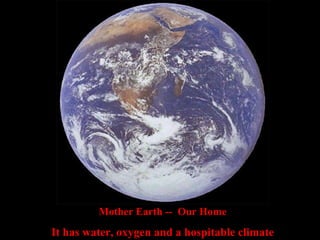
Mother Earth --  Our Home It has water, oxygen and a hospitable climate
Out Line 1. Introduction 2. Inequalities and Access to Resources: 2.1 Inequalities of access to educational resources 2.2 Inequalities of access to Health Facilities 2.3 Inequalities of access to Food 2.4 Inequalities of access to Clean Water 3. Key Challenges of Sustainable Development Policy Challenges towards SD Human Resource Challenges Sustainable Developments Thoughts Challenges to Global Trend The Human cost of  Contemporary Development Conclusion Farewell Calls
1. Introduction 1.1 Several challenges threaten progress towards sustainable development. The price hike in food and energy prices in 2008 led to a severe food crisis.  1.2 The subsequent fall of energy prices has eased some of the pressure on energy importing countries. Yet, food prices remain high.  1.3 The global financial and economic crisis in 2009  exacerbated the situation: Growth rates are falling, unemployment is rising, poverty in deepening, hunger and malnutrition are on the increase again 1.4 The main challenge is to gradually change our current unsustainable consumption and production patterns and the non-integrated approach to policy-making.”
Contd... 2.1 Inequalities of access to educational resources:  Social and ethnic inequality in educational achievement constitute a troublesome and enduring aspect of schooling. Large proficiency gaps between students of high and low socio-economic status exhits all over the world.  2.  Inequalities and Access to Resources:
2.2  Inequalities of access to Health Facilities:  2.2.1  Prior to the 1970s, the main movement of health workers was from the developed to the developing world. The new pattern runs in the opposite direction and weakens already fragile health systems, especially in sub-Saharan Africa (Social Science & Medicine, Nov. 2007).  2.2.2 Increased flows of labour and goods in a global health market, combined with decreased regulation, leads to increased inequality (both between and within countries) in health status and access to health care.  2.2.3 Declining public investment in the health sector has worsened conditions in both source and destination countries.
2.2.4 Health has become a commodity in a global market. This new economy involves the cross-border flow of technologies, particularly, pharmaceutical products, and health-related human resources.  2.2.5 The patterns of technological diffusion, finance and governance are complex and diverse. Inequalities in access to resources and variations in knowledge, training and cultural constructions of health combine with growing demand for health care produce global problems. 2.2.6 There are clear differences in the incidence of ill-health by social class. People in lower social classes, including children, are more likely to suffer from infective and parasitic diseases, pneumonia, poisonings or violence. Adults in lower social classes are more likely, in addition, to suffer from cancer, heart disease dialectics  and respiratory disease.
2.2.4 Insufficient data and knowledge about the inequalities generated by the new health-related global flows of labour and medical technologies is a services problem (Lancet, Feb. 2008).  2.2.8 Global health campaigns, such as the World Health Organization's "Train, Retain and Sustain" initiative, and the G8/UN campaign for universal access to AIDS medicines may fail to achieve their objectives. It is because of limited understanding of the problems involved. These problems have important socio-cultural, economic and biomedical implications.
2.3  Inequalities of access to Food:   2.3.1 Access to healthy food is one of those issues that anyone - no matter their racial, ethnic, geographic or political stripes - can agree upon, simply because everyone has to eat. When most Americans think of food insecurity, they will immediately think of famine in some nameless countries in the developing world. But rarely do Americans think of the food injustices happening in their own backyard. 2.3.2 Intra-country inequality of access to food is due mainly to differences in income or purchasing power among households. The share of food in household expenditure declines with rising income. In addition, there are upper and lower limits to food consumption (expressed in kcal). This means that actual changes in access to food, as opposed to income is not always from.
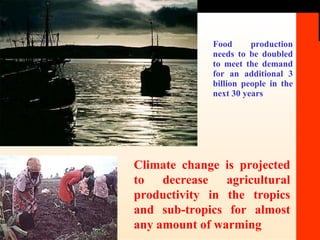
Food production needs to be doubled to meet the demand for an additional 3 billion people in the next 30 years Climate change is projected to decrease agricultural productivity in the tropics and sub-tropics for almost any amount of warming
2.4  Inequalities of access to Clean Water:   2.4.1 Water is a fundamental environmental resource. Access to water is a basic necessity for human survival, for agricultural production and industrial development.  2.4.2  The management of water resources can present a major challenge even for rich technologically advanced societies in temperate climates. Analysis of disputes over water resources touching on issues on politics, power, justice and law – all central concepts are within the considerations of environmental justice. 2.4.3 Inequalities in access to water resources and  exposure to and effects of flooding are apparent at global, national and local levels. The 5 challenge for sustainable development and social justice in both the 3 rd   developed and developing worlds are there.
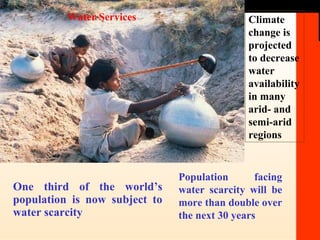
One third of the world’s population is now subject to water scarcity Population facing water scarcity will be more than double over the next 30 years Climate change is projected to decrease water availability in many arid- and semi-arid regions Water Services
3.1 Climate change and clean energy 3.2 Sustainable transport system. 3.3 Sustainable consumption and production Patterns. 3.4 Conservation and management of natural resources 3.5 Public health system.  3.6 Social inclusion, demography and migration issues  3.7 Global poverty and sustainable development challenges 3.  Key Challenges of Sustainable Development:
3.1 Climate change & clean energy i) Global temperature rise be limited to 2°C Ii)  Renewables: Ensure 12% energy consumption by 2010 (15% by 2015); 21% electricity consumption iii)  Biofuels: Ensure   5.75% transport by 2010 (8% by 2015) iv) Energy efficiency: Ensure   overall saving of 9% by 2017 v)  Greenhouse gases: Ensure   reduction of 15-30% by 2020  Vi) Make sure Average car CO2 emissions 140 g/km by 2008/09, 120 g/km by 2012
3.2 Sustainable transport: i) Sustainable transport (or green transport) refers to any means of transport with low impact on the environment, and includes walking and cycling, transit oriented development, green vehicles, Car Sharing, and building or protecting urban transport systems that are fuel-efficient, space-saving and promote healthy lifestyles. ii) Sustainable transport systems make a positive contribution to the environmental, social and economic sustainability of the communities they serve. Transport systems exist to provide social and economic connections, and people quickly take up the opportunities offered by increased mobility iii) Transport systems have significant impacts on the environment, accounting for between 20% and 25% of world energy consumption and carbon dioxide emissions. Greenhouse gas emissions from transport are increasing at a faster rate than any other energy using sector. Road transport is also a major contributor to local air pollution and smog
iv) Decouple economic growth and transport demand v)  Reduced transport energy and GHG emissions  vi)  Reduce health-related pollution  vii)  Modal shift viii) Reduced noise ix)  Halve road deaths in 2010 compared with 2000 x) Shift from road to rail, water and public transport for passenger and freight xi)  Improve energy efficiency through use of cost-effective instruments xii)  Infrastructure charging via satellite information  xiii) External costs methodology xiv)  International maritime and air traffic xv) Road safety
3.3 Sustainable consumption & production i) Development within ecosystems’ carrying capacity ii) Decouple growth from environmental degradation iii) Improving environmental and social performance  for products and processes iv) Best practice Green Public Procurement (GPP) v) Increase global market share in field of  environmental technologies and eco-innovations. vi) Promote sustainable products like organic farming
3.4  Conservation & management of natural resources i) Resource efficiency  ii) Eco-innovations iii) Reduce global biodiversity loss by 2010 iv) Waste reduction v) Agriculture: rural development programme, organic farming, animal welfare, biomass action plan vi) Fisheries: reformed Common Fisheries Policy vii) Integrated water resource management, marine environment, integrated coastal zone management
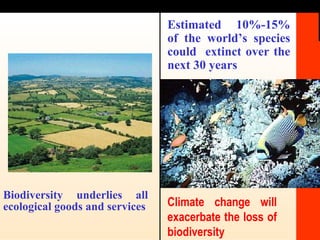
Biodiversity underlies all ecological goods and services Climate change will exacerbate the loss of biodiversity Estimated 10%-15% of the world’s species could  extinct over the next 30 years
3.5 Public health i) Food and feed legislation, including labelling ii) Improve Animal health and welfare  iii) Curbing lifestyle-related and chronic diseases iv) Reduce health inequalities v) Rules by 2020 for chemicals (including pesticides)  vi) Mental health and suicide risks vii) Health determinants and lifestyle  viii) Food and feed legislation, including GMOs ix) HIV/AIDS, Tuberculosis and Malaria x) Indoor air quality xi) Transport, Health and Environment
3.6 Social inclusion, demography & migration i) Social cohesion, respect for cultural diversity ii) Adapt to demographic change iii) Increase employment by women, older workers, migrants, young people, disabled iv) Develop migration policy v) Reduce negative effects of globalization on workers vi) Social services  vii) Modernize social protection systems viii) Implications of demographic change for land use and resource and energy consumption and mobility
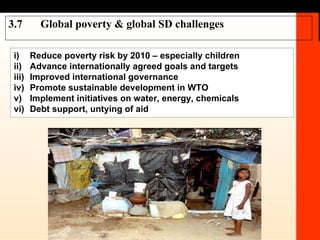
3.7 Global poverty & global SD challenges i) Reduce poverty risk by 2010 – especially children ii) Advance  internationally agreed goals and targets iii) Improved international governance iv) Promote sustainable development in WTO v) Implement initiatives on water, energy, chemicals vi) Debt support, untying of aid
4. Policy Challenges towards SD: . 4.1 Join-up policy goals under the SD umbrella 4.2 Signal SD in external partnerships / relationships 4.3 Effective stakeholder engagement 4.4 Building SD capacity among delivery partners
5. Human Resource Challenges . SD will need to be adequately reflected on : 5.1      Core vision and values 5.2         Training and development  5.3         Performance management  5.4         Recruitment 5.5         Career planning and placements 5.6         Internal communications 5.7         Volunteering / Fund raising
6. Sustainable Developments Thoughts 6.1 OLD SCHOOL THOUGHTS “ Few trends could so thoroughly undermine the very foundations of our free society as the acceptance by corporate officials of a social responsibility other than to make as much money for their stockholders as possible” (“Capitalism and Freedom” – Milton Friedman, 1962) 6.1 Today’s New School Of Thoughts “ There is no conflict between social responsibility and the obligation on companies to use scarce resources efficiently and be profitable – an unprofitable business is a drain on society. The essence of the contract between society and business is that companies shall not pursue their immediate profit objectives at the expense of the longer term interests of the community.”  (“Corporate Governance and Chairmanship” – Adrian Cadbury, 2002)
7. Challenges to Global Trend 7.1 Mindset change 7.2 How to operationalize Initiatives  7.3 New Emerging Market Forces (China, India) want to catch  up on fruits of development using old models 7.4 Sustainable Development Models not fully ‘mainstream” 7.5 Weak Demand Side (consumers need to be more aware and  demand more affirmative action)
Mindset Change i) old school = rational economic men so deeply imbedded; limited measures of success ii) Poverty Issues is not sole responsibility of Governments  iii) Looking at the “Poor” as market potential (Prahalad: The Fortune at the Bottom of the Pyramid)
8. Human Cost of  Contemporary Development 8.1 Food Crises. 8.2 Health risks increases (Break out of new diseases) 8.3 Increases mortality rate. 8.3 Increases road accident:  The social costs of transport include road crashes, air pollution, physical inactivity, time taken away from the family while commuting and vulnerability to fuel price increases. Many of these negative impacts fall disproportionately on those social groups who are also least likely to own and drive cars.
9. Conclusion :  9.1 Socio-Economic Integration and good  Governance must ensure Sustainable Development  9.2 Change Mindset about the “Poor” 9.3 Establish SD Model and replace old school models entirely by way of effective adoption of global initiatives at operational levels.  9.4 Sustainable Development Model must be adopted by Governments and the Corporate Sector
1o.  Farewell Call: „ Many people at many different places doing many little things have the power to change the image of the world.“ African Saying
THANK YOU! For Your Patient Hearing

Sustainable development chalenges(l-02)

  • 1.
    LECTURE:02 SUSTAINABLE DEVELOPMENT: CHALLENGES M. A. Kamal, Ph.D Director General National Academy for Planning and Development
  • 2.
    Mother Earth -- Our Home It has water, oxygen and a hospitable climate
  • 3.
    Out Line 1.Introduction 2. Inequalities and Access to Resources: 2.1 Inequalities of access to educational resources 2.2 Inequalities of access to Health Facilities 2.3 Inequalities of access to Food 2.4 Inequalities of access to Clean Water 3. Key Challenges of Sustainable Development Policy Challenges towards SD Human Resource Challenges Sustainable Developments Thoughts Challenges to Global Trend The Human cost of Contemporary Development Conclusion Farewell Calls
  • 4.
    1. Introduction 1.1Several challenges threaten progress towards sustainable development. The price hike in food and energy prices in 2008 led to a severe food crisis. 1.2 The subsequent fall of energy prices has eased some of the pressure on energy importing countries. Yet, food prices remain high. 1.3 The global financial and economic crisis in 2009 exacerbated the situation: Growth rates are falling, unemployment is rising, poverty in deepening, hunger and malnutrition are on the increase again 1.4 The main challenge is to gradually change our current unsustainable consumption and production patterns and the non-integrated approach to policy-making.”
  • 5.
    Contd... 2.1 Inequalitiesof access to educational resources: Social and ethnic inequality in educational achievement constitute a troublesome and enduring aspect of schooling. Large proficiency gaps between students of high and low socio-economic status exhits all over the world. 2. Inequalities and Access to Resources:
  • 6.
    2.2 Inequalitiesof access to Health Facilities: 2.2.1 Prior to the 1970s, the main movement of health workers was from the developed to the developing world. The new pattern runs in the opposite direction and weakens already fragile health systems, especially in sub-Saharan Africa (Social Science & Medicine, Nov. 2007). 2.2.2 Increased flows of labour and goods in a global health market, combined with decreased regulation, leads to increased inequality (both between and within countries) in health status and access to health care. 2.2.3 Declining public investment in the health sector has worsened conditions in both source and destination countries.
  • 7.
    2.2.4 Health hasbecome a commodity in a global market. This new economy involves the cross-border flow of technologies, particularly, pharmaceutical products, and health-related human resources. 2.2.5 The patterns of technological diffusion, finance and governance are complex and diverse. Inequalities in access to resources and variations in knowledge, training and cultural constructions of health combine with growing demand for health care produce global problems. 2.2.6 There are clear differences in the incidence of ill-health by social class. People in lower social classes, including children, are more likely to suffer from infective and parasitic diseases, pneumonia, poisonings or violence. Adults in lower social classes are more likely, in addition, to suffer from cancer, heart disease dialectics and respiratory disease.
  • 8.
    2.2.4 Insufficient dataand knowledge about the inequalities generated by the new health-related global flows of labour and medical technologies is a services problem (Lancet, Feb. 2008). 2.2.8 Global health campaigns, such as the World Health Organization's "Train, Retain and Sustain" initiative, and the G8/UN campaign for universal access to AIDS medicines may fail to achieve their objectives. It is because of limited understanding of the problems involved. These problems have important socio-cultural, economic and biomedical implications.
  • 9.
    2.3 Inequalitiesof access to Food: 2.3.1 Access to healthy food is one of those issues that anyone - no matter their racial, ethnic, geographic or political stripes - can agree upon, simply because everyone has to eat. When most Americans think of food insecurity, they will immediately think of famine in some nameless countries in the developing world. But rarely do Americans think of the food injustices happening in their own backyard. 2.3.2 Intra-country inequality of access to food is due mainly to differences in income or purchasing power among households. The share of food in household expenditure declines with rising income. In addition, there are upper and lower limits to food consumption (expressed in kcal). This means that actual changes in access to food, as opposed to income is not always from.
  • 10.
    Food production needsto be doubled to meet the demand for an additional 3 billion people in the next 30 years Climate change is projected to decrease agricultural productivity in the tropics and sub-tropics for almost any amount of warming
  • 11.
    2.4 Inequalitiesof access to Clean Water: 2.4.1 Water is a fundamental environmental resource. Access to water is a basic necessity for human survival, for agricultural production and industrial development. 2.4.2 The management of water resources can present a major challenge even for rich technologically advanced societies in temperate climates. Analysis of disputes over water resources touching on issues on politics, power, justice and law – all central concepts are within the considerations of environmental justice. 2.4.3 Inequalities in access to water resources and exposure to and effects of flooding are apparent at global, national and local levels. The 5 challenge for sustainable development and social justice in both the 3 rd developed and developing worlds are there.
  • 12.
    One third ofthe world’s population is now subject to water scarcity Population facing water scarcity will be more than double over the next 30 years Climate change is projected to decrease water availability in many arid- and semi-arid regions Water Services
  • 13.
    3.1 Climate changeand clean energy 3.2 Sustainable transport system. 3.3 Sustainable consumption and production Patterns. 3.4 Conservation and management of natural resources 3.5 Public health system. 3.6 Social inclusion, demography and migration issues 3.7 Global poverty and sustainable development challenges 3. Key Challenges of Sustainable Development:
  • 14.
    3.1 Climate change& clean energy i) Global temperature rise be limited to 2°C Ii) Renewables: Ensure 12% energy consumption by 2010 (15% by 2015); 21% electricity consumption iii) Biofuels: Ensure 5.75% transport by 2010 (8% by 2015) iv) Energy efficiency: Ensure overall saving of 9% by 2017 v) Greenhouse gases: Ensure reduction of 15-30% by 2020 Vi) Make sure Average car CO2 emissions 140 g/km by 2008/09, 120 g/km by 2012
  • 15.
    3.2 Sustainable transport:i) Sustainable transport (or green transport) refers to any means of transport with low impact on the environment, and includes walking and cycling, transit oriented development, green vehicles, Car Sharing, and building or protecting urban transport systems that are fuel-efficient, space-saving and promote healthy lifestyles. ii) Sustainable transport systems make a positive contribution to the environmental, social and economic sustainability of the communities they serve. Transport systems exist to provide social and economic connections, and people quickly take up the opportunities offered by increased mobility iii) Transport systems have significant impacts on the environment, accounting for between 20% and 25% of world energy consumption and carbon dioxide emissions. Greenhouse gas emissions from transport are increasing at a faster rate than any other energy using sector. Road transport is also a major contributor to local air pollution and smog
  • 16.
    iv) Decouple economicgrowth and transport demand v) Reduced transport energy and GHG emissions vi) Reduce health-related pollution vii) Modal shift viii) Reduced noise ix) Halve road deaths in 2010 compared with 2000 x) Shift from road to rail, water and public transport for passenger and freight xi) Improve energy efficiency through use of cost-effective instruments xii) Infrastructure charging via satellite information xiii) External costs methodology xiv) International maritime and air traffic xv) Road safety
  • 17.
    3.3 Sustainable consumption& production i) Development within ecosystems’ carrying capacity ii) Decouple growth from environmental degradation iii) Improving environmental and social performance for products and processes iv) Best practice Green Public Procurement (GPP) v) Increase global market share in field of environmental technologies and eco-innovations. vi) Promote sustainable products like organic farming
  • 18.
    3.4 Conservation& management of natural resources i) Resource efficiency ii) Eco-innovations iii) Reduce global biodiversity loss by 2010 iv) Waste reduction v) Agriculture: rural development programme, organic farming, animal welfare, biomass action plan vi) Fisheries: reformed Common Fisheries Policy vii) Integrated water resource management, marine environment, integrated coastal zone management
  • 19.
    Biodiversity underlies allecological goods and services Climate change will exacerbate the loss of biodiversity Estimated 10%-15% of the world’s species could extinct over the next 30 years
  • 20.
    3.5 Public healthi) Food and feed legislation, including labelling ii) Improve Animal health and welfare iii) Curbing lifestyle-related and chronic diseases iv) Reduce health inequalities v) Rules by 2020 for chemicals (including pesticides) vi) Mental health and suicide risks vii) Health determinants and lifestyle viii) Food and feed legislation, including GMOs ix) HIV/AIDS, Tuberculosis and Malaria x) Indoor air quality xi) Transport, Health and Environment
  • 21.
    3.6 Social inclusion,demography & migration i) Social cohesion, respect for cultural diversity ii) Adapt to demographic change iii) Increase employment by women, older workers, migrants, young people, disabled iv) Develop migration policy v) Reduce negative effects of globalization on workers vi) Social services vii) Modernize social protection systems viii) Implications of demographic change for land use and resource and energy consumption and mobility
  • 22.
    3.7 Global poverty& global SD challenges i) Reduce poverty risk by 2010 – especially children ii) Advance internationally agreed goals and targets iii) Improved international governance iv) Promote sustainable development in WTO v) Implement initiatives on water, energy, chemicals vi) Debt support, untying of aid
  • 23.
    4. Policy Challengestowards SD: . 4.1 Join-up policy goals under the SD umbrella 4.2 Signal SD in external partnerships / relationships 4.3 Effective stakeholder engagement 4.4 Building SD capacity among delivery partners
  • 24.
    5. Human ResourceChallenges . SD will need to be adequately reflected on : 5.1     Core vision and values 5.2        Training and development 5.3        Performance management 5.4        Recruitment 5.5        Career planning and placements 5.6        Internal communications 5.7        Volunteering / Fund raising
  • 25.
    6. Sustainable DevelopmentsThoughts 6.1 OLD SCHOOL THOUGHTS “ Few trends could so thoroughly undermine the very foundations of our free society as the acceptance by corporate officials of a social responsibility other than to make as much money for their stockholders as possible” (“Capitalism and Freedom” – Milton Friedman, 1962) 6.1 Today’s New School Of Thoughts “ There is no conflict between social responsibility and the obligation on companies to use scarce resources efficiently and be profitable – an unprofitable business is a drain on society. The essence of the contract between society and business is that companies shall not pursue their immediate profit objectives at the expense of the longer term interests of the community.” (“Corporate Governance and Chairmanship” – Adrian Cadbury, 2002)
  • 26.
    7. Challenges toGlobal Trend 7.1 Mindset change 7.2 How to operationalize Initiatives 7.3 New Emerging Market Forces (China, India) want to catch up on fruits of development using old models 7.4 Sustainable Development Models not fully ‘mainstream” 7.5 Weak Demand Side (consumers need to be more aware and demand more affirmative action)
  • 27.
    Mindset Change i)old school = rational economic men so deeply imbedded; limited measures of success ii) Poverty Issues is not sole responsibility of Governments iii) Looking at the “Poor” as market potential (Prahalad: The Fortune at the Bottom of the Pyramid)
  • 28.
    8. Human Costof Contemporary Development 8.1 Food Crises. 8.2 Health risks increases (Break out of new diseases) 8.3 Increases mortality rate. 8.3 Increases road accident: The social costs of transport include road crashes, air pollution, physical inactivity, time taken away from the family while commuting and vulnerability to fuel price increases. Many of these negative impacts fall disproportionately on those social groups who are also least likely to own and drive cars.
  • 29.
    9. Conclusion : 9.1 Socio-Economic Integration and good Governance must ensure Sustainable Development 9.2 Change Mindset about the “Poor” 9.3 Establish SD Model and replace old school models entirely by way of effective adoption of global initiatives at operational levels. 9.4 Sustainable Development Model must be adopted by Governments and the Corporate Sector
  • 30.
    1o. FarewellCall: „ Many people at many different places doing many little things have the power to change the image of the world.“ African Saying
  • 31.
    THANK YOU! ForYour Patient Hearing

Editor's Notes

  • #18 http://www.npl.co.uk/environment/images/blueprocess.gif
  • #19 http://www.elephantcare.org/IMAGES/SUMATRA/CONSERVE/employ.jpg
  • #21 http://clubs.ntu.edu.sg/earthlink/images/Past/air01.jpg
  • #22 http://www.nde.state.ne.us/SS/irish/emigration.gif
  • #23 http://www.genderandhealth.ca/en/modules/poverty/imageContent/JBUHX86N.jpg
  • #24 Slide 19
  • #25 Slide 19