CONVENTIONS &
AGREEMENTS
Tanvi Potluri
Nikitha Polineni
Pintu Kumar
Convention:
• Gathering of individuals
• Meet at an arranged place and time
• Discuss or engage in some common interest
• Based upon industry, profession, and fandom
Treaty:
• Agreement under international law
• Entered into by sovereign states and international organizations
• May also be known as
an agreement, protocol, covenant, convention, pact, or exchange of
letters
Treatiescan be looselycompared to contracts:
• Both are means of willing parties
• Assume obligations among themselves
• A party that fails to live up to their obligations can be held
liable under international law.
List of intl. conventions related to “Biotechnology”:
(1900 onwards)
1900-1999:
•Strasbourg Convention
•WIPO Convention
•Patent Cooperation Treaty (PCT)
•IPC Agreement
• European Patent Convention (EPC)
•CITES
• International Seed Treaty
•Convention on the Conservation of Migratory Species of Wild
Animals
•Ramsar Convention
•International Plant Protection Convention
•Montreal Protocol on Substances that Deplete the Ozone Layer
•United Nations Framework Convention on Climate Change
•Law of the Sea Convention
•Convention on Biological Diversity (CBD)
•United Nations Convention to Combat Desertification
•World Intellectual Property Organization Copyright Treaty
2000-Present:
•The Kyoto Protocol
•Patent Law Treaty (PLT)
•Energy Community of South East Europe (ECSEE)
Upcoming:
• Anti-Counterfeiting Trade Agreement (ACTA)
•Substantive Patent Law Treaty (SPLT)
StrasbourgConvention:
•Also known as “Convention on the Unification of Certain Points of
Substantive Law on Patents for Invention”
• Multilateral treaty signed by Member States of the Council of Europe in
1963
• Entered into force on August 1, 1980
• Establishes patentability criteria
• Led to a significant harmonization of patent laws across European
countries
StrasbourgAgreement Concerning the International Patent Classification:
• Also known as the IPC Agreement
• Signed in Strasbourg, France
• Entered into force on October 7, 1975
• Establishes a common classification
for patents for invention, inventors’ certificates, utility
models and utility certificates, known as the “International Patent
Classification” (IPC)
• There are 62 contracting parties to the Strasbourg Agreement
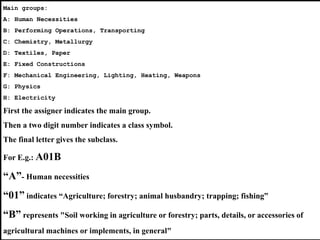
Main groups:
A: Human Necessities
B: Performing Operations, Transporting
C: Chemistry, Metallurgy
D: Textiles, Paper
E: Fixed Constructions
F: Mechanical Engineering, Lighting, Heating, Weapons
G: Physics
H: Electricity
First the assigner indicates the main group.
Then a two digit number indicates a class symbol.
The final letter gives the subclass.
For E.g.: A01B
“A”- Human necessities
“01” indicates “Agriculture; forestry; animal husbandry; trapping; fishing”
“B” represents "Soil working in agriculture or forestry; parts, details, or accessories of
agricultural machines or implements, in general"
Convention on International Trade in Endangered Species of WildFaunaand Flora:
• Also known as Washington Convention/ CITES
• Multilateral treaty to protect endangered plants and animals
• Entered into force on 1 July 1975
• 35,000 protected species or population
• Included in one of three lists, called Appendices
• The Appendix that lists a species or population reflects the extent
of the threat to it and the controls that apply to the trade
•Appendix I (1200 species) - threatened with extinction and are or
may be affected by trade. Commercial trade in wild-caught
specimens of these species is illegal
•Appendix II (21,000 species)- not necessarily threatened with
extinction, but may become so unless trade in specimens of such
species is subject to strict regulation
•Appendix III (170 species)- not necessarily threatened with
extinction globally; only restricted across some regions
International Plant ProtectionConvention:
• Also known as IPCC
• 1951 multilateral treaty overseen by the Food and Agriculture
Organization
• Prevent and to control the introduction and spread of pests of plants
and plant products
• Convention has 181 parties
• It also takes into consideration both direct and indirect damage by
pests, so it includes weeds
• The Convention also covers research materials, biological control
organisms, germplasm banks, containment facilities, food aid, emergency
aid and anything else that can act as a vector for the spread of plant pests
• Protecting sustainable agriculture and enhancing global food security
through the prevention of pest spread
EnergyCommunityof SouthEast Europe (ECSEE):
• Also referred to as the “The Energy Community”
• international organisation established between the European Union (EU)
and a number of third countries
• the Contracting Parties commit themselves to implement the relevant EU
energy acquis communautaire
• The Energy Community aims at establishing a Pan-European energy
market by extending the energy acquis of the European Union to the
territories of third countries
• It now also includes legislation in relation to security of supply, energy
efficiency, oil, renewable energy and statistics
Anti-CounterfeitingTrade Agreement (ACTA):
• Multinational treaty for the purpose of establishing
international standards for intellectual property rights
enforcement
• Aims to establish an international legal framework for
targeting counterfeit goods, generic medicines and copyright
infringement on the Internet
• Organisations representing citizens and non-governmental
interests argued that ACTA could infringe fundamental rights
including freedom of expression and privacy
• ACTA has also been criticised by Doctors Without Borders for
Ramsar Convention:
• Also known as Convention on Wetlands of International Importance
• An international treaty for the conservation and sustainable utilization
of wetlands
• Recognizes the fundamental ecological functions of wetlands and their
economic, cultural, scientific, and recreational value
• “Areas of marine water the depth of which at low tide does not exceed
six meters”
• Named after the city of Ramsar in Iran, where the Convention was signed
in 1971
• The headquarters is located in Gland, Switzerland
• The Ramsar List of Wetlands of International Importance now includes
Convention on Biological Diversity (CBD):
• Known informally as the Biodiversity Convention
• Multilateral treaty
• Entered into force on 29 December 1993
• 2010 was the International Year of Biodiversity
• Its objective is to develop national strategies for the conservation and
sustainable use of biological diversity
• The Cartagena Protocol on Biosafety of the Convention, also known as
the Biosafety Protocol, was adopted in January 2000
• The Biosafety Protocol seeks to protect biological diversity from the
potential risks posed by living modified organisms resulting from modern
biotechnology
Convention on the Conservation of Migratory Species of WildAnimals:
• Convention on Migratory Species (CMS) or the Bonn Convention
• conserve terrestrial, marine and avian migratory species throughout
their range
• It is an intergovernmental treaty, concluded under the aegis of
the United Nations Environment Programme
• CMS and its daughter agreements determine policy and provide further
guidance on specific issues through their Strategic Plans, Action Plans,
resolutions, decisions and guidelines.
• Migratory species threatened with extinction are listed on Appendix I
• Migratory species that need or would significantly benefit from
international co-operation are listed in Appendix II of the Convention
International SeedTreaty:
• The International Treaty on Plant Genetic Resources for Food and
Agriculture (IT PGRFA)
• aims at guaranteeing food security through the conservation, exchange
and sustainable use of the world's plant genetic resources for food and
agriculture
• the protection of traditional knowledge relevant to plant genetic
resources for food and agriculture
• The treaty was under negotiation for 7 years
• entry into force was on 29 June 2004
• The Treaty establishes the Multilateral System of Access and Benefit-
sharing to facilitate plant germplasm exchanges and benefit sharing
through Standard Material Transfer Agreement (SMTA)
Biological andToxinWeapons Convention:
• Convention on the Prohibition of the Development, Production and
Stockpiling of Bacteriological (Biological) and Toxin Weapons and on
their Destruction
• Replaces 1925 Geneva Protocol
• This includes all microbial and other biological agents or toxins and
their means of delivery
• The BWC has 173 States Parties as of January 2015
• However, the absence of any formal verification regime to monitor
compliance has limited the effectiveness of the Convention
Montreal Protocol on Substancesthat Depletethe Ozone Layer:
• An international treaty designed to protect the ozone layer by phasing
out the production of numerous substances that are responsible
for ozone depletion
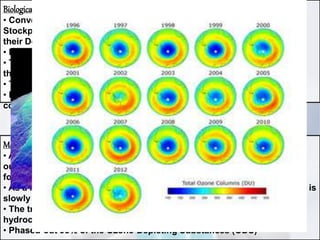
• As a result of the international agreement, the ozone hole in Antarctica is
slowly recovering.
• The treaty is structured around several groups of halogenated
hydrocarbons that have been shown to play a role in ozone depletion
• Phased-out 98% of the Ozone-Depleting Substances (ODS)
UnitedNationsFrameworkConvention on ClimateChange:
• An international environmental treaty
• The objective of the treaty is to "stabilize greenhouse gas
concentrations in the atmosphere at a level that would prevent
dangerous anthropogenic interference with the climate system“
• The parties to the convention have met annually from 1995 in
Conferences of the Parties (COP) to assess progress in dealing with
climate change
• UNFCC has 196 parties
Lawof the SeaConvention:
• The United Nations Convention on the Law of the Sea (UNCLOS)
• defines the rights and responsibilities of nations with respect to their
use of the world's oceans
• establishing guidelines for businesses, the environment, and the
management of marine natural resources
• 166 countries and the European Union have joined in the Convention
• UNCLOS came into force in 1994
UnitedNationsConvention to Combat Desertification:
• United Nations Convention to Combat Desertification in Those Countries
Experiencing Serious Drought and/or Desertification, Particularly in Africa
(UNCCD)
• Combat desertification and mitigate the effects of drought
• Incorporate long-term strategies supported by international cooperation
and partnership arrangements
• Was adopted in Paris, France on 17 June 1994 and entered into force in
December 1996
• To help publicise the Convention, 2006 was declared "International Year
of Deserts and Desertification“
• The permanent Secretariat of the UNCCD was established during the
first Conference of the parties (COP 1) held in Rome in 1997
• The UN Convention to Combat Desertification has established a
Committee on Science and Technology (CST)
• Under the authority of the CST, a Group of Experts was established by
the COP to assist in improving the efficiency and effectiveness of the CST
• National Action Programmes (NAP) are one of the key instruments in the
implementation of the Convention
• They are strengthened by Action Programmes on Sub-regional (SRAP)
and Regional (RAP) level
The KyotoProtocol:
• extends the 1992 United Nations Framework Convention on Climate
Change (UNFCCC)
• Was adopted in Kyoto, Japan, on 11 December 1997 and entered into
force on 16 February 2005
• Currently there are 192 Parties
• It puts the obligation to reduce current emissions on developed
countries on the basis that they are historically responsible for the
current levels of greenhouse gases in the atmosphere
• The ultimate objective of the UNFCCC is the "stabilization of greenhouse
gas concentrations in the atmosphere at a level that would stop
dangerous anthropogenic interference with the climate system.“
• A number of emissions trading schemes (ETS) have been, or are
planned to be, implemented
WIPOConvention:
• World Intellectual Property Organization (WIPO)
• WIPO was created in 1967 "to encourage creative activity, to promote the
protection of intellectual property throughout the world
• WIPO currently has 188 member states
• is headquartered in Geneva, Switzerland
• promotion of the protection of intellectual property involves the more
complex task of promoting technology transfer and economic
development
Patent Cooperation Treaty(PCT):
• International patent law treaty, concluded in 1970
• Provides a unified procedure for filing patent applications to
protect inventions in each of its contracting states
• A patent application filed under the PCT is called an international
application, or PCT application
• A PCT application, which establishes a filing date in all contracting
states, must be followed up with the step of entering into national or
regional phases to proceed towards grant of one or more patents
• The states which are parties to the PCT, constitute the International
Patent Cooperation Union
• A majority of the world's countries are parties to the PCT, including all of
the major industrialised countries (with a few exceptions,
including Argentina, and Taiwan).
• As of 12 July 2013, there were 148 contracting states to the PCT
• The millionth PCT application was filed at the end of 2004,whereas the
two millionth application was filed in 2011
• A search or international search is made by an authorised International
Searching Authority (ISA) to find the most relevant prior art documents
regarding the claimed subject matter
European Patent Convention(EPC):
• Convention on the Grant of European Patents of 5 October 1973
• Multilateral treaty instituting the European Patent Organisation
• Provides an autonomous legal system according to which European
patents are granted
• The EPC is separate from the European Union (EU), and its membership
is different
• The EPC requires all jurisdictions to give a European patent a term of 20
years from the filing date
• Different languages are indeed utilised across the European countries
and there is substantial expense in preparing translations into each of
those languages
• A single patent application, in one language, may be filed at the
European Patent Office at Munich, at its branches at The Hague or Berlin
World Intellectual PropertyOrganization Copyright Treaty:
• WIPO Copyright Treaty or WCT
• An international treaty on copyright law adopted by the member states
of the World Intellectual Property Organization (WIPO) in 1996
• Additional protections for copyright deemed necessary due to advances
in information technology since the formation of previous copyright
treaties before it
• It ensures that computer programs are protected as literary works, and
that the arrangement and selection of material in databases is protected
• Provides authors of works with control over their rental and distribution
• The WIPO Copyright Treaty is implemented in United States law by
the Digital Millennium Copyright Act (DMCA)
• Also prohibits circumvention of technological measures for the
protection of works and unauthorized modification of rights management
Patent LawTreaty(PLT):
• Multilateral treaty concluded on 1 June 2000
• In Geneva, Switzerland
• 53 States and the European Patent Organisation
• Its aim is to harmonize formal procedures such as the requirements to
obtain a filing date for a patent application, the form and content of a
patent application, and representation
Substantive Patent LawTreaty(SPLT):
• Proposed international patent law treaty aimed at
harmonizing substantive points of patent law
• SPLT aims at going far beyond formalities to harmonize
substantive requirements such as novelty, inventive step
and non-obviousness, industrial applicability and utility, as
well as sufficient disclosure, unity of invention,
Agreements:
A negotiated and usually legally enforceable understanding between two
or more legally competent parties
A trade agreement (also known as trade pact) is a wide ranging tax, tariff
and trade treaty that often includes investment guarantees
A free-trade area is the region encompassing a trade bloc whose member
countries have signed a free trade agreement (FTA). Such
agreements involve cooperation between at least two countries to
reduce trade barriers—import quotas and tariffs— and to increase trade
of goods and services with each other
TRIPSAgreement:
• Agreement on Trade-Related Aspects of Intellectual Property Rights (TRIPS)
• International agreement administered by the World Trade Organization (WTO)
• It sets down minimum standards for many forms of intellectual property (IP)
regulation as applied to nationals of other WTO Members
• It was negotiated at the end of the Uruguay Round of the General Agreement on
Tariffs and Trade (GATT) in 1994.
• The TRIPS agreement introduced intellectual property law into the international
trading system for the first time and remains the most comprehensive
international agreement on intellectual property to date
• TRIPS requires WTO members to provide copyright rights, covering content
producers including performers, producers of sound recordings and broadcasting
organizations; geographical indications, including appellations of
origin; industrial designs; integrated circuit layout-designs; patents; new plant
varieties; trademarks; trade dress; and undisclosed or confidential information
• TRIPS also specifies enforcement procedures, remedies, and dispute
Agreement on the Application of Sanitaryand PhytosanitaryMeasures:
• Also known as the SPS Agreement
• An international treaty of the World Trade Organization
• Entered into force with the establishment of the WTO at the beginning of
1995
• Agreement are those aimed at the protection of human, animal or plant
life or health from certain risks
• Sets constraints on member-states' policies relating to food safety
(bacterial contaminants, pesticides, inspection and labelling) as well as
animal and plant health (phytosanitation) with respect to imported pests
and diseases
• A prominent SPS case is the hormone-treated beef case
Agreement on Agriculture :
• An international treaty of the World Trade Organization
• Entered into force with the establishment of the WTO on January 1, 1995
• The Agreement on Agriculture has three pillars—domestic support, market
access, and export subsidies
• The first pillar of the Agreement on Agriculture is "domestic support“.
Includes the classification of subsidies into "boxes" depending on their
effects on production and trade: amber (most directly linked to production
levels), blue (production-limiting programmes that still distort trade), and
green (minimal distortion)
• Market access refers to the reduction of tariff (or non-tariff) barriers to trade
by WTO members. Least developed countries (LDCs) were exempt from tariff
reductions
• Export subsidies are the third pillar. The 1995 Agreement on Agriculture
required developed countries to reduce export subsidies by at least 36% (by
SouthAsian Free Trade Area(SAFTA):
• Agreement reached on 6 January 2004
• Signed a framework agreement on SAFTA to reduce customs duties of all
traded goods to zero by the year 2016
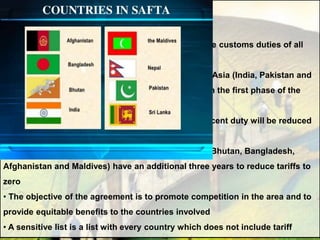
• SAFTA requires the developing countries in South Asia (India, Pakistan and
Sri Lanka) to bring their duties down to 20 percent in the first phase of the
two-year period ending in 2007
• In the final five-year phase ending 2012, the 20 percent duty will be reduced
to zero in a series of annual cuts
• The least developed nations in South Asia (Nepal, Bhutan, Bangladesh,
Afghanistan and Maldives) have an additional three years to reduce tariffs to
zero
• The objective of the agreement is to promote competition in the area and to
provide equitable benefits to the countries involved
• A sensitive list is a list with every country which does not include tariff
Association of Southeast Asian Nations:
• Is a political and economic organisation of ten Southeast
Asian countries
• Aims include accelerating economic growth, social progress,
and sociocultural evolution among its members, protection of regional
peace and stability, and opportunities for member countries to resolve
differences peacefully
• The members of ASEAN met in the Indonesian capital of Jakarta to
launch a charter, signed in November 2007, with the aim of moving closer
to “an EU-style community”
• Free trade initiatives in ASEAN are spearheaded by the implementation
of the ASEAN Trade in Goods Agreement (ATIGA) and Agreement on
Customs
• ASEAN-India bilateral trade crossed the US$70 billion target in 2012
Comprehensive EconomicPartnershipAgreement:
• free trade agreement between India and South Korea
• signed on August 7, 2009
• As per the agreement South Korean will cut tariffs on 93% on
goods from India
• India will cut 75% of total tariffs
• The agreement will ease restrictions on foreign direct
investments
Broad-based Trade and Investment Agreement (BTIA):
• India–European Union bilateral agreement
• 13th and final round was held from 25-29 November 2013 in
New Delhi
MERCOSURPreferential Trade Agreement (PTA):
• MERCOSUR is a trading bloc in South America region
comprising of Argentina, Brazil, Paraguay and Uruguay
• A Framework Agreement was signed between India and
MERCOSUR on 17th June 2003
• Grants reciprocal tariff preferences in the first stage and, in the
second stage, a free trade area between the two parties
Other Bilateral Agreementsof India: (Some in negotiation stages)
• India-Israel Free Trade Agreement (FTA) Negotiations
• India-Indonesia Comprehensive Economic Cooperation Agreement
(CECA)
• India-Australia Comprehensive Economic Cooperation Agreement
(CECA)
• India-Canada Comprehensive Economic Partnership Agreement (CEPA)
• India -New Zealand Free Trade Agreement / Comprehensive Economic
Cooperation Agreement
• Asia Pacific Trade Agreement (APTA)
• Global System of Trade Preferences (GSTP)
• India EFTA Broad based Trade and Investment Agreement (BTIA)
Negotiations
• India-Pakistan Trading Arrangement
• India-Gulf Cooperation Council (GCC) Free Trade Agreement (FTA)
negotiations
• India-SACU Preferential Trade Agreement (PTA) negotiations
• India-Singapore Comprehensive Economic Cooperation Agreement
(CECA)
• Bay of Bengal Initiative for Multi-Sectoral Technical and Economic
Cooperation (BIMSTEC) Free Trade Agreement (FTA) negotiations
• India-Thailand Comprehensive Economic Cooperation Agreement
Conventions & agreements  tanvi

Conventions & agreements tanvi

  • 1.
  • 2.
    Convention: • Gathering ofindividuals • Meet at an arranged place and time • Discuss or engage in some common interest • Based upon industry, profession, and fandom Treaty: • Agreement under international law • Entered into by sovereign states and international organizations • May also be known as an agreement, protocol, covenant, convention, pact, or exchange of letters Treatiescan be looselycompared to contracts: • Both are means of willing parties • Assume obligations among themselves • A party that fails to live up to their obligations can be held liable under international law.
  • 3.
    List of intl.conventions related to “Biotechnology”: (1900 onwards) 1900-1999: •Strasbourg Convention •WIPO Convention •Patent Cooperation Treaty (PCT) •IPC Agreement • European Patent Convention (EPC) •CITES • International Seed Treaty •Convention on the Conservation of Migratory Species of Wild Animals •Ramsar Convention •International Plant Protection Convention •Montreal Protocol on Substances that Deplete the Ozone Layer •United Nations Framework Convention on Climate Change •Law of the Sea Convention •Convention on Biological Diversity (CBD) •United Nations Convention to Combat Desertification •World Intellectual Property Organization Copyright Treaty
  • 4.
    2000-Present: •The Kyoto Protocol •PatentLaw Treaty (PLT) •Energy Community of South East Europe (ECSEE) Upcoming: • Anti-Counterfeiting Trade Agreement (ACTA) •Substantive Patent Law Treaty (SPLT)
  • 5.
    StrasbourgConvention: •Also known as“Convention on the Unification of Certain Points of Substantive Law on Patents for Invention” • Multilateral treaty signed by Member States of the Council of Europe in 1963 • Entered into force on August 1, 1980 • Establishes patentability criteria • Led to a significant harmonization of patent laws across European countries StrasbourgAgreement Concerning the International Patent Classification: • Also known as the IPC Agreement • Signed in Strasbourg, France • Entered into force on October 7, 1975 • Establishes a common classification for patents for invention, inventors’ certificates, utility models and utility certificates, known as the “International Patent Classification” (IPC) • There are 62 contracting parties to the Strasbourg Agreement Main groups: A: Human Necessities B: Performing Operations, Transporting C: Chemistry, Metallurgy D: Textiles, Paper E: Fixed Constructions F: Mechanical Engineering, Lighting, Heating, Weapons G: Physics H: Electricity First the assigner indicates the main group. Then a two digit number indicates a class symbol. The final letter gives the subclass. For E.g.: A01B “A”- Human necessities “01” indicates “Agriculture; forestry; animal husbandry; trapping; fishing” “B” represents "Soil working in agriculture or forestry; parts, details, or accessories of agricultural machines or implements, in general"
  • 6.
    Convention on InternationalTrade in Endangered Species of WildFaunaand Flora: • Also known as Washington Convention/ CITES • Multilateral treaty to protect endangered plants and animals • Entered into force on 1 July 1975 • 35,000 protected species or population • Included in one of three lists, called Appendices • The Appendix that lists a species or population reflects the extent of the threat to it and the controls that apply to the trade •Appendix I (1200 species) - threatened with extinction and are or may be affected by trade. Commercial trade in wild-caught specimens of these species is illegal •Appendix II (21,000 species)- not necessarily threatened with extinction, but may become so unless trade in specimens of such species is subject to strict regulation •Appendix III (170 species)- not necessarily threatened with extinction globally; only restricted across some regions
  • 7.
    International Plant ProtectionConvention: •Also known as IPCC • 1951 multilateral treaty overseen by the Food and Agriculture Organization • Prevent and to control the introduction and spread of pests of plants and plant products • Convention has 181 parties • It also takes into consideration both direct and indirect damage by pests, so it includes weeds • The Convention also covers research materials, biological control organisms, germplasm banks, containment facilities, food aid, emergency aid and anything else that can act as a vector for the spread of plant pests • Protecting sustainable agriculture and enhancing global food security through the prevention of pest spread
  • 8.
    EnergyCommunityof SouthEast Europe(ECSEE): • Also referred to as the “The Energy Community” • international organisation established between the European Union (EU) and a number of third countries • the Contracting Parties commit themselves to implement the relevant EU energy acquis communautaire • The Energy Community aims at establishing a Pan-European energy market by extending the energy acquis of the European Union to the territories of third countries • It now also includes legislation in relation to security of supply, energy efficiency, oil, renewable energy and statistics Anti-CounterfeitingTrade Agreement (ACTA): • Multinational treaty for the purpose of establishing international standards for intellectual property rights enforcement • Aims to establish an international legal framework for targeting counterfeit goods, generic medicines and copyright infringement on the Internet • Organisations representing citizens and non-governmental interests argued that ACTA could infringe fundamental rights including freedom of expression and privacy • ACTA has also been criticised by Doctors Without Borders for
  • 9.
    Ramsar Convention: • Alsoknown as Convention on Wetlands of International Importance • An international treaty for the conservation and sustainable utilization of wetlands • Recognizes the fundamental ecological functions of wetlands and their economic, cultural, scientific, and recreational value • “Areas of marine water the depth of which at low tide does not exceed six meters” • Named after the city of Ramsar in Iran, where the Convention was signed in 1971 • The headquarters is located in Gland, Switzerland • The Ramsar List of Wetlands of International Importance now includes
  • 10.
    Convention on BiologicalDiversity (CBD): • Known informally as the Biodiversity Convention • Multilateral treaty • Entered into force on 29 December 1993 • 2010 was the International Year of Biodiversity • Its objective is to develop national strategies for the conservation and sustainable use of biological diversity • The Cartagena Protocol on Biosafety of the Convention, also known as the Biosafety Protocol, was adopted in January 2000 • The Biosafety Protocol seeks to protect biological diversity from the potential risks posed by living modified organisms resulting from modern biotechnology
  • 11.
    Convention on theConservation of Migratory Species of WildAnimals: • Convention on Migratory Species (CMS) or the Bonn Convention • conserve terrestrial, marine and avian migratory species throughout their range • It is an intergovernmental treaty, concluded under the aegis of the United Nations Environment Programme • CMS and its daughter agreements determine policy and provide further guidance on specific issues through their Strategic Plans, Action Plans, resolutions, decisions and guidelines. • Migratory species threatened with extinction are listed on Appendix I • Migratory species that need or would significantly benefit from international co-operation are listed in Appendix II of the Convention
  • 12.
    International SeedTreaty: • TheInternational Treaty on Plant Genetic Resources for Food and Agriculture (IT PGRFA) • aims at guaranteeing food security through the conservation, exchange and sustainable use of the world's plant genetic resources for food and agriculture • the protection of traditional knowledge relevant to plant genetic resources for food and agriculture • The treaty was under negotiation for 7 years • entry into force was on 29 June 2004 • The Treaty establishes the Multilateral System of Access and Benefit- sharing to facilitate plant germplasm exchanges and benefit sharing through Standard Material Transfer Agreement (SMTA)
  • 13.
    Biological andToxinWeapons Convention: •Convention on the Prohibition of the Development, Production and Stockpiling of Bacteriological (Biological) and Toxin Weapons and on their Destruction • Replaces 1925 Geneva Protocol • This includes all microbial and other biological agents or toxins and their means of delivery • The BWC has 173 States Parties as of January 2015 • However, the absence of any formal verification regime to monitor compliance has limited the effectiveness of the Convention Montreal Protocol on Substancesthat Depletethe Ozone Layer: • An international treaty designed to protect the ozone layer by phasing out the production of numerous substances that are responsible for ozone depletion • As a result of the international agreement, the ozone hole in Antarctica is slowly recovering. • The treaty is structured around several groups of halogenated hydrocarbons that have been shown to play a role in ozone depletion • Phased-out 98% of the Ozone-Depleting Substances (ODS)
  • 14.
    UnitedNationsFrameworkConvention on ClimateChange: •An international environmental treaty • The objective of the treaty is to "stabilize greenhouse gas concentrations in the atmosphere at a level that would prevent dangerous anthropogenic interference with the climate system“ • The parties to the convention have met annually from 1995 in Conferences of the Parties (COP) to assess progress in dealing with climate change • UNFCC has 196 parties Lawof the SeaConvention: • The United Nations Convention on the Law of the Sea (UNCLOS) • defines the rights and responsibilities of nations with respect to their use of the world's oceans • establishing guidelines for businesses, the environment, and the management of marine natural resources • 166 countries and the European Union have joined in the Convention • UNCLOS came into force in 1994
  • 15.
    UnitedNationsConvention to CombatDesertification: • United Nations Convention to Combat Desertification in Those Countries Experiencing Serious Drought and/or Desertification, Particularly in Africa (UNCCD) • Combat desertification and mitigate the effects of drought • Incorporate long-term strategies supported by international cooperation and partnership arrangements • Was adopted in Paris, France on 17 June 1994 and entered into force in December 1996 • To help publicise the Convention, 2006 was declared "International Year of Deserts and Desertification“ • The permanent Secretariat of the UNCCD was established during the first Conference of the parties (COP 1) held in Rome in 1997 • The UN Convention to Combat Desertification has established a Committee on Science and Technology (CST) • Under the authority of the CST, a Group of Experts was established by the COP to assist in improving the efficiency and effectiveness of the CST • National Action Programmes (NAP) are one of the key instruments in the implementation of the Convention • They are strengthened by Action Programmes on Sub-regional (SRAP) and Regional (RAP) level
  • 16.
    The KyotoProtocol: • extendsthe 1992 United Nations Framework Convention on Climate Change (UNFCCC) • Was adopted in Kyoto, Japan, on 11 December 1997 and entered into force on 16 February 2005 • Currently there are 192 Parties • It puts the obligation to reduce current emissions on developed countries on the basis that they are historically responsible for the current levels of greenhouse gases in the atmosphere • The ultimate objective of the UNFCCC is the "stabilization of greenhouse gas concentrations in the atmosphere at a level that would stop dangerous anthropogenic interference with the climate system.“ • A number of emissions trading schemes (ETS) have been, or are planned to be, implemented
  • 17.
    WIPOConvention: • World IntellectualProperty Organization (WIPO) • WIPO was created in 1967 "to encourage creative activity, to promote the protection of intellectual property throughout the world • WIPO currently has 188 member states • is headquartered in Geneva, Switzerland • promotion of the protection of intellectual property involves the more complex task of promoting technology transfer and economic development
  • 18.
    Patent Cooperation Treaty(PCT): •International patent law treaty, concluded in 1970 • Provides a unified procedure for filing patent applications to protect inventions in each of its contracting states • A patent application filed under the PCT is called an international application, or PCT application • A PCT application, which establishes a filing date in all contracting states, must be followed up with the step of entering into national or regional phases to proceed towards grant of one or more patents • The states which are parties to the PCT, constitute the International Patent Cooperation Union • A majority of the world's countries are parties to the PCT, including all of the major industrialised countries (with a few exceptions, including Argentina, and Taiwan). • As of 12 July 2013, there were 148 contracting states to the PCT • The millionth PCT application was filed at the end of 2004,whereas the two millionth application was filed in 2011 • A search or international search is made by an authorised International Searching Authority (ISA) to find the most relevant prior art documents regarding the claimed subject matter
  • 19.
    European Patent Convention(EPC): •Convention on the Grant of European Patents of 5 October 1973 • Multilateral treaty instituting the European Patent Organisation • Provides an autonomous legal system according to which European patents are granted • The EPC is separate from the European Union (EU), and its membership is different • The EPC requires all jurisdictions to give a European patent a term of 20 years from the filing date • Different languages are indeed utilised across the European countries and there is substantial expense in preparing translations into each of those languages • A single patent application, in one language, may be filed at the European Patent Office at Munich, at its branches at The Hague or Berlin
  • 20.
    World Intellectual PropertyOrganizationCopyright Treaty: • WIPO Copyright Treaty or WCT • An international treaty on copyright law adopted by the member states of the World Intellectual Property Organization (WIPO) in 1996 • Additional protections for copyright deemed necessary due to advances in information technology since the formation of previous copyright treaties before it • It ensures that computer programs are protected as literary works, and that the arrangement and selection of material in databases is protected • Provides authors of works with control over their rental and distribution • The WIPO Copyright Treaty is implemented in United States law by the Digital Millennium Copyright Act (DMCA) • Also prohibits circumvention of technological measures for the protection of works and unauthorized modification of rights management
  • 21.
    Patent LawTreaty(PLT): • Multilateraltreaty concluded on 1 June 2000 • In Geneva, Switzerland • 53 States and the European Patent Organisation • Its aim is to harmonize formal procedures such as the requirements to obtain a filing date for a patent application, the form and content of a patent application, and representation Substantive Patent LawTreaty(SPLT): • Proposed international patent law treaty aimed at harmonizing substantive points of patent law • SPLT aims at going far beyond formalities to harmonize substantive requirements such as novelty, inventive step and non-obviousness, industrial applicability and utility, as well as sufficient disclosure, unity of invention,
  • 22.
    Agreements: A negotiated andusually legally enforceable understanding between two or more legally competent parties A trade agreement (also known as trade pact) is a wide ranging tax, tariff and trade treaty that often includes investment guarantees A free-trade area is the region encompassing a trade bloc whose member countries have signed a free trade agreement (FTA). Such agreements involve cooperation between at least two countries to reduce trade barriers—import quotas and tariffs— and to increase trade of goods and services with each other
  • 23.
    TRIPSAgreement: • Agreement onTrade-Related Aspects of Intellectual Property Rights (TRIPS) • International agreement administered by the World Trade Organization (WTO) • It sets down minimum standards for many forms of intellectual property (IP) regulation as applied to nationals of other WTO Members • It was negotiated at the end of the Uruguay Round of the General Agreement on Tariffs and Trade (GATT) in 1994. • The TRIPS agreement introduced intellectual property law into the international trading system for the first time and remains the most comprehensive international agreement on intellectual property to date • TRIPS requires WTO members to provide copyright rights, covering content producers including performers, producers of sound recordings and broadcasting organizations; geographical indications, including appellations of origin; industrial designs; integrated circuit layout-designs; patents; new plant varieties; trademarks; trade dress; and undisclosed or confidential information • TRIPS also specifies enforcement procedures, remedies, and dispute
  • 24.
    Agreement on theApplication of Sanitaryand PhytosanitaryMeasures: • Also known as the SPS Agreement • An international treaty of the World Trade Organization • Entered into force with the establishment of the WTO at the beginning of 1995 • Agreement are those aimed at the protection of human, animal or plant life or health from certain risks • Sets constraints on member-states' policies relating to food safety (bacterial contaminants, pesticides, inspection and labelling) as well as animal and plant health (phytosanitation) with respect to imported pests and diseases • A prominent SPS case is the hormone-treated beef case
  • 25.
    Agreement on Agriculture: • An international treaty of the World Trade Organization • Entered into force with the establishment of the WTO on January 1, 1995 • The Agreement on Agriculture has three pillars—domestic support, market access, and export subsidies • The first pillar of the Agreement on Agriculture is "domestic support“. Includes the classification of subsidies into "boxes" depending on their effects on production and trade: amber (most directly linked to production levels), blue (production-limiting programmes that still distort trade), and green (minimal distortion) • Market access refers to the reduction of tariff (or non-tariff) barriers to trade by WTO members. Least developed countries (LDCs) were exempt from tariff reductions • Export subsidies are the third pillar. The 1995 Agreement on Agriculture required developed countries to reduce export subsidies by at least 36% (by
  • 26.
    SouthAsian Free TradeArea(SAFTA): • Agreement reached on 6 January 2004 • Signed a framework agreement on SAFTA to reduce customs duties of all traded goods to zero by the year 2016 • SAFTA requires the developing countries in South Asia (India, Pakistan and Sri Lanka) to bring their duties down to 20 percent in the first phase of the two-year period ending in 2007 • In the final five-year phase ending 2012, the 20 percent duty will be reduced to zero in a series of annual cuts • The least developed nations in South Asia (Nepal, Bhutan, Bangladesh, Afghanistan and Maldives) have an additional three years to reduce tariffs to zero • The objective of the agreement is to promote competition in the area and to provide equitable benefits to the countries involved • A sensitive list is a list with every country which does not include tariff
  • 27.
    Association of SoutheastAsian Nations: • Is a political and economic organisation of ten Southeast Asian countries • Aims include accelerating economic growth, social progress, and sociocultural evolution among its members, protection of regional peace and stability, and opportunities for member countries to resolve differences peacefully • The members of ASEAN met in the Indonesian capital of Jakarta to launch a charter, signed in November 2007, with the aim of moving closer to “an EU-style community” • Free trade initiatives in ASEAN are spearheaded by the implementation of the ASEAN Trade in Goods Agreement (ATIGA) and Agreement on Customs • ASEAN-India bilateral trade crossed the US$70 billion target in 2012
  • 28.
    Comprehensive EconomicPartnershipAgreement: • freetrade agreement between India and South Korea • signed on August 7, 2009 • As per the agreement South Korean will cut tariffs on 93% on goods from India • India will cut 75% of total tariffs • The agreement will ease restrictions on foreign direct investments Broad-based Trade and Investment Agreement (BTIA): • India–European Union bilateral agreement • 13th and final round was held from 25-29 November 2013 in New Delhi
  • 29.
    MERCOSURPreferential Trade Agreement(PTA): • MERCOSUR is a trading bloc in South America region comprising of Argentina, Brazil, Paraguay and Uruguay • A Framework Agreement was signed between India and MERCOSUR on 17th June 2003 • Grants reciprocal tariff preferences in the first stage and, in the second stage, a free trade area between the two parties
  • 30.
    Other Bilateral AgreementsofIndia: (Some in negotiation stages) • India-Israel Free Trade Agreement (FTA) Negotiations • India-Indonesia Comprehensive Economic Cooperation Agreement (CECA) • India-Australia Comprehensive Economic Cooperation Agreement (CECA) • India-Canada Comprehensive Economic Partnership Agreement (CEPA) • India -New Zealand Free Trade Agreement / Comprehensive Economic Cooperation Agreement • Asia Pacific Trade Agreement (APTA) • Global System of Trade Preferences (GSTP) • India EFTA Broad based Trade and Investment Agreement (BTIA) Negotiations • India-Pakistan Trading Arrangement • India-Gulf Cooperation Council (GCC) Free Trade Agreement (FTA) negotiations • India-SACU Preferential Trade Agreement (PTA) negotiations • India-Singapore Comprehensive Economic Cooperation Agreement (CECA) • Bay of Bengal Initiative for Multi-Sectoral Technical and Economic Cooperation (BIMSTEC) Free Trade Agreement (FTA) negotiations • India-Thailand Comprehensive Economic Cooperation Agreement

Editor's Notes

  • #2 Talk about conventions and agreements first and what they encompass. Going to explore several treaties and agreements from the past century as well as the present one. Tried to focus mainly on the ones about biotechnology. But regarding agreements, expanded horizons a bit and included trade agreements as well. Cuz trade agreements can include free trade of medicines and medicinal equipment, and any other industrial produce. I am going to start with a few conventions and nikitha is going to procede furthur. Pintu will finish up with agreements.
  • #6 specifies on which grounds inventions can be rejected as not patentable. Substantive law is the statutory, or written law, that defines rights and duties, such as crimes and punishments (in the criminal law), civil rights and responsibilities in civil law. It is codified in legislated statutes or can be enacted through the initiative process. Procedural law governs the mechanics of how a legal case flows, including steps to process a case. he International Patent Classification (IPC) is a hierarchical patent classification system used in over 100 countries to classify the content of patents in a uniform manner. Patent publications from all of the Contracting States (and also most others) are each assigned at least one classification term indicating the subject to which the invention relates and may also be assigned further classification and indexing terms to give further details of the contents. This is followed by a two digit number to give a "class symbol" (A01 represents "Agriculture; forestry; animal husbandry; trapping; fishing"). The final letter makes up the "subclass" (A01B represents "Soil working in agriculture or forestry; parts, details, or accessories of agricultural machines or implements, in general"). The subclass is then followed by a one-to-three-digit "group" number, an oblique stroke and a number of at least two digits representing a "main group" or "subgroup". A patent examiner assigns a classification to the patent application or other document at the most detailed level which is applicable to its contents. A: Human NecessitiesB: Performing Operations, TransportingC: Chemistry, MetallurgyD: Textiles, PaperE: Fixed ConstructionsF: Mechanical Engineering, Lighting, Heating, WeaponsG: PhysicsH: Electricity
  • #7 Appendix I include the red panda (Ailurus fulgens), western gorilla (Gorilla gorilla), the chimpanzee species (Pan spp.),tigers (Panthera tigris subspecies), Asiatic lion (Panthera leo persica) Examples of species listed on Appendix II are the great white shark(Carcharodon carcharias), the American black bear (Ursus americanus),Hartmann's mountain zebra (Equus hartmannae), African grey parrot(Psittacus erithacus), green iguana (Iguana iguana) Examples of species listed on Appendix III and the countries that listed them are the two-toed sloth (Choloepus hoffmanni) by Costa Rica, African civet(Civettictis civetta) by Botswana, and the alligator snapping turtle (Macrochelys temminckii) by the USA. , are species that are listed after one member country has asked other CITES Parties for assistance in controlling trade in a species
  • #9 The Community acquis[1] or acquis communautaire (/ˈækiː kəˈmjuːnətɛər/; French: [aˌki kɔmynoˈtɛːʁ]),[2] sometimes called the EU acquis and often shortened to acquis,[2] is the accumulated legislation, legal acts, and court decisions which constitute the body of European Union law. The term is French: acquis meaning "that which has been acquired or obtained", and communautaire meaning "of the community".
  • #10 There is a standing committee, a scientific review panel, and a secretariat. The headquarters is located in Gland, Switzerland, shared with the IUCN. The Ramsar Convention works closely with five other organisations known as International Organization Partners (IOPs). These are Birdlife International, the International Union for Conservation of Nature (IUCN), the International Water Management Institute (IWMI), Wetlands International and WWF International.
  • #11 On 22 December 2010, the UN declared the period from 2011 to 2020 as the UN Decade on Biodiversity
  • #14 The Geneva Protocol prohibits use but not possession or development of chemical and biological weapons  Due to its widespread adoption and implementation it has been hailed as an example of exceptional international co-operation, with Kofi Annan quoted as saying that "perhaps the single most successful international agreement to date has been the Montreal Protocol however, the job is not yet done and the current moment could not be more pivotal for accomplishing its vital mission Since the beginning of the 1980s, an ozone hole has developed over Antarctica during the southern spring – September to November – resulting in a decrease in ozone concentration of up to 70%.
  • #15 currently the only international climate policy venue with broad legitimacy, due in part to its virtually universal membership
  • #25 In 1996, the USA and Canada challenged before the WTO Dispute Settlement Body (DSB) a number of EUdirectives prohibiting the importation and sale of meat and meat products treated with certain growth hormones. The complainants alleged that the EU directives violated, among other things, several provisions of the SPS Agreement. The EU contended that the presence of the banned hormones in food may present a risk to consumers' health and that, as a consequence, the directives were justified under several WTO provisions authorizing the adoption of trade-restrictive measures that are necessary to protect human health. In 1997 and 1998, the WTO adjudicating bodies admitted USA and Canada claims and invited the EU to bring the directives into conformity with WTO law before end of May 1999. EU did not comply and the DSB authorized the USA and Canada to take countermeasures against the EU. The countermeasures took the form of increased custom duties applied by the USA and Canada on certain EU products, including the notorious Roquefort cheese. In 2004, while the ban on hormone-treated meat was still in place, the EU initiated before the DSB new proceedings seeking the lifting of the countermeasures applied by the USA and Canada. EU alleged that it had collected new scientific data evidencing that the banned hormones may cause harm to consumers. According to the EU, the new scientific data provides sufficient ground for the ban on hormones, which may no more be sanctioned by the countermeasures imposed by the USA and Canada. As of January 2007, the proceedings initiated by the EU were still pending.
  • #26 During the Doha negotiations, developing countries have fought to protect their interest and population, afraid of competing on the global market with strong developed and exporting economies. Many have large rural populations composed of resource-poor farmers with limited access to infrastructure and few employment alternatives. Thus, these countries are concerned that domestic rural populations employed in import-competing sectors might be negatively affected by further trade liberalization, becoming increasingly vulnerable to market instability and import surges as tariff barriers are removed. Several mechanisms have been suggested in order to preserve those countries: the Special Safeguard Mechanism (SSM) and treatment of Special Products (SPs).