%< $5& $'9,625< *5283                                                              0$5&+ 


               *OREDO /RJLVWLFV 6WUDWHJLHV

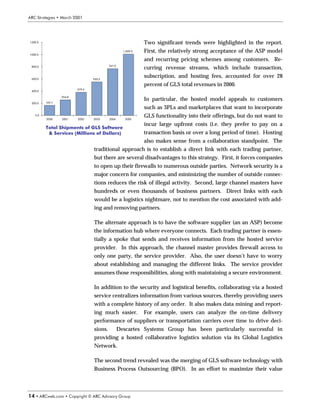
:KDW ,V *OREDO /RJLVWLFV 

*OREDO *RRGV 'RFXPHQWV ,QIR                 0RQH  

UHDWLQJ 9DOXH $FURVV (QWHUSULVH 

5HFHQW $5 5HVHDUFK )LQGLQJV  

*OREDO /RJLVWLFV 6ROXWLRQV  

6WUDWHJLHV IRU 6XFFHVV 


(%XVLQHVV           0DQXIDFWXULQJ 6WUDWHJLHV IRU ,QGXVWU ([HFXWLYHV
6S8ÃT‡…h‡rtvr†Ã‡ÃHh…puÃ! Ã


                                               )UHLJKW
                       6XSSOLHU                                XVWRPV            DUULHUV         %DQNV
                                             )RUZDUGHUV
                                                              RXQWU $


                           ,QIRUPDWLRQ              'RFXPHQWV             *RRGV               0RQH


                                               )UHLJKW
                       XVWRPHU                                XVWRPV            DUULHUV         %DQNV
                                             )RUZDUGHUV
                                                              RXQWU %


                                            *OREDO /RJLVWLFV
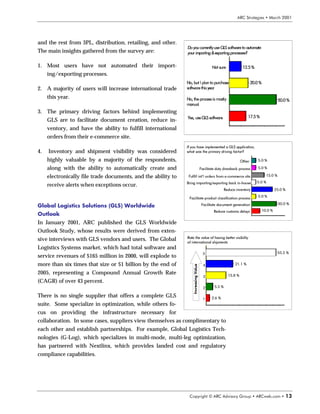
                          )ORZ RI ,QIRUPDWLRQ 'RFXPHQWV *RRGV DQG 0RQH


                               7ULOOLRQ
:RUOG 0HUFKDQGLVH ,PSRUWV                       ([SRUWV IURP :72
ÇÃ6S8rip‚€Ã‡Ã8‚ƒ’…vtu‡Ã‹Ã6S8Ã6q‰v†‚…’ÃB…‚ˆƒ
à                                                                                      6S8ÃT‡…h‡rtvr†Ã‡ÃHh…puÃ! Ã


:KDW ,V *OREDO /RJLVWLFV

Globalization has been a trend for some time, but it only gained momentum
over the past two decades thanks to advancing technology, improving politi-
cal/economic environments, and the elimination of trade barriers.

These forces led to the creation of the virtual corporation, where a company
delegates a majority of its business functions, such as manufacturing and dis-
tribution, to partners are usually located in different parts of the world. For
example, semiconductor wafer fabrication is usually done
in the US, assembly is in Asia or Mexico, and final test                   7KH UDSLG ULVH LQ JOREDO WUDGH LV
                                                                   FUHDWLQJ D KHLJKWHQ QHHG IRU VROXWLRQV
and distribution is done somewhere else. The virtual cor-
                                                                    WKDW SURYLGH ERWK DJLOLW DQG YLVLELOLW
poration essentially coordinates the activities of its
                                                                   IRU LQWHUQDWLRQDO ORJLVWLFV WUDQVDFWLRQV
partners to meet customer commitments, minimize costs,
and maximize profits.

Mergers and acquisitions are increasing as companies seek to gain market
share, expand their product footprint, and enter new markets. Often, the ac-
quired company is located in a different geographic region. The new entity,
therefore, becomes a global company instantaneously. The same is true for
companies that establish relationships with distribution partners overseas.

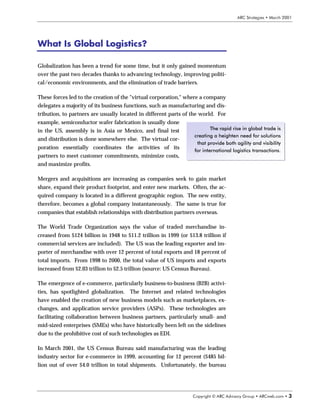
The World Trade Organization says the value of traded merchandise in-
creased from $124 billion in 1948 to $11.2 trillion in 1999 (or $13.8 trillion if
commercial services are included). The US was the leading exporter and im-
porter of merchandise with over 12 percent of total exports and 18 percent of
total imports. From 1998 to 2000, the total value of US imports and exports
increased from $2.03 trillion to $2.5 trillion (source: US Census Bureau).

The emergence of e-commerce, particularly business-to-business (B2B) activi-
ties, has spotlighted globalization. The Internet and related technologies
have enabled the creation of new business models such as marketplaces, ex-
changes, and application service providers (ASPs). These technologies are
facilitating collaboration between business partners, particularly small- and
mid-sized enterprises (SMEs) who have historically been left on the sidelines
due to the prohibitive cost of such technologies as EDI.

In March 2001, the US Census Bureau said manufacturing was the leading
industry sector for e-commerce in 1999, accounting for 12 percent ($485 bil-
lion out of over $4.0 trillion in total shipments. Unfortunately, the bureau


                                                                  8‚ƒ’…vtu‡Ã‹Ã6S8Ã6q‰v†‚…’ÃB…‚ˆƒÃ‡Ã6S8rip‚€Ã‡Ã
6S8ÃT‡…h‡rtvr†Ã‡ÃHh…puÃ! Ã


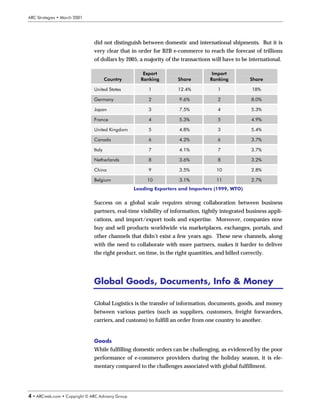
                               did not distinguish between domestic and international shipments. But it is
                               very clear that in order for B2B e-commerce to reach the forecast of trillions
                               of dollars by 2005, a majority of the transactions will have to be international.

                                                     ([SRUW                       ,PSRUW
                                       RXQWU      5DQNLQJ        6KDUH         5DQNLQJ           6KDUH

                               8QLWHG 6WDWHV                                                  

                               *HUPDQ                                                        

                               -DSDQ                                                          

                               )UDQFH                                                         

                               8QLWHG .LQJGRP                                                 

                               DQDGD                                                         

                               ,WDO                                                          

                               1HWKHUODQGV                                                    

                               KLQD                                                         

                               %HOJLXP                                                      
                                                  /HDGLQJ ([SRUWHUV DQG ,PSRUWHUV  :72
Success on a global scale requires strong collaboration between business
                               partners, real-time visibility of information, tightly integrated business appli-
                               cations, and import/export tools and expertise. Moreover, companies now
                               buy and sell products worldwide via marketplaces, exchanges, portals, and
                               other channels that didn’t exist a few years ago. These new channels, along
                               with the need to collaborate with more partners, makes it harder to deliver
                               the right product, on time, in the right quantities, and billed correctly.


                               *OREDO *RRGV 'RFXPHQWV ,QIR                                    0RQH

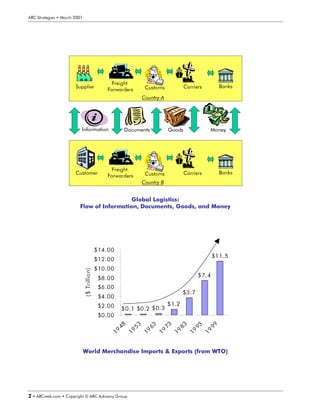
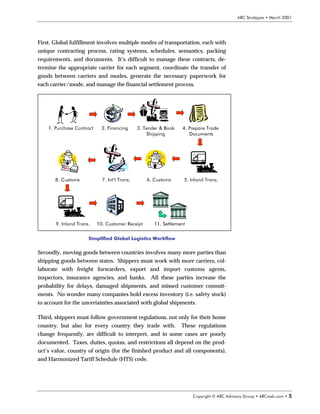
                               Global Logistics is the transfer of information, documents, goods, and money
                               between various parties (such as suppliers, customers, freight forwarders,
                               carriers, and customs) to fulfill an order from one country to another.


                               *RRGV
                               While fulfilling domestic orders can be challenging, as evidenced by the poor
                               performance of e-commerce providers during the holiday season, it is ele-
                               mentary compared to the challenges associated with global fulfillment.


ÇÃ6S8rip‚€Ã‡Ã8‚ƒ’…vtu‡Ã‹Ã6S8Ã6q‰v†‚…’ÃB…‚ˆƒ
à                                                                                          6S8ÃT‡…h‡rtvr†Ã‡ÃHh…puÃ! Ã


First, Global fulfillment involves multiple modes of transportation, each with
unique contracting process, rating systems, schedules, semantics, packing
requirements, and documents. It’s difficult to manage these contracts, de-
termine the appropriate carrier for each segment, coordinate the transfer of
goods between carriers and modes, generate the necessary paperwork for
each carrier/mode, and manage the financial settlement process.


     3XUFKDVH RQWUDFW      )LQDQFLQJ       7HQGHU %RRN     3UHSDUH 7UDGH
                                                   6KLSSLQJ         'RFXPHQWV


        XVWRPV             ,QW·O 7UDQV       XVWRPV       ,QODQG 7UDQV


        ,QODQG 7UDQV     XVWRPHU 5HFHLSW       6HWWOHPHQW


                      6LPSOLILHG *OREDO /RJLVWLFV :RUNIORZ


Secondly, moving goods between countries involves many more parties than
shipping goods between states. Shippers must work with more carriers, col-
laborate with freight forwarders, export and import customs agents,
inspectors, insurance agencies, and banks. All these parties increase the
probability for delays, damaged shipments, and missed customer commit-
ments. No wonder many companies hold excess inventory (i.e. safety stock)
to account for the uncertainties associated with global shipments.

Third, shippers must follow government regulations, not only for their home
country, but also for every country they trade with.             These regulations
change frequently, are difficult to interpret, and in some cases are poorly
documented. Taxes, duties, quotas, and restrictions all depend on the prod-
uct’s value, country of origin (for the finished product and all components),
and Harmonized Tariff Schedule (HTS) code.


                                                                      8‚ƒ’…vtu‡Ã‹Ã6S8Ã6q‰v†‚…’ÃB…‚ˆƒÃ‡Ã6S8rip‚€Ã‡Ã
6S8ÃT‡…h‡rtvr†Ã‡ÃHh…puÃ! Ã


                                     It is against US trade laws to ship certain goods, such as chemicals and high-
                                     tech electronics, to specific countries or entities, such as known terrorist or-
                                     ganizations. Other countries have their own set of restrictions. For example,
                                     some Middle East countries do not allow any products to be imported that
                                     contain components manufactured or assembled in Israel.

                                                                In July 2000, the exporter and importer of record rules
                                                                were issued. They dictate that the exporter of record
          !'È
                                                     Xh‡r…      is responsible for ensuring that all outbound ship-
                                                     P‡ur…      ments comply with US export regulations. In other
                                        # È          U…ˆpx
                                                                words, even though the shipment may be managed
                                                     Qvƒryvr
                                                     Shvy       by a freight forwarder, it is the exporter that is ulti-
       $È                                            6v…        mately liable.   Similarly, the importer of record is
         È
                                                                ultimately responsible for complying with import
                ! È             #È                              laws.
       Tuh…rÂsÃD ‡ yÃU…hqrÃi’ÃH ‚qrÃi’ÃWhyˆ rÃ

                   VTÃ9PUÃ   ((

                                                                Since non-compliance can mean loss of export li-
                                     censes, stiff penalties (up to 50 percent of invoice value), or jail, many com-
                                     panies are looking to bring GLS capability in-house, particularly the ability to
                                     perform restricted party screenings and the ability to generate/file all appro-
                                     priate trade documents.

                                     According to the US Department of Transportation, ocean shipments ac-
                                     counted for 41 percent of international shipments in 1997 based on value
                                     (almost 63 percent based on tonnage), the largest share among all modes.
                                     Over the past 15 years, ocean trade has almost doubled to 1.13 billion metric
                                     tons, and it is expected to double again over the next twenty years.

                                     While air cargo accounts for less than 1 percent of international tonnage, it is
                                     28 percent of these shipments’ value, due to the fact that nearly 20 percent of
                                     air shipments are electronics and computers. In addition, international ton-
                                     miles have increased fivefold over the past twenty years. Air transportation
                                     will undoubtedly play a more important role in the near future as companies
                                     adopt make-to-order models and inventory reduction policies.


                                     'RFXPHQWV
                                     Global Logistics also involves the transfer of documents between different
                                     parties. The amount of paperwork required to ship goods across borders is
                                     simply astounding (see table below). Many of these documents are produced
                                     in multiple copies, and if there are changes to the original itinerary or details,
                                     they have to be regenerated. Considering that freight forwarders can charge


ÇÃ6S8rip‚€Ã‡Ã8‚ƒ’…vtu‡Ã‹Ã6S8Ã6q‰v†‚…’ÃB…‚ˆƒ
à                                                                                                     6S8ÃT‡…h‡rtvr†Ã‡ÃHh…puÃ! Ã


as much as $75 per trade document, many companies are looking to bring the
document-creation process in-house.

,PSRUW                   'HVFULSWLRQ

(QWU 0DQLIHVW           DSWXUHV LQIRUPDWLRQ VXFK DV DUULYDO GDWH LPSRUWHU RI UHFRUG FDUULHU GHWDLOV DQG SURGXFW GHWDLOV

RPPHUFLDO ,QYRLFH       5HFHLSW IRU JRRGV SXUFKDVHG LQGLFDWLQJ WKH VHOOHU DQG WKH SXUFKDVHU ,W PXVW FRQWDLQ DQ LWHPL]HG
                         OLVW RI WKH PHUFKDQGLVH FRPSOHWH GHVFULSWLRQ RI JRRGV WKHLU XQLW YDOXH DQG H[WHQGHG WRWDO YDOXH

%LOO RI /DGLQJ RU        ,VVXHG E D FRPPRQ FDUULHU WR D VKLSSHU WKDW VHUYHV DV D UHFHLSW IRU WKH JRRGV GHOLYHUHG WR WKH
$LU :DELOO              FDUULHU IRU VKLSPHQW D GHILQLWLRQ RI WKH FRQWUDFW IRU WKH FDUULDJH RI WKH JRRGV DQG D 'RFXPHQW RI
                         7LWOH WR WKH JRRGV GHVFULEHG WKHUHLQ

(QWU 6XPPDU            8VHG E 86 XVWRPV WR FROOHFW GXWLHV DQG WD[HV UHFRUG VWDWLVWLFDO GDWD RQ LPSRUWV DQG SURYLGH D
                         FRQFLVH VXPPDU RI WKH LPSRUW WUDQVDFWLRQ E FODVVLILFDWLRQ DQG YDOXH

,PSRUW /LFHQVH           HUWLILFDWH LVVXHG E FRXQWULHV WKDW SHUPLWV LPSRUWDWLRQ RI WKH DUWLFOHV VWDWHG LQ WKH OLFHQVH

([SRUW                   'HVFULSWLRQ

6KLSSHU·V ([SRUW         $ IRUP FRPSOHWHG E D VKLSSHU WKDW VKRZV WKH YDOXH ZHLJKW DQG GHVWLQDWLRQ RI H[SRUW VKLSPHQWV
'HFODUDWLRQ              DV ZHOO DV 6FKHGXOH % FRPPRGLW FRGH

HUWLILFDWH RI 2ULJLQ    $ GRFXPHQW FRQWDLQLQJ DQ DIILGDYLW WR SURYH WKH RULJLQ RI LPSRUWHG JRRGV

([SRUW /LFHQVH           $ GRFXPHQW VHFXUHG IURP D JRYHUQPHQW DXWKRUL]LQJ D VKLSSHU WR H[SRUW D VSHFLILF TXDQWLW RI D
                         SDUWLFXODU FRPPRGLW WR D FHUWDLQ FRXQWU

,QVSHFWLRQ HUWLILFDWH   $ FHUWLILFDWH LVVXHG E DQ LQGHSHQGHQW DJHQW DWWHVWLQJ WR WKH TXDOLW DQGRU TXDQWLW RI WKH PHU
                         FKDQGLVH EHLQJ VKLSSHG

'HVWLQDWLRQ RQWURO      6WDWHPHQWV 86 JRYHUQPHQW UHTXLUHV WR EH GLVSODHG RQ H[SRUW VKLSPHQWV WKDW VSHFLI WKH DXWKRU
6WDWHPHQWV               L]HG GHVWLQDWLRQV
                    /HDGLQJ ([SRUWHUV DQG ,PSRUWHUV  :72
Fortunately, there is a move towards electronic filing of these documents.
For example, as of November 1, 2000, the US Census Bureau and US Cus-
toms stopped accepting Shipper’s Export Declarations (SEDs) via fax. The
preferred method is via an Internet system called AES Direct (Automated
Export System). A similar system exists for importers called ABI (Automated
Broker Interface). The benefits of automating document creation are primar-
ily threefold: cheaper, faster, and fewer errors.                The latter has ancillary
benefits, including fewer delays at customs and faster payment cycles.

In summary, many documents are required to import or export a single
shipment. These documents flow between the shipper, its carriers, freight
forwarders, government agencies, banks, and other parties. A single clerical
error can result in delays, fines, or withheld payments. Therefore, automa-
tion of this laborious process is a necessity.


                                                                               8‚ƒ’…vtu‡Ã‹Ã6S8Ã6q‰v†‚…’ÃB…‚ˆƒÃ‡Ã6S8rip‚€Ã‡Ã
6S8ÃT‡…h‡rtvr†Ã‡ÃHh…puÃ! Ã


                               ,QIRUPDWLRQ
                               It has been said that information is the most valuable thing to possess. The
                               more accurate and current the information, the greater its value. This dictum
                               certainly holds true in global logistics.

                               Traditionally, once an international shipment left the dock, it entered a black
                               hole where information about its status was virtually impossible to obtain.
                               Today, thanks to the Internet, satellite technology, messaging tools, bar-
                               coding, and improved software, the black hole is quickly disappearing.

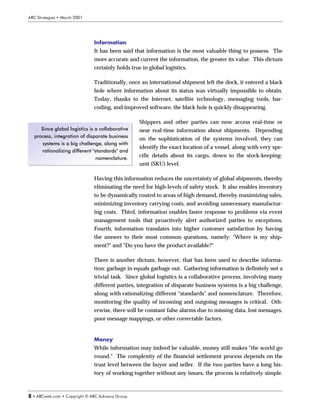
                                                   Shippers and other parties can now access real-time or
      6LQFH JOREDO ORJLVWLFV LV D FROODERUDWLYH    near real-time information about shipments. Depending
   SURFHVV LQWHJUDWLRQ RI GLVSDUDWH EXVLQHVV
                                                   on the sophistication of the systems involved, they can
      VVWHPV LV D ELJ FKDOOHQJH DORQJ ZLWK
                                                   identify the exact location of a vessel, along with very spe-
      UDWLRQDOL]LQJ GLIIHUHQW VWDQGDUGV DQG
                                QRPHQFODWXUH
                                                   cific details about its cargo, down to the stock-keeping-
                                                   unit (SKU) level.

                               Having this information reduces the uncertainty of global shipments, thereby
                               eliminating the need for high-levels of safety stock. It also enables inventory
                               to be dynamically routed to areas of high demand, thereby maximizing sales,
                               minimizing inventory carrying costs, and avoiding unnecessary manufactur-
                               ing costs. Third, information enables faster response to problems via event
                               management tools that proactively alert authorized parties to exceptions.
                               Fourth, information translates into higher customer satisfaction by having
                               the answer to their most common questions, namely: Where is my ship-
                               ment? and Do you have the product available?

                               There is another dictum, however, that has been used to describe informa-
                               tion: garbage in equals garbage out. Gathering information is definitely not a
                               trivial task. Since global logistics is a collaborative process, involving many
                               different parties, integration of disparate business systems is a big challenge,
                               along with rationalizing different standards and nomenclature. Therefore,
                               monitoring the quality of incoming and outgoing messages is critical. Oth-
                               erwise, there will be constant false alarms due to missing data, lost messages,
                               poor message mappings, or other correctable factors.


                               0RQH
                               While information may indeed be valuable, money still makes the world go
                               round. The complexity of the financial settlement process depends on the
                               trust level between the buyer and seller. If the two parties have a long his-
                               tory of working together without any issues, the process is relatively simple.


ÇÃ6S8rip‚€Ã‡Ã8‚ƒ’…vtu‡Ã‹Ã6S8Ã6q‰v†‚…’ÃB…‚ˆƒ
à                                                                                       6S8ÃT‡…h‡rtvr†Ã‡ÃHh…puÃ! Ã


However, if there is no prior relationship (as is common in public on-line
marketplaces), the transaction size is relatively large, and there is a desire for
higher levels of payment guarantee, then the process becomes complicated.

There are numerous payment terms used for transactions, but the most
common method of settling large international trade transactions is by ob-
taining a Letter of Credit (L/C).

Simply stated, the process of issuing a Letter of Credit and finalizing pay-
ment generally takes a long time (sometimes months), requires many
documents, is easily delayed by any clerical errors, is relatively expensive,
and involves many parties. Banks play the role of neutral third-party in the
transaction. Due to the labor-intensive nature of the process, they charge
both the buyer and the seller between 0.5% and 3.0% of the payment amount,
plus as much as $100 each time the L/C is amended. For a $5 million dollar
transaction, an L/C can cost over $150,000.

To summarize, global logistics involves more than just the physical move-
ment of goods across borders, which in itself is a complicated process. It also
involves the movement of documents, information, and (of course) money
between the numerous parties in the logistics ecosystem. All four compo-
nents are interrelated and critical for success.


UHDWLQJ 9DOXH $FURVV (QWHUSULVH

Global Logistics information, particularly trade content, obviously impacts
fulfillment. Its value, however, extends to other business processes, such as
product development, network design, vendor selection, and customer rela-
tionship management.


3URGXFW 'HYHORSPHQW
As highlighted earlier, many trade regulations are based on the characteris-
tics of the product, which form the basis of its HTS code.             The code
determines the duty rate applied, the trade documents required, and the ap-
propriate government agency to oversee the import. Since a product’s HTS
classification is essentially defined during its development, it is critical for
developers to understand the impact of their design choices as they relate to
trade regulations in each target market.


                                                                   8‚ƒ’…vtu‡Ã‹Ã6S8Ã6q‰v†‚…’ÃB…‚ˆƒÃ‡Ã6S8rip‚€Ã‡Ã
6S8ÃT‡…h‡rtvr†Ã‡ÃHh…puÃ! Ã


                                  For example, an adhesive is comprised of several chemical components. The
                                  choice of components and their overall amount plays a role in how the fin-
                                  ished product is classified. Too much of Component A and the adhesive
                                                          becomes flammable or unstable, thereby resulting in a
                                                          more regulated classification and perhaps illegal to im-
                                                          port into certain countries. If Component Z is chosen
                     Ir‡‚…xÃ9r†vt                       instead, the adhesive becomes biodegradable, thereby
                                                          resulting in a more favorable classification in terms of
                         By‚ihy
                         U…hqr                            minimizing or eliminating duties and less paperwork.
Q…‚qˆp‡Ã9r‰ry‚ƒ€r‡                    Wrq‚…ÃTryrp‡v‚
                        8‚‡r‡


                                                          The bottom line: the decisions product developers make
                                                          when designing a product impacts the cost and viability
                                                          of importing/exporting.
               8SH                  Aˆysvyy€r‡


                                  1HWZRUN 'HVLJQ
                                  As with product development, the decisions made during network design
                                  have a large and somewhat lasting impact on global fulfillment. Companies
                                  evaluate their network design every one to two years, or more frequently if
                                  they acquire another entity or significant changes occur within their supply
                                  chains. The process entails determining the location, size, and number of
                                  plants, distribution centers, suppliers, and third-party partners.

                                  Obviously, local tax rates, labor costs, and currency valuations play an im-
                                  portant role in the decision-making process. But as indicated earlier, country
                                  of origin is also factor, along with preferential trade agreements such as
                                  NAFTA and MERCOSUR (a trade alliance between Argentina, Brazil, Para-
                                  guay and Uruguay, with Chile and Bolivia as associate members). Free
                                  Trade Zones (FTZ) are also important. These are ports designated by a
                                  government for duty-free entry of non-prohibited goods. Merchandise may
                                  be stored and used for manufacturing within the zone and re-exported
                                  without duties being paid. Duties are imposed only when the original goods
                                  or items manufactured from those goods pass from the FTZ into an area of
                                  the country subject to customs authority.

                                  Therefore, companies should take into account global trade information
                                  when evaluating their network design. In particular, they should consider
                                  the following questions:

                                      •    Which is the better option: exporting merchandise directly to its des-
                                           tination or exporting it to a nearby country that has more favorable


ÇÃ6S8rip‚€Ã‡Ã8‚ƒ’…vtu‡Ã‹Ã6S8Ã6q‰v†‚…’ÃB…‚ˆƒ
à                                                                                          6S8ÃT‡…h‡rtvr†Ã‡ÃHh…puÃ! Ã


          import regulations (perhaps due to a trade alliance) and then re-
          exporting the merchandise to its final destination?

    •     Can I establish/utilize FTZs to eliminate duties?
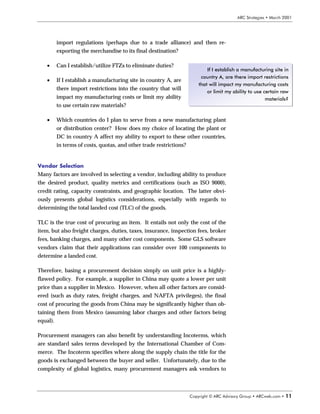
                                                                             ,I , HVWDEOLVK D PDQXIDFWXULQJ VLWH LQ
                                                                          FRXQWU $ DUH WKHUH LPSRUW UHVWULFWLRQV
    •     If I establish a manufacturing site in country A, are
                                                                         WKDW ZLOO LPSDFW P PDQXIDFWXULQJ FRVWV
          there import restrictions into the country that will
                                                                             RU OLPLW P DELOLW WR XVH FHUWDLQ UDZ
          impact my manufacturing costs or limit my ability                                              PDWHULDOV
          to use certain raw materials?

    •     Which countries do I plan to serve from a new manufacturing plant
          or distribution center? How does my choice of locating the plant or
          DC in country A affect my ability to export to these other countries,
          in terms of costs, quotas, and other trade restrictions?


9HQGRU 6HOHFWLRQ
Many factors are involved in selecting a vendor, including ability to produce
the desired product, quality metrics and certifications (such as ISO 9000),
credit rating, capacity constraints, and geographic location. The latter obvi-
ously presents global logistics considerations, especially with regards to
determining the total landed cost (TLC) of the goods.

TLC is the true cost of procuring an item. It entails not only the cost of the
item, but also freight charges, duties, taxes, insurance, inspection fees, broker
fees, banking charges, and many other cost components. Some GLS software
vendors claim that their applications can consider over 100 components to
determine a landed cost.

Therefore, basing a procurement decision simply on unit price is a highly-
flawed policy. For example, a supplier in China may quote a lower per unit
price than a supplier in Mexico. However, when all other factors are consid-
ered (such as duty rates, freight charges, and NAFTA privileges), the final
cost of procuring the goods from China may be significantly higher than ob-
taining them from Mexico (assuming labor charges and other factors being
equal).

Procurement managers can also benefit by understanding Incoterms, which
are standard sales terms developed by the International Chamber of Com-
merce. The Incoterm specifies where along the supply chain the title for the
goods is exchanged between the buyer and seller. Unfortunately, due to the
complexity of global logistics, many procurement managers ask vendors to


                                                                     8‚ƒ’…vtu‡Ã‹Ã6S8Ã6q‰v†‚…’ÃB…‚ˆƒÃ‡Ã6S8rip‚€Ã‡Ã
6S8ÃT‡…h‡rtvr†Ã‡ÃHh…puÃ! Ã


                                  quote “landed cost” prices, thereby forfeiting control of many cost compo-
                                  nents such as freight charges and insurance. In short, better collaboration
                                  between logistics and procurement with an enterprise can result in cost
                                  avoidance.

 ,QFRWHUP                                 'HWDLOV

 ([ :RUNV (;:
%XHU DVVXPHV DOO UHVSRQVLELOLW IURP SLFNLQJ XS DW VHOOHU·V ORFDWLRQ WR ILQDO
                                          GHOLYHU

 )UHH DUULHU )$
6HOOHU UHVSRQVLEOH IRU LQODQG WUDQVSRUWDWLRQ DQG H[SRUW FXVWRPV FOHDULQJ %XHU
                                          DVVXPHV UHVSRQVLELOLW IURP LQW·O VKLSPHQW ORDGLQJ WKURXJK ILQDO GHOLYHU

 )UHH $ORQJVLGH 6KLS )$6
6LPLODU WR )$

 )UHH 2QERDUG )2%
6HOOHU UHVSRQVLEOH WKURXJK LQW·O VKLSPHQW ORDGLQJ %XHU UHVSRQVLEOH IRU WKH UHVW

 RVW DQG )UHLJKW )5
6HOOHU UHVSRQVLEOH WKURXJK LQW·O IUHLJKW %XHU UHVSRQVLEOH IRU WKH UHVW

 DUULDJH 3DLG 7R 37
6LPLODU WR )5

 RVW ,QVXUDQFH )UHLJKW ,)
6LPLODU WR )5 SOXV 6HOOHU UHVSRQVLEOH IRU LQW·O LQVXUDQFH

 DUULDJH DQG ,QVXUDQFH 3DLG 7R ,3
6LPLODU WR ,)

 'HOLYHUHG $W )URQWLHU '$)

Global logistics strategies

  • 1.
    %< $5& $'9,625<*5283 0$5&+ *OREDO /RJLVWLFV 6WUDWHJLHV :KDW ,V *OREDO /RJLVWLFV *OREDO *RRGV 'RFXPHQWV ,QIR 0RQH UHDWLQJ 9DOXH $FURVV (QWHUSULVH 5HFHQW $5 5HVHDUFK )LQGLQJV *OREDO /RJLVWLFV 6ROXWLRQV 6WUDWHJLHV IRU 6XFFHVV (%XVLQHVV 0DQXIDFWXULQJ 6WUDWHJLHV IRU ,QGXVWU ([HFXWLYHV
  • 2.
    6S8ÃT‡…h‡rtvr†Ã‡ÃHh…puÃ! à )UHLJKW 6XSSOLHU XVWRPV DUULHUV %DQNV )RUZDUGHUV RXQWU $ ,QIRUPDWLRQ 'RFXPHQWV *RRGV 0RQH )UHLJKW XVWRPHU XVWRPV DUULHUV %DQNV )RUZDUGHUV RXQWU % *OREDO /RJLVWLFV )ORZ RI ,QIRUPDWLRQ 'RFXPHQWV *RRGV DQG 0RQH 7ULOOLRQ
  • 3.
    :RUOG 0HUFKDQGLVH ,PSRUWV ([SRUWV IURP :72
  • 4.
  • 5.
    à 6S8ÃT‡…h‡rtvr†Ã‡ÃHh…puÃ! à :KDW ,V *OREDO /RJLVWLFV Globalization has been a trend for some time, but it only gained momentum over the past two decades thanks to advancing technology, improving politi- cal/economic environments, and the elimination of trade barriers. These forces led to the creation of the virtual corporation, where a company delegates a majority of its business functions, such as manufacturing and dis- tribution, to partners are usually located in different parts of the world. For example, semiconductor wafer fabrication is usually done in the US, assembly is in Asia or Mexico, and final test 7KH UDSLG ULVH LQ JOREDO WUDGH LV FUHDWLQJ D KHLJKWHQ QHHG IRU VROXWLRQV and distribution is done somewhere else. The virtual cor- WKDW SURYLGH ERWK DJLOLW DQG YLVLELOLW poration essentially coordinates the activities of its IRU LQWHUQDWLRQDO ORJLVWLFV WUDQVDFWLRQV partners to meet customer commitments, minimize costs, and maximize profits. Mergers and acquisitions are increasing as companies seek to gain market share, expand their product footprint, and enter new markets. Often, the ac- quired company is located in a different geographic region. The new entity, therefore, becomes a global company instantaneously. The same is true for companies that establish relationships with distribution partners overseas. The World Trade Organization says the value of traded merchandise in- creased from $124 billion in 1948 to $11.2 trillion in 1999 (or $13.8 trillion if commercial services are included). The US was the leading exporter and im- porter of merchandise with over 12 percent of total exports and 18 percent of total imports. From 1998 to 2000, the total value of US imports and exports increased from $2.03 trillion to $2.5 trillion (source: US Census Bureau). The emergence of e-commerce, particularly business-to-business (B2B) activi- ties, has spotlighted globalization. The Internet and related technologies have enabled the creation of new business models such as marketplaces, ex- changes, and application service providers (ASPs). These technologies are facilitating collaboration between business partners, particularly small- and mid-sized enterprises (SMEs) who have historically been left on the sidelines due to the prohibitive cost of such technologies as EDI. In March 2001, the US Census Bureau said manufacturing was the leading industry sector for e-commerce in 1999, accounting for 12 percent ($485 bil- lion out of over $4.0 trillion in total shipments. Unfortunately, the bureau 8‚ƒ’…vtu‡Ã‹Ã6S8Ã6q‰v†‚…’ÃB…‚ˆƒÃ‡Ã6S8rip‚€Ã‡Ã
  • 6.
    6S8ÃT‡…h‡rtvr†Ã‡ÃHh…puÃ! à did not distinguish between domestic and international shipments. But it is very clear that in order for B2B e-commerce to reach the forecast of trillions of dollars by 2005, a majority of the transactions will have to be international. ([SRUW ,PSRUW RXQWU 5DQNLQJ 6KDUH 5DQNLQJ 6KDUH 8QLWHG 6WDWHV *HUPDQ -DSDQ )UDQFH 8QLWHG .LQJGRP DQDGD ,WDO 1HWKHUODQGV KLQD %HOJLXP /HDGLQJ ([SRUWHUV DQG ,PSRUWHUV :72
  • 7.
    Success on aglobal scale requires strong collaboration between business partners, real-time visibility of information, tightly integrated business appli- cations, and import/export tools and expertise. Moreover, companies now buy and sell products worldwide via marketplaces, exchanges, portals, and other channels that didn’t exist a few years ago. These new channels, along with the need to collaborate with more partners, makes it harder to deliver the right product, on time, in the right quantities, and billed correctly. *OREDO *RRGV 'RFXPHQWV ,QIR 0RQH Global Logistics is the transfer of information, documents, goods, and money between various parties (such as suppliers, customers, freight forwarders, carriers, and customs) to fulfill an order from one country to another. *RRGV While fulfilling domestic orders can be challenging, as evidenced by the poor performance of e-commerce providers during the holiday season, it is ele- mentary compared to the challenges associated with global fulfillment. ÇÃ6S8rip‚€Ã‡Ã8‚ƒ’…vtu‡Ã‹Ã6S8Ã6q‰v†‚…’ÃB…‚ˆƒ
  • 8.
    à 6S8ÃT‡…h‡rtvr†Ã‡ÃHh…puÃ! à First, Global fulfillment involves multiple modes of transportation, each with unique contracting process, rating systems, schedules, semantics, packing requirements, and documents. It’s difficult to manage these contracts, de- termine the appropriate carrier for each segment, coordinate the transfer of goods between carriers and modes, generate the necessary paperwork for each carrier/mode, and manage the financial settlement process. 3XUFKDVH RQWUDFW )LQDQFLQJ 7HQGHU %RRN 3UHSDUH 7UDGH 6KLSSLQJ 'RFXPHQWV XVWRPV ,QW·O 7UDQV XVWRPV ,QODQG 7UDQV ,QODQG 7UDQV XVWRPHU 5HFHLSW 6HWWOHPHQW 6LPSOLILHG *OREDO /RJLVWLFV :RUNIORZ Secondly, moving goods between countries involves many more parties than shipping goods between states. Shippers must work with more carriers, col- laborate with freight forwarders, export and import customs agents, inspectors, insurance agencies, and banks. All these parties increase the probability for delays, damaged shipments, and missed customer commit- ments. No wonder many companies hold excess inventory (i.e. safety stock) to account for the uncertainties associated with global shipments. Third, shippers must follow government regulations, not only for their home country, but also for every country they trade with. These regulations change frequently, are difficult to interpret, and in some cases are poorly documented. Taxes, duties, quotas, and restrictions all depend on the prod- uct’s value, country of origin (for the finished product and all components), and Harmonized Tariff Schedule (HTS) code. 8‚ƒ’…vtu‡Ã‹Ã6S8Ã6q‰v†‚…’ÃB…‚ˆƒÃ‡Ã6S8rip‚€Ã‡Ã
  • 9.
    6S8ÃT‡…h‡rtvr†Ã‡ÃHh…puÃ! à It is against US trade laws to ship certain goods, such as chemicals and high- tech electronics, to specific countries or entities, such as known terrorist or- ganizations. Other countries have their own set of restrictions. For example, some Middle East countries do not allow any products to be imported that contain components manufactured or assembled in Israel. In July 2000, the exporter and importer of record rules were issued. They dictate that the exporter of record !'È Xh‡r… is responsible for ensuring that all outbound ship- P‡ur… ments comply with US export regulations. In other # È U…ˆpx words, even though the shipment may be managed Qvƒryvr Shvy by a freight forwarder, it is the exporter that is ulti- $È 6v… mately liable. Similarly, the importer of record is È ultimately responsible for complying with import ! È #È laws. Tuh…rÂsÃD ‡ yÃU…hqrÃi’ÃH ‚qrÃi’ÃWhyˆ rà VTÃ9PUà (( Since non-compliance can mean loss of export li- censes, stiff penalties (up to 50 percent of invoice value), or jail, many com- panies are looking to bring GLS capability in-house, particularly the ability to perform restricted party screenings and the ability to generate/file all appro- priate trade documents. According to the US Department of Transportation, ocean shipments ac- counted for 41 percent of international shipments in 1997 based on value (almost 63 percent based on tonnage), the largest share among all modes. Over the past 15 years, ocean trade has almost doubled to 1.13 billion metric tons, and it is expected to double again over the next twenty years. While air cargo accounts for less than 1 percent of international tonnage, it is 28 percent of these shipments’ value, due to the fact that nearly 20 percent of air shipments are electronics and computers. In addition, international ton- miles have increased fivefold over the past twenty years. Air transportation will undoubtedly play a more important role in the near future as companies adopt make-to-order models and inventory reduction policies. 'RFXPHQWV Global Logistics also involves the transfer of documents between different parties. The amount of paperwork required to ship goods across borders is simply astounding (see table below). Many of these documents are produced in multiple copies, and if there are changes to the original itinerary or details, they have to be regenerated. Considering that freight forwarders can charge ÇÃ6S8rip‚€Ã‡Ã8‚ƒ’…vtu‡Ã‹Ã6S8Ã6q‰v†‚…’ÃB…‚ˆƒ
  • 10.
    à 6S8ÃT‡…h‡rtvr†Ã‡ÃHh…puÃ! à as much as $75 per trade document, many companies are looking to bring the document-creation process in-house. ,PSRUW 'HVFULSWLRQ (QWU 0DQLIHVW DSWXUHV LQIRUPDWLRQ VXFK DV DUULYDO GDWH LPSRUWHU RI UHFRUG FDUULHU GHWDLOV DQG SURGXFW GHWDLOV RPPHUFLDO ,QYRLFH 5HFHLSW IRU JRRGV SXUFKDVHG LQGLFDWLQJ WKH VHOOHU DQG WKH SXUFKDVHU ,W PXVW FRQWDLQ DQ LWHPL]HG OLVW RI WKH PHUFKDQGLVH FRPSOHWH GHVFULSWLRQ RI JRRGV WKHLU XQLW YDOXH DQG H[WHQGHG WRWDO YDOXH %LOO RI /DGLQJ RU ,VVXHG E D FRPPRQ FDUULHU WR D VKLSSHU WKDW VHUYHV DV D UHFHLSW IRU WKH JRRGV GHOLYHUHG WR WKH $LU :DELOO FDUULHU IRU VKLSPHQW D GHILQLWLRQ RI WKH FRQWUDFW IRU WKH FDUULDJH RI WKH JRRGV DQG D 'RFXPHQW RI 7LWOH WR WKH JRRGV GHVFULEHG WKHUHLQ (QWU 6XPPDU 8VHG E 86 XVWRPV WR FROOHFW GXWLHV DQG WD[HV UHFRUG VWDWLVWLFDO GDWD RQ LPSRUWV DQG SURYLGH D FRQFLVH VXPPDU RI WKH LPSRUW WUDQVDFWLRQ E FODVVLILFDWLRQ DQG YDOXH ,PSRUW /LFHQVH HUWLILFDWH LVVXHG E FRXQWULHV WKDW SHUPLWV LPSRUWDWLRQ RI WKH DUWLFOHV VWDWHG LQ WKH OLFHQVH ([SRUW 'HVFULSWLRQ 6KLSSHU·V ([SRUW $ IRUP FRPSOHWHG E D VKLSSHU WKDW VKRZV WKH YDOXH ZHLJKW DQG GHVWLQDWLRQ RI H[SRUW VKLSPHQWV 'HFODUDWLRQ DV ZHOO DV 6FKHGXOH % FRPPRGLW FRGH HUWLILFDWH RI 2ULJLQ $ GRFXPHQW FRQWDLQLQJ DQ DIILGDYLW WR SURYH WKH RULJLQ RI LPSRUWHG JRRGV ([SRUW /LFHQVH $ GRFXPHQW VHFXUHG IURP D JRYHUQPHQW DXWKRUL]LQJ D VKLSSHU WR H[SRUW D VSHFLILF TXDQWLW RI D SDUWLFXODU FRPPRGLW WR D FHUWDLQ FRXQWU ,QVSHFWLRQ HUWLILFDWH $ FHUWLILFDWH LVVXHG E DQ LQGHSHQGHQW DJHQW DWWHVWLQJ WR WKH TXDOLW DQGRU TXDQWLW RI WKH PHU FKDQGLVH EHLQJ VKLSSHG 'HVWLQDWLRQ RQWURO 6WDWHPHQWV 86 JRYHUQPHQW UHTXLUHV WR EH GLVSODHG RQ H[SRUW VKLSPHQWV WKDW VSHFLI WKH DXWKRU 6WDWHPHQWV L]HG GHVWLQDWLRQV /HDGLQJ ([SRUWHUV DQG ,PSRUWHUV :72
  • 11.
    Fortunately, there isa move towards electronic filing of these documents. For example, as of November 1, 2000, the US Census Bureau and US Cus- toms stopped accepting Shipper’s Export Declarations (SEDs) via fax. The preferred method is via an Internet system called AES Direct (Automated Export System). A similar system exists for importers called ABI (Automated Broker Interface). The benefits of automating document creation are primar- ily threefold: cheaper, faster, and fewer errors. The latter has ancillary benefits, including fewer delays at customs and faster payment cycles. In summary, many documents are required to import or export a single shipment. These documents flow between the shipper, its carriers, freight forwarders, government agencies, banks, and other parties. A single clerical error can result in delays, fines, or withheld payments. Therefore, automa- tion of this laborious process is a necessity. 8‚ƒ’…vtu‡Ã‹Ã6S8Ã6q‰v†‚…’ÃB…‚ˆƒÃ‡Ã6S8rip‚€Ã‡Ã
  • 12.
    6S8ÃT‡…h‡rtvr†Ã‡ÃHh…puÃ! à ,QIRUPDWLRQ It has been said that information is the most valuable thing to possess. The more accurate and current the information, the greater its value. This dictum certainly holds true in global logistics. Traditionally, once an international shipment left the dock, it entered a black hole where information about its status was virtually impossible to obtain. Today, thanks to the Internet, satellite technology, messaging tools, bar- coding, and improved software, the black hole is quickly disappearing. Shippers and other parties can now access real-time or 6LQFH JOREDO ORJLVWLFV LV D FROODERUDWLYH near real-time information about shipments. Depending SURFHVV LQWHJUDWLRQ RI GLVSDUDWH EXVLQHVV on the sophistication of the systems involved, they can VVWHPV LV D ELJ FKDOOHQJH DORQJ ZLWK identify the exact location of a vessel, along with very spe- UDWLRQDOL]LQJ GLIIHUHQW VWDQGDUGV DQG QRPHQFODWXUH cific details about its cargo, down to the stock-keeping- unit (SKU) level. Having this information reduces the uncertainty of global shipments, thereby eliminating the need for high-levels of safety stock. It also enables inventory to be dynamically routed to areas of high demand, thereby maximizing sales, minimizing inventory carrying costs, and avoiding unnecessary manufactur- ing costs. Third, information enables faster response to problems via event management tools that proactively alert authorized parties to exceptions. Fourth, information translates into higher customer satisfaction by having the answer to their most common questions, namely: Where is my ship- ment? and Do you have the product available? There is another dictum, however, that has been used to describe informa- tion: garbage in equals garbage out. Gathering information is definitely not a trivial task. Since global logistics is a collaborative process, involving many different parties, integration of disparate business systems is a big challenge, along with rationalizing different standards and nomenclature. Therefore, monitoring the quality of incoming and outgoing messages is critical. Oth- erwise, there will be constant false alarms due to missing data, lost messages, poor message mappings, or other correctable factors. 0RQH While information may indeed be valuable, money still makes the world go round. The complexity of the financial settlement process depends on the trust level between the buyer and seller. If the two parties have a long his- tory of working together without any issues, the process is relatively simple. ÇÃ6S8rip‚€Ã‡Ã8‚ƒ’…vtu‡Ã‹Ã6S8Ã6q‰v†‚…’ÃB…‚ˆƒ
  • 13.
    à 6S8ÃT‡…h‡rtvr†Ã‡ÃHh…puÃ! à However, if there is no prior relationship (as is common in public on-line marketplaces), the transaction size is relatively large, and there is a desire for higher levels of payment guarantee, then the process becomes complicated. There are numerous payment terms used for transactions, but the most common method of settling large international trade transactions is by ob- taining a Letter of Credit (L/C). Simply stated, the process of issuing a Letter of Credit and finalizing pay- ment generally takes a long time (sometimes months), requires many documents, is easily delayed by any clerical errors, is relatively expensive, and involves many parties. Banks play the role of neutral third-party in the transaction. Due to the labor-intensive nature of the process, they charge both the buyer and the seller between 0.5% and 3.0% of the payment amount, plus as much as $100 each time the L/C is amended. For a $5 million dollar transaction, an L/C can cost over $150,000. To summarize, global logistics involves more than just the physical move- ment of goods across borders, which in itself is a complicated process. It also involves the movement of documents, information, and (of course) money between the numerous parties in the logistics ecosystem. All four compo- nents are interrelated and critical for success. UHDWLQJ 9DOXH $FURVV (QWHUSULVH Global Logistics information, particularly trade content, obviously impacts fulfillment. Its value, however, extends to other business processes, such as product development, network design, vendor selection, and customer rela- tionship management. 3URGXFW 'HYHORSPHQW As highlighted earlier, many trade regulations are based on the characteris- tics of the product, which form the basis of its HTS code. The code determines the duty rate applied, the trade documents required, and the ap- propriate government agency to oversee the import. Since a product’s HTS classification is essentially defined during its development, it is critical for developers to understand the impact of their design choices as they relate to trade regulations in each target market. 8‚ƒ’…vtu‡Ã‹Ã6S8Ã6q‰v†‚…’ÃB…‚ˆƒÃ‡Ã6S8rip‚€Ã‡Ã
  • 14.
    6S8ÃT‡…h‡rtvr†Ã‡ÃHh…puÃ! à For example, an adhesive is comprised of several chemical components. The choice of components and their overall amount plays a role in how the fin- ished product is classified. Too much of Component A and the adhesive becomes flammable or unstable, thereby resulting in a more regulated classification and perhaps illegal to im- port into certain countries. If Component Z is chosen Ir‡‚…xÃ9r†vt instead, the adhesive becomes biodegradable, thereby resulting in a more favorable classification in terms of By‚ihy U…hqr minimizing or eliminating duties and less paperwork. Q…‚qˆp‡Ã9r‰ry‚ƒ€r‡ Wrq‚…ÃTryrp‡v‚ 8‚‡r‡ The bottom line: the decisions product developers make when designing a product impacts the cost and viability of importing/exporting. 8SH Aˆysvyy€r‡ 1HWZRUN 'HVLJQ As with product development, the decisions made during network design have a large and somewhat lasting impact on global fulfillment. Companies evaluate their network design every one to two years, or more frequently if they acquire another entity or significant changes occur within their supply chains. The process entails determining the location, size, and number of plants, distribution centers, suppliers, and third-party partners. Obviously, local tax rates, labor costs, and currency valuations play an im- portant role in the decision-making process. But as indicated earlier, country of origin is also factor, along with preferential trade agreements such as NAFTA and MERCOSUR (a trade alliance between Argentina, Brazil, Para- guay and Uruguay, with Chile and Bolivia as associate members). Free Trade Zones (FTZ) are also important. These are ports designated by a government for duty-free entry of non-prohibited goods. Merchandise may be stored and used for manufacturing within the zone and re-exported without duties being paid. Duties are imposed only when the original goods or items manufactured from those goods pass from the FTZ into an area of the country subject to customs authority. Therefore, companies should take into account global trade information when evaluating their network design. In particular, they should consider the following questions: • Which is the better option: exporting merchandise directly to its des- tination or exporting it to a nearby country that has more favorable ÇÃ6S8rip‚€Ã‡Ã8‚ƒ’…vtu‡Ã‹Ã6S8Ã6q‰v†‚…’ÃB…‚ˆƒ
  • 15.
    à 6S8ÃT‡…h‡rtvr†Ã‡ÃHh…puÃ! à import regulations (perhaps due to a trade alliance) and then re- exporting the merchandise to its final destination? • Can I establish/utilize FTZs to eliminate duties? ,I , HVWDEOLVK D PDQXIDFWXULQJ VLWH LQ FRXQWU $ DUH WKHUH LPSRUW UHVWULFWLRQV • If I establish a manufacturing site in country A, are WKDW ZLOO LPSDFW P PDQXIDFWXULQJ FRVWV there import restrictions into the country that will RU OLPLW P DELOLW WR XVH FHUWDLQ UDZ impact my manufacturing costs or limit my ability PDWHULDOV to use certain raw materials? • Which countries do I plan to serve from a new manufacturing plant or distribution center? How does my choice of locating the plant or DC in country A affect my ability to export to these other countries, in terms of costs, quotas, and other trade restrictions? 9HQGRU 6HOHFWLRQ Many factors are involved in selecting a vendor, including ability to produce the desired product, quality metrics and certifications (such as ISO 9000), credit rating, capacity constraints, and geographic location. The latter obvi- ously presents global logistics considerations, especially with regards to determining the total landed cost (TLC) of the goods. TLC is the true cost of procuring an item. It entails not only the cost of the item, but also freight charges, duties, taxes, insurance, inspection fees, broker fees, banking charges, and many other cost components. Some GLS software vendors claim that their applications can consider over 100 components to determine a landed cost. Therefore, basing a procurement decision simply on unit price is a highly- flawed policy. For example, a supplier in China may quote a lower per unit price than a supplier in Mexico. However, when all other factors are consid- ered (such as duty rates, freight charges, and NAFTA privileges), the final cost of procuring the goods from China may be significantly higher than ob- taining them from Mexico (assuming labor charges and other factors being equal). Procurement managers can also benefit by understanding Incoterms, which are standard sales terms developed by the International Chamber of Com- merce. The Incoterm specifies where along the supply chain the title for the goods is exchanged between the buyer and seller. Unfortunately, due to the complexity of global logistics, many procurement managers ask vendors to 8‚ƒ’…vtu‡Ã‹Ã6S8Ã6q‰v†‚…’ÃB…‚ˆƒÃ‡Ã6S8rip‚€Ã‡Ã
  • 16.
    6S8ÃT‡…h‡rtvr†Ã‡ÃHh…puÃ! à quote “landed cost” prices, thereby forfeiting control of many cost compo- nents such as freight charges and insurance. In short, better collaboration between logistics and procurement with an enterprise can result in cost avoidance. ,QFRWHUP 'HWDLOV ([ :RUNV (;:
  • 17.
    %XHU DVVXPHV DOOUHVSRQVLELOLW IURP SLFNLQJ XS DW VHOOHU·V ORFDWLRQ WR ILQDO GHOLYHU )UHH DUULHU )$
  • 18.
    6HOOHU UHVSRQVLEOH IRULQODQG WUDQVSRUWDWLRQ DQG H[SRUW FXVWRPV FOHDULQJ %XHU DVVXPHV UHVSRQVLELOLW IURP LQW·O VKLSPHQW ORDGLQJ WKURXJK ILQDO GHOLYHU )UHH $ORQJVLGH 6KLS )$6
  • 19.
    6LPLODU WR )$ )UHH 2QERDUG )2%
  • 20.
    6HOOHU UHVSRQVLEOH WKURXJKLQW·O VKLSPHQW ORDGLQJ %XHU UHVSRQVLEOH IRU WKH UHVW RVW DQG )UHLJKW )5
  • 21.
    6HOOHU UHVSRQVLEOH WKURXJKLQW·O IUHLJKW %XHU UHVSRQVLEOH IRU WKH UHVW DUULDJH 3DLG 7R 37
  • 22.
    6LPLODU WR )5 RVW ,QVXUDQFH )UHLJKW ,)
  • 23.
    6LPLODU WR )5SOXV 6HOOHU UHVSRQVLEOH IRU LQW·O LQVXUDQFH DUULDJH DQG ,QVXUDQFH 3DLG 7R ,3
  • 24.
    6LPLODU WR ,) 'HOLYHUHG $W )URQWLHU '$)