FB602: Global Marketing
Management
24/3/2014Russell Preston
Recap
• World Communications
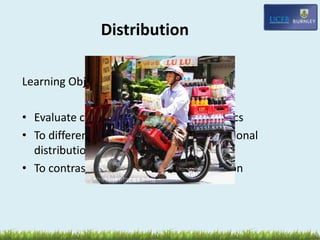
Distribution
Learning Objectives:
• Evaluate channels of distribution/logistics
• To differentiate complexities of international
distribution
• To contrast service & product distribution
Background
4
• Efficiently & Effectively
• Decreases in transportation costs
• Reliability increased
• Opening up of markets
• Increases chance of success
Definition
• “defined as the design and management
of a system that directs and controls the
flows of materials into, through and out of
the firm across national boundaries to
achieve its corporate objectives at a
minimum total cost”
source: Kotabe & Helsen, (2011) Global Marketing
Management, 5th edn, p500
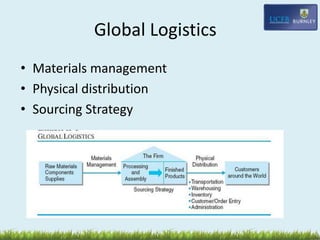
Global Logistics
• Materials management
• Physical distribution
• Sourcing Strategy
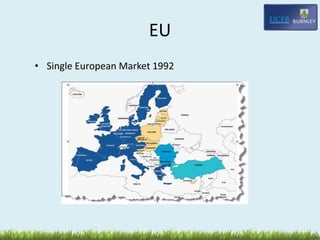
EU
• Single European Market 1992
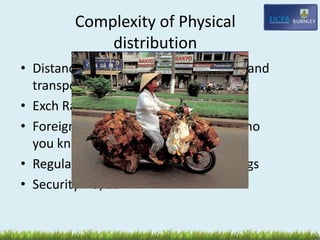
Complexity of Physical
distribution
• Distance –higher costs, eg insurance and
transport, pilferage, warehousing
• Exch Rate fluctuation
• Foreign Intermediaries – in Asia its who
you know to get things moving
• Regulation – US domestic shipping regs
• Security – 9/11
Modes of Transport
• Value-to-volume ratio determined by how much value
is added to the materials used in the product
• Perishability – quality degradation over time
• Cost of transportation – see above dependencies
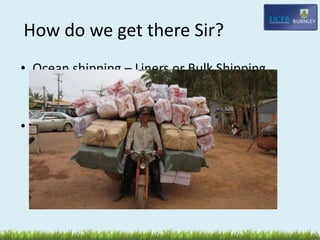
How do we get there Sir?
• Ocean shipping – Liners or Bulk Shipping
(container cargoes)
• Air freight – expensive, prob high value eg
semi conductors
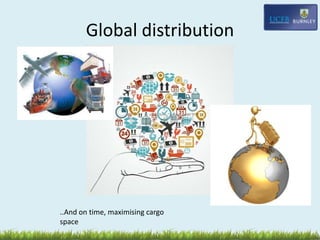
Global distribution
..And on time, maximising cargo
space
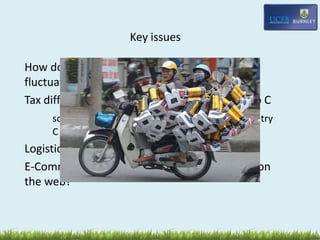
Key issues
How do you hedge against inflation/currency
fluctuations?
Tax differentials transfer from country A to B to C
so an export from country B? assembled in country
C gets tax breaks?
Logistical Integration/Rationalisation
E-Commerce – so what happens once you are on
the web?
E-commerce
• Amazon.com
• 5 million books
• Which one? Who do
you buy from?
• Dymocks Australia
• 100,000 books
• Who is truly global?
Why?
Sourcing Strategy
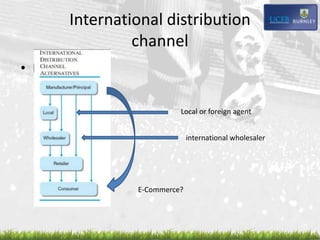
International distribution
channel
• Lo
Local or foreign agent
international wholesaler
E-Commerce?
Channel Management
An indirect distribution channel threatens control
Some guidelines:
• Seek intermediaries capable of developing
markets, not just those with good contacts
• Regard intermediaries as long term partners – not
as a means to get entry
• Actively search and select intermediaries
• Support your intermediaries with mktg/know how
• Attempt to control as much as you can over
marketing
Retailing
• Growth
• Own label lines
• e-tailing
• Wal-Mart are P&Gs largest customer,
buying more than the whole of Japan
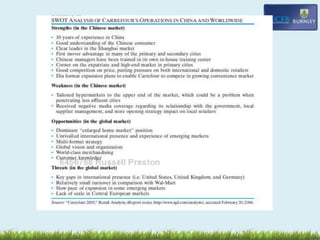
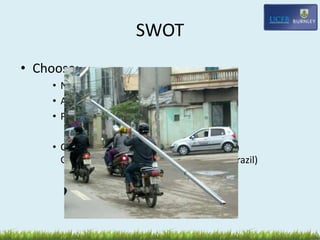
SWOT
• Choose:
• Nike or
• Adidas or
• Puma
• Complete a SWOT for one of the above in
Germany (Nike), Adidas (China), Puma (Brazil)
Retailing differences across
the world
• Japan, historically tight regulation, department stores
led, no cars for shopping, smaller stores/head of
population, no parking
• Germany –no Sunday opening, close at 6pm, open 1
Saturday in a month
• UK Sunday opening is the only limitation
• Asia, fresh produce, markets very strong. Low incomes
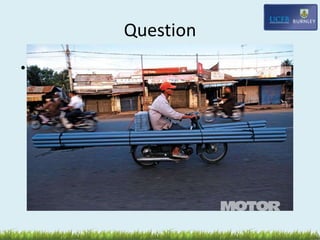
Question
• Carrefour, being the 2nd largest retailer in
the world, what are the implications of its
pull-out from Japan for other global
retailers such as Wal-Mart which is
struggling to survive ?
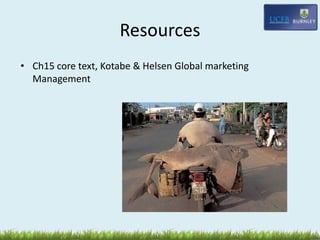
Resources
• Ch15 core text, Kotabe & Helsen Global marketing
Management

Global Marketing - Distribution/logistics

  • 1.
  • 2.
  • 3.
    Distribution Learning Objectives: • Evaluatechannels of distribution/logistics • To differentiate complexities of international distribution • To contrast service & product distribution
  • 4.
    Background 4 • Efficiently &Effectively • Decreases in transportation costs • Reliability increased • Opening up of markets • Increases chance of success
  • 5.
    Definition • “defined asthe design and management of a system that directs and controls the flows of materials into, through and out of the firm across national boundaries to achieve its corporate objectives at a minimum total cost” source: Kotabe & Helsen, (2011) Global Marketing Management, 5th edn, p500
  • 6.
    Global Logistics • Materialsmanagement • Physical distribution • Sourcing Strategy
  • 7.
  • 8.
    Complexity of Physical distribution •Distance –higher costs, eg insurance and transport, pilferage, warehousing • Exch Rate fluctuation • Foreign Intermediaries – in Asia its who you know to get things moving • Regulation – US domestic shipping regs • Security – 9/11
  • 9.
    Modes of Transport •Value-to-volume ratio determined by how much value is added to the materials used in the product • Perishability – quality degradation over time • Cost of transportation – see above dependencies
  • 10.
    How do weget there Sir? • Ocean shipping – Liners or Bulk Shipping (container cargoes) • Air freight – expensive, prob high value eg semi conductors
  • 11.
    Global distribution ..And ontime, maximising cargo space
  • 12.
    Key issues How doyou hedge against inflation/currency fluctuations? Tax differentials transfer from country A to B to C so an export from country B? assembled in country C gets tax breaks? Logistical Integration/Rationalisation E-Commerce – so what happens once you are on the web?
  • 13.
    E-commerce • Amazon.com • 5million books • Which one? Who do you buy from? • Dymocks Australia • 100,000 books • Who is truly global? Why?
  • 14.
  • 15.
    International distribution channel • Lo Localor foreign agent international wholesaler E-Commerce?
  • 16.
    Channel Management An indirectdistribution channel threatens control Some guidelines: • Seek intermediaries capable of developing markets, not just those with good contacts • Regard intermediaries as long term partners – not as a means to get entry • Actively search and select intermediaries • Support your intermediaries with mktg/know how • Attempt to control as much as you can over marketing
  • 17.
    Retailing • Growth • Ownlabel lines • e-tailing • Wal-Mart are P&Gs largest customer, buying more than the whole of Japan
  • 19.
    SWOT • Choose: • Nikeor • Adidas or • Puma • Complete a SWOT for one of the above in Germany (Nike), Adidas (China), Puma (Brazil)
  • 20.
    Retailing differences across theworld • Japan, historically tight regulation, department stores led, no cars for shopping, smaller stores/head of population, no parking • Germany –no Sunday opening, close at 6pm, open 1 Saturday in a month • UK Sunday opening is the only limitation • Asia, fresh produce, markets very strong. Low incomes
  • 21.
    Question • Carrefour, beingthe 2nd largest retailer in the world, what are the implications of its pull-out from Japan for other global retailers such as Wal-Mart which is struggling to survive ?
  • 22.
    Resources • Ch15 coretext, Kotabe & Helsen Global marketing Management

Editor's Notes

  • #17 Criticism – too general to relate to consumption patternsValue based segmentation schemes not always actionable, effective segmentation needs to be actionableUnstable, values change over timeLifestyles can vary from region to region