

Mobile Technologies and Supply Chain
Beyond the Perfect Order Metric Seminar
February 10, 2011
Adrian Gonzalez
Director, Logistics Viewpoints
Adrian@Logisticsviewpoints.com
2
© ARC Advisory Group
Key Takeaways
 Mobile Internet usage is and will be bigger than
most people think.
 Use of mobile technologies by consumers is
growing quickly, especially in Asia and emerging
economies. This will impact supply chains.
 Mobile + Social Media = Process Innovation
 Supply chain software vendors are investing
heavily in mobile solutions.
 Early adopters, including CPG companies and 3PLs,
are already achieving benefits.
3
© ARC Advisory Group
Consumers Much More Instrumented
“Today’s consumers are much more instrumented than their predecessors,
and they are increasingly ready to use these technologies to interact both
with retailers and with other consumers. Our research suggests that they
would like to use…mobile phones to find out where the nearest store is
located (75 percent), compare prices (71 percent) and check that the goods
they want are in stock before going to the store (66 percent).”
4
© ARC Advisory Group
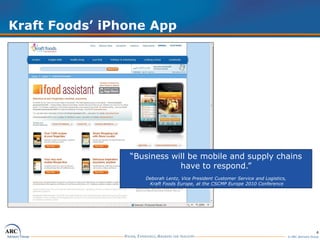
Kraft Foods’ iPhone App
“Business will be mobile and supply chains
have to respond.”
Deborah Lentz, Vice President Customer Service and Logistics,
Kraft Foods Europe, at the CSCMP Europe 2010 Conference
5
© ARC Advisory Group
Mobile Internet Usage Is and Will Be…
…Bigger Than Most People Think!
Source: Mary Meeker, Morgan Stanley, Web 2.0 Summit, October 2009
6
© ARC Advisory Group
Mobile + Social Media = Process Innovation
Source: Mary Meeker, Morgan Stanley, Web 2.0 Summit, October 2009
Improvements in social networking and mobile computing
platforms…are fundamentally changing the ways people
communicate with each other ...
7
© ARC Advisory Group
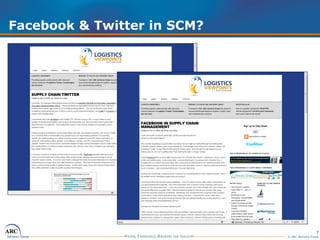
Facebook & Twitter in SCM?
8
© ARC Advisory Group
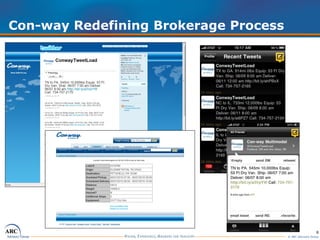
Con-way Redefining Brokerage Process
9
© ARC Advisory Group
ARC Survey Results
Source: ARC Advisory Group web survey of 60 supply chain and logistics executives, May-Aug 2010
0.0% 10.0% 20.0% 30.0% 40.0% 50.0% 60.0% 70.0% 80.0%
Other
Active (battery-powered) RFID tags
Not using any mobile technologies
Passive (no battery) RFID tags
Wearable (hands-free) computers (e.g., Motorola)
In-cab computers
Mobile voice recognition headsets (e.g., Vocollect)
Telematics (engine and vehicle sensor data)
Environmental sensors (temperature, humidty, etc)
Global Positioning Satellite (GPS)
Mobile bar code scanners
Cellular networks (voice and data)
Handheld computers (e.g., Motorola, Intermec)
Smartphones (e.g., Blackberry, iPhone)
Mobile Technologies Currently Used in Supply Chain and Logistics Operations
N = 59
Smartphones are becoming a
ubiquitous computing platform
10
© ARC Advisory Group
ARC Survey Results
Source: ARC Advisory Group web survey of 60 supply chain and logistics executives, May-Aug 2010
0.0% 10.0% 20.0% 30.0% 40.0% 50.0%
Other
To facilitate product recalls
To prevent/detect counterfeiting
To track, communicate, and execute transactions with/by merchandisers
To track the location/status of ocean containers
Not using mobile technologies
To enable end-to-end track and trace (including ePedigree)
To track the location/status of mobile assets (e.g., pallets, totes, cages, forklifts)
To enable direct store deliveries (DSD)
To track, communicate, and execute transactions with/by field technicians
To obtain environmental sensor data
To enable dynamic routing of trucks
To track the location/status of trailers
To obtain engine and vehicle sensor data
To better manage and track inventory (incl. lot #s, experation dates, etc.)
To enable just-in-time (JIT) operations
To track, communicate, and execute transactions with/by drivers
To communicate and execute transactions with suppliers, customers, partners
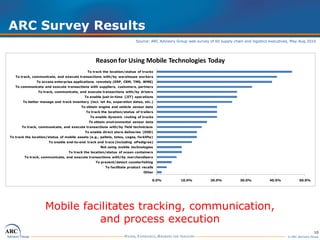
To access enterprise applications remotely (ERP, CRM, TMS, WMS)
To track, communicate, and execute transactions with/by warehouse workers
To track the location/status of trucks
Reason for Using Mobile Technologies Today
Mobile facilitates tracking, communication,
and process execution
11
© ARC Advisory Group
ARC Survey Results
0% 10% 20% 30% 40% 50% 60% 70% 80% 90%
To obtain engine and vehicle sensor data
To enable direct store delivery (DSD)
To obtain environmental sensor data
To track the location/status of ocean containers
To track the location/status of trailers
To track, communicate, and execute transactions
with/by drivers, field techs, or merchandisers
To track the location/status of trucks
To track the location/status of mobile assets
(pallets, totes, etc.)
To track, communicate, and execute transactions
with/by warehouse workers
To communicate and execute transactions with
suppliers, customers, partners
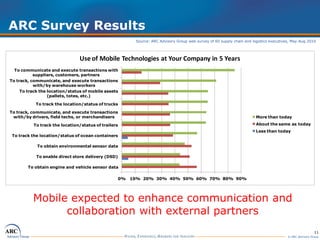
Use of Mobile Technologies at Your Company in 5 Years
More than today
About the same as today
Less than today
Source: ARC Advisory Group web survey of 60 supply chain and logistics executives, May-Aug 2010
Mobile expected to enhance communication and
collaboration with external partners
12
© ARC Advisory Group
ARC Survey Results
0.0% 10.0% 20.0% 30.0% 40.0% 50.0% 60.0% 70.0%
Other
No benefits, not using mobile technologies
Cost avoidance by rejecting shipments that violated environmental specs
Increased sales (e.g., from enabling DSD or driver sales transactions)
Reduction of lost/stolen mobile assets
Faster payment cycle (e.g., invoice triggered by proof of delivery sent wirelessly)
Reduced downtime of vehicles via proactive maintenance
Improved safety performance (e.g., telematics data leading to less speeding)
Increased utlization of mobile assets
Enhanced security of goods in transit (e.g., geo-fencing)
Increased utlization of trucks
Increased on-shelf availability of product
Faster resolution to exceptions (due to enhanced real-time visibility)
Reduced lead times via enhanced visibility
Increased productivity of warehouse workers
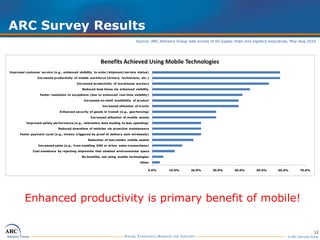
Increased productivity of mobile workforce (drivers, technicians, etc.)
Improved customer service (e.g., enhanced visibility to order/shipment/service status)
Benefits Achieved Using Mobile Technologies
Source: ARC Advisory Group web survey of 60 supply chain and logistics executives, May-Aug 2010
Enhanced productivity is primary benefit of mobile!
13
© ARC Advisory Group
ARC Survey Results
0.0% 10.0% 20.0% 30.0% 40.0% 50.0% 60.0%
Other technologies are a better fit
Other
Inability to convince upper management of value
Lack of trading partner support (suppliers, customers, carriers,…
Too complex to implement and manage
Cultural change issues
Would require significant process changes to achieve benefits
Freeze on capital investments
Not compatible with ERP or supply chain software
Lack of global standards/protocols
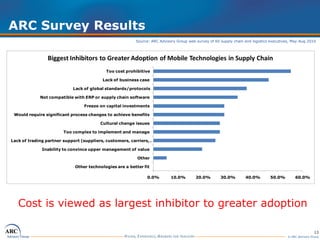
Lack of business case
Too cost prohibitive
Biggest Inhibitors to Greater Adoption of Mobile Technologies in Supply Chain
Source: ARC Advisory Group web survey of 60 supply chain and logistics executives, May-Aug 2010
Cost is viewed as largest inhibitor to greater adoption
14
© ARC Advisory Group
Summary
 Mobile Internet usage is and will be bigger than
most people think.
 Use of mobile technologies by consumers is
growing quickly, especially in Asia and emerging
economies.
 Mobile + Social Media = Process Innovation
 Supply chain software vendors are investing
heavily in mobile solutions.
 Early adopters, including CPG companies and 3PLs,
are already achieving benefits.
15
© ARC Advisory Group
Thank You!
Adrian Gonzalez
Director, Logistics Viewpoints
617.529.9639
adrian@logisticsviewpoints.com
Go to LogisticsViewpoints.com to stay informed of the latest logistics trends, technologies, and services

Mobile Technologies and Supply Chain @ ARC's 2011 Industry Forum

  • 1.
    Mobile Technologies andSupply Chain Beyond the Perfect Order Metric Seminar February 10, 2011 Adrian Gonzalez Director, Logistics Viewpoints Adrian@Logisticsviewpoints.com
  • 2.
    2 © ARC AdvisoryGroup Key Takeaways  Mobile Internet usage is and will be bigger than most people think.  Use of mobile technologies by consumers is growing quickly, especially in Asia and emerging economies. This will impact supply chains.  Mobile + Social Media = Process Innovation  Supply chain software vendors are investing heavily in mobile solutions.  Early adopters, including CPG companies and 3PLs, are already achieving benefits.
  • 3.
    3 © ARC AdvisoryGroup Consumers Much More Instrumented “Today’s consumers are much more instrumented than their predecessors, and they are increasingly ready to use these technologies to interact both with retailers and with other consumers. Our research suggests that they would like to use…mobile phones to find out where the nearest store is located (75 percent), compare prices (71 percent) and check that the goods they want are in stock before going to the store (66 percent).”
  • 4.
    4 © ARC AdvisoryGroup Kraft Foods’ iPhone App “Business will be mobile and supply chains have to respond.” Deborah Lentz, Vice President Customer Service and Logistics, Kraft Foods Europe, at the CSCMP Europe 2010 Conference
  • 5.
    5 © ARC AdvisoryGroup Mobile Internet Usage Is and Will Be… …Bigger Than Most People Think! Source: Mary Meeker, Morgan Stanley, Web 2.0 Summit, October 2009
  • 6.
    6 © ARC AdvisoryGroup Mobile + Social Media = Process Innovation Source: Mary Meeker, Morgan Stanley, Web 2.0 Summit, October 2009 Improvements in social networking and mobile computing platforms…are fundamentally changing the ways people communicate with each other ...
  • 7.
    7 © ARC AdvisoryGroup Facebook & Twitter in SCM?
  • 8.
    8 © ARC AdvisoryGroup Con-way Redefining Brokerage Process
  • 9.
    9 © ARC AdvisoryGroup ARC Survey Results Source: ARC Advisory Group web survey of 60 supply chain and logistics executives, May-Aug 2010 0.0% 10.0% 20.0% 30.0% 40.0% 50.0% 60.0% 70.0% 80.0% Other Active (battery-powered) RFID tags Not using any mobile technologies Passive (no battery) RFID tags Wearable (hands-free) computers (e.g., Motorola) In-cab computers Mobile voice recognition headsets (e.g., Vocollect) Telematics (engine and vehicle sensor data) Environmental sensors (temperature, humidty, etc) Global Positioning Satellite (GPS) Mobile bar code scanners Cellular networks (voice and data) Handheld computers (e.g., Motorola, Intermec) Smartphones (e.g., Blackberry, iPhone) Mobile Technologies Currently Used in Supply Chain and Logistics Operations N = 59 Smartphones are becoming a ubiquitous computing platform
  • 10.
    10 © ARC AdvisoryGroup ARC Survey Results Source: ARC Advisory Group web survey of 60 supply chain and logistics executives, May-Aug 2010 0.0% 10.0% 20.0% 30.0% 40.0% 50.0% Other To facilitate product recalls To prevent/detect counterfeiting To track, communicate, and execute transactions with/by merchandisers To track the location/status of ocean containers Not using mobile technologies To enable end-to-end track and trace (including ePedigree) To track the location/status of mobile assets (e.g., pallets, totes, cages, forklifts) To enable direct store deliveries (DSD) To track, communicate, and execute transactions with/by field technicians To obtain environmental sensor data To enable dynamic routing of trucks To track the location/status of trailers To obtain engine and vehicle sensor data To better manage and track inventory (incl. lot #s, experation dates, etc.) To enable just-in-time (JIT) operations To track, communicate, and execute transactions with/by drivers To communicate and execute transactions with suppliers, customers, partners To access enterprise applications remotely (ERP, CRM, TMS, WMS) To track, communicate, and execute transactions with/by warehouse workers To track the location/status of trucks Reason for Using Mobile Technologies Today Mobile facilitates tracking, communication, and process execution
  • 11.
    11 © ARC AdvisoryGroup ARC Survey Results 0% 10% 20% 30% 40% 50% 60% 70% 80% 90% To obtain engine and vehicle sensor data To enable direct store delivery (DSD) To obtain environmental sensor data To track the location/status of ocean containers To track the location/status of trailers To track, communicate, and execute transactions with/by drivers, field techs, or merchandisers To track the location/status of trucks To track the location/status of mobile assets (pallets, totes, etc.) To track, communicate, and execute transactions with/by warehouse workers To communicate and execute transactions with suppliers, customers, partners Use of Mobile Technologies at Your Company in 5 Years More than today About the same as today Less than today Source: ARC Advisory Group web survey of 60 supply chain and logistics executives, May-Aug 2010 Mobile expected to enhance communication and collaboration with external partners
  • 12.
    12 © ARC AdvisoryGroup ARC Survey Results 0.0% 10.0% 20.0% 30.0% 40.0% 50.0% 60.0% 70.0% Other No benefits, not using mobile technologies Cost avoidance by rejecting shipments that violated environmental specs Increased sales (e.g., from enabling DSD or driver sales transactions) Reduction of lost/stolen mobile assets Faster payment cycle (e.g., invoice triggered by proof of delivery sent wirelessly) Reduced downtime of vehicles via proactive maintenance Improved safety performance (e.g., telematics data leading to less speeding) Increased utlization of mobile assets Enhanced security of goods in transit (e.g., geo-fencing) Increased utlization of trucks Increased on-shelf availability of product Faster resolution to exceptions (due to enhanced real-time visibility) Reduced lead times via enhanced visibility Increased productivity of warehouse workers Increased productivity of mobile workforce (drivers, technicians, etc.) Improved customer service (e.g., enhanced visibility to order/shipment/service status) Benefits Achieved Using Mobile Technologies Source: ARC Advisory Group web survey of 60 supply chain and logistics executives, May-Aug 2010 Enhanced productivity is primary benefit of mobile!
  • 13.
    13 © ARC AdvisoryGroup ARC Survey Results 0.0% 10.0% 20.0% 30.0% 40.0% 50.0% 60.0% Other technologies are a better fit Other Inability to convince upper management of value Lack of trading partner support (suppliers, customers, carriers,… Too complex to implement and manage Cultural change issues Would require significant process changes to achieve benefits Freeze on capital investments Not compatible with ERP or supply chain software Lack of global standards/protocols Lack of business case Too cost prohibitive Biggest Inhibitors to Greater Adoption of Mobile Technologies in Supply Chain Source: ARC Advisory Group web survey of 60 supply chain and logistics executives, May-Aug 2010 Cost is viewed as largest inhibitor to greater adoption
  • 14.
    14 © ARC AdvisoryGroup Summary  Mobile Internet usage is and will be bigger than most people think.  Use of mobile technologies by consumers is growing quickly, especially in Asia and emerging economies.  Mobile + Social Media = Process Innovation  Supply chain software vendors are investing heavily in mobile solutions.  Early adopters, including CPG companies and 3PLs, are already achieving benefits.
  • 15.
    15 © ARC AdvisoryGroup Thank You! Adrian Gonzalez Director, Logistics Viewpoints 617.529.9639 adrian@logisticsviewpoints.com Go to LogisticsViewpoints.com to stay informed of the latest logistics trends, technologies, and services