The document discusses the challenges and future trends in the logistics industry, highlighting rising operational costs, changing supply chain models, and the need for skilled talent. It emphasizes the impact of globalization and technological advancements on logistics, such as the shift from air to ocean transport and increasing automation. Additionally, it focuses on Hong Kong's logistics landscape, noting its significant contribution to GDP and the challenges of infrastructure and human resource shortages.
LOGISTICS : FUTURE&
CHALLANGES
Teguh Siswanto
Chairman of Indonesian Logistics Community
2.
AGENDA
- Logistics IndustryOverview
- Challenges Faced by the Logistics Industry
- Upward Trend on Operating Costs
- Change of Supply Chain Model
- Fast Pace Development of nearby areas
- Human Resources & Talents
- Way Forward
2
3.
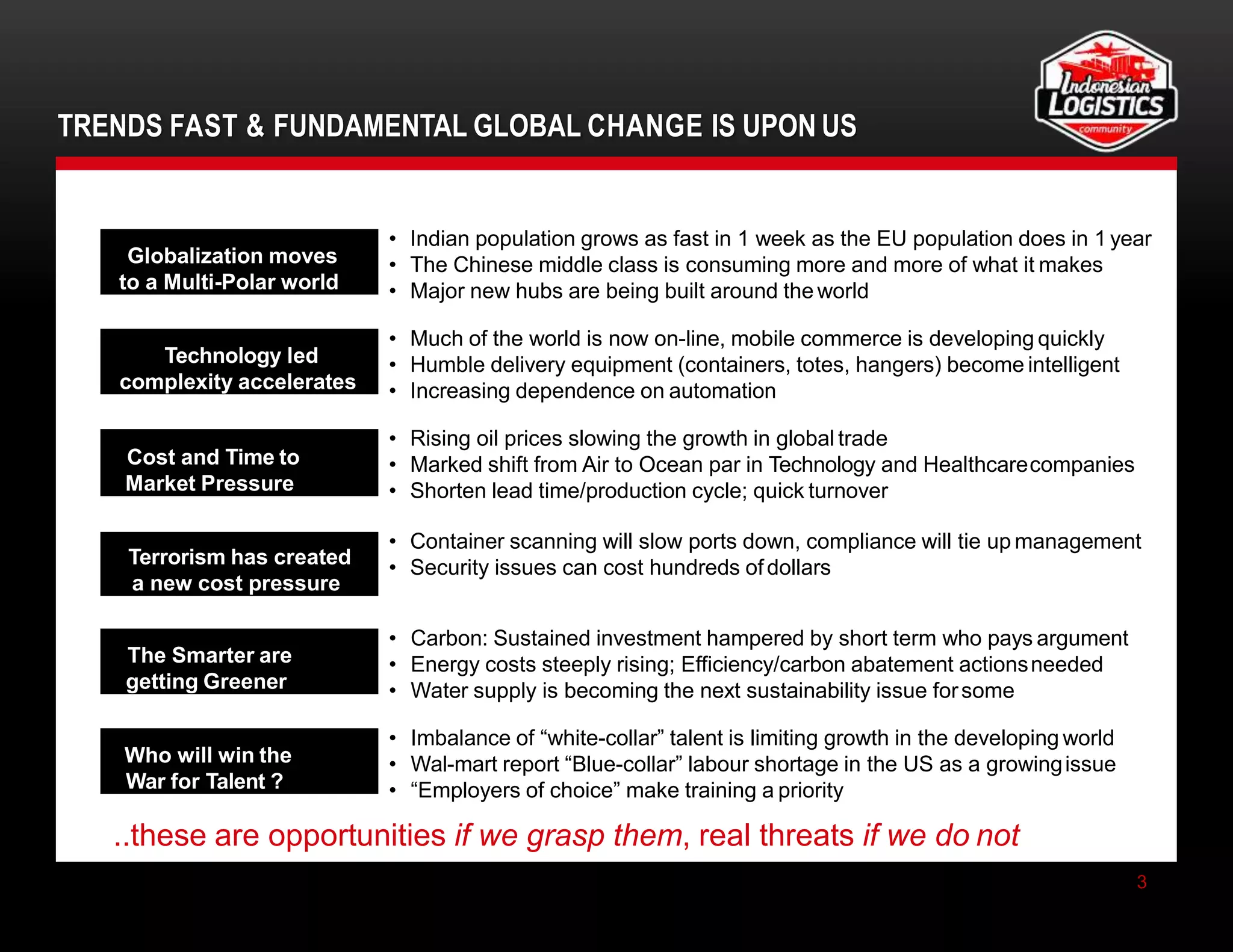
TRENDS FAST &FUNDAMENTAL GLOBAL CHANGE IS UPON US
3
Globalization moves
to a Multi-Polar world
Technology led
complexity accelerates
Cost and Time to
Market Pressure
The Smarter are
getting Greener
Terrorism has created
a new cost pressure
Who will win the
War for Talent ?
• Indian population grows as fast in 1 week as the EU population does in 1 year
• The Chinese middle class is consuming more and more of what it makes
• Major new hubs are being built around the world
• Much of the world is now on-line, mobile commerce is developing quickly
• Humble delivery equipment (containers, totes, hangers) become intelligent
• Increasing dependence on automation
• Rising oil prices slowing the growth in global trade
• Marked shift from Air to Ocean par in Technology and Healthcarecompanies
• Shorten lead time/production cycle; quick turnover
• Container scanning will slow ports down, compliance will tie up management
• Security issues can cost hundreds ofdollars
• Carbon: Sustained investment hampered by short term who pays argument
• Energy costs steeply rising; Efficiency/carbon abatement actionsneeded
• Water supply is becoming the next sustainability issue forsome
• Imbalance of “white-collar” talent is limiting growth in the developing world
• Wal-mart report “Blue-collar” labour shortage in the US as a growingissue
• “Employers of choice” make training a priority
..these are opportunities if we grasp them, real threats if we do not
4.
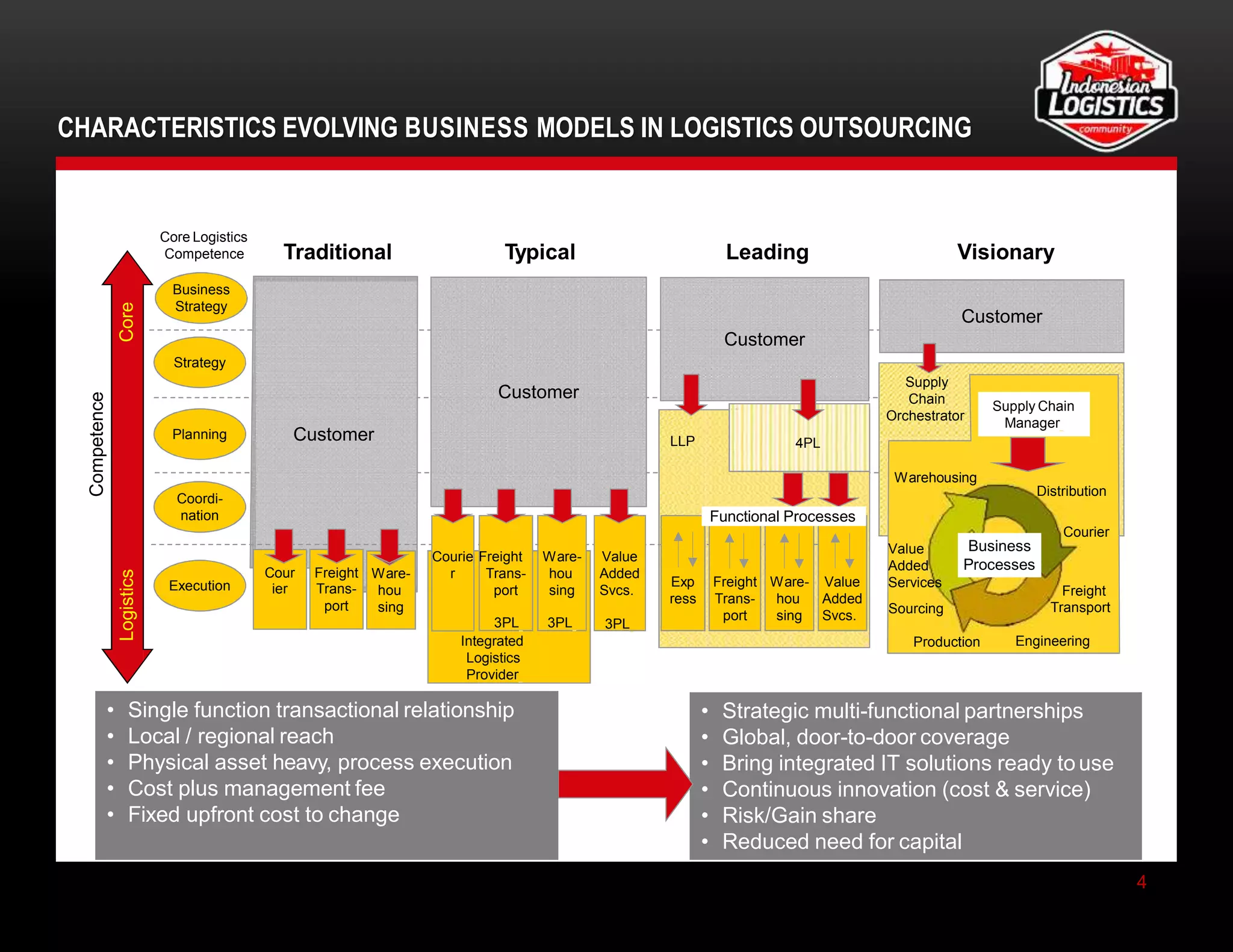
• Strategic multi-functionalpartnerships
• Global, door-to-door coverage
• Bring integrated IT solutions ready touse
• Continuous innovation (cost & service)
• Risk/Gain share
• Reduced need for capital
CHARACTERISTICS EVOLVING BUSINESS MODELS IN LOGISTICS OUTSOURCING
Strategy
Traditional Typical Leading Visionary
Business
Strategy
Core Logistics
Competence
Customer
Customer
Core
Supply
Chain
Orchestrator
Supply Chain
Manager
Customer
• Single function transactional relationship
• Local / regional reach
• Physical asset heavy, process execution
• Cost plus management fee
• Fixed upfront cost to change
Business
Processes
Warehousing
Freight
Transport
Value
Added
Services
Sourcing
Production
Coordi-
nation
Execution
LLP 4PL
Integrated
Logistics
Provider
Ware-
hou
sing
Value
Added
Svcs.
Ware-
hou
sing
Value
Added
Svcs.
Ware-
hou
sing
Trans-
port
3PL 3PL 3PL
Logistics
Exp Freight
ress Trans-
port
Courie Freight
rCour Freight
ier Trans-
port
Engineering
Distribution
Planning Customer
Competence
Functional Processes
4
Courier
5.
HONG KONG LOGISTICSINDUSTRY OVERVIEW
Page 10
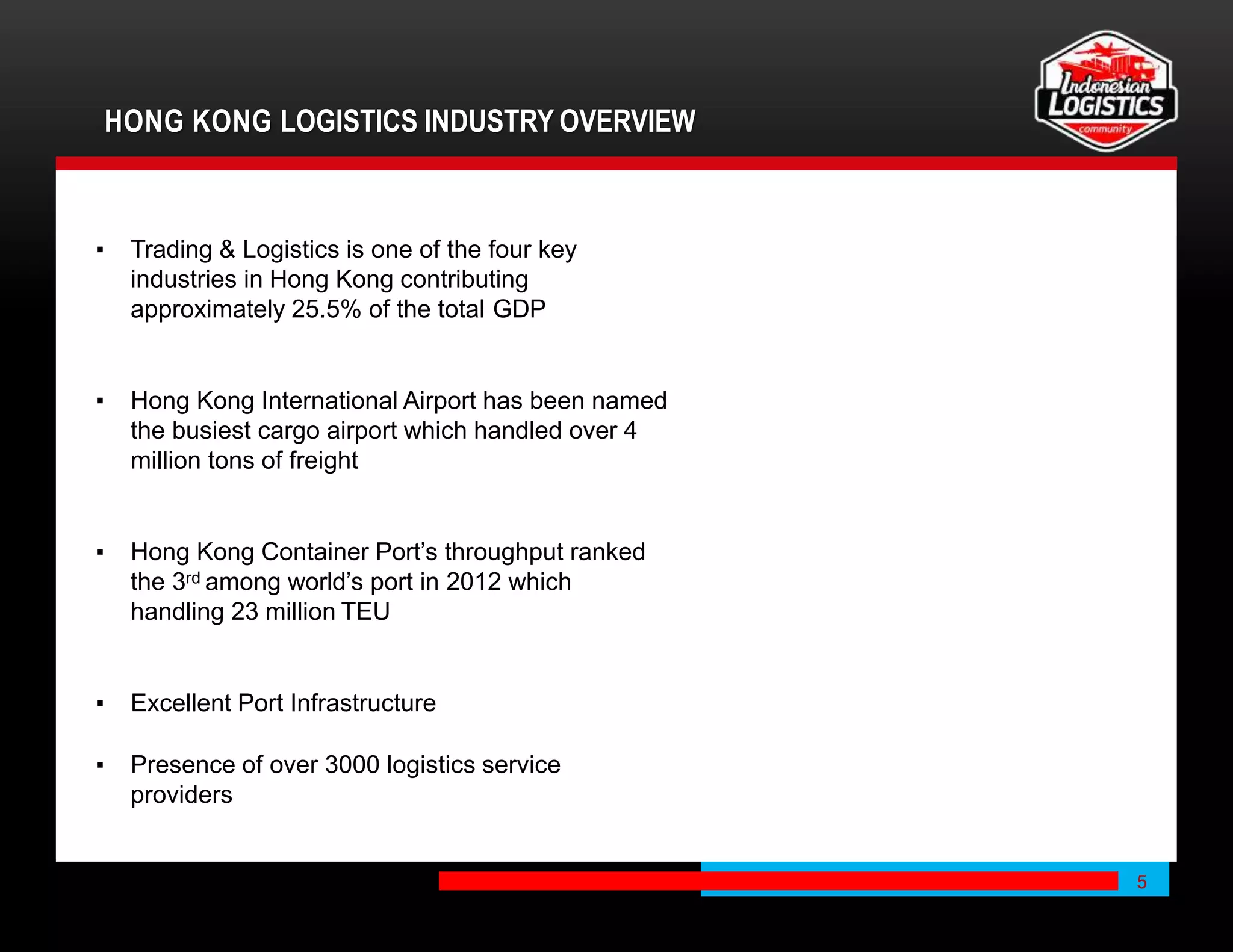
▪ Trading & Logistics is one of the four key
industries in Hong Kong contributing
approximately 25.5% of the total GDP
▪ Hong Kong International Airport has been named
the busiest cargo airport which handled over 4
million tons of freight
▪ Hong Kong Container Port’s throughput ranked
the 3rd among world’s port in 2012 which
handling 23 million TEU
▪ Excellent Port Infrastructure
▪ Presence of over 3000 logistics service
providers
5
6.
HONG KONG AIRFREIGHT & LOGISTICS INDUSTRY OVERVIEW
Sources: Hong Kong Census and Statistics Department
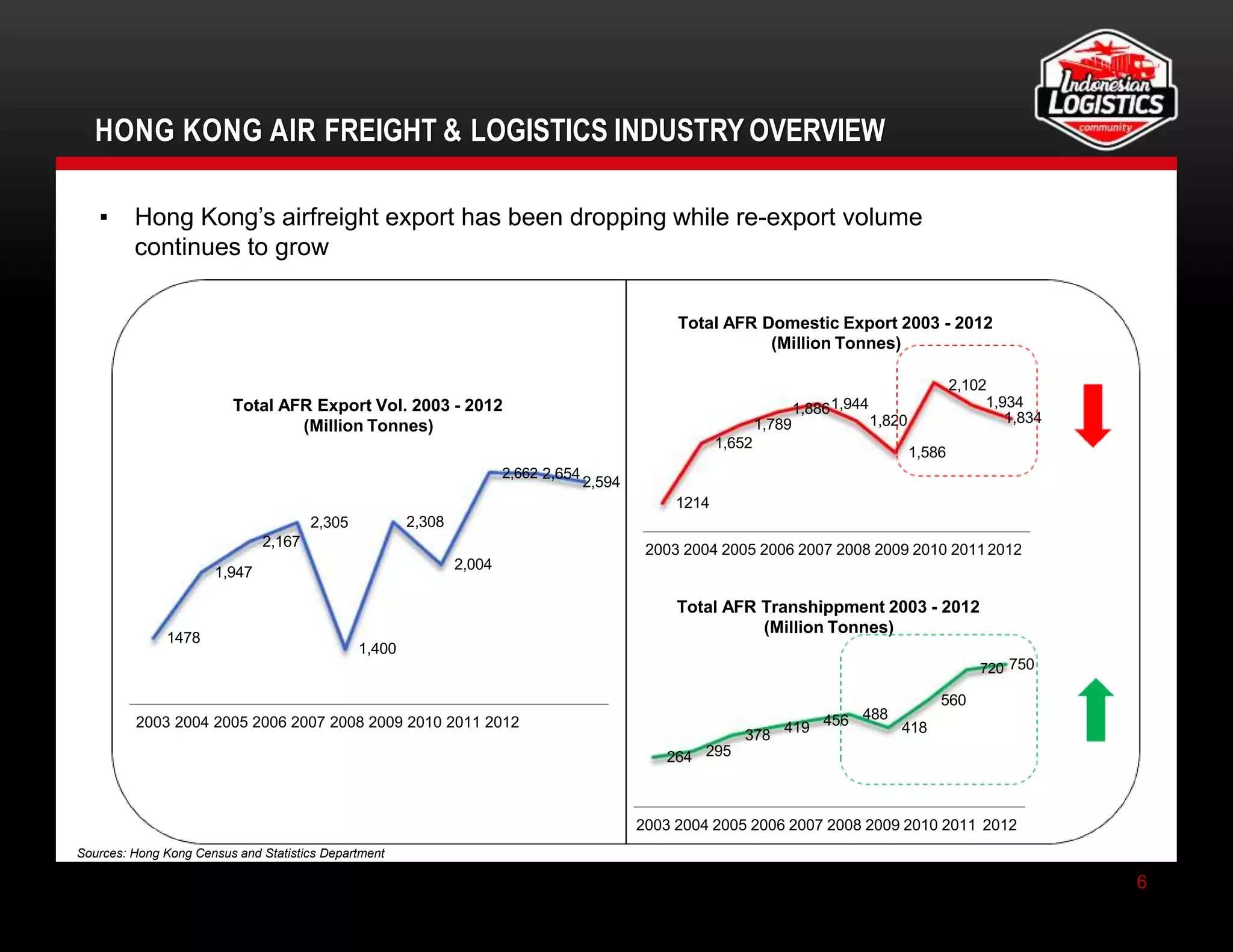
1478
1,947
2,167
2,305
1,400
2,308
2,004
2,662 2,654
2,594
2003 2004 2005 2006 2007 2008 2009 2010 2011 2012
Total AFR Export Vol. 2003 - 2012
(Million Tonnes)
1214
1,886
1,789
1,652
1,944
1,820
1,586
1,934
1,834
2003 2004 2005 2006 2007 2008 2009 2010 20112012
▪ Hong Kong’s airfreight export has been dropping while re-export volume
continues to grow
Total AFR Domestic Export 2003 - 2012
(Million Tonnes)
2,102
264 295
378 419 456 488
418
720 750
560
2003 2004 2005 2006 2007 2008 2009 2010 2011 2012
Total AFR Transhippment 2003 - 2012
(Million Tonnes)
6
7.
HONG KONG OCEANFREIGHT & LOGISTICS INDUSTRY OVERVIEW
Sources: Hong Kong Marine Department
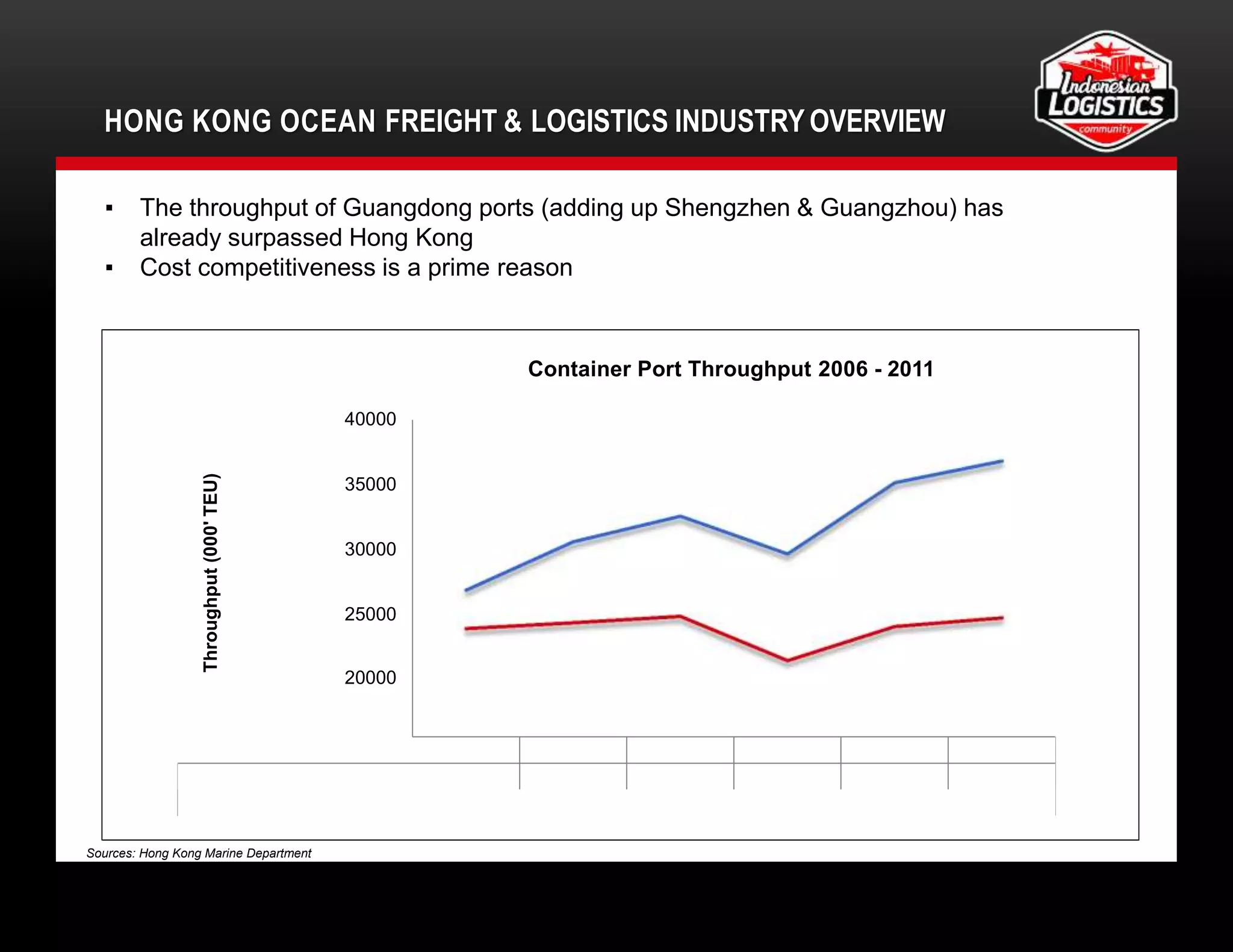
▪ The throughput of Guangdong ports (adding up Shengzhen & Guangzhou) has
already surpassed Hong Kong
▪ Cost competitiveness is a prime reason
15000
2006 2007 2008 2009 2010 2011
Hong Kong (000' TEU) 23539 23998 24494 21040 23699 24384
Guangdong (000' TEU) 26590 30399 32418 29450 35056 36767
40000
35000
30000
25000
20000
Throughput(000'TEU)
Container Port Throughput 2006 - 2011
7
8.
AGENDA
- Hong KongLogistics Industry Overview
- Challenges Faced by the Logistics Industry
- Upward Trend on Operating Costs
- Change of Supply Chain Model
- Shift of Production Pattern
- Human Resources & Talents
- Way Forward
8
9.
CHALLENGES FACED BYTHE LOGISTICS INDUSTRY
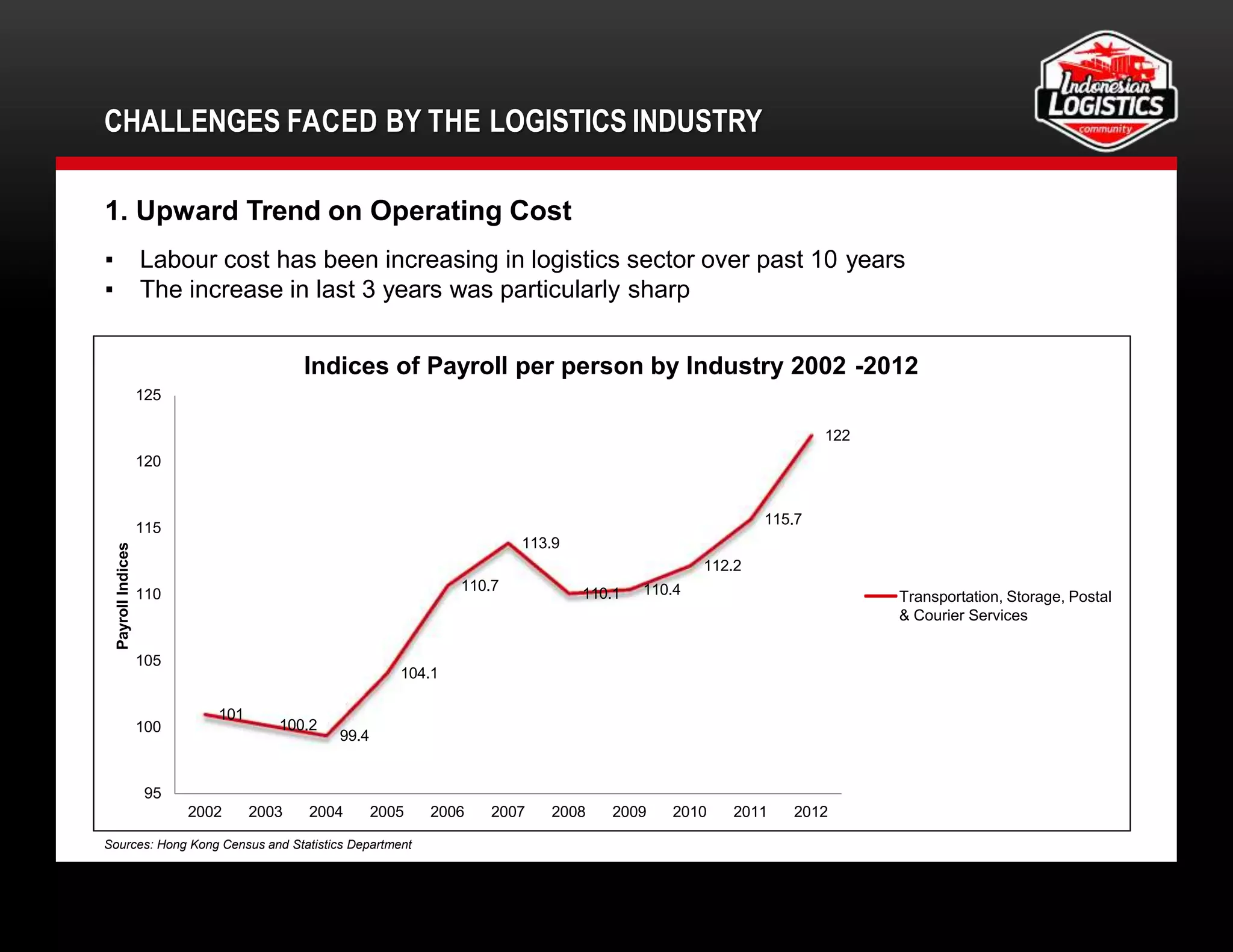
101
100.2
99.4
104.1
110.7
113.9
110.1 110.4
112.2
115.7
122
100
105
110
115
120
125
95
2002 2003 2004 2005 2006 2007 2008 2009 2010 2011 2012
PayrollIndices
1. Upward Trend on Operating Cost
▪ Labour cost has been increasing in logistics sector over past 10 years
▪ The increase in last 3 years was particularly sharp
Indices of Payroll per person by Industry 2002 -2012
Transportation, Storage, Postal
& Courier Services
Sources: Hong Kong Census and Statistics Department
9
10.
CHALLENGES FACED BYTHE LOGISTICS INDUSTRY
10
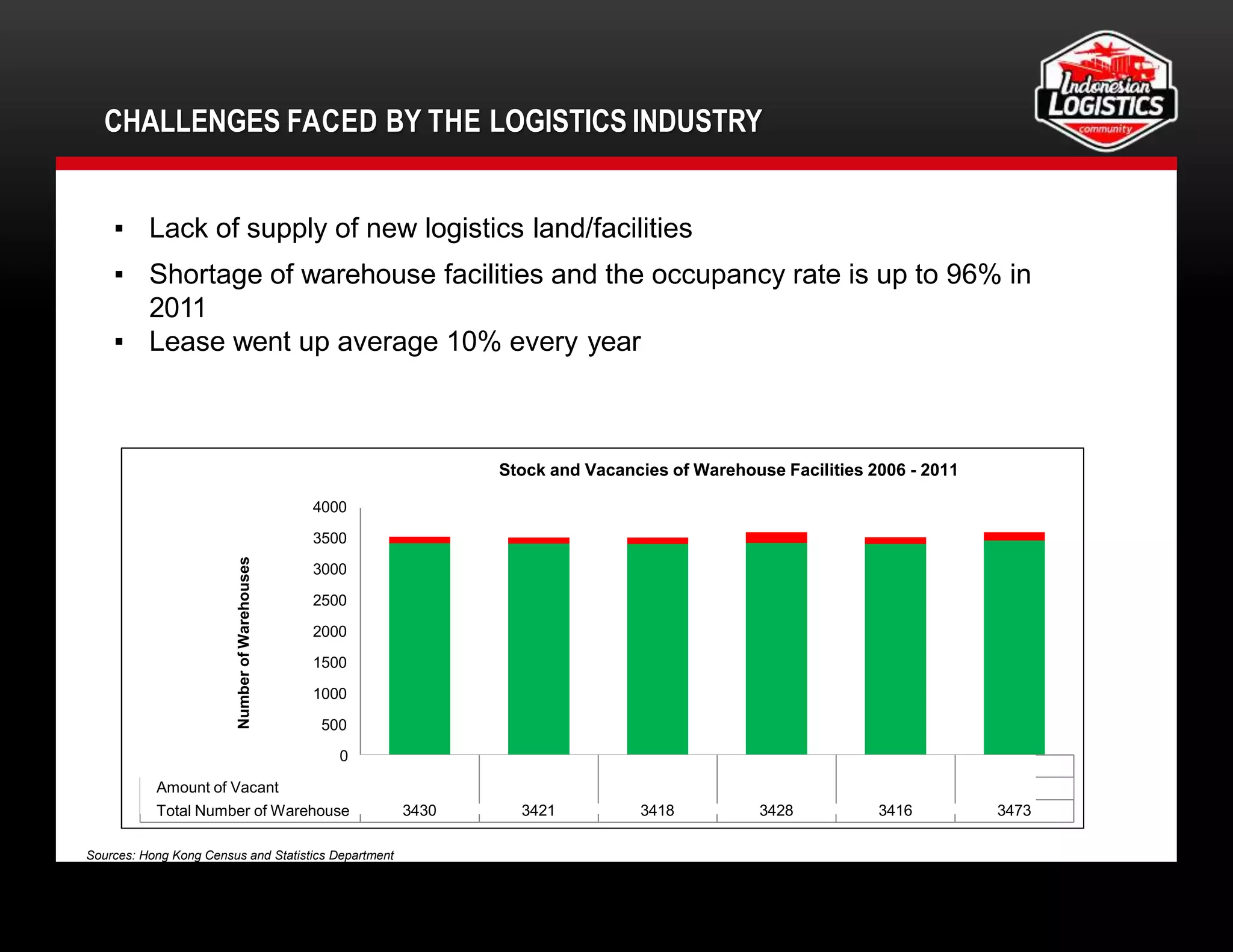
▪ Lack of supply of new logistics land/facilities
▪ Shortage of warehouse facilities and the occupancy rate is up to 96% in
2011
▪ Lease went up average 10% every year
2006 2007 2008 2009 2010 2011
101 96 99 177 107 131Amount of Vacant
Total Number of Warehouse 3430 3421 3418 3428 3416 3473
4000
3500
3000
2500
2000
1500
1000
500
0
NumberofWarehouses
Stock and Vacancies of Warehouse Facilities 2006 - 2011
Sources: Hong Kong Census and Statistics Department
11.
AGENDA
11
- Hong KongAir Freight and Logistics Industry Overview
- Challenges Faced by Air Freight and Logistics Industry
- Upward Trend on Operating Cost
- Change of Supply Chain Model
- Shift of Production Pattern
- Fast Pace of Development in Southern China
- Way Forward
12.
CHALLENGES FACED BYTHE LOGISTICS INDUSTRY
12
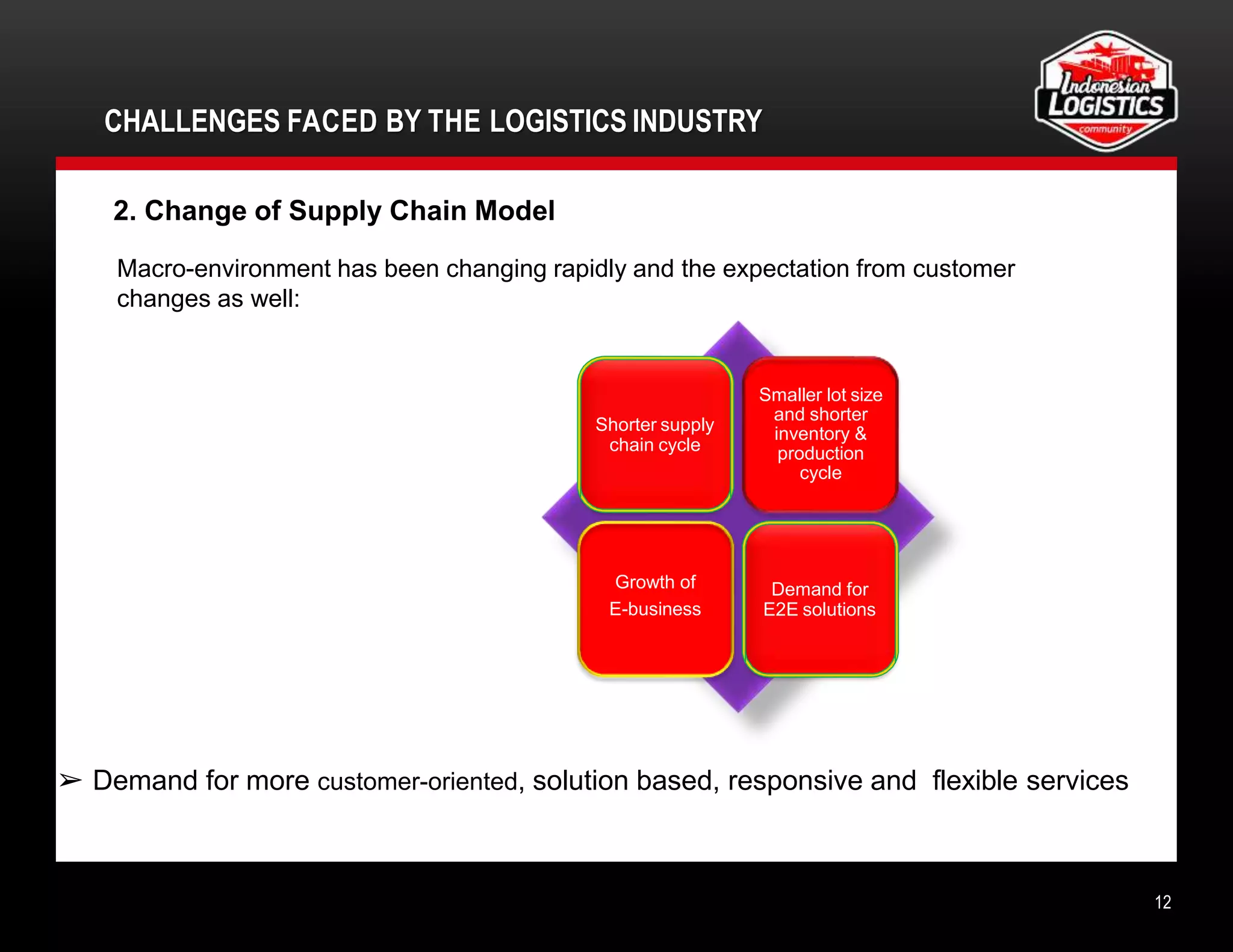
2. Change of Supply Chain Model
Macro-environment has been changing rapidly and the expectation from customer
changes as well:
Shorter supply
chain cycle
Smaller lot size
and shorter
inventory &
production
cycle
Growth of
E-business
Demand for
E2E solutions
➢ Demand for more customer-oriented, solution based, responsive and flexible services
13.
AGENDA
13
- Hong KongAir Freight and Logistics Industry Overview
- Challenges Faced by Air Freight and Logistics Industry
- Upward Trend on Operating Cost
- Change of Supply Chain Model
- Shift of Production Pattern
- Human Resources & Talents
- Way Forward
14.
CHALLENGES FACED BYTHE LOGISTICS INDUSTRY
14
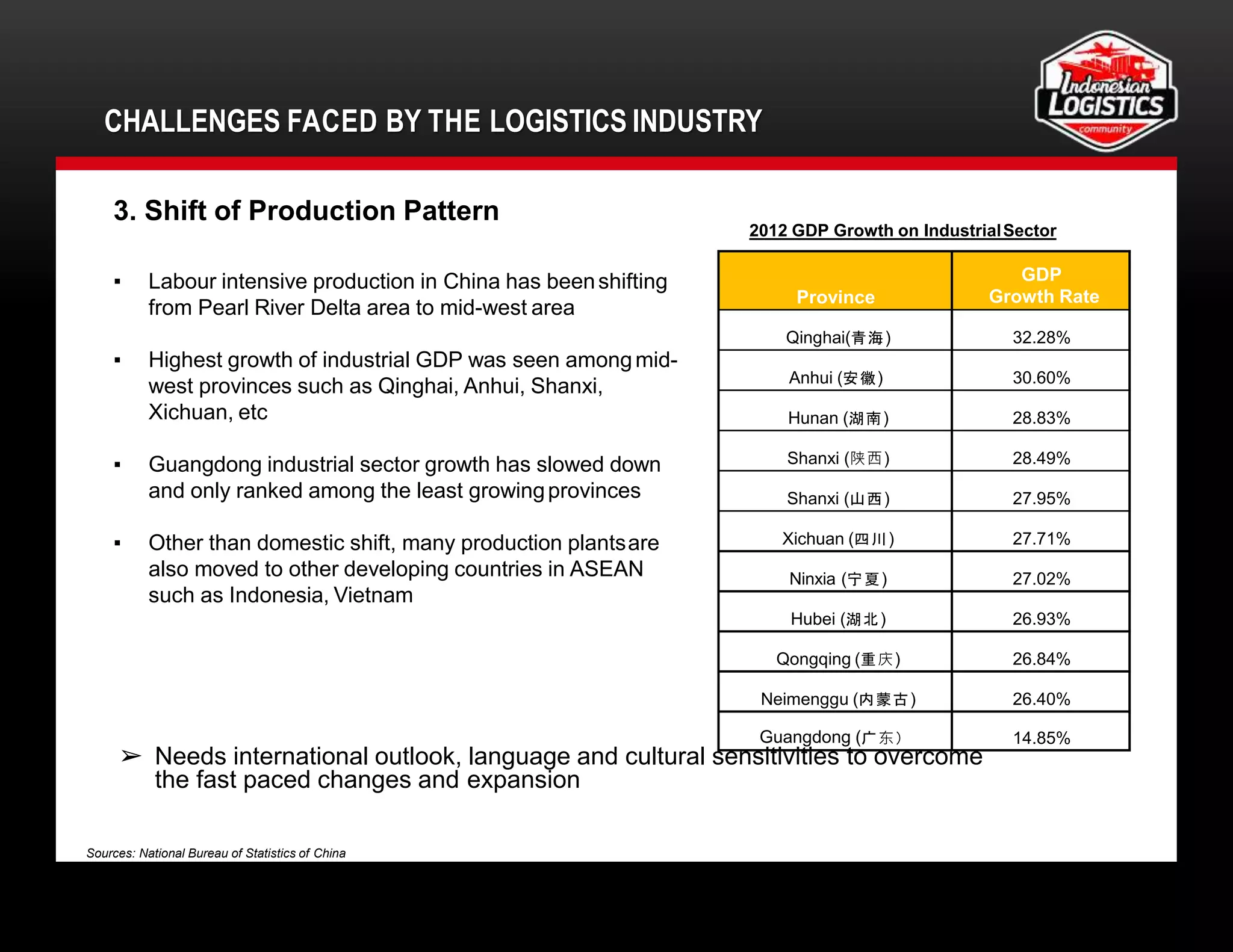
Province
GDP
Growth Rate
Qinghai(青海) 32.28%
Anhui (安徽) 30.60%
Hunan (湖南) 28.83%
Shanxi (陕西) 28.49%
Shanxi (山西) 27.95%
Xichuan (四川) 27.71%
Ninxia (宁夏) 27.02%
Hubei (湖北) 26.93%
Qongqing (重庆) 26.84%
Neimenggu (内蒙古) 26.40%
Guangdong (广东) 14.85%
3. Shift of Production Pattern
▪ Labour intensive production in China has beenshifting
from Pearl River Delta area to mid-west area
▪ Highest growth of industrial GDP was seen amongmid-
west provinces such as Qinghai, Anhui, Shanxi,
Xichuan, etc
▪ Guangdong industrial sector growth has slowed down
and only ranked among the least growingprovinces
▪ Other than domestic shift, many production plantsare
also moved to other developing countries in ASEAN
such as Indonesia, Vietnam
Sources: National Bureau of Statistics of China
2012 GDP Growth on IndustrialSector
➢ Needs international outlook, language and cultural sensitivities to overcome
the fast paced changes and expansion
15.
AGENDA
15
- Hong KongFreight and Logistics Industry Overview
- Challenges Faced by the Logistics Industry
- Upward Trend on Operating Cost
- Change of Supply Chain Model
- Shift of Production Pattern
- Human Resources & Talents
- Way Forward
16.
CHALLENGES FACED BYTHE LOGISTICS INDUSTRY
16
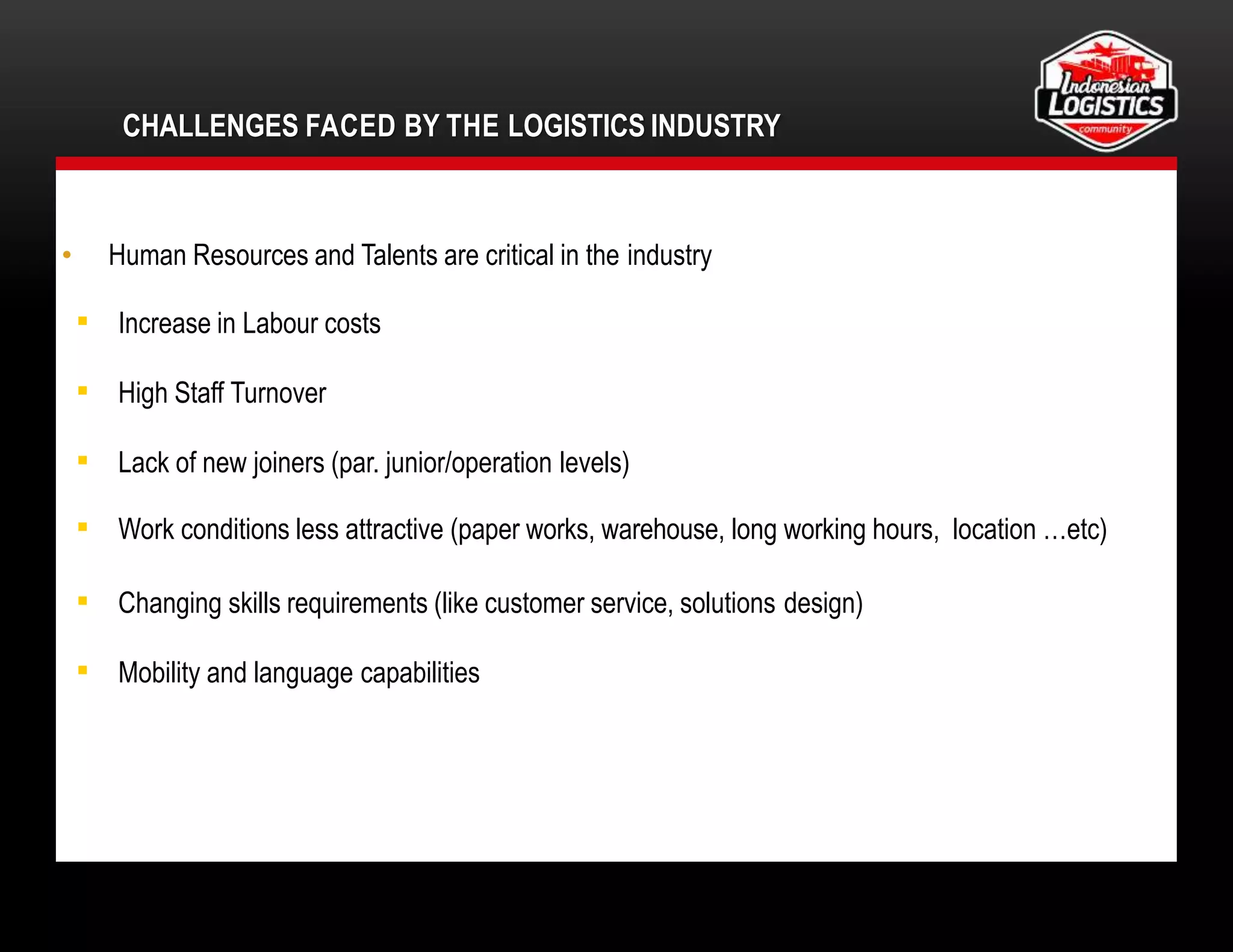
• Human Resources and Talents are critical in the industry
▪ Increase in Labour costs
▪ High Staff Turnover
▪ Lack of new joiners (par. junior/operation levels)
▪ Work conditions less attractive (paper works, warehouse, long working hours, location …etc)
▪ Changing skills requirements (like customer service, solutions design)
▪ Mobility and language capabilities
17.
AGENDA
17
- Hong KongAir Freight and Logistics Industry Overview
- Challenges Faced by Air Freight and Logistics Industry
- Upward Trend on Operating Cost
- Change of Supply Chain Model
- Shift of Production Pattern
- Fast Pace of Development in Southern China
- Way Forward
18.
WAY FORWARD
18
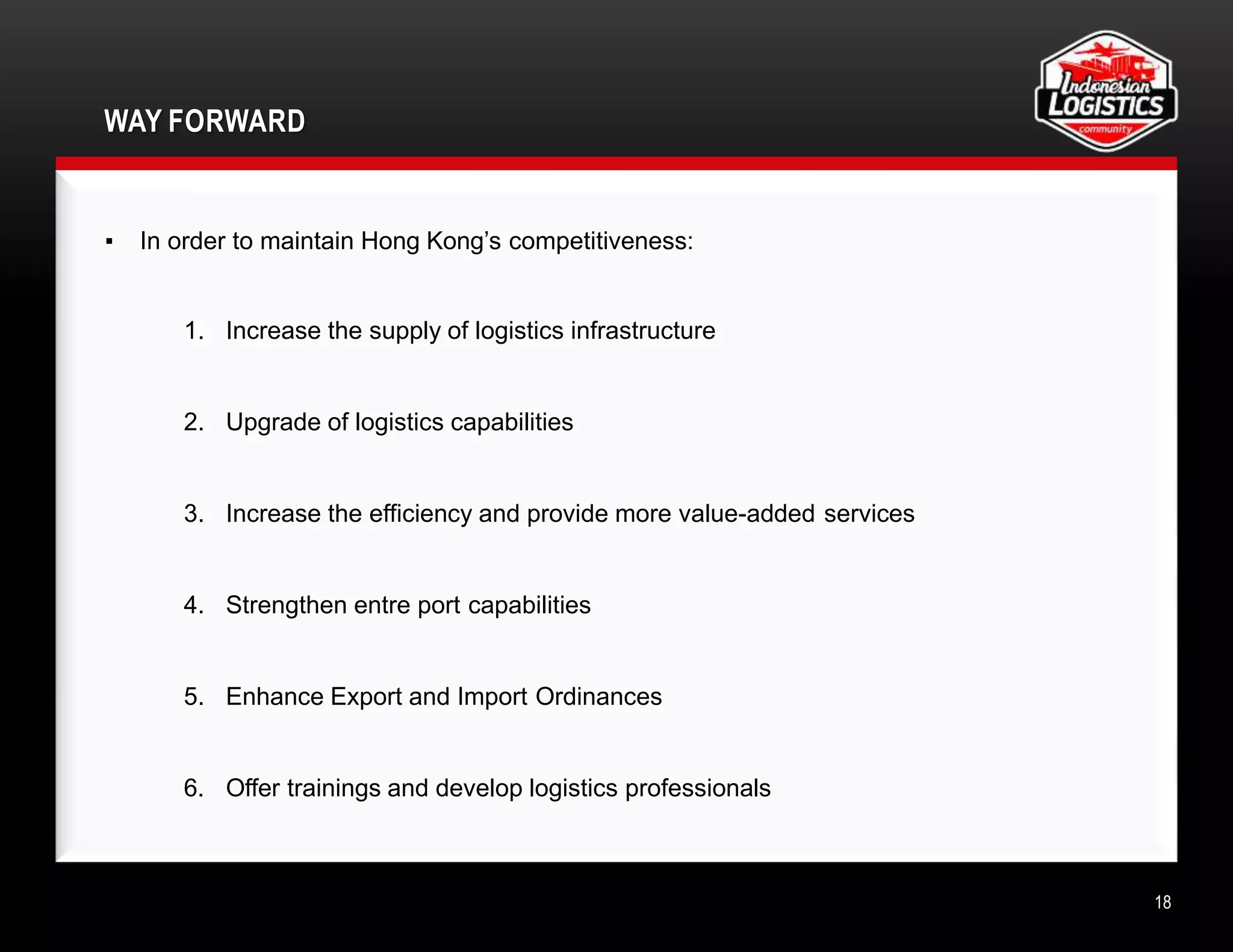
▪ Inorder to maintain Hong Kong’s competitiveness:
1. Increase the supply of logistics infrastructure
2. Upgrade of logistics capabilities
3. Increase the efficiency and provide more value-added services
4. Strengthen entre port capabilities
5. Enhance Export and Import Ordinances
6. Offer trainings and develop logistics professionals