Supply Chain Risk Guest lecture, LOG 711, 12.11.2008 Jan Husdal    jan.husdal@himolde.no    71214289
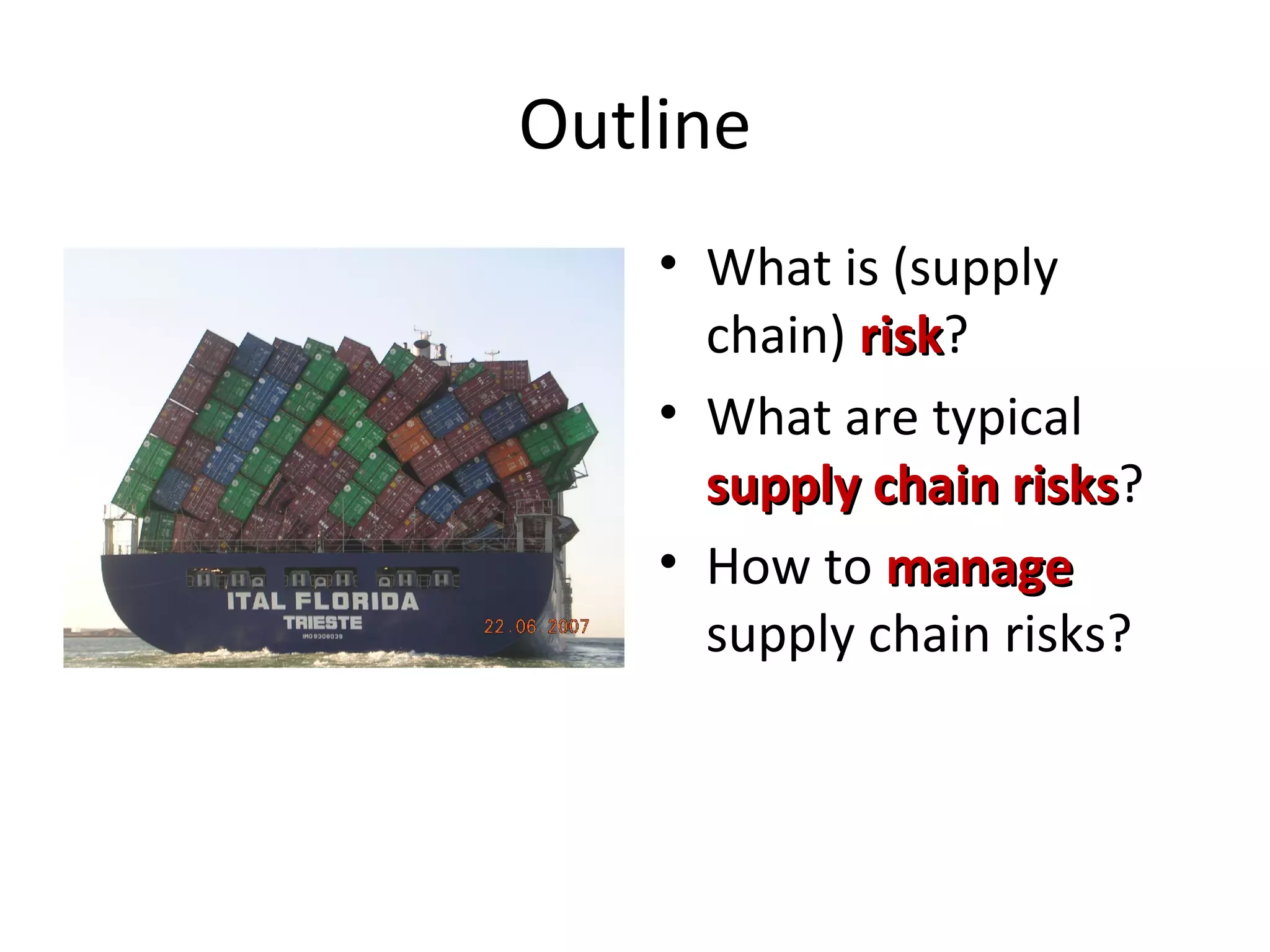
Outline What is (supply chain)  risk ? What are typical  supply chain risks ? How to  manage  supply chain risks?
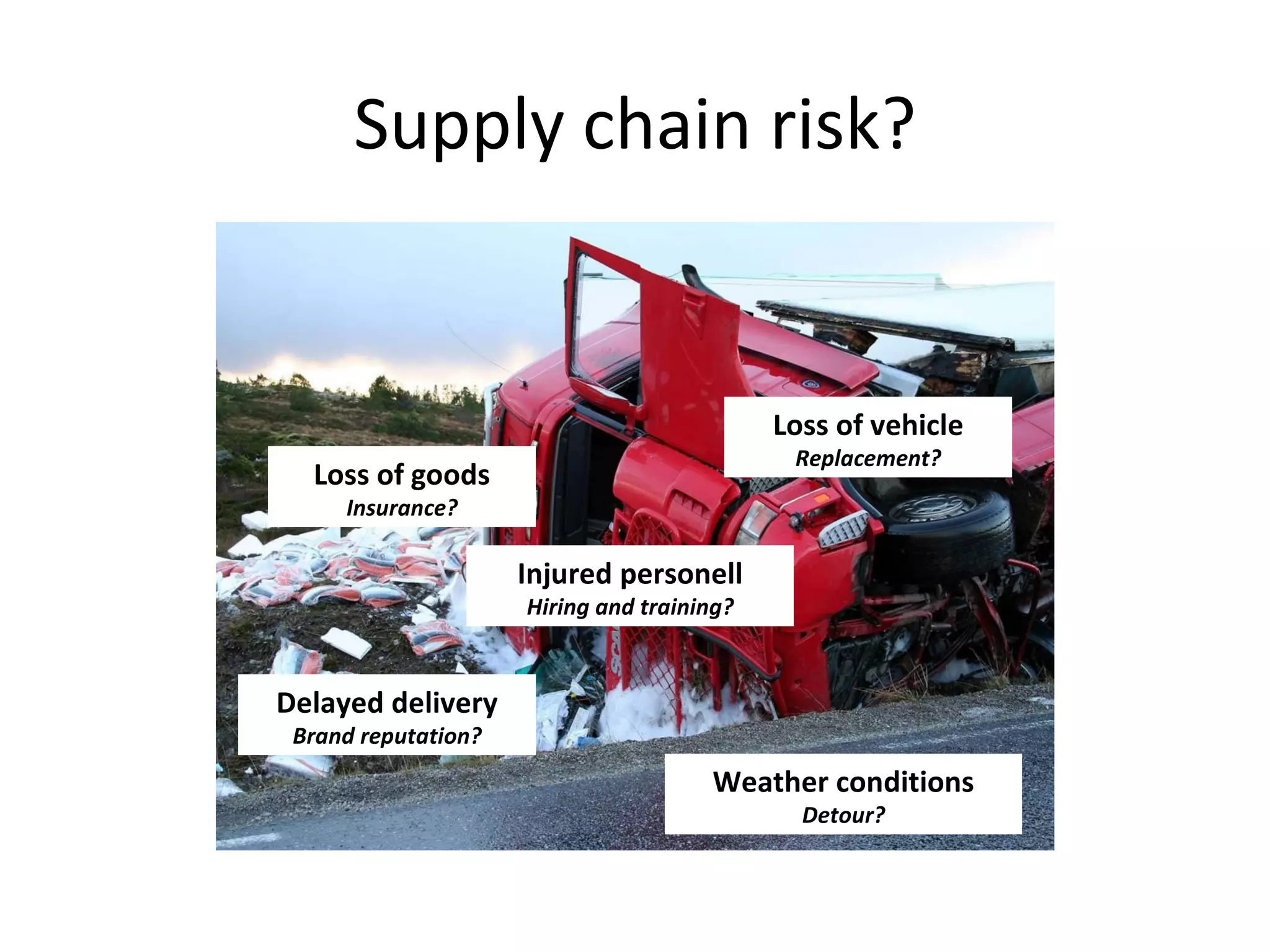
Supply chain risk? Loss of goods Insurance? Loss of vehicle Replacement? Delayed delivery Brand reputation? Injured personell Hiring and training? Weather conditions Detour?
Supply Chain  Trends   >>>   Consequences The trend towards  just-in-time  and  lean  practices  >>>  efficiency   rather than  effectiveness . The trend towards  reducing costs  (at almost any cost)  >>>  globalization   of supply chains, more  complex  and  vulnerable . The trend towards  economies of scale >>>  centralized   distribution and manufacturing >>>  lower costs  but at the same time  less flexibility . The trend towards  outsourcing  non-core business activities >>>  loss of control  of the supply chain when it is most needed . The trend towards  consolidation of suppliers (intentional and incidental mergers and acquisitions) >>>  increased potential for  supply failure .  Christopher, M. (2005)  Managing risk in the supply chain . In: Christopher, M. (Ed.)  Logistics and Supply Chain Management.  3rd ed., Prentice Hall, pp. 231-258.
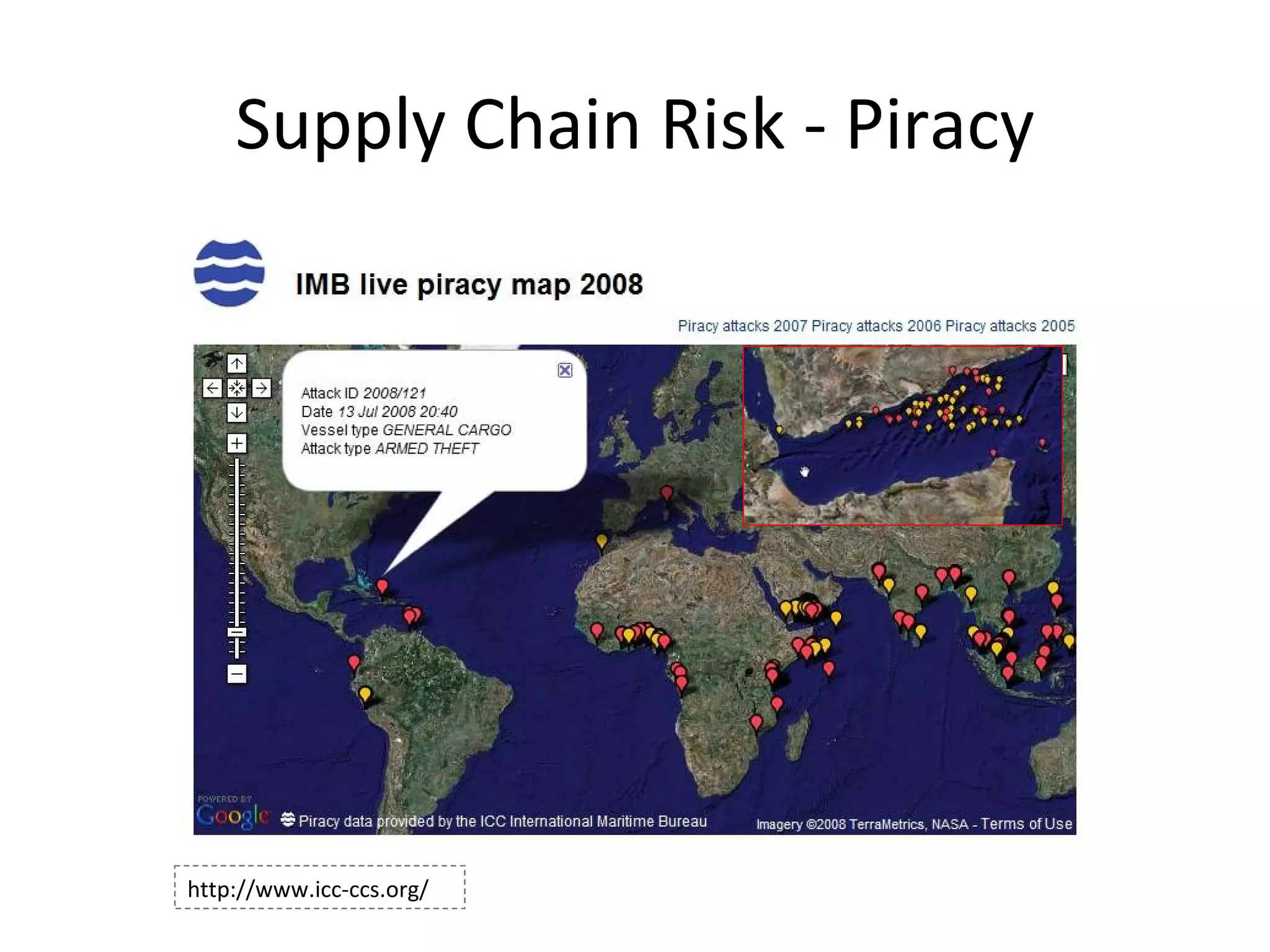
Supply Chain Risk - Piracy http://www.icc-ccs.org/
Why is supply chain risk important? Even a relatively small supply chain disruption caused by a  localized event  may have  consequences across the global economic system . Globalization, offshoring and outsourcing leads to  >> “no” control over  causes  to events in the supply chain. >>  “only” control over  consequences  of events in the supply chain. World Economic Forum (2008)  Hyper-optimization and supply chain vulnerability: an invisible global risk?  In: Global Risks 2008 – A Global Risk Network Report, REF: 090108, World Economic Forum, Switzerland. http://www.weforum.org/pdf/globalrisk/report2008.pdf
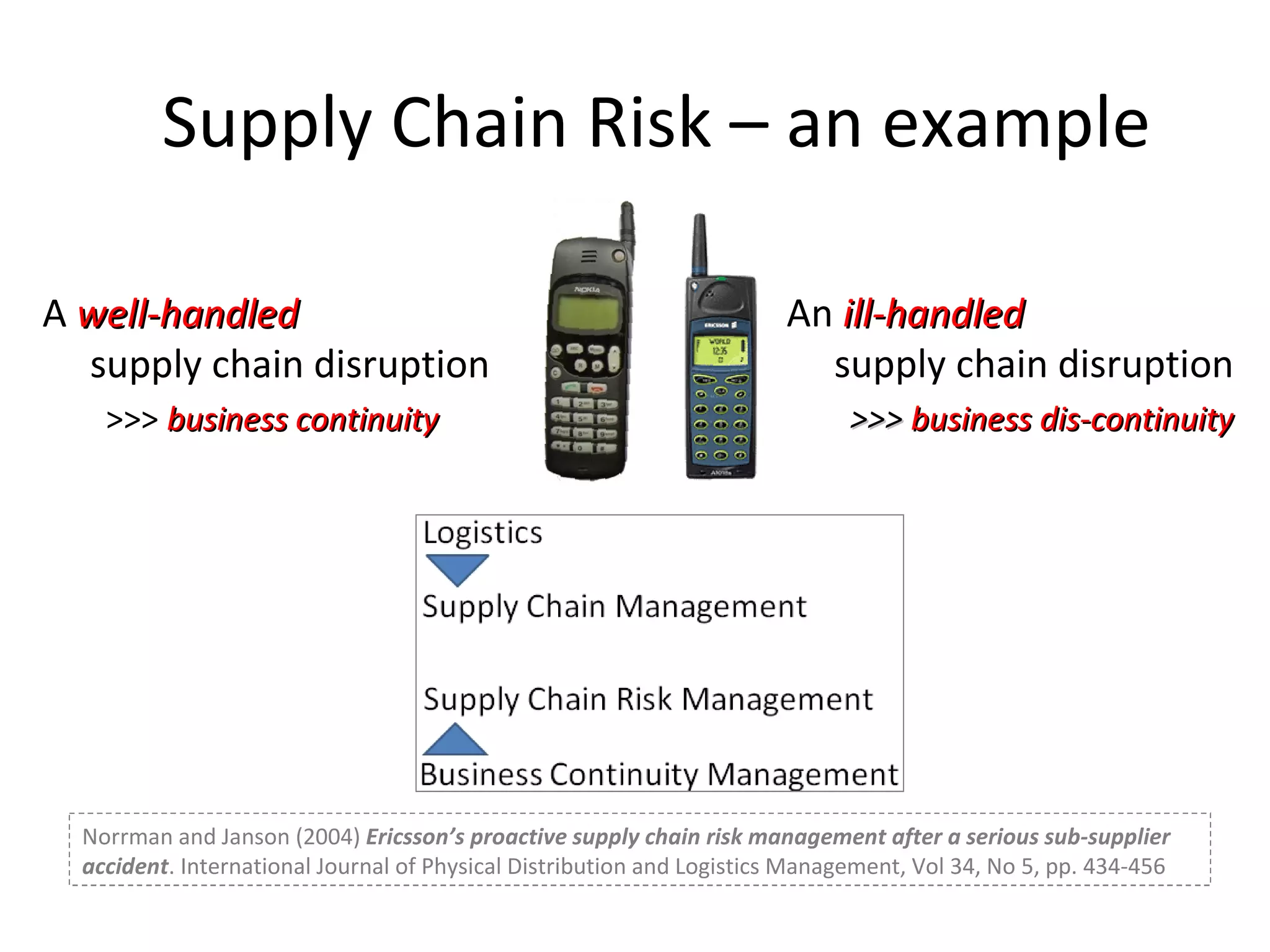
Supply Chain Risk – an example An  ill-handled   supply chain disruption >>>  business dis-continuity A  well-handled   supply chain disruption >>>  business continuity Norrman and Janson (2004)  Ericsson’s proactive supply chain risk management after a serious sub-supplier accident . International Journal of Physical Distribution and Logistics Management, Vol 34, No 5, pp. 434-456
What is risk? Risk : -  exposure  to the chance of injury or loss -  hazard  or dangerous  chance - chance of  loss - degree of  probability  of such a loss Aven, T. (2002)  Foundations of Risk Analysis : A Knowledge and Decision-Oriented Perspective, John Wiley & Sons.
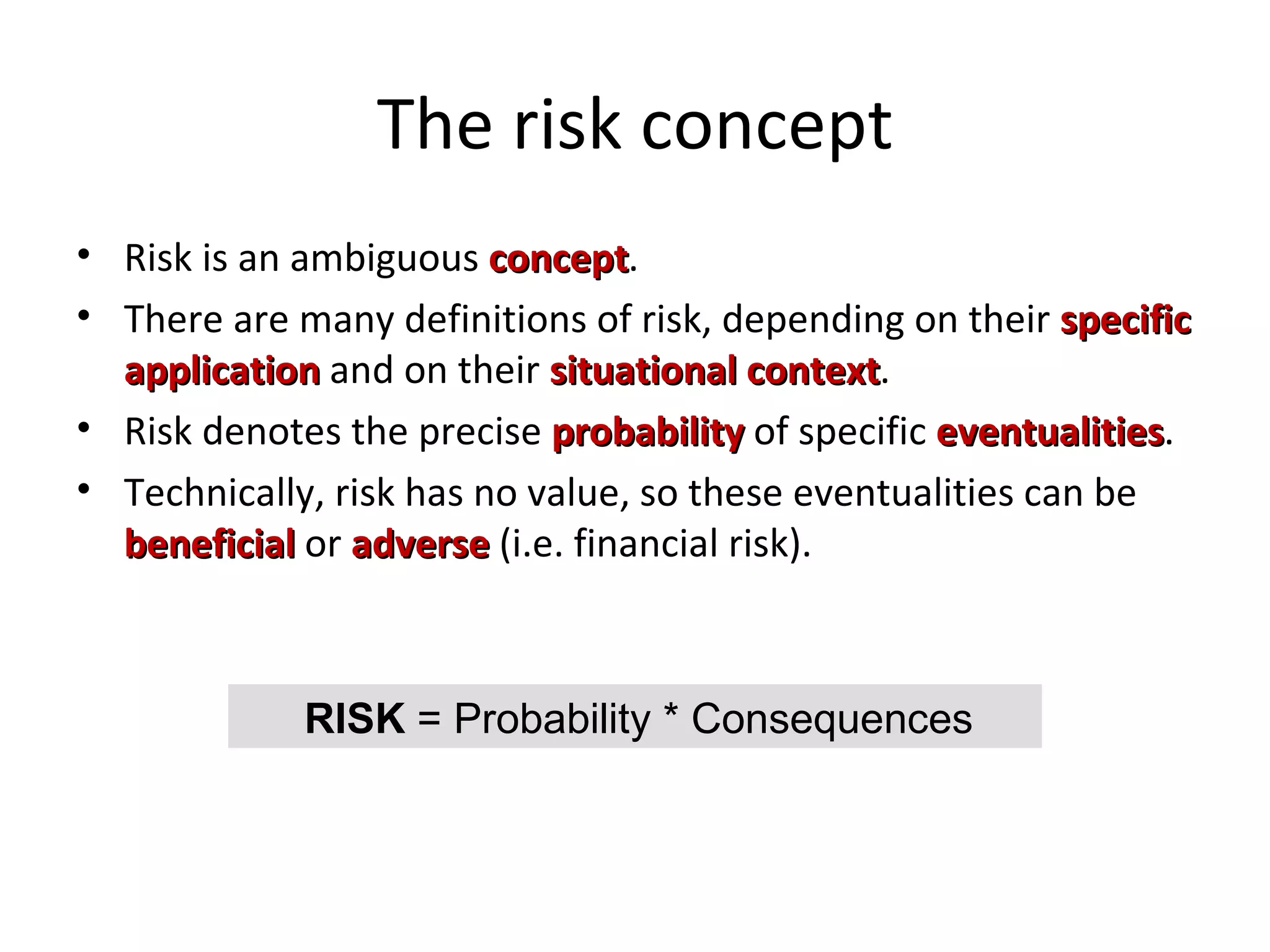
The risk concept Risk is an ambiguous  concept . There are many definitions of risk, depending on their  specific application  and on their  situational context . Risk denotes the precise  probability  of   specific  eventualities . Technically, risk has no value, so these eventualities can be  beneficial  or  adverse  (i.e. financial risk). RISK  = Probability * Consequences
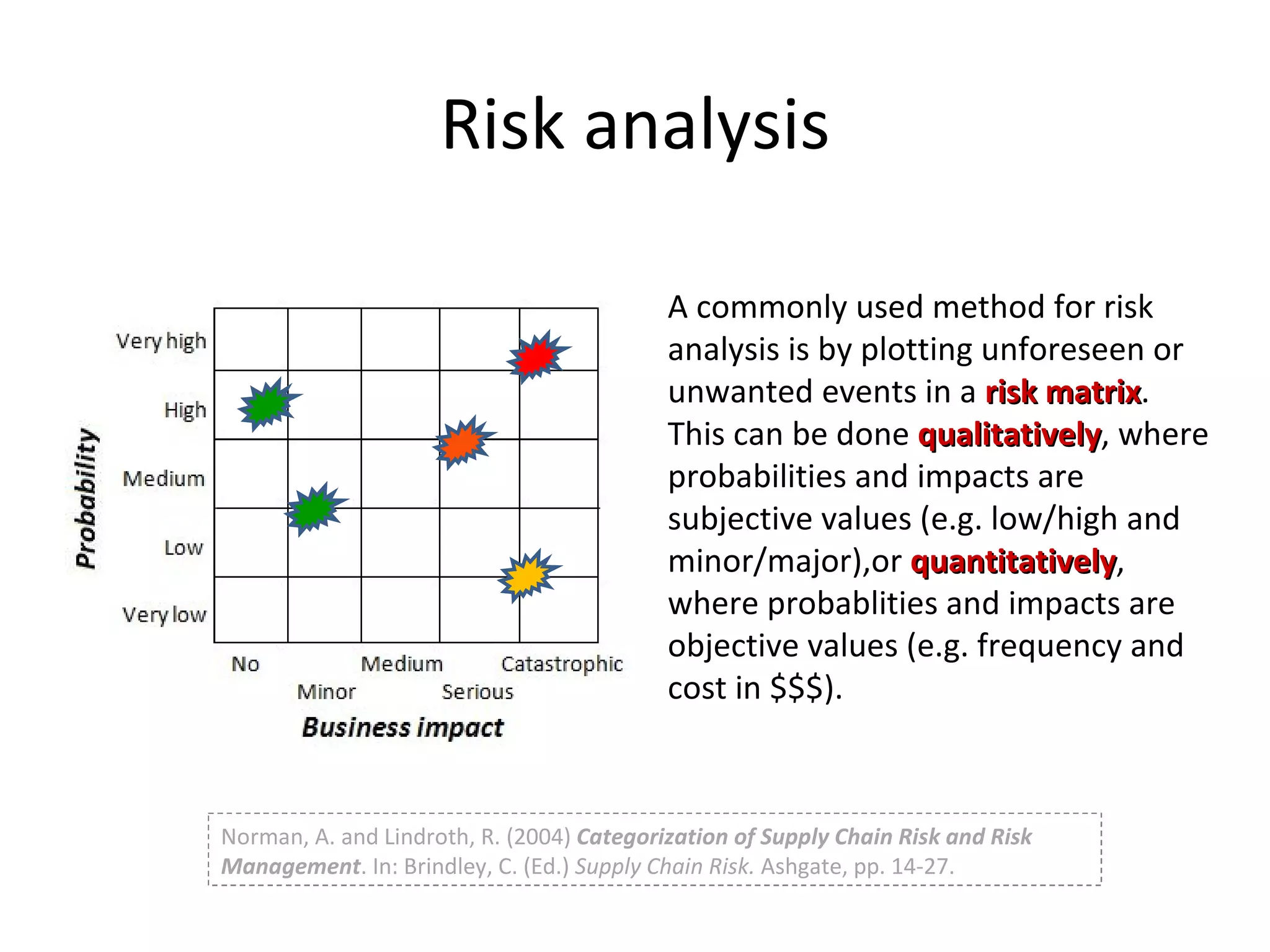
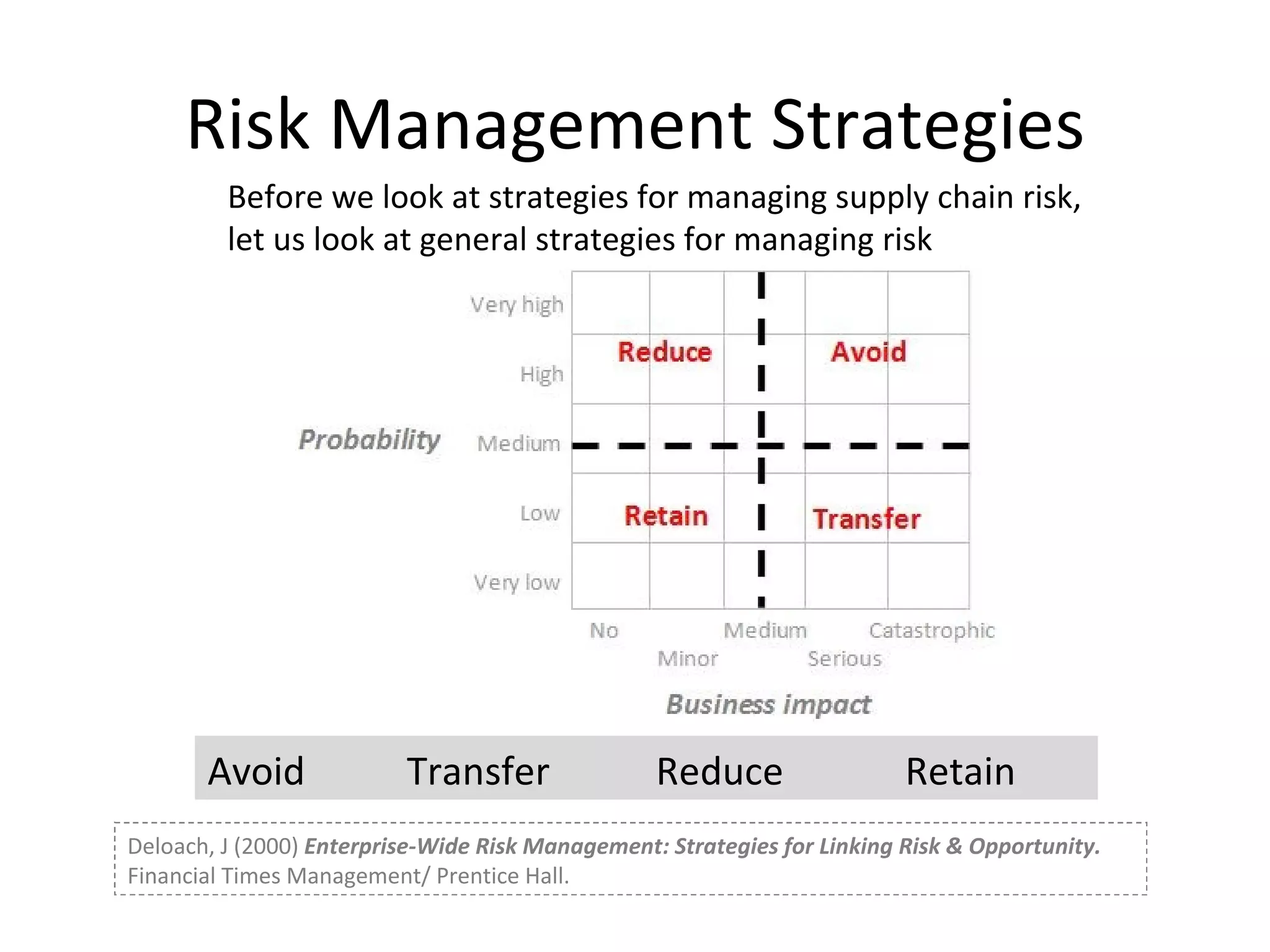
Risk analysis A commonly used method for risk analysis is by plotting unforeseen or unwanted events in a  risk matrix . This can be done  qualitatively , where probabilities and impacts are subjective values (e.g. low/high and minor/major),or  quantitatively , where probablities and impacts are objective values (e.g. frequency and cost in $$$). Norman, A. and Lindroth, R. (2004)  Categorization of Supply Chain Risk and Risk Management . In: Brindley, C. (Ed.)  Supply Chain Risk.  Ashgate, pp. 14-27.
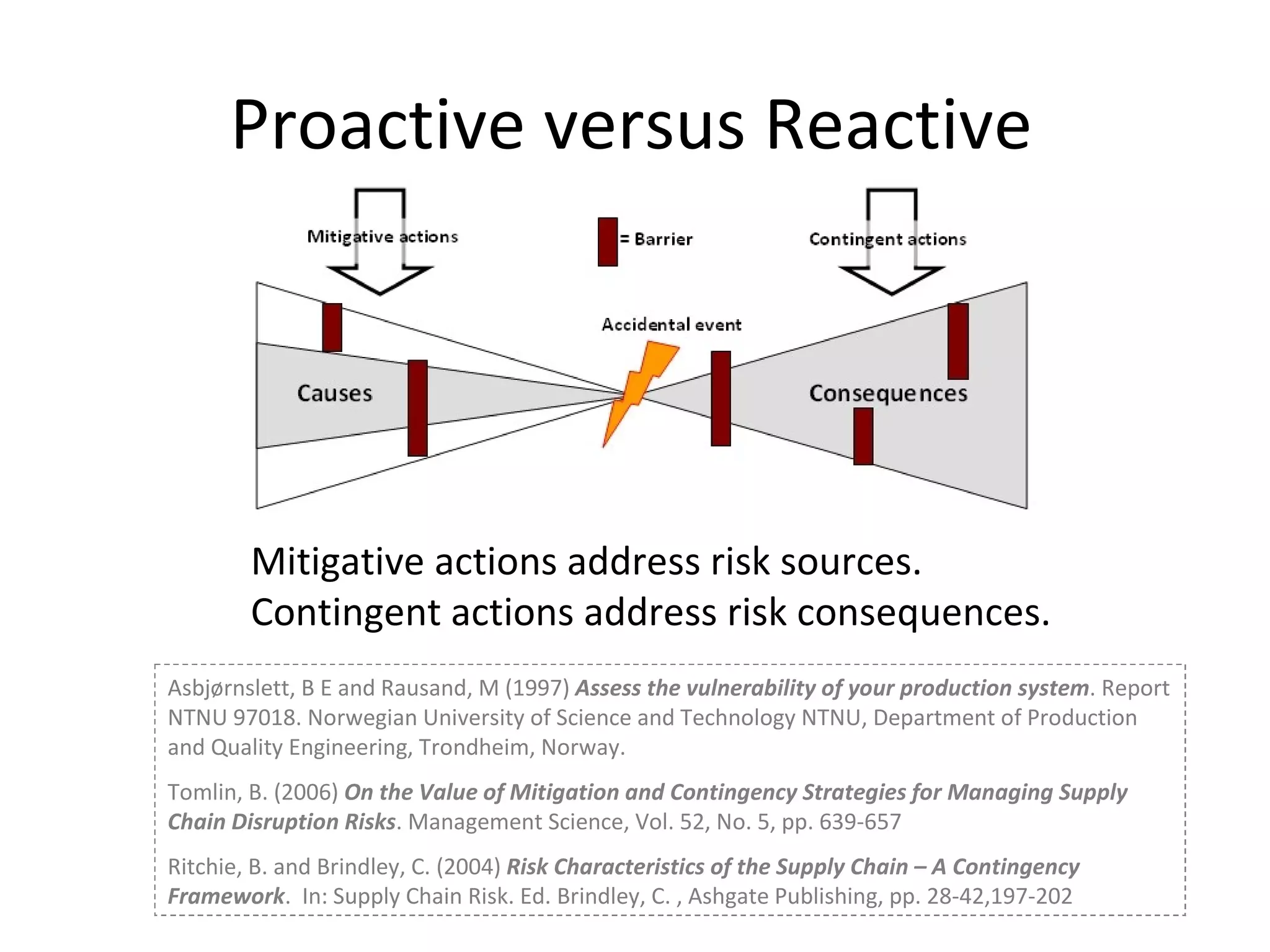
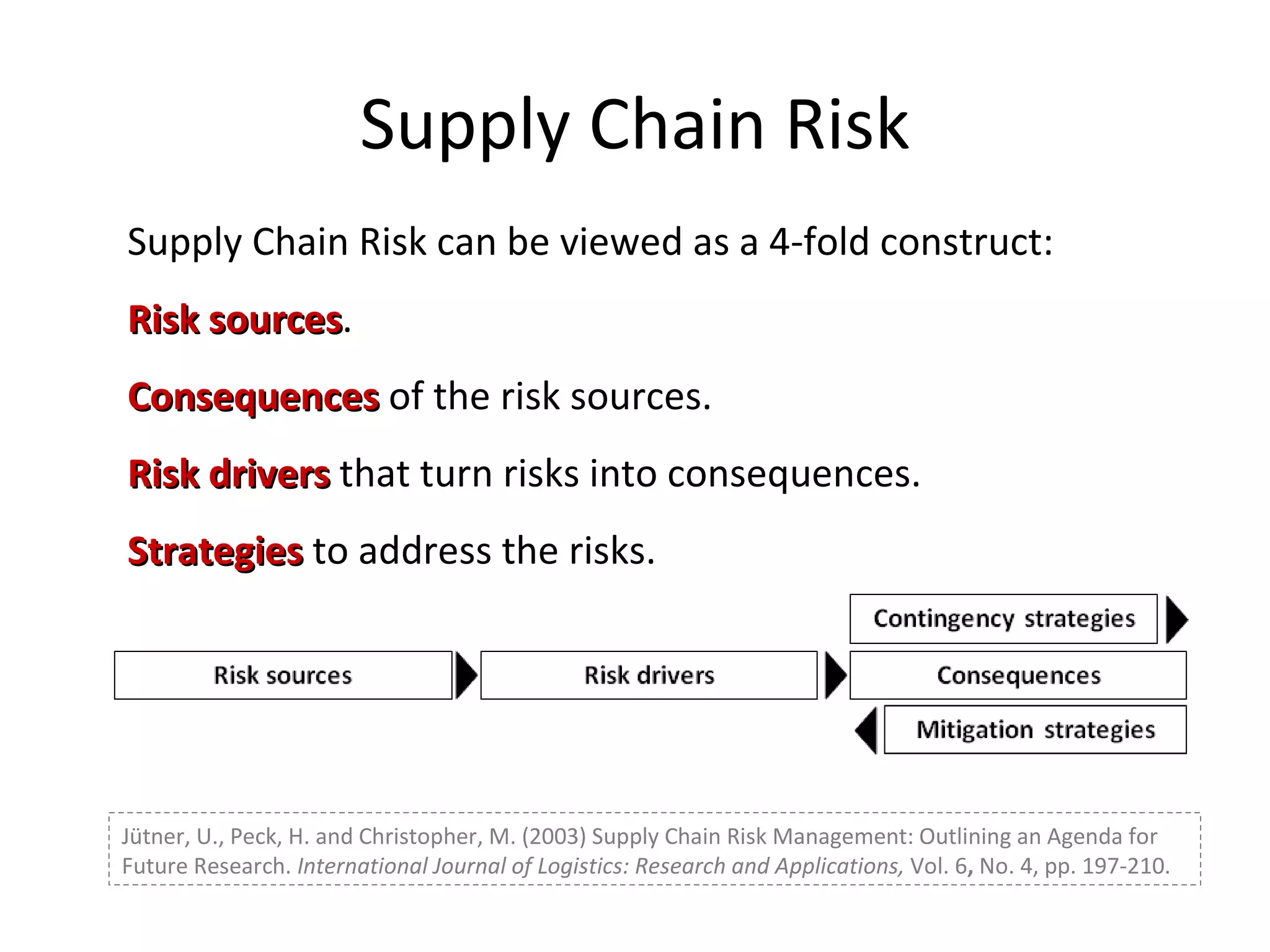
Proactive versus Reactive Asbjørnslett, B E and Rausand, M (1997)  Assess the vulnerability of your production system . Report NTNU 97018. Norwegian University of Science and Technology NTNU, Department of Production and Quality Engineering, Trondheim, Norway. Tomlin, B. (2006)  On the Value of Mitigation and Contingency Strategies for Managing Supply Chain Disruption Risks . Management Science, Vol. 52, No. 5, pp. 639-657 Ritchie, B. and Brindley, C. (2004)  Risk Characteristics of the Supply Chain – A Contingency Framework .  In: Supply Chain Risk. Ed. Brindley, C. , Ashgate Publishing, pp. 28-42,197-202 Mitigative actions address risk sources. Contingent actions address risk consequences.
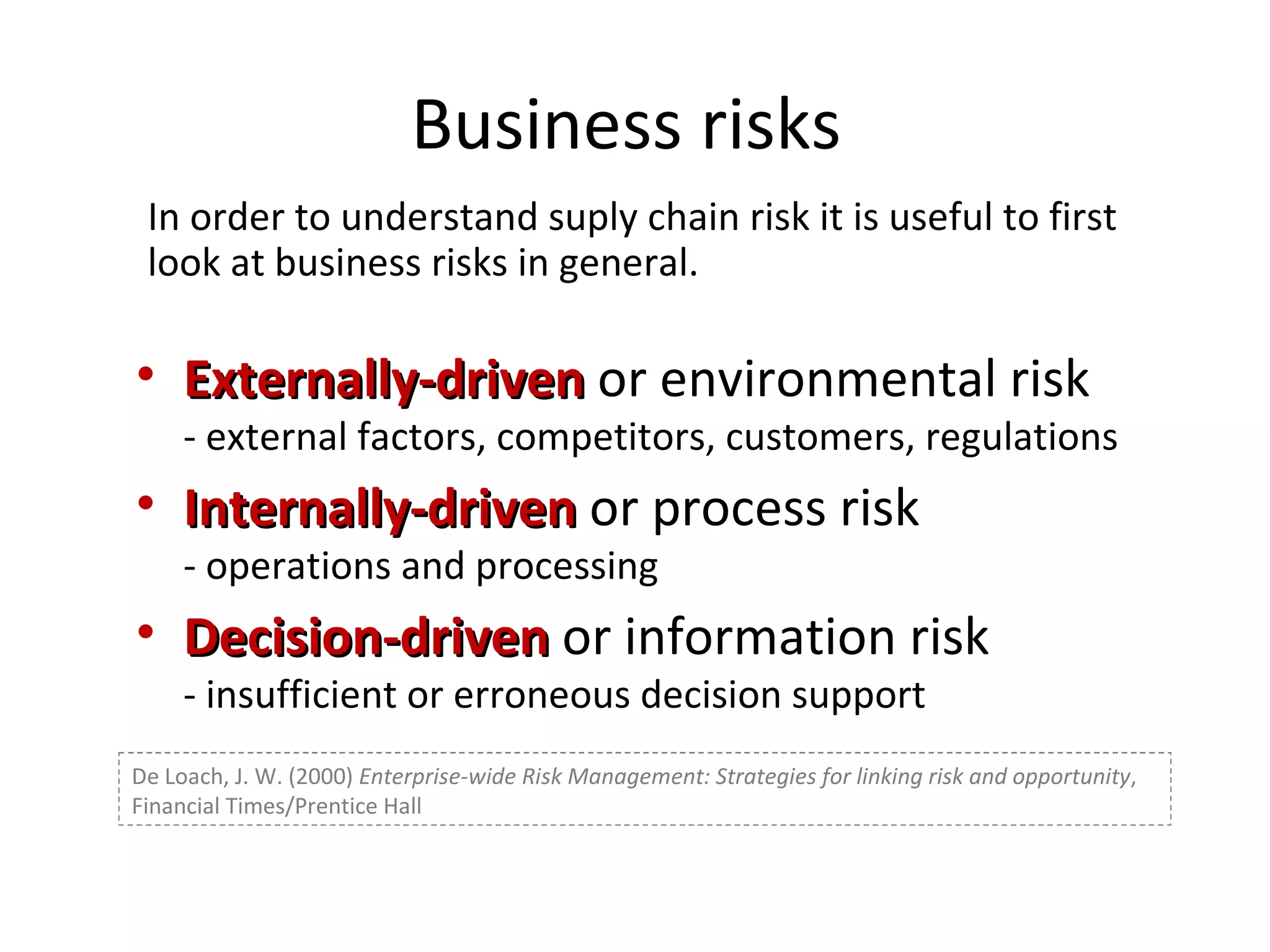
Business risks  Externally-driven  or environmental risk - external factors, competitors, customers, regulations Internally-driven  or process risk - operations and processing Decision-driven  or information risk - insufficient or erroneous decision support De Loach, J. W. (2000)  Enterprise-wide Risk Management: Strategies for linking risk and opportunity , Financial Times/Prentice Hall In order to understand suply chain risk it is useful to first look at business risks in general.
Supply Chain Risk Jütner, U., Peck, H. and Christopher, M. (2003) Supply Chain Risk Management: Outlining an Agenda for Future Research.  International Journal of Logistics: Research and Applications,  Vol. 6 ,  No. 4, pp. 197-210. Supply Chain Risk can be viewed as a 4-fold construct: Risk sources . Consequences  of the risk sources. Risk drivers  that turn risks into consequences. Strategies   to address the risks.
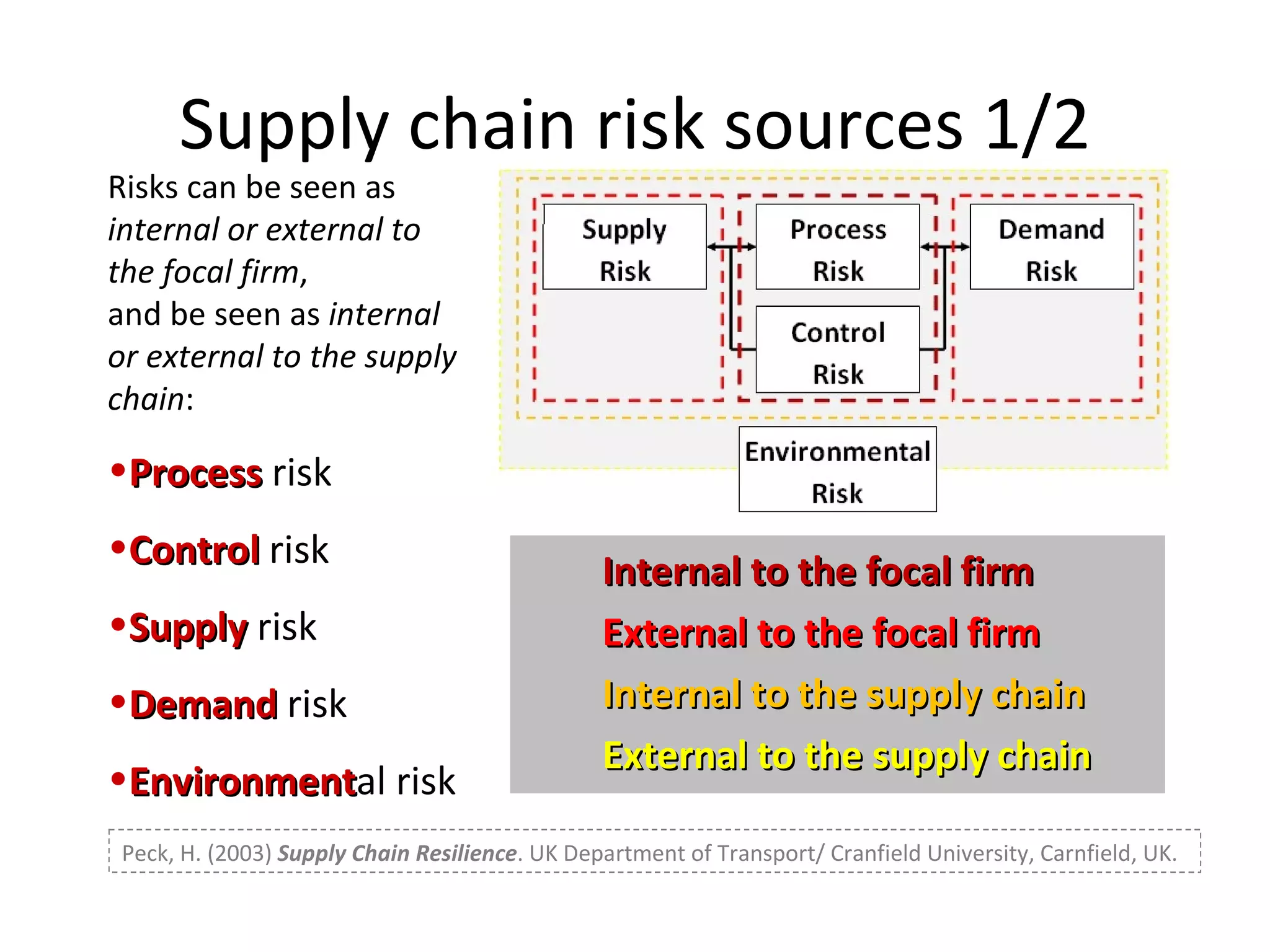
Supply chain risk sources 1/2 Internal to the focal firm External to the focal firm Internal to the supply chain External to the supply chain Peck, H. (2003)  Supply Chain Resilience . UK Department of Transport/ Cranfield University, Carnfield, UK. Risks can be seen as  internal or external to the focal firm ,  and be seen as  internal or external to the supply chain : Process  risk Control  risk Supply  risk Demand  risk Environment al risk
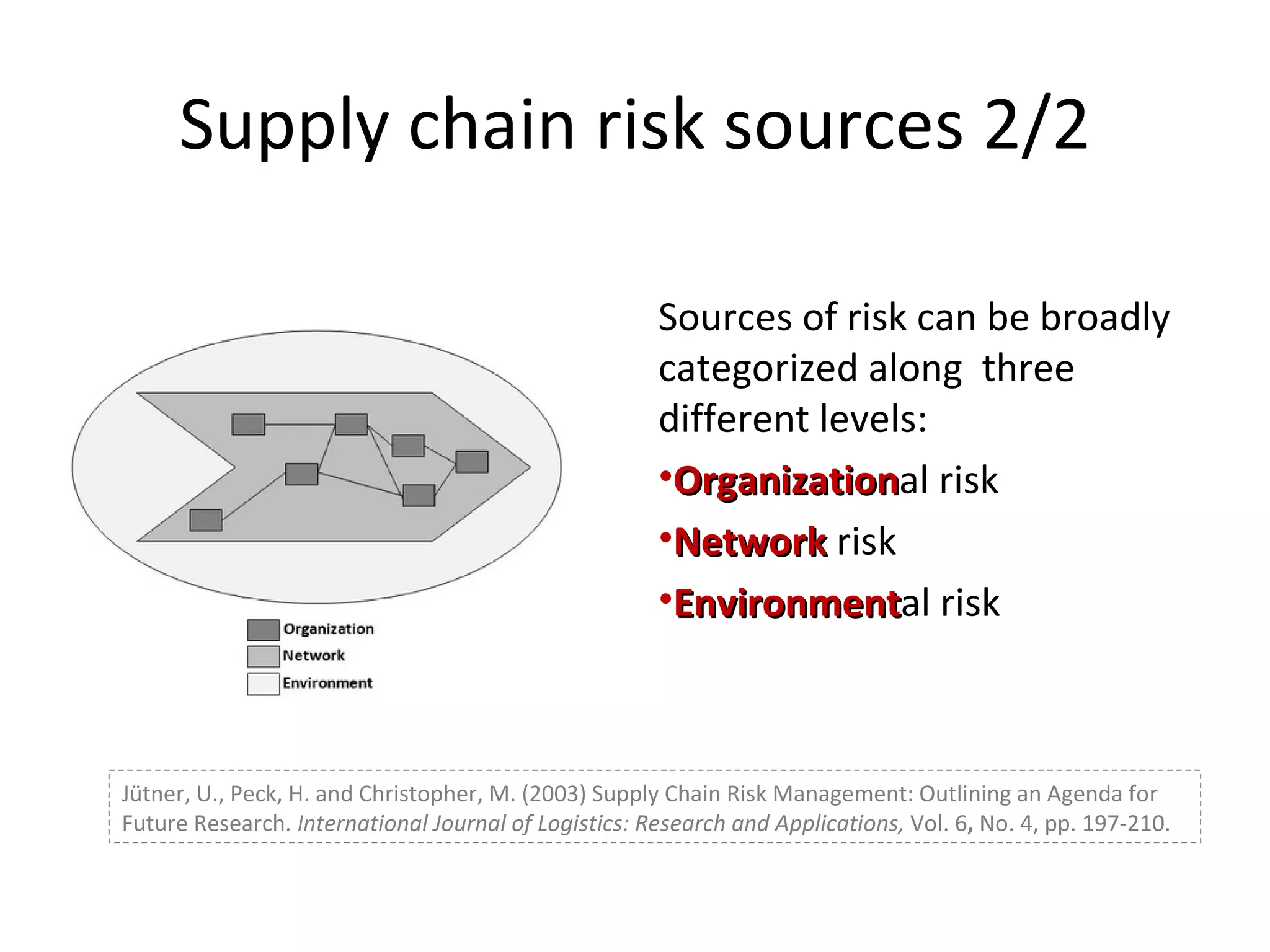
Supply chain risk sources 2/2 Sources of risk can be broadly categorized along  three different levels:  Organization al risk Network  risk Environment al risk Jütner, U., Peck, H. and Christopher, M. (2003) Supply Chain Risk Management: Outlining an Agenda for Future Research.  International Journal of Logistics: Research and Applications,  Vol. 6 ,  No. 4, pp. 197-210.
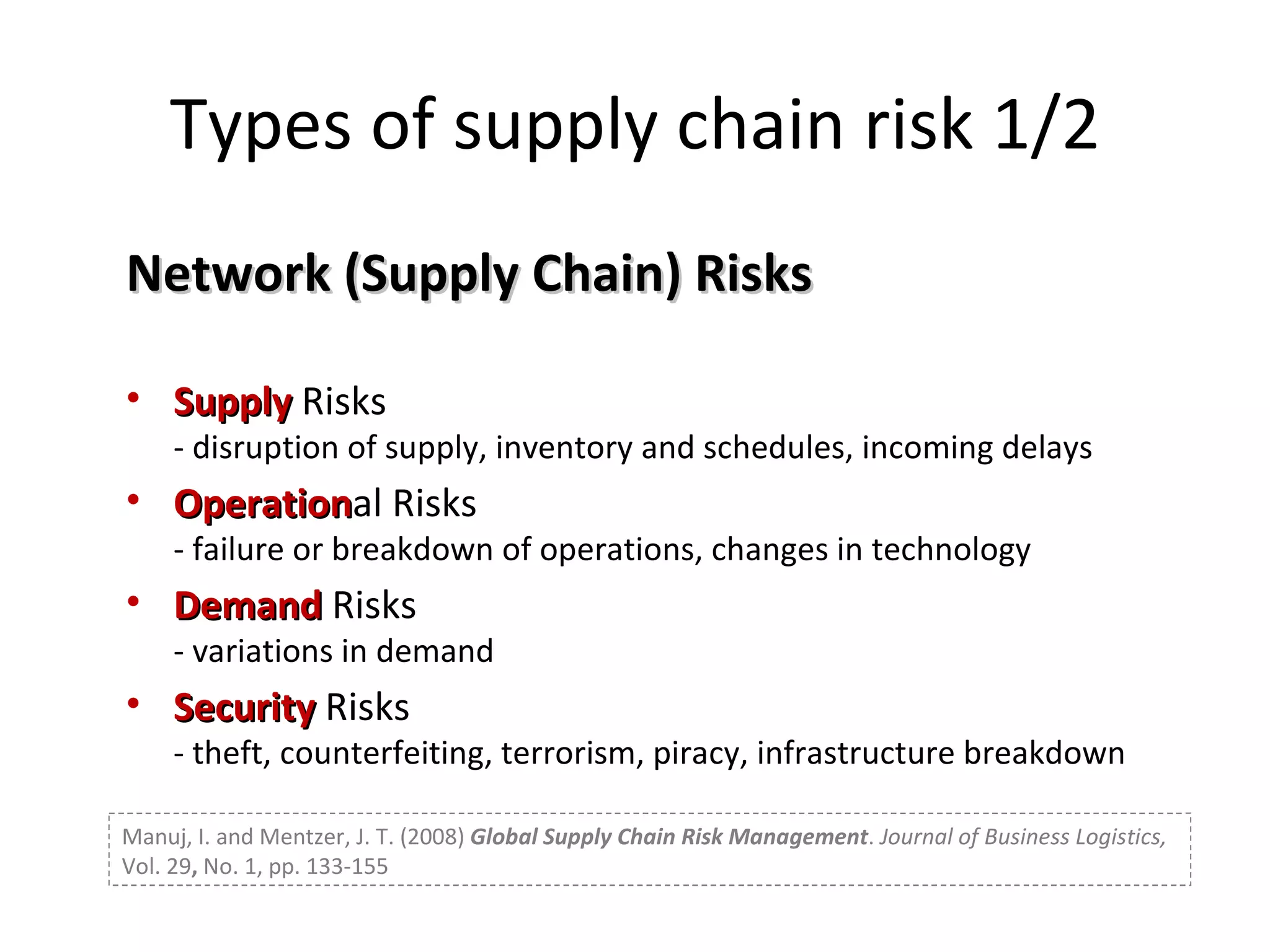
Types of supply chain risk 1/2 Network (Supply Chain) Risks Supply  Risks - disruption of supply, inventory and schedules, incoming delays Operation al Risks - failure or breakdown of operations, changes in technology Demand  Risks - variations in demand Security  Risks - theft, counterfeiting, terrorism, piracy, infrastructure breakdown Manuj, I. and Mentzer, J. T. (2008)  Global Supply Chain Risk Management .  Journal of Business Logistics,  Vol. 29 ,  No. 1, pp. 133-155
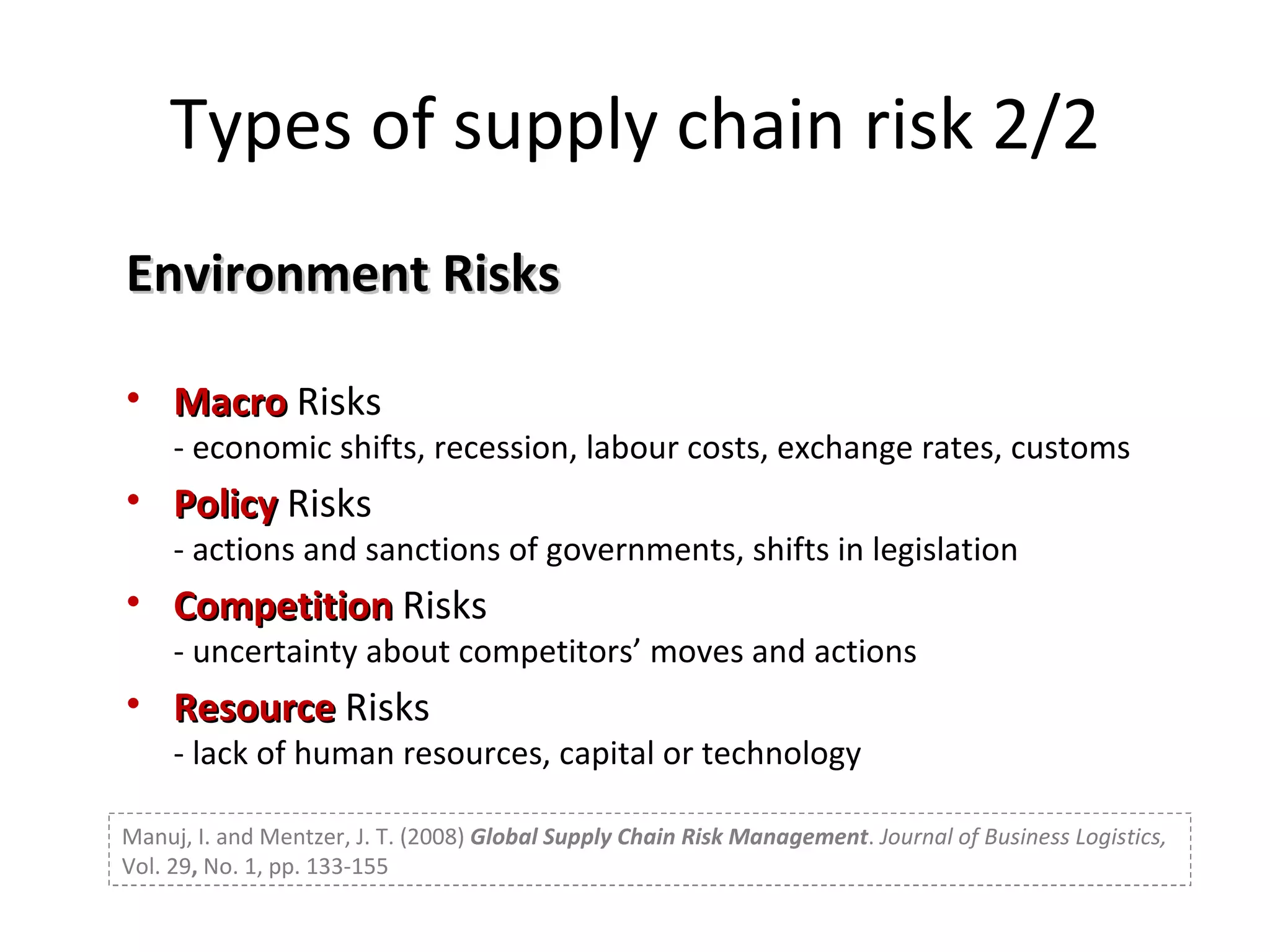
Environment Risks Macro  Risks - economic shifts, recession, labour costs, exchange rates, customs Policy  Risks - actions and sanctions of governments, shifts in legislation Competition  Risks - uncertainty about competitors’ moves and actions Resource  Risks - lack of human resources, capital or technology Types of supply chain risk 2/2 Manuj, I. and Mentzer, J. T. (2008)  Global Supply Chain Risk Management .  Journal of Business Logistics,  Vol. 29 ,  No. 1, pp. 133-155
Risk Management Strategies Avoid Transfer Reduce Retain Deloach, J (2000)  Enterprise-Wide Risk Management: Strategies for Linking Risk & Opportunity.  Financial Times Management/ Prentice Hall. Before we look at strategies for managing supply chain risk, let us look at general strategies for managing risk
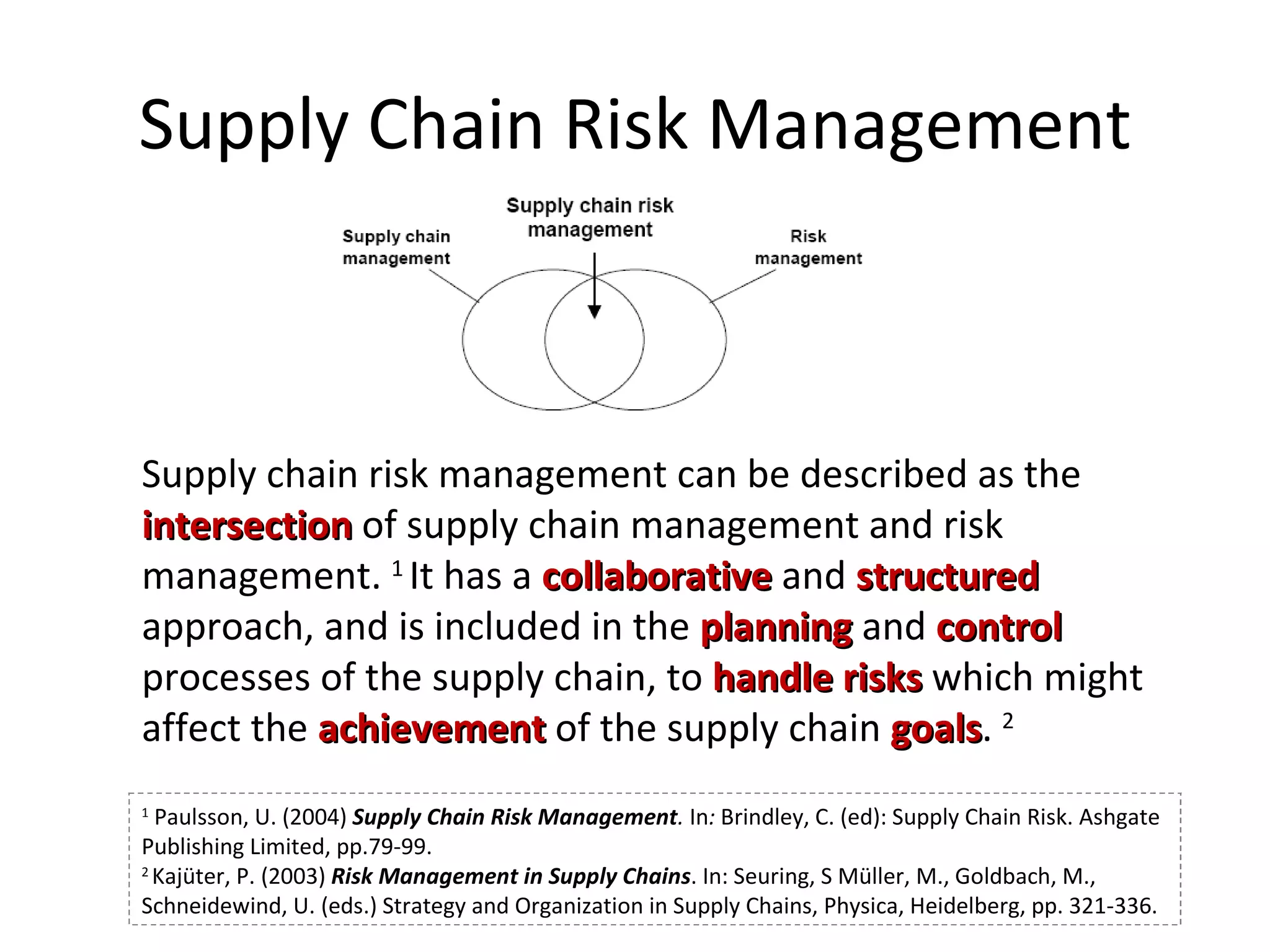
Supply Chain Risk Management Supply chain risk management can be described as the  intersection  of supply chain management and risk management.  1  It has a  collaborative  and  structured  approach, and is included in the  planning  and  control  processes of the supply chain, to  handle risks  which might affect the  achievement  of the supply chain  goals .  2 1  Paulsson, U. (2004)  Supply Chain Risk Management .  In :  Brindley, C. (ed): Supply Chain Risk. Ashgate  Publishing Limited, pp.79-99. 2  Kajüter, P. (2003)  Risk Management in Supply Chains . In: Seuring, S Müller, M.,  Goldbach, M., Schneidewind, U. (eds.) Strategy and Organization in  Supply Chains, Physica, Heidelberg, pp. 321-336.
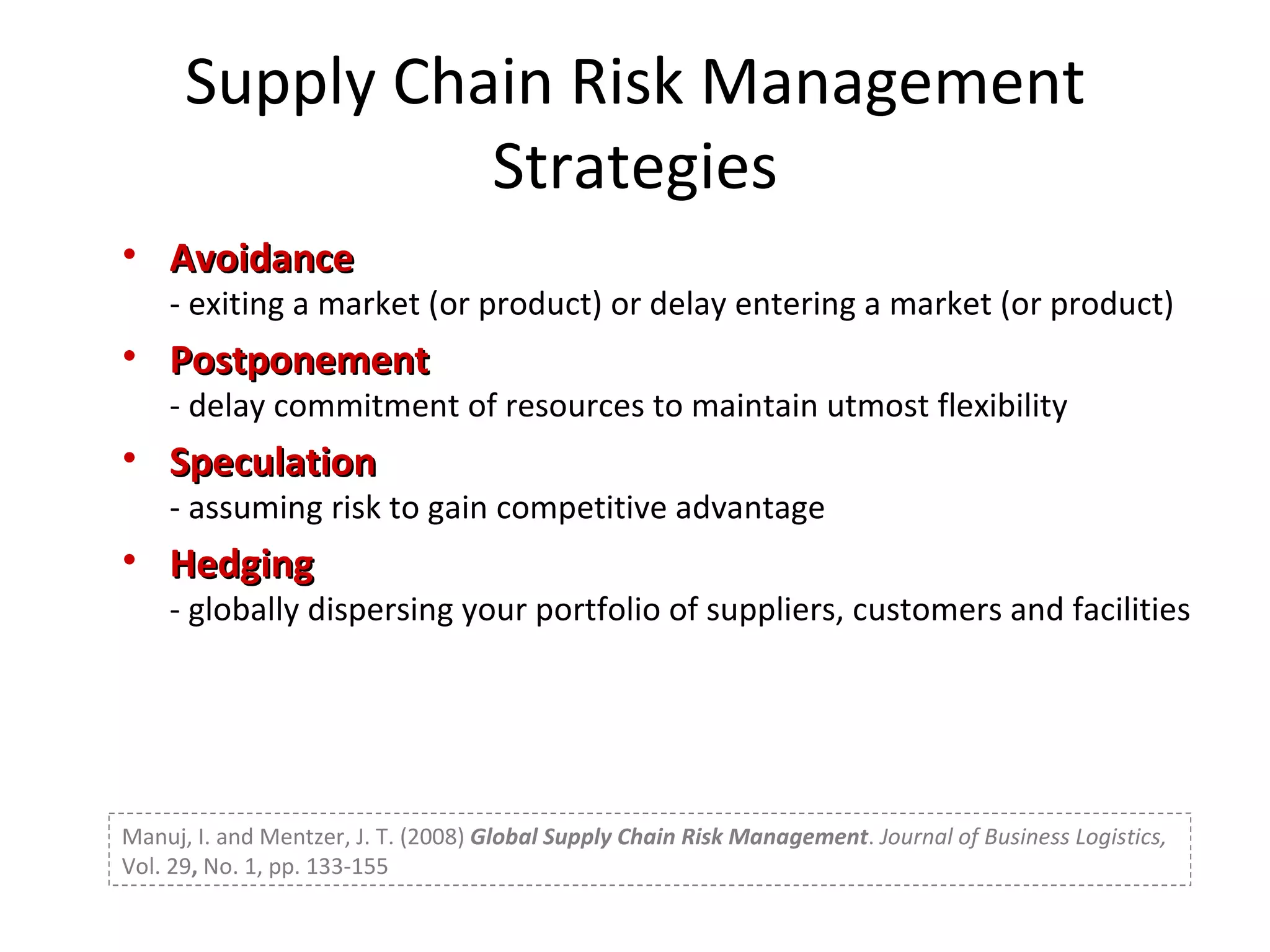
Supply Chain Risk Management Strategies Avoidance - exiting a market (or product) or delay entering a market (or product) Postponement - delay commitment of resources to maintain utmost flexibility Speculation - assuming risk to gain competitive advantage Hedging - globally dispersing your portfolio of suppliers, customers and facilities Manuj, I. and Mentzer, J. T. (2008)  Global Supply Chain Risk Management .  Journal of Business Logistics,  Vol. 29 ,  No. 1, pp. 133-155
Supply Chain Risk Management Strategies Control - vertical and lateral integration of suppliers and business partners Transferring/sharing risk - outsourcing, offshoring, contracting Security - identifying and protecting against unwanted penetration Manuj, I. and Mentzer, J. T. (2008)  Global Supply Chain Risk Management .  Journal of Business Logistics,  Vol. 29 ,  No. 1, pp. 133-155
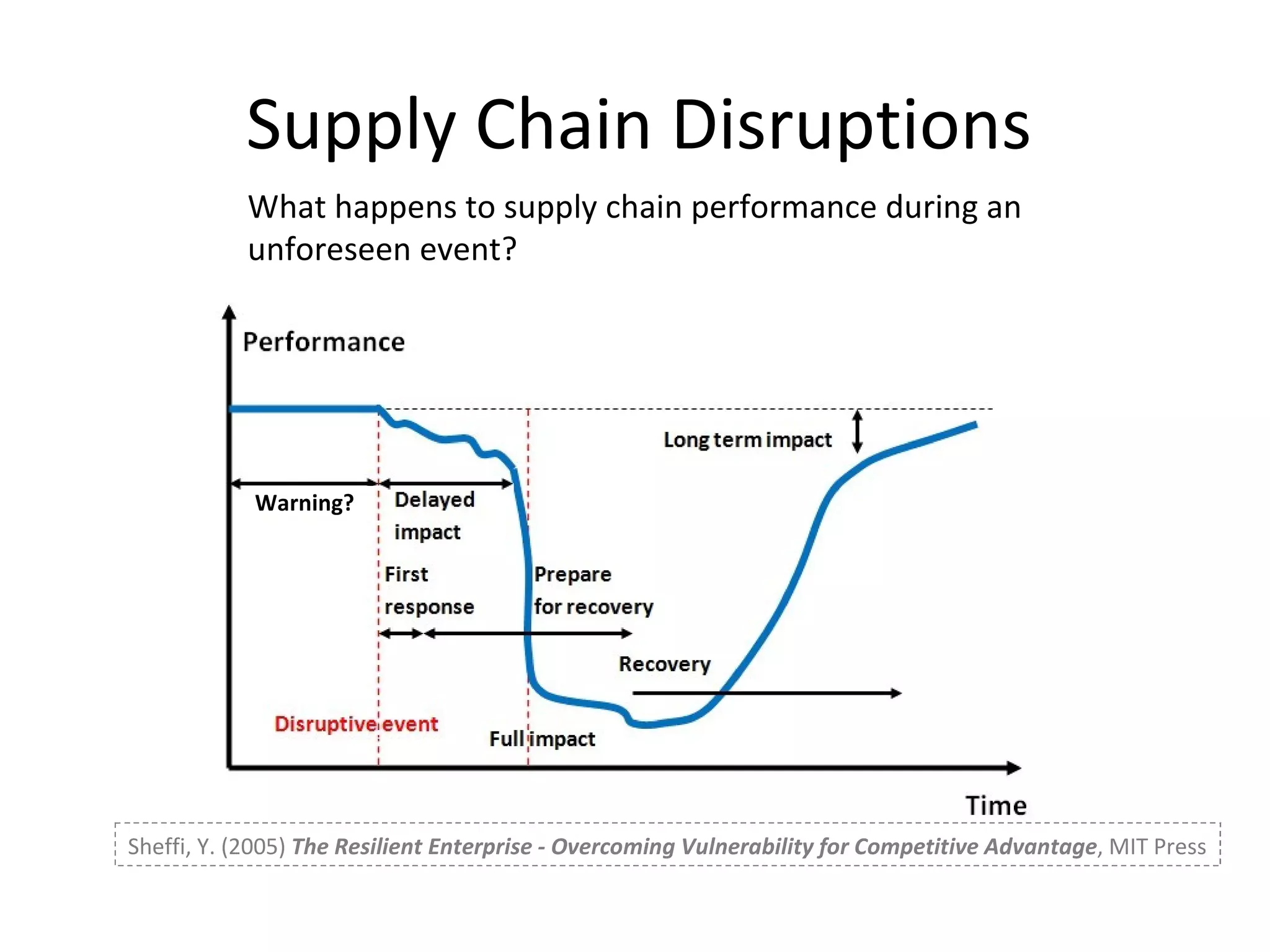
Supply Chain Disruptions Sheffi, Y. (2005)  The Resilient Enterprise - Overcoming Vulnerability for Competitive Advantage , MIT Press Warning? What happens to supply chain performance during an unforeseen event?
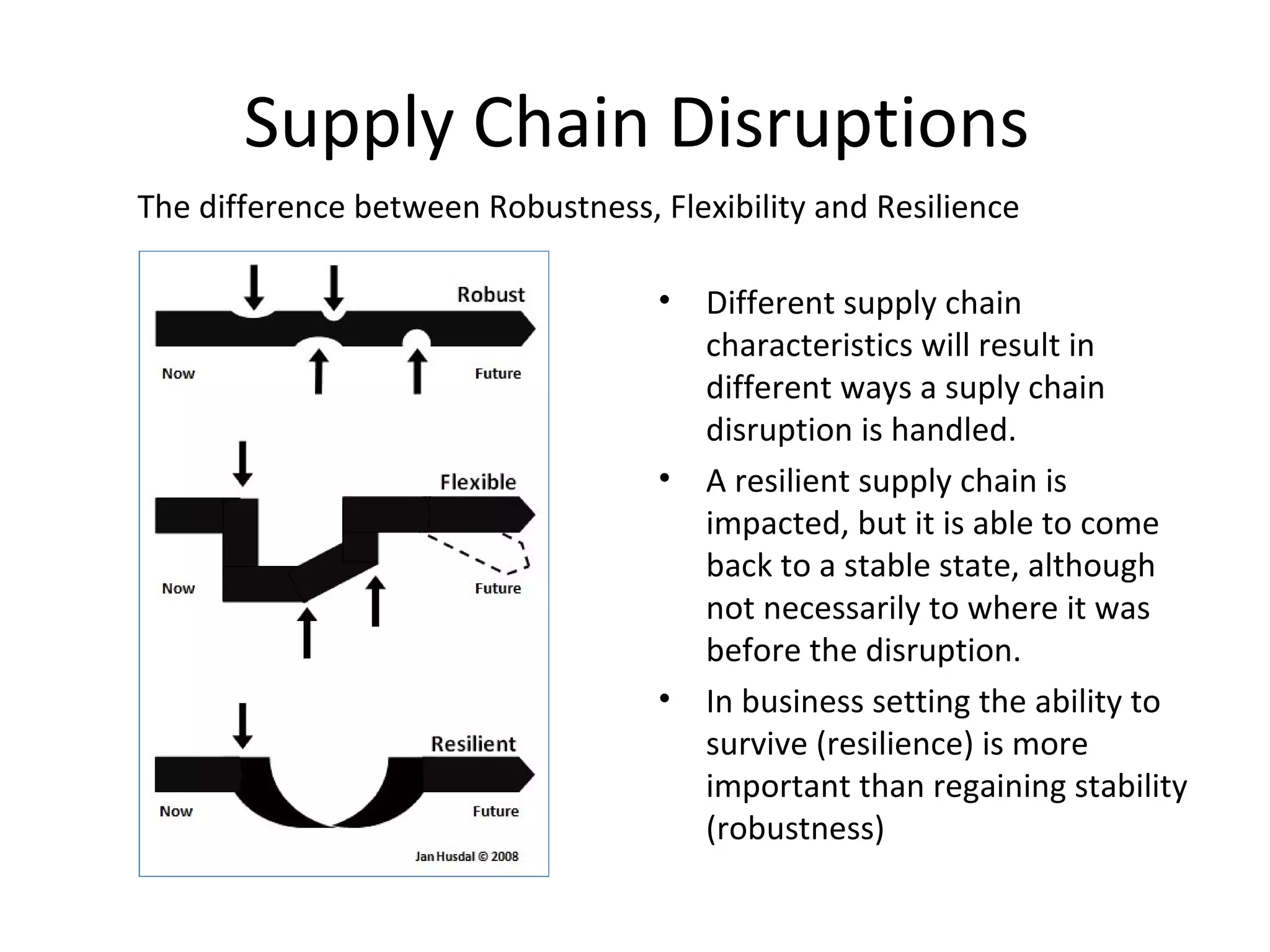
Different supply chain characteristics will result in different ways a suply chain disruption is handled. A resilient supply chain is impacted, but it is able to come back to a stable state, although not necessarily to where it was before the disruption. In business setting the ability to survive (resilience) is more important than regaining stability (robustness) The difference between Robustness, Flexibility and Resilience Supply Chain Disruptions
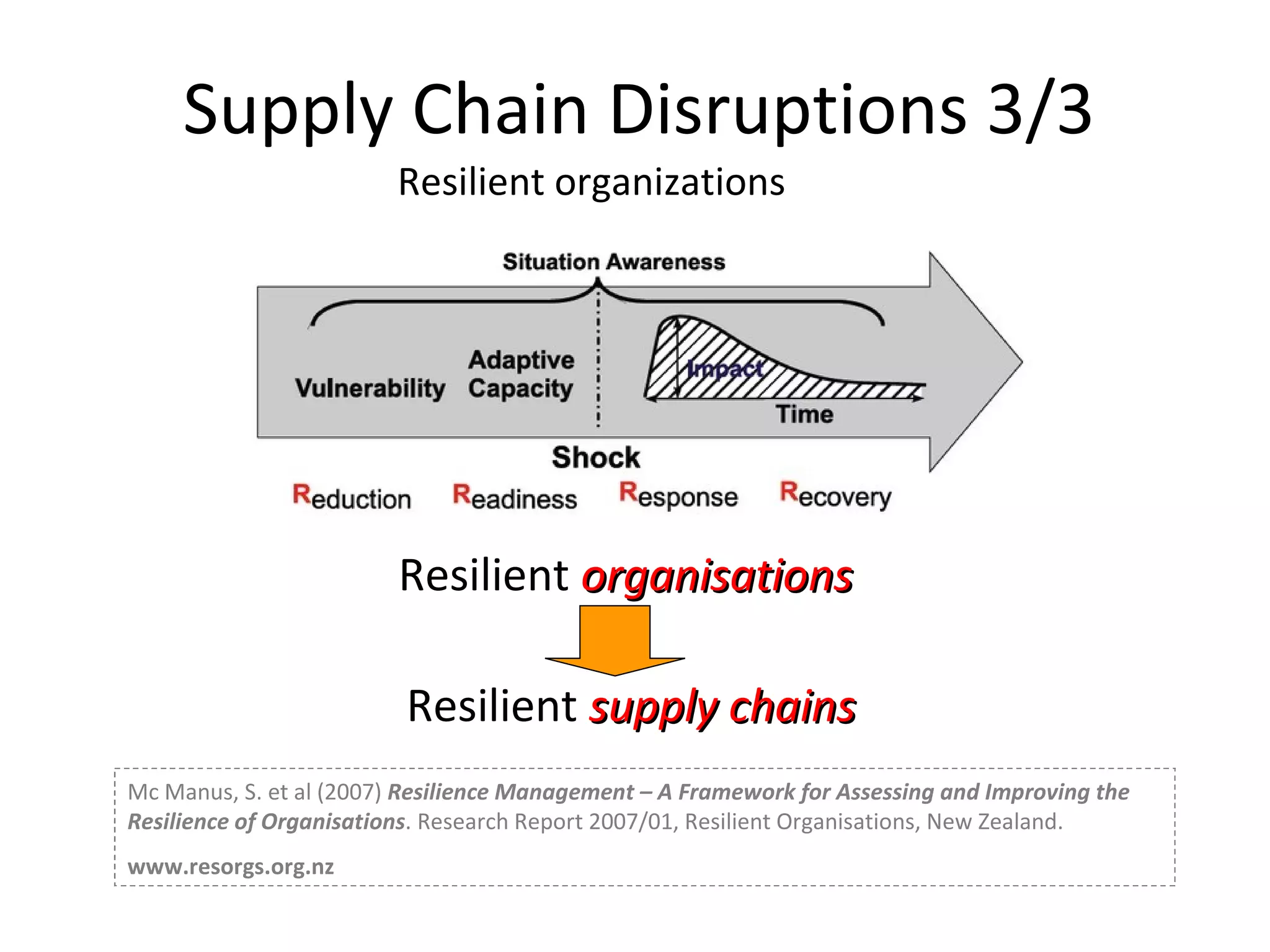
Supply Chain Disruptions 3/3 Resilient  organisations   Resilient  supply chains Mc Manus, S. et al (2007)  Resilience Management – A Framework for Assessing and Improving the Resilience of Organisations . Research Report 2007/01, Resilient Organisations, New Zealand.  www.resorgs.org.nz Resilient organizations
Supply Chain Design A supply chain is more likely to be severely impacted if there is supply chain density supply chain complexity node criticality Supply Chain Mitigation Capability A supply chain is less likely to be severely impacted if there is adaptive capacity (recovery capability) information sharing/ visibility (warning capability) Supply Chain Design  vis-a-vis supply chain disruptions Craighead, C. W., Blackhurst, J., Rungtusanatham, M. J. & Handfield, R. B. (2007)  The Severity of Supply Chain Disruptions: Design Characteristics and Mitigation Capabilities . Decision Sciences, Vol. 38, No. 1, pp. 131-156. Factors (risk drivers) that can aggravate or lessen  supply chain disruptions:
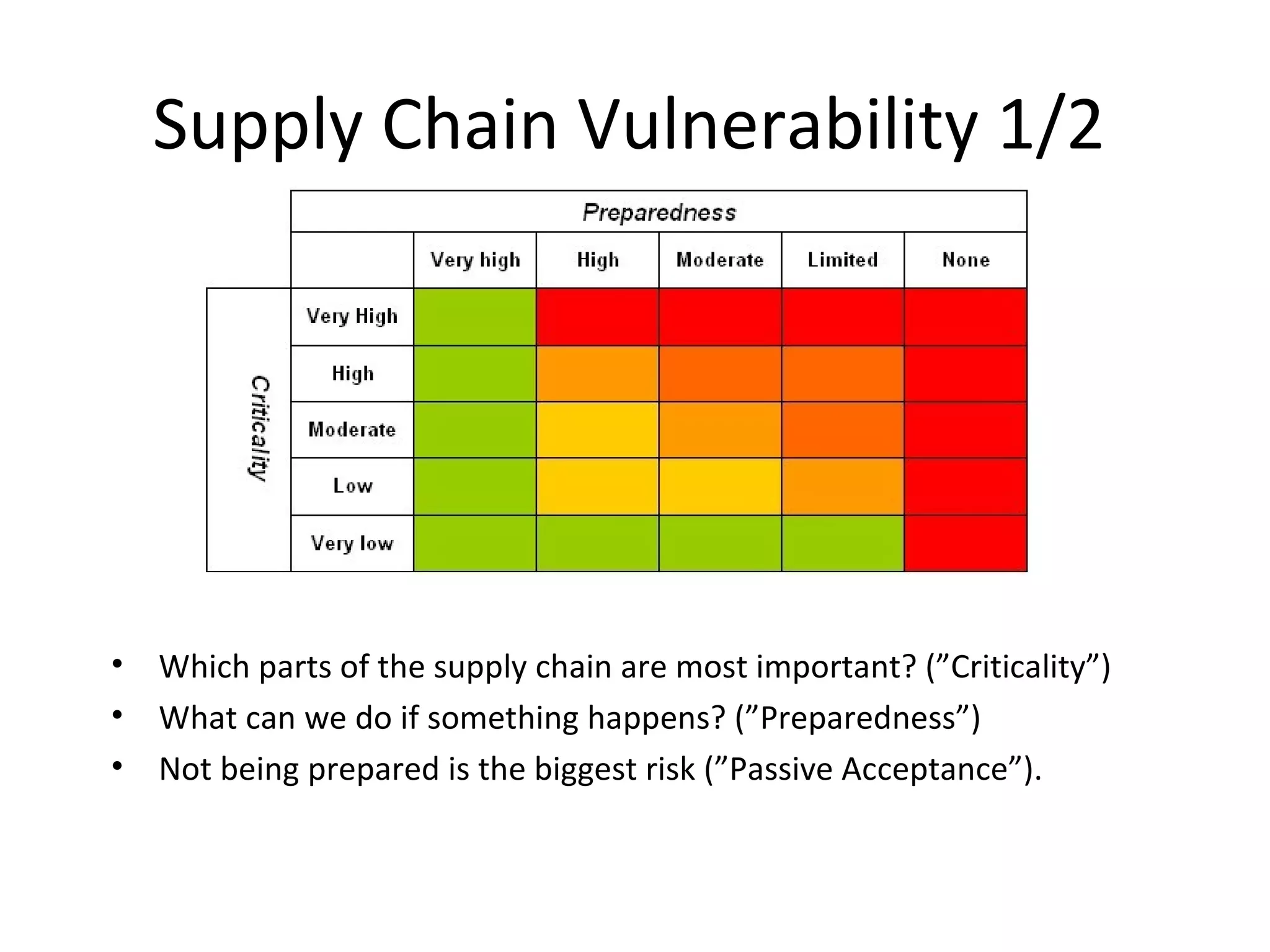
Supply Chain Vulnerability 1/2 Which parts of the supply chain are most important? (”Criticality”) What can we do if something happens? (”Preparedness”) Not being prepared is the biggest risk (”Passive Acceptance”).
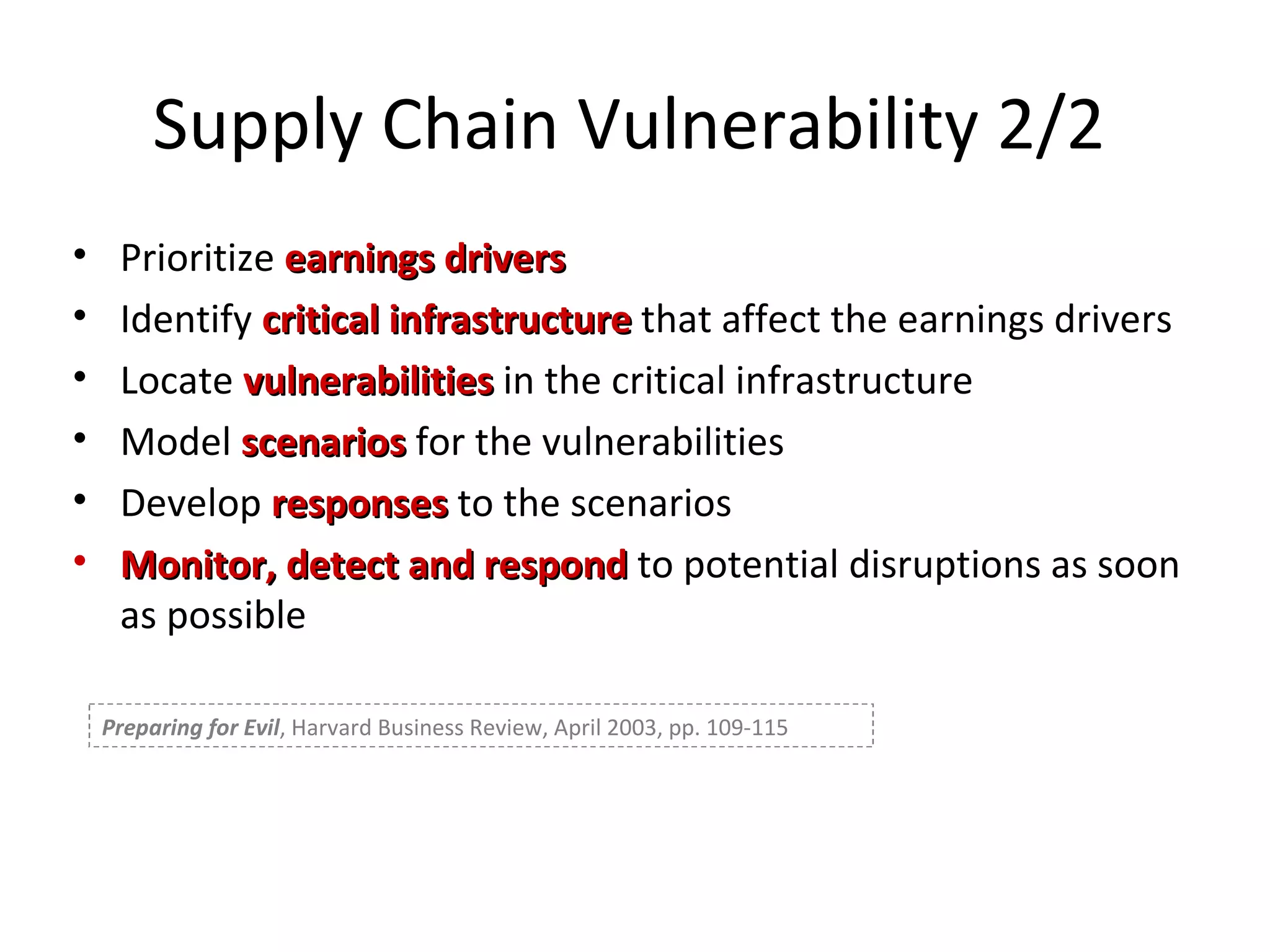
Supply Chain Vulnerability 2/2 Prioritize  earnings drivers Identify  critical infrastructure  that affect the earnings drivers Locate  vulnerabilities  in the critical infrastructure Model  scenarios  for the vulnerabilities Develop  responses  to the scenarios Monitor, detect and respond  to potential disruptions as soon as possible Preparing for Evil , Harvard Business Review, April 2003, pp. 109-115
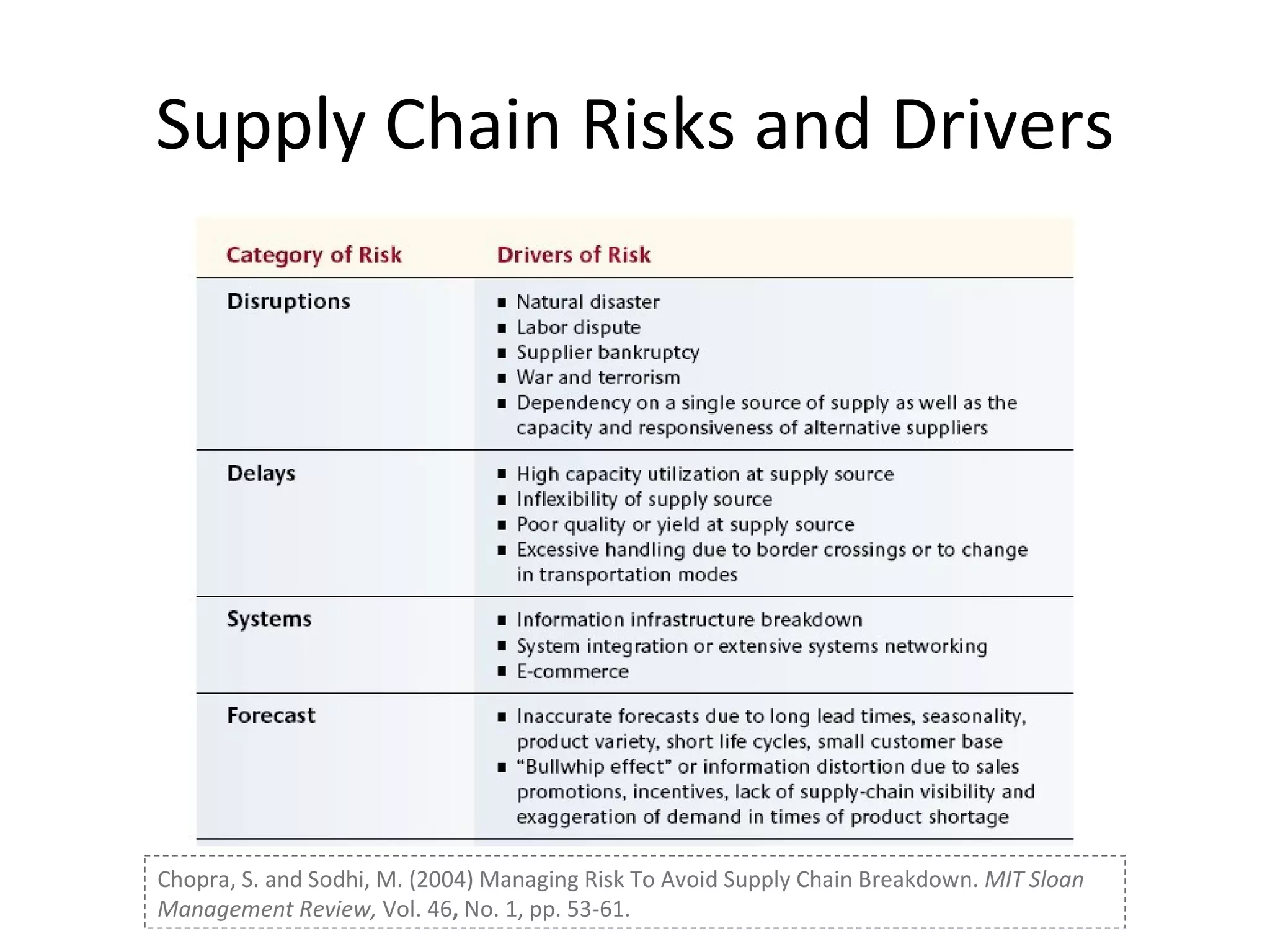
Supply Chain Risks and Drivers Chopra, S. and Sodhi, M. (2004) Managing Risk To Avoid Supply Chain Breakdown.  MIT Sloan Management Review,  Vol. 46 ,  No. 1, pp. 53-61.
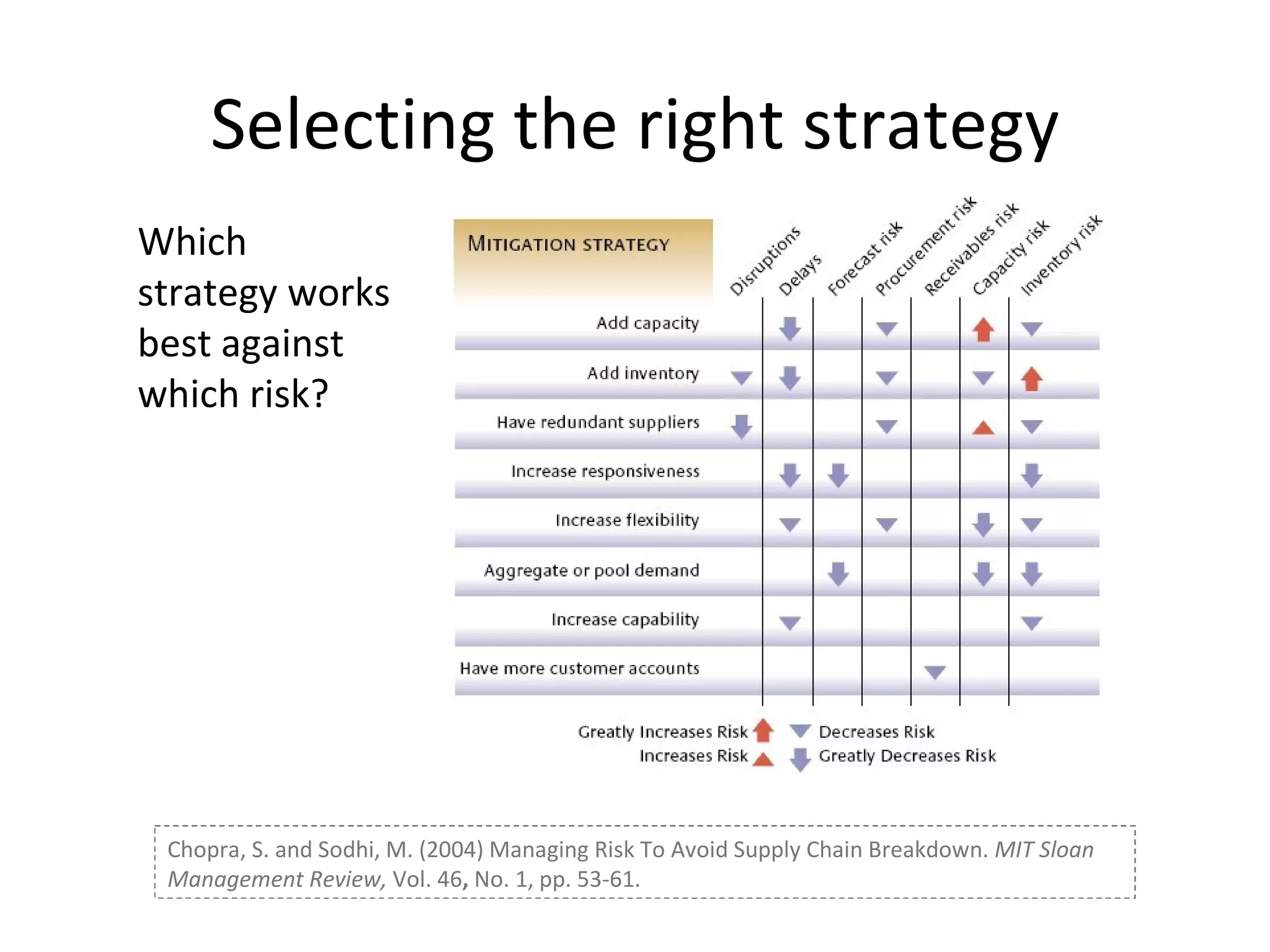
Selecting the right strategy Chopra, S. and Sodhi, M. (2004) Managing Risk To Avoid Supply Chain Breakdown.  MIT Sloan Management Review,  Vol. 46 ,  No. 1, pp. 53-61.  Which strategy works best against which risk?
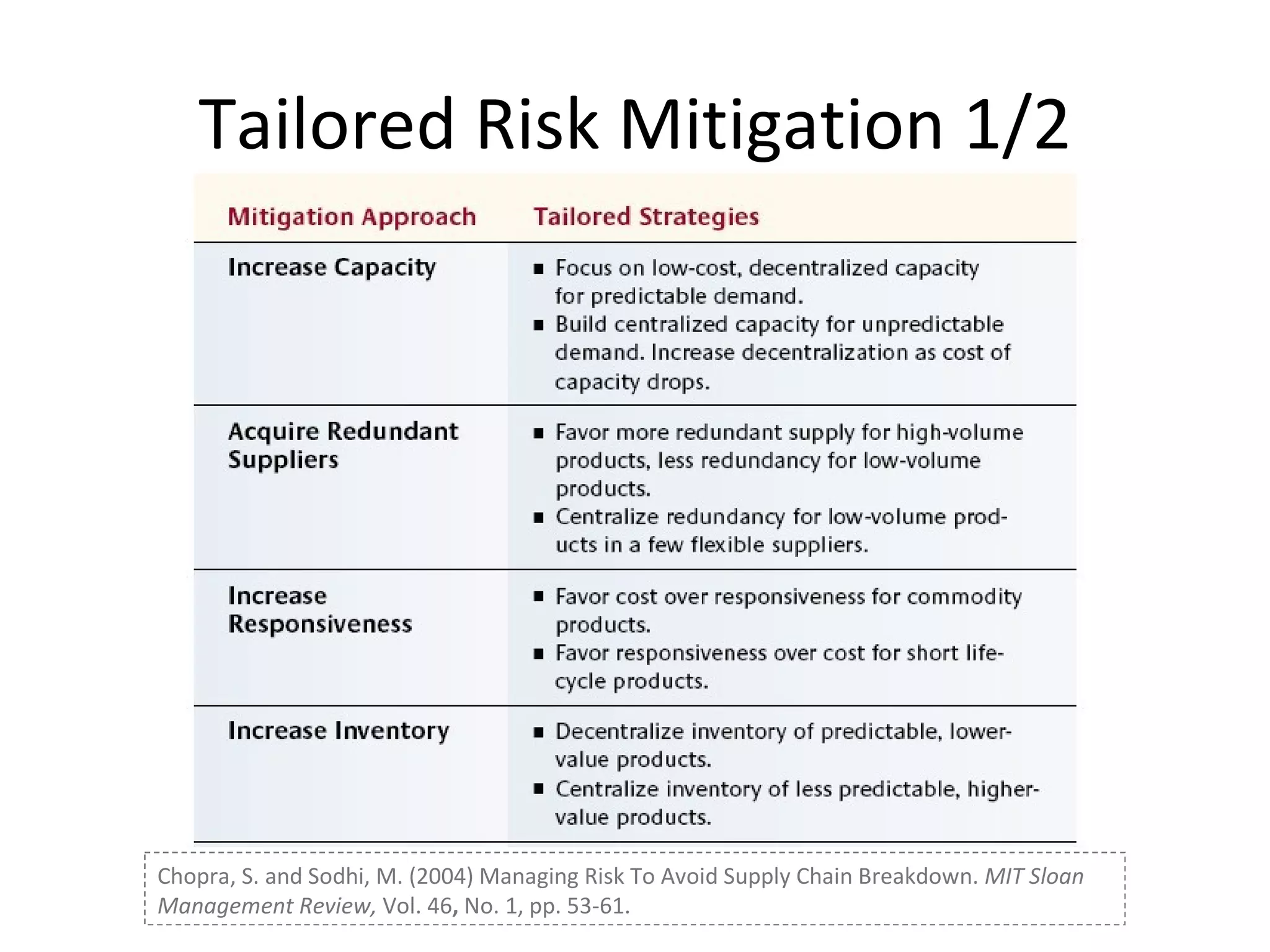
Tailored Risk Mitigation 1/2 Chopra, S. and Sodhi, M. (2004) Managing Risk To Avoid Supply Chain Breakdown.  MIT Sloan Management Review,  Vol. 46 ,  No. 1, pp. 53-61.
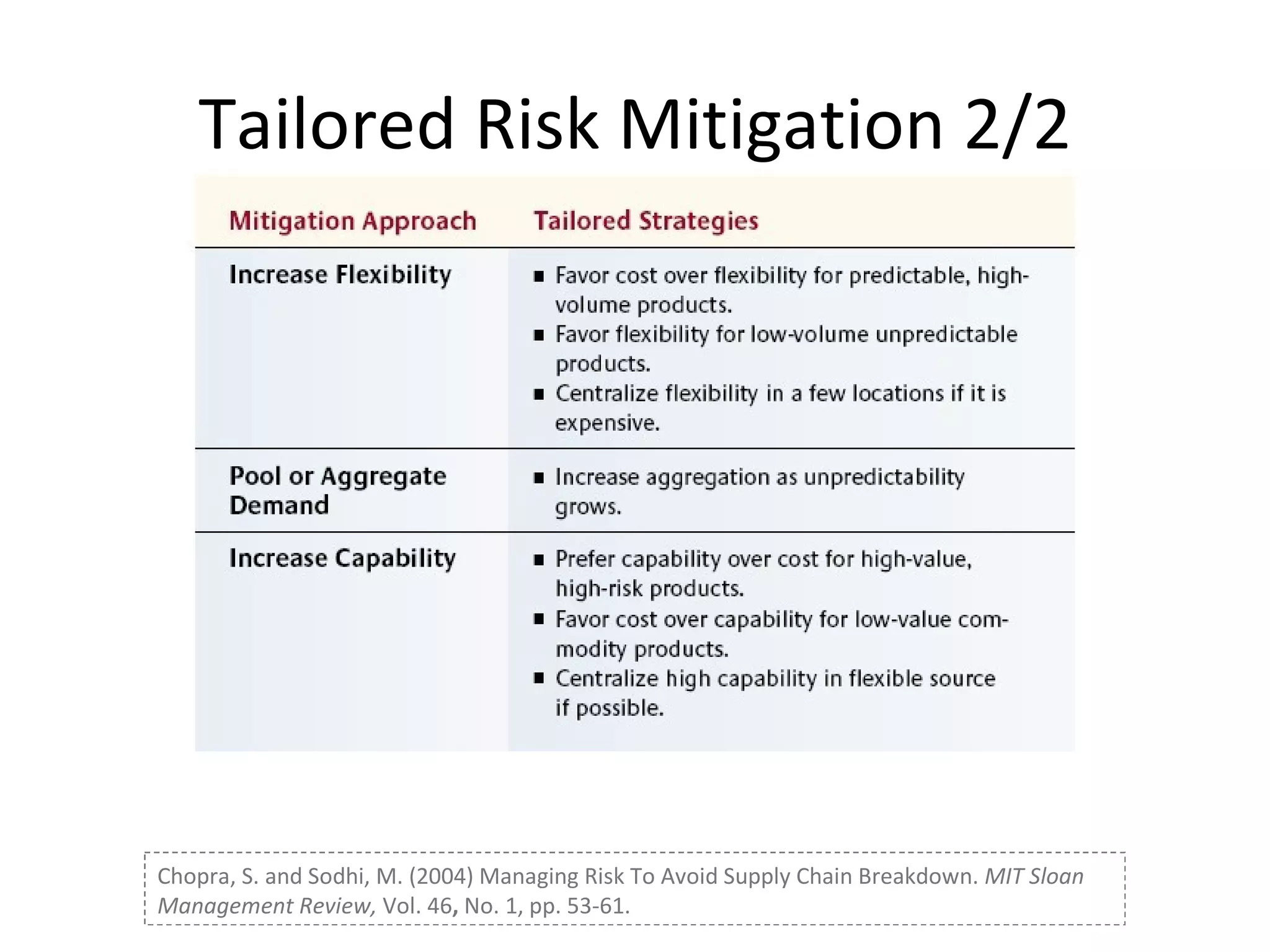
Tailored Risk Mitigation 2/2 Chopra, S. and Sodhi, M. (2004) Managing Risk To Avoid Supply Chain Breakdown.  MIT Sloan Management Review,  Vol. 46 ,  No. 1, pp. 53-61.
Manage supply chain risk 1/2 Understand  the supply chain view it from end to end, from supplier to end customer. Improve  the supply chain can you simplify and reduce complexity and variability? Identify  critical paths what are the bottlenecks and key nodes/links? Manage  the critical paths make contingency plans. Christopher, M. (2005)  Managing risk in the supply chain . In: Christopher, M. (Ed.)  Logistics and Supply Chain Management.  3rd ed., Prentice Hall, pp. 231-258.
Manage supply chain risk 2/2 Allow  network visibility don't be afraid to share information. Establish  a supply chain continuity team make it cross-functional Work with  suppliers and customers are your suppliers and customers aware of their own vulnerabilities? Christopher, M. (2005)  Managing risk in the supply chain . In: Christopher, M. (Ed.)  Logistics and Supply Chain Management.  3rd ed., Prentice Hall, pp. 231-258.
Summary Supply Chains are exposed to  a variety of risks  that are unique to each supply chain. These risks are related to  actions  and  events  that are  inside  and  outside  of the supply chain. Supply Chain Risk Analysis seeks to  identify  these risks, their  sources  and  driver s, and their  impact  on the supply chain. Supply Chain Risk Management seeks to establish  mitigative  and  contingent  strategies for how to deal with the identified risks and their potential impact on the supply chain.
Thank you

Supply Chain Risk

  • 1.
    Supply Chain RiskGuest lecture, LOG 711, 12.11.2008 Jan Husdal  jan.husdal@himolde.no  71214289
  • 2.
    Outline What is(supply chain) risk ? What are typical supply chain risks ? How to manage supply chain risks?
  • 3.
    Supply chain risk?Loss of goods Insurance? Loss of vehicle Replacement? Delayed delivery Brand reputation? Injured personell Hiring and training? Weather conditions Detour?
  • 4.
    Supply Chain Trends >>> Consequences The trend towards just-in-time and lean practices >>> efficiency rather than effectiveness . The trend towards reducing costs (at almost any cost) >>> globalization of supply chains, more complex and vulnerable . The trend towards economies of scale >>> centralized distribution and manufacturing >>> lower costs but at the same time less flexibility . The trend towards outsourcing non-core business activities >>> loss of control of the supply chain when it is most needed . The trend towards consolidation of suppliers (intentional and incidental mergers and acquisitions) >>> increased potential for supply failure . Christopher, M. (2005) Managing risk in the supply chain . In: Christopher, M. (Ed.) Logistics and Supply Chain Management. 3rd ed., Prentice Hall, pp. 231-258.
  • 5.
    Supply Chain Risk- Piracy http://www.icc-ccs.org/
  • 6.
    Why is supplychain risk important? Even a relatively small supply chain disruption caused by a localized event may have consequences across the global economic system . Globalization, offshoring and outsourcing leads to >> “no” control over causes to events in the supply chain. >> “only” control over consequences of events in the supply chain. World Economic Forum (2008) Hyper-optimization and supply chain vulnerability: an invisible global risk? In: Global Risks 2008 – A Global Risk Network Report, REF: 090108, World Economic Forum, Switzerland. http://www.weforum.org/pdf/globalrisk/report2008.pdf
  • 7.
    Supply Chain Risk– an example An ill-handled supply chain disruption >>> business dis-continuity A well-handled supply chain disruption >>> business continuity Norrman and Janson (2004) Ericsson’s proactive supply chain risk management after a serious sub-supplier accident . International Journal of Physical Distribution and Logistics Management, Vol 34, No 5, pp. 434-456
  • 8.
    What is risk?Risk : - exposure to the chance of injury or loss - hazard or dangerous chance - chance of loss - degree of probability of such a loss Aven, T. (2002) Foundations of Risk Analysis : A Knowledge and Decision-Oriented Perspective, John Wiley & Sons.
  • 9.
    The risk conceptRisk is an ambiguous concept . There are many definitions of risk, depending on their specific application and on their situational context . Risk denotes the precise probability of specific eventualities . Technically, risk has no value, so these eventualities can be beneficial or adverse (i.e. financial risk). RISK = Probability * Consequences
  • 10.
    Risk analysis Acommonly used method for risk analysis is by plotting unforeseen or unwanted events in a risk matrix . This can be done qualitatively , where probabilities and impacts are subjective values (e.g. low/high and minor/major),or quantitatively , where probablities and impacts are objective values (e.g. frequency and cost in $$$). Norman, A. and Lindroth, R. (2004) Categorization of Supply Chain Risk and Risk Management . In: Brindley, C. (Ed.) Supply Chain Risk. Ashgate, pp. 14-27.
  • 11.
    Proactive versus ReactiveAsbjørnslett, B E and Rausand, M (1997) Assess the vulnerability of your production system . Report NTNU 97018. Norwegian University of Science and Technology NTNU, Department of Production and Quality Engineering, Trondheim, Norway. Tomlin, B. (2006) On the Value of Mitigation and Contingency Strategies for Managing Supply Chain Disruption Risks . Management Science, Vol. 52, No. 5, pp. 639-657 Ritchie, B. and Brindley, C. (2004) Risk Characteristics of the Supply Chain – A Contingency Framework . In: Supply Chain Risk. Ed. Brindley, C. , Ashgate Publishing, pp. 28-42,197-202 Mitigative actions address risk sources. Contingent actions address risk consequences.
  • 12.
    Business risks Externally-driven or environmental risk - external factors, competitors, customers, regulations Internally-driven or process risk - operations and processing Decision-driven or information risk - insufficient or erroneous decision support De Loach, J. W. (2000) Enterprise-wide Risk Management: Strategies for linking risk and opportunity , Financial Times/Prentice Hall In order to understand suply chain risk it is useful to first look at business risks in general.
  • 13.
    Supply Chain RiskJütner, U., Peck, H. and Christopher, M. (2003) Supply Chain Risk Management: Outlining an Agenda for Future Research. International Journal of Logistics: Research and Applications, Vol. 6 , No. 4, pp. 197-210. Supply Chain Risk can be viewed as a 4-fold construct: Risk sources . Consequences of the risk sources. Risk drivers that turn risks into consequences. Strategies to address the risks.
  • 14.
    Supply chain risksources 1/2 Internal to the focal firm External to the focal firm Internal to the supply chain External to the supply chain Peck, H. (2003) Supply Chain Resilience . UK Department of Transport/ Cranfield University, Carnfield, UK. Risks can be seen as internal or external to the focal firm , and be seen as internal or external to the supply chain : Process risk Control risk Supply risk Demand risk Environment al risk
  • 15.
    Supply chain risksources 2/2 Sources of risk can be broadly categorized along three different levels: Organization al risk Network risk Environment al risk Jütner, U., Peck, H. and Christopher, M. (2003) Supply Chain Risk Management: Outlining an Agenda for Future Research. International Journal of Logistics: Research and Applications, Vol. 6 , No. 4, pp. 197-210.
  • 16.
    Types of supplychain risk 1/2 Network (Supply Chain) Risks Supply Risks - disruption of supply, inventory and schedules, incoming delays Operation al Risks - failure or breakdown of operations, changes in technology Demand Risks - variations in demand Security Risks - theft, counterfeiting, terrorism, piracy, infrastructure breakdown Manuj, I. and Mentzer, J. T. (2008) Global Supply Chain Risk Management . Journal of Business Logistics, Vol. 29 , No. 1, pp. 133-155
  • 17.
    Environment Risks Macro Risks - economic shifts, recession, labour costs, exchange rates, customs Policy Risks - actions and sanctions of governments, shifts in legislation Competition Risks - uncertainty about competitors’ moves and actions Resource Risks - lack of human resources, capital or technology Types of supply chain risk 2/2 Manuj, I. and Mentzer, J. T. (2008) Global Supply Chain Risk Management . Journal of Business Logistics, Vol. 29 , No. 1, pp. 133-155
  • 18.
    Risk Management StrategiesAvoid Transfer Reduce Retain Deloach, J (2000) Enterprise-Wide Risk Management: Strategies for Linking Risk & Opportunity. Financial Times Management/ Prentice Hall. Before we look at strategies for managing supply chain risk, let us look at general strategies for managing risk
  • 19.
    Supply Chain RiskManagement Supply chain risk management can be described as the intersection of supply chain management and risk management. 1 It has a collaborative and structured approach, and is included in the planning and control processes of the supply chain, to handle risks which might affect the achievement of the supply chain goals . 2 1 Paulsson, U. (2004) Supply Chain Risk Management . In : Brindley, C. (ed): Supply Chain Risk. Ashgate Publishing Limited, pp.79-99. 2 Kajüter, P. (2003) Risk Management in Supply Chains . In: Seuring, S Müller, M., Goldbach, M., Schneidewind, U. (eds.) Strategy and Organization in Supply Chains, Physica, Heidelberg, pp. 321-336.
  • 20.
    Supply Chain RiskManagement Strategies Avoidance - exiting a market (or product) or delay entering a market (or product) Postponement - delay commitment of resources to maintain utmost flexibility Speculation - assuming risk to gain competitive advantage Hedging - globally dispersing your portfolio of suppliers, customers and facilities Manuj, I. and Mentzer, J. T. (2008) Global Supply Chain Risk Management . Journal of Business Logistics, Vol. 29 , No. 1, pp. 133-155
  • 21.
    Supply Chain RiskManagement Strategies Control - vertical and lateral integration of suppliers and business partners Transferring/sharing risk - outsourcing, offshoring, contracting Security - identifying and protecting against unwanted penetration Manuj, I. and Mentzer, J. T. (2008) Global Supply Chain Risk Management . Journal of Business Logistics, Vol. 29 , No. 1, pp. 133-155
  • 22.
    Supply Chain DisruptionsSheffi, Y. (2005) The Resilient Enterprise - Overcoming Vulnerability for Competitive Advantage , MIT Press Warning? What happens to supply chain performance during an unforeseen event?
  • 23.
    Different supply chaincharacteristics will result in different ways a suply chain disruption is handled. A resilient supply chain is impacted, but it is able to come back to a stable state, although not necessarily to where it was before the disruption. In business setting the ability to survive (resilience) is more important than regaining stability (robustness) The difference between Robustness, Flexibility and Resilience Supply Chain Disruptions
  • 24.
    Supply Chain Disruptions3/3 Resilient organisations Resilient supply chains Mc Manus, S. et al (2007) Resilience Management – A Framework for Assessing and Improving the Resilience of Organisations . Research Report 2007/01, Resilient Organisations, New Zealand. www.resorgs.org.nz Resilient organizations
  • 25.
    Supply Chain DesignA supply chain is more likely to be severely impacted if there is supply chain density supply chain complexity node criticality Supply Chain Mitigation Capability A supply chain is less likely to be severely impacted if there is adaptive capacity (recovery capability) information sharing/ visibility (warning capability) Supply Chain Design vis-a-vis supply chain disruptions Craighead, C. W., Blackhurst, J., Rungtusanatham, M. J. & Handfield, R. B. (2007) The Severity of Supply Chain Disruptions: Design Characteristics and Mitigation Capabilities . Decision Sciences, Vol. 38, No. 1, pp. 131-156. Factors (risk drivers) that can aggravate or lessen supply chain disruptions:
  • 26.
    Supply Chain Vulnerability1/2 Which parts of the supply chain are most important? (”Criticality”) What can we do if something happens? (”Preparedness”) Not being prepared is the biggest risk (”Passive Acceptance”).
  • 27.
    Supply Chain Vulnerability2/2 Prioritize earnings drivers Identify critical infrastructure that affect the earnings drivers Locate vulnerabilities in the critical infrastructure Model scenarios for the vulnerabilities Develop responses to the scenarios Monitor, detect and respond to potential disruptions as soon as possible Preparing for Evil , Harvard Business Review, April 2003, pp. 109-115
  • 28.
    Supply Chain Risksand Drivers Chopra, S. and Sodhi, M. (2004) Managing Risk To Avoid Supply Chain Breakdown. MIT Sloan Management Review, Vol. 46 , No. 1, pp. 53-61.
  • 29.
    Supply Chain Risksand Drivers Chopra, S. and Sodhi, M. (2004) Managing Risk To Avoid Supply Chain Breakdown. MIT Sloan Management Review, Vol. 46 , No. 1, pp. 53-61.
  • 30.
    Selecting the rightstrategy Chopra, S. and Sodhi, M. (2004) Managing Risk To Avoid Supply Chain Breakdown. MIT Sloan Management Review, Vol. 46 , No. 1, pp. 53-61. Which strategy works best against which risk?
  • 31.
    Tailored Risk Mitigation1/2 Chopra, S. and Sodhi, M. (2004) Managing Risk To Avoid Supply Chain Breakdown. MIT Sloan Management Review, Vol. 46 , No. 1, pp. 53-61.
  • 32.
    Tailored Risk Mitigation2/2 Chopra, S. and Sodhi, M. (2004) Managing Risk To Avoid Supply Chain Breakdown. MIT Sloan Management Review, Vol. 46 , No. 1, pp. 53-61.
  • 33.
    Manage supply chainrisk 1/2 Understand the supply chain view it from end to end, from supplier to end customer. Improve the supply chain can you simplify and reduce complexity and variability? Identify critical paths what are the bottlenecks and key nodes/links? Manage the critical paths make contingency plans. Christopher, M. (2005) Managing risk in the supply chain . In: Christopher, M. (Ed.) Logistics and Supply Chain Management. 3rd ed., Prentice Hall, pp. 231-258.
  • 34.
    Manage supply chainrisk 2/2 Allow network visibility don't be afraid to share information. Establish a supply chain continuity team make it cross-functional Work with suppliers and customers are your suppliers and customers aware of their own vulnerabilities? Christopher, M. (2005) Managing risk in the supply chain . In: Christopher, M. (Ed.) Logistics and Supply Chain Management. 3rd ed., Prentice Hall, pp. 231-258.
  • 35.
    Summary Supply Chainsare exposed to a variety of risks that are unique to each supply chain. These risks are related to actions and events that are inside and outside of the supply chain. Supply Chain Risk Analysis seeks to identify these risks, their sources and driver s, and their impact on the supply chain. Supply Chain Risk Management seeks to establish mitigative and contingent strategies for how to deal with the identified risks and their potential impact on the supply chain.
  • 36.