THOUGHT LEADERS FOR MANUFACTURING & SUPPLY CHAIN
ARC INSIGHTS
By John Moore
A critical and often broken link in
manufacturing today is the link between
design and manufacturing processes. The
lack of a tight link hinders responsiveness
to market needs. IBM/Dassault and EDS,
two of the leading PLM suppliers, seek to
address this issue through partners.
INSIGHT# 2003-17E
APRIL 23, 2003
Closing the Gap on Digital Manufacturing
Keywords
PLM, CAD/CAM, CPM, IBM, EDS
Summary
The concurrent engineering required for new product designs between de-
sign engineering and manufacturing engineering has always been a critical
focal point for manufacturers to shorten time-to-market, accelerate time-to-
volume, and minimize cost of production. Today, collaboration between
product design (CAD) and manufacturing proc-
esses (CAM) is a robust process due to tight
integration between CAD and CAM and the emer-
gence of extended PDM and PLM systems.
However, there has not been a corresponding
level of tight integration between CAD/CAM and
production management. But the benefits of ex-
changing information between the product
definition domain and production management are becoming clear as
manufacturers move to a collaborative environment. Two leading PLM
suppliers, EDS and IBM/Dassault, have recently launched new programs
to integrate these disparate domains.
Analysis
Manufacturers are under pressure to accelerate the design, production, and
marketing of new products to retain customers and gain new ones. Subse-
quently, manufacturers have made enormous technology investments in
enterprise software and factory automation. As a result, virtually all indus-
tries have seen impressive productivity gains, but companies must
continually seek new ways to improve their numerous business processes
to gain that critical competitive advantage.
Toward that end, leading companies like Boeing, DaimlerChrysler, and GM
are pursuing a vision of digital manufacturing, encompassing everything
from initial design through production and service. This will be addressed
through a digital information pipeline that will automate numerous proc-
ARC Insights, Page 2
©2003 • ARC • 3 Allied Drive • Dedham, MA 02026 USA • 781-471-1000 • ARCweb.com
esses and manage by exception with integrated, tight feedback loops to op-
timize production resources and improve product quality.
Increasing attention is focusing on the hand-off between the design process
and manufacturing production planning, an area traditionally defined by
manufacturing processes unique to each company and an area rife with
proprietary solutions to link the two activities.
Both processes fall within ARC’s definition of Product Lifecycle Manage-
ment, the former referred to as collaborative design and the latter as
manufacturing process management (MPM). There is also an increasingly
tight link between MPM and collaborative production management (CPM).
The former plans and defines the production processes to be used, while
CPM provides day-to-day production execution functions.
Two PLM Leaders Step Forward
In the last several months, two PLM leaders have announced their strate-
gies for tightly linking design and production processes. Last year, IBM
partnered with Rockwell, Cisco, and MRO Software as part of its automo-
tive initiative, while EDS partnered with Tecnomatix to address the
automotive and electronics (EMS) verticals. More recently, EDS partnered
with the newly formed Visiprise for highly regulated industries.
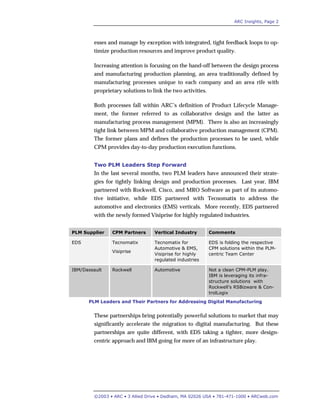
These partnerships bring potentially powerful solutions to market that may
significantly accelerate the migration to digital manufacturing. But these
partnerships are quite different, with EDS taking a tighter, more design-
centric approach and IBM going for more of an infrastructure play.
PLM Supplier CPM Partners Vertical Industry Comments
EDS Tecnomatix
Visiprise
Tecnomatix for
Automotive & EMS,
Visiprise for highly
regulated industries
EDS is folding the respective
CPM solutions within the PLM-
centric Team Center
IBM/Dassault Rockwell Automotive Not a clean CPM-PLM play.
IBM is leveraging its infra-
structure solutions with
Rockwell’s RSBizware & Con-
trolLogix
PLM Leaders and Their Partners for Addressing Digital Manufacturing
ARC Insights, Page 3
©2003 • ARC • 3 Allied Drive • Dedham, MA 02026 USA • 781-471-1000 • ARCweb.com
EDS’s choice of partners was lead
in large part by their desire to have
partners that did not infringe upon
their core competency of authoring
and product definition.
EDS’ Partners Focus on Process Definition
For MPM and CPM, EDS clearly did not want partners involved in product
definition, EDS’ core competency. In Tecnomatix and Visiprise, EDS found
two partners that complemented its existing offerings within its Teamcenter
Manufacturing platform, which in itself is a subset of E-factory.
Tecnomatix, which has quietly added CPM functional-
ity to its core MPM solution, is EDS’s partner for the
automotive and EMS verticals. Tecnomatix, with its
eMPower solution, is a partner that can act as the “sys-
tem of record” for production, from planning to
execution. In turn, Tecnomatix is adopting EDS’ PLM
Open platform for tight integration with EDS. This allows design and pro-
duction teams to collaborate more readily within a common framework,
thereby accelerating production process planning and execution. While
these two share many of the same customers, they have yet to report any
customers that are using the combined solution today.
With Visiprise, EDS will target highly regulated industries such as aero-
space & defense, and life sciences. Visiprise, newly formed by NetVendor’s
acquisition of Teradyne’s CPM business, had sought a PLM partner that
shared its vision of bringing CPM and design functionality closer together,
something they found at EDS. Visiprise’s product, SCE with its deep func-
tionality in execution processes will be integrated within the EDS
Teamcenter Manufacturing suite.
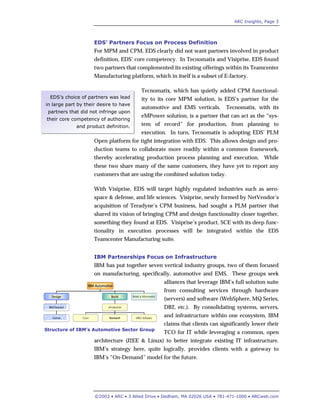
IBM Partnerships Focus on Infrastructure
IBM has put together seven vertical industry groups, two of them focused
on manufacturing, specifically, automotive and EMS. These groups seek
alliances that leverage IBM’s full solution suite
from consulting services through hardware
(servers) and software (WebSphere, MQ Series,
DB2, etc.). By consolidating systems, servers,
and infrastructure within one ecosystem, IBM
claims that clients can significantly lower their
TCO for IT while leveraging a common, open
architecture (J2EE & Linux) to better integrate existing IT infrastructure.
IBM’s strategy here, quite logically, provides clients with a gateway to
IBM’s “On-Demand” model for the future.
IBM Automotive
Design Build Retail & Aftermarket
IBM/Dassault
Delmia
eProduction
Cisco Rockwell MRO Software
IBM Automotive
Design Build Retail & Aftermarket
IBM/Dassault
Delmia
eProduction
Cisco Rockwell MRO Software
Structure of IBM’s Automotive Sector Group
ARC Insights, Page 4
©2003 • ARC • 3 Allied Drive • Dedham, MA 02026 USA • 781-471-1000 • ARCweb.com
Within automotive, IBM has three sub-groups, each addressing a broad
business area: design, build, and aftermarket (retail). For design, IBM
works closely with its long-time partner, Dassault, which acquired the
DELMIA manufacturing process planning solution. It is similar to Tecno-
matix in functionality, but unlike Tecnomatix, DELMIA does not have deep
CPM capabilities. For that, IBM has established a relationship with Rock-
well under the eProduction group of the automotive vertical.
With Rockwell and others, IBM will provide what it calls an “automotive
common environment” with WebSphere at its core. This will help build
specific business processes to better link production to other busi-
ness/enterprise activities. One automotive customer has gone live and
three are currently implementing this new joint offering.
Currently, IBM’s link between design and build functions is weaker than
that provided by EDS. While IBM offers a common environment, by which
a client or IBM Global Services could build such linkages, they will be cus-
tom build. This provides flexibility for a client, but at a cost.
Recommendations
• Both EDS and IBM are investing heavily to bring solutions to market
that will more tightly integrate design and manufacturing. These solu-
tions, while relatively new, offer real promise. Manufacturers in all
verticals, particularly in Tier 1, should monitor these developments.
Also, while IBM and EDS may lead this initiative, others will quickly
follow with solutions and partnerships for other vertical sectors.
• Manufacturers should first look to software suppliers for solutions,
rather than build proprietary solutions in-house. Apply the 80/20 rule:
If a supplier’s solution meets 80% of your need adopt it. The long-term
savings will more then make up the lack of 100% functionality.
Please help us improve our deliverables to you – take our survey linked to this
transmittal e-mail or at www.arcweb.com/myarc in the Client Area. For further
information, contact your account manager or the author at jmoore@arcweb.com.
Recommended circulation: All EAS clients. ARC Insights are published and
copyrighted by ARC Advisory Group. The information is proprietary to ARC and
no part of it may be reproduced without prior permission from ARC.

Closing the Gap on Digital Manufacturing

  • 1.
    THOUGHT LEADERS FORMANUFACTURING & SUPPLY CHAIN ARC INSIGHTS By John Moore A critical and often broken link in manufacturing today is the link between design and manufacturing processes. The lack of a tight link hinders responsiveness to market needs. IBM/Dassault and EDS, two of the leading PLM suppliers, seek to address this issue through partners. INSIGHT# 2003-17E APRIL 23, 2003 Closing the Gap on Digital Manufacturing Keywords PLM, CAD/CAM, CPM, IBM, EDS Summary The concurrent engineering required for new product designs between de- sign engineering and manufacturing engineering has always been a critical focal point for manufacturers to shorten time-to-market, accelerate time-to- volume, and minimize cost of production. Today, collaboration between product design (CAD) and manufacturing proc- esses (CAM) is a robust process due to tight integration between CAD and CAM and the emer- gence of extended PDM and PLM systems. However, there has not been a corresponding level of tight integration between CAD/CAM and production management. But the benefits of ex- changing information between the product definition domain and production management are becoming clear as manufacturers move to a collaborative environment. Two leading PLM suppliers, EDS and IBM/Dassault, have recently launched new programs to integrate these disparate domains. Analysis Manufacturers are under pressure to accelerate the design, production, and marketing of new products to retain customers and gain new ones. Subse- quently, manufacturers have made enormous technology investments in enterprise software and factory automation. As a result, virtually all indus- tries have seen impressive productivity gains, but companies must continually seek new ways to improve their numerous business processes to gain that critical competitive advantage. Toward that end, leading companies like Boeing, DaimlerChrysler, and GM are pursuing a vision of digital manufacturing, encompassing everything from initial design through production and service. This will be addressed through a digital information pipeline that will automate numerous proc-
  • 2.
    ARC Insights, Page2 ©2003 • ARC • 3 Allied Drive • Dedham, MA 02026 USA • 781-471-1000 • ARCweb.com esses and manage by exception with integrated, tight feedback loops to op- timize production resources and improve product quality. Increasing attention is focusing on the hand-off between the design process and manufacturing production planning, an area traditionally defined by manufacturing processes unique to each company and an area rife with proprietary solutions to link the two activities. Both processes fall within ARC’s definition of Product Lifecycle Manage- ment, the former referred to as collaborative design and the latter as manufacturing process management (MPM). There is also an increasingly tight link between MPM and collaborative production management (CPM). The former plans and defines the production processes to be used, while CPM provides day-to-day production execution functions. Two PLM Leaders Step Forward In the last several months, two PLM leaders have announced their strate- gies for tightly linking design and production processes. Last year, IBM partnered with Rockwell, Cisco, and MRO Software as part of its automo- tive initiative, while EDS partnered with Tecnomatix to address the automotive and electronics (EMS) verticals. More recently, EDS partnered with the newly formed Visiprise for highly regulated industries. These partnerships bring potentially powerful solutions to market that may significantly accelerate the migration to digital manufacturing. But these partnerships are quite different, with EDS taking a tighter, more design- centric approach and IBM going for more of an infrastructure play. PLM Supplier CPM Partners Vertical Industry Comments EDS Tecnomatix Visiprise Tecnomatix for Automotive & EMS, Visiprise for highly regulated industries EDS is folding the respective CPM solutions within the PLM- centric Team Center IBM/Dassault Rockwell Automotive Not a clean CPM-PLM play. IBM is leveraging its infra- structure solutions with Rockwell’s RSBizware & Con- trolLogix PLM Leaders and Their Partners for Addressing Digital Manufacturing
  • 3.
    ARC Insights, Page3 ©2003 • ARC • 3 Allied Drive • Dedham, MA 02026 USA • 781-471-1000 • ARCweb.com EDS’s choice of partners was lead in large part by their desire to have partners that did not infringe upon their core competency of authoring and product definition. EDS’ Partners Focus on Process Definition For MPM and CPM, EDS clearly did not want partners involved in product definition, EDS’ core competency. In Tecnomatix and Visiprise, EDS found two partners that complemented its existing offerings within its Teamcenter Manufacturing platform, which in itself is a subset of E-factory. Tecnomatix, which has quietly added CPM functional- ity to its core MPM solution, is EDS’s partner for the automotive and EMS verticals. Tecnomatix, with its eMPower solution, is a partner that can act as the “sys- tem of record” for production, from planning to execution. In turn, Tecnomatix is adopting EDS’ PLM Open platform for tight integration with EDS. This allows design and pro- duction teams to collaborate more readily within a common framework, thereby accelerating production process planning and execution. While these two share many of the same customers, they have yet to report any customers that are using the combined solution today. With Visiprise, EDS will target highly regulated industries such as aero- space & defense, and life sciences. Visiprise, newly formed by NetVendor’s acquisition of Teradyne’s CPM business, had sought a PLM partner that shared its vision of bringing CPM and design functionality closer together, something they found at EDS. Visiprise’s product, SCE with its deep func- tionality in execution processes will be integrated within the EDS Teamcenter Manufacturing suite. IBM Partnerships Focus on Infrastructure IBM has put together seven vertical industry groups, two of them focused on manufacturing, specifically, automotive and EMS. These groups seek alliances that leverage IBM’s full solution suite from consulting services through hardware (servers) and software (WebSphere, MQ Series, DB2, etc.). By consolidating systems, servers, and infrastructure within one ecosystem, IBM claims that clients can significantly lower their TCO for IT while leveraging a common, open architecture (J2EE & Linux) to better integrate existing IT infrastructure. IBM’s strategy here, quite logically, provides clients with a gateway to IBM’s “On-Demand” model for the future. IBM Automotive Design Build Retail & Aftermarket IBM/Dassault Delmia eProduction Cisco Rockwell MRO Software IBM Automotive Design Build Retail & Aftermarket IBM/Dassault Delmia eProduction Cisco Rockwell MRO Software Structure of IBM’s Automotive Sector Group
  • 4.
    ARC Insights, Page4 ©2003 • ARC • 3 Allied Drive • Dedham, MA 02026 USA • 781-471-1000 • ARCweb.com Within automotive, IBM has three sub-groups, each addressing a broad business area: design, build, and aftermarket (retail). For design, IBM works closely with its long-time partner, Dassault, which acquired the DELMIA manufacturing process planning solution. It is similar to Tecno- matix in functionality, but unlike Tecnomatix, DELMIA does not have deep CPM capabilities. For that, IBM has established a relationship with Rock- well under the eProduction group of the automotive vertical. With Rockwell and others, IBM will provide what it calls an “automotive common environment” with WebSphere at its core. This will help build specific business processes to better link production to other busi- ness/enterprise activities. One automotive customer has gone live and three are currently implementing this new joint offering. Currently, IBM’s link between design and build functions is weaker than that provided by EDS. While IBM offers a common environment, by which a client or IBM Global Services could build such linkages, they will be cus- tom build. This provides flexibility for a client, but at a cost. Recommendations • Both EDS and IBM are investing heavily to bring solutions to market that will more tightly integrate design and manufacturing. These solu- tions, while relatively new, offer real promise. Manufacturers in all verticals, particularly in Tier 1, should monitor these developments. Also, while IBM and EDS may lead this initiative, others will quickly follow with solutions and partnerships for other vertical sectors. • Manufacturers should first look to software suppliers for solutions, rather than build proprietary solutions in-house. Apply the 80/20 rule: If a supplier’s solution meets 80% of your need adopt it. The long-term savings will more then make up the lack of 100% functionality. Please help us improve our deliverables to you – take our survey linked to this transmittal e-mail or at www.arcweb.com/myarc in the Client Area. For further information, contact your account manager or the author at jmoore@arcweb.com. Recommended circulation: All EAS clients. ARC Insights are published and copyrighted by ARC Advisory Group. The information is proprietary to ARC and no part of it may be reproduced without prior permission from ARC.