Food safety in a social context
Delia Grace,
Professor Food Safety Systems, Natural Resources Institute, Chatham, UK
Scientist International Livestock Research Institute, Nairobi, Kenya
Co-authors: Bernard Bett, Theo Knight-Jones, Florence Mutua, Hung Nguyen, Himadri Pal,
Kristina Roesel
Understanding the social context of One Health
World One Health Congress, Singapore 7-11 November 2022
Overview
1. Why study food safety in a OH
2. What have we learned?
3. The missing middle – incentives & institutions
4. Way forward
Context
“Quadripartite Launches Joint Action
Plan to Promote One Health
Approach”
The five-year plan outlines six action tracks:
– enhancing One Health capacities to strengthen health systems;
– reducing the risks from emerging and re-emerging zoonotic epidemics and
pandemics;
– controlling and eliminating endemic zoonotic, neglected tropical, and vector-
borne diseases;
– strengthening the assessment, management, and communication of food safety
risks;
– curbing the silent pandemic of antimicrobial resistance; and
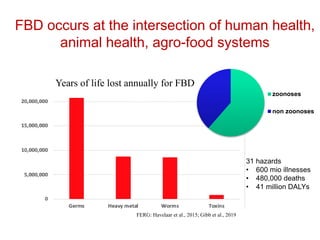
Years of life lost annually for FBD
FERG: Havelaar et al., 2015; Gibb et al., 2019
Health impact of FBD comparable to
that of malaria, HIV/AIDs or TB
31 hazards
• 600 mio illnesses
• 480,000 deaths
• 41 million DALYs
zoonoses
non zoonoses
FBD occurs at the intersection of human health,
animal health, agro-food systems
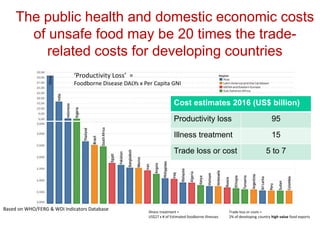
The public health and domestic economic costs
of unsafe food may be 20 times the trade-
related costs for developing countries
Cost estimates 2016 (US$ billion)
Productivity loss 95
Illness treatment 15
Trade loss or cost 5 to 7
‘Productivity Loss’ =
Foodborne Disease DALYs x Per Capita GNI
Based on WHO/FERG & WDI Indicators Database Illness treatment =
US$27 x # of Estimated foodborne illnesses
Trade loss or costs =
2% of developing country high value food exports
6
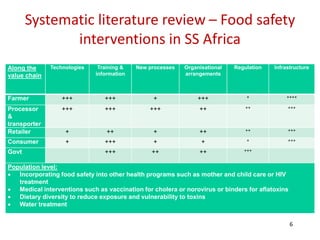
Systematic literature review – Food safety
interventions in SS Africa
Along the
value chain
Technologies Training &
information
New processes Organisational
arrangements
Regulation Infrastructure
Farmer +++ +++ + +++ + ++++
Processor
&
transporter
+++ +++ +++ ++ ++ +++
Retailer + ++ + ++ ++ +++
Consumer + +++ + + + +++
Govt +++ ++ ++ +++
Population level:
 Incorporating food safety into other health programs such as mother and child care or HIV
treatment
 Medical interventions such as vaccination for cholera or norovirus or binders for aflatoxins
 Dietary diversity to reduce exposure and vulnerability to toxins
 Water treatment
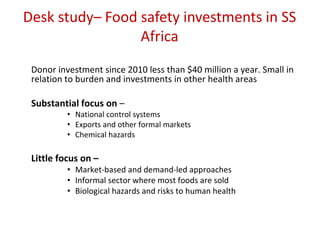
• Donor investment since 2010 less than $40 million a year. Small in
relation to burden and investments in other health areas
• Substantial focus on –
• National control systems
• Exports and other formal markets
• Chemical hazards
•
• Little focus on –
• Market-based and demand-led approaches
• Informal sector where most foods are sold
• Biological hazards and risks to human health
Desk study– Food safety investments in SS
Africa
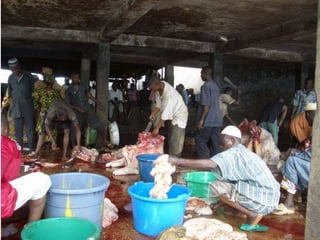
Reliance on regulations without institution
building
 100% of milk in Assam doesn’t meet standards
 98% of beef in Ibadan, 52% pork in Ha Noi, unacceptable
bacteria counts
 92% of Addis milk and 46% of Nairobi milk had aflatoxins
over EU standards
 36% of farmed fish from Kafrelsheikh exceed one or more
MPL
 30% of chicken from commercial broilers in Pretoria
unacceptable for S. aureus
 24% of boiled milk in Abidjan unacceptable S. aureus
9
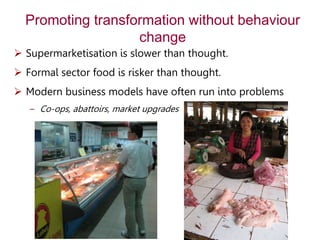
Promoting transformation without behaviour
change
 Supermarketisation is slower than thought.
 Formal sector food is risker than thought.
 Modern business models have often run into problems
– Co-ops, abattoirs, market upgrades
11
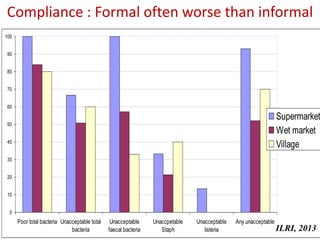
0
10
20
30
40
50
60
70
80
90
100
Poor total bacteria Unacceptable total
bacteria
Unacceptable
faecal bacteria
Unaccpetable
Staph
Unacceptable
listeria
Any unacceptable
Supermarket
Wet market
Village
Compliance : Formal often worse than informal
ILRI, 2013
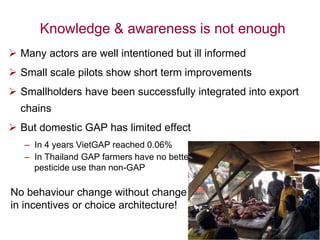
Knowledge & awareness is not enough
 Many actors are well intentioned but ill informed
 Small scale pilots show short term improvements
 Smallholders have been successfully integrated into export
chains
 But domestic GAP has limited effect
– In 4 years VietGAP reached 0.06%
– In Thailand GAP farmers have no better
pesticide use than non-GAP
No behaviour change without change
in incentives or choice architecture!
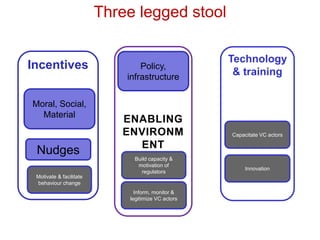
Incentives
Technology
& training
ENABLING
ENVIRONM
ENT
Moral, Social,
Material
Capacitate VC actors
Inform, monitor &
legitimize VC actors
Build capacity &
motivation of
regulators
Nudges
Three legged stool
Policy,
infrastructure
Motivate & facilitate
behaviour change
Innovation
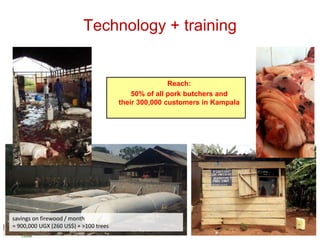
Technology + training
savings on firewood / month
= 900,000 UGX (260 US$) + >100 trees
Reach:
50% of all pork butchers and
their 300,000 customers in Kampala
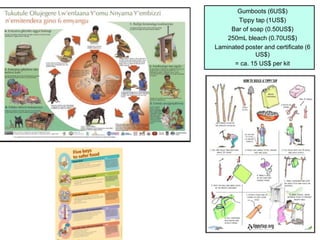
Gumboots (6US$)
Tippy tap (1US$)
Bar of soap (0.50US$)
250mL bleach (0.70US$)
Laminated poster and certificate (6
US$)
= ca. 15 US$ per kit
16
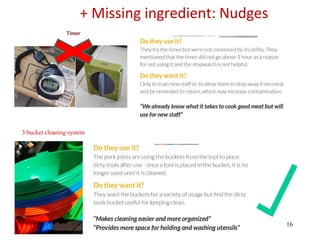
+ Missing ingredient: Nudges
3 bucket cleaning system
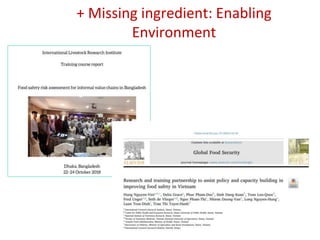
+ Missing ingredient: Enabling
Environment
Take home messages
 FBD is important for health, wealth and development
 Huge health & economic burden: most is due to microbes &
worms in fresh foods sold in wet markets in LMICs
 Interventions: training very easy, technologies quite easy,
infrastructure moderate difficulty, authority buy-in moderate
difficulty, motivation almost never addressed
 Currently no proven approaches for mass markets in LMIC
that are scalable and sustainable
 The 3-legged stool (pull-push) most promising approach:
capacity, enabling environment, motivation for behaviour
change
Acknowledgements and Further Reading
20
THANK YOU

Food safety in a social context

  • 1.
    Food safety ina social context Delia Grace, Professor Food Safety Systems, Natural Resources Institute, Chatham, UK Scientist International Livestock Research Institute, Nairobi, Kenya Co-authors: Bernard Bett, Theo Knight-Jones, Florence Mutua, Hung Nguyen, Himadri Pal, Kristina Roesel Understanding the social context of One Health World One Health Congress, Singapore 7-11 November 2022
  • 2.
    Overview 1. Why studyfood safety in a OH 2. What have we learned? 3. The missing middle – incentives & institutions 4. Way forward
  • 3.
    Context “Quadripartite Launches JointAction Plan to Promote One Health Approach” The five-year plan outlines six action tracks: – enhancing One Health capacities to strengthen health systems; – reducing the risks from emerging and re-emerging zoonotic epidemics and pandemics; – controlling and eliminating endemic zoonotic, neglected tropical, and vector- borne diseases; – strengthening the assessment, management, and communication of food safety risks; – curbing the silent pandemic of antimicrobial resistance; and
  • 4.
    Years of lifelost annually for FBD FERG: Havelaar et al., 2015; Gibb et al., 2019 Health impact of FBD comparable to that of malaria, HIV/AIDs or TB 31 hazards • 600 mio illnesses • 480,000 deaths • 41 million DALYs zoonoses non zoonoses FBD occurs at the intersection of human health, animal health, agro-food systems
  • 5.
    The public healthand domestic economic costs of unsafe food may be 20 times the trade- related costs for developing countries Cost estimates 2016 (US$ billion) Productivity loss 95 Illness treatment 15 Trade loss or cost 5 to 7 ‘Productivity Loss’ = Foodborne Disease DALYs x Per Capita GNI Based on WHO/FERG & WDI Indicators Database Illness treatment = US$27 x # of Estimated foodborne illnesses Trade loss or costs = 2% of developing country high value food exports
  • 6.
    6 Systematic literature review– Food safety interventions in SS Africa Along the value chain Technologies Training & information New processes Organisational arrangements Regulation Infrastructure Farmer +++ +++ + +++ + ++++ Processor & transporter +++ +++ +++ ++ ++ +++ Retailer + ++ + ++ ++ +++ Consumer + +++ + + + +++ Govt +++ ++ ++ +++ Population level:  Incorporating food safety into other health programs such as mother and child care or HIV treatment  Medical interventions such as vaccination for cholera or norovirus or binders for aflatoxins  Dietary diversity to reduce exposure and vulnerability to toxins  Water treatment
  • 7.
    • Donor investmentsince 2010 less than $40 million a year. Small in relation to burden and investments in other health areas • Substantial focus on – • National control systems • Exports and other formal markets • Chemical hazards • • Little focus on – • Market-based and demand-led approaches • Informal sector where most foods are sold • Biological hazards and risks to human health Desk study– Food safety investments in SS Africa
  • 8.
    Reliance on regulationswithout institution building  100% of milk in Assam doesn’t meet standards  98% of beef in Ibadan, 52% pork in Ha Noi, unacceptable bacteria counts  92% of Addis milk and 46% of Nairobi milk had aflatoxins over EU standards  36% of farmed fish from Kafrelsheikh exceed one or more MPL  30% of chicken from commercial broilers in Pretoria unacceptable for S. aureus  24% of boiled milk in Abidjan unacceptable S. aureus
  • 9.
  • 10.
    Promoting transformation withoutbehaviour change  Supermarketisation is slower than thought.  Formal sector food is risker than thought.  Modern business models have often run into problems – Co-ops, abattoirs, market upgrades
  • 11.
    11 0 10 20 30 40 50 60 70 80 90 100 Poor total bacteriaUnacceptable total bacteria Unacceptable faecal bacteria Unaccpetable Staph Unacceptable listeria Any unacceptable Supermarket Wet market Village Compliance : Formal often worse than informal ILRI, 2013
  • 12.
    Knowledge & awarenessis not enough  Many actors are well intentioned but ill informed  Small scale pilots show short term improvements  Smallholders have been successfully integrated into export chains  But domestic GAP has limited effect – In 4 years VietGAP reached 0.06% – In Thailand GAP farmers have no better pesticide use than non-GAP No behaviour change without change in incentives or choice architecture!
  • 13.
    Incentives Technology & training ENABLING ENVIRONM ENT Moral, Social, Material CapacitateVC actors Inform, monitor & legitimize VC actors Build capacity & motivation of regulators Nudges Three legged stool Policy, infrastructure Motivate & facilitate behaviour change Innovation
  • 14.
    Technology + training savingson firewood / month = 900,000 UGX (260 US$) + >100 trees Reach: 50% of all pork butchers and their 300,000 customers in Kampala
  • 15.
    Gumboots (6US$) Tippy tap(1US$) Bar of soap (0.50US$) 250mL bleach (0.70US$) Laminated poster and certificate (6 US$) = ca. 15 US$ per kit
  • 16.
    16 + Missing ingredient:Nudges 3 bucket cleaning system
  • 17.
    + Missing ingredient:Enabling Environment
  • 18.
    Take home messages FBD is important for health, wealth and development  Huge health & economic burden: most is due to microbes & worms in fresh foods sold in wet markets in LMICs  Interventions: training very easy, technologies quite easy, infrastructure moderate difficulty, authority buy-in moderate difficulty, motivation almost never addressed  Currently no proven approaches for mass markets in LMIC that are scalable and sustainable  The 3-legged stool (pull-push) most promising approach: capacity, enabling environment, motivation for behaviour change
  • 19.
  • 20.
  • 21.