By: Idris

A Global Distribution System (GDS) is a
network operated by a company that enables
automated transactions between Vendors
and booking agents in order to provision
travel related services to the end consumers.
Global Distribution
System

Competitive advantage
Competitive strategies
Distribution as a competitive
advantage

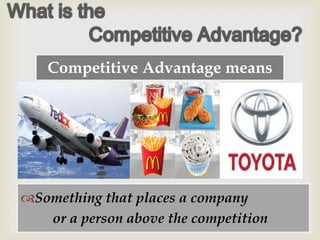
Something that places a company
or a person above the competition
Competitive Advantage means

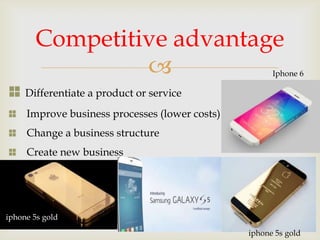
Differentiate a product or service
Improve business processes (lower costs)
Change a business structure
Create new business
Competitive advantage
iphone 5s gold
Iphone 6
iphone 5s gold

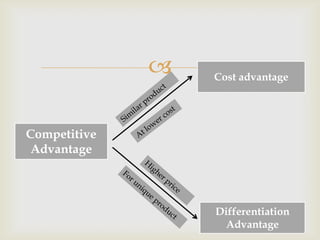
Competitive
Advantage
Cost advantage
Differentiation
Advantage

A Model of Competitive advantage
Resources
Distinctive
Competencies
Capabilities
Cost advantage
Or
Differentiation advantage
Value
Creation

 How a firm can actually
create and sustain a
competitive advantage in its
industry?
“Competitive strategy is about being
different. It means deliberately choosing to
perform activities differently or to perform
different activities than rivals to deliver a
unique mix of value.”
 -- Michael Porter

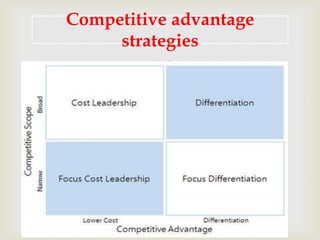
Competitive advantage
strategies
1. Cost Leadership (Low Cost Strategy)
cost Leadership mean that produce goods level of equal more in
expensive
2. Differentiation (Differentiation Strategy)
Differentiation is that provide inventive value can improve of
perceive valued of consumers toward product(or service) in the
market.
3. Focus Cost Leadership / Differentiation:
When competition's range is narrow, in other words when target on
specific customer segment will be focused cheap price and
differentiation strategy.

Competitive Weapon -
Sustainability
• Very few companies sustain their
competitive edge over the long term
• Sustainability occurs when it is difficult
or impossible for the competition to
respond

1. How long a competitor responds?
2. Which competitors can/will respond?
3. Will the response be effective?

3 Pillars Supporting Sustainable
Advantage
• Lead Time
• Information leaks
• Followers take short cuts
• Followers implement better solutions
• Competitor Analysis
 (Difficulty of competitor to respond or copy application)
• Supply system analysis
• Market capture
• Switching costs
GLOBAL LOGISTICS – the transportation & storage
activities necessary to transfer the physical product from the
manufacturing plants & warehouses in different countries
to various local market countries
Nowadays, global distribution has been consolidated such
that fully integrated transportation from point to point
across the world is possible at low cost.
Global Logistics

Elements of International Logistics
•The environment in which international logisticians operate is
quite different from the domestic environment.
•The decisions regarding international transportation are much
more complicated than domestic transportation.
•The number of intermediaries involved is greater.
•The inherent risks and hazards of international transportation are
much more significant.
•International insurance is much more complex.
•International means of payment are more complicated.
•Terms of trade are more complicated.
•The crossing of borders represents specific challenges.

Global Logistics
 Air Express
 Technical innovations in computerized inventory
systems and numerically controlled machines for
good handling made possible the growth of air
express systems
 Ocean Carriers
 For shipments of bulky and low-value-per-unit
products
 Ocean vessels are still the most economical carrier
alternative overseas
 There have been a number of global carrier alliances in
the shipping industry due to the savings involved in
sharing resources and the advantage in providing
integrated one-stop services to the shipper

Global Logistics
 Overland Transportation
 The increasing volume of international trade has put the
inland distribution system under pressure
 One North American solution has been the roll-on-roll-off
system in which a loaded container is simply rolled onto a
railcar and shipped by rail for part of the way, avoiding
congested freeways
 Warehousing
 The competitive need on the part of global companies to
be “close to the customer” and provide fast and efficient
service
 This places increased demand on warehousing and
inventory management
 NABARD Warehousing Scheme (NWS) 2013- 14
GRAY TRADE - parallel distribution on genuine goods by
intermediaries other than authorized channel members
Three main factors motivate entrepreneurs to engage in gray trade:
1. Wide price discrepancies between national markets
2. Limited availability of certain models or versions in one market
3. Inexpensive logistics means that transportation can be
accomplished with relative ease
Parallel Distribution & Gray Trade
EROSION OF BRAND EQUITY
can happen if the gray goods do not perform to the level expected
STRAINED RELATIONSHIPS WITH AUTHORIZED
CHANNEL MEMBERS
arises when channel members face intra-brand competition
LEGAL LIABILITIES
usually involves warranties that can’t be honored
COMPLICATION OF GLOBAL MARKETING
STRATEGIES
forecasted sales in a market may not be realized when
there is a sudden influx of gray goods
Effects of Gray Trade
What type of channel/middlemen should be used to ensure
that the strategic marketing objectives are met in that country?
What are the important functions in the channel network for
that country?
Global Channel Design
Two major considerations:
REVISIT YOUR FSA’S
Key success factors and FSA’s vary across countries and across channels
WHAT CHANNELS ARE AVAILABLE?
Once you identify the critical features of your channel network, find out
if the country market possesses these channels
CHANNEL TIE-UP
Channel members might be difficult to enlist due to entry barriers,
competition, and special trade allowances
COORDINATION & CONTROL
Once a distribution network is established, coordination & control from
a centralized headquarters should be feasible
Designing Global Channels

Global distribution system

  • 1.
  • 2.
     A Global DistributionSystem (GDS) is a network operated by a company that enables automated transactions between Vendors and booking agents in order to provision travel related services to the end consumers. Global Distribution System
  • 3.
  • 4.
     Something that placesa company or a person above the competition Competitive Advantage means
  • 5.
     Differentiate a productor service Improve business processes (lower costs) Change a business structure Create new business Competitive advantage iphone 5s gold Iphone 6 iphone 5s gold
  • 6.
  • 7.
     A Model ofCompetitive advantage Resources Distinctive Competencies Capabilities Cost advantage Or Differentiation advantage Value Creation
  • 8.
      How afirm can actually create and sustain a competitive advantage in its industry?
  • 9.
    “Competitive strategy isabout being different. It means deliberately choosing to perform activities differently or to perform different activities than rivals to deliver a unique mix of value.”  -- Michael Porter
  • 10.
  • 11.
    1. Cost Leadership(Low Cost Strategy) cost Leadership mean that produce goods level of equal more in expensive 2. Differentiation (Differentiation Strategy) Differentiation is that provide inventive value can improve of perceive valued of consumers toward product(or service) in the market. 3. Focus Cost Leadership / Differentiation: When competition's range is narrow, in other words when target on specific customer segment will be focused cheap price and differentiation strategy.
  • 12.
     Competitive Weapon - Sustainability •Very few companies sustain their competitive edge over the long term • Sustainability occurs when it is difficult or impossible for the competition to respond
  • 13.
     1. How longa competitor responds? 2. Which competitors can/will respond? 3. Will the response be effective?
  • 14.
     3 Pillars SupportingSustainable Advantage • Lead Time • Information leaks • Followers take short cuts • Followers implement better solutions • Competitor Analysis  (Difficulty of competitor to respond or copy application) • Supply system analysis • Market capture • Switching costs
  • 15.
    GLOBAL LOGISTICS –the transportation & storage activities necessary to transfer the physical product from the manufacturing plants & warehouses in different countries to various local market countries Nowadays, global distribution has been consolidated such that fully integrated transportation from point to point across the world is possible at low cost. Global Logistics
  • 16.
     Elements of InternationalLogistics •The environment in which international logisticians operate is quite different from the domestic environment. •The decisions regarding international transportation are much more complicated than domestic transportation. •The number of intermediaries involved is greater. •The inherent risks and hazards of international transportation are much more significant. •International insurance is much more complex. •International means of payment are more complicated. •Terms of trade are more complicated. •The crossing of borders represents specific challenges.
  • 17.
     Global Logistics  AirExpress  Technical innovations in computerized inventory systems and numerically controlled machines for good handling made possible the growth of air express systems  Ocean Carriers  For shipments of bulky and low-value-per-unit products  Ocean vessels are still the most economical carrier alternative overseas  There have been a number of global carrier alliances in the shipping industry due to the savings involved in sharing resources and the advantage in providing integrated one-stop services to the shipper
  • 18.
     Global Logistics  OverlandTransportation  The increasing volume of international trade has put the inland distribution system under pressure  One North American solution has been the roll-on-roll-off system in which a loaded container is simply rolled onto a railcar and shipped by rail for part of the way, avoiding congested freeways  Warehousing  The competitive need on the part of global companies to be “close to the customer” and provide fast and efficient service  This places increased demand on warehousing and inventory management  NABARD Warehousing Scheme (NWS) 2013- 14
  • 19.
    GRAY TRADE -parallel distribution on genuine goods by intermediaries other than authorized channel members Three main factors motivate entrepreneurs to engage in gray trade: 1. Wide price discrepancies between national markets 2. Limited availability of certain models or versions in one market 3. Inexpensive logistics means that transportation can be accomplished with relative ease Parallel Distribution & Gray Trade
  • 20.
    EROSION OF BRANDEQUITY can happen if the gray goods do not perform to the level expected STRAINED RELATIONSHIPS WITH AUTHORIZED CHANNEL MEMBERS arises when channel members face intra-brand competition LEGAL LIABILITIES usually involves warranties that can’t be honored COMPLICATION OF GLOBAL MARKETING STRATEGIES forecasted sales in a market may not be realized when there is a sudden influx of gray goods Effects of Gray Trade
  • 21.
    What type ofchannel/middlemen should be used to ensure that the strategic marketing objectives are met in that country? What are the important functions in the channel network for that country? Global Channel Design Two major considerations:
  • 22.
    REVISIT YOUR FSA’S Keysuccess factors and FSA’s vary across countries and across channels WHAT CHANNELS ARE AVAILABLE? Once you identify the critical features of your channel network, find out if the country market possesses these channels CHANNEL TIE-UP Channel members might be difficult to enlist due to entry barriers, competition, and special trade allowances COORDINATION & CONTROL Once a distribution network is established, coordination & control from a centralized headquarters should be feasible Designing Global Channels