FROM COMPUTER RESERVATION SYSTEMS TO
GLOBAL DISTRIBUTION SYSTEMS
- Lesson 3 -
Angelina Njeguš, PhD
Associate Professor at Singidunum University
Belgrade - Serbia, 2013
Prof. dr Angelina Njeguš
Table of Contents
 Introduction to Computer Reservation Systems
 Typical CRS Functions
 Evolution of CRS
 Global Distribution Systems
 GDS Organisations
 Challenges for CRS/GDS
 Big Data
Prof. dr Angelina Njeguš
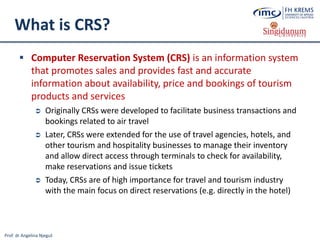
What is CRS?
 Computer Reservation System (CRS) is an information system
that promotes sales and provides fast and accurate
information about availability, price and bookings of tourism
products and services
 Originally CRSs were developed to facilitate business transactions and
bookings related to air travel
 Later, CRSs were extended for the use of travel agencies, hotels, and
other tourism and hospitality businesses to manage their inventory
and allow direct access through terminals to check for availability,
make reservations and issue tickets
 Today, CRSs are of high importance for travel and tourism industry
with the main focus on direct reservations (e.g. directly in the hotel)
Prof. dr Angelina Njeguš
CRS History
 CRS is the first information system that was used in tourism
industry
 Primarily was used as inventory-control system by airlines
 In 1962 American Airlines introduced SABRE (Semi-Automated
Business Research Environment) the first commercial CRS,
developed by IBM, that was used for:
 generating flight plans for the aircraft
 tracking spare parts
 scheduling crews ...
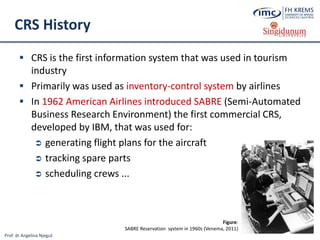
Figure:
SABRE Reservation system in 1960s (Venema, 2011)
Prof. dr Angelina Njeguš
Typical CRS Functions
 Flight schedule information
 Days and times for flights operated by the airline
 Availability information
 Seat availability on a flight by service class (i.e. Economy, business, first class)
 Fare quotes
 A consolidated fare for an itinerary based on flight, day, time, service class and
passenger types chosen
 Reservation information
 Seat bookings
 Ticketing information
 Generating and storing tickets
 Refunds and cancellations
 Cancellation of existing reservations and tickets
Prof. dr Angelina Njeguš
Evolution of CRS
 In the 1970s and 80s multiple CRSs
came up
 The growth of air traffic expanded
CRS
 In order to distribute up-to-date
information to all potential customers
worldwide and to support the operation
and administration of airlines, CRS
evolves from the central to the
distribution system
 In the mid 1980s, CRS developed into
much more comprehensive global
distribution system (GDS) offering a wide
range of tourism products and providing
the backbone mechanism for
communication between actors in
tourism industry
Source: Dennis, 2012.
Prof. dr Angelina Njeguš
Travel Agent before GDSs
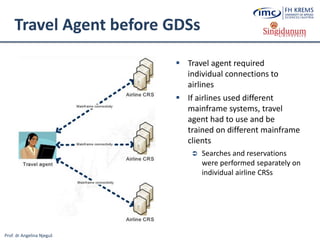
 Travel agent required
individual connections to
airlines
 If airlines used different
mainframe systems, travel
agent had to use and be
trained on different mainframe
clients
 Searches and reservations
were performed separately on
individual airline CRSs
Prof. dr Angelina Njeguš
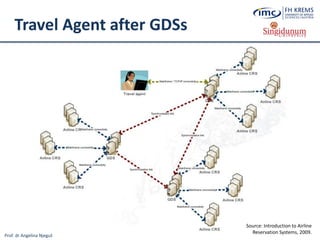
Travel Agent after GDSs
Source: Introduction to Airline
Reservation Systems, 2009.
Prof. dr Angelina Njeguš
From CRS to GDS
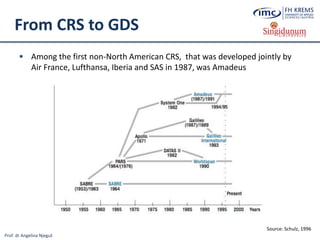
 Among the first non-North American CRS, that was developed jointly by
Air France, Lufthansa, Iberia and SAS in 1987, was Amadeus
Source: Schulz, 1996
Prof. dr Angelina Njeguš
Global Distribution Systems - GDS
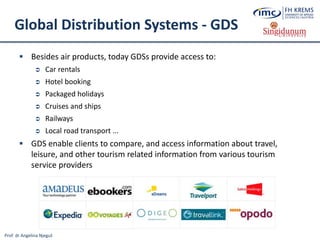
 Besides air products, today GDSs provide access to:
 Car rentals
 Hotel booking
 Packaged holidays
 Cruises and ships
 Railways
 Local road transport ...
 GDS enable clients to compare, and access information about travel,
leisure, and other tourism related information from various tourism
service providers
Prof. dr Angelina Njeguš
What is GDS?
 GDS is an integrated information system and communication
channel that:
 incorporates all travel services
 connects service providers with end users
 providing information from all segments of the journey
 allows booking and selling of the required services
 Today GDS is:
 the most cost effective tool for buyers of business travel to manage
the complexity of supply
 more than just a reservation tool - integrates the core business
processes of tourism businesses and therefore increase their
productivity, speed, and performance
Prof. dr Angelina Njeguš
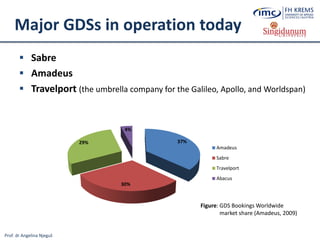
Major GDSs in operation today
 Sabre
 Amadeus
 Travelport (the umbrella company for the Galileo, Apollo, and Worldspan)
Figure: GDS Bookings Worldwide
market share (Amadeus, 2009)
37%
30%
29%
4%
Amadeus
Sabre
Travelport
Abacus
Prof. dr Angelina Njeguš
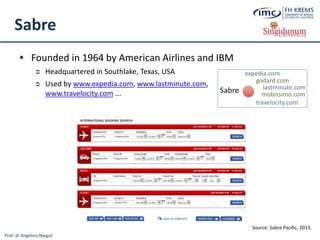
Sabre
 Founded in 1964 by American Airlines and IBM
 Headquartered in Southlake, Texas, USA
 Used by www.expedia.com, www.lastminute.com,
www.travelocity.com ...
Source: Sabre Pacific, 2013.
Prof. dr Angelina Njeguš
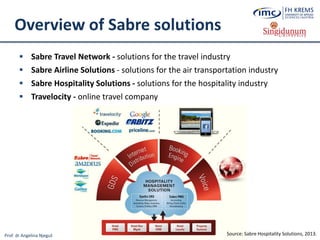
Overview of Sabre solutions
 Sabre Travel Network - solutions for the travel industry
 Sabre Airline Solutions - solutions for the air transportation industry
 Sabre Hospitality Solutions - solutions for the hospitality industry
 Travelocity - online travel company
Source: Sabre Hospitality Solutions, 2013.
Prof. dr Angelina Njeguš
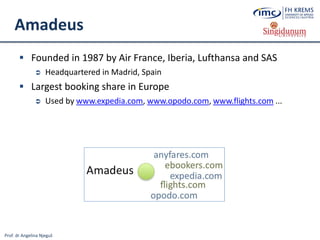
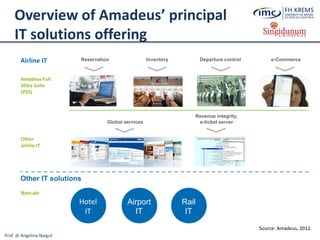
Amadeus
 Founded in 1987 by Air France, Iberia, Lufthansa and SAS
 Headquartered in Madrid, Spain
 Largest booking share in Europe
 Used by www.expedia.com, www.opodo.com, www.flights.com ...
Prof. dr Angelina Njeguš
Overview of Amadeus’ principal
IT solutions offering
Amadeus Full
Altéa Suite
(PSS)
Airline IT
Other IT solutions
Other
airline IT
Reservation Inventory Departure control e-Commerce
Global services
Revenue integrity,
e-ticket server
Non-air
Hotel
IT
Airport
IT
Rail
IT
Source: Amadeus, 2012.
Prof. dr Angelina Njeguš
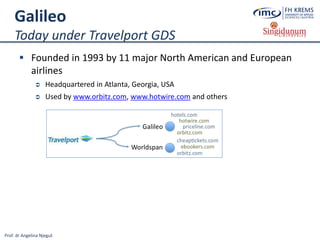
Galileo
Today under Travelport GDS
 Founded in 1993 by 11 major North American and European
airlines
 Headquartered in Atlanta, Georgia, USA
 Used by www.orbitz.com, www.hotwire.com and others
Prof. dr Angelina Njeguš
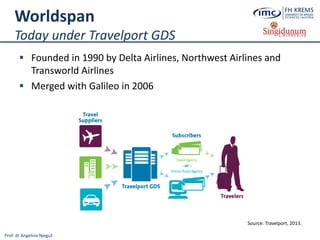
Worldspan
Today under Travelport GDS
 Founded in 1990 by Delta Airlines, Northwest Airlines and
Transworld Airlines
 Merged with Galileo in 2006
Source: Travelport, 2013.
Prof. dr Angelina Njeguš
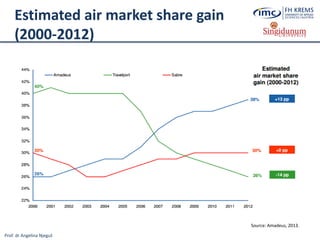
Estimated air market share gain
(2000-2012)
Source: Amadeus, 2013.
Prof. dr Angelina Njeguš
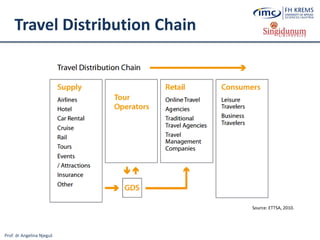
Travel Distribution Chain
Source: ETTSA, 2010.
Prof. dr Angelina Njeguš
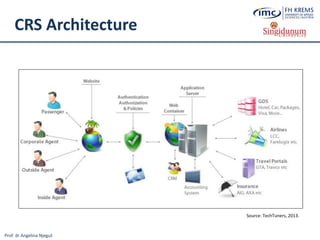
CRS Architecture
Source: TechTuners, 2013.
Prof. dr Angelina Njeguš
GDS Organisations
 In order to promote fair competition and to ensure that consumers do not receive
inaccurate or misleading information on travel services, it is necessary to have
regulations on GDS
 Organisations work together with governments, and other relevant authorities to
help define the correct regulatory framework for the travel and transport industry
 There are several organisations, such as:
 IATA - International Air Transport Association
 ICAO - International Civil Aviation Organization
 ETTSA - European Technology and Travel Services Association
 ATPCO - Airline Tariff Publishing Company
 IATAN - International Airlines Travel Agent Network
 SITA - Société Internationale de Télécommunications Aéronautiques
and many others
Prof. dr Angelina Njeguš
IATA
International Air Transport Association
 Trade association for the world’s airlines
 Representing around 240 airlines or 84% of total air traffic
 Formed on 1945
 Headquartered in Montreal, Quebec, Canada
 Supports many areas of aviation activity and helps formulate industry policy and
standards on critical aviation issues, such as:
 Security of passengers and cargo
 Airline safety
 Airline revenues
 Infrastructure issues
 Chargers and economic regulation and taxation
 Fuel
 Airline distribution
 Environment ...
Prof. dr Angelina Njeguš
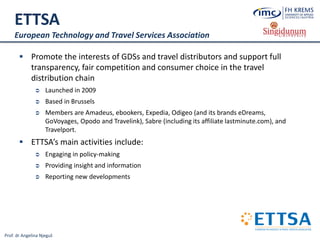
ETTSA
European Technology and Travel Services Association
 Promote the interests of GDSs and travel distributors and support full
transparency, fair competition and consumer choice in the travel
distribution chain
 Launched in 2009
 Based in Brussels
 Members are Amadeus, ebookers, Expedia, Odigeo (and its brands eDreams,
GoVoyages, Opodo and Travelink), Sabre (including its affiliate lastminute.com), and
Travelport.
 ETTSA’s main activities include:
 Engaging in policy-making
 Providing insight and information
 Reporting new developments
Prof. dr Angelina Njeguš
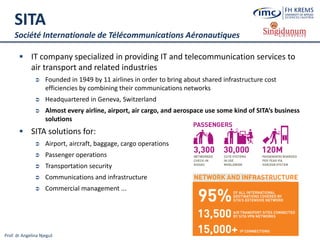
SITA
Société Internationale de Télécommunications Aéronautiques
 IT company specialized in providing IT and telecommunication services to
air transport and related industries
 Founded in 1949 by 11 airlines in order to bring about shared infrastructure cost
efficiencies by combining their communications networks
 Headquartered in Geneva, Switzerland
 Almost every airline, airport, air cargo, and aerospace use some kind of SITA’s business
solutions
 SITA solutions for:
 Airport, aircraft, baggage, cargo operations
 Passenger operations
 Transportation security
 Communications and infrastructure
 Commercial management ...
Prof. dr Angelina Njeguš
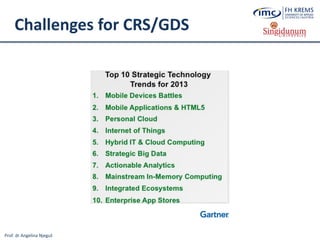
Challenges for CRS/GDS
Prof. dr Angelina Njeguš
Problems of Big Data
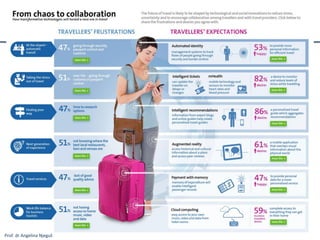
 Analysis from Google shows that the typical traveller uses 22 websites to
research a trip, in multiple shopping sessions, before booking
 The growth of Cloud, Mobile and Social Computing leads to the fact that
organisations are flooded by:
 Huge volume of data
 High velocity of data
 Variety of data
Digital content will grow to 8ZB by 2015
Prof. dr Angelina Njeguš
The physical size of Big Data
Name Symbol Binary Decimal
byte B 20=1 byte 100=1
kilobyte KB 210=1.024 byte (B) 103=1.000
megabyte MB 220=1.048.576 B 106=1.000.000
gigabyte GB 230=1.073.741.824 B 109=1.000.000.000
terabyte TB 240=1.099.511.627.776 B 1012=1.000.000.000.000
petabyte PB 250=1.125.899.906.842.624 B 1015=1.000.000.000.000.000
exabyte EB 260=1.152.921.504.606.846.976 B 1018=1.000.000.000.000.000.000
zettabyte ZB 270=1.180.591.620.717.411.303.424 B 1021=1.000.000.000.000.000.000.000
yottabyte YB 280=1.208.925.819.614.629.174.706.176 B 1024=1.000.000.000.000.000.000.000.000
brontobyte BB 290=1.237.940.039.285.380.274.899.124.224 B 1027=1.000.000.000.000.000.000.000.000.000
geopbyte GeB 2100=1.267.650.600.228.229.401.496.703.205.376 B 1030=1.000.000.000.000.000.000.000.000.000.000
 Bit (b) – 0 or 1
 Byte (B) – 8 bits
 Kilobyte (KB) – 1024 bytes
Prof. dr Angelina Njeguš
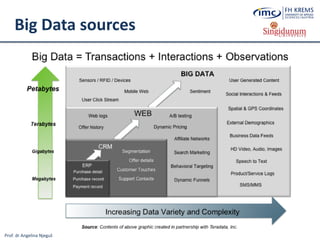
Big Data sources
Prof. dr Angelina Njeguš
What is Big Data?
Source: Informatika. Available at: http://www.informatica.com/us/vision/harnessing-big-data/
Prof. dr Angelina Njeguš
References
1. Markiewicz, P. (2013) Computer History – Mainframe Era (1944-1978). Available at: http://plyojump.com/classes/mainframe_era.php (accessed:
17.07.2013)
2. Venema, M. (2011). Global Distribution Systems (GDS). Edutour – Education for Tourism. Available at: http://www.slideshare.net/magielsr/gds-
overview-1232798141856259-2-2359117 (accessed: 18.07.2013)
3. Introduction to Airline Reservation Systems. Available at: http://www.slideshare.net/mave_boy/introduction-to-airline-reservation-systems-1237705
(Accessed: 17.07.2013)
4. Dennis, B. (2012). Hospitality Internet Booking Engines & Central Reservation Systems: A thought-piece concerning online reservation technology for
the hospitality industry. Buuteeq, Seattle, WA.
5. Schulz, A. (1996). The Role of Global Computer Reservation Systems in the Travel Industry Today and in the Future. Electronic Markets, 6(2). Available
at: http://aws.iwi.uni-leipzig.de/em/fileadmin/user_upload/doc/Issues/Volume_06/Issue_02/The_Role_of_Global_Computer_Reservation.pdf
(accessed 17.07.2013)
6. Amadeus (2012). Corporate presentation 2012. PowerPoint presentation. Amadeus.
7. Sabre Pacific (2013). Sabre online enhancements power increased productivity. Travel Blackboard. Available at:
http://www.etravelblackboard.com/article/143630/sabre-online-enhancements-power-increased-productivity (accessed: 18.07.2013)
8. Sabre Hospitality Solutions (2013). Central Reservation System (CRS). Sabre. Available at: http://www.sabrehospitality.com/central-reservation-
systems.php (accessed 18.07.2013)
9. Travelport (2013). Travelport GDS Privacy Policy. Available at: http://www.travelport.com/Privacy-Policy/Travelport%20GDS (accessed: 18.07.2013)
10. Amdekar, J., Padmanabhuni, S. (2006). Future of Travel & Tourism Industry with the adoption of Web Services in Electronic Distribution. Infosys.
Available at: http://www.infosys.com/industries/hospitality-leisure/white-papers/Documents/webservices-adoption-travel-tourism.pdf (accessed
18.07.2013)
11. ETTSA (2010). Technology and Independent Distribution in the European Travel Industry. PhoCusWright . Available at:
http://www.ettsa.eu/uploads/documents/ETTSA_Study_2010_Single_Pages.pdf (accessed 18.07.2013)
12. TechTuners (2013). T-RES. Available at: http://www.techtuners.com/TRES.aspx (accessed 18.07.2013)
13. Davenport, T.H. (2013). At the Big Data Crossroads: Tuning towards a smarter travel experience. Amadeus IT Group. Available at:
http://www.bigdata.amadeus.com/assets/pdf/Amadeus_Big_Data.pdf (accessed 18.07.2013)
14. Videcom (2013). GDS Distribution. Videcom Airline Reservation Systems. Available at: http://www.videcom.com/airline-global-distribution-
systems.aspx (accessed 18.07.2013)
15. Amadeus (2013). Amadeus Introductory presentation. Available at:
http://www.investors.amadeus.com/media/files/english/column_boxes/Introductory Presentation (long form) February 2013.pdf (accessed
18.07.2013)