Special Fares
How to Calculate Special IATA Fares?
Magiel Venema
Revised 2017 Edition
2
What are Special Fares?
• Reduced Fares, but with:
• Certain Travel Restrictions
– Stopovers
– Minimum Stay Requirement
– Maximum Stay
• Why: to fill up empty spaces
• Why Restrictions:
– To make them unattractive for full fare paying
passengers, like business travelers
3
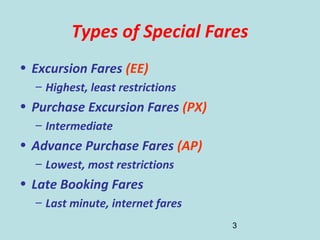
Types of Special Fares
• Excursion Fares (EE)
– Highest, least restrictions
• Purchase Excursion Fares (PX)
– Intermediate
• Advance Purchase Fares (AP)
– Lowest, most restrictions
• Late Booking Fares
– Last minute, internet fares
4
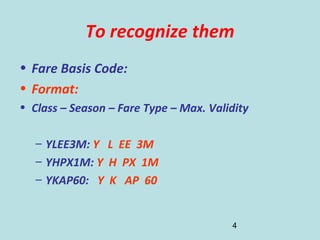
To recognize them
• Fare Basis Code:
• Format:
• Class – Season – Fare Type – Max. Validity
– YLEE3M: Y L EE 3M
– YHPX1M: Y H PX 1M
– YKAP60: Y K AP 60
5
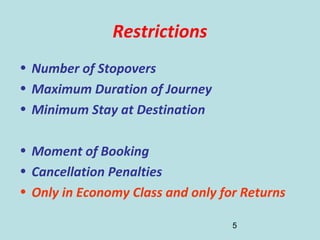
Restrictions
• Number of Stopovers
• Maximum Duration of Journey
• Minimum Stay at Destination
• Moment of Booking
• Cancellation Penalties
• Only in Economy Class and only for Returns
6
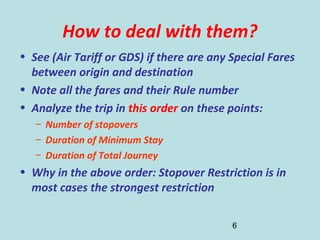
How to deal with them?
• See (Air Tariff or GDS) if there are any Special Fares
between origin and destination
• Note all the fares and their Rule number
• Analyze the trip in this order on these points:
– Number of stopovers
– Duration of Minimum Stay
– Duration of Total Journey
• Why in the above order: Stopover Restriction is in
most cases the strongest restriction
7
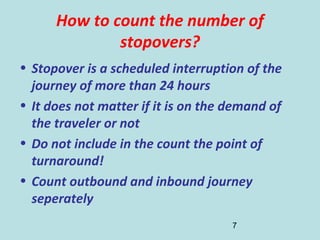
How to count the number of
stopovers?
• Stopover is a scheduled interruption of the
journey of more than 24 hours
• It does not matter if it is on the demand of
the traveler or not
• Do not include in the count the point of
turnaround!
• Count outbound and inbound journey
seperately
8
How to analyze the maximum
duration of the journey?
• Count from the day after departure to the
day of departure for the (last leg) of the
return journey
• Validity in months: to the same day of the
last month
– 3 months: November 30 -> February 28!
9
How to analyze the Minimum
Stay?
• At what date is the departure from last
stopover point (including for this matter, also
the point of Turnaround)?
• Start counting from the day after departure
from Point of Origin to that date
• Compare number of days with the minimum
stay requirement
• Easy?
10
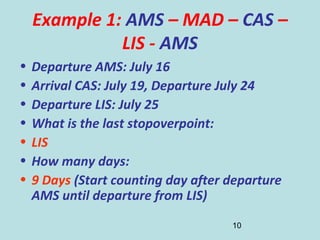
Example 1: AMS – MAD – CAS –
LIS - AMS
• Departure AMS: July 16
• Arrival CAS: July 19, Departure July 24
• Departure LIS: July 25
• What is the last stopoverpoint:
• LIS
• How many days:
• 9 Days (Start counting day after departure
AMS until departure from LIS)
11
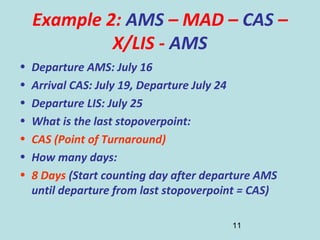
Example 2: AMS – MAD – CAS –
X/LIS - AMS
• Departure AMS: July 16
• Arrival CAS: July 19, Departure July 24
• Departure LIS: July 25
• What is the last stopoverpoint:
• CAS (Point of Turnaround)
• How many days:
• 8 Days (Start counting day after departure AMS
until departure from last stopoverpoint = CAS)
12
Structure of the Rules
• Each Special Fare has its own Rule
• Each Rule has 30 paragraphs (0 – 29)
• With the rules, only the paragraphs that are
different from the Standard Paragraph SC100
are mentioned
• Mentioned Paragraphs have precedence over
Standard Paragraphs
13
How to go ahead
• Analyze the itinerary of the trip
• Go to the rule of the lowest Special Fare
• Check paragraphs 8 – 6 – 7
• If paragraph is not mentioned, then consult
Standard Rule SC 100
• Compare checks with itinerary
• If it matches, then use that fare
• If not, go to the next lower Special Fare and repeat
your checks
• Etc.
14
Once you have found an
applicable Special Fare
• Check for the season (Paragraph 3):
• Day of departure decides which season is applicable
• Write down the correct Fare Basis
• Note date and city from which earliest return may
commence
• Note last date of validity
• Write down ‘Not Valid Before’ and ‘Not Valid After’
for the applicable segments of the journey
15
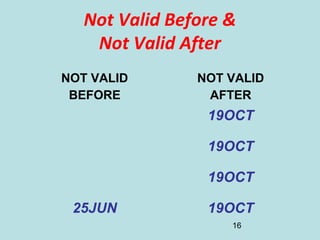
Example Not Valid Before
Not Valid After
• Departure Date: 19JUN
• Fare Basis YHEE4M
• Minimum Stay Requirement: 6 Days:
– Earliest departure last stopover city is 25JUN
• Maximum Validity: 4 Months
– Latest day of validity is 19OCT
16
Not Valid Before &
Not Valid After
NOT VALID
BEFORE
NOT VALID
AFTER
19OCT
19OCT
19OCT
25JUN 19OCT
17
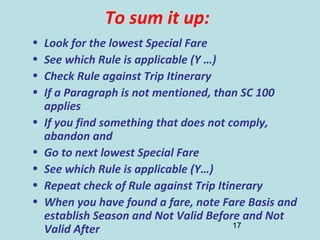
To sum it up:
• Look for the lowest Special Fare
• See which Rule is applicable (Y …)
• Check Rule against Trip Itinerary
• If a Paragraph is not mentioned, than SC 100
applies
• If you find something that does not comply,
abandon and
• Go to next lowest Special Fare
• See which Rule is applicable (Y…)
• Repeat check of Rule against Trip Itinerary
• When you have found a fare, note Fare Basis and
establish Season and Not Valid Before and Not
Valid After
18
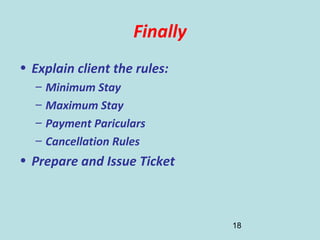
Finally
• Explain client the rules:
– Minimum Stay
– Maximum Stay
– Payment Pariculars
– Cancellation Rules
• Prepare and Issue Ticket

Special Fares Calculation

  • 1.
    Special Fares How toCalculate Special IATA Fares? Magiel Venema Revised 2017 Edition
  • 2.
    2 What are SpecialFares? • Reduced Fares, but with: • Certain Travel Restrictions – Stopovers – Minimum Stay Requirement – Maximum Stay • Why: to fill up empty spaces • Why Restrictions: – To make them unattractive for full fare paying passengers, like business travelers
  • 3.
    3 Types of SpecialFares • Excursion Fares (EE) – Highest, least restrictions • Purchase Excursion Fares (PX) – Intermediate • Advance Purchase Fares (AP) – Lowest, most restrictions • Late Booking Fares – Last minute, internet fares
  • 4.
    4 To recognize them •Fare Basis Code: • Format: • Class – Season – Fare Type – Max. Validity – YLEE3M: Y L EE 3M – YHPX1M: Y H PX 1M – YKAP60: Y K AP 60
  • 5.
    5 Restrictions • Number ofStopovers • Maximum Duration of Journey • Minimum Stay at Destination • Moment of Booking • Cancellation Penalties • Only in Economy Class and only for Returns
  • 6.
    6 How to dealwith them? • See (Air Tariff or GDS) if there are any Special Fares between origin and destination • Note all the fares and their Rule number • Analyze the trip in this order on these points: – Number of stopovers – Duration of Minimum Stay – Duration of Total Journey • Why in the above order: Stopover Restriction is in most cases the strongest restriction
  • 7.
    7 How to countthe number of stopovers? • Stopover is a scheduled interruption of the journey of more than 24 hours • It does not matter if it is on the demand of the traveler or not • Do not include in the count the point of turnaround! • Count outbound and inbound journey seperately
  • 8.
    8 How to analyzethe maximum duration of the journey? • Count from the day after departure to the day of departure for the (last leg) of the return journey • Validity in months: to the same day of the last month – 3 months: November 30 -> February 28!
  • 9.
    9 How to analyzethe Minimum Stay? • At what date is the departure from last stopover point (including for this matter, also the point of Turnaround)? • Start counting from the day after departure from Point of Origin to that date • Compare number of days with the minimum stay requirement • Easy?
  • 10.
    10 Example 1: AMS– MAD – CAS – LIS - AMS • Departure AMS: July 16 • Arrival CAS: July 19, Departure July 24 • Departure LIS: July 25 • What is the last stopoverpoint: • LIS • How many days: • 9 Days (Start counting day after departure AMS until departure from LIS)
  • 11.
    11 Example 2: AMS– MAD – CAS – X/LIS - AMS • Departure AMS: July 16 • Arrival CAS: July 19, Departure July 24 • Departure LIS: July 25 • What is the last stopoverpoint: • CAS (Point of Turnaround) • How many days: • 8 Days (Start counting day after departure AMS until departure from last stopoverpoint = CAS)
  • 12.
    12 Structure of theRules • Each Special Fare has its own Rule • Each Rule has 30 paragraphs (0 – 29) • With the rules, only the paragraphs that are different from the Standard Paragraph SC100 are mentioned • Mentioned Paragraphs have precedence over Standard Paragraphs
  • 13.
    13 How to goahead • Analyze the itinerary of the trip • Go to the rule of the lowest Special Fare • Check paragraphs 8 – 6 – 7 • If paragraph is not mentioned, then consult Standard Rule SC 100 • Compare checks with itinerary • If it matches, then use that fare • If not, go to the next lower Special Fare and repeat your checks • Etc.
  • 14.
    14 Once you havefound an applicable Special Fare • Check for the season (Paragraph 3): • Day of departure decides which season is applicable • Write down the correct Fare Basis • Note date and city from which earliest return may commence • Note last date of validity • Write down ‘Not Valid Before’ and ‘Not Valid After’ for the applicable segments of the journey
  • 15.
    15 Example Not ValidBefore Not Valid After • Departure Date: 19JUN • Fare Basis YHEE4M • Minimum Stay Requirement: 6 Days: – Earliest departure last stopover city is 25JUN • Maximum Validity: 4 Months – Latest day of validity is 19OCT
  • 16.
    16 Not Valid Before& Not Valid After NOT VALID BEFORE NOT VALID AFTER 19OCT 19OCT 19OCT 25JUN 19OCT
  • 17.
    17 To sum itup: • Look for the lowest Special Fare • See which Rule is applicable (Y …) • Check Rule against Trip Itinerary • If a Paragraph is not mentioned, than SC 100 applies • If you find something that does not comply, abandon and • Go to next lowest Special Fare • See which Rule is applicable (Y…) • Repeat check of Rule against Trip Itinerary • When you have found a fare, note Fare Basis and establish Season and Not Valid Before and Not Valid After
  • 18.
    18 Finally • Explain clientthe rules: – Minimum Stay – Maximum Stay – Payment Pariculars – Cancellation Rules • Prepare and Issue Ticket