Travel Agency and Tour 
Operations
The Philippine Tourism Industry 
The tourism industry is recognized by the government as an important 
contributor to the generation of foreign exchange earnings, investments, 
revenue, and employment and to the growth of the country be output. The 
inclusion of tourism as a major pillar in the Medium Term Philippine 
Development Plan (MTPDP) has given priority to the tourism sector by 
promoting the Philippines as a premier tourist destination and investment 
site. If developed in a sustainable manner, indeed it can be a powerful 
economic growth engine for the country. It deserves to be a top priority 
for national development because of the following reasons: 
• It is a powerful and efficient industry; 
• Its impact on social development are broad and deep; 
• It creates strong peripheral benefits; 
• The Philippines can compete and win; and 
• It helps maintains cultural integrity, essential ecological processes, 
biological diversity and life support systems.
The Philippine Tourism Industry 
The industry is powerful and efficient because: 
• It is global in size; 
• It has a strong potential for growth; 
• It can accommodate large levels of investments 
• it has a very high value retention rate, i.e., relatively 
low import component; 
• It generates direct and indirect jobs; 
• It generates huge foreign exchange movements; and 
• It can be developed quickly;
The Philippine Tourism Industry 
Its impacts on social development are broad 
and deep because: 
• It is both labor and capital intensive; 
• It promotes skills and vocational development 
that can be exported; and 
• It promotes a ‘culture of tourism’ through a 
safer and cleaner environment that benefits not 
only tourists but also the entire community.
The Philippine Tourism Industry 
It promotes and creates strong peripheral 
benefits to other economic sectors and 
society as a whole through: 
• Tourism infrastructure spending; 
• Catalyzing entrepreneurship; and 
• Improving the image of the country in 
international trade and investment
The Philippine Tourism Industry 
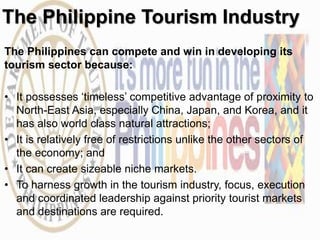
The Philippines can compete and win in developing its 
tourism sector because: 
• It possesses ‘timeless’ competitive advantage of proximity to 
North-East Asia, especially China, Japan, and Korea, and it 
has also world class natural attractions; 
• It is relatively free of restrictions unlike the other sectors of 
the economy; and 
• It can create sizeable niche markets. 
• To harness growth in the tourism industry, focus, execution 
and coordinated leadership against priority tourist markets 
and destinations are required.
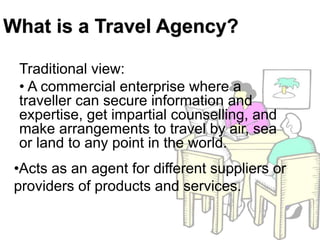
What is a Travel Agency? 
Traditional view: 
• A commercial enterprise where a 
traveller can secure information and 
expertise, get impartial counselling, and 
make arrangements to travel by air, sea 
or land to any point in the world. 
•Acts as an agent for different suppliers or 
providers of products and services.
Travel Management Companies/ 
Travel Agency 
ARTICLE OF THE TOURISM CODE OF1980 DEFINES A 
TRAVEL AGENCY 
A Travel and Tour Agency is an entity 
engaged in the business of extending 
to individuals or groups travel 
services and assistance to include 
documentations, ticketing, booking 
for transportation and/ or 
accommodation arrangements, 
handling and/ or conduct of tours 
within or outside the Philippines 
whether or not for a fee, commission 
or any form of monetary 
consideration.
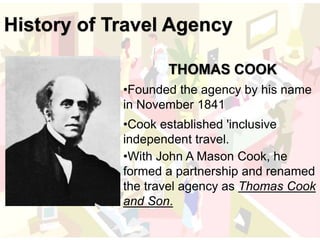
History of Travel Agency 
THOMAS COOK 
•Founded the agency by his name 
in November 1841 
•Cook established 'inclusive 
independent travel. 
•With John A Mason Cook, he 
formed a partnership and renamed 
the travel agency as Thomas Cook 
and Son.
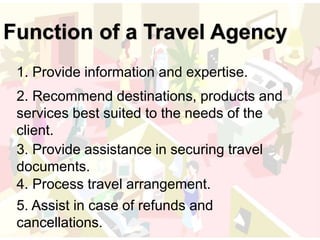
Function of a Travel Agency 
1. Provide information and expertise. 
2. Recommend destinations, products and 
services best suited to the needs of the 
client. 
3. Provide assistance in securing travel 
documents. 
4. Process travel arrangement. 
5. Assist in case of refunds and 
cancellations.
Characteristics of a Travel 
Management Company 
1. Retailer 
2. Counsellor 
3. Derives income from a pre-determined 
fixed commission dictated by suppliers or a 
professional fee negotiated with client 
4. Charges fees for ancillary services.
Tour Operator and Travel 
Agency 
TOUR OPERATOR – an enterprise regularly engaged in the 
business of inbound and/or local tour operation such as making 
online reservations, arranging and booking for transportation 
and accommodation, handling and/or conducting tours for a 
fee, commission, or any form of remuneration. 
TRAVEL AGENCY – an enterprise regularly engaged in the 
business of providing services such as reservations/bookings, 
documentation of travel papers, sales and/or issuance of tickets 
and selling of outbound tours for a fee, commission, or any form 
of remuneration
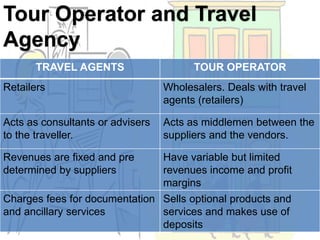
Tour Operator and Travel 
Agency 
TRAVEL AGENTS TOUR OPERATOR 
Retailers Wholesalers. Deals with travel 
agents (retailers) 
Acts as consultants or advisers 
to the traveller. 
Acts as middlemen between the 
suppliers and the vendors. 
Revenues are fixed and pre 
determined by suppliers 
Have variable but limited 
revenues income and profit 
margins 
Charges fees for documentation 
and ancillary services 
Sells optional products and 
services and makes use of 
deposits
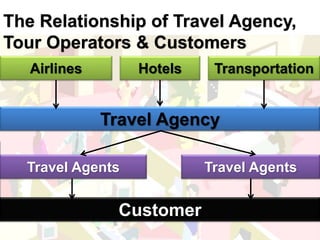
The Relationship of Travel Agency, 
Tour Operators & Customers 
Airlines Hotels Transportation 
Travel Agency 
Travel Agents Travel Agents 
Customer
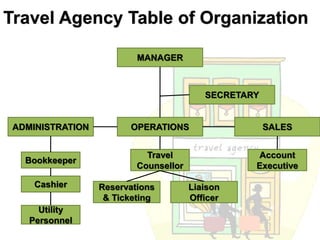
Travel Agency Table of Organization 
MANAGER 
SECRETARY 
ADMINISTRATION OPERATIONS SALES 
Bookkeeper 
Cashier 
Utility 
Personnel 
Travel 
Counsellor 
Reservations 
& Ticketing 
Liaison 
Officer 
Account 
Executive
Administration 
Deals with the day-to-day management 
activities of the company . 
•Has 4 functions: 
General Administration 
Personnel 
Accounting 
Finance
Operations 
•Core of the Travel Agency business 
•Engaged in the efficient and effective delivery of 
the organizations services. 
•For larger-sized TMCS operations are divided 
into 2: 
1.Travel Operations 
2.Tour Operations. 
•This department has the following employees: 
Travel Managers and supervisors 
Reservations and ticketing officers and; 
Liaison Officers
Operations 
The Travel Counsellor 
• Provides all necessary information requested by 
prospective travellers 
•Recommends products and services best suited to 
the travellers needs 
•Keep updated on new travel information and trends. 
•Fill out all travel information in the booking card for 
travel. 
•Relay all changes and confirmations to clients 
•Process refunds and processing fees 
•Monitor processing of travel documents and insure 
that they are all in order prior to release to clients.
Operations 
The Reservations Officer 
• Place all required reservations with different 
suppliers 
•Follow up on reservations placed until confirmed 
•To change reservations when itineraries are 
amended 
•Look for alternative suppliers in the same level of 
service in case preferred supplier is not available 
•Monitor issuance of travel vouchers and tickets 
•Act as back up to the ticketing Officer
Operations 
The Ticketing Officer 
• Correctly source or calculate fares when the need 
arises 
•Issue air tickets manually or through the automated 
ticketing system 
•Correctly issue purchase orders in accordance to 
clients itinerary 
•Check the accuracy of travel documents 
•Reissue tickets when required 
•Act as a back up to the travel counsellor
Operations 
The Liaison Officer 
•Determines what visas and other documents are 
required for travel 
•Check the authenticity of all documents submitted 
•Checks all relevant support papers. 
•Insures that documents filed are released on time 
•Arranges and coordinates appointments and visits 
to the various consulates and government offices
Sales & Marketing 
•Sales can either be walk-in or field sales 
•Marketing: everything that is done in order to attract or create 
awareness about the company. 
•Lead by the sales and marketing manager 
Prepares annual marketing plans 
Sets annual sales goals and develops working plans to carry out 
these goals 
Participate in the preparation of the organization’s budget 
Decide on negotiated rates and concessions 
Prepare proposal letters and contracts 
Prepares and submits marketing and sales reports 
In charge of all marketing activities and attends tradeshows and 
fairs 
Maintain an updated clients and prospective clients and 
performs regular sales calls on major accounts and suppliers.
Kinds of Travel Agencies 
Conventional, Full Service Agencies 
These agencies sell it all: Air, Lodging Car Rentals, Rail 
Travel, Cruise Tour, Tours and most other forms of travel 
packages. Customers can book and receive advise by 
phone, email or visiting agency in person.
Kinds of Travel Agencies 
Online Agencies 
Online agencies operate almost excusively through their 
web sites. These agencies concentrate on selling travel 
commodities such as air, lodging and car rentals. They 
do also sell experiential products such as cruises and 
tours. A travel agent who works for the online travel 
agency can explain their products thru phone or online 
chat.
Corporate Travel Management 
The travel agent like employees of these division 
are usually called corporate travel managers. 
Corporate travel management personnel have many 
duties. They do the following: 
• Set corporate travel policy 
• Plan meetings, conferences and convetion programs 
• Negotiate with suppliers 
• Manage travel budgets 
• Arrange personnel relocation and housing 
• Communicate with management in other departments 
of the corporation
Setting up a Travel Management 
Company / Travel Agency 
•SOLE OR SINGLE PROPRIETORSHIP 
1.Bureau of Domestic Trade Registration 
a. Trade Name Registration 
b. Bank Certificate for the Company’s 
Capitalization 
c. Tax Identification Number of the owner.
Setting up a Travel Management 
Company / Travel Agency 
•SOLE OR SINGLE PROPRIETORSHIP 
2. Local Government Unit 
a. DTI’s Certificate of Business Name 
Registration 
b. Copy of the Lease Contract Agreement 
of the Premises 
c. Bank Certificate of the company’s paid-up 
capital 
d. Financial projections for the next three 
months 
e. Bio-data of the General Manager
Setting up a Travel Management 
Company / Travel Agency 
•SOLE OR SINGLE PROPRIETORSHIP 
2. Local Government Unit 
f. List of the Company’s employees with 
respective bio data 
g. Duly accomplished application form 
h. Proof of payment of application fee 
i. General Liability Insurance Policy 
(varies according to the LGU) 
j. Surety bond from accredited insurance 
k. Barangay Clearance
Setting up a Travel Management 
Company / Travel Agency 
•PARTNERSHIP 
1. Securities and Exchange Commission 
a. Articles of Partnership 
b. Bank Certificate of Capital fund paid-up
Setting up a Travel Management 
Company / Travel Agency 
•PARTNERSHIP 
2. Department of Trade and Industry 
Registration 
a. Articles of Partnership 
b. Bank Certificate of Capital fund paid-up
Setting up a Travel Management 
Company / Travel Agency 
•PARTNERSHIP 
3. Local Government Unit 
a. SEC- Security and Exchange 
Commission approved partnership 
document 
b. Copy of lease Contract Agreement of 
the Premises 
c. Bank Certificate of capital fund paid- up 
d. Financial projections for the next three 
years 
e. Bio data of General Manager
Setting up a Travel Management 
Company / Travel Agency 
•PARTNERSHIP 
3. Local Government Unit 
f. List of company’s employees with 
respective bio data 
g. Duly accomplished application fee 
h. Proof of payment of application fee 
i. General liability insurance policy (varies 
according to the LGU) 
j. Surely bond from an accredited 
insurance company (varies according to 
the LGU) 
k. Barangay clearance
Setting up a Travel Management 
Company / Travel Agency 
•CORPORATION 
1. Securities and Exchange Commission 
a. Articles of Incorporation 
b. By laws 
c. Bank Certificate of the capital fund 
paid- up 
d. Incorporations bio data
Setting up a Travel Management 
Company / Travel Agency 
•CORPORATION 
2. Department of Trade and Industry 
Registration 
a. Article of Incorporation 
b. By laws 
c. Bank Certificate of the capital fund 
paid- up 
d. Incorporations bio data
The Size of the Travel Management 
Company 
•Small sized TMC: no more than 10 employees 
with a manager supervising all three departments 
•A medium sized TMC: 20 or so employees with 
three departmental heads reporting to one 
manager 
•A large Sized TMC: at least 30 employees a 
comptroller is with the general manager
Travel Agency Office Requirements 
 Commercial district 
 Easily identifiable 
 Exclusive for the travel and tour operations 
 Minimum of three (3) employees 
• (1 General Manager and 2 permanent staff) 
Source: OFFICE OF TOURISM STANDARDS AND REGULATION 
ACCREDITATION DIVISION
Travel Agency Office Requirements 
Office shall be adequately furnished and 
properly equipped for the conduct of business. 
Equipments checklist: 
Air Conditioning 
Units/Electric Fans 
Tables and Chairs 
Filing Cabinet 
Sitting Area and Lounge 
Counter 
Brochure Rack 
Telephone and Fax 
Machine 
Computers and Printers 
Global Distribution System 
(GDS) or Computer 
Reservation System (CRS) 
Fire Extinguishers 
Source: OFFICE OF TOURISM STANDARDS AND REGULATION 
ACCREDITATION DIVISION
Travel Agent’s Value 
•A travel agent is more skilled at finding the best 
travel solution. 
•A travel agent can find the best deal. 
•A travel agent saves time and trouble. 
•A travel agent is accountable. 
•A travel agent knows supplier better 
•A travel agent knows destination better. 
•A travel agent is largely partial.
Sales and Revenues of a Travel 
Management Company 
1. As travel arranges, managers or consults, 
TMC’s charge negotiated professional or handling 
fee (cost- plus), which may be fixed amount per 
transactions or percentage of the travel cost. 
2. As agents for transportation companies, TMC 
receive either fixed commission on regular fares 
(rate- minus) or a reasonable mark- up in net 
fares (net- plus).
Sales and Revenues of a Travel 
Management Company 
3. For certain ancillary service, such as those for 
travel documentation, TMC’s collect service fees 
from the clients. 
4. In some cases they also receive production 
incentive and relates from suppliers.
Kinds of Tours 
1. Escorted Tours- The group of people who 
separately bought the tour package and are 
meeting for the first time, structured journeys on 
which the tour participants are accompanied by a 
travel professional who sees to their needs. On a 
escorted tour, the person in charge of ensuring an 
enjoyable experience called tour manager.
Tour Manager Key Responsibilities 
• Coordinate all travel logistics, such as hotel check- in, 
baggage handling and group transportation 
• Guide the travelers through the tour’s itinerary, 
keeping everyone well informed and on schedule 
• Offer fun and fascinating commentary while traveling 
and sightseeing, often in conjunction with local 
sightseeing guides 
• Handle any and all problems, personally conflicts, and 
emergencies 
• Sometimes accompany the group on the first and last 
days flights
Kinds of Tours 
2. Hosted Tours- similar to escorted tours but the 
“host” (a tour representative) only meets with the 
tour travellers when they need to see him or her. 
3. Day Tours- are tours that last fewer than 24 
hours most city tours would fall into this category 
they usually conducted via motor coach, minibus, 
van or as a part of walking tour.
Kinds of Tours 
4. Adventure Tours- features physically active, 
exotic and sometimes demanding experiences. 
The packages may include hotel 
accommodations, a round trip flight, three meals 
a day, a climb up the mountain. 
5. Incentive Tour- a reward for a company’s 
most productive employees.
Reasons Why People takes Tours 
1. Time and Money- Travel may be reward for work, 
a tour that’s through fully arranged and conducted 
promises travellers that they’ll get their destination 
and see the sights in a reasonable amount of time 
and comfort. 
2. Quest of Knowledge- learning is the most 
important benefit of a tour. 
3. Camaraderie- The tours in which the group 
members already know each other. Its members 
will have similar interests and be of comparable 
socio-economic status.
Reasons Tours are been sold 
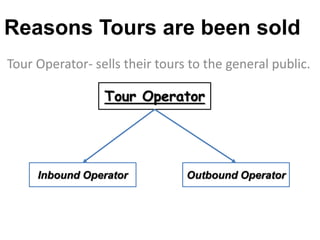
Tour Operator- sells their tours to the general public. 
Tour Operator 
Inbound Operator Outbound Operator
Reasons Tours are been sold 
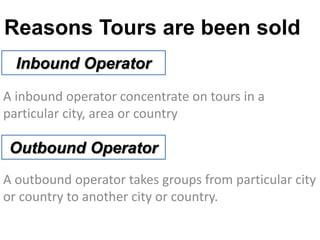
Inbound Operator 
A inbound operator concentrate on tours in a 
particular city, area or country 
Outbound Operator 
A outbound operator takes groups from particular city 
or country to another city or country.
Travel Documents: 
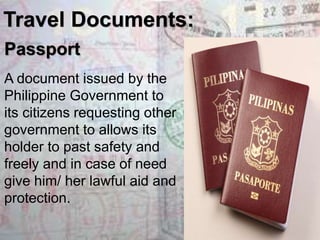
Passport 
A document issued by the 
Philippine Government to 
its citizens requesting other 
government to allows its 
holder to past safety and 
freely and in case of need 
give him/ her lawful aid and 
protection.
Travel Documents: 
Passport 
• The passport is the traveller badge of citizenship 
proclaiming his / her national affiliation. 
• The country / state foreign affairs department 
issue passport only to its citizens. 
• Consulates / Embassy also issued passport to 
citizens who happen out to the country.
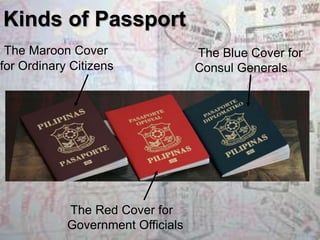
Kinds of Passport 
The Maroon Cover 
for Ordinary Citizens 
The Red Cover for 
Government Officials 
The Blue Cover for 
Consul Generals
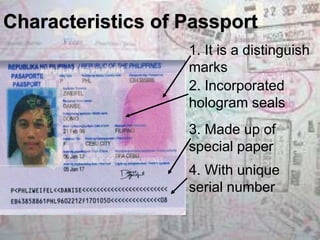
Characteristics of Passport 
1. It is a distinguish 
marks 
2. Incorporated 
hologram seals 
3. Made up of 
special paper 
4. With unique 
serial number
Travel Documents: 
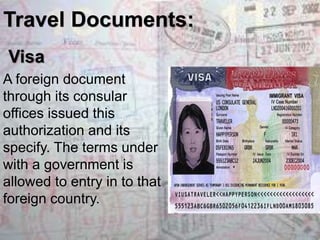
Visa 
A foreign document 
through its consular 
offices issued this 
authorization and its 
specify. The terms under 
with a government is 
allowed to entry in to that 
foreign country.
The Visa’s following terms: 
1. Purpose of Journey 
2. Maximum length of stay 
3. Period of validity for visa
Types of Visa 
1. Tourist Visa 
2. Working / Business Visa 
3. Student Visa 
4. Transit Visa 
5. Minor Visa 
6. Seaman Visa
Travel Documents: 
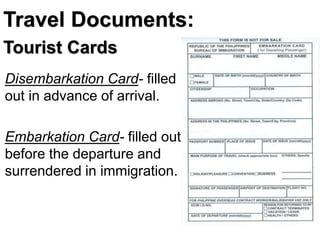
Tourist Cards 
Disembarkation Card- filled 
out in advance of arrival. 
Embarkation Card- filled out 
before the departure and 
surrendered in immigration.
Travel Documents: 
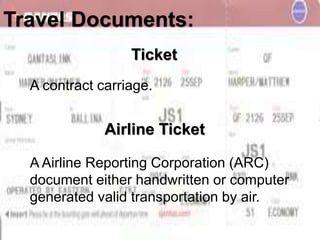
Ticket 
A contract carriage. 
Airline Ticket 
A Airline Reporting Corporation (ARC) 
document either handwritten or computer 
generated valid transportation by air.
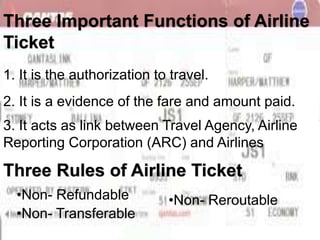
Three Important Functions of Airline 
Ticket 
1. It is the authorization to travel. 
2. It is a evidence of the fare and amount paid. 
3. It acts as link between Travel Agency, Airline 
Reporting Corporation (ARC) and Airlines 
Three Rules of Airline Ticket 
•Non- Refundable 
•Non- Reroutable 
•Non- Transferable
Flight Reservations 
- Sector / Leg Segment: Sectors being travelled, 
that is the point of origin to point of destination. 
-Date of Travel: Date the passenger(s) is / are 
travelling per sector. 
-Flight Number / Class: The prefer flight number 
and class. 
-Passenger(s) Name: and how many passenger 
(adults / children with corresponding ages) or are 
seats are being reserved.
Flight Reservations 
After providing the above information, the airline 
will given you the transaction / reservation status 
Ex. Confirmed, Waitlisted or Unable, the 
Passenger Number Record (PNR) which the 
code reference for all the transaction , and the 
ticket option which is the date and the time when 
the ticket(s) has to be purchased / issued in order 
not to lose the reservation.
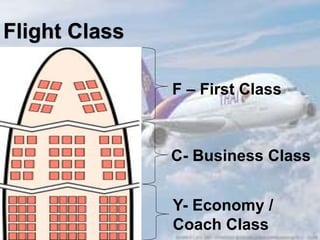
Flight Class 
F – First Class 
C- Business Class 
Y- Economy / 
Coach Class
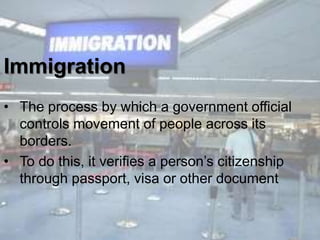
Immigration 
• The process by which a government official 
controls movement of people across its 
borders. 
• To do this, it verifies a person’s citizenship 
through passport, visa or other document
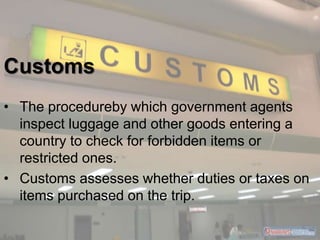
Customs 
• The procedureby which government agents 
inspect luggage and other goods entering a 
country to check for forbidden items or 
restricted ones. 
• Customs assesses whether duties or taxes on 
items purchased on the trip.
Safety and Security Issues 
1. Before selecting a foreign destination, check 
for official government assessments and 
warning about the countries you’ll be visiting. 
2. Keep up to date on recent news 
3. You should be careful of petty theft 
4. Go with brands you know 
5. Be prepared for a series of security checks 
6. Keep up on restrictions 
7. Always bring identification card or passport 
8. Never leave valuable items openly visible in 
your hotel room.