Global Distribution Systems (GDS)
An overview
by
Magiel Venema
Magiel.venema@tip.nl
© 2017, Edutour BV (Netherlands)
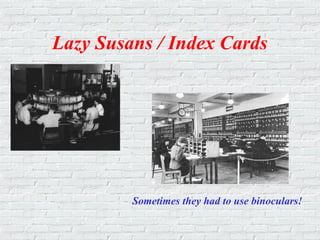
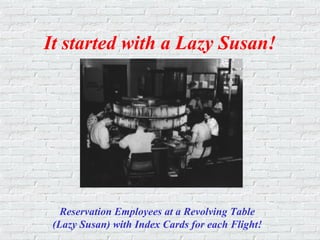
It started with a Lazy Susan!
Reservation Employees at a Revolving Table
(Lazy Susan) with Index Cards for each Flight!
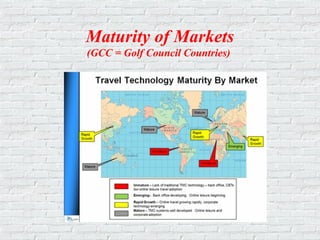
Maturity of Markets
(GCC = Golf Council Countries)
How it was…..
• Travelers had to go to a Travel Agency for a ticket
• Travel Agency then phoned the airline requesting a
specific flight on a specific time and date
• Fares were the same on each flight with each airline
• Reservations staff retrieved an index-card for that
flight/date from a Lazy Susan (revolving tray with index
cards)
(In 1946 American Airlines introduced the Reservisor,
for internal use only, storing max. 1000 flights up to 10
days in the future)
• Then the Travel Agency’s request could be answered!
• Travel Agency issued the ticket, collected payment and
received a commission from the airline
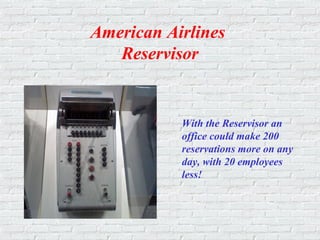
American Airlines
Reservisor
With the Reservisor an
office could make 200
reservations more on any
day, with 20 employees
less!
Then on a day, back in 1953…..
• In that year, on a certain day on a certain flight
two persons met by chance:
• Mr. Smith from American Airlines (AA)
• Mr. Smith from International Business
Machines (IBM)
• Result: A plan to automate the AA reservation
process with the help of IBM hard- and software
• Result: In 1960 SABRE (Semi Automatic
Business Research Environment) was introduced
by American Airlines
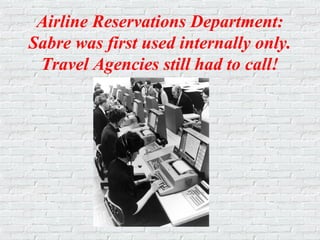
Airline Reservations Department:
Sabre was first used internally only.
Travel Agencies still had to call!
Situation of Today
• Now there are 4 major GDS:
Amadeus – Sabre – Galileo - Worldspan
• They can handle up to 17.000 messages
per second!
Timeline GDS
• 50’s: Airline Reservation Centers get first terminals
• 60’s: First CRS Terminals in Travel Agencies
• 70’s: Dumb Terminals become CRS
• 80’s: CRS become GDS
• 90’s: Ownership Change: Airlines divest their GDS
• 90’s: Rise of direct sales through Internet
• 00’s: GDS facing new entrants, Airlines reclaim the
ownership of the channell, Low Cost Carriers, New
business models, GDS loose market share, …
So let's take a closer look at the history
Global Distribution Systems
• Formerly known as CRS:
Computer Reservation System
• A passive system that only handled bookings
• Now new Name:
GDS - Global Distribution System
• Name change because of function change:
– Airline Reservations  All Travel Services
– Distribution Channel in its own right (from passive to
active)
Main Functions
• Reservations: Creating a PNR (Passenger Name
Record = booking file containing all relevant
reservation data)
• Back-office integration
• Management Info:
– Yield Management
– Market Information Data Transfer (MITD)
Features of a GDS
• Reservation starts with the request for a flight
• System looks into database for flight availablility
• Checks fare and rules
• Creation of a PNR (Passenger Name Record):
Itinerary – Passenger Name – Contact Details (Phone) –
Date of Ticketing – Received from – Fare - SSR/OSI – Seat
(In Red = Mandatory Parts)
N.B. Each GDS adheres to these rules!
• Issue of Tickets (Traditional or E-Ticket)
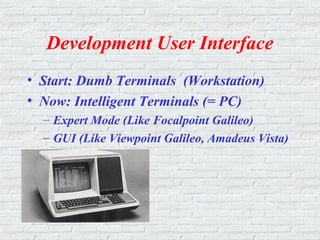
Development User Interface
• Start: Dumb Terminals (Workstation)
• Now: Intelligent Terminals (= PC)
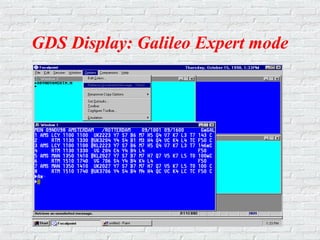
– Expert Mode (Like Focalpoint Galileo)
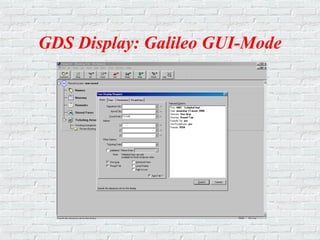
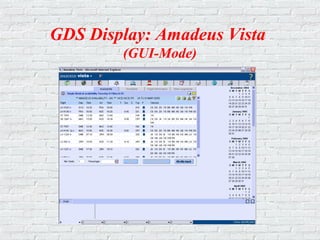
– GUI (Like Viewpoint Galileo, Amadeus Vista)
GDS Display: Galileo Expert mode
GDS Display: Galileo GUI-Mode
GDS Display: Amadeus Vista
(GUI-Mode)
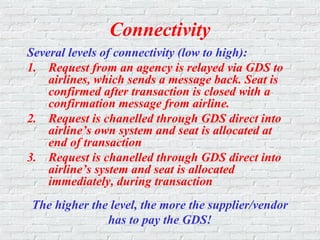
Connectivity
Several levels of connectivity (low to high):
1. Request from an agency is relayed via GDS to
airlines, which sends a message back. Seat is
confirmed after transaction is closed with a
confirmation message from airline.
2. Request is chanelled through GDS direct into
airline’s own system and seat is allocated at
end of transaction
3. Request is chanelled through GDS direct into
airline’s system and seat is allocated
immediately, during transaction
The higher the level, the more the supplier/vendor
has to pay the GDS!
GDS: History (1)
• Originally: Lazy Susans
– Request and Report
– and/or Sell and Report
• 1950’s: Internal airline systems
– Host: airline owner of a CRS
– Co-hosting: Selling space on own system to other
airlines
• 1960’s: Entrance to travel agencies: CRS
Lazy Susans / Index Cards
Sometimes they had to use binoculars!
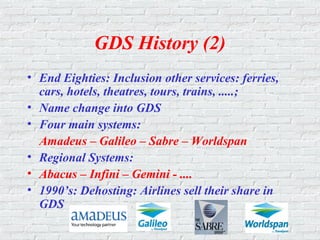
GDS History (2)
• End Eighties: Inclusion other services: ferries,
cars, hotels, theatres, tours, trains, .....;
• Name change into GDS
• Four main systems:
Amadeus – Galileo – Sabre – Worldspan
• Regional Systems:
• Abacus – Infini – Gemini - ....
• 1990’s: Dehosting: Airlines sell their share in
GDS
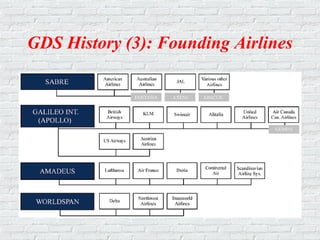
GDS History (3): Founding Airlines
GDS History (4)
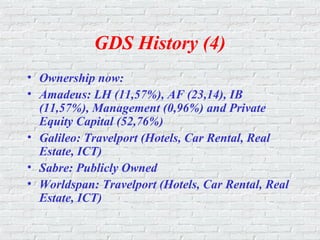
• Ownership now:
• Amadeus: LH (11,57%), AF (23,14), IB
(11,57%), Management (0,96%) and Private
Equity Capital (52,76%)
• Galileo: Travelport (Hotels, Car Rental, Real
Estate, ICT)
• Sabre: Publicly Owned
• Worldspan: Travelport (Hotels, Car Rental, Real
Estate, ICT)
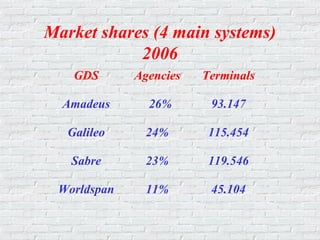
Market shares (4 main systems)
2006
GDS Agencies Terminals
Amadeus 26% 93.147
Galileo 24% 115.454
Sabre 23% 119.546
Worldspan 11% 45.104
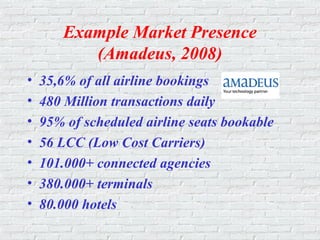
Example Market Presence
(Amadeus, 2008)
• 35,6% of all airline bookings
• 480 Million transactions daily
• 95% of scheduled airline seats bookable
• 56 LCC (Low Cost Carriers)
• 101.000+ connected agencies
• 380.000+ terminals
• 80.000 hotels
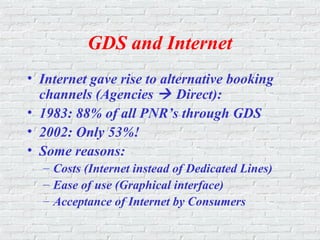
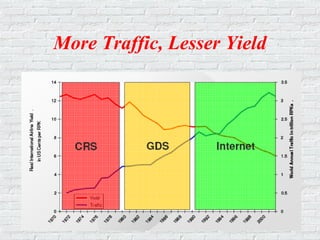
GDS and Internet
• Internet gave rise to alternative booking
channels (Agencies  Direct):
• 1983: 88% of all PNR’s through GDS
• 2002: Only 53%!
• Some reasons:
– Costs (Internet instead of Dedicated Lines)
– Ease of use (Graphical interface)
– Acceptance of Internet by Consumers
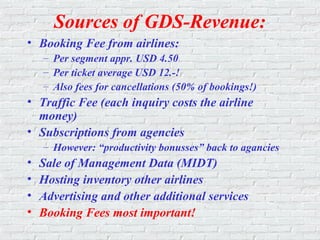
Sources of GDS-Revenue:
• Booking Fee from airlines:
– Per segment appr. USD 4.50
– Per ticket average USD 12.-!
– Also fees for cancellations (50% of bookings!)
• Traffic Fee (each inquiry costs the airline
money)
• Subscriptions from agencies
– However: “productivity bonusses” back to agancies
• Sale of Management Data (MIDT)
• Hosting inventory other airlines
• Advertising and other additional services
• Booking Fees most important!
Position Vendors (Airlines):
• Vendors pay for both looking and booking
• Huge commissions to pay to GDS
• Looking for ways to bypass GDS by creating own
internet channels:
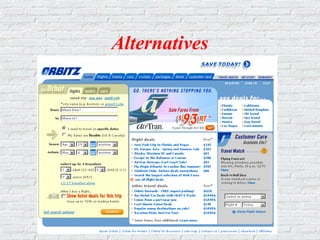
– USA: Orbitz
– EUR: Opodo
– Internet based systems, owned by airlines, that
consumers can use from their own PC without having
to use the GDS and/or agency
• Agencies receive large kick-backs from GDS’s:
Airlines claim why not lower the booking fees
instead?
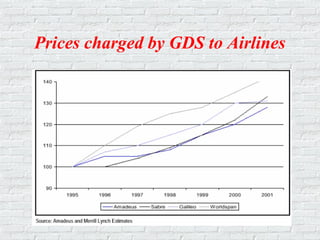
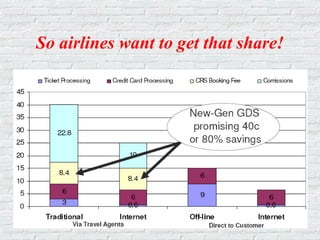
Prices charged by GDS to Airlines
More Traffic, Lesser Yield
Situation Airline Industry
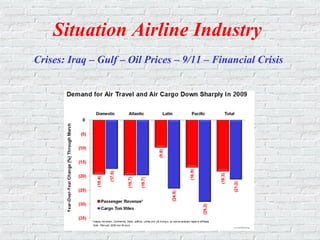
Crises: Iraq – Gulf – Oil Prices – 9/11 – Financial Crisis
So airlines want to get that share!
Alternatives
Airline Strategies
• To increase airline direct distribution
• Try to decrease GDS-fees
• Abolish high cost/ low yield distribution channels
• Establish alternative electronic channels
• Switch the distribution costs to the user instead
of the vendor
• Discriminate between original GDS (not all fares
available in all GDS)
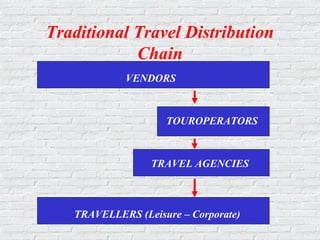
Traditional Travel Distribution
Chain
VENDORS
TOUROPERATORS
TRAVEL AGENCIES
TRAVELLERS (Leisure – Corporate)
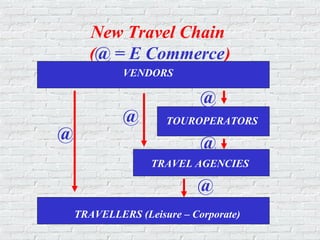
New Travel Chain
(@ = E Commerce)
VENDORS
TOUROPERATORS
TRAVEL AGENCIES
TRAVELLERS (Leisure – Corporate)
@
@
@
@
@
New Business Models
• Thanks to ICT new business models are possible
• Reverse auctions: Hotwire
• Customer names his price: Priceline
• Virtual Agencies: Expedia
• Multi channeling: Clicks, Bricks & Mortar and
Calls:
– Clicks (E-commerce)
– Bricks and Mortar (Traditional agency)
– Calls (Call-centers)
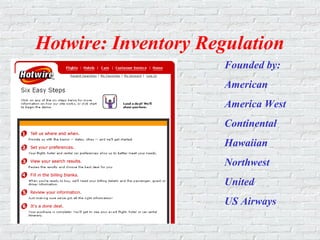
Hotwire: Inventory Regulation
Founded by:
American
America West
Continental
Hawaiian
Northwest
United
US Airways
GDS Regulation (1)
• Before 1984: Systems not allowed to discriminate
against each other, other airlines and agencies
• Each airline and each fare had to be present in
all systems
• However: Biased display
– Own airline was favoured (1st lines on 1st screen)
– Reason: Out of habit and ease, agencies book almost
always the first flight from the first screen
GDS Regulation (2)
• 1992: New set of rules (both in US and
EU):
– Neutral Display based on departure time and
connection (direct flights first)
– No favours for hosts
– Participation in systems open to all airlines on
a non-discriminatory base (all flights, all fares
in each system)
– Free choice for travel agencies
GDS Deregulation 2003/2004
• Airlines and GDS can now deal with each other
seperately
• Possible Result: Airline ‘X’ only in system ‘B’
• Possible Result: Airline ‘X’ only part of
inventory in system ‘B’
• Possible Result: Not all fares in the GDS
• Discrimination with Opodo/ Orbitz: Only the best
fares in those systems
• Danger of bypassing GDS by both agencies and
consumers
• In favour of dominant carriers
Effects on GDS’s
• Looking for new revenue models: Supplier
of IT-services for Airlines, e-commerce
technology for agencies, ….
• De-list smaller vendors (because they do
not generate enough revenue)
• Third party agreements for additional
services
Example: Amadeus as technology
provider for airline
• Amadeus as technology provider for
airlines (through Altéa daughter):
– Inventory Management
– Reservations process
– Departure control
– E-commerce solutions
Effects on Airlines
• To buy preferred position in systems
• Downward price pressure on GDS by large
airlines
• Smaller and regional carriers possibly
switch to internet
• MIDT value will become less, because less
traffic is handled through GDS
Effects on Agencies
• Fragmented info will be an opportunity to
become data aggregators
• Need for tools for multiple GDS capability
• Some GDS’s may leverage their unique
ownership position: Travelport owns Galileo,
Worldspan and other industry players like hotels,
agencies, car-rentals etc.
• Higher costs will be levied upon final customer
• GDS booking rewards will likely disappear: loss
of revenue
Reaction of GDS’s
• Own Internet Booking Sites:
– Travelocity, The Trip, Hotwire, ...
• As Booking Engine behind other sites like
Expedia
• Additional Services:
– Corporate Travel Booking Tools
– Agency Booking tools, Web-presence
GDS New Entrants: GNE’s
New companies claim they can replace GDS:
• Farelogix
• G2 Switchworks
• ITA Software
GNE’s are sometimes also called:
• Alternative Content Access Platforms
(ACAP)
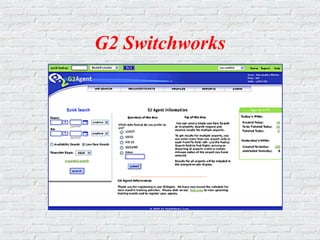
G2 Switchworks
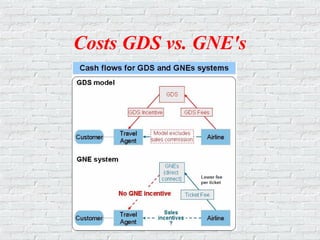
Costs GDS vs. GNE's
Barriers for GNE’s
• Agencies rely heavy on GDS kick-backs since
airlines capped/cut commissions
• Switching costs for agencies (equipment,
training, back-office integration) can remain a
barrier for GNE’s
• However: United Airlines (member Star
Alliance) considers paying agencies a USD 5.-
bonus for each booking made through a GNE!
• No car and hotel at the moment
• No worldwide coverage yet
Chances for GNE’s
• Possibility to make distribution more competitive
(breaking oligopoly of GDS’s)
• Direct link to airline inventory
• Need for airlines to cut costs (Distribution costs 20% of
total costs and are the only costs that can be most easily
controlled)
• Star Alliance is investigating GNE’s/ACAP’s (they spend
each year USD 2 Bln. on GDS fees)
• Agencies get access to all fares (public and web-fares!)
• Desktop not longer controlled by GDS’s
Preferred Booking Channels
• Airlines have now the right to decide if they want to be
present in a GDS and also have the option to decide the
participation level (meaning making a selection of all
available fares, schedules and inventory)
• This is called Preferred- or Competitive Booking
Channels
• Through such a channel the airline pays less to a GDS
• July 2006: Major US Airlines will start charging users
(agencies and corporate clients) a booking fee of USD
3.50 per segment, which are booked through 'non
preferred booking channels'
Reason for Preferred Channels
• Airlines maintain control of the
distribution model
• Reduction of GDS fees
• Shift of cost of GDS-distribution from
supplier to subscriber:
• Agencies have to pay the airline a
surcharge when a ticket is booked through
the GDS
Reaction GDS
• Alle major GDS are now offering their clients (agencies
and corporate clients) special 'Opt-in Programs' that
protect them from paying a booking fee
• Three types of subscriptions:
– Opt-in 1: Full content, no segment fee
– Opt-in 2: Full content, segment fee
– No opt-in: Regulated content, service fee
• Difference between those programs are the subscription
costs
• This situation will last until 2013: then new negotiations
between GDS and airlines about new conditions
American Airlines imposes booking
fees for agencies booking through
Travelport
• Recently (November 2010), American Airlines received
notification from the Travelport GDS that booking fees
will be dramatically increased in many international
points of sale.
• As a result, American is instituting a Booking Source
Premium in several countries outside the U.S. and
Caribbean for bookings made through the Travelport
GDSs -- both Worldspan and Galileo -- beginning on
December 20, 2010.
• This premium is being applied to bring American's cost
for bookings through the Travelport GDSs back in line
with the costs of other GDSs in these countries.
New GDS arrangements without
fees
• Sabre Efficient Access Solution
• Galileo Content Continuity Program
• Worldspan Super Access Product
• Amadeus (no name)
• Two new entrants:
• G2 Switchworks
• Farelogix
American Airlines takes another
step towards exclusion of GDS
• In December 2010 AA excluded Orbitz (of which
it was one of the founders!) from selling its
tickets
• AA tickets only available through an own system
of AA: AA Direct Connect
• If the US-courts approve of this, the exclusion of
other GDS will probably follow and will be
followed by other airlines as well!
GDS and the Low Cost Carriers
(LCC)
• Until recently GDS did not have the
inventory and fares of the LCC
• LCC sell almost exclusively (and
successfully!) through their own websites
• Reason: LCC felt they did not need the
GDS
• However, if they want to penetrate the
corporate market, they have to!
GDS and LCC
• Amadeus introduced in 2006 Amadeus
Ticketless Access
• This enables LCC (Low Cost Carriers) to
participate in GDS
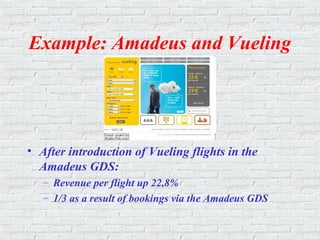
Example: Amadeus and Vueling
• After introduction of Vueling flights in the
Amadeus GDS:
– Revenue per flight up 22,8%
– 1/3 as a result of bookings via the Amadeus GDS
New applications
New type of ICT application: Cross GDS content
• Airline content via Direct Connect
• Low-cost carrier content
• Consolidator net fare content
• Charter content
• Web-fare content
• XML interface
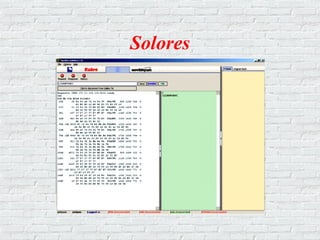
Solores
Questions