GLAUCOMA
DEPARTMENT
OF
MEDICAL SURGICAL NURSING
Learning Objectives:
• At the end of this lecture the students will
be able to:
• Understand the disease aspect of
Glaucoma.
• Be able to identify and manage the
clinical manifestations of glaucoma.
• Be able to administer nursing care to
clients with Glaucoma
Definition
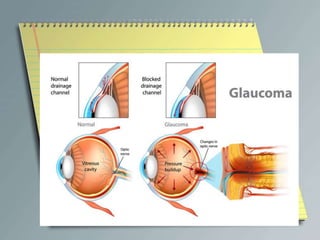
• It’s a ocular condition characterised by optic
nerve damage because of increased intraocular
pressure caused by congestion of aqueous
humor in the eye .
Incidence
• 40 years of age
• men >women
• African and American race
Risk Factors for Glaucoma
• Family history of glaucoma
• African American race
• Older age
• Diabetes
•Cardiovascular disease
•Migraine syndromes
•Nearsightedness (myopia)
• Eye trauma
• Prolonged use of topical or systemic
corticosteroids
• Cardiovascular disease
• Migraine syndromes
• Nearsightedness (myopia)
• Eye trauma
• Prolonged use of topical or systemic
corticosteroids
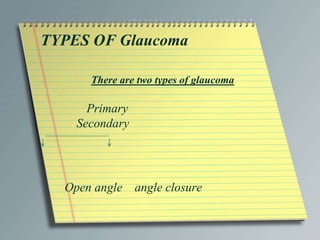
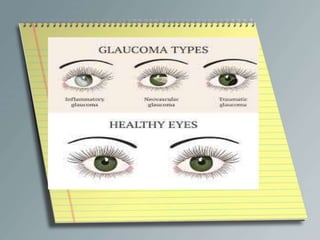
TYPES OF Glaucoma
There are two types of glaucoma
Primary
Secondary
Open angle angle closure
Primary glaucoma –etiology
• Family history
• African and american race
• Older age
• Diabetes Mellitus
• Cardiovascular disease
• Migrane syndrome
• Near sightedness
• Eye trauma
• Prolonged use of topical (or) systemic
corticosteriod
Secondary glaucoma -etiology
• Trauma
• Intra occular or periorbital neoplasm
• Iris neovascularisation ( New blood vessel
growth )
• Other occular and systemic disorders .
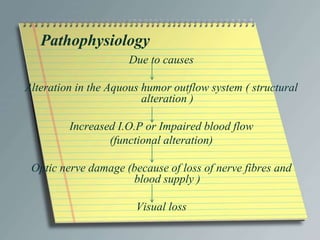
Pathophysiology
Due to causes
Alteration in the Aquous humor outflow system ( structural
alteration )
Increased I.O.P or Impaired blood flow
(functional alteration)
Optic nerve damage (because of loss of nerve fibres and
blood supply )
Visual loss
Sign and symptoms
• Asymptomatic
• Blurred vision
• Difficulty in focusing
• Loss of peripheral vision
• Discomfort around the eyes
• Headache
Diagnostic evaluation
• History taking
• Physical Examination
• Tonometry
• Opthalmoscopy
• Goniomscope
MANAGEMENT
• Miotics
• Adrenergic agonists
• B-Blockers
• Alpa adrenergic blockers
• Carbonic anhydrase
• Prostaglandin analogues
SURGICAL MANAGEMENT
• Laser trabeculoplasty
• Filtering procedures
• Laser iridotomy
• Trabeculectomy
• Drainage implants or shunts
Nursing management
• Impaired visual perception
• Risk for injury
• Ineffective coping
• Ineffective therapeutic regimen
• Knowledge deficit regarding therapeutic
regimen
Summary
• So far we have discussed about definition,
causes, clinical manifestations, diagnostic
evaluation and managements of glaucoma
Bibliography
• Lewis et al, Medical Surgical Nursing,
Mosby Elsevier,7th edition.
• Joyce.M.Black et al, Medical Surgical
Nursing, Saunders publication.
• Brunner and Siddhartha, Medical Surgical
Nursing, Lippincott Williams and Wilkins.
Thank
you

Glaucoma

  • 1.
  • 2.
    Learning Objectives: • Atthe end of this lecture the students will be able to: • Understand the disease aspect of Glaucoma. • Be able to identify and manage the clinical manifestations of glaucoma. • Be able to administer nursing care to clients with Glaucoma
  • 3.
    Definition • It’s aocular condition characterised by optic nerve damage because of increased intraocular pressure caused by congestion of aqueous humor in the eye .
  • 5.
    Incidence • 40 yearsof age • men >women • African and American race
  • 6.
    Risk Factors forGlaucoma • Family history of glaucoma • African American race • Older age • Diabetes •Cardiovascular disease •Migraine syndromes •Nearsightedness (myopia) • Eye trauma • Prolonged use of topical or systemic corticosteroids
  • 7.
    • Cardiovascular disease •Migraine syndromes • Nearsightedness (myopia) • Eye trauma • Prolonged use of topical or systemic corticosteroids
  • 8.
    TYPES OF Glaucoma Thereare two types of glaucoma Primary Secondary Open angle angle closure
  • 9.
    Primary glaucoma –etiology •Family history • African and american race • Older age • Diabetes Mellitus • Cardiovascular disease
  • 10.
    • Migrane syndrome •Near sightedness • Eye trauma • Prolonged use of topical (or) systemic corticosteriod
  • 11.
    Secondary glaucoma -etiology •Trauma • Intra occular or periorbital neoplasm • Iris neovascularisation ( New blood vessel growth ) • Other occular and systemic disorders .
  • 13.
    Pathophysiology Due to causes Alterationin the Aquous humor outflow system ( structural alteration ) Increased I.O.P or Impaired blood flow (functional alteration) Optic nerve damage (because of loss of nerve fibres and blood supply ) Visual loss
  • 14.
    Sign and symptoms •Asymptomatic • Blurred vision • Difficulty in focusing • Loss of peripheral vision • Discomfort around the eyes • Headache
  • 15.
    Diagnostic evaluation • Historytaking • Physical Examination • Tonometry • Opthalmoscopy • Goniomscope
  • 16.
    MANAGEMENT • Miotics • Adrenergicagonists • B-Blockers • Alpa adrenergic blockers • Carbonic anhydrase • Prostaglandin analogues
  • 17.
    SURGICAL MANAGEMENT • Lasertrabeculoplasty • Filtering procedures • Laser iridotomy • Trabeculectomy • Drainage implants or shunts
  • 18.
  • 19.
    • Impaired visualperception • Risk for injury • Ineffective coping • Ineffective therapeutic regimen • Knowledge deficit regarding therapeutic regimen
  • 20.
    Summary • So farwe have discussed about definition, causes, clinical manifestations, diagnostic evaluation and managements of glaucoma
  • 21.
    Bibliography • Lewis etal, Medical Surgical Nursing, Mosby Elsevier,7th edition. • Joyce.M.Black et al, Medical Surgical Nursing, Saunders publication. • Brunner and Siddhartha, Medical Surgical Nursing, Lippincott Williams and Wilkins.
  • 22.