
PRAGYANSHREE NANDA
PG 1ST YR
MED-SURG SPECIALITY
KIIT UNIVERSITY
BASIC
ANATOMY &
PHYSIOLOGY
OF EYES
GLAUCOMA
DEFINITION
Glaucoma is a disease that damages
your eye’s optic nerve It usually
happens when fluid builds up in the
front part of your eye. That extra fluid
increases the pressure in your eye,
damaging the optic nerve
INCIDENCE
Totally, 14,092 individuals participated; 2.7%
were detected to have glaucoma in rural and
3.23% in urban . In urban population, 2.10% had
primary open angle glaucoma (POAG), 0.97%
had primary angle closure glaucoma (PACG),
and 0.15% had secondary glaucoma. In rural
population, 1.45% had POAG, 1.15% had ACG,
and 0.10% had secondary glaucoma
TYPES OF GLAUCOMA
TYPES OF GLAUCOMA
Open angle glaucoma
Closed angle glaucoma
Normal tension glaucoma
Congenital galucoma
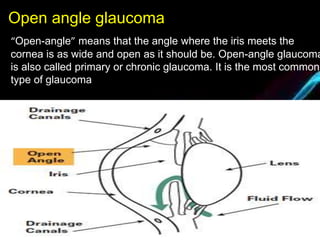
Open angle glaucoma
“Open-angle” means that the angle where the iris meets the
cornea is as wide and open as it should be. Open-angle glaucoma
is also called primary or chronic glaucoma. It is the most common
type of glaucoma, affecting about three million Americans.
•Open-angle glaucoma, the most common form of
glaucoma, accounting for at least 90% of all
glaucoma cases:
•Is caused by the slow clogging of the drainage
canals, resulting in increased eye pressure
•Has a wide and open angle between the iris and
cornea
•Develops slowly and is a lifelong condition
•Has symptoms and damage that are not noticed.
angle-closure glaucoma
It is also called acute glaucoma or narrow-angle
glaucoma. angle-closure glaucoma is a result of the
angle between the iris and cornea closing
•Is caused by blocked drainage canals,
resulting in a sudden rise in intraocular
pressure
•Has a closed or narrow angle between the
iris and cornea
•Develops very quickly
•Has symptoms and damage that are
usually very noticeable
•Demands immediate medical attention.
Normal-Tension Glaucoma (NTG)
Also called low-tension or normal-pressure
glaucoma. In normal-tension glaucoma the
optic nerve is damaged even though the
eye pressure is not very high. We still don't
know why some people’s optic nerves are
damaged even though they have almost
normal pressure levels.
Congenital Glaucoma
This type of glaucoma occurs in babies when
there is incorrect or incomplete development of
the eye's drainage canals during the prenatal
period. This is a rare condition that may be
inherited. When uncomplicated, microsurgery can
often correct the structural defects. Other cases
are treated with medication and surgery.
ETIOLOGY
RISK FACTORS
•Diabetes
•Eye surgery or injury
•High blood pressure
•Use of corticosteroids
•Age 40 and older
•Eye injury or eye surgery
•Cardiovascular disease
•Family history of glaucoma
Symptoms
•Hazy or blurred vision
•The appearance of rainbow-colored
circles around bright lights
•Severe eye and head pain
•Sudden sight loss
•Nausea or vomiting
•Red eyes.
•Sudden, unexpected vision problems
DIAGNOSISDIAGNOSIS
DIAGNOSIS
• TONOMETRY (measure your eye pressure)
•Inspect eye’s drainage angle
•examine optic nerve for damage
•test peripheral (side) vision
•take a picture or computer measurement of optic
nerve
•measure the thickness of cornea
MANAGMENT
MEDICAL MANAGMENT
SURGICAL MANAGMENT
NURSING MANAGMENT
DIATERY MANAGMENT
MEDICAL MANAGMENT
 prostaglandin analogues
• currently available for clinical use:
latanoprost, bimatoprost, travoprost, and
tafluprost
•MOA:-mechanism of action increase in uveoscleral
outflow is generally accepted as the primary mechanism &
also increase trabecular outflow)
Cholinergic stimulator
MOA:- Pilocarpine is the most commonly used
cholinergic in medical practice. Pilocarpine
decreases IOP by stimulating ciliary muscle
contraction
 α2-adrenergic agonists
•apraclonidine
• brimonidine
MOA:- The α2-agonists decrease aqueous
production and increase aqueous outflow
Carbonic anhydrase inhibitors(CAIs)
MOA:
function as direct antagonists to ciliary epithelial
carbonic anhydrase, an enzyme necessary for
production of aqueous humor. More than 90% of this
enzyme must be inhibited in order to decrease
intraocular pressure
β-blockers
non-selective β-
blockers
• timolol
• levobunolol
• carteolol
• selective β-
blocker
• Betaxolol
The mechanism of action involves the blockade of
sympathetic nerve endings in the ciliary epithelium,
decreasing cyclic adenosine monophosphate (cAMP)
production, and subsequently decreasing aqueous humor
secretion by 20-30%
SURGICAL MANAGMENT
•Trabeculoplasty
• a laser beam is used to unblock clogged
drainage canals, making it easier for the fluid
inside the eye to drain out.
•Filtering surgery (viscocanalostomy)
• this may be carried out if nothing else works,
including laser surgery. Channels within the eye
are opened up to improve fluid drainage.
Drainage implant (aqueous shunt
implant) this option is sometimes used for
children or those with secondary glaucoma. A
small silicone tube is inserted into the eye to
help it drain out fluids better
Iridectomy;
Surgical removal of a portion of the
iris facilitates drainage of aqueous
humor through a newly created
opening in the the iris connecting to
normal.
NURSING MANAGMENT
NURSING DIAGNOSIS
•Altered sensory reception r/t status of sense organ As
evidenced by Progressive loss of visual field
•Anxiety related to Physiological factors, change in health
status; presence of pain; possibility/reality of loss of vision
evidence by Expressed concern regarding changes in life
events
•Deficient Knowledge related to Lack of
exposure/unfamiliarity with resources as evidenced by
Questions; statement of misconception
DITEARY MANAGEMENT
•Dark green, yellow, and orange fruits &
vegetables:
•Fruits &vegetables abundant in vitamin C.
•Foods containing vitamin E:
•Foods containing vitamin A.
•Foods with vitamin D
•Foods with zinc
•Foods with omega-3 fatty acids
SUMMARY
CONCLUSION
ASSINGMENT
Glaucoma

Glaucoma

  • 1.
    PRAGYANSHREE NANDA PG 1STYR MED-SURG SPECIALITY KIIT UNIVERSITY
  • 4.
  • 7.
  • 8.
    DEFINITION Glaucoma is adisease that damages your eye’s optic nerve It usually happens when fluid builds up in the front part of your eye. That extra fluid increases the pressure in your eye, damaging the optic nerve
  • 10.
    INCIDENCE Totally, 14,092 individualsparticipated; 2.7% were detected to have glaucoma in rural and 3.23% in urban . In urban population, 2.10% had primary open angle glaucoma (POAG), 0.97% had primary angle closure glaucoma (PACG), and 0.15% had secondary glaucoma. In rural population, 1.45% had POAG, 1.15% had ACG, and 0.10% had secondary glaucoma
  • 11.
  • 12.
    TYPES OF GLAUCOMA Openangle glaucoma Closed angle glaucoma Normal tension glaucoma Congenital galucoma
  • 14.
    Open angle glaucoma “Open-angle”means that the angle where the iris meets the cornea is as wide and open as it should be. Open-angle glaucoma is also called primary or chronic glaucoma. It is the most common type of glaucoma, affecting about three million Americans.
  • 15.
    •Open-angle glaucoma, themost common form of glaucoma, accounting for at least 90% of all glaucoma cases: •Is caused by the slow clogging of the drainage canals, resulting in increased eye pressure •Has a wide and open angle between the iris and cornea •Develops slowly and is a lifelong condition •Has symptoms and damage that are not noticed.
  • 16.
    angle-closure glaucoma It isalso called acute glaucoma or narrow-angle glaucoma. angle-closure glaucoma is a result of the angle between the iris and cornea closing
  • 17.
    •Is caused byblocked drainage canals, resulting in a sudden rise in intraocular pressure •Has a closed or narrow angle between the iris and cornea •Develops very quickly •Has symptoms and damage that are usually very noticeable •Demands immediate medical attention.
  • 18.
    Normal-Tension Glaucoma (NTG) Alsocalled low-tension or normal-pressure glaucoma. In normal-tension glaucoma the optic nerve is damaged even though the eye pressure is not very high. We still don't know why some people’s optic nerves are damaged even though they have almost normal pressure levels.
  • 19.
    Congenital Glaucoma This typeof glaucoma occurs in babies when there is incorrect or incomplete development of the eye's drainage canals during the prenatal period. This is a rare condition that may be inherited. When uncomplicated, microsurgery can often correct the structural defects. Other cases are treated with medication and surgery.
  • 20.
  • 21.
    •Diabetes •Eye surgery orinjury •High blood pressure •Use of corticosteroids •Age 40 and older •Eye injury or eye surgery •Cardiovascular disease •Family history of glaucoma
  • 22.
  • 23.
    •Hazy or blurredvision •The appearance of rainbow-colored circles around bright lights •Severe eye and head pain •Sudden sight loss •Nausea or vomiting •Red eyes. •Sudden, unexpected vision problems
  • 24.
    DIAGNOSISDIAGNOSIS DIAGNOSIS • TONOMETRY (measureyour eye pressure) •Inspect eye’s drainage angle •examine optic nerve for damage •test peripheral (side) vision •take a picture or computer measurement of optic nerve •measure the thickness of cornea
  • 25.
  • 26.
  • 27.
  • 28.
     prostaglandin analogues •currently available for clinical use: latanoprost, bimatoprost, travoprost, and tafluprost •MOA:-mechanism of action increase in uveoscleral outflow is generally accepted as the primary mechanism & also increase trabecular outflow) Cholinergic stimulator MOA:- Pilocarpine is the most commonly used cholinergic in medical practice. Pilocarpine decreases IOP by stimulating ciliary muscle contraction
  • 29.
     α2-adrenergic agonists •apraclonidine •brimonidine MOA:- The α2-agonists decrease aqueous production and increase aqueous outflow Carbonic anhydrase inhibitors(CAIs) MOA: function as direct antagonists to ciliary epithelial carbonic anhydrase, an enzyme necessary for production of aqueous humor. More than 90% of this enzyme must be inhibited in order to decrease intraocular pressure
  • 30.
    β-blockers non-selective β- blockers • timolol •levobunolol • carteolol • selective β- blocker • Betaxolol The mechanism of action involves the blockade of sympathetic nerve endings in the ciliary epithelium, decreasing cyclic adenosine monophosphate (cAMP) production, and subsequently decreasing aqueous humor secretion by 20-30%
  • 31.
  • 32.
    •Trabeculoplasty • a laserbeam is used to unblock clogged drainage canals, making it easier for the fluid inside the eye to drain out. •Filtering surgery (viscocanalostomy) • this may be carried out if nothing else works, including laser surgery. Channels within the eye are opened up to improve fluid drainage.
  • 33.
    Drainage implant (aqueousshunt implant) this option is sometimes used for children or those with secondary glaucoma. A small silicone tube is inserted into the eye to help it drain out fluids better Iridectomy; Surgical removal of a portion of the iris facilitates drainage of aqueous humor through a newly created opening in the the iris connecting to normal.
  • 34.
  • 35.
    NURSING DIAGNOSIS •Altered sensoryreception r/t status of sense organ As evidenced by Progressive loss of visual field •Anxiety related to Physiological factors, change in health status; presence of pain; possibility/reality of loss of vision evidence by Expressed concern regarding changes in life events •Deficient Knowledge related to Lack of exposure/unfamiliarity with resources as evidenced by Questions; statement of misconception
  • 36.
    DITEARY MANAGEMENT •Dark green,yellow, and orange fruits & vegetables: •Fruits &vegetables abundant in vitamin C. •Foods containing vitamin E: •Foods containing vitamin A. •Foods with vitamin D •Foods with zinc •Foods with omega-3 fatty acids
  • 37.
  • 38.
  • 39.