AURORA BOREALIS
Kilian Schönberger
December 2009
SAS 8 – Norwegian Area Studies
Content
1. Name and Origins
2. History
3. Northern Light Times
4. Morphing the Magnetic Field
5. Forming of Auroras
6. The Aurora Oval
7. Aurora Forms
8. Dancing Colours
9. Sources
Name and Origins
• Name: „Aurora Borealis“ Latin for „Northern Dawn“
• One of the most impressive natural phenomena
• First recorded incident: “La Caverne de Lascaux” SW
France
• Fascinates and terrifies humans
• Aurora Legends: Every northern culture has oral legends
about the aurora, passed down for generations
Medieval Age
• People believed that the polar light is a bad omen
• Fearing the red light
• Especially while it is very rare in Middle Europe
• The aurora was for example described as heaven battles
or as candles
Image source: gedds.pfrr.alaska.edu
Fridtjof Nansen
• This Norwegian polar explorer tried to reach the north
pole with his ship Fram in 1895-96
• He was blocked by ice but made many woodcuts and
drawings about the aurora
Fridtjof Nansen 1861-1930
Image source: gedds.pfrr.alaska.edu Image source: gedds.pfrr.alaska.edu
Northern Light Times
• Solar phenomenon in the
Ionosphere
• Occurs while periods of high
solar activity
• 80-200km above ground
connected to the
magnetosphere
http://ds9.ssl.berkeley.edu/lws_gems/6/images_6/ion470.jpg
Image source: http://ds9.ssl.berkeley.edu/
Image source: gedds.pfrr.alaska.edu
Solar Winds
• Solar winds are caused by energy released by the sun
• Extension of Sun’s corona
• High speed plasma
Image Source:
http://talklikeaphysicist.com/wp-
content/uploads/2008/10/sun-corona-
mass-
A long way towards earth
• Interactions with the Ionosphere – solar wind (speed
450km/h) carries a weak magnetic field
• Interaction between this and the magnetic field of earth
• Changes form of the earth‘s magnetosphere
• energy dissipates into gaseous form, causing Aurora’s or
stays in electric form
• Dangers: Interrupting satellite transmissions / power
grids
Morphing the magnetic field
• earth has a magnetosphere surrounding the planet
• solar wind flowing past the earth
• solar wind and the magnetosphere are two electrically
conducting fluids with magnetic fields
• plasma and atoms collide
• energy flow causes a change in magnetic field
Image Source:
http://odin.gi.alaska.edu/FAQ/
Magnetosphere
• Earth has a dipole magnetic field similar to a bar magnet
• Invisible magnetic field lines entering at the north pole, exiting at the south
pole
• periods of high solar activity interaction between the solar wind and
magnetosphere
• solar winds effect the comet shape
Bare Magnet
Image source: gedds.pfrr.alaska.edu Image source: wikipedia.com
Forming of Auroras
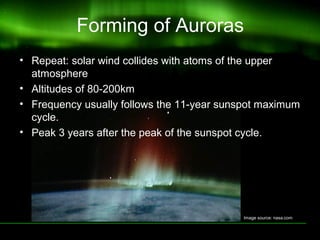
• Repeat: solar wind collides with atoms of the upper
atmosphere
• Altitudes of 80-200km
• Frequency usually follows the 11-year sunspot maximum
cycle.
• Peak 3 years after the peak of the sunspot cycle.
Image source: nasa.com
The Aurora Oval
Image Source: Akasofu, Syun-Ichi. Secrets of the Aurora Borealis
• The aurora is often visible
at high latitudes
• Magnetic field pressure is
strongest
• Most often: Oval located
between 65 and 75
degrees latitude
• Oval ranges from 500 to
1500 km in width
• Zone statistically defined
A aurora seen from space
Nasa
Image source: http://en.wikipedia.org/wiki/File:Aurora_Borealis.jpg
Where the aurora can be seen
• Number of nights per
year aurora can be seen
at certain locations
• Northern Norway:
100 nights each per year
• Rest of Norway:
10 nights every year
• Middle Europe:
1 to 0,1 nights each
years
http://gedds.pfrr.alaska.edu/aurora/Images/w1.jpg
Image source: http://gedds.pfrr.alaska.edu/
Simple aurora structure elements
Images by Tom McEwan
Image source: http://gedds.pfrr.alaska.edu/
Complex formations
Images by Tom McEwan
Complex formations out of the shown elements:
• Curl
• Curtain
• Omega band
• Corona
• Pulsating aurora
Combinations are also possible
Image source: fotocommunity.de
Why colourfull?
High-speed discharge electrons collide with
atoms and molecules in the upper
atmosphere
Different kinds of atoms and molecules
produce different colours of lights
Emissions between 100 and 300 km
altitude
Image source: fotocommunity.de
Dancing Colours
>500km:
Hydrogen and Helium atoms take over
200-500km:
Oxygen atoms – green / brownish-red
brightest single line emission of the aurora
100-200km:
Nitrogen molecules – blue / red
blue/purple border
green line emission (oxygen) is quenched at this altitude
The color of light emitted depends on the wavelength of
a photon: visible light ~400-700 nanometers (blue-red)
Akasofu, Syun-Ichi. Secrets of the Aurora Borealis.
Auroras on other planets
• Planets with magnetic fields have Auroras
• Jupiter, Saturn have highest concentrations
• Caused by Solar Winds
• NASA image of Jupiter aurora in UV, Hubble Space
Telescope:
Image source: http://en.wikipedia.org/wiki/File:Jupiter.Aurora.HST.UV.jpg
Sources
• Bryson, G. (2003): Nordlicht – a study of the aurora
borealis, Mathematics Senior Thesis Presentation
• Blixt, E. (2006): Optical flow analysis of the aurora
borealis, Trans. Geoscience and Remote sensing
• Canadian Space Agency, Aurora Borealis – Northern
Lights
• University of Alaska, http://
asahi-classroom.gi.alaska.edu/ (18.11.2009)
• http://wikipedia.org (18.11.2009)
• http://www.fotocommunity.de (18.11.2009) Profil Thilo
Bubek
• http://nasa.com (18.11.2009)

Aurora Borealis

  • 1.
    AURORA BOREALIS Kilian Schönberger December2009 SAS 8 – Norwegian Area Studies
  • 2.
    Content 1. Name andOrigins 2. History 3. Northern Light Times 4. Morphing the Magnetic Field 5. Forming of Auroras 6. The Aurora Oval 7. Aurora Forms 8. Dancing Colours 9. Sources
  • 3.
    Name and Origins •Name: „Aurora Borealis“ Latin for „Northern Dawn“ • One of the most impressive natural phenomena • First recorded incident: “La Caverne de Lascaux” SW France • Fascinates and terrifies humans • Aurora Legends: Every northern culture has oral legends about the aurora, passed down for generations
  • 4.
    Medieval Age • Peoplebelieved that the polar light is a bad omen • Fearing the red light • Especially while it is very rare in Middle Europe • The aurora was for example described as heaven battles or as candles Image source: gedds.pfrr.alaska.edu Image source: gedds.pfrr.alaska.edu
  • 5.
    Fridtjof Nansen • ThisNorwegian polar explorer tried to reach the north pole with his ship Fram in 1895-96 • He was blocked by ice but made many woodcuts and drawings about the aurora Fridtjof Nansen 1861-1930 Image source: gedds.pfrr.alaska.edu Image source: gedds.pfrr.alaska.edu
  • 6.
    Northern Light Times •Solar phenomenon in the Ionosphere • Occurs while periods of high solar activity • 80-200km above ground connected to the magnetosphere http://ds9.ssl.berkeley.edu/lws_gems/6/images_6/ion470.jpg Image source: http://ds9.ssl.berkeley.edu/ Image source: gedds.pfrr.alaska.edu
  • 7.
    Solar Winds • Solarwinds are caused by energy released by the sun • Extension of Sun’s corona • High speed plasma Image Source: http://talklikeaphysicist.com/wp- content/uploads/2008/10/sun-corona- mass-
  • 8.
    A long waytowards earth • Interactions with the Ionosphere – solar wind (speed 450km/h) carries a weak magnetic field • Interaction between this and the magnetic field of earth • Changes form of the earth‘s magnetosphere • energy dissipates into gaseous form, causing Aurora’s or stays in electric form • Dangers: Interrupting satellite transmissions / power grids
  • 9.
    Morphing the magneticfield • earth has a magnetosphere surrounding the planet • solar wind flowing past the earth • solar wind and the magnetosphere are two electrically conducting fluids with magnetic fields • plasma and atoms collide • energy flow causes a change in magnetic field Image Source: http://odin.gi.alaska.edu/FAQ/
  • 10.
    Magnetosphere • Earth hasa dipole magnetic field similar to a bar magnet • Invisible magnetic field lines entering at the north pole, exiting at the south pole • periods of high solar activity interaction between the solar wind and magnetosphere • solar winds effect the comet shape Bare Magnet Image source: gedds.pfrr.alaska.edu Image source: wikipedia.com
  • 11.
    Forming of Auroras •Repeat: solar wind collides with atoms of the upper atmosphere • Altitudes of 80-200km • Frequency usually follows the 11-year sunspot maximum cycle. • Peak 3 years after the peak of the sunspot cycle. Image source: nasa.com
  • 12.
    The Aurora Oval ImageSource: Akasofu, Syun-Ichi. Secrets of the Aurora Borealis • The aurora is often visible at high latitudes • Magnetic field pressure is strongest • Most often: Oval located between 65 and 75 degrees latitude • Oval ranges from 500 to 1500 km in width • Zone statistically defined
  • 13.
    A aurora seenfrom space Nasa Image source: http://en.wikipedia.org/wiki/File:Aurora_Borealis.jpg
  • 14.
    Where the auroracan be seen • Number of nights per year aurora can be seen at certain locations • Northern Norway: 100 nights each per year • Rest of Norway: 10 nights every year • Middle Europe: 1 to 0,1 nights each years http://gedds.pfrr.alaska.edu/aurora/Images/w1.jpg Image source: http://gedds.pfrr.alaska.edu/
  • 15.
    Simple aurora structureelements Images by Tom McEwan Image source: http://gedds.pfrr.alaska.edu/
  • 16.
    Complex formations Images byTom McEwan Complex formations out of the shown elements: • Curl • Curtain • Omega band • Corona • Pulsating aurora Combinations are also possible Image source: fotocommunity.de
  • 17.
    Why colourfull? High-speed dischargeelectrons collide with atoms and molecules in the upper atmosphere Different kinds of atoms and molecules produce different colours of lights Emissions between 100 and 300 km altitude Image source: fotocommunity.de
  • 18.
    Dancing Colours >500km: Hydrogen andHelium atoms take over 200-500km: Oxygen atoms – green / brownish-red brightest single line emission of the aurora 100-200km: Nitrogen molecules – blue / red blue/purple border green line emission (oxygen) is quenched at this altitude The color of light emitted depends on the wavelength of a photon: visible light ~400-700 nanometers (blue-red) Akasofu, Syun-Ichi. Secrets of the Aurora Borealis.
  • 19.
    Auroras on otherplanets • Planets with magnetic fields have Auroras • Jupiter, Saturn have highest concentrations • Caused by Solar Winds • NASA image of Jupiter aurora in UV, Hubble Space Telescope: Image source: http://en.wikipedia.org/wiki/File:Jupiter.Aurora.HST.UV.jpg
  • 20.
    Sources • Bryson, G.(2003): Nordlicht – a study of the aurora borealis, Mathematics Senior Thesis Presentation • Blixt, E. (2006): Optical flow analysis of the aurora borealis, Trans. Geoscience and Remote sensing • Canadian Space Agency, Aurora Borealis – Northern Lights • University of Alaska, http:// asahi-classroom.gi.alaska.edu/ (18.11.2009) • http://wikipedia.org (18.11.2009) • http://www.fotocommunity.de (18.11.2009) Profil Thilo Bubek • http://nasa.com (18.11.2009)

Editor's Notes

  • #4 Ancient Eskimo stories often are associated with notions of life after death. Some thought that the aurora was a narrow and dangerous pathway for the departed souls to heaven.