DENTAL CEMENTS
Part-3
Presented By-
Dhananjay Singh
CONTENTS
◦ Glass ionomer cement (GIC)
◦ Metal-reinforced glass ionomer cement
◦ High viscosity glass ionomer cement
◦ Resin modified glass ionomer cement
◦ Calcium aluminate Glass ionomer cement
◦ Compomer
◦ Resin cement
◦ Mineral trioxide aggregate cement
◦ Root canal sealer
◦ Conclusion
GLASS IONOMER CEMENT (GIC)
◦ GIC is the generic name for materials based on reaction of
glass powder and polyacyrlic acid.
◦ These cements where introduced in 1970 to improve clinical
performance compared with silicate cements and to reduce
pulp damage.
◦ GIC consider superior to many cements as it is adherent and
translucent.
◦ GIC has been used for esthetic restoration for ant teeth e.g
class 3 and 5 , as a luting agent, as intermediate restoration
and as a Lining cements and base.
◦The glass Ionomer cements classified below :
◦TYPE 1 – Luting crowns, bridges and orthodontic
brackets
◦TYPE 2a - Esthetic restorative cements
◦TYPE 2b – Reinforced restorative cements
◦TYPE 3 – Lining cements and base
Glass composition
◦ It’s varies among manufactures but it Always have alumina , silica, calcia and
fluoride.
◦ The ratio of alumina to silica is key to their reactivity with Polyacrylic acid.
◦ Additionally it has barium, strontium and some other higher atomic number
metal oxide to increase glass radiopacity.
◦ Silica glass melts between 1100°c – 1500°c depending upon overall
composition.
◦ The glass is grounded Into powder With partical size ranging between 15
micrometer to 50 micrometer, depending upon indication.
Liquid composition
◦ Originally, Aqueous solution of Polyacrylic acid (About 40-
50%) were used. But such liquid has short shelf life due to
gelation.
◦ Currently the liquid are copolymer of itaconic acid, maleic
acid and tricarboxylic acid.
◦ Tartaric acid is a rate-controlling addictive in the GICs liquid
that allows a wide range of glasses to be used.
SETTING
REACTIO
N
Clinical Manipulation
◦ The following condition for GIC must be satisfied for cementing fixed
prosthesis.
1. The surface of prepared tooth must be clean and blotted dry.
2. The Prosthesis must be coated with luting cement and seated
completely.
3. The excess cement must be removed at appropriate time.
◦ For restoravtive indication, the GIC surface must be protected to
prevent dehydration or premature exposure to saliva.
Surface Preparation
◦ Clean tooth surface is essential for sustained adhesion.
◦ Smear layer produced by prepared cavity can be removed
by a slurry of pumic stone.
◦ Alternatively, tooth can be etched by 34-37% phosphoric acid
or 10-20% Polyacrylic acid for 10-20sec. Followed by water
rinse.
◦ The surface should be dry and uncontaminated by blood and
saliva.
Material
preparation
Biological and Mechanical Property
◦ Anticariogenic potential due to release of fluoride.
◦ Biocompatibility.
◦ Compressive strength – 200 MPa
◦ Flexural strength – 5-40 MPa
◦ Shear strength – 3-5 MPa
Metal-Reinforced Glass Ionomer
Cement
◦ Metallic fillers have been incorporated in GICs to improve
their fracture toughness and stress-bearing capacity.
◦ Metal-reinforced GIC are of limited in use as an alternative to
amalgam or composite for posterior restoration.
◦ They are weaker then resin bases composite cores.
◦ They harden rapidly which is useful for pedodontic cases.
High-Viscosity Glass Ionomer
Cement
◦ These GIC contain small glass particle size and use a higher
P/L ratio, yielding greater compressive strength.
◦ They exhibit excellent packability for better handling
characteristics.
◦ They are also used for core buildup, primary tooth filling, non-
stress bearing restoration and intermediate restorations.
Resin-Modified Glass Ionomer
Cement ( Hybrid Ionomer)
◦ Water soluble methacrylate base monomer have been used to replace
part of liquid component of conventional GIC results in a group of
materials called resin-Modified glass Ionomer cement.
◦ The monomer can be polymerized by a chemical or light activation or
both and the GIC acid base reaction will occur along with
polymerization.
◦ Some of these cement contain non-reactive filler particles, which
lengthens the working time, improve strength, make less sensitive to
moisture during setting.
Composition
◦Powder
◦ Alumino-silicate glass particle
◦ Polymerization initiator
◦ Chemical initiator – Benzoyl peroxide
◦ Photo-initiator – Camphroquinon
◦ Both – triple cured materials
◦Liquid
◦ Aqueous solution of poly alkenoic acid
◦ Polyacrylic acid having some carboxylic groups modified with methacrylate or
HEMA monomer
Setting Reaction
Theacid – base
reaction begin
upon mixing and
continue after
polymerization at
a much slower
rate than for
conventional
glass Ionomer
cement because
less water is
present.
Clinical Applications
◦ Liners
◦ Fissure sealants
◦ Base material
◦ Core buildup
◦ Repair material for damaged amalgam core or cusp
◦ Retrograde root filling material
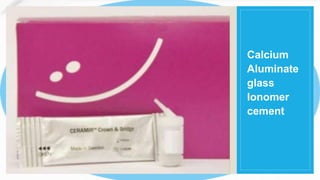
Calcium Aluminate Glass Ionomer
Cement
◦ A hybrid product with a composition between that of calcium Aluminate
and GIC, designed for luting fixed prosthesis.
◦ The calcium Aluminate component is made by sintering a mixture of
high-purity Al2O3 and CaO ( approximately 1:1 molar ratio) to create
monocalcium Aluminate.
◦ The main ingredients in the powder of this hybrid cementare calcium
Aluminate, polyacrylic acid, tartaric acid, strontium-fluoro-alumino-glass
and strontium fluoride.
◦ The liquid component contains 99.6% water and 0.4%
additives which controls setting.
◦ The calcium Aluminate has a basic pH during curing,
reduction in microleakage, excellent biocompatibility, and
long term stability and strength.
Calcium
Aluminate
glass
Ionomer
cement
COMPOMER
◦ Compomer is a polyacid-modified composite made by incorporation glass particles of
GIC in water-free polyacid liquid monomer with appropriate initiator.
◦ The Rationale for using this material is the the integration of the fluoride releasing
capacity of Glass Ionomer with the durability of resin composites.
◦ Compomer process properties distinctly different from those of resin composites and
glass ionomer.
◦ Compomers are usually a one-paste, light-cure materials for restorative applications,
although powder liquid system is for luting application.
Composition
◦ Resin matrix-dimethacrylate monomers with two Carboxylic group
present in their structure
◦ Fillers-reactive silicate glass containing
◦ photoinitiators and stabilizer
◦ there is no water in composition and ion leachable glass is partially
Silanized to ensure bonding to matrix
Setting reaction
◦ These materials set by free radical polymerization reaction.
◦ there are two stages of polymerization reaction
◦ Stage I – Typical light activated composite resin polymerization
reaction occurs which helps in forming resin network enclosing the filler
particles. Reaction causes hardening of products.
◦ Stage II – it occur after initial setting the the restoration absorb water
and carboxyl group present in the polyacid and metal ions in the the
glass ionomer shows slow acid base reaction. This results in formation
of hydrogen it is like glass ionomer cement within the set resin
structure. Slow release of fluoride also occurs.
Manipulation
◦ For single component system the tooth is etched and bonding agent
applied. The material is injected into the cavity and cured by light.
◦ For powder liquid system the Powder and liquid is dispensed and
mixed according to the manufacture instruction for 30 second.
◦ For the automixing system the material comes out mixed when it is
forced through special mixing tips.
Uses
◦ Pits and fissure sealants
◦ Restoration of primary teeth
◦ liners and bases
◦ core buildup material
◦ for class III & V lesions
◦ cervical erosion or abrasion
◦ repair of defective margins in restoration
◦ feeling of root surface for over dentures
◦ retrograde filling materials
RESIN CEMENT
◦ Resin Cements are the newest type of cements used to lute and Bond
indirect restorations.
◦ They have higher compressive,tensile and flexual strength and wear
resistance compared to conventional luting cement.
◦ They comes in different shades and insoluble in oral fluids providing
better marginal seas than other cement types.
◦ Resin Cements should Bond both to the tooth structure and the internal
surface of restoration.
RESIN CEMENT
Composition
◦ Powder
◦ Resin matrix (diacrylate monomer, Bis-GMA, UDMA, TEGDMA)
◦ Inoraganic fillers
◦ Coupling agent (organic silane)
◦ Chemical Or photo initiators and activators
◦ Tri-n-butylborane(TBB) as a catalyst
◦ Liquid
◦ Methy methacrylate
◦ Tertiary amine
◦ 4-META, MDP
◦Polymerization of the resin cement occur by chemical
light aur dual cure mechanism. The majority of resin
cements today are of dual cure variety. Light cure
resin cement is less common because of the potential
for incomplete polymerization of the cement under a
prosthesis.
◦ Applications
◦ Cementation of Crowns and bridges
◦ Cementation of porcelain veneers and Inlays
◦ bonding of orthodontic brackets to acid etched enamel
◦ Commercial name
◦ Infinity
◦ procelite dual cure(Kerr)
Clinical Manipulation
◦ Monomeric component irritating to the Pulp – pulp protection with liner
◦ Chemically cured resin cement
◦ all types of restoration
◦ Supplied as powder and liquid or two paste
◦ mixed on a paper pad for 20 to 30 second
◦ slow and provides extended working time
◦ Dual-cure cement
◦ mixing similar to that for chemical cure system
◦ Curing proceeds slowly until the cement is exposed to the
curing light
◦ Should not be used in prosthesis thicker than 2.5 mm
◦ Metallic prostheses
◦ Roughness by electrochemical etching or grit blasting with
30-50 micrometer alumina particles at an air pressure.
◦ Polymeric prostheses
◦ Polymer‘s surface should be grit-blasted to increase the
roughness for mechanical adhesion
◦ Cerami Prostheses
◦ some dental ceramic restorations are translucent- shade of
luting agent must be matched.
◦ Silica based – etched with hydrofluoric acid and silane
coating is applied prior To Cementation.
◦ Alumina And zirconia based ceramic-grit blasting
◦ orthodontic brackets
◦ Mechanical retention such as the metal mesh of a metal
bracket or retentive dimples or ridges on ceramic or or
polymer brackets.
MINERAL TRIOXIDE AGGREGATE
CEMENT
◦ A new category of cement based on some of same
compound found in portland cement Has gained popularity
for endodontic applications.
◦ This material is beneficial because of its sealing ability and
biocompatibility.
◦ The first product called mineral trioxide aggregate is made up
of a hydraulically active powder that combines calcium oxide
Aluminium oxide Silicon dioxide into hydraulically active
ceramic compounds.
Mineral
Trioxide
Aggregate
Composition
◦ Tricalcium silicate
◦ Dicalcium silicate
◦ Tricalcium aluminate
◦ Tetracalcium aluminoferrite
◦ Calcium sulfate
◦ Bismuth oxide
Characteristics of MTA
◦ Biocompatible with periradicular tissues.
◦ Non cytotoxic to cell, but antimicrobial to bacteria
◦ Non-resorbable
◦ Minimal leakage around the margins
◦ very basic alkaline initial pH 10.2 initially and it rose to 12.5 after 3
hours
◦ MTA Powder Contains fine hydrophilic particles that set in the presence
of moisture
◦ Radiopaque
Advantages
◦ Antimicrobial activity
◦ Hardens in the presence of moisture
◦ non toxic
◦ Vasoconstrictive –this could be beneficial for hemostasis(most
importantly in pulp capping)
◦ cell adherence and growth
◦ Interleukin production
◦ Periodontal ligament attachment to cementum growth
◦ dental Bridge formation
Disadvantages
◦Difficult to manipulate as a root canal filling material
include difficulty in obturation of curved root canal due
to Sandy nature of MTA
◦Longer setting time
◦ discoloration potential
MTA Mixing
◦ Prepared immediately before use- kept always in in closed containers or free
from moisture
◦ glass or paper slab used for mixing with plastic or metal spatula
◦ poor handling properties – the loose sandy nature of the mixing causes much
difficulty for the insertion and packing
◦ It takes longer time to set compared to to any other material.
◦ Being hydrophilic requires moisture to set making absolute dryness
contraindication
◦ It should Not be condensed with excess pressure because it might reduce the
surface hardness
MTA MIXING
USES
◦ Pulp capping
◦ internal and external root resorption & obturation
◦ lateral or furcation perforation
◦ Root canal sealer
◦ root and feeling after Apicoectomy
◦ Apexification
◦ Apexogenesis
ROOT CANAL SEALER
◦ Root canal sealers are used in conjunction with biologically
active acceptable semisolid or solid obturating materials to
establish an adequate seal of the root canal system.
◦ Sealers are binding agent use to fill up the gaps between root
canal walls and obturating materials.
◦ They also fill up the irregularities, lateral canal and
accessory canal.
Root Canal
Sealer
Grossman’s criteria for ideal root
canal sealer
◦ Provide good adhesion Between it self and Canal wall and the Filling material.
◦ Radio opaque
◦ Should not stain tooth structure
◦ Should be dimensionally stable
◦ Be easy mixed and introduced to Canal
◦ Should Be easy to remove if necessary
◦ Insoluble in tissue fluid
◦ Bactericidal or bacteriostatic
◦ Non irritating to Peri radicular tissues.
◦ Should set slowly to provide working time
Uses
◦ Antimicrobial agent
◦ Binding agent
◦ A filler
◦ A Lubricant
◦ provide radio opacity
◦ As a canal obturating material
Conclusion
◦ No single type of cement Satisfy all ideal Requirement aur
best suited for all indication in dentistry.
◦ Each situation must be evaluated based on environment,
mechanical and biological factor and Finally decide on which
material used in each case.
THANK
YOU

Dental cements part 3

  • 1.
  • 2.
    CONTENTS ◦ Glass ionomercement (GIC) ◦ Metal-reinforced glass ionomer cement ◦ High viscosity glass ionomer cement ◦ Resin modified glass ionomer cement ◦ Calcium aluminate Glass ionomer cement ◦ Compomer ◦ Resin cement ◦ Mineral trioxide aggregate cement ◦ Root canal sealer ◦ Conclusion
  • 3.
    GLASS IONOMER CEMENT(GIC) ◦ GIC is the generic name for materials based on reaction of glass powder and polyacyrlic acid. ◦ These cements where introduced in 1970 to improve clinical performance compared with silicate cements and to reduce pulp damage. ◦ GIC consider superior to many cements as it is adherent and translucent. ◦ GIC has been used for esthetic restoration for ant teeth e.g class 3 and 5 , as a luting agent, as intermediate restoration and as a Lining cements and base.
  • 4.
    ◦The glass Ionomercements classified below : ◦TYPE 1 – Luting crowns, bridges and orthodontic brackets ◦TYPE 2a - Esthetic restorative cements ◦TYPE 2b – Reinforced restorative cements ◦TYPE 3 – Lining cements and base
  • 5.
    Glass composition ◦ It’svaries among manufactures but it Always have alumina , silica, calcia and fluoride. ◦ The ratio of alumina to silica is key to their reactivity with Polyacrylic acid. ◦ Additionally it has barium, strontium and some other higher atomic number metal oxide to increase glass radiopacity. ◦ Silica glass melts between 1100°c – 1500°c depending upon overall composition. ◦ The glass is grounded Into powder With partical size ranging between 15 micrometer to 50 micrometer, depending upon indication.
  • 6.
    Liquid composition ◦ Originally,Aqueous solution of Polyacrylic acid (About 40- 50%) were used. But such liquid has short shelf life due to gelation. ◦ Currently the liquid are copolymer of itaconic acid, maleic acid and tricarboxylic acid. ◦ Tartaric acid is a rate-controlling addictive in the GICs liquid that allows a wide range of glasses to be used.
  • 7.
  • 8.
    Clinical Manipulation ◦ Thefollowing condition for GIC must be satisfied for cementing fixed prosthesis. 1. The surface of prepared tooth must be clean and blotted dry. 2. The Prosthesis must be coated with luting cement and seated completely. 3. The excess cement must be removed at appropriate time. ◦ For restoravtive indication, the GIC surface must be protected to prevent dehydration or premature exposure to saliva.
  • 9.
    Surface Preparation ◦ Cleantooth surface is essential for sustained adhesion. ◦ Smear layer produced by prepared cavity can be removed by a slurry of pumic stone. ◦ Alternatively, tooth can be etched by 34-37% phosphoric acid or 10-20% Polyacrylic acid for 10-20sec. Followed by water rinse. ◦ The surface should be dry and uncontaminated by blood and saliva.
  • 10.
  • 12.
    Biological and MechanicalProperty ◦ Anticariogenic potential due to release of fluoride. ◦ Biocompatibility. ◦ Compressive strength – 200 MPa ◦ Flexural strength – 5-40 MPa ◦ Shear strength – 3-5 MPa
  • 13.
    Metal-Reinforced Glass Ionomer Cement ◦Metallic fillers have been incorporated in GICs to improve their fracture toughness and stress-bearing capacity. ◦ Metal-reinforced GIC are of limited in use as an alternative to amalgam or composite for posterior restoration. ◦ They are weaker then resin bases composite cores. ◦ They harden rapidly which is useful for pedodontic cases.
  • 14.
    High-Viscosity Glass Ionomer Cement ◦These GIC contain small glass particle size and use a higher P/L ratio, yielding greater compressive strength. ◦ They exhibit excellent packability for better handling characteristics. ◦ They are also used for core buildup, primary tooth filling, non- stress bearing restoration and intermediate restorations.
  • 15.
    Resin-Modified Glass Ionomer Cement( Hybrid Ionomer) ◦ Water soluble methacrylate base monomer have been used to replace part of liquid component of conventional GIC results in a group of materials called resin-Modified glass Ionomer cement. ◦ The monomer can be polymerized by a chemical or light activation or both and the GIC acid base reaction will occur along with polymerization. ◦ Some of these cement contain non-reactive filler particles, which lengthens the working time, improve strength, make less sensitive to moisture during setting.
  • 16.
    Composition ◦Powder ◦ Alumino-silicate glassparticle ◦ Polymerization initiator ◦ Chemical initiator – Benzoyl peroxide ◦ Photo-initiator – Camphroquinon ◦ Both – triple cured materials ◦Liquid ◦ Aqueous solution of poly alkenoic acid ◦ Polyacrylic acid having some carboxylic groups modified with methacrylate or HEMA monomer
  • 17.
    Setting Reaction Theacid –base reaction begin upon mixing and continue after polymerization at a much slower rate than for conventional glass Ionomer cement because less water is present.
  • 18.
    Clinical Applications ◦ Liners ◦Fissure sealants ◦ Base material ◦ Core buildup ◦ Repair material for damaged amalgam core or cusp ◦ Retrograde root filling material
  • 19.
    Calcium Aluminate GlassIonomer Cement ◦ A hybrid product with a composition between that of calcium Aluminate and GIC, designed for luting fixed prosthesis. ◦ The calcium Aluminate component is made by sintering a mixture of high-purity Al2O3 and CaO ( approximately 1:1 molar ratio) to create monocalcium Aluminate. ◦ The main ingredients in the powder of this hybrid cementare calcium Aluminate, polyacrylic acid, tartaric acid, strontium-fluoro-alumino-glass and strontium fluoride.
  • 20.
    ◦ The liquidcomponent contains 99.6% water and 0.4% additives which controls setting. ◦ The calcium Aluminate has a basic pH during curing, reduction in microleakage, excellent biocompatibility, and long term stability and strength.
  • 21.
  • 22.
    COMPOMER ◦ Compomer isa polyacid-modified composite made by incorporation glass particles of GIC in water-free polyacid liquid monomer with appropriate initiator. ◦ The Rationale for using this material is the the integration of the fluoride releasing capacity of Glass Ionomer with the durability of resin composites. ◦ Compomer process properties distinctly different from those of resin composites and glass ionomer. ◦ Compomers are usually a one-paste, light-cure materials for restorative applications, although powder liquid system is for luting application.
  • 24.
    Composition ◦ Resin matrix-dimethacrylatemonomers with two Carboxylic group present in their structure ◦ Fillers-reactive silicate glass containing ◦ photoinitiators and stabilizer ◦ there is no water in composition and ion leachable glass is partially Silanized to ensure bonding to matrix
  • 25.
    Setting reaction ◦ Thesematerials set by free radical polymerization reaction. ◦ there are two stages of polymerization reaction ◦ Stage I – Typical light activated composite resin polymerization reaction occurs which helps in forming resin network enclosing the filler particles. Reaction causes hardening of products. ◦ Stage II – it occur after initial setting the the restoration absorb water and carboxyl group present in the polyacid and metal ions in the the glass ionomer shows slow acid base reaction. This results in formation of hydrogen it is like glass ionomer cement within the set resin structure. Slow release of fluoride also occurs.
  • 26.
    Manipulation ◦ For singlecomponent system the tooth is etched and bonding agent applied. The material is injected into the cavity and cured by light. ◦ For powder liquid system the Powder and liquid is dispensed and mixed according to the manufacture instruction for 30 second. ◦ For the automixing system the material comes out mixed when it is forced through special mixing tips.
  • 27.
    Uses ◦ Pits andfissure sealants ◦ Restoration of primary teeth ◦ liners and bases ◦ core buildup material ◦ for class III & V lesions ◦ cervical erosion or abrasion ◦ repair of defective margins in restoration ◦ feeling of root surface for over dentures ◦ retrograde filling materials
  • 28.
    RESIN CEMENT ◦ ResinCements are the newest type of cements used to lute and Bond indirect restorations. ◦ They have higher compressive,tensile and flexual strength and wear resistance compared to conventional luting cement. ◦ They comes in different shades and insoluble in oral fluids providing better marginal seas than other cement types. ◦ Resin Cements should Bond both to the tooth structure and the internal surface of restoration.
  • 29.
  • 30.
    Composition ◦ Powder ◦ Resinmatrix (diacrylate monomer, Bis-GMA, UDMA, TEGDMA) ◦ Inoraganic fillers ◦ Coupling agent (organic silane) ◦ Chemical Or photo initiators and activators ◦ Tri-n-butylborane(TBB) as a catalyst ◦ Liquid ◦ Methy methacrylate ◦ Tertiary amine ◦ 4-META, MDP
  • 31.
    ◦Polymerization of theresin cement occur by chemical light aur dual cure mechanism. The majority of resin cements today are of dual cure variety. Light cure resin cement is less common because of the potential for incomplete polymerization of the cement under a prosthesis.
  • 32.
    ◦ Applications ◦ Cementationof Crowns and bridges ◦ Cementation of porcelain veneers and Inlays ◦ bonding of orthodontic brackets to acid etched enamel ◦ Commercial name ◦ Infinity ◦ procelite dual cure(Kerr)
  • 33.
    Clinical Manipulation ◦ Monomericcomponent irritating to the Pulp – pulp protection with liner ◦ Chemically cured resin cement ◦ all types of restoration ◦ Supplied as powder and liquid or two paste ◦ mixed on a paper pad for 20 to 30 second ◦ slow and provides extended working time
  • 34.
    ◦ Dual-cure cement ◦mixing similar to that for chemical cure system ◦ Curing proceeds slowly until the cement is exposed to the curing light ◦ Should not be used in prosthesis thicker than 2.5 mm ◦ Metallic prostheses ◦ Roughness by electrochemical etching or grit blasting with 30-50 micrometer alumina particles at an air pressure. ◦ Polymeric prostheses ◦ Polymer‘s surface should be grit-blasted to increase the roughness for mechanical adhesion
  • 35.
    ◦ Cerami Prostheses ◦some dental ceramic restorations are translucent- shade of luting agent must be matched. ◦ Silica based – etched with hydrofluoric acid and silane coating is applied prior To Cementation. ◦ Alumina And zirconia based ceramic-grit blasting ◦ orthodontic brackets ◦ Mechanical retention such as the metal mesh of a metal bracket or retentive dimples or ridges on ceramic or or polymer brackets.
  • 36.
    MINERAL TRIOXIDE AGGREGATE CEMENT ◦A new category of cement based on some of same compound found in portland cement Has gained popularity for endodontic applications. ◦ This material is beneficial because of its sealing ability and biocompatibility. ◦ The first product called mineral trioxide aggregate is made up of a hydraulically active powder that combines calcium oxide Aluminium oxide Silicon dioxide into hydraulically active ceramic compounds.
  • 37.
  • 38.
    Composition ◦ Tricalcium silicate ◦Dicalcium silicate ◦ Tricalcium aluminate ◦ Tetracalcium aluminoferrite ◦ Calcium sulfate ◦ Bismuth oxide
  • 39.
    Characteristics of MTA ◦Biocompatible with periradicular tissues. ◦ Non cytotoxic to cell, but antimicrobial to bacteria ◦ Non-resorbable ◦ Minimal leakage around the margins ◦ very basic alkaline initial pH 10.2 initially and it rose to 12.5 after 3 hours ◦ MTA Powder Contains fine hydrophilic particles that set in the presence of moisture ◦ Radiopaque
  • 40.
    Advantages ◦ Antimicrobial activity ◦Hardens in the presence of moisture ◦ non toxic ◦ Vasoconstrictive –this could be beneficial for hemostasis(most importantly in pulp capping) ◦ cell adherence and growth ◦ Interleukin production ◦ Periodontal ligament attachment to cementum growth ◦ dental Bridge formation
  • 41.
    Disadvantages ◦Difficult to manipulateas a root canal filling material include difficulty in obturation of curved root canal due to Sandy nature of MTA ◦Longer setting time ◦ discoloration potential
  • 42.
    MTA Mixing ◦ Preparedimmediately before use- kept always in in closed containers or free from moisture ◦ glass or paper slab used for mixing with plastic or metal spatula ◦ poor handling properties – the loose sandy nature of the mixing causes much difficulty for the insertion and packing ◦ It takes longer time to set compared to to any other material. ◦ Being hydrophilic requires moisture to set making absolute dryness contraindication ◦ It should Not be condensed with excess pressure because it might reduce the surface hardness
  • 43.
  • 44.
    USES ◦ Pulp capping ◦internal and external root resorption & obturation ◦ lateral or furcation perforation ◦ Root canal sealer ◦ root and feeling after Apicoectomy ◦ Apexification ◦ Apexogenesis
  • 45.
    ROOT CANAL SEALER ◦Root canal sealers are used in conjunction with biologically active acceptable semisolid or solid obturating materials to establish an adequate seal of the root canal system. ◦ Sealers are binding agent use to fill up the gaps between root canal walls and obturating materials. ◦ They also fill up the irregularities, lateral canal and accessory canal.
  • 46.
  • 47.
    Grossman’s criteria forideal root canal sealer ◦ Provide good adhesion Between it self and Canal wall and the Filling material. ◦ Radio opaque ◦ Should not stain tooth structure ◦ Should be dimensionally stable ◦ Be easy mixed and introduced to Canal ◦ Should Be easy to remove if necessary ◦ Insoluble in tissue fluid ◦ Bactericidal or bacteriostatic ◦ Non irritating to Peri radicular tissues. ◦ Should set slowly to provide working time
  • 48.
    Uses ◦ Antimicrobial agent ◦Binding agent ◦ A filler ◦ A Lubricant ◦ provide radio opacity ◦ As a canal obturating material
  • 49.
    Conclusion ◦ No singletype of cement Satisfy all ideal Requirement aur best suited for all indication in dentistry. ◦ Each situation must be evaluated based on environment, mechanical and biological factor and Finally decide on which material used in each case.
  • 50.