GLASS IONOMER
CEMENT
Applied Dental Materials
3rd year
DC, DU
Background
Developed in attempt to combine the favorable
properties of silicate cement and
polycarboxylate cement.
Was introduced in 1972 by Wilson and Kent.
The first introduced GIC was opaque, limited
shade selections, mixing and handling
problems and technique sensitivity.
Silicate Cements
It was introduced in~1870 as direct aesthetic
restoration [historical type]
Supplied form : Powder & Liquid
Composition:
Powder: Fluoro- calcium- aluminum- silicate
glass (ion leach-able glass )

Liquid: Aqueous solution of phosphoric acid
Setting Reaction
It is an acid base reaction
Base + Acid

Salt + Water

It is a surface reaction

cored structure

Advantages :
Aesthetic [glass content]
Anticariogenic [fluoride content]
Disadvantages
[Early clinical failure].
Highly irritant to the pulp due to.
- Its high acidity.
- Arsenic impurity content.
Highly soluble in oral fluids.
Inadequate mechanical properties.
Discoloration by time.
Radiolucent.
No adhesive bond between the tooth &
restoration.
Glass Ionomer
Cements
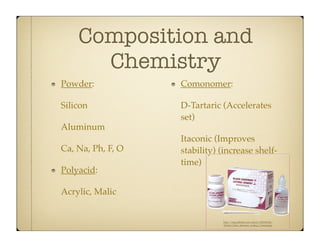
Composition and
Chemistry
Powder:

Comonomer:

Silicon

D-Tartaric (Accelerates
set)

Aluminum
Ca, Na, Ph, F, O
Polyacid:

Itaconic (Improves
stability) (increase shelftime)

Acrylic, Malic

http://img.alibaba.com/photo/100541026/
Dental_Glass_Ionomer_Luting_Cement.jpg
Powder
Fluoro-aluminosilicate glass prepared with
fluoride fluxes.
Type II (restorative material) is generally coarser
than that of type I (Luting agent).
Glass is thermally treated to form the powder,
the quality of the setting reaction can be partially
controlled by the thermal handling.
melting temp.

more rapid setting rate
Liquid
The major component of the liquid is water.
35-65% aqueous solution of various polyacids.
Most common polyacids, polyacrylic acid or
copolymers of acrylic, Maleic acid or acrylic and
Itatonic acid.
Itatonic acid tends to reduce the viscosity,
Tartaric acid in small amount improves working
and setting characteristics.
Some manufacturers freeze or vacuum dry the
polyacids and copolymers, to incorporate them
with the cement powder rather than the liquid.
this was an attempt to ensure the accuracy of
the P/L ratio, and avoid the thickening of the
liquid with storage.
Hydrous Cement
Anhydrous Cements
Semihydrous cements
Setting Reaction
A typical acid base reaction
Metal + Acid = Salts (exothermic)
Powder+liquid
acid soluble glass reacts
with the polyacids releasing Al, Ca, Na, F ions.
Ca and Al polysalts are formed.
The salts Hydrate to form a gel matrix, while the
unreacted glass particles act as fillers
surrounded by the gel.
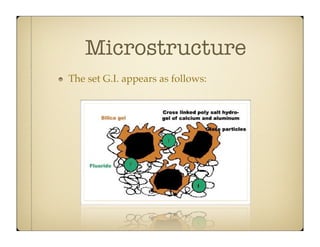
Set cement consist of unreacted glass
surrounded by silica gel bonded together by a
matrix of hydrated Ca and Al-polysalts.
Fluoride ions are not integral part of the
matrix formation, they are available for
clinical release without compromising the
structure of the cement.
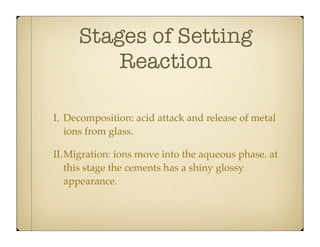
Stages of Setting
Reaction
I. Decomposition: acid attack and release of metal
ions from glass.
II.Migration: ions move into the aqueous phase. at
this stage the cements has a shiny glossy
appearance.
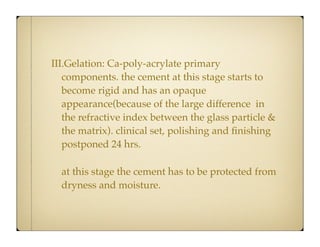
III.Gelation: Ca-poly-acrylate primary
components. the cement at this stage starts to
become rigid and has an opaque
appearance(because of the large difference in
the refractive index between the glass particle &
the matrix). clinical set, polishing and finishing
postponed 24 hrs.
at this stage the cement has to be protected from
dryness and moisture.
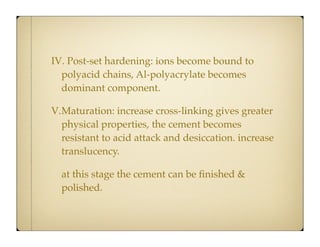
IV. Post-set hardening: ions become bound to
polyacid chains, Al-polyacrylate becomes
dominant component.
V.Maturation: increase cross-linking gives greater
physical properties, the cement becomes
resistant to acid attack and desiccation. increase
translucency.
at this stage the cement can be finished &
polished.
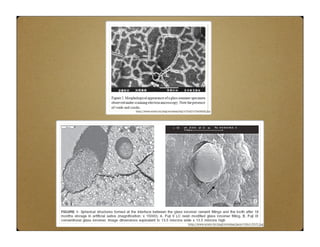
Microstructure
The set G.I. appears as follows:
Role of Water
Water plays a crucial role in the setting reaction
of glass-ionomer cement.
It act as a reaction medium.
Facilitate the formation of the hydration of the
salts and enable the cross-linking to progress
properly.
Amount of available water is crucial, if it varies
the results can be catastrophic:
Excess water: contamination will dilute the
metal ions in soluble form and result in
increased opacity and decreased strength and
hardness of the final cement.
Water loss during setting: desiccation of the
hydrogel disrupts the cement structure during
maturation resulting in crazing and cracking of
the final cement.
http://www.scielo.br/img/revistas/bdj/v17n2/v17a04f02.jpg

http://www.scielo.br/img/revistas/jaos/v16n1/01f1.jpg
Manipulation:
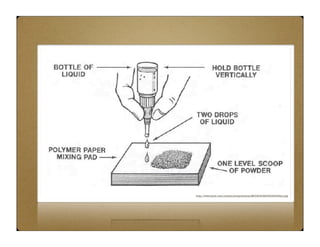
The P/L ratio of GIC is critical.
P/L ratio is 3:1 by weight.
Must be mixed within 45 sec.
the resulting mix must have a surface gloss or
it will not adhere.
Pre-capsulated form is available.
Care of the liquid: In order to preserve the amount
of water inside the liquid
1)Dispense the liquid just before mixing
2)Reseal the bottle immediately
3)Discard the last third of the liquid
Use cool glass slab(not below the dew point in
order not to change the water content)
http://www.tpub.com/content/armymedical/MD0502/MD05020023im.jpg
Mixing over large area (for heat dissipation) with
plastic spatula
Isolation of the cavity
Application of calcium hydroxide liner
Conditioning of cavity wall
Bulk insertion of the G.I.
Coating of the G.I. surface with cavity varnish
Finishing &polishing
Properties
Biological Properties:
G.I. is mildly irritant to the pulp due to:
Mild exothermic setting reaction
Mild acidic irritation of polycarboxylic acid
Rapid rise to neutrality within 24 hrs.
Difficult penetration of the large acid molecules
inside the dentinal tubules.
Anti-cariogenic property due to
Fluoride release from G.I. to tooth
Recharging ability
It is recommended in patients with high
caries index.
Mechanical
Properties:
Compressive strength: fairly high up to 200 MPa.
Flexural strength: fairly low 5 to 40 MPa.
Shear strength: fairly low 3 to 5 MPa.
Coefficient of thermal expansion similar to tooth
structure.
Dimensional changes: shrinks on setting, expand
with water sorption.
The strength and hardness are lower than those
of the silicate cements.
low toughness and less wear resistance when
compared with resin composite.
The strength of G.I. depends on:
1)Powder/Liquid
2)Protection of G.I. against dryness & moisture in
the initial set stage
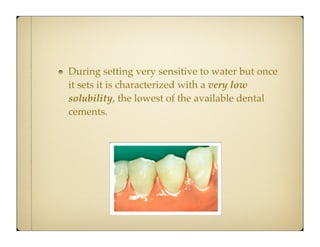
During setting very sensitive to water but once
it sets it is characterized with a very low
solubility, the lowest of the available dental
cements.
Esthetic & Optical
Properties
Tooth colored restoration, acceptable esthetic
but not as good as the resin composite.
G.I. is radio-opaue by the addition of barium to
the glass powder.
Bonding TO Tooth
Structure
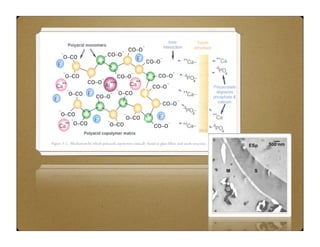
GIC share the adhesive potential of the
polycarboxylate cement.
They appear to bond primarily to the inorganic
component (Ca) of the tooth st. by initial hydrogen
bonding, forming a metal ion bridges.
Good isolation to avoid contamination and
moisture, smear layer should be removed and the
cement should be used when its in its glossy stage.
Clinical Uses for GIC
Type I cement:

luting agent or liner

The film thickness is 20µm.
Type II cement: Class V erosion/caries
Temporary rest (caries control)
Class II, III, IV(dentin margins)
The film thickness is 45µm.
Type III cement: Pit & Fissure sealant.
The film thickness is25-35µm
Type IV cement: for core build up in high stress
bearing areas.
The film thickness is 45µm or more
Type V cement:

for liner & bases
Modifications
PURPOSE:
1 )To improve the mechanical properties
2 )To decrease the moisture sensitivity
The modification is done either to the powder or
to the liquid.
TYPES OF MODIFICATIONS:
1)METAL G.I. MIXTURE (MIRACLE MIX):
G.I. powder +Amalgam alloy powder
It was not successful
2) CERMET:
Precious metal e.g. silver is sintered to the G.I.
Cermet
Cermet can be used
as:
1)Core build up
2)Deciduous
posterior restorations

Properties of cermet :
1)Higher mechanical
properties
2)More opaque
3)Less fluoride
release
Resin-modified GIC
Glass ionomer cement in which the acid-base
setting reaction has been supplemented by a
polymerization reaction of added resin
components.
the following criteria must be fulfilled:
the acid base reaction must be critical to the
setting reaction.
must contain fluoroaluminosilicate glass,
polymeric carboxylic acid and water.
A hydrophilic monomer as HEMA is grafted to
the aqueous polycarboxylic acid copolymer
liquid
1)The monomer should be hydrophilic to
avoid separation of the resin from the liquid.
2)Initiator activator system for light & or
chemical curing of HEMA should be included.
Setting reaction:(supplied as powder&liquid)
1)Acid base reaction
2)Light polymerization of HEMA
3)Chemical polymerization of HEMA

Hybrid ionomer can be used as:
1)Lining under composite restorations
2)Anterior restorations Class III & V
Compomer
( Polyacid Modified Composite Resin):
It is a modified C.R.( C.R.+G.I.)
Composition:
1)Dimethacrylate oligomer with two carboxylic
groups.
2)Ion leachable glass filler.
3)Partially silanated to allow for bonding of filler to
matrix&leaching out of fluoride from the filler.
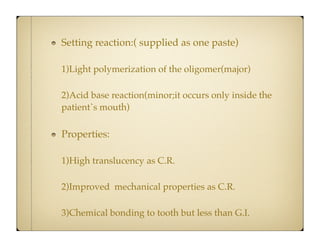
Setting reaction:( supplied as one paste)
1)Light polymerization of the oligomer(major)
2)Acid base reaction(minor;it occurs only inside the
patient`s mouth)

Properties:
1)High translucency as C.R.
2)Improved mechanical properties as C.R.
3)Chemical bonding to tooth but less than G.I.
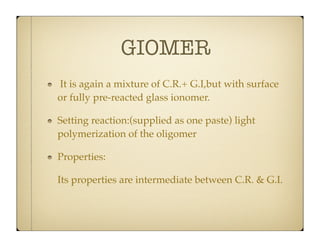
GIOMER
It is again a mixture of C.R.+ G.I,but with surface
or fully pre-reacted glass ionomer.
Setting reaction:(supplied as one paste) light
polymerization of the oligomer
Properties:
Its properties are intermediate between C.R. & G.I.
Any Q?

GIC

  • 1.
    GLASS IONOMER CEMENT Applied DentalMaterials 3rd year DC, DU
  • 2.
    Background Developed in attemptto combine the favorable properties of silicate cement and polycarboxylate cement. Was introduced in 1972 by Wilson and Kent. The first introduced GIC was opaque, limited shade selections, mixing and handling problems and technique sensitivity.
  • 3.
    Silicate Cements It wasintroduced in~1870 as direct aesthetic restoration [historical type] Supplied form : Powder & Liquid Composition: Powder: Fluoro- calcium- aluminum- silicate glass (ion leach-able glass ) Liquid: Aqueous solution of phosphoric acid
  • 4.
    Setting Reaction It isan acid base reaction Base + Acid Salt + Water It is a surface reaction cored structure Advantages : Aesthetic [glass content] Anticariogenic [fluoride content]
  • 5.
    Disadvantages [Early clinical failure]. Highlyirritant to the pulp due to. - Its high acidity. - Arsenic impurity content. Highly soluble in oral fluids.
  • 6.
    Inadequate mechanical properties. Discolorationby time. Radiolucent. No adhesive bond between the tooth & restoration.
  • 7.
  • 8.
    Composition and Chemistry Powder: Comonomer: Silicon D-Tartaric (Accelerates set) Aluminum Ca,Na, Ph, F, O Polyacid: Itaconic (Improves stability) (increase shelftime) Acrylic, Malic http://img.alibaba.com/photo/100541026/ Dental_Glass_Ionomer_Luting_Cement.jpg
  • 9.
    Powder Fluoro-aluminosilicate glass preparedwith fluoride fluxes. Type II (restorative material) is generally coarser than that of type I (Luting agent). Glass is thermally treated to form the powder, the quality of the setting reaction can be partially controlled by the thermal handling. melting temp. more rapid setting rate
  • 10.
    Liquid The major componentof the liquid is water. 35-65% aqueous solution of various polyacids. Most common polyacids, polyacrylic acid or copolymers of acrylic, Maleic acid or acrylic and Itatonic acid. Itatonic acid tends to reduce the viscosity, Tartaric acid in small amount improves working and setting characteristics.
  • 11.
    Some manufacturers freezeor vacuum dry the polyacids and copolymers, to incorporate them with the cement powder rather than the liquid. this was an attempt to ensure the accuracy of the P/L ratio, and avoid the thickening of the liquid with storage. Hydrous Cement Anhydrous Cements Semihydrous cements
  • 12.
    Setting Reaction A typicalacid base reaction Metal + Acid = Salts (exothermic) Powder+liquid acid soluble glass reacts with the polyacids releasing Al, Ca, Na, F ions. Ca and Al polysalts are formed. The salts Hydrate to form a gel matrix, while the unreacted glass particles act as fillers surrounded by the gel.
  • 13.
    Set cement consistof unreacted glass surrounded by silica gel bonded together by a matrix of hydrated Ca and Al-polysalts. Fluoride ions are not integral part of the matrix formation, they are available for clinical release without compromising the structure of the cement.
  • 14.
    Stages of Setting Reaction I.Decomposition: acid attack and release of metal ions from glass. II.Migration: ions move into the aqueous phase. at this stage the cements has a shiny glossy appearance.
  • 15.
    III.Gelation: Ca-poly-acrylate primary components.the cement at this stage starts to become rigid and has an opaque appearance(because of the large difference in the refractive index between the glass particle & the matrix). clinical set, polishing and finishing postponed 24 hrs. at this stage the cement has to be protected from dryness and moisture.
  • 16.
    IV. Post-set hardening:ions become bound to polyacid chains, Al-polyacrylate becomes dominant component. V.Maturation: increase cross-linking gives greater physical properties, the cement becomes resistant to acid attack and desiccation. increase translucency. at this stage the cement can be finished & polished.
  • 17.
    Microstructure The set G.I.appears as follows:
  • 18.
    Role of Water Waterplays a crucial role in the setting reaction of glass-ionomer cement. It act as a reaction medium. Facilitate the formation of the hydration of the salts and enable the cross-linking to progress properly.
  • 19.
    Amount of availablewater is crucial, if it varies the results can be catastrophic: Excess water: contamination will dilute the metal ions in soluble form and result in increased opacity and decreased strength and hardness of the final cement. Water loss during setting: desiccation of the hydrogel disrupts the cement structure during maturation resulting in crazing and cracking of the final cement.
  • 20.
  • 21.
    Manipulation: The P/L ratioof GIC is critical. P/L ratio is 3:1 by weight. Must be mixed within 45 sec. the resulting mix must have a surface gloss or it will not adhere. Pre-capsulated form is available.
  • 22.
    Care of theliquid: In order to preserve the amount of water inside the liquid 1)Dispense the liquid just before mixing 2)Reseal the bottle immediately 3)Discard the last third of the liquid Use cool glass slab(not below the dew point in order not to change the water content)
  • 23.
  • 24.
    Mixing over largearea (for heat dissipation) with plastic spatula Isolation of the cavity Application of calcium hydroxide liner Conditioning of cavity wall Bulk insertion of the G.I. Coating of the G.I. surface with cavity varnish Finishing &polishing
  • 25.
    Properties Biological Properties: G.I. ismildly irritant to the pulp due to: Mild exothermic setting reaction Mild acidic irritation of polycarboxylic acid Rapid rise to neutrality within 24 hrs. Difficult penetration of the large acid molecules inside the dentinal tubules.
  • 26.
    Anti-cariogenic property dueto Fluoride release from G.I. to tooth Recharging ability It is recommended in patients with high caries index.
  • 27.
    Mechanical Properties: Compressive strength: fairlyhigh up to 200 MPa. Flexural strength: fairly low 5 to 40 MPa. Shear strength: fairly low 3 to 5 MPa. Coefficient of thermal expansion similar to tooth structure. Dimensional changes: shrinks on setting, expand with water sorption.
  • 28.
    The strength andhardness are lower than those of the silicate cements. low toughness and less wear resistance when compared with resin composite. The strength of G.I. depends on: 1)Powder/Liquid 2)Protection of G.I. against dryness & moisture in the initial set stage
  • 29.
    During setting verysensitive to water but once it sets it is characterized with a very low solubility, the lowest of the available dental cements.
  • 30.
    Esthetic & Optical Properties Toothcolored restoration, acceptable esthetic but not as good as the resin composite. G.I. is radio-opaue by the addition of barium to the glass powder.
  • 31.
    Bonding TO Tooth Structure GICshare the adhesive potential of the polycarboxylate cement. They appear to bond primarily to the inorganic component (Ca) of the tooth st. by initial hydrogen bonding, forming a metal ion bridges. Good isolation to avoid contamination and moisture, smear layer should be removed and the cement should be used when its in its glossy stage.
  • 33.
    Clinical Uses forGIC Type I cement: luting agent or liner The film thickness is 20µm. Type II cement: Class V erosion/caries Temporary rest (caries control) Class II, III, IV(dentin margins) The film thickness is 45µm.
  • 34.
    Type III cement:Pit & Fissure sealant. The film thickness is25-35µm Type IV cement: for core build up in high stress bearing areas. The film thickness is 45µm or more Type V cement: for liner & bases
  • 35.
    Modifications PURPOSE: 1 )To improvethe mechanical properties 2 )To decrease the moisture sensitivity The modification is done either to the powder or to the liquid.
  • 36.
    TYPES OF MODIFICATIONS: 1)METALG.I. MIXTURE (MIRACLE MIX): G.I. powder +Amalgam alloy powder It was not successful 2) CERMET: Precious metal e.g. silver is sintered to the G.I.
  • 37.
    Cermet Cermet can beused as: 1)Core build up 2)Deciduous posterior restorations Properties of cermet : 1)Higher mechanical properties 2)More opaque 3)Less fluoride release
  • 38.
    Resin-modified GIC Glass ionomercement in which the acid-base setting reaction has been supplemented by a polymerization reaction of added resin components. the following criteria must be fulfilled: the acid base reaction must be critical to the setting reaction. must contain fluoroaluminosilicate glass, polymeric carboxylic acid and water.
  • 39.
    A hydrophilic monomeras HEMA is grafted to the aqueous polycarboxylic acid copolymer liquid 1)The monomer should be hydrophilic to avoid separation of the resin from the liquid. 2)Initiator activator system for light & or chemical curing of HEMA should be included.
  • 40.
    Setting reaction:(supplied aspowder&liquid) 1)Acid base reaction 2)Light polymerization of HEMA 3)Chemical polymerization of HEMA Hybrid ionomer can be used as: 1)Lining under composite restorations 2)Anterior restorations Class III & V
  • 41.
    Compomer ( Polyacid ModifiedComposite Resin): It is a modified C.R.( C.R.+G.I.) Composition: 1)Dimethacrylate oligomer with two carboxylic groups. 2)Ion leachable glass filler. 3)Partially silanated to allow for bonding of filler to matrix&leaching out of fluoride from the filler.
  • 42.
    Setting reaction:( suppliedas one paste) 1)Light polymerization of the oligomer(major) 2)Acid base reaction(minor;it occurs only inside the patient`s mouth) Properties: 1)High translucency as C.R. 2)Improved mechanical properties as C.R. 3)Chemical bonding to tooth but less than G.I.
  • 43.
    GIOMER It is againa mixture of C.R.+ G.I,but with surface or fully pre-reacted glass ionomer. Setting reaction:(supplied as one paste) light polymerization of the oligomer Properties: Its properties are intermediate between C.R. & G.I.
  • 44.