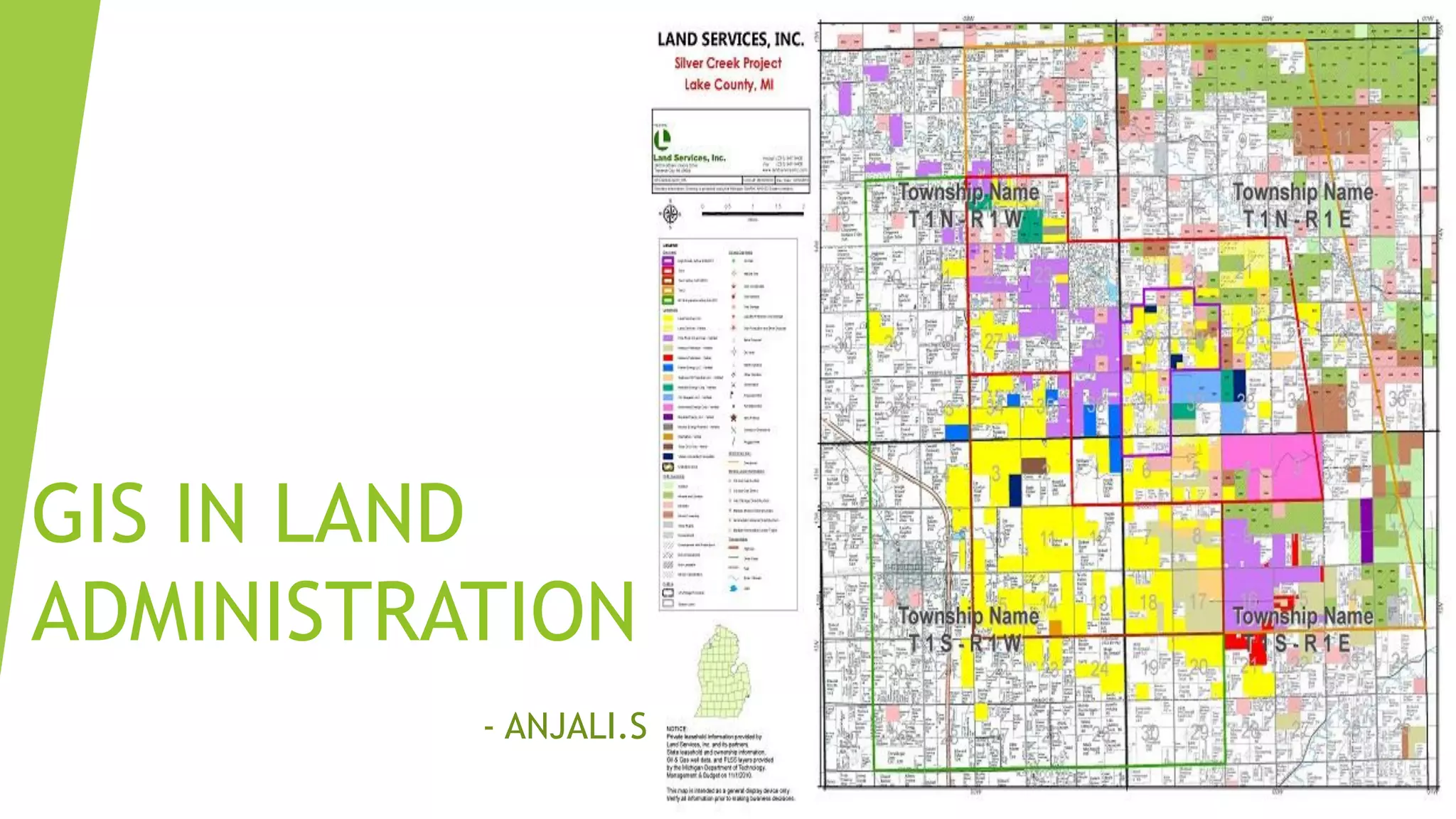
GIS IN LAND
ADMINISTRATION
- ANJALI.S
LAND ADMINISTRATION
 It refers to the processes of recording information about
the ownership, value, and use of land and its associated
resources.
 It includes the determination of rights and other
attributes of the land, the survey and description of
these, their detailed documentation, and the provision of
relevant information in support of land markets.
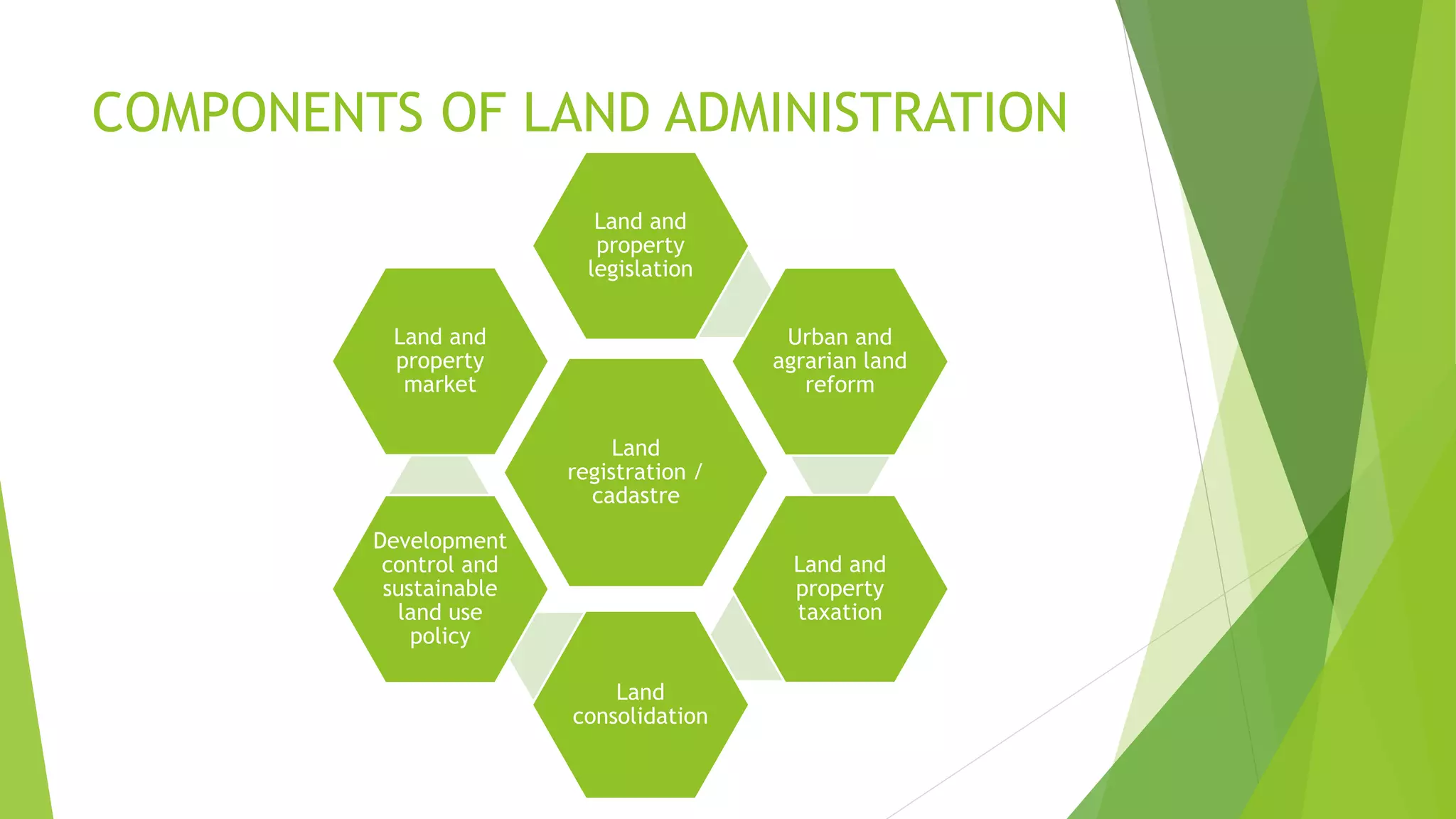
COMPONENTS OF LAND ADMINISTRATION
Land
registration /
cadastre
Land and
property
legislation
Urban and
agrarian land
reform
Land and
property
taxation
Land
consolidation
Development
control and
sustainable
land use
policy
Land and
property
market
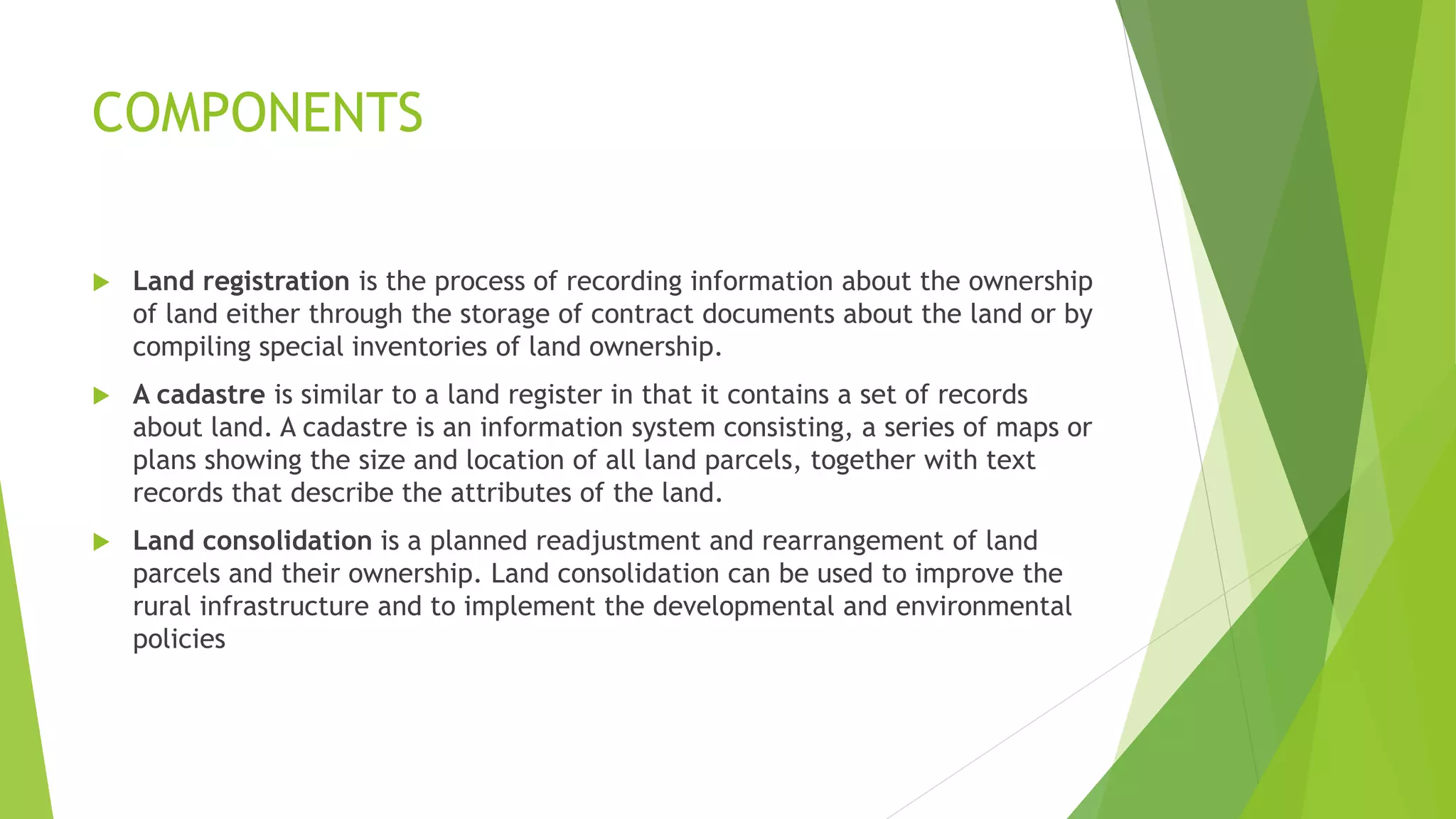
COMPONENTS
 Land registration is the process of recording information about the ownership
of land either through the storage of contract documents about the land or by
compiling special inventories of land ownership.
 A cadastre is similar to a land register in that it contains a set of records
about land. A cadastre is an information system consisting, a series of maps or
plans showing the size and location of all land parcels, together with text
records that describe the attributes of the land.
 Land consolidation is a planned readjustment and rearrangement of land
parcels and their ownership. Land consolidation can be used to improve the
rural infrastructure and to implement the developmental and environmental
policies
INTRODUCTION
 For planning purpose all land-associated information should be available in
the form of a computer database, which can be easily accessed, manipulated
by decision makers while formulating and executing a work. such a database
system is called Land Information System(LIS).
 Cadastral applications will include cadastral index maps and land registration
data in a digital format.
 Automation linkages will be created and developed between textual data
(legal land registration data) and parcel maps.
 The final goal is to generate digital maps which will facilitate land
management and planning and in particular land registration and the issuance
of land titles in order to promote security of land tenure and reduce land
disputes.
INTRODUCTION
 GIS based land acquisition management system will provide complete
information about the land. Land acquisition managements is being used for
the past 3 or 4 years only. It would help in assessment, payments for private
land with owner details, tracking of land allotments and possessions
identification and timely resolution of land acquisition related issues.
 Maps help determine the location of property, indicate the size and shape of
each parcel and reveal geographic relationships that affect property value.
 Maps and map data are important not only for assessors, but also for other
governmental agencies, the public at large, and the land information
community (such as realtors, title companies, and surveyors). In addition, the
assessor must track current ownership of all parcels, so that the proper party
can receive assessment notices and tax bills.
ROLE OF GIS IN LAND ADMINISTRATION
 Data for defining land ownership and supporting land transfer, mortgaging,
and investment
 Data for assessing the value of land and property (for example, for taxation or
calculating land acquisition compensation)
 Data for land market support and analysis, and for identifying trends in rents
and prices and their relation to location
 Data for the planning and management of utilities such as water, sewerage,
electricity, telecommunications, and cable television
 Data for the management of soils, agriculture, and forestry;
 Data on existing forms of land-use;
 Data that can support environmental impact assessment.
 GIS helps identify and eliminate errors in data and parcel boundaries. By
having a complete inventory of a city’s land.
 GIS allows the government to increase its revenue base from land resources.
 It also allows for the development of mapping standards to maintain the
data’s integrity.
 GIS provides city planners, city managers and land administrators with
opportunities for more effective management of land parcel data as well as
the environment.
ROLE OF GIS IN LAND ADMINISTRATION
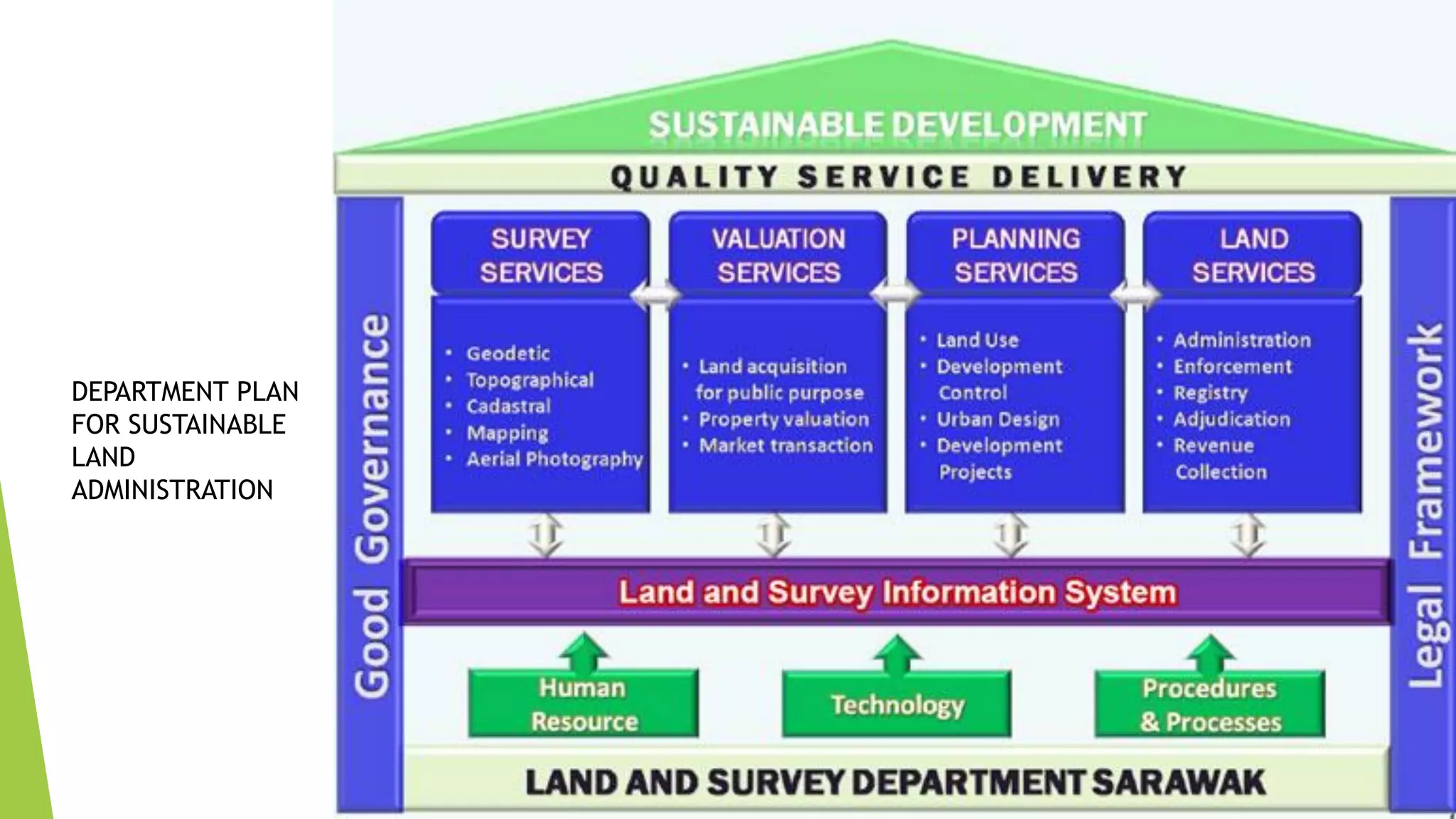
DEPARTMENT PLAN
FOR SUSTAINABLE
LAND
ADMINISTRATION
REQUIREMENTS
 Geospatial datasets available for such analysis and decision-making for
development planning include:
❖ Cadastral layer and ownership information
❖ Digital Terrain Model (DTM) generated from digital aerial photographs
❖ Orthophoto (aerial photograph mosaics)
❖ Topographic maps
❖ Land use map
❖ Water catchment map
❖ Road map
A CASE STUDY OF LIS OF TIRAT AND
CHALBALPUR RURAL REGION OF RANIGANJ
IN BARDDHAMAN DISTRICT
INTRODUCTION
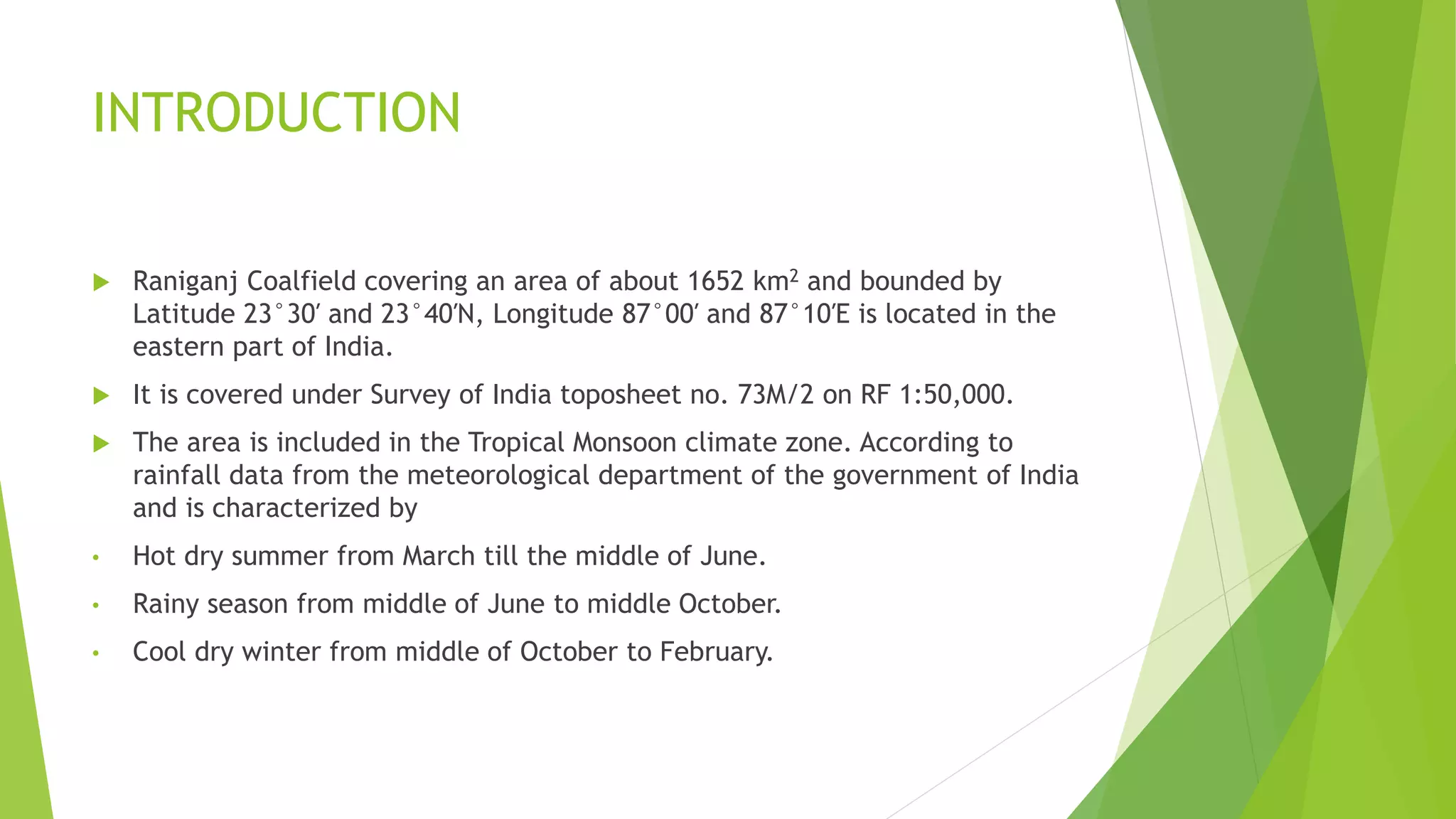
 Raniganj Coalfield covering an area of about 1652 km2 and bounded by
Latitude 23°30′ and 23°40′N, Longitude 87°00′ and 87°10′E is located in the
eastern part of India.
 It is covered under Survey of India toposheet no. 73M/2 on RF 1:50,000.
 The area is included in the Tropical Monsoon climate zone. According to
rainfall data from the meteorological department of the government of India
and is characterized by
• Hot dry summer from March till the middle of June.
• Rainy season from middle of June to middle October.
• Cool dry winter from middle of October to February.
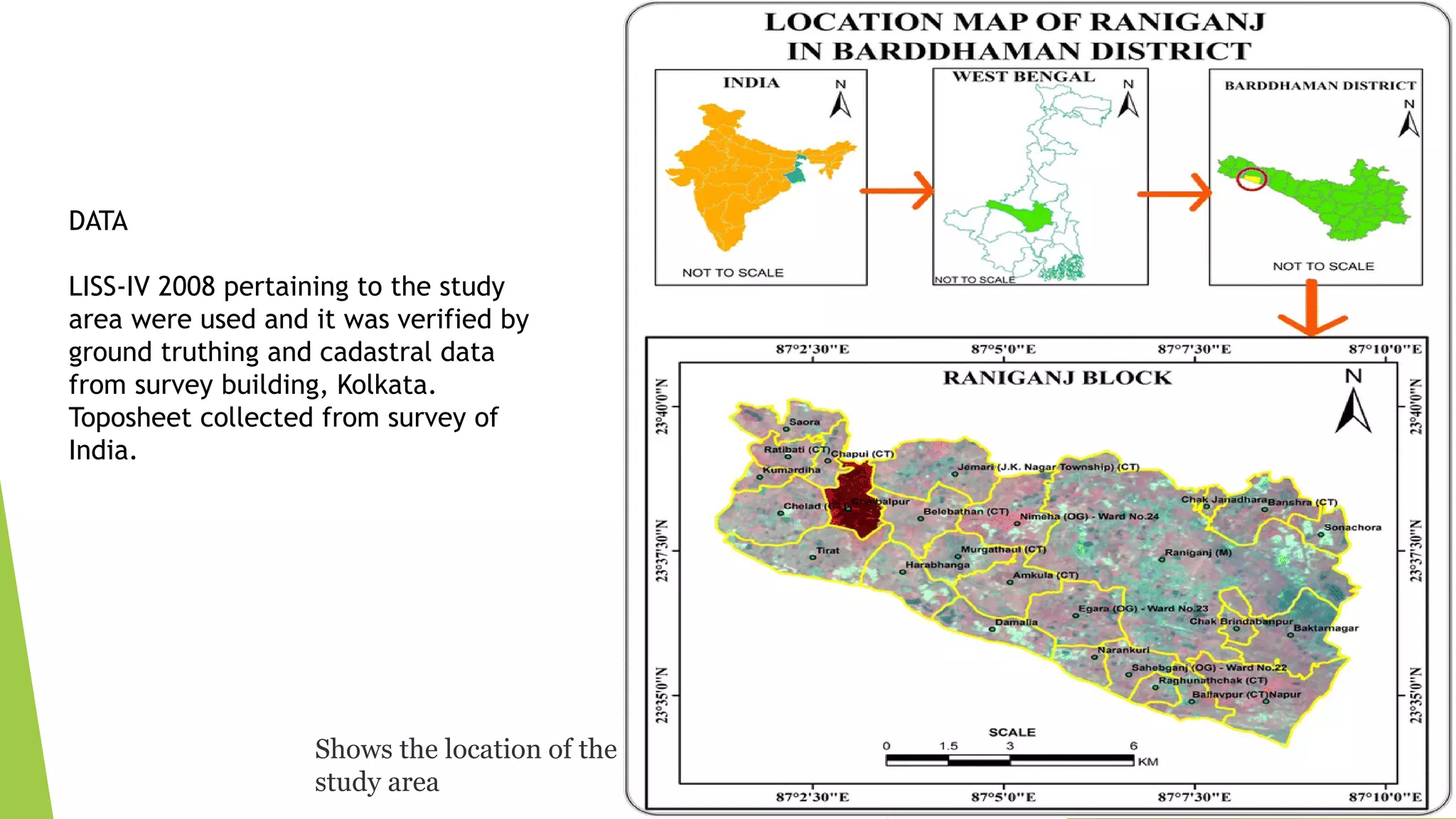
Shows the location of the
study area
DATA
LISS-IV 2008 pertaining to the study
area were used and it was verified by
ground truthing and cadastral data
from survey building, Kolkata.
Toposheet collected from survey of
India.
METHODOLOGY
 Collection of analogue cadastral village maps with sheet wise.
 Scanning of those cadastral map.
 Create various data layer such as road, pond, parcel etc.
 Generate a database with Dag number and Patta number.
 Then every digitize sheet are convert into sheet.
 Checking for GIS conversion, attributes, null and duplicate errors.
 Conversion of the digitized data into topologically correct GIS data format
Here the cadastral map has given every parcel of land with Dag number and
Patta number. This map is fully digitize from cadastral sheet.
Selecting the rectification method in the
study
 Aerial photographs must be geometrically corrected before they can be used
in an on-screen vectorisation.
 The process of correcting and removing these displacements can be divided in
two steps to correct the systematic distortion.
 Those produced by lens distortion, earth curvature, refraction and scanning;
and rectification, to remove the effects of tilt and establish scale. Since the
photographs were taken with a photogrammetric camera at a relatively low
altitude and the scanning size was 42 µm without noticeable geometric
distortions, we have considered the previously mentioned systematic
distortions negligible.
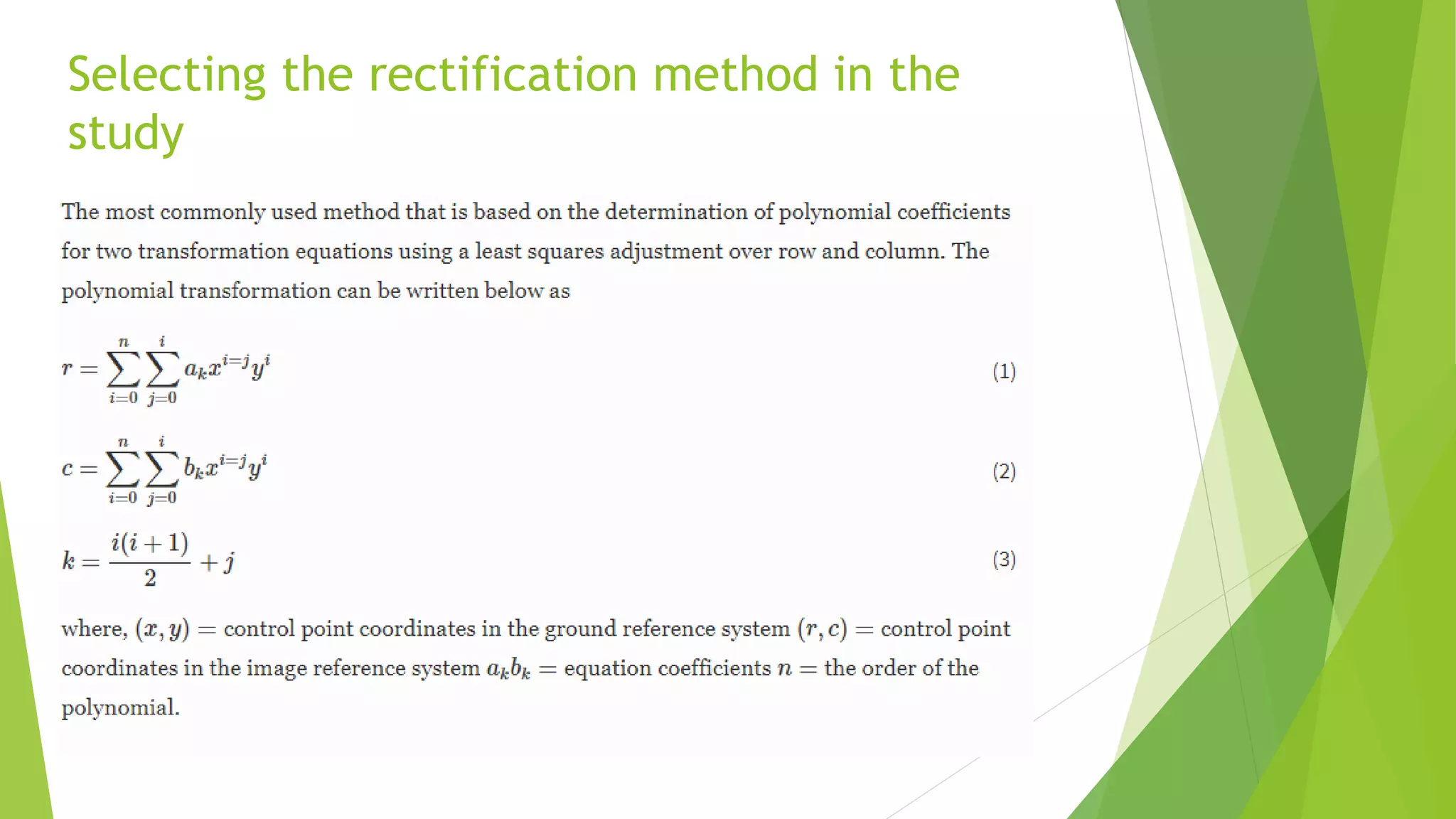
 As part of the digital rectification process, the mathematical relationships
between the map coordinate system and the scanned aerial photograph must
be determined. These relationships can be modelled using one of several
algorithms.
Selecting the rectification method in the
study
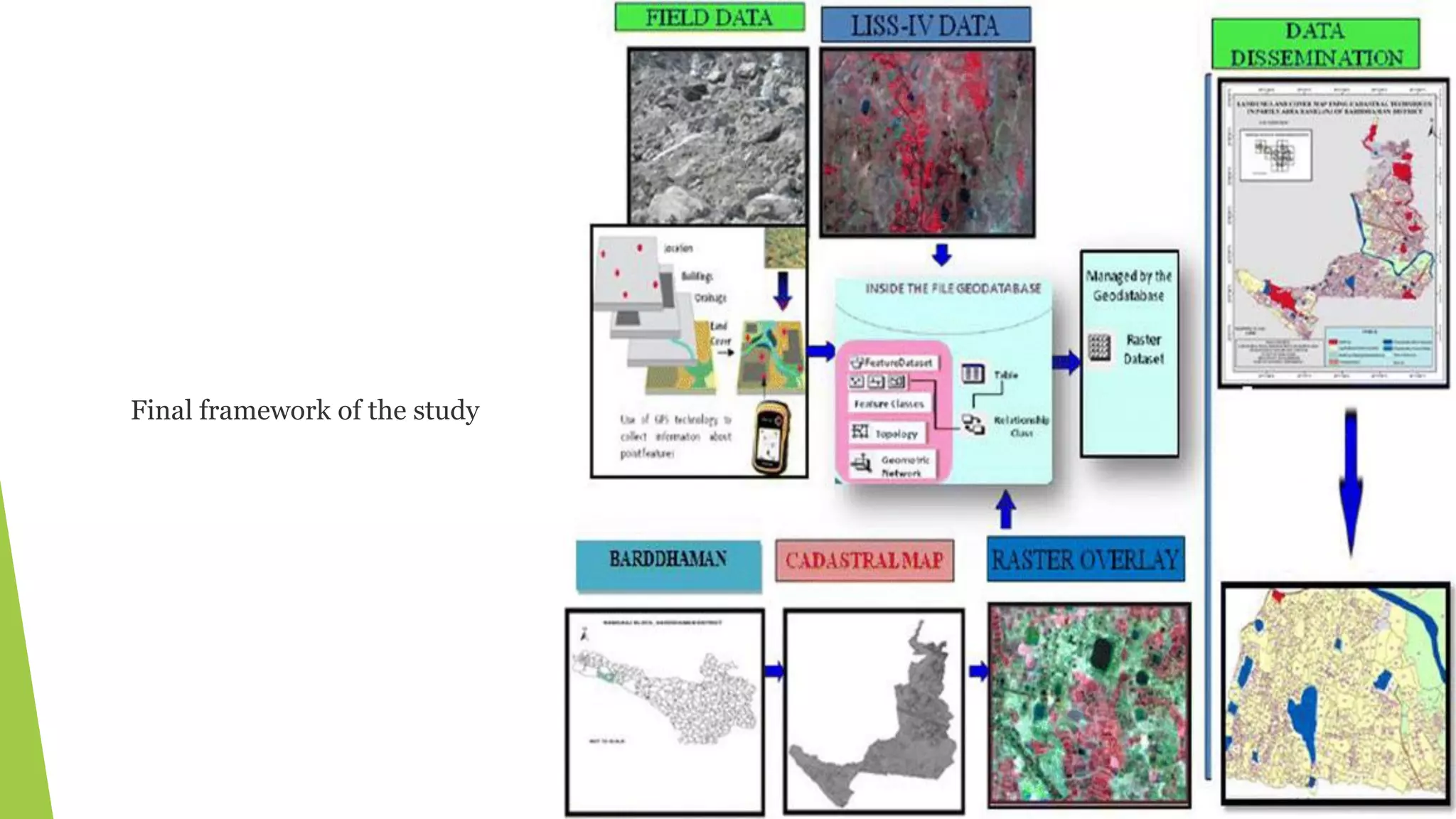
Final framework of the study
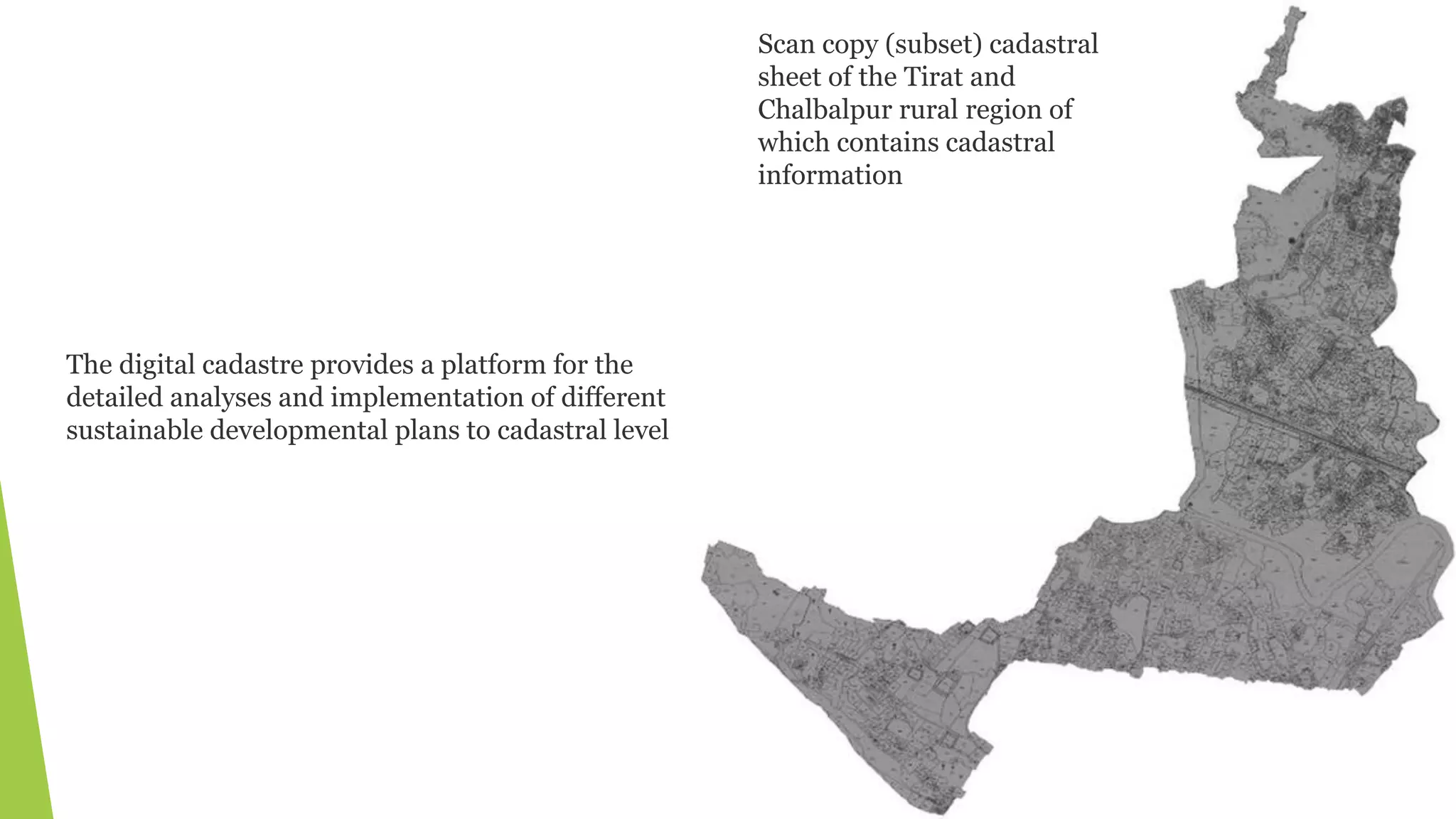
Scan copy (subset) cadastral
sheet of the Tirat and
Chalbalpur rural region of
which contains cadastral
information
The digital cadastre provides a platform for the
detailed analyses and implementation of different
sustainable developmental plans to cadastral level
Map showing parcel wise land used/land
cover map and plot number
The pictorial representation of the same area-wise
distribution of the eight different LU/LC in the same
location
Table 1 provides the distribution of the different area-wise
covers of eight LU/LC observed in the Tirat and
Chalbalpur rural region of Raniganj.
These statistical information proves to be very much useful for any decision makers while
planning the natural resource utilization in and around the area. The attribute data of this
plot would serve as a check to understand the compliances with various environmental and
other norms set by the state/central government agencies.
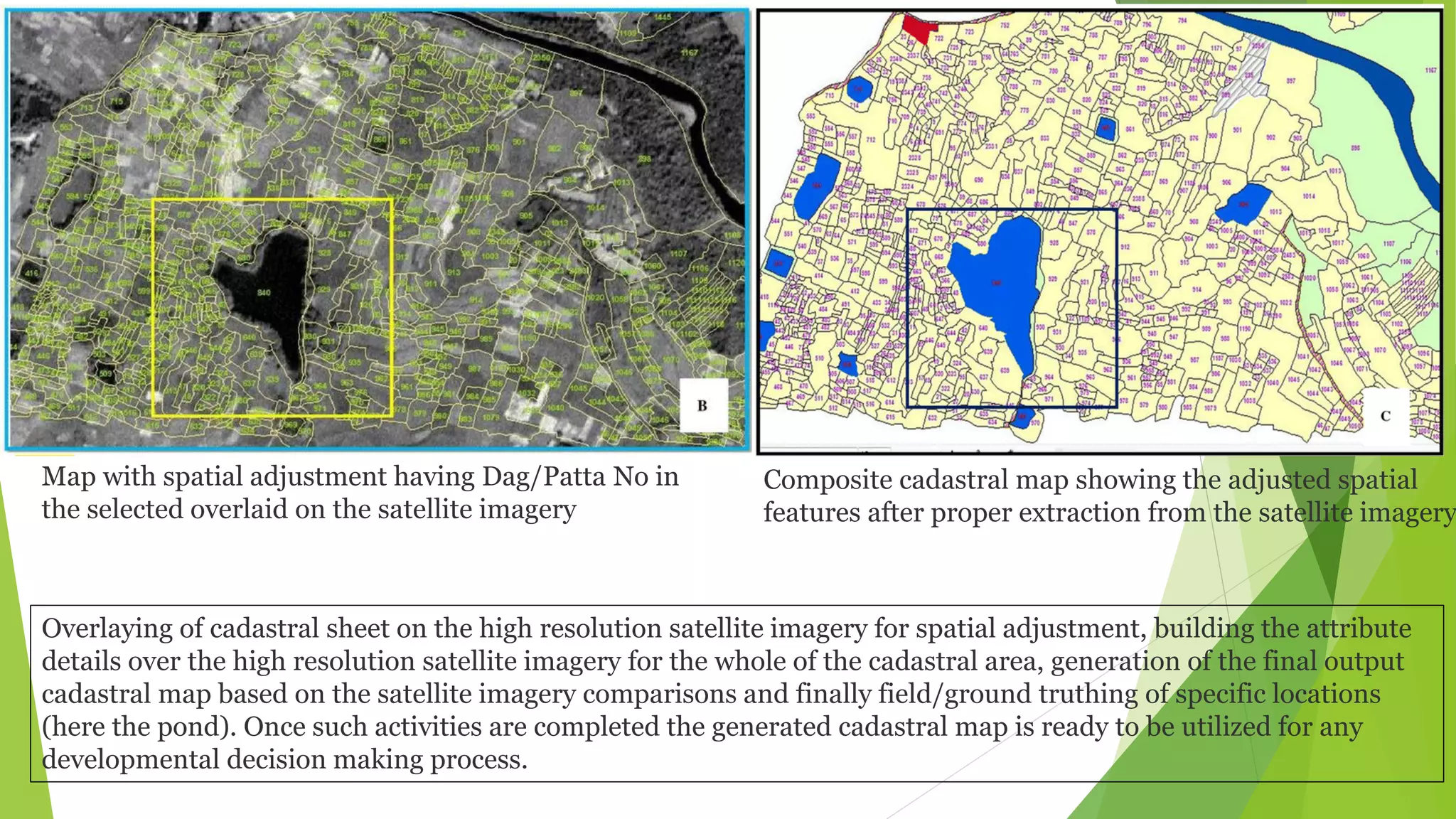
Overlaying of cadastral sheet on the high resolution satellite imagery for spatial adjustment, building the attribute
details over the high resolution satellite imagery for the whole of the cadastral area, generation of the final output
cadastral map based on the satellite imagery comparisons and finally field/ground truthing of specific locations
(here the pond). Once such activities are completed the generated cadastral map is ready to be utilized for any
developmental decision making process.
Map with spatial adjustment having Dag/Patta No in
the selected overlaid on the satellite imagery
Composite cadastral map showing the adjusted spatial
features after proper extraction from the satellite imagery
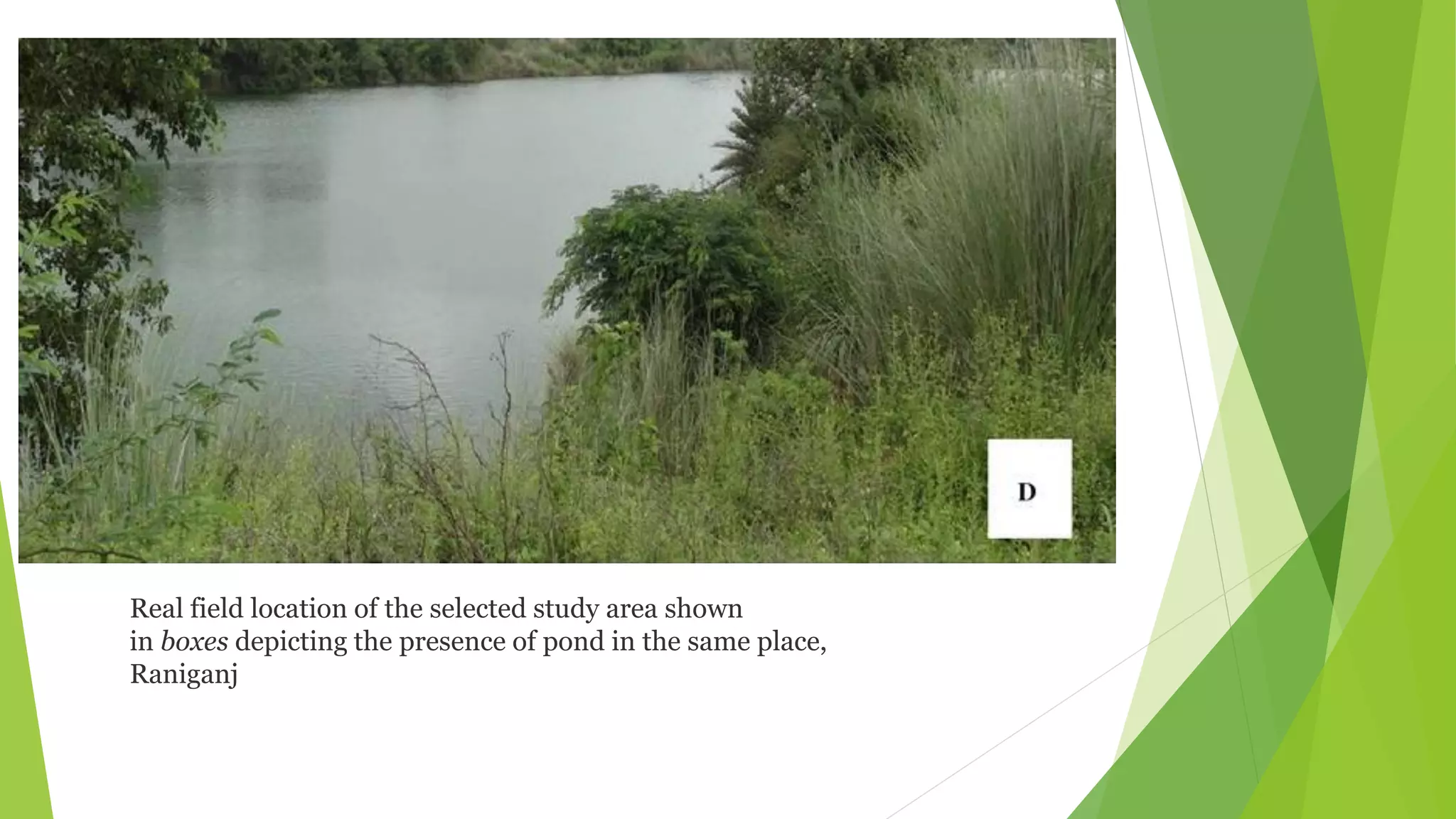
Real field location of the selected study area shown
in boxes depicting the presence of pond in the same place,
Raniganj
ACCURACY CHECKING TECHNIQUES
 In the present study area, several visits were made to many interior areas of
Raniganj and finally accuracy of data sets was checked in three steps given
below:
 First step involves comparison of geo-coordinates (of randomly selected
points) generated by computer with those of actually observed ones obtained
using GPS.
 Second step involves comparison of length measurement (of tie lines)
generated by computer with that of actual field measurement.
 Third step involves comparison of boundary measurements (of randomly
selected parcels) generated from image data set with that of actual field
measurements.
CONCLUSION
 The study aimed at GIS techniques for Cadastral application include cadastral
index maps and land registration data in a digital format.
 Automation linkages should be create and developed between textual data
(legal land registration data) and parcel maps.
 The final goal is to generate digital maps which will facilitate land planning,
management and also parcel information system.
REFERENCES
 https://www.geos.ed.ac.uk/~gisteac/gis_book_abridged/files/ch61.pdf
 ARTICLE - Mondal, S., Chakravarty, D., Bandyopadhyay, J. et al. Model. Earth
Syst. Environ. (2016) 2: 120. https://doi.org/10.1007/s40808-016-0161-3

GIS in land administration

  • 1.
  • 2.
    LAND ADMINISTRATION  Itrefers to the processes of recording information about the ownership, value, and use of land and its associated resources.  It includes the determination of rights and other attributes of the land, the survey and description of these, their detailed documentation, and the provision of relevant information in support of land markets.
  • 3.
    COMPONENTS OF LANDADMINISTRATION Land registration / cadastre Land and property legislation Urban and agrarian land reform Land and property taxation Land consolidation Development control and sustainable land use policy Land and property market
  • 4.
    COMPONENTS  Land registrationis the process of recording information about the ownership of land either through the storage of contract documents about the land or by compiling special inventories of land ownership.  A cadastre is similar to a land register in that it contains a set of records about land. A cadastre is an information system consisting, a series of maps or plans showing the size and location of all land parcels, together with text records that describe the attributes of the land.  Land consolidation is a planned readjustment and rearrangement of land parcels and their ownership. Land consolidation can be used to improve the rural infrastructure and to implement the developmental and environmental policies
  • 5.
    INTRODUCTION  For planningpurpose all land-associated information should be available in the form of a computer database, which can be easily accessed, manipulated by decision makers while formulating and executing a work. such a database system is called Land Information System(LIS).  Cadastral applications will include cadastral index maps and land registration data in a digital format.  Automation linkages will be created and developed between textual data (legal land registration data) and parcel maps.  The final goal is to generate digital maps which will facilitate land management and planning and in particular land registration and the issuance of land titles in order to promote security of land tenure and reduce land disputes.
  • 6.
    INTRODUCTION  GIS basedland acquisition management system will provide complete information about the land. Land acquisition managements is being used for the past 3 or 4 years only. It would help in assessment, payments for private land with owner details, tracking of land allotments and possessions identification and timely resolution of land acquisition related issues.  Maps help determine the location of property, indicate the size and shape of each parcel and reveal geographic relationships that affect property value.  Maps and map data are important not only for assessors, but also for other governmental agencies, the public at large, and the land information community (such as realtors, title companies, and surveyors). In addition, the assessor must track current ownership of all parcels, so that the proper party can receive assessment notices and tax bills.
  • 7.
    ROLE OF GISIN LAND ADMINISTRATION  Data for defining land ownership and supporting land transfer, mortgaging, and investment  Data for assessing the value of land and property (for example, for taxation or calculating land acquisition compensation)  Data for land market support and analysis, and for identifying trends in rents and prices and their relation to location  Data for the planning and management of utilities such as water, sewerage, electricity, telecommunications, and cable television  Data for the management of soils, agriculture, and forestry;  Data on existing forms of land-use;  Data that can support environmental impact assessment.
  • 8.
     GIS helpsidentify and eliminate errors in data and parcel boundaries. By having a complete inventory of a city’s land.  GIS allows the government to increase its revenue base from land resources.  It also allows for the development of mapping standards to maintain the data’s integrity.  GIS provides city planners, city managers and land administrators with opportunities for more effective management of land parcel data as well as the environment. ROLE OF GIS IN LAND ADMINISTRATION
  • 9.
  • 10.
    REQUIREMENTS  Geospatial datasetsavailable for such analysis and decision-making for development planning include: ❖ Cadastral layer and ownership information ❖ Digital Terrain Model (DTM) generated from digital aerial photographs ❖ Orthophoto (aerial photograph mosaics) ❖ Topographic maps ❖ Land use map ❖ Water catchment map ❖ Road map
  • 11.
    A CASE STUDYOF LIS OF TIRAT AND CHALBALPUR RURAL REGION OF RANIGANJ IN BARDDHAMAN DISTRICT
  • 12.
    INTRODUCTION  Raniganj Coalfieldcovering an area of about 1652 km2 and bounded by Latitude 23°30′ and 23°40′N, Longitude 87°00′ and 87°10′E is located in the eastern part of India.  It is covered under Survey of India toposheet no. 73M/2 on RF 1:50,000.  The area is included in the Tropical Monsoon climate zone. According to rainfall data from the meteorological department of the government of India and is characterized by • Hot dry summer from March till the middle of June. • Rainy season from middle of June to middle October. • Cool dry winter from middle of October to February.
  • 13.
    Shows the locationof the study area DATA LISS-IV 2008 pertaining to the study area were used and it was verified by ground truthing and cadastral data from survey building, Kolkata. Toposheet collected from survey of India.
  • 14.
    METHODOLOGY  Collection ofanalogue cadastral village maps with sheet wise.  Scanning of those cadastral map.  Create various data layer such as road, pond, parcel etc.  Generate a database with Dag number and Patta number.  Then every digitize sheet are convert into sheet.  Checking for GIS conversion, attributes, null and duplicate errors.  Conversion of the digitized data into topologically correct GIS data format Here the cadastral map has given every parcel of land with Dag number and Patta number. This map is fully digitize from cadastral sheet.
  • 15.
    Selecting the rectificationmethod in the study  Aerial photographs must be geometrically corrected before they can be used in an on-screen vectorisation.  The process of correcting and removing these displacements can be divided in two steps to correct the systematic distortion.  Those produced by lens distortion, earth curvature, refraction and scanning; and rectification, to remove the effects of tilt and establish scale. Since the photographs were taken with a photogrammetric camera at a relatively low altitude and the scanning size was 42 µm without noticeable geometric distortions, we have considered the previously mentioned systematic distortions negligible.  As part of the digital rectification process, the mathematical relationships between the map coordinate system and the scanned aerial photograph must be determined. These relationships can be modelled using one of several algorithms.
  • 16.
    Selecting the rectificationmethod in the study
  • 17.
  • 18.
    Scan copy (subset)cadastral sheet of the Tirat and Chalbalpur rural region of which contains cadastral information The digital cadastre provides a platform for the detailed analyses and implementation of different sustainable developmental plans to cadastral level
  • 19.
    Map showing parcelwise land used/land cover map and plot number
  • 20.
    The pictorial representationof the same area-wise distribution of the eight different LU/LC in the same location Table 1 provides the distribution of the different area-wise covers of eight LU/LC observed in the Tirat and Chalbalpur rural region of Raniganj. These statistical information proves to be very much useful for any decision makers while planning the natural resource utilization in and around the area. The attribute data of this plot would serve as a check to understand the compliances with various environmental and other norms set by the state/central government agencies.
  • 21.
    Overlaying of cadastralsheet on the high resolution satellite imagery for spatial adjustment, building the attribute details over the high resolution satellite imagery for the whole of the cadastral area, generation of the final output cadastral map based on the satellite imagery comparisons and finally field/ground truthing of specific locations (here the pond). Once such activities are completed the generated cadastral map is ready to be utilized for any developmental decision making process. Map with spatial adjustment having Dag/Patta No in the selected overlaid on the satellite imagery Composite cadastral map showing the adjusted spatial features after proper extraction from the satellite imagery
  • 22.
    Real field locationof the selected study area shown in boxes depicting the presence of pond in the same place, Raniganj
  • 23.
    ACCURACY CHECKING TECHNIQUES In the present study area, several visits were made to many interior areas of Raniganj and finally accuracy of data sets was checked in three steps given below:  First step involves comparison of geo-coordinates (of randomly selected points) generated by computer with those of actually observed ones obtained using GPS.  Second step involves comparison of length measurement (of tie lines) generated by computer with that of actual field measurement.  Third step involves comparison of boundary measurements (of randomly selected parcels) generated from image data set with that of actual field measurements.
  • 24.
    CONCLUSION  The studyaimed at GIS techniques for Cadastral application include cadastral index maps and land registration data in a digital format.  Automation linkages should be create and developed between textual data (legal land registration data) and parcel maps.  The final goal is to generate digital maps which will facilitate land planning, management and also parcel information system. REFERENCES  https://www.geos.ed.ac.uk/~gisteac/gis_book_abridged/files/ch61.pdf  ARTICLE - Mondal, S., Chakravarty, D., Bandyopadhyay, J. et al. Model. Earth Syst. Environ. (2016) 2: 120. https://doi.org/10.1007/s40808-016-0161-3