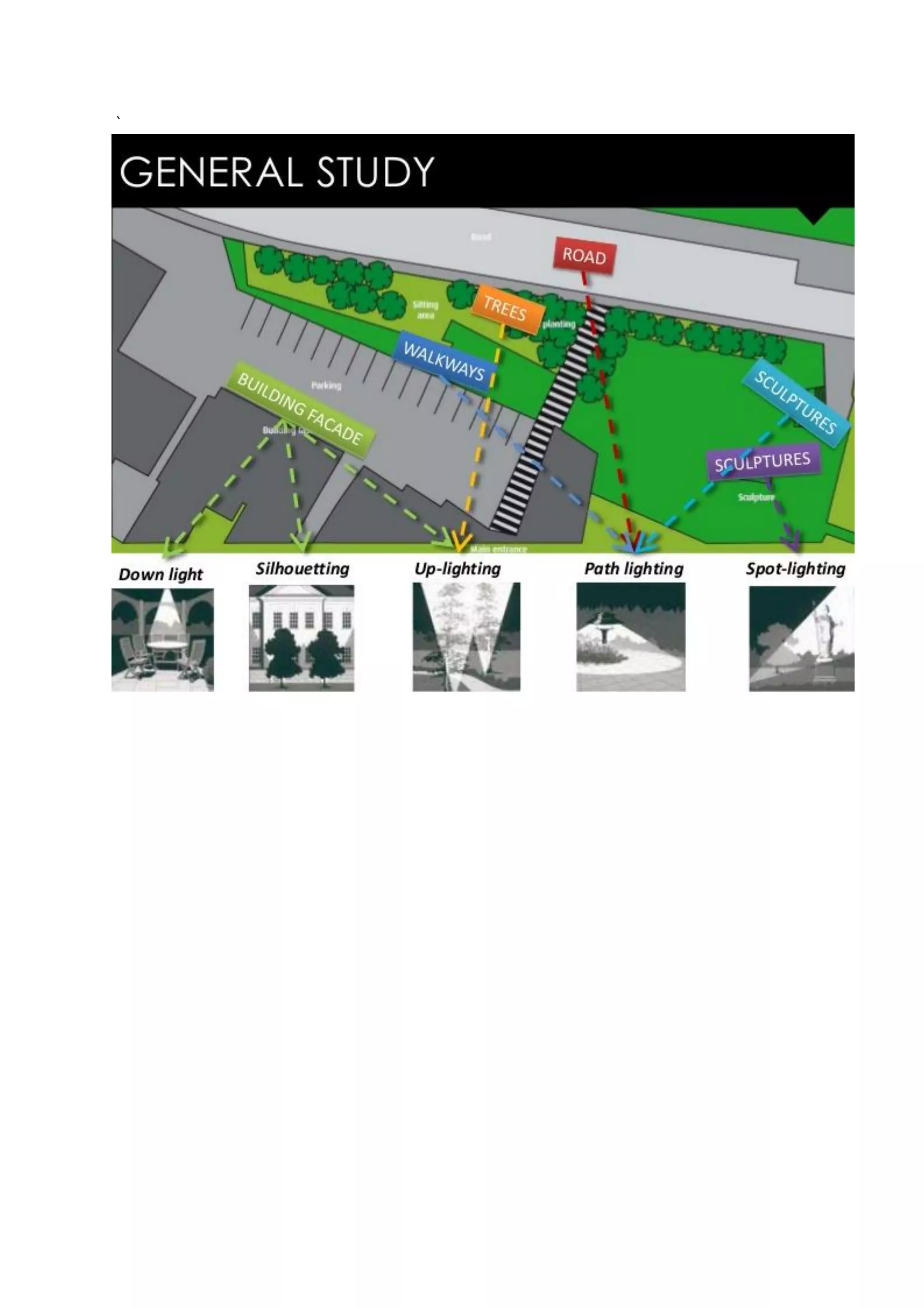
CLASSIFICATION OF OUTDOOR LIGHTING
➢ Street lighting
➢ Roadway lighting
➢ Parks
➢ Stadiums
➢ Parking lots
➢ Landscaping
➢ Pedestrian and bicycling pathways
➢ Pool lighting
PURPOSE OF OUTDOOR LIGHTING
➢ Provide a safe and secure environment at night
➢ Extend the use of parks and walkways in the night
➢ To enhance historic/notable features
➢ To enhance travel on the roads and at intersections
➢ Outdoor lighting should – enhance visibility, not impede it
➢ Not produce glare
Outdoor lights are
usually different from
those bulbs used
indoors because they
need to be much
brighter and last
longer.
Halogen bulbs are often found in homes as
spotlights or floodlights, in cars as headlights, or at
sports fields as stadium lights. These bulbs work in a
similar way to an incandescent bulb by running
electricity through a tungsten filament. Unlike the
incandescent, there is halogen gas inside the bulb. When the
tungsten burns off the filament, the gas re-deposits it back onto the
filament to be reused. Halogen bulbs last much longer than
incandescent, but these bulbs are much brighter and burn much
hotter than traditional incandescent bulbs.
Metal halide - Metal halide lamps are commonly used
in streetlights, parking lot lights, and stadium lights.
They are very bright and contribute to a lot of light
pollution. They are fairly efficient. They produce very white light and
have good color rendition, meaning that objects under these lights
look their true color.
High pressure sodium - The high-pressure sodium
lamp (HPS) is the most commonly used street
light throughout the world. It produces light by
running electricity through a mixture of gases,
which produces light. The lamp itself is preferred
because it requires little maintenance. These lamps are fairly efficient.
They take a while to turn on completely and produce a yellow-orange
glow.
Low pressure sodium – The low-pressure sodium
(LPS) lamp works similarly to the HPS light. Instead
of producing white light (all the colors of the
rainbow), LPS lamps produce almost exclusively
yellow light. While this light is fairly efficient, it
takes several minutes for the bulb to turn on. The
light is very yellow-orange. This yellow light makes
objects it is illuminating look a different color or gray.
LED street lamps - LED technologies have
developed rapidly in recent years and
these bulbs are now being integrated into
outdoor lighting solutions. While the
energy savings are significant, LEDs
produce a lot of blue light, too much of
which can have negative effects on
human health and wildlife.
Application – signs and traffic signals, displays, vehicle indicators,
flashlights, accent, parking garage, downlights, etc
LIGHTING TECHNIQUES FOR OUTDOOR
LIGHTING
PATH LIGHTING
This technique is used primarily for safety to highlight sidewalks drives
or any path to ensure safety passage at night
Choose pathway lights offering downlighting with emphasis placed on
fixtures that incorporate diffused or shielded lamps
Avoid lighting that shines in the eyes
Typical fixtures – mushrooms, tulip light, lantern, speciality lights,
column mounted fittings, bollards, recessed lightings,
Applications – walkways, driveway
SILHOUETTING – is created when the image of a distinctive plant tree
statue or other landscape object is reflected against a wall or other
vertical surface. Lights are placed behind the object to direct the light
upward onto the backdrop to create this dramatic effect
Spread lights are typically bi-pin halogen bulbs with a mirrored
background. They create a wide band of clean white light, perfect for
backlighting a wall, house or structure to create a silhouette effect.
Multiple fixtures may be required depending on how much of the wall
you need to light.
SHADOWING - This involves washing a feature such as a tree or statue
so that it casts a shadow on a wall or fence. The play of light and
darkness can be quite intriguing, especially if the object is affected by
the breeze. Lighting the object from low down and angling upward
can provide a larger than life dramatic effect.
MOON LIGHTING -This technique is achieved by placing light
fixtures within branches of a mature tree or by attaching a fixture to a
nearby wall that shines through the branches. This effect will cast
unique shadows in your landscape.
STEP AND DECK LIGHTING - Light fixtures can be recessed in the
risers of steps to illuminate and provide safety for stairways. Deck
fixtures can be placed as surface lights between vertical posts and
railings.
UP LIGHTING- The object is lit in one direction only and the fixture
is usually placed in or above the ground below what you are
accenting. This is a common way to highlight elements in your
landscape, like flags or large flowering trees.
Spotlighting - Fixtures are placed high on walls, eaves, or shade
structures in order to light specific areas in your landscape. Some
areas worth spotlighting would be decks, pools, hot tubs, arbours, or
lawn and planting areas. This technique also brings a sense of safety
to a dark yard.
Underwater lightingFixtures submersed in water features create
an extra special effect at night. Light literally dances across walls and
room ceilings when water passes over it. Use submersible lights in
ponds, fountains and swimming pools. Moving water, especially, can
change and produce fascinating ripples and glints. A fish crossing over
the light produces wonderful effects of color and shadow. And
lighting the water from underneath adds depth to what would
otherwise be a flat surface.
LIGHTING
TECHNIQUE
APPLICATIONS LIGHTING
FIXTURES
TYPES OF
LAMP
Downlighting Parking lots,
streets,
playgrounds,
parks, roads
Pole mounted
bollard
HID, Metal
halide, LED’s
Up lighting landscape Spot light, accent
lights. flood
lights, well lights
Halogen, LED
bulbs
Underwater
lighting
Pool Flood wash
water proof spot
lights
LED’s
Moon lighting Landscape Spot light, accent
lights. flood
lights, well lights
Halogen,
LED’s
Path lighting Walkways Mushrooms.
Tulip lights tier
lights specialty
lights bollard
LED’s
Shadowing Landscape
sculptures in
outdoors
Well lights spot
lights wall wash
lights
Halogen,
LED’s
Silhouetting Landscape,
sculptures in
park
Well lights spot
lights wall wash
lights
Bi – pin
halogen
bulbs
Spot lighting Deck pools lawns Flood lights spot
lights recessed
lights
HID lamps,
LED
LIGHTING IN PARKING LOT
POLE LIGHTS
In most areas, parking lots are required to meet some type of lighting
level standard recommended by the Illuminating Engineering Society
(IES). And the best way to meet those standards and disperse light
over the wide-open area of a parking lot is by strategically placing
pole lights throughout the property.
Pole lights come in a wide range of architectural designs and are
made of steel, aluminium, concrete, fiberglass, and even wood.
Typical poles have anywhere from one to four fixtures at the top with
luminaires that must be able to withstand harsh weather and,
unfortunately, rocks and other projectiles thrown by vandals.
High-intensity discharge (HID) and metal halide (MH) lamps are
historically the most popular type of lights used in parking lot
applications. However, because their light output significantly
decreases over time and there are currently more efficient bulbs on
the market, energy efficiency groups no longer recommend these two
bulbs for pole lights. Instead, induction lamps, or even better, LEDs
are preferred for parking lots because of their lower energy
requirements, good color, and durability. Although more expensive,
LED outdoor lights have particularly long lifespans and deliver
targeted illumination which helps to reduce light pollution.
Flood Lights
Flood lights are used in parking lots.
You can affix them to poles, use them
to illuminate something you want to
highlight, or position them in
landscaped areas where they’ll be both
functional and aesthetically pleasing. They are commonly used to
increase safety and in applications where a great deal of light output
is needed, such as car lots.
For years, many consumers opted for metal halide lamps in flood
lighting applications, because of the MH’s bright, true-white color.
However, with advancements in led technology, led bulbs are now
able to provide a bright, white color that’s comparable to the MH’s
and with lower energy demands.
OUTDOOR LIGHTING FOR PARKS AND
PUBLIC GARDENS
Light sources
Parks and gardens generally require white light in order to obtain a
better color rendering. The white light provides improved visibility for
pedestrians. Therefore, metal halide lamps with ceramic arc tube or
the white LEDs are great options.
Recommended level of lighting for a park
Lighting in park areas shall meet recommended levels, and also
minimize light pollution and intrusion on neighbouring properties. The
lighting level can significantly impact on the appearance and safety of
the park at night. The high-pressure sodium lamps, a commonly used
source for urban light, cast a yellow-orange light that gives poor color
rendering; this light challenges the visual clarity and considerably
impairs the overall quality of the night urban environment. In
contrast, metal halide lamps diffuse a soft white light that makes
colors more accurate; they provide better visual clarity, and require
less power for the same perceived visibility. The light quality is also
influenced by the amount of light – or more precisely, by the
relationship between the brightness of light and the distance to the
light source. The light becomes more diffused as we are farther from
the source, so that for a given brightness, there are heights where we
should place the light source to create the desired light quality.
Lighting fixtures for parks and gardens
waterproof light fixtures
maintain the initial performance as long as possible.
When the fixtures are installed at a relatively low height (up to 5m),
vandalism should be taken into account.
The lighting fixtures shall be built with strong material, such as
aluminium body or polycarbonate for protection.
Highlighting Techniques for parks and gardens
Path lighting
Wall lighting
Down lighting
up lighting
`
Outdoor lighting

Outdoor lighting

  • 1.
    CLASSIFICATION OF OUTDOORLIGHTING ➢ Street lighting ➢ Roadway lighting ➢ Parks ➢ Stadiums ➢ Parking lots ➢ Landscaping ➢ Pedestrian and bicycling pathways ➢ Pool lighting PURPOSE OF OUTDOOR LIGHTING ➢ Provide a safe and secure environment at night ➢ Extend the use of parks and walkways in the night ➢ To enhance historic/notable features ➢ To enhance travel on the roads and at intersections ➢ Outdoor lighting should – enhance visibility, not impede it ➢ Not produce glare
  • 2.
    Outdoor lights are usuallydifferent from those bulbs used indoors because they need to be much brighter and last longer. Halogen bulbs are often found in homes as spotlights or floodlights, in cars as headlights, or at sports fields as stadium lights. These bulbs work in a similar way to an incandescent bulb by running electricity through a tungsten filament. Unlike the incandescent, there is halogen gas inside the bulb. When the tungsten burns off the filament, the gas re-deposits it back onto the filament to be reused. Halogen bulbs last much longer than incandescent, but these bulbs are much brighter and burn much hotter than traditional incandescent bulbs. Metal halide - Metal halide lamps are commonly used in streetlights, parking lot lights, and stadium lights. They are very bright and contribute to a lot of light pollution. They are fairly efficient. They produce very white light and have good color rendition, meaning that objects under these lights look their true color.
  • 3.
    High pressure sodium- The high-pressure sodium lamp (HPS) is the most commonly used street light throughout the world. It produces light by running electricity through a mixture of gases, which produces light. The lamp itself is preferred because it requires little maintenance. These lamps are fairly efficient. They take a while to turn on completely and produce a yellow-orange glow. Low pressure sodium – The low-pressure sodium (LPS) lamp works similarly to the HPS light. Instead of producing white light (all the colors of the rainbow), LPS lamps produce almost exclusively yellow light. While this light is fairly efficient, it takes several minutes for the bulb to turn on. The light is very yellow-orange. This yellow light makes objects it is illuminating look a different color or gray. LED street lamps - LED technologies have developed rapidly in recent years and these bulbs are now being integrated into outdoor lighting solutions. While the energy savings are significant, LEDs produce a lot of blue light, too much of which can have negative effects on human health and wildlife. Application – signs and traffic signals, displays, vehicle indicators, flashlights, accent, parking garage, downlights, etc
  • 4.
    LIGHTING TECHNIQUES FOROUTDOOR LIGHTING PATH LIGHTING This technique is used primarily for safety to highlight sidewalks drives or any path to ensure safety passage at night Choose pathway lights offering downlighting with emphasis placed on fixtures that incorporate diffused or shielded lamps Avoid lighting that shines in the eyes Typical fixtures – mushrooms, tulip light, lantern, speciality lights, column mounted fittings, bollards, recessed lightings, Applications – walkways, driveway
  • 5.
    SILHOUETTING – iscreated when the image of a distinctive plant tree statue or other landscape object is reflected against a wall or other vertical surface. Lights are placed behind the object to direct the light upward onto the backdrop to create this dramatic effect Spread lights are typically bi-pin halogen bulbs with a mirrored background. They create a wide band of clean white light, perfect for backlighting a wall, house or structure to create a silhouette effect. Multiple fixtures may be required depending on how much of the wall you need to light. SHADOWING - This involves washing a feature such as a tree or statue so that it casts a shadow on a wall or fence. The play of light and darkness can be quite intriguing, especially if the object is affected by the breeze. Lighting the object from low down and angling upward can provide a larger than life dramatic effect.
  • 6.
    MOON LIGHTING -Thistechnique is achieved by placing light fixtures within branches of a mature tree or by attaching a fixture to a nearby wall that shines through the branches. This effect will cast unique shadows in your landscape. STEP AND DECK LIGHTING - Light fixtures can be recessed in the risers of steps to illuminate and provide safety for stairways. Deck fixtures can be placed as surface lights between vertical posts and railings.
  • 7.
    UP LIGHTING- Theobject is lit in one direction only and the fixture is usually placed in or above the ground below what you are accenting. This is a common way to highlight elements in your landscape, like flags or large flowering trees. Spotlighting - Fixtures are placed high on walls, eaves, or shade structures in order to light specific areas in your landscape. Some areas worth spotlighting would be decks, pools, hot tubs, arbours, or lawn and planting areas. This technique also brings a sense of safety to a dark yard.
  • 8.
    Underwater lightingFixtures submersedin water features create an extra special effect at night. Light literally dances across walls and room ceilings when water passes over it. Use submersible lights in ponds, fountains and swimming pools. Moving water, especially, can change and produce fascinating ripples and glints. A fish crossing over the light produces wonderful effects of color and shadow. And lighting the water from underneath adds depth to what would otherwise be a flat surface.
  • 9.
    LIGHTING TECHNIQUE APPLICATIONS LIGHTING FIXTURES TYPES OF LAMP DownlightingParking lots, streets, playgrounds, parks, roads Pole mounted bollard HID, Metal halide, LED’s Up lighting landscape Spot light, accent lights. flood lights, well lights Halogen, LED bulbs Underwater lighting Pool Flood wash water proof spot lights LED’s Moon lighting Landscape Spot light, accent lights. flood lights, well lights Halogen, LED’s Path lighting Walkways Mushrooms. Tulip lights tier lights specialty lights bollard LED’s Shadowing Landscape sculptures in outdoors Well lights spot lights wall wash lights Halogen, LED’s Silhouetting Landscape, sculptures in park Well lights spot lights wall wash lights Bi – pin halogen bulbs Spot lighting Deck pools lawns Flood lights spot lights recessed lights HID lamps, LED
  • 10.
    LIGHTING IN PARKINGLOT POLE LIGHTS In most areas, parking lots are required to meet some type of lighting level standard recommended by the Illuminating Engineering Society (IES). And the best way to meet those standards and disperse light over the wide-open area of a parking lot is by strategically placing pole lights throughout the property. Pole lights come in a wide range of architectural designs and are made of steel, aluminium, concrete, fiberglass, and even wood. Typical poles have anywhere from one to four fixtures at the top with luminaires that must be able to withstand harsh weather and, unfortunately, rocks and other projectiles thrown by vandals. High-intensity discharge (HID) and metal halide (MH) lamps are historically the most popular type of lights used in parking lot applications. However, because their light output significantly decreases over time and there are currently more efficient bulbs on the market, energy efficiency groups no longer recommend these two bulbs for pole lights. Instead, induction lamps, or even better, LEDs are preferred for parking lots because of their lower energy requirements, good color, and durability. Although more expensive, LED outdoor lights have particularly long lifespans and deliver targeted illumination which helps to reduce light pollution.
  • 11.
    Flood Lights Flood lightsare used in parking lots. You can affix them to poles, use them to illuminate something you want to highlight, or position them in landscaped areas where they’ll be both functional and aesthetically pleasing. They are commonly used to increase safety and in applications where a great deal of light output is needed, such as car lots. For years, many consumers opted for metal halide lamps in flood lighting applications, because of the MH’s bright, true-white color. However, with advancements in led technology, led bulbs are now able to provide a bright, white color that’s comparable to the MH’s and with lower energy demands.
  • 12.
    OUTDOOR LIGHTING FORPARKS AND PUBLIC GARDENS Light sources Parks and gardens generally require white light in order to obtain a better color rendering. The white light provides improved visibility for pedestrians. Therefore, metal halide lamps with ceramic arc tube or the white LEDs are great options. Recommended level of lighting for a park Lighting in park areas shall meet recommended levels, and also minimize light pollution and intrusion on neighbouring properties. The lighting level can significantly impact on the appearance and safety of the park at night. The high-pressure sodium lamps, a commonly used source for urban light, cast a yellow-orange light that gives poor color rendering; this light challenges the visual clarity and considerably impairs the overall quality of the night urban environment. In contrast, metal halide lamps diffuse a soft white light that makes colors more accurate; they provide better visual clarity, and require less power for the same perceived visibility. The light quality is also influenced by the amount of light – or more precisely, by the relationship between the brightness of light and the distance to the light source. The light becomes more diffused as we are farther from the source, so that for a given brightness, there are heights where we should place the light source to create the desired light quality. Lighting fixtures for parks and gardens waterproof light fixtures maintain the initial performance as long as possible. When the fixtures are installed at a relatively low height (up to 5m), vandalism should be taken into account. The lighting fixtures shall be built with strong material, such as aluminium body or polycarbonate for protection.
  • 13.
    Highlighting Techniques forparks and gardens Path lighting Wall lighting Down lighting up lighting
  • 14.