Gibson assembly in
Cloning
Muhammed Ameer
2021-11-133
Dept. of Plant Biotechnology
Kerala Agricultural University
MICRO 503 – MICROBIAL GENETICS
DNA Cloning and DNA
assembly
DNA cloning is the process of making multiple, identical copies of
a particular piece of DNA.
For the purpose of cloning, DNA assembly refers to a method to
physically link together multiple fragments of DNA, in an end-to-
end fashion, to achieve a desired, higher-order assembly prior to
joining to a vector.
DNA Assembly methods:
Restriction based (Golden Gate, Biobrick)
Sequence homology based (Gibson, CPEC, USER)
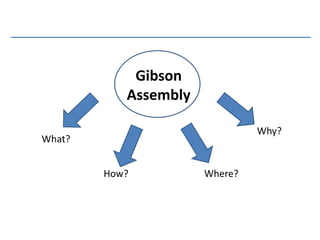
Gibson
Assembly
What?
How? Where?
Why?
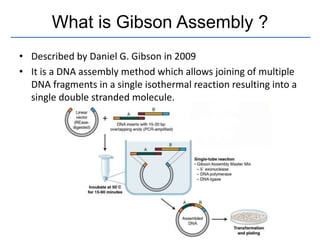
What is Gibson Assembly ?
• Described by Daniel G. Gibson in 2009
• It is a DNA assembly method which allows joining of multiple
DNA fragments in a single isothermal reaction resulting into a
single double stranded molecule.
Procedure
Requirements:
1. DNA fragments with
overlaps
2. T5 Exonuclease
3. DNA phusion polymerase
4. Taq DNA Ligase
Overlapping regions can be added to ends of DNA
fragments by using PCR with primers which have added
“flaps”.
Procedure
T5 Exonuclease: chews back 5’ end and expose
complementary sequence for annealing
DNA phusion polymerase: fills gap on annealed region:
long range amplification, high processivity and
proofreading activity
Taq DNA Ligase: High specificity - It will not ligate if
there is a small mismatch
These three enzymes are mixed together with adjacent
DNA fragments that have at least around 20-40 bp
overlaps. Incubate it for an hour at 50
0
C.
Applications
• Assembly of large DNA fragments (up to 100 kb)
• Site-directed mutagenesis
• DNA Library construction
• Shot gun cloning
Advantages
 Less no. of components
 Carried out in a single tube
 Few steps, less time
 No restriction digestion
 No restriction scars remain
 Multiple fragments combined simultaneously in a
single reaction
 Proof-reading polymerase included in the master
mix
Disadvantages
 Require long oligonucleotides
 Does not work well with small fragments
 Errors may occur at recombination junction due to
reagents
References
• Gibson, D. G., Young, L., Chuang, R. Y., Venter, J. C., Hutchison, C. A., &
Smith, H. O. (2009). Enzymatic assembly of DNA molecules up to several
hundred kilobases. Nature Methods, 6(5), 343–345.
https://doi.org/10.1038/nmeth.1318
• Chao, R., Yuan, Y., & Zhao, H. (2014). Recent advances in DNA assembly
technologies. FEMS Yeast Research. https://doi.org/10.1111/1567-
1364.12171
• https://www.youtube.com/watch?v=tlVbf5fXhp4
• https://www.youtube.com/watch?v=e245UfXUgVE&t=149s

Gibson Assembly in Cloning

  • 1.
    Gibson assembly in Cloning MuhammedAmeer 2021-11-133 Dept. of Plant Biotechnology Kerala Agricultural University MICRO 503 – MICROBIAL GENETICS
  • 2.
    DNA Cloning andDNA assembly DNA cloning is the process of making multiple, identical copies of a particular piece of DNA. For the purpose of cloning, DNA assembly refers to a method to physically link together multiple fragments of DNA, in an end-to- end fashion, to achieve a desired, higher-order assembly prior to joining to a vector. DNA Assembly methods: Restriction based (Golden Gate, Biobrick) Sequence homology based (Gibson, CPEC, USER)
  • 3.
  • 4.
    What is GibsonAssembly ? • Described by Daniel G. Gibson in 2009 • It is a DNA assembly method which allows joining of multiple DNA fragments in a single isothermal reaction resulting into a single double stranded molecule.
  • 5.
    Procedure Requirements: 1. DNA fragmentswith overlaps 2. T5 Exonuclease 3. DNA phusion polymerase 4. Taq DNA Ligase Overlapping regions can be added to ends of DNA fragments by using PCR with primers which have added “flaps”.
  • 6.
    Procedure T5 Exonuclease: chewsback 5’ end and expose complementary sequence for annealing DNA phusion polymerase: fills gap on annealed region: long range amplification, high processivity and proofreading activity Taq DNA Ligase: High specificity - It will not ligate if there is a small mismatch
  • 7.
    These three enzymesare mixed together with adjacent DNA fragments that have at least around 20-40 bp overlaps. Incubate it for an hour at 50 0 C.
  • 8.
    Applications • Assembly oflarge DNA fragments (up to 100 kb) • Site-directed mutagenesis • DNA Library construction • Shot gun cloning
  • 9.
    Advantages  Less no.of components  Carried out in a single tube  Few steps, less time  No restriction digestion  No restriction scars remain  Multiple fragments combined simultaneously in a single reaction  Proof-reading polymerase included in the master mix
  • 10.
    Disadvantages  Require longoligonucleotides  Does not work well with small fragments  Errors may occur at recombination junction due to reagents
  • 11.
    References • Gibson, D.G., Young, L., Chuang, R. Y., Venter, J. C., Hutchison, C. A., & Smith, H. O. (2009). Enzymatic assembly of DNA molecules up to several hundred kilobases. Nature Methods, 6(5), 343–345. https://doi.org/10.1038/nmeth.1318 • Chao, R., Yuan, Y., & Zhao, H. (2014). Recent advances in DNA assembly technologies. FEMS Yeast Research. https://doi.org/10.1111/1567- 1364.12171 • https://www.youtube.com/watch?v=tlVbf5fXhp4 • https://www.youtube.com/watch?v=e245UfXUgVE&t=149s