1
UNIVERSITY OF AGRICULTURAL SCIENCES,
BANGALORE
Submitted to
Dr. G. Eswarappa
Dr. Ashok Doddamani
Name: MUHAMMED AMEER ID Number: ALB7108
College of Agriculture, GKVK, Bangalore- 560065
2020-2021 RAWEP
2
CERTIFICATE
This is to certify that the report of Rural Agriculture Work Experience
Programme (Rawep) activities submitted by Muhammed Ameer, ID
No: ALB7108 during the semester VIII of BSc (Hons.) Agriculture
program, under the supervision of Dr.G.Eshwarappa and Dr. Ashok
Doddamani, University of Agricultural Sciences, Bangalore.
Signature of the Supervisor:
Date: 07/07/2021
3
ACKNOWLEDGEMENT
First and foremost, praises and thanks to Lord Almighty, for the showers
of blessings to complete the assigned work successfully.
I would like to express my deep and sincere gratitude to my
contact farmers and our RAWE group teachers, Dr. G. Eshwarappa and
Dr. Ashok Doddamani for providing me with the inevitable guidance
throughout the program. They have filled us with motivation and taught
us the methodology to carry out the weekly activities as clearly as
possible. I would also like to thank the friendship and the sense of
togetherness offered by my classmates during the period of our RAWE
work. I am extending my heartfelt thanks to respected Dean and RAWE
coordinators for their support.
My special thanks go to my parents for their love and support, for
helping me with this project.
4
CONTENTS
CONTENTS PAGE NO.
WEEK 1 5
WEEK 2 23
WEEK 3 52
WEEK 4 81
WEEK 5 105
WEEK 6 133
WEEK 7 150
WEEK 8 163
RURAL AGRICULTURAL WORK
EXPERIENCE PROGRAM 2021
WEEKLY REPORT- 1
Name: Muhammed Ameer ID Number: ALB 7108
Team: 19
College of Agriculture, GKVK, Bangalore- 560065
2020-2021
5
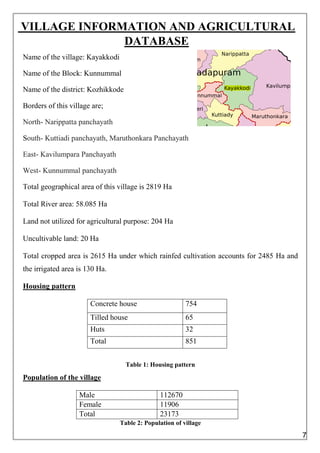
WEEK 1 ACTIVITIES
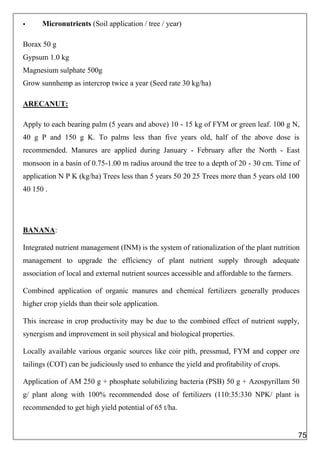
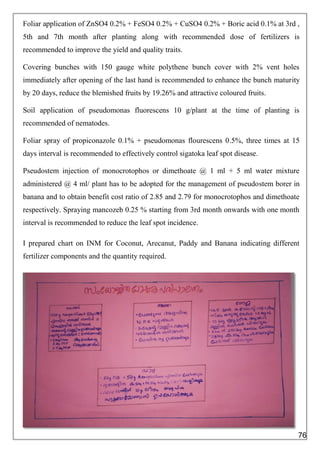
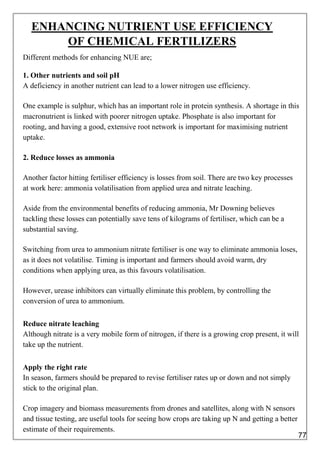
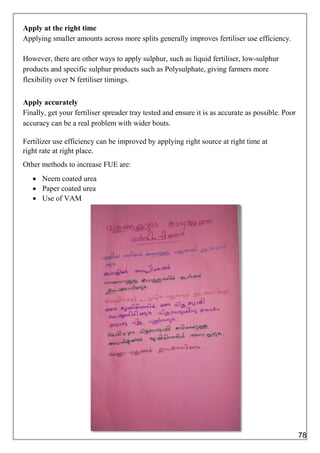
1. Collection of village information and agricultural database
2. Data collection of contact farmers
3. Identifying thrust area for the village
4. PRA techniques / extension methods adopted
5. Virtual group formation and information sharing
6. Identifying major agricultural problems
7. Identifying major crops and familiarizing with pop
8. Identifying technical problems in the major crops and methods to overcome
9. Calculating cost of cultivation of major crops and methods to increase the
income
10.Identifying status of developmental programs in village
11.Status Covid awareness in village
12.Farm and home visit to contact farmers
13.Visit to KRISHIBHAVAN
14.Work diary
6
VILLAGE INFORMATION AND AGRICULTURAL
DATABASE
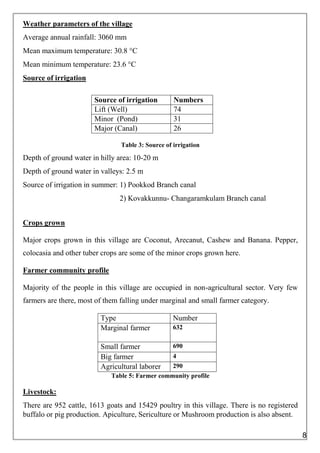
Name of the village: Kayakkodi
Name of the Block: Kunnummal
Name of the district: Kozhikkode
Borders of this village are;
North- Narippatta panchayath
South- Kuttiadi panchayath, Maruthonkara Panchayath
East- Kavilumpara Panchayath
West- Kunnummal panchayath
Total geographical area of this village is 2819 Ha
Total River area: 58.085 Ha
Land not utilized for agricultural purpose: 204 Ha
Uncultivable land: 20 Ha
Total cropped area is 2615 Ha under which rainfed cultivation accounts for 2485 Ha and
the irrigated area is 130 Ha.
Housing pattern
Concrete house 754
Tilled house 65
Huts 32
Total 851
Table 1: Housing pattern
Population of the village
Male 112670
Female 11906
Total 23173
Table 2: Population of village
7
Weather parameters of the village
Average annual rainfall: 3060 mm
Mean maximum temperature: 30.8 °C
Mean minimum temperature: 23.6 °C
Source of irrigation
Table 3: Source of irrigation
Depth of ground water in hilly area: 10-20 m
Depth of ground water in valleys: 2.5 m
Source of irrigation in summer: 1) Pookkod Branch canal
2) Kovakkunnu- Changaramkulam Branch canal
Crops grown
Major crops grown in this village are Coconut, Arecanut, Cashew and Banana. Pepper,
colocasia and other tuber crops are some of the minor crops grown here.
Farmer community profile
Majority of the people in this village are occupied in non-agricultural sector. Very few
farmers are there, most of them falling under marginal and small farmer category.
Type Number
Marginal farmer 632
Small farmer 690
Big farmer 4
Agricultural laborer 290
Table 5: Farmer community profile
Livestock:
There are 952 cattle, 1613 goats and 15429 poultry in this village. There is no registered
buffalo or pig production. Apiculture, Sericulture or Mushroom production is also absent.
Source of irrigation Numbers
Lift (Well) 74
Minor (Pond) 31
Major (Canal) 26
8
CONTACT FARMERS
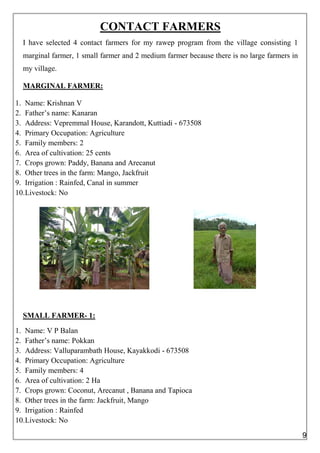
I have selected 4 contact farmers for my rawep program from the village consisting 1
marginal farmer, 1 small farmer and 2 medium farmer because there is no large farmers in
my village.
MARGINAL FARMER:
1. Name: Krishnan V
2. Father’s name: Kanaran
3. Address: Vepremmal House, Karandott, Kuttiadi - 673508
4. Primary Occupation: Agriculture
5. Family members: 2
6. Area of cultivation: 25 cents
7. Crops grown: Paddy, Banana and Arecanut
8. Other trees in the farm: Mango, Jackfruit
9. Irrigation : Rainfed, Canal in summer
10.Livestock: No
SMALL FARMER- 1:
1. Name: V P Balan
2. Father’s name: Pokkan
3. Address: Valluparambath House, Kayakkodi - 673508
4. Primary Occupation: Agriculture
5. Family members: 4
6. Area of cultivation: 2 Ha
7. Crops grown: Coconut, Arecanut , Banana and Tapioca
8. Other trees in the farm: Jackfruit, Mango
9. Irrigation : Rainfed
10.Livestock: No
9
SMALL FARMER- 2:
1. Name: Aravindakshan K
2. Father’s name: Balagopalan Nair
3. Address: Kokkunnummal House, Kovakkunnu, Mokeri - 673507
4. Primary Occupation: Agriculture
5. Family members: 7
6. Area of cultivation: 1.6 Ha
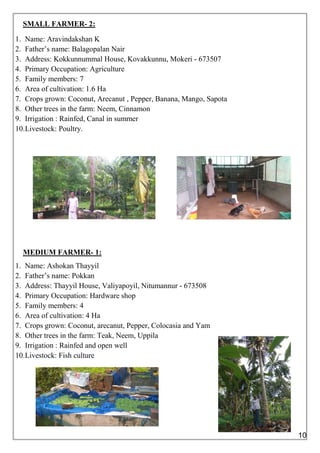
7. Crops grown: Coconut, Arecanut , Pepper, Banana, Mango, Sapota
8. Other trees in the farm: Neem, Cinnamon
9. Irrigation : Rainfed, Canal in summer
10.Livestock: Poultry.
MEDIUM FARMER- 1:
1. Name: Ashokan Thayyil
2. Father’s name: Pokkan
3. Address: Thayyil House, Valiyapoyil, Nitumannur - 673508
4. Primary Occupation: Hardware shop
5. Family members: 4
6. Area of cultivation: 4 Ha
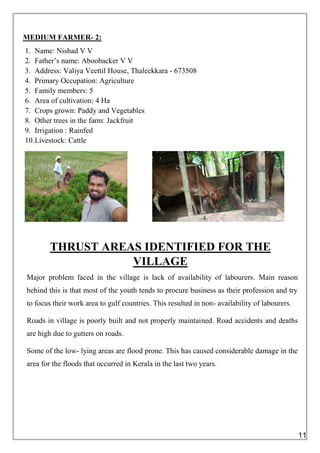
7. Crops grown: Coconut, arecanut, Pepper, Colocasia and Yam
8. Other trees in the farm: Teak, Neem, Uppila
9. Irrigation : Rainfed and open well
10.Livestock: Fish culture
10
MEDIUM FARMER- 2:
1. Name: Nishad V V
2. Father’s name: Aboobacker V V
3. Address: Valiya Veettil House, Thaleekkara - 673508
4. Primary Occupation: Agriculture
5. Family members: 5
6. Area of cultivation: 4 Ha
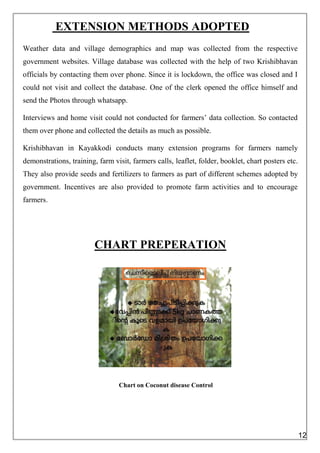
7. Crops grown: Paddy and Vegetables
8. Other trees in the farm: Jackfruit
9. Irrigation : Rainfed
10.Livestock: Cattle
THRUST AREAS IDENTIFIED FOR THE
VILLAGE
Major problem faced in the village is lack of availability of labourers. Main reason
behind this is that most of the youth tends to procure business as their profession and try
to focus their work area to gulf countries. This resulted in non- availability of labourers.
Roads in village is poorly built and not properly maintained. Road accidents and deaths
are high due to gutters on roads.
Some of the low- lying areas are flood prone. This has caused considerable damage in the
area for the floods that occurred in Kerala in the last two years.
11
EXTENSION METHODS ADOPTED
Weather data and village demographics and map was collected from the respective
government websites. Village database was collected with the help of two Krishibhavan
officials by contacting them over phone. Since it is lockdown, the office was closed and I
could not visit and collect the database. One of the clerk opened the office himself and
send the Photos through whatsapp.
Interviews and home visit could not conducted for farmers’ data collection. So contacted
them over phone and collected the details as much as possible.
Krishibhavan in Kayakkodi conducts many extension programs for farmers namely
demonstrations, training, farm visit, farmers calls, leaflet, folder, booklet, chart posters etc.
They also provide seeds and fertilizers to farmers as part of different schemes adopted by
government. Incentives are also provided to promote farm activities and to encourage
farmers.
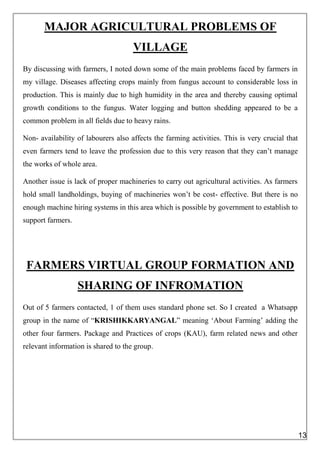
CHART PREPERATION
Chart on Coconut disease Control
12
MAJOR AGRICULTURAL PROBLEMS OF
VILLAGE
By discussing with farmers, I noted down some of the main problems faced by farmers in
my village. Diseases affecting crops mainly from fungus account to considerable loss in
production. This is mainly due to high humidity in the area and thereby causing optimal
growth conditions to the fungus. Water logging and button shedding appeared to be a
common problem in all fields due to heavy rains.
Non- availability of labourers also affects the farming activities. This is very crucial that
even farmers tend to leave the profession due to this very reason that they can’t manage
the works of whole area.
Another issue is lack of proper machineries to carry out agricultural activities. As farmers
hold small landholdings, buying of machineries won’t be cost- effective. But there is no
enough machine hiring systems in this area which is possible by government to establish to
support farmers.
FARMERS VIRTUAL GROUP FORMATION AND
SHARING OF INFROMATION
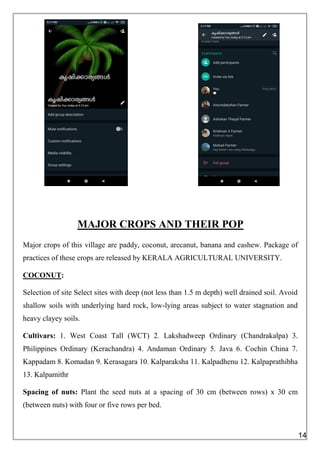
Out of 5 farmers contacted, 1 of them uses standard phone set. So I created a Whatsapp
group in the name of “KRISHIKKARYANGAL” meaning ‘About Farming’ adding the
other four farmers. Package and Practices of crops (KAU), farm related news and other
relevant information is shared to the group.
13
MAJOR CROPS AND THEIR POP
Major crops of this village are paddy, coconut, arecanut, banana and cashew. Package of
practices of these crops are released by KERALA AGRICULTURAL UNIVERSITY.
COCONUT:
Selection of site Select sites with deep (not less than 1.5 m depth) well drained soil. Avoid
shallow soils with underlying hard rock, low-lying areas subject to water stagnation and
heavy clayey soils.
Cultivars: 1. West Coast Tall (WCT) 2. Lakshadweep Ordinary (Chandrakalpa) 3.
Philippines Ordinary (Kerachandra) 4. Andaman Ordinary 5. Java 6. Cochin China 7.
Kappadam 8. Komadan 9. Kerasagara 10. Kalparaksha 11. Kalpadhenu 12. Kalpaprathibha
13. Kalpamithr
Spacing of nuts: Plant the seed nuts at a spacing of 30 cm (between rows) x 30 cm
(between nuts) with four or five rows per bed.
14
Method of planting seed nuts: Plant the seed nuts in the beds in trenches 25-30 cm deep
and cover with soil so that to portion of husk alone is visible. The nuts may be planted
either horizontally with the widest of the segments at the top or vertically with stalk-end
up. Vertical planting is preferable on account of convenience in transporting and lesser risk
of seedling injury.
Shading and irrigation: For the first two years from planting, irrigate @ 45 litres of water
per seedling, once in 4 days, during dry summer months. Provide adequate shade to the
transplanted seedlings.
Manuring: young palms For the first three years after planting under rainfed conditions,
apply fertilizers in two split doses at the rates
ARECANUT:
Varieties: Mangala, Sumangala, Sreemangala and Mohitnagar, VTLAH1, VTLAH2
Selection of site Select sites with deep well drained soil without high water table. Provide
adequate irrigation facilities. Selection of mother palms Select mother palms showing
earliness and regularity in bearing, high percentage of fruit set and dwarf to semi-tall
stature.
Selection of seed nuts: Select fully tree-ripe nuts from middle bunches during mid season.
Discard nuts, which are undersized, malformed and low in weight. Nursery techniques
Sow selected seed nuts soon after harvest in nursery bed with stalk-end up and with a
spacing of 5-6 cm. Cover the seed nuts with sand and irrigate daily
Cultural operations: Keep the garden free of weeds and break up surface crust by light
forking or digging after cessation of monsoon during OctoberNovember. In slopes, prevent
soil erosion by terracing. Sow seeds of green manure-cumcover crops such as Mimosa
invisa, Stylosanthes gracilis and Calapagonium muconoides in April-May with the onset of
pre-monsoon rains. Cut and apply them to the palms in September-October.
BANANA:
Varieties Nendran (Clones): Nedunendran, Chengalikodan, Manjeri Nendran, Zanzibar,
Big Ebanga.
15
Planting Plant suckers upright in the centre of pits with 5 cm pseudostem remaining above
soil level. Press soil around the sucker to avoid hollow air spaces.
Manuring 1. Apply compost, cattle manure or green leaves @ 10 kg/plant at the time of
planting. For double sucker planting at a spacing of 3 m x 2 m, 133 per cent of
recommended dose for single sucker planting in six splits is needed when farm yard
manure is used as the organic source. The recommended dose for single sucker itself is
sufficient with vermicompost as organic source. This should be accompanied with in situ
green manuring @ 15 g cowpea seeds per pit (25 kg ha-1) at the time of planting.
Incorporate the cowpea crop into soil 40 days after sowing
Irrigation 1. During summer months, irrigate once in three days. 2. Ensure good drainage
and prevent water logging.
Desuckering Remove side suckers produced till the emergence of bunch. Retain one or
two suckers produced after the emergence of bunch
Manures and Fertilizers: Apply FYM @ 15-20 kg per plant and lime 1 kg per plant at
the time of land preparation. Apply N:P2 O5 :K2 O @ 300:115:450 g per plant in six split
doses
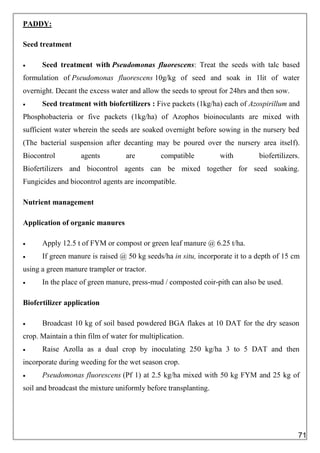
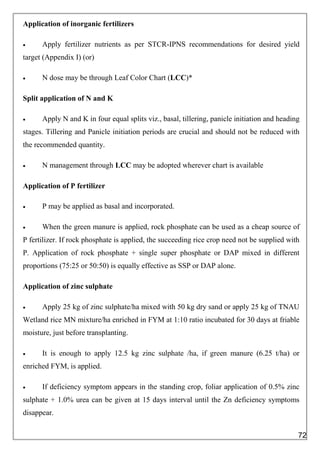
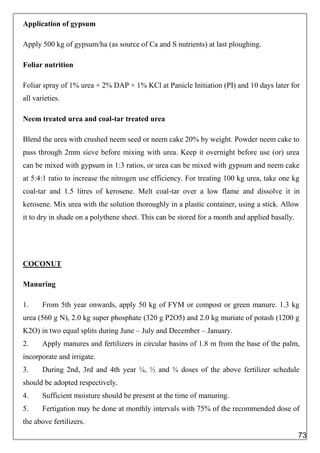
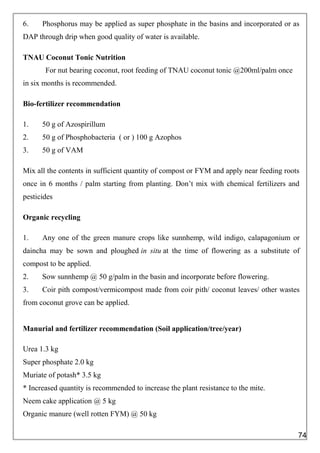
PADDY:
Seed rate :for Transplanting is 60-85 kg ha-1, Broadcasting 80-100 kg ha-1 , Dibbling
80-90 kg ha-1. The above seed rates are specified for farmers’ field on the basis of
minimum germination of 80 per cent.
Seed treatment
Dry seed treatment: Dress seeds with P. fluorescenes @ 10 g/kg of seeds before sowing
or with the following fungicides on the previous day of sowing (12 to 16 hours ahead) at
dosage given below: Carbendazim 2g per kg of seed
Wet seed treatment: Soak seed for 12 to 16 hours in a solution of P. fluorescenes @ 10
g/litre of water per kg of seed or Carbendazim 2 g/kg of seed per litre of water and drain to
induce germination
16
Land preparation: Plough the field thoroughly to incorporate the weeds and straw into
the soil. Ensure a smooth, level field for transplanting the seedlings. It would be better to
transplant 10-15 days after incorporating organic manure. Before transplanting or sowing,
apply manures and fertilizers at the rates specified for the region and varieties as indicated
in Table 4. Apply fertilizers on the drained soil at the time of final ploughing and levelling
and thoroughly mix into the soil.
Transplanting: Transplant seedlings of appropriate age for the variety @ 2-3 seedlings
per hill in rows, at suitable spacing
Methods of fertilizer application: For pre-planting application, apply the fertilizers at the
final ploughing. In areas where availability of water is assured, temporarily draining the
field one day prior to application and re-flooding after twelve hours is recommended for
top dressing of fertilizer. For increasing the efficiency of urea for top dressing, mix urea
with six times its weight of slightly moist soil and apply to the field 24- 28 hours after
mixing. Oil seed cakes such as punna and neem cakes can also be mixed with urea (1 part
of oil cake + 5 parts of urea by weight) for increasing fertilizer use efficiency. This method
is particularly useful for basal application of nitrogen. Under special conditions of drought
and water-logging, apply nitrogen as foliar spray. Urea may be applied as a low volume
spray at 15 per cent concentration using power sprayer or at 5 per cent concentration using
a high volume sprayer, the quantity applied in one application being limited to 15 kg ha-1.
When zinc deficiency is noticed, apply zinc sulphate @ 20 kg ha-1. K status of soil is
maintained by straw incorporation. After straw incorporation, if soil analysis prior to
cropping season indicates low K status, K should be applied @ 15 kg K2 O ha -1.
TECHNICAL PROBLEMS OF MAJOR CROPS
AND METHODS TO OVERCOME
COCONUT: Main problem in cocnut plantation is drought management. It can be
controlled by
1. Husk burial for moisture conservation Burying of fresh or dried coconut husk around
the palm is a desirable practice particularly for moisture retention. The husk can be buried
either in linear trenches taken 3 m away from the trunk between rows of palms or in
17
circular trenches taken around the palm at a distance of 2 m from the trunk. The trenches
may be of 0.5 m width and depth. The husks are to be placed in layers with concave
surface facing upwards and covered with soil.
2. Mulching : Mulch the coconut basins with green / dry leaves. In level lands, during
rainy seasons excess water may be conserved in small trenches dug out in the plantation.
In sloppy areas, land may be terraced and trenches dug across. This will facilitate
maximum percolation of rainwater and water conservation. For moisture conservation,
lowermost 3-5 leaves may be cut and removed. Provide adequate shade for the
transplanted seedlings for 1-2 years. To minimize the sun scorch on the srunk, application
of lime solution on the trunk up to a height of 2-3 m at the start of the summer season is
recommended.
3. Green manure and cover crops: Green manure and cover crops recommended for
cultivation in coconut gardens are: a. Green manure crops: Crotalaria juncea (sunhemp),
Tephrosia purpurea (kolinji), Indigofera hirsuta, Pueraria phaseoloides b. Cover crops:
Calapagonium muconoides, Mimosa invisa, Stylosanthes gracilis c. Shade-cum-green
manure shrub: Tephrosia candida
ARECANUT: Main problems in arecanut cultivation here is mahali disease and de
husking facility
1. Koleroga (Mahali or fruit rot) (Phytophthora palmivora) :Spray Bordeaux mixture 1
per cent on all bunches three times in a year, one just before the onset of southwest
monsoon and the rest at 40 days intervals. If monsoon season is prolonged give a
third spray. Use rosin soda adhesive to ensure tenacity of the spray deposit on
treated substrate. Remove and burn all fallen and infected nuts
2. De-husking: A simple de-husking device has been standardized by the CPCRI,
Kasaragod. The out turn with this device is 60 kg of husked nuts in the case of dry
nuts and 30 kg in the case of green nuts.The cost of the device is about Rs. 250/
BANANA: Main issues in banana cultivation which farmers of this area faces are banana
pseudo stem weevil and sigatoka leaf spot
18
Banana Pseudostem weevil : Field sanitation is the most important factor in the
prophylactic and curative control of this pest AND Remove affected plants along with the
rhizome in full and destroy them by burning the life stages of the insect using kerosene or
by burying the material in deep pits in soil.
Sigatoka leaf spot (Mycosphaerella sp.) 1. Cut and burn all severely affected leaves. 2.
Spray 1 per cent Bordeaux mixture with sticker soon after the appearance of the initial
symptoms of the disease. The disease appears with the commencement of southwest
monsoon. Five to six sprayings at fortnightly intervals are to be given depending upon the
severity of the disease. 3. Petroleum based mineral oil 1 per cent emulsion is also effective
in controlling the disease. 4. Spray carbendazim 1 g l-1 or give alternate sprays of
mancozeb (2 g l-1) and carbendazim (1 g l-1) soon after the appearance of initial
symptoms of the disease. Three to four sprays at fortnightly intervals are to be given
depending on the severity of disease
PADDY: Pest and disease attack can be managed by following the IPM suggested by
KAU.Other than the pest and disease main problem in rice cultivation is birds. Method to
over come that is,
Install artificial nesting sites viz., wooden nest boxes in the rice fields (@ 12 nests ha-1)
for colonization by cavity nesting birds (magpie robin, common myna, barn owl, etc.)
which play a vital role in managing a variety of insect and non-insect pests. The nest
boxes should be installed at a height more than 8 feet on wooden pole, tree trunk, etc.
COST OF CULTIVATION OF MAJOR CROPS
Major crop of my village is coconut, arecanut, banana and paddy. Cost of cultivation of the
crops is given in the table.
Average cost incurred for coconut is 64821/- and for arecanut is 60255/-. Average cost of
banana cultivation is 160214/-. Average cost incurred by the farmers for paddy is 99297 /-.
The cost can be reduced by Growing a green manure crop like daincha in April-May in
areas where the virippu crop is usually transplanted. Puddle and level the field thoroughly.
This will help to reduce the cost of weed control and also the loss of water and nutrients
19
through percolation. The cost of cultivation can be reduced by using high yielding
varieties, using optimum plant density etc. maintaining proper distance will help in
reducing cost of weed control and pest control.
Table 6: Cost of cultivation of major crops
Particular Paddy Coconut Arecanut Banana
HIRED HUMAN LABOUR 68775 35891 34169 65315
ANIMAL LABOUR 153 0 0 0
MACHINE LABOUR 8369 58 36 314
SEED /SEEDLINGS 2405 691 542 23517
FERTILISER 8522 12592 8466 37897
PLANT PROTECTION 819 250 175 1521
LAND TAX AND IRRIGATION
CESS
139 240 233 613
REPAIR AND MAINTENANCE
CHARGES OF IMPLEMENT AND
MACHINERIES
751 1361 3267 1452
INTEREST ON WORKING
CAPITAL
3250 5290 4631 14096
OTHER EXPENSES 3670 3419 2922 12391
INTEREST ON FIXED CAPITAL 2444 5029 5814 3098
TOTAL(Rs) 99297 64821 60255 160214
20
AWARENESS OR STATUS OF
DEVELOPMENTAL PROGRAMS
1. Life Mission – A helping scheme for providing initially land and home for
landless and homeless families. Every year 5 – 6 families are being gifted a
home as a helping hand to improve living standard of poor families.
2. Paddy development scheme – A scheme for the promotion of paddy
cultivation especially in fallow lands like unused wetlands.
a) Rs. 3 lakh given to Padashekhara Samiti for conducting group activities under
cooperative farming.
b) Input assistance of Rs. 5500 per hectare.
3. Kudumbasree – A comprehensive poverty alleviation programme to focus
primarily on poor rural and urban women. It includes neighborhood groups,
area development societies and community development societies. Work
includes under women self-help groups for financial and technical upliftment.
COVID AWARENESS CREATED
1. Awareness on COVID was done by grama panchayat through public
announcements, placing posters and banners in public places
2. Break the chain campaign promoted regular washing of hands and use of sanitizer
at public places
3. Regular patrolling by police ensured social distancing among people and avoided
crowds.
4. Locality based RRT and coordinated activities
5. Community kitchen by kudumbashree
6. Free covid test in primary health center
FARM AND HOME VISIT TO CONTACT
FARMERS AND KRISHIBHAVAN
I could not visit any farm as there is lockdown in my area. I contacted both farmers and
agricultural officer in krishibhavan over phone call.
21
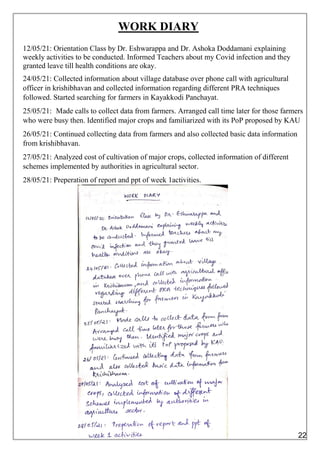
WORK DIARY
12/05/21: Orientation Class by Dr. Eshwarappa and Dr. Ashoka Doddamani explaining
weekly activities to be conducted. Informed Teachers about my Covid infection and they
granted leave till health conditions are okay.
24/05/21: Collected information about village database over phone call with agricultural
officer in krishibhavan and collected information regarding different PRA techniques
followed. Started searching for farmers in Kayakkodi Panchayat.
25/05/21: Made calls to collect data from farmers. Arranged call time later for those farmers
who were busy then. Identified major crops and familiarized with its PoP proposed by KAU
26/05/21: Continued collecting data from farmers and also collected basic data information
from krishibhavan.
27/05/21: Analyzed cost of cultivation of major crops, collected information of different
schemes implemented by authorities in agricultural sector.
28/05/21: Preperation of report and ppt of week 1activities.
22
RURAL AGRICULTURAL WORK
EXPERIENCE PROGRAM 2021
WEEKLY REPORT- 2
Name: Muhammed Ameer ID Number: ALB 7108
Team: 19
College of Agriculture, GKVK, Bangalore- 560065
2020-2021
23
WEEK 2 ACTIVITIES
1. Soil Sampling and Soil Testing
2. Problematic Soils and Reclamation
3. Contingent Cropping Plan
4. FYM/ Compost Preperation Using Crop Residues.
5. Crop Museum
6. Agricultural Inputs and Requirement
7. Seed Testing
8. Seed Production
9. Awareness on PPV & FR Act
10. Seed Treatment
11. Beejamruth
12. Seed Replacement rate
13. Aberrations In Weather and Preperation Of Crop Planning
14. Information Center
15. Work Diary
24
SOIL SAMPLING AND SOIL TESTING
Soil sampling is important as it measures the nutrients that are left in your field following
harvest. Tells you which nutrients are lacking or are in excess throughout the soil in a field.
Helps you determine the most favourable fertilizer plan to increase or maintain yields for
the following year. This allows you to determine the soils fertility, nutrient deficiencies and
excesses and come up with the best plan as you head into spring and prepare for next years’
crop. Doing a conventional soil sampling one takes 10 – 15 samples from throughout a
field.
To get an accurate representation of the field stay away from hill tops and low spots and
take soil from areas of the field where the yield is usually average. The results obtained
should then be an average representation of the field. each sample collected must be a true
representative of the area being sampled. Utility of the results obtained from the laboratory
analysis depends on the sampling precision. Hence, collection of large number of samples
is advisable so that sample of desired size can be obtained by sub-sampling. In general,
sampling is done at the rate of one sample for every two hectare area. However, at-least one
sample should be collected for a maximum area of five hectares. For soil survey work,
samples are collected from a soil profile representative to the soil of the surrounding area.
Points to be considered
1. Collect the soil sample during fallow period.
2. In the standing crop, collect samples between rows.
3. Sampling at several locations in a zig-zag pattern ensures homogeneity.
4. Fields, which are similar in appearance, production and past-management practices,
can be grouped into a single sampling unit.
5. Collect separate samples from fields that differ in colour, slope, drainage, past
management practices like liming, gypsum application, fertilization, cropping system etc.
6. Avoid sampling in dead furrows, wet spots, areas near main bund, trees, manure
heaps and irrigation channels.
7. For shallow rooted crops, collect samples up to 15 cm depth. For deep rooted crops,
collect samples up to 30 cm depth. For tree crops, collect profile samples.
25
8. Always collect the soil sample in presence of the farm owner who knows the farm
better
Procedure
Divide the field into different homogenous units based on the visual observation and
farmer’s experience Remove the surface litter at the sampling spot. Drive the auger to a
plough depth of 15 cm and draw the soil sample. Collect at least 10 to 15 samples from
each sampling unit and place in a bucket or tray.If auger is not available, make a ‘V’
shaped cut to a depth of 15 cm in the sampling spot using spade.Remove thick slices of soil
from top to bottom of exposed face of the ‘V’ shaped cut and place in a clean container.
Mixing of soil sample : Mix the samples thoroughly and remove foreign materials like
roots, stones, pebbles and gravels. Reduce the bulk to about half to one kilogram by
quartering or compartmentalization. Quartering is done by dividing the thoroughly mixed
sample into four equal parts. The two opposite quarters are discarded and the remaining
two quarters are remixed and the process repeated until the desired sample size is obtained.
Compartmentalization is done by uniformly spreading the soil over a clean hard surface
and dividing into smaller compartments by drawing lines along and across the length and
breadth. From each compartment a pinch of soil is collected. This process is repeated till
the desired quantity of sample is obtained. Collect the sample in a clean cloth or polythene
bag.
Label the bag with information like name of the farmer, location of the farm, survey
number, previous crop grown, present crop, crop to be grown in the next season, date of
collection, name of the sampler etc.
Processing and storage
Assign the sample number and enter it in the laboratory soil sample register. Dry the
sample collected from the field in shade by spreading on a clean sheet of paper after
breaking the large lumps, if present. Spread the soil on a paper or polythene sheet on a hard
surface and powder the sample by breaking the clods to its ultimate soil particle using a
wooden mallet. Sieve the soil material through 2 mm sieve. Repeat powdering and sieving
until only materials of >2 mm (no soil or clod) are left on the sieve. Collect the material
passing through the sieve and store in a clean glass or plastic container or polythene bag
26
with proper labelling for laboratory analysis. For the determination of organic matter it is
desirable to grind a representative sub sample and sieve it through 0.2 mm sieve. If the
samples are meant for the analysis of micronutrients at-most care is needed in handling the
sample to avoid contamination of iron, zinc and copper. Brass sieves should be avoided and
it is better to use stainless steel or polythene materials for collection, processing and storage
of samples. Air-drying of soils must be avoided if the samples are to be analysed for NO3-
N and NH4-N as well as for bacterial count. Field moisture content must be estimated in
un-dried sample or to be preserved in a sealed polythene bag immediately after collection.
Estimate the moisture content of sample before every analysis to express the results on dry
weight basis.
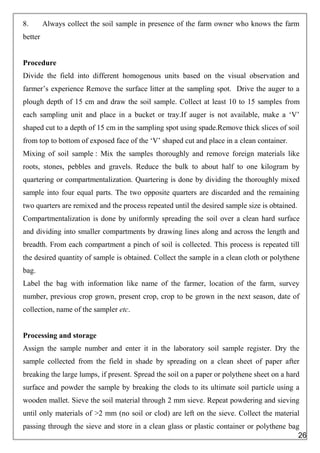
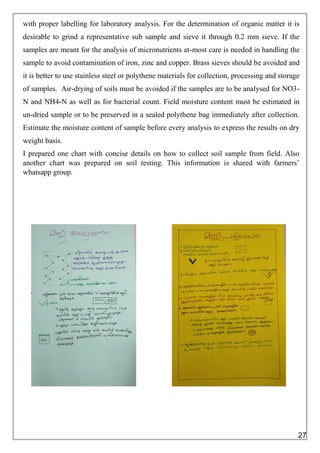
I prepared one chart with concise details on how to collect soil sample from field. Also
another chart was prepared on soil testing. This information is shared with farmers’
whatsapp group.
27
PROBLEMATIC SOILS AND ITS RECLAMATION
Problematic soils are the soil that causes additional problems from the engineering point of
view as a result of the circumstances of its composition or a change in environmental
conditions. hese soils need special management for satisfactory crop production. Physical
limitations can be managed by irrigation, drainage, mulching, manuring, tillage,
and soil conservation measures such as terracing, contouring, and cover crops whichever is
appropriate.different forms of problematic soils are
 Aline soil
 Sodic/alkaline soil
 Saline –sodic
 Acidic soils
Soil of my village is acidic in nature.
RECLAMATION OF ACID SOILS : Acidic soils can be managed by the methods like
liming, using suitable crop, soil fertility managemnetn etc.
Liming:
Application of lime is recommended for reclaming acid soils. Chemicals used for liming
are , Burnt lime -CaO, Hydrated lime- Ca(OH)2, Basic slag –CaSiO3, Dolomite-
CaCO3.MgCO3, Calcite. Etc.,.
It improves the base saturation,inactivates iron ,manganese and aluminium in soil solution
.Lime should be applied once in five years depending on soil pH.
Choice of crops:
• Rice is relatively tolerant to soil acidity,since flooding the field raise soil pH to near
neutrality. • Millets and oats among cereals, groundnut among the legumes, tea and potato
among others can be grown on acid soils.
Soil fertility management:
Leaching losses of nitrogen fertilisers can be reduced by split by split applications. • Use
of completely water soluble sources like SSP,TSP,DAP should be avoided. • Potassium
sulphate is preferred over murate of potash, but there are certain Problems associated with
over liming .
28
They are:
1) Deficiency of Fe, Cu,Mn,Zn
2) Phosphorus availability reduce
3) Incidence of diseases like Scab in root crops increases.
4) Boron deficiency is seen , it adsorbed on Al(OH)3
5) Root tip swelling due to high cons. of OH- ion
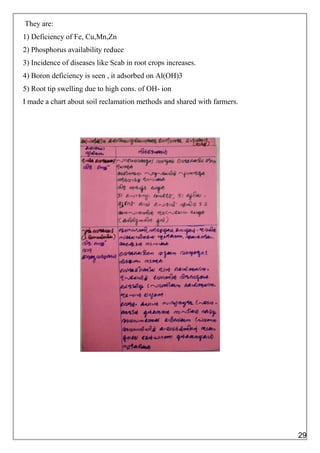
I made a chart about soil reclamation methods and shared with farmers.
29
CONTINGENT CROPPING PLAN
Contingency cropping is growing of a suitable crop in place of normally sown highly
profitable crop of the region due to aberrant weather conditions. In dryland agriculture,
contingency of growing another crop in place of normally grown crop arises due to delay in
the onset of monsoon. As per the report by kerala agricultural university, the main
contingency this area prone to are, flood , sea -water intrusion, pest and disease incidence
and man- animal conflict. Contingency crop planning refers to implementing a plan for
making alternate crop or cultivar choices in tune with the actual rainfall situation and soils
in a given location. In rainfed areas, as a general rule early sowing of crops with the onset
of monsoon is the best-bet practice that gives higher realizable yield. n general, the change
in sowing or planting time of crops, change in seed rate, change in schedule of fertilizer
use, use of short duration varieties, improved crop genotypeform the core component of
contingency crop planning.
Contingent plan Under irregular rain
For rice: Improve drainage facility at vegetative stage , flowering stage and Harvest the
crop at physiological maturity and Improve storage facility
For horticulture crops: Improve drainage facility, Collection and conservation of rain
water, mulching
Contingent plan heavy rain and wind:
For Rice: Improve drainage facility, alley cropping, providing wind breaks . Improve
storage after harvest
Horticulture crops : Improve drainage facility, Propping of Banana plants facility
Outbreak of pests and diseases due to unseasonal rains:
Rice Cultivation of resistant varieties, Use of disease free healthy seeds, proper seed
treatment, application of bio control agents, phytosanitation, balanced fertilizer application,
adopt suitable cultural practices
Coconut, areca nut : Avoid water stagnation in the garden by providing drainage
facilities, prophylactic spray of 1% Bordeaux mixture, adopt phyto sanitation, cleaning of
the crown,
30
Banana Use disease free healthy suckers, provide better drainage facility, prophylactic
application of Bordeaux mixture, use of bio control agents, removal and destruction of
inoculum from the field
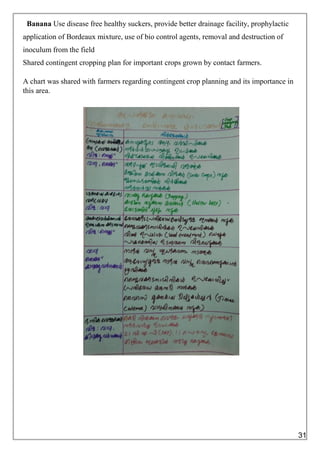
Shared contingent cropping plan for important crops grown by contact farmers.
A chart was shared with farmers regarding contingent crop planning and its importance in
this area.
31
FYM/ COMPOST PREPARATION
Farmyard Manure (FYM)is primarily made from cow dung, cow urine, waste grass, and
other dairy waste. Properties of FYM are,FYM is nutrient-rich. A small portion of N is
available directly to the plants, while a greater portion is made available when FYM
decomposes. Once cow dung and urine are combined, the plants get good nutrition.
Potassium and phosphorus available from FYM are similar to those from inorganic sources.
FYM implementation increases soil fertility.
compost is a mixture of ingredients used to fertilise and improve the soil. Compost is
commonly prepared by decomposing plant and food waste, recycling the organic materials
so that the mixture is rich in plant nutrients and beneficial organisms such as worms and
fungal mycelium.
Method of making FYM (Farm Yard Manure):
To prepare good quality FYM, it should be prepared in the pit. FYM should be prepared
in fixed dimension pits. In pits the FYM gets rotten in good way and its dosage element is
handled. The right way to make FYM properly is this way.
Gathering of animals excreta:The important thing is to gather animal excreta without
losing its urine. Therefore straw, waste fodder or remains of crop is spread under the
animals so that urine gets absorbed in it. Paddy straw is very suitable for this. 1 kg straw
will absorb approximately 1.5 kg urine. By absorbing urine in straw, the proportion of
carbon and nitrogen also gets reduced. Because of this reason the straw gets rotten earlier.
If there is a solid floor under the animal, then about 50% urine can be gathered, which can
be added on Farm waste with the help of buckets.
Pit digging: the dimensions of pit will depend upon the number of animals and the amount
of excreta. Mainly for 3-5 animals excreta, 6-7 m long, 1-1.5 m wide and 3 feet deep pit is
enough. The depth of pit from one side should be 3 feet and from another side it should be
3.5 feet. Dug the pit at a place where rain water cannot gets gathered. Ridges should be
made around the pit.
Pit filling: Starts filling the pit with a low deep side and fill it up to 1.5 feet high from the
ground and then make 1.5-2 inch thick soil layer above it. By doing this, the seeds of the
farm waste will also be degraded and the dosage elements will be saved from the sunlight.
32
Number of pits: Every farmer must have at least 2-3 pits so that first pit gets covered after
adding soil and then second pit should be start filling. During this time, the FYM of first pit
will be ready to be added in the field, which will again get free after using manure.
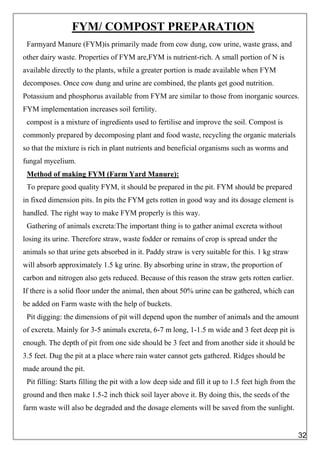
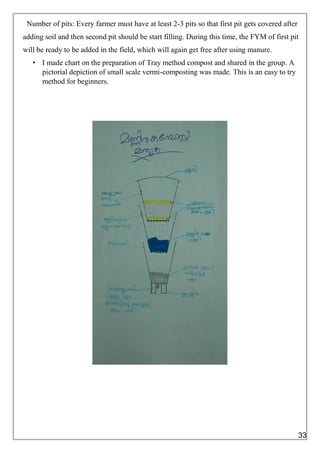
• I made chart on the preparation of Tray method compost and shared in the group. A
pictorial depiction of small scale vermi-composting was made. This is an easy to try
method for beginners.
33
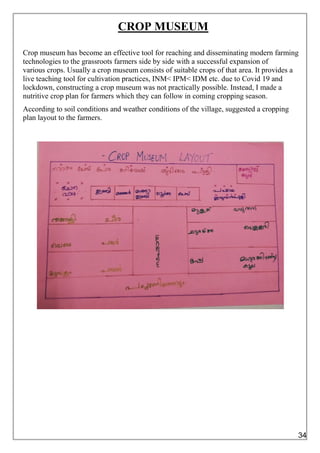
CROP MUSEUM
Crop museum has become an effective tool for reaching and disseminating modern farming
technologies to the grassroots farmers side by side with a successful expansion of
various crops. Usually a crop museum consists of suitable crops of that area. It provides a
live teaching tool for cultivation practices, INM< IPM< IDM etc. due to Covid 19 and
lockdown, constructing a crop museum was not practically possible. Instead, I made a
nutritive crop plan for farmers which they can follow in coming cropping season.
According to soil conditions and weather conditions of the village, suggested a cropping
plan layout to the farmers.
34
AGRICULTURAL INPUTS AND REQUIREMENT
Agricultural inputs are defined as products permitted for use in organic farming. These
include feedstuffs, fertilizers and permitted plant protection products as well as cleaning
agents and additives used in food production.
Important agricultural inputs required for major crops grown in maniyur village is as
follows:
For paddy:
Transplating material: available from different nurseries
Rice planter: from Krishi bhavan on rent. It is used for transplanting the seedlings to main
field
Drone sprayer: the nearest market where drone available is Calicut. It is used for precised
spraying of plant protection chemicals
Fertiliser,chemical: for effective plant growth
Harvester: used to harvest the crop
Thresher
For coconut:
planting material: nuts from the nursey
Fertiliser and chemicals: for effective plant growth
Coconut climber
For Arecanut:
Planting material
fertiliser and chemicals
Arecanut climber, harvester & sprayer
For Banana
Planting material,
digger
Fertiliser and chemicals
Banana cutter
Main stages where these inputs are used are, planting stages, for intercultivation, for
harvesting, and for post harvest processing.
35
SEED TESTING
Seed testing is determining the standards of a seed lot viz., physical purity, moisture,
germination and ODV and thereby enabling the farming community to get quality seeds.
The Seed Testing Laboratory is the hub of seed quality control. The most common tests are
the cold germination test, accelerated aging test, the tetrazolium test and warm
germination test. Each test is designed to evaluate various qualities of the seed. The most
common test is a warm germination test because it is required by seed laws to appear on the
label. Seeds are tested for germination to determine how they will perform when planted in
the field, the garden, or in a seedling nursery. This information is also needed for labeling
and marketing purposes or to determine if a seed lot has been properly labeled when sold or
offered for sale. The most common methods of seed testing is germination test
The most accurate test of viability is the germination test and this will be described here.
The germination test is made under controlled conditions to find out how many seeds will
germinate and produce normal seedlings which could develop into normal reproductively
mature plants.
Germination test
A germination test determines the percentage of seeds that are alive in any seed lot. ...
While the speed of germination varies slightly across varieties, seeds should absorb
moisture within two days and produce a root and the first leaf within four days. At this
point, the seed is considered to have germinated.
A germination test is often the only test a farmer can conduct on the seed to determine if it
is suitable for planting. When seed is stored in traditional open systems, the germination
rate of most rice seed begins to deteriorate rapidly after six months. Also, many varieties
have a dormancy period immediately after harvest that can last for 1−2 months. By
knowing the germination rate, farmers can adjust their planting rates to attain the desired
plant population in the field. Equipment
To conduct this test, you will need the following:
 Waterproof tray. A flat-sided water bottle cut in half-lengthwise makes a good tray.
 Water-absorbent material. Tissues or cotton wool are ideal.
36
 Seeds
 Water supply
Procedure
 Place the water-absorbent material inside the waterproof tray.
 Take random samples from each seed lot and mix those in a container
 Take at least three seed samples from the mixed grain.
 Count out 100 seeds from each sample and place on absorbent material inside the
tray.
 Carefully saturate the absorbent material
 For each of 10 days, check to see that the absorbent material remains moist and
record the number of germinated seeds.
 Compute germination test after five days, and another after ten days.
The rate of germination is an indicator of vigor. Rapid seed germination increases the
chance of the seed establishing in the field.
Calculatinggerminationrate: Germination rate is the average number of seeds that germinate
over the 5- and 10- day periods.
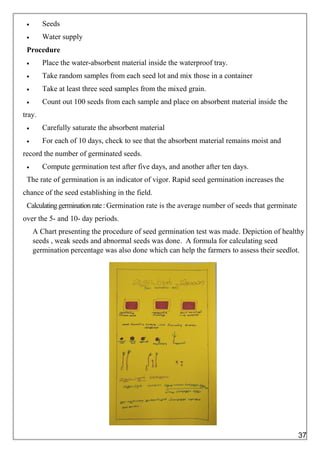
A Chart presenting the procedure of seed germination test was made. Depiction of healthy
seeds , weak seeds and abnormal seeds was done. A formula for calculating seed
germination percentage was also done which can help the farmers to assess their seedlot.
37
SEED PRODUCTION
Availability of quality seeds of improved cultivars is considered crucial for realizing
productivity and adoption of cultivars in different agro-climatic conditions. The quality of
seed alone is known to account for at least 10-15% increase in the productivity (ICAR
1993). However, lack of quality seed continues to be one of the greatest impediments to
bridging the vast yield gap. Therefore, to approach the potentially realizable yield of a
cultivar, production and distribution of quality seed is essential. The good quality seed
should have the following characters:
 Genetic purity, and uniformity and should conform to the standards of theparticular
cultivar.
 Disease free, viable seeds.
 Free from admixtures of other crop seeds, weeds and inert matter.
 Acceptable uniformity with respect to size, shape and color.
Seed Production: Systemized crop production is known as seed production. In seed
production adequate care is given from the purchase of seeds upto harvest adopting proper
seed and crop management techniques. The benefits of seed production are  Higher
income  Higher quality seed for next sowing.
There are two types (major) of seed production ie. Varietal and hybrid.
Seed is the critical determinant of agricultural production on which depends the
performance and efficacy of other inputs. Quality seeds appropriate to different agro-
climatic conditions and in sufficient quantity at affordable prices are required to raise
productivity. Availability and use of quality seeds is not a onetime affair. Sustained
increase in agriculture production and productivity necessarily requires continuous
development of new and improved varieties of crops and efficient system of production and
supply of seeds to farmers. The National Seeds Policy 2002 clearly emphasizes that “It has
become evident that in order to achieve the food production targets of the future, a major
38
effort will be required to enhance the seed replacement rates of various crops. This would
require a major increase in the production of quality seeds” According to the National seeds
Policy 2002, the thrust areas have to be 1. Varietal Development. 2. Seed Production. 3.
Seed Replacement Rate Enhancement. 4. Primary responsibility for production of breeder
seed to be that of the ICAR/State Agriculture Universities. 5. An effective seed production
programme. 6. Popularization of new varieties. 7. Availability of newly developed varieties
to farmers with minimum time gap. 8. Provision of incentives to domestic seed industry to
enable it to produce seeds ofhigh yielding varieties and hybrid seeds at a faster pace to meet
the challenges of domestic requirements. After the genesis of NSP, NSE & SSC and private
seed companies, production of certified and foundation seeds have been undertaken by
them.
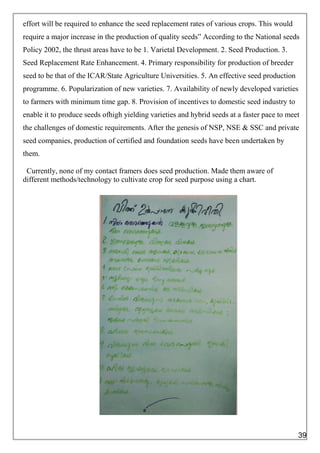
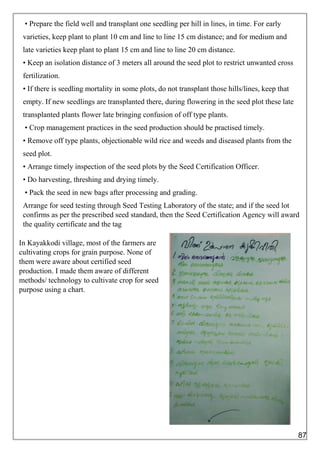
Currently, none of my contact framers does seed production. Made them aware of
different methods/technology to cultivate crop for seed purpose using a chart.
39
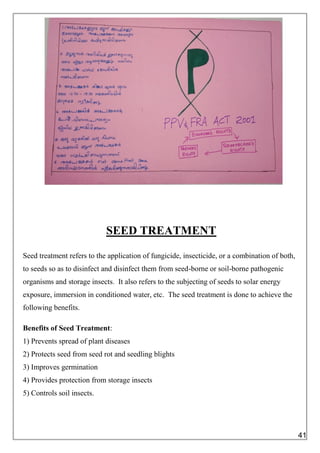
AWARENESS ON PPV&FR ACT,2001
The Protection of Plant Varieties and Farmers’ Rights Act (PPV&FR Act) seeks to address
the rights of plant breeders and farmers on an equal footing. It affirms the necessity of
recognizing and protecting the rights of farmers with respect to the contribution they make
in conserving, improving and making Plant Genetic Resources (PGR) available for the
development of new plant varieties.
The PPV&FR Act recognizes the multiple roles played by farmers in cultivating,
conserving, developing and selecting varieties. With regard to developing or selecting
varieties, the Act refers to the value added by farmers to wild species or traditional
varieties/ landraces through selection and identification for their economic traits.
Accordingly, farmers’ rights encompass the roles of farmers as users, conservers and
breeders. Farmers are granted nine specific rights, which are as under:
A patent deals with IPR over devices of Industrial applications whereas PPV & FR Act,
2001 confers IPR to plant breeders who have bred or developed plant varieties. A patent is
a set of exclusive rights granted by a state (national government) to an inventor or their
assignee for a limited period of time in exchange for the public disclosure of an invention.
The PPV&FR Act, give rights to farmers, breeders and researches besides giving protection
to varieties of all crop species which are notified under the Act. There is also provision for
benefits sharing, compensation to the farmers, recognition and award to the farmers for
supporting conservation and sustainable use of plant genetics resource
Most of my contact farmers were unaware of the Act. They were made aware of the
incentives and recognition given to farmers who protect and improve traditional farm saved
seeds through a chart depiction.
40
SEED TREATMENT
Seed treatment refers to the application of fungicide, insecticide, or a combination of both,
to seeds so as to disinfect and disinfect them from seed-borne or soil-borne pathogenic
organisms and storage insects. It also refers to the subjecting of seeds to solar energy
exposure, immersion in conditioned water, etc. The seed treatment is done to achieve the
following benefits.
Benefits of Seed Treatment:
1) Prevents spread of plant diseases
2) Protects seed from seed rot and seedling blights
3) Improves germination
4) Provides protection from storage insects
5) Controls soil insects.
41
Types of Seed Treatment:
1) Seed disinfection: Seed disinfection refers to the eradication of fungal spores that have
become established within the seed coat, or i more deep-seated tissues. For effective
control, the fungicidal treatment must actually penetrate the seed in order to kill the fungus
that is present.
2) Seed disinfestation: Seed disinfestation refers to the destruction of surface-borne
organisms that have contaminated the seed surface but not infected the seed surface.
Chemical dips, soaks, fungicides applied as dust, slurry or liquid have been found
successful.
3) Seed Protection: The purpose of seed protection is to protect the seed and young
seedling from organisms in the soil which might otherwise cause decay of the seed before
germination.
Conditions under which seed must be treated
1) Injured Seeds: Any break in the seed coat of a seed affords an excellent opportunity for
fungi to enter the seed and either kill it, or awaken the seedling that will be produced from
it. Seeds suffer mechanical injury during combining and threshing operations, or from
being dropped from excessive heights. They may also be injured by weather or improper
storage.
2) Diseased seed: Seed may be infected by disease organisms even at the time of harvest, or
may become infected during processing, if processed on contaminated machinery or if
stored in contaminated containers or warehouses.
3) Undesirable soil conditions: Seeds are sometimes planted under unfavourable soil
conditions such as cold and damp soils, or extremely dry soils. Such unfavourable soil
conditions may be favourable to the growth and development of certain fungi spores
enabling them to attack and damage the seeds.
4) Disease-free seed: Seeds are invariably infected, by disease organisms ranging from no
economic consequence to severe economic consequences. Seed treatment provides a good
42
insurance against diseases, soil-borne organisms and thus affords protection to weak seeds
enabling them to germinate and produce seedlings.
Precautions in Seed Treatment:
Most products used in the treatment of seeds are harmful to humans, but they can also be
harmful to seeds. Extreme care is required to ensure that treated seed is never used as
human or animal food. To minimise this possibility, treated seed should be clearly labelled
as being dangerous, if consumed. The temptation to use unsold treated seed for human or
animal feed can be avoided if care is taken to treat only the quantity for which sales are
assured.
Care must also be taken to treat seed at the correct dosage rate; applying too much or too
little material can be as damaging as never treating at all. Seed with a very high moisture
content is very susceptible to injury when treated with some of the concentrated liquid
products.
If the seeds are to be treated with bacterial cultures also, the order in which seed treatments
should be done shall be as follows
i) Chemical treatments
ii) Insecticide and fungicide treatments
iii) Special treatments
Types of Seed Treatment
Pre sowing seed treatments: It is the treatments given to the seeds before sowing to
improve the germination and vigour potential and as well as to maintain the health of the
seed. Pre sowing seed treatments includes the following
1.Chemical treatments to improve germination and vigour potential.:
43
Soaking / treating the seeds with nutrients vitamins and micronutrients etc. Paddy: Seeds
can be soaked in 1 % KCl solution for 12 hours to improve the germination and vigour
potential
2.Insecticidal and fungicidal treatment.
Seed Treatment Fungicides Fungicides are applied to seed prior to planting to provide
effective protection against many seed and soil-borne plant pathogens. Chemical
(fungicide) treatment guards against the various seed rots and seedling blights that occur
during storage or after planting.Fungicidal seed treatment may be divided into three
categories, depending on the nature and purpose of the treatment. These categories are:
(1) seed disinfection: - Disinfection is the elimination of a pathogen which has penetrated
into living cells of the seed, infected it and become established-for example, loose smut of
barley and wheat.
(2) seed disinfestation: Disinfestation is the control of spores and other forms of pathogenic
organisms found on the surface of the seed.
(3) seed protection: Seed protection is chemical treatment to protect the seed and young
seedling from pathogenic organisms in the soil. Seed treatment materials are usually
applied to seed in one of four forms: dust; slurry (a mixture of wettable powder in water);
liquids; and planter-box formulations. Based on composition, seed treatment fungicides
may be organic or inorganic, metallic or non-metallic, and, until recently, mercurial or non-
mercurial.
Seed Treatment Insecticides: Insecticides are often applied to seed to control or reduce
insect damage to seed during storage and, to a lesser degree, to prevent damage from such
insects as wireworms and seed corn maggots in the soil. Combinations Since some
pesticides are selective in their control of pests, many times two or more compounds are
combined in the treater tank, or an extra tank may be used, to give the spectrum of control
needed. The manufacturers of pesticides are now making combinations available to seed
processors, but should a processor blend two or more pesticides, the compatibility of the
materials must be determined, since some combinations of materials may seriously reduce
44
seed germination. Also, when applying two or more pesticides, even at different times, the
sequence of application may be very important. Whether a single pesticide or a
combination is to be applied to the seed, read the label and follow the manufacturer's
directions carefully.
3. Special treatments:
i) Seed hardening treatment Seeds can be hardened for 2 purposes I) Drought tolerance ii)
Cold tolerance The treatments are imposed to the seeds mainly to tolerate initial drought
and cold. Cold tolerance treatment is given to germinated seeds, such treatments are given
only to temperate crop and tree seeds.
ii) Seed fortification Main aim is to supply nutrients to seeds. The main objective is to
achieve the high vigour to overcome unfavourable soil reactions
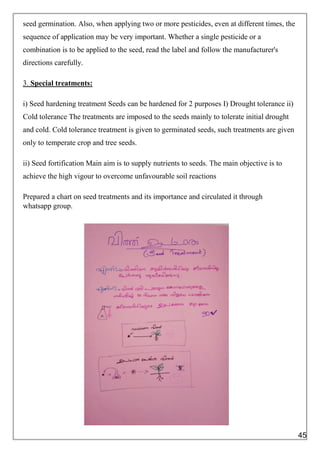
Prepared a chart on seed treatments and its importance and circulated it through
whatsapp group.
45
BEEJAMRUTH
Beejamruth is used as a treatment for seeds, seedlings or any planting plant material. It is
very effective in protecting young roots from fungus and other microbes as well as from
soil borne and seed-borne diseases that commonly affect plants after the monsoon season.
Beejamruth is composed of similar ingredients as Jeevamrutha - local cow dung that is a
powerful natural fungicide and cow urine which a strong anti-bacterial liquid, lime, and
soil. It is nothing but the Jeevamrutha applied as a seed treatment.
Application of Beejamrutha
Apply as a seed treatment to the seeds of any crop or coat them, mixing by hand and dry
them well before using them for sowing. For leguminous seeds/ crops, just dip the seeds
quickly and let them dry in shade.
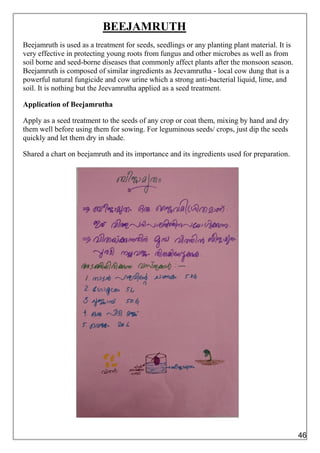
Shared a chart on beejamruth and its importance and its ingredients used for preparation.
46
SEED REPLACEMENT RATE
Seed Replacement Rate (SSR) or Seed Replacement Ratio is a measure of how much of the
total cropped area was sown with certified seeds in comparison to farm saved seeds. As
adequate information is not available on replacement schedules followed by farmers, how
to compute actual replacement rates? One simple method is to take the ratio of
quality seed of a crop produced during the year to the total seed needed to cover the entire
area under the crop. SRR is a measure of cropped area covered with quality seed.
Hence SRR is having a direct bearing on productivity augmentation and enhancement in
farmers' income and is one of the means for achieving doubling the farmers' income.
Distribution of good quality seeds at subsidized rates will encourage the farmers to use
certified good quality seeds in place of farm saved seeds which will enhance the Seed
Replacement Rate & ultimately increase the productivity & production and income of the
farmers of the state. A better seed replacement rate shows a better utilization of the
Certified / Quality Seeds. Since certified seeds are better in productivity, the Seed
Replacement Rate is directly proportional to productivity. Thus, higher the Seed
Replacement Ratio, higher is production as well as productivity and higher are chances of
achieving nutritional security, food security and containing food price inflation. Supply of
quality seeds is not a onetime affair; they need to be produced every new season
continuously. The hybrid seeds (those produced by cross pollinating of plants) can be sown
only once because the seed from their first generation does not reliably produce the same
copies of their parents. Thus, every new crop season requires purchase of new seeds.
Producing certified seeds from breeder seeds takes at least three years efforts.
Due to huge demand supply gap, India suffers from a dismal seed Replacement Ratio.
Currently, only around 15 per cent of India’s total cropped area is planted with freshly
obtained quality seeds every year. A huge 85 per cent area is sown with farm saved seeds.
This ratio varies from crop to crop between 7% in staple crops to maximum 70% in some
vegetables and fruits. For wheat and rice, it is between 9 to 18%.
We note here that enough seeds are available for fruits, vegetables, flowers and high value /
costly seed crops but not enough seeds are supplied in case of low value and high volume
crops such as rice, wheat. For crops such as wheat; this ratio must be between 20-30%. For
47
oilseeds and pulses; this ratio must be between 20-100% and for some crops such as Hybrid
cotton, it must be 100%.
Without achieving the optimal seed replacement ration, any efforts to get expected yields
will be futile.
ABERRATIONS IN WEATHER AND
PREPERATION OF CROP PLANNING
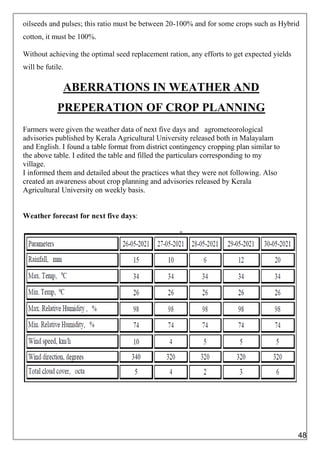
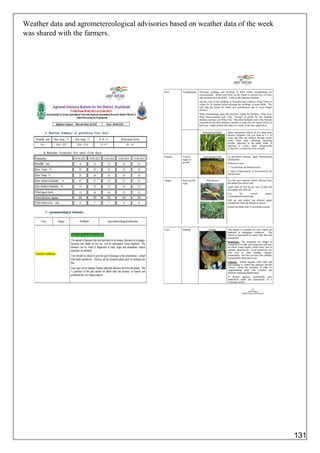
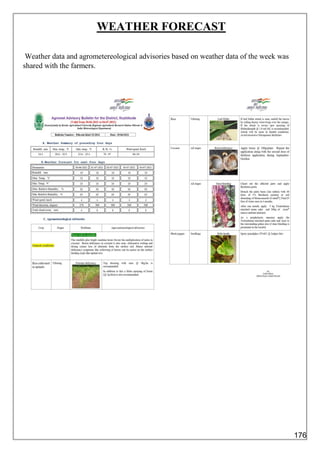
Farmers were given the weather data of next five days and agrometeorological
advisories published by Kerala Agricultural University released both in Malayalam
and English. I found a table format from district contingency cropping plan similar to
the above table. I edited the table and filled the particulars corresponding to my
village.
I informed them and detailed about the practices what they were not following. Also
created an awareness about crop planning and advisories released by Kerala
Agricultural University on weekly basis.
Weather forecast for next five days:
48
Rice Land
preparation
In places where broadcasting is adopted, apply lime to the soil @ 140 kg/acre
of land.
Where ever transplanting is adopted, while preparing nursery apply FYM or
compost @ 1kg/m2
of land. Before sowing treat the seeds with
Pseudomonas fluorescens (@ 10g Pseudomonas per kilogram of seeds).
Parallelly the main field preparations also should be undertaken. All the
blocks in the drainage channels should be cleared to ensure good drainage.
Remove all the weeds on the bunds. First ploughing can be undertaken.
Incorporate lime to the soil @ 140 kg/acre of land while ploughing.
Coconut All stages Fertilizer can be applied by opening basins in midlands and hilly areas where
there may not be any water stagnation.
Open the basins at a radium of 1.8 to 2m; with a slop from the basal of the
trunk so that the depth of the basins will be 30cm near its circumference.
Uniformly spread dolomite/lime @ 1.0 kg per palm in the basin around the
palm. Apply green/green leaf manures @ 25kg/palm.
After a week, FYM and the first dose of fertilizers can be applied. For an
adult coconut palm with more than three years of age; apply 250g urea +
300g rock phosphate + 400g potash + 250g magnesium sulfate, around the
basin leaving 1.5m distance from the trunk.
The seedlings can be supplied with 1/10th
of the above dose during the year
of planting. The one year old palms should be provided with 1/3rd
of the
dose and second year old palms with 2/3rd
of the adult dose. From three year
age onwards the adult dose is recommended
NB:- This is a general recommendation under ordinary management
conditions. Depending on the varieties and management conditions, the
fertilizer dozes can be adjusted based on soil test values.
Black pepper All stages Foot rot As prophylactic measure, apply 150 gram of
Trichoderma enriched neem cake - cow dung
mixture in the basins of the vines and
incorporate thoroughly with the soil.
If disease already appeared, drench soil in the
plant basins with Redomil 0.2% (2g/litre of
water). Spray the same on the leaves also.
Banana Various
stages of
growth
Sigatoka leaf spot Cut and burn all affected leaves.
Spray Propiconazole or Hexaconazole (@ 2ml
per litre)
Crop Stages Problems Agro-meteorological advisories
General conditions
There will be moderate rainfalls up to 30th
May In isolated places
thunderstorm with lightning and heavy winds can also be expected.
Do not keep harvested produces like rice, rubber, copra, pulses,
vegetables, seeds, etc. and fertilizers at open places.
Give strong propping to banana, vegetables and other soft stemmed crop
plants.
The prevailing high humidity together with increased heat index may
cause wide spread of fungal diseases like Bud rot and in coconut and
Mahali in Arecanut. As a prophylactic measure apply 1% Bordeaux
mixture on the spindle leaves of Coconut and on leaves and bunches of
Arecanut
Rice Land
preparation
In places where broadcasting is adopted, apply lime to the soil @ 140 kg/acre
of land.
Where ever transplanting is adopted, while preparing nursery apply FYM or
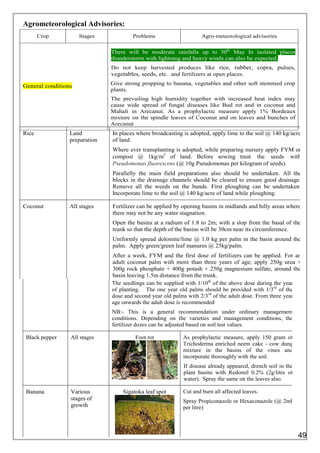
compost @ 1kg/m2
of land. Before sowing treat the seeds with
Pseudomonas fluorescens (@ 10g Pseudomonas per kilogram of seeds).
Parallelly the main field preparations also should be undertaken. All the
blocks in the drainage channels should be cleared to ensure good drainage.
Remove all the weeds on the bunds. First ploughing can be undertaken.
Incorporate lime to the soil @ 140 kg/acre of land while ploughing.
Coconut All stages Fertilizer can be applied by opening basins in midlands and hilly areas where
there may not be any water stagnation.
Open the basins at a radium of 1.8 to 2m; with a slop from the basal of the
trunk so that the depth of the basins will be 30cm near its circumference.
Uniformly spread dolomite/lime @ 1.0 kg per palm in the basin around the
palm. Apply green/green leaf manures @ 25kg/palm.
After a week, FYM and the first dose of fertilizers can be applied. For an
adult coconut palm with more than three years of age; apply 250g urea +
300g rock phosphate + 400g potash + 250g magnesium sulfate, around the
basin leaving 1.5m distance from the trunk.
The seedlings can be supplied with 1/10th
of the above dose during the year
of planting. The one year old palms should be provided with 1/3rd
of the
dose and second year old palms with 2/3rd
of the adult dose. From three year
age onwards the adult dose is recommended
NB:- This is a general recommendation under ordinary management
conditions. Depending on the varieties and management conditions, the
fertilizer dozes can be adjusted based on soil test values.
Black pepper All stages Foot rot As prophylactic measure, apply 150 gram of
Trichoderma enriched neem cake - cow dung
mixture in the basins of the vines and
incorporate thoroughly with the soil.
If disease already appeared, drench soil in the
plant basins with Redomil 0.2% (2g/litre of
water). Spray the same on the leaves also.
Banana Various
stages of
growth
Sigatoka leaf spot Cut and burn all affected leaves.
Spray Propiconazole or Hexaconazole (@ 2ml
per litre)
Agrometeorological Advisories:
49
INFORMATION CENTER
Whatsapp group used as the information center. Shared all AV aids prepared this week
among the farmers.
All the charts and information were shared with contact farmers through whatsapp
group.
50
WORK DIARY
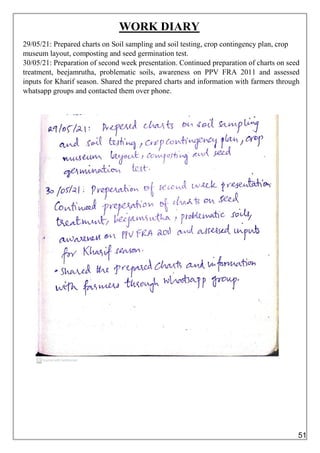
29/05/21: Prepared charts on Soil sampling and soil testing, crop contingency plan, crop
museum layout, composting and seed germination test.
30/05/21: Preparation of second week presentation. Continued preparation of charts on seed
treatment, beejamrutha, problematic soils, awareness on PPV FRA 2011 and assessed
inputs for Kharif season. Shared the prepared charts and information with farmers through
whatsapp groups and contacted them over phone.
51
RURAL AGRICULTURAL WORK
EXPERIENCE PROGRAM 2021
WEEKLY REPORT- 3
Name: Muhammed Ameer ID Number: ALB 7108
Team: 19
College of Agriculture, GKVK, Bangalore- 560065
2020-2021
52
WEEK 3 ACTIVITIES
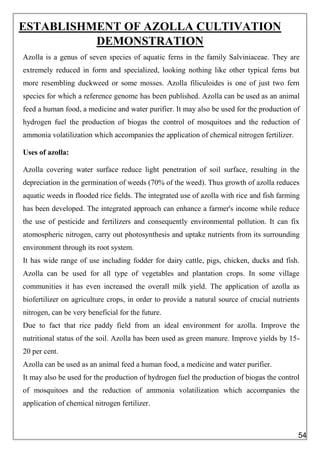
1. Establishment of Azolla Cultivation Demonstration
2. Nutrient Requirements of Important Crops
3. Vermicomposting- Importance, Production and Maintenance
4. Easy Methods For Identifying Adulterated Fertilizers
5. Adoption Integrated Nutrient Management Practices For Different Crops
6. Enhancing Nutrient Use Efficiency Of Chemical Fertilizers
7. Information Center
8. Work Diary
53
ESTABLISHMENT OF AZOLLA CULTIVATION
DEMONSTRATION
Azolla is a genus of seven species of aquatic ferns in the family Salviniaceae. They are
extremely reduced in form and specialized, looking nothing like other typical ferns but
more resembling duckweed or some mosses. Azolla filiculoides is one of just two fern
species for which a reference genome has been published. Azolla can be used as an animal
feed a human food, a medicine and water purifier. It may also be used for the production of
hydrogen fuel the production of biogas the control of mosquitoes and the reduction of
ammonia volatilization which accompanies the application of chemical nitrogen fertilizer.
Uses of azolla:
Azolla covering water surface reduce light penetration of soil surface, resulting in the
depreciation in the germination of weeds (70% of the weed). Thus growth of azolla reduces
aquatic weeds in flooded rice fields. The integrated use of azolla with rice and fish farming
has been developed. The integrated approach can enhance a farmer's income while reduce
the use of pesticide and fertilizers and consequently environmental pollution. It can fix
atomospheric nitrogen, carry out photosynthesis and uptake nutrients from its surrounding
environment through its root system.
It has wide range of use including fodder for dairy cattle, pigs, chicken, ducks and fish.
Azolla can be used for all type of vegetables and plantation crops. In some village
communities it has even increased the overall milk yield. The application of azolla as
biofertilizer on agriculture crops, in order to provide a natural source of crucial nutrients
nitrogen, can be very beneficial for the future.
Due to fact that rice paddy field from an ideal environment for azolla. Improve the
nutritional status of the soil. Azolla has been used as green manure. Improve yields by 15-
20 per cent.
Azolla can be used as an animal feed a human food, a medicine and water purifier.
It may also be used for the production of hydrogen fuel the production of biogas the control
of mosquitoes and the reduction of ammonia volatilization which accompanies the
application of chemical nitrogen fertilizer.
54
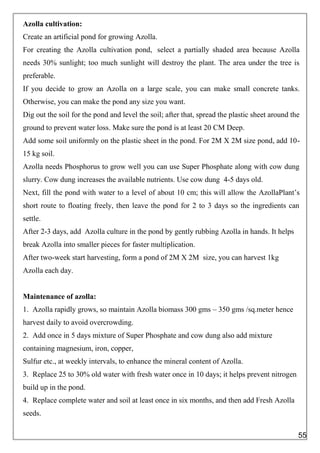
Azolla cultivation:
Create an artificial pond for growing Azolla.
For creating the Azolla cultivation pond, select a partially shaded area because Azolla
needs 30% sunlight; too much sunlight will destroy the plant. The area under the tree is
preferable.
If you decide to grow an Azolla on a large scale, you can make small concrete tanks.
Otherwise, you can make the pond any size you want.
Dig out the soil for the pond and level the soil; after that, spread the plastic sheet around the
ground to prevent water loss. Make sure the pond is at least 20 CM Deep.
Add some soil uniformly on the plastic sheet in the pond. For 2M X 2M size pond, add 10-
15 kg soil.
Azolla needs Phosphorus to grow well you can use Super Phosphate along with cow dung
slurry. Cow dung increases the available nutrients. Use cow dung 4-5 days old.
Next, fill the pond with water to a level of about 10 cm; this will allow the AzollaPlant’s
short route to floating freely, then leave the pond for 2 to 3 days so the ingredients can
settle.
After 2-3 days, add Azolla culture in the pond by gently rubbing Azolla in hands. It helps
break Azolla into smaller pieces for faster multiplication.
After two-week start harvesting, form a pond of 2M X 2M size, you can harvest 1kg
Azolla each day.
Maintenance of azolla:
1. Azolla rapidly grows, so maintain Azolla biomass 300 gms – 350 gms /sq.meter hence
harvest daily to avoid overcrowding.
2. Add once in 5 days mixture of Super Phosphate and cow dung also add mixture
containing magnesium, iron, copper,
Sulfur etc., at weekly intervals, to enhance the mineral content of Azolla.
3. Replace 25 to 30% old water with fresh water once in 10 days; it helps prevent nitrogen
build up in the pond.
4. Replace complete water and soil at least once in six months, and then add Fresh Azolla
seeds.
55
5. Maintain the water level of at least 10 cm, so Azolla root doesn’t grow in the soil by
keeping the roots floating, it becomes easy to harvest.
6. Harvested Azolla wash thoroughly, so it removes dirt and smell of cow dung and then
feeds them to animals.
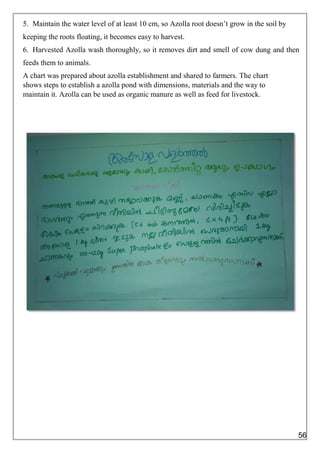
A chart was prepared about azolla establishment and shared to farmers. The chart
shows steps to establish a azolla pond with dimensions, materials and the way to
maintain it. Azolla can be used as organic manure as well as feed for livestock.
56
NUTRIENT REQUIREMENTS OF IMPORTANT
CROPS
Nutrients can be divided into the two categories: macro nutrients and micro nutrients. The six elements
normally classified as macro nutrients are: nitrogen (N), phosphorus (P), potassium (K), sulphur (S),
calcium (Ca) and magnesium (Mg). The plant roots mainly take up these nutrients in ionic form.
N is the element that plants require in greatest amounts and frequently the most limiting nutrient for plant
growth. The use of N is usually higher than the total use of the other macro nutrients and micro nutrients
together. N is essential to the photosynthesis and healthy cell growth and reproduction. It is vital in
producing chlorophyll (which gives the leaves good green colour) and amino acids. It also promotes shoot
and leaf growth.The plant takes up N as ions of nitrate (NO3-) and ammonium (NH4+). The main natural
sources in soil of plant available N are degradation of organic matter and N fixation by microorganisms
living in symbiosis with the roots of legumes.
P is taken up by the plants in the form of phosphate ions (at pH 5- to 7 mainly as HPO42-and H2PO4-). P is
required for cell growth and plant reproduction, for the conversion of light energy to chemical energy
during photosynthesis and is crucial for flower and fruit formation. Too little phosphorus can result in
stunting, but too much can cause bitter flavour in crops. Symptoms of phosphorus deficiency are often
mistakenly attributed to viral diseases. The supply of plant-available P comes from dissolution of soluble
phosphates in the soil and from mineralisation of organic matter. P is not easy to dissolve in water, so
plants often miss P if the level of organic matter in the soil is low.
K can be taken up in large amounts by many crops. High water solubility and natural K-content in the soil
often results in a good supply of plant-available K, e.g. of K+. However, crops such as vegetables need
large amounts of K and therefore additional K fertilisation may improve plant growth. K enhances plant
health, reduces pest sensitivity, increases share of vitamins, proteins and oil in the plants. It increases
drought tolerance and helps building up fibre in the plants.
S is also highly water-soluble and most crops need it in somewhat smaller amounts than P. S is a
component of amino acids and proteins and important for plant growth.Yearly fertilisation with S is often
needed. S is taken up as SO42+.
The addition of Ca and Mg is often not needed since soils with acceptable pH contain enough Ca and Mg.
The most important macro nutrients that need to be added frequently during crop production are therefore
N, P, K and S.
Micro nutrients are as essential for plant growth as macro nutrients, but are taken up in fairly small (micro)
amounts. The elements normally considered micro nutrients are boron (B), copper (Cu), iron (Fe), chloride
(Cl), manganese (Mn), molybdenum (Mo) and zinc (Zn) (FRAUSTO DA SILVA 1997 and
MARSCHNER 1997). Most of the micro nutrients are needed for the formation of different enzymes.
These micro nutrients are normally available in sufficient quantities through initial soil content and
57
mineralisation of organic material. Only in special circumstances does scarcity of micro nutrients limit
plant growth. When human excreta or manure are used as a fertiliser, the risk for such deficiency is
minimal as excreta contain all micro nutrients necessary for plant growth.
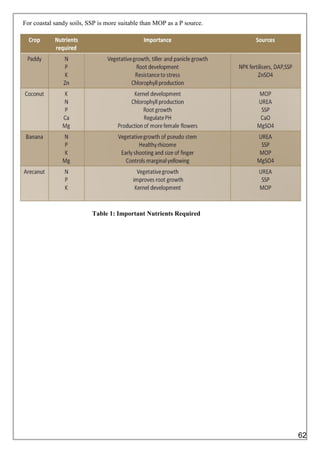
Each crop requires various nutrient for its proper growth . major crops grown by farmers and important
nutrients required for its growth is listed down:
PADDY
Paddy requires the following essential nutrients for its normal development:
Nitrogen: Nitrogen, the most important nutrient for rice, is universally limiting the rice productivity.
Nitrogen encourages the vegetative development of plants by imparting a healthy green color to the leaves.
Phosphorus: Phosphorus is particularly important in early growth stages.It is mobile within the plant and
promotes root development (Particularly the development of fibrous roots),tillering and early flowering.
Potassium: Potassium enhances the ability of the plants to resist diseases, insect attacks, cold and other
adverse conditions.It plays an essential part in the formation of starch and in the production and
translocation of sugars, and is thus of special value to carbohydrate-rich crops.Involves in working of
enzymes.
Micronutrients:
Ca: Calcium combines with pectin in the plant to form calcium pectate, which is an essential constituent of
the cell-wall
Zn: Essential for the transformation of carbohydrates. Regulates consumption of sugars.The function of
zinc in plants is as a metal activator of enzymes. Deficiency of zinc in lowland rice occurs in near neural to
alkaline
COCONUT:
Of the primary nutrients, potash(K) has been found to be the most important in coconut cultivation,
followed by nitrogen(N). There is a general response to the application of K and N; while response to
phosphorous (P) is seen only in certain restricted and localized condition.
Among the secondary nutrients, magnesium (Mg) and chlorine (Cl) have beneficial effects, followed by


calcium (Ca), Sulphur(S) and sodium (Na). Among micro-nutrients, zinc (Zn), boron (B) and manganese
(Mn) are required under certain restricted conditions.
Pottassium:
Adequate supply of potash helps for development of kernel and the formation of oil in it. It is usually
reflected in high setting percentage and better copra outturn.
58
K content of leaves is reported to reach up to 0.8 to 1.0%. An increase in level of potash in the leaves
improves the precocity of flowering, increasing number of female flowers and setting percentage; number
of bunches per palm; average copra per nut and total copra production per palm. It improves all the nut
characteristics by 14% including quality and quantity of copra.
Nitrogen
Nitrogen is a constituent of plant cells and green colouring matter i.e., chlorophyll of leaves. Nitrogen
hunger is very common in most of the plants; and in case of palms, it is often more apparent in young
plantations. Increase in nitrogen doses in the absence of P, leads to a corresponding increase in the
incidence of leaf-spot diseases.
The deficiency of N is usually reflected in the restricted growth, yellowing of young and old leaves to
varied degrees. Causes of N deficiency are climatic, pedagogical and agronomic conditions.
For coastal sandy soils, Urea formaldehyde is more preferable as a N source.
Phosphate
Phosphate promotes root growth, enhances flowering and ripening of fruits. However, an overdose of
phosphate results in the production of barren nuts or nuts with poor copra content. Phosphate is essentially
found in the leaves and seeds and where vigorous division takes place like growing parts of the shoot and
root.
Among phosphatic fertilizers, di-calcium phosphate application significantly increases production of nuts
and copra content per nut. Rock phosphate (Musoorie phos) application proves to be better than
superphosphate for acidic soils.
For coastal sandy soils, SSP is more suitable than MOP as a P source.
Effect of N, P, K in Combination
 The beneficial effects in the growth and productivity of coconut palms are manifested only if P and
K are provided with N and thus the complete effects of N in plant metabolism can be achieved.
Effects of Lime
 Calcium is particularly important as a nutrient in the acid laterite soils, where it increases P
availability. Lime is also supposed to regulate base saturation and pH, if applied in larger quantities and
thus lime serves two-fold functions. It can exert beneficial effect by counteracting toxic effect of high
content of soluble aluminium (A1) salts. However, the actual lime requirement of coconut is small which
can be met by calcium in the bonemeal, superphosphate etc. Quick lime or freshly slaked lime also
increases the coconut yield. Calcium can only be studied properly in association with other cationic
59
elements. Hence, the disturbance in nutrient uptake in acidic coconut soils may be compensated by
increasing the Ca concentration in the soil.
Effect of Magnesium
 Magnesium (Mg) and chlorine (CI) have beneficial effects on the general growth and productivity
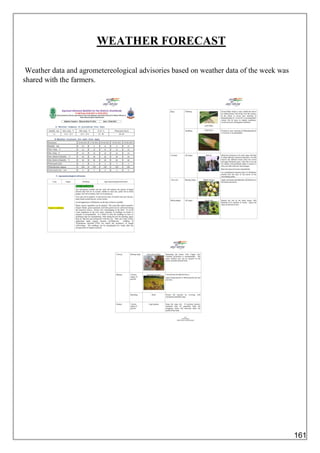
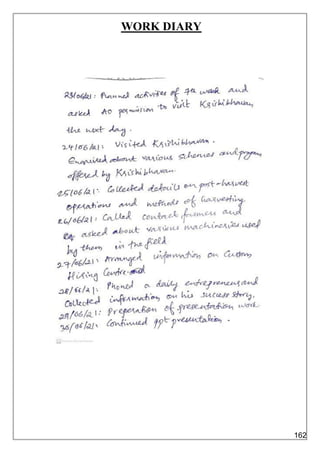
of palm. Mg deficiency is most prevalent in acidic sandy soils. It is reported that the quantity of Mg in
sandy soils is correlated with the availability of organic matter. Mg deficient chlorosis is very common in
most of the high rainfall regions. However, Mg hunger may exist at levels under 0.2% of leaf magnesium.
 There is a positive effect of magnesium sulphate on the production of more female flowers, high
setting percentage and more number of nuts per bunch. It also plays an important role in photosynthesis
and greenness of leaves. It brings out full benefit of K-fertilization. Application of magnesium increases
Mg content in the lecithin of copra. It is reported that 500g MgSO4 (i.e., 170 g MgO)/palm/year gives
beneficial results.
BANANA:
Crop growth depends on, among other things, nutrients. Both macro and micronutrients are essential for
plant growth.
Macronutrients are those elements needed in large amounts by the crop, and large quantities have to be
applied if the soil is deficient in one or more of them.
Nitrogen (N), Phosphorus (P) and Potassium (K) are the ‘primary macronutrients’ and these form the basis
of NPK fertilizer compounds. The ‘secondary macronutrients’ are Calcium (Ca), Magnesium (Mg) and
Sulphur (S).
Micronutrients are those elements required in very small quantities. Despite being needed in small
quantities, micronutrients are essential for the overall performance and health of the Ragi crop. They
include Iron (Fe), Manganese (Mn), Zinc (Zn), Copper (Cu), Molybdenum (Mo), and Boron (B).
Nitrogen: Nitrogen is the chief promoter of growth. It induces vegetative growth of pseudostem and
leaves giving a healthy green colour and robust frame which are essential for high yields.
N influences the number of leaves produced, time taken for the leaf unfolding and longitudinal growth of
petioles.
Phosphorus: Phosphorus helps produce healthy rhizome and a strong root system.
It also influences flower setting and general vegetative growth.
60
Potassium: Potassium stimulates early shooting and significantly shortens the time required for fruit
maturity.
It improves bunch grade and size of fingers and also the quality of the fruits.
Magnesium: Deficiencies usually occur while bananas have been grown for 10-12 years without
magnesium fertilizer or where high amounts of potassium fertilizer have been given for a number of years.
Magnesium is considered to be moderately redistributed in the banana plant.
Calcium: Although calcium is quite immobile in the banana, early description of calcium deficiency
referred to a marginal scorch on older leaves.
It appears that these symptoms may have been an artifact of high sodium supply. In the field calcium
deficiency symptoms include spike leaves i.e. leaves in which the banana is deformed or almost absent.
ARECANUT:
Pottassium:
 Adequate supply of potash helps for development of kernel and the formation of oil in it. It is
usually reflected in high setting percentage and better copra outturn.
Nitrogen:
Nitrogen is a constituent of plant cells and green colouring matter i.e., chlorophyll of leaves. Nitrogen
hunger is very common in most of the plants; and in case of palms, it is often more apparent in young
plantations. Increase in nitrogen doses in the absence of P, leads to a corresponding increase in the
incidence of leaf-spot diseases.
 The deficiency of N is usually reflected in the restricted growth, yellowing of young and old leaves
to varied degrees. Causes of N deficiency are climatic, pedagogical and agronomic conditions.
 For coastal sandy soils, Urea formaldehyde is more preferable as a N source.
Phosphate
 Phosphate promotes root growth, enhances flowering and ripening of fruits. However, an overdose
of phosphate results in the production of barren nuts or nuts with poor copra content. Phosphate is
essentially found in the leaves and seeds and where vigorous division takes place like growing parts of the
shoot and root.
 Among phosphatic fertilizers, di-calcium phosphate application significantly increases production
of nuts and copra content per nut. Rock phosphate (Musoorie phos) application proves to be better than
superphosphate for acidic soils.
61
For coastal sandy soils, SSP is more suitable than MOP as a P source.
Table 1: Important Nutrients Required
62
VERMICOMPOSTING- IMPORTANCE,
PRODUCTION AND MAINTENANCE
Vermicompost (vermi-compost) is the product of the decomposition process using various
species of worms, usually red wigglers, white worms, and other earthworms, to create a
mixture of decomposing vegetable or food waste, bedding materials, and vermicast. This
process is called vermicomposting, while the rearing of worms for this purpose is called
vermiculture.
Vermicast (also called worm castings, worm humus, worm manure, or worm faeces) is the
end-product of the breakdown of organic matter by earthworms.[1]
These castings have
been shown to contain reduced levels of contaminants and a higher saturation of nutrients
than the organic materials before vermicomposting. Vermicompost contains water-soluble
nutrients and is an excellent, nutrient-rich organic fertilizer and soil conditioner. It is used
in farming and small scale sustainable, organic farming.
Vermicomposting can also be applied for treatment of sewage. A variation of the process
is vermifiltration (or vermidigestion) which is used to remove organic matter, pathogens
and oxygen demand from wastewater or directly from blackwater of flush toilets.
vermicomposting has gained popularity in both industrial and domestic settings because, as
compared with conventional composting, it provides a way to treat organic wastes more
quickly. In manure composting, it also generates products that have lower salinity levels.
The earthworm species (or composting worms) most often used are red wigglers (Eisenia
fetida or Eisenia andrei), though European nightcrawlers (Eisenia hortensis,
synonym Dendrobaena veneta) and red earthworm (Lumbricus rubellus) could also be
used.[7]
Red wigglers are recommended by most vermicomposting experts, as they have
some of the best appetites and breed very quickly. Users refer to European nightcrawlers by
a variety of other names, including dendrobaenas, dendras, Dutch nightcrawlers, and
Belgian nightcrawlers.
Containing water-soluble nutrients, vermicompost is a nutrient-rich organic fertilizer and
soil conditioner in a form that is relatively easy for plants to absorb. Worm castings are
sometimes used as an organic fertilizer. Because the earthworms grind and uniformly mix
minerals in simple forms, plants need only minimal effort to obtain them. The worms'
63
digestive systems create environments that allow certain species of microbes to thrive to
help create a "living" soil environment for plants. The fraction of soil which has gone
through the digestive tract of earthworms is called the drilosphere. Vermicomposting is a
common practice in permaculture.
Preparation method:
For vermicomposting at home, a large variety of bins are commercially available, or a
variety of adapted containers may be used. They may be made of old plastic containers,
wood, Styrofoam, or metal containers. The design of a small bin usually depends on where
an individual wishes to store the bin and how they wish to feed the worms.
Some materials are less desirable than others in worm bin construction. Metal containers
often conduct heat too readily, are prone to rusting, and may release heavy metals into the
vermicompost. Styrofoam containers may release chemicals into the organic
material Some cedars, yellow cedar, and redwood contain resinous oils that may harm
worms, although western red cedar has excellent longevity in composting
conditions. Hemlock is another inexpensive and fairly rot-resistant wood species that may
be used to build worm bins.
Bins need holes or mesh for aeration. Some people add a spout or holes in the bottom for
excess liquid to drain into a tray for collection. The most common materials used are
plastic: recycled polyethylene and polypropylene and wood. Worm compost bins made
from plastic are ideal, but require more drainage than wooden ones because they are non-
absorbent. However, wooden bins will eventually decay and need to be replaced.
Small-scale vermicomposting is well-suited to turn kitchen waste into high-quality soil
amendments, where space is limited. Worms can decompose organic matter without the
additional human physical effort (turning the bin) that bin composting requires.
Composting worms which are detritivorous (eaters of trash), such as the red
wiggler Eisenia fetida, are epigeic (surface dwellers) and together with symbiotic
associated microbes are the ideal vectors for decomposing food waste. Common
earthworms such as Lumbricus terrestris are anecic (deep burrowing) species and hence
unsuitable for use in a closed system. Other soil species that contribute include insects,
other worms and molds. Such systems usually use kitchen and garden waste, using
64
"earthworms and other microorganisms to digest organic wastes, such as kitchen
scraps". This includes:
 All fruits and vegetables (including citrus, in limited quantities)
 Vegetable and fruit peels and ends
 Coffee grounds and filters
 Tea bags (even those with high tannin levels)
 Grains such as bread, cracker and cereal (including moldy and stale)
 Eggshells (rinsed off)
 Leaves and grass clippings (not sprayed with pesticides)
 Newspapers (most inks used in newspapers are not toxic)
 Paper toweling (which has not been used with cleaners or chemicals)
Benefits
Soil
 Improves soil aeration
 Enriches soil with micro-organisms (adding enzymes such
as phosphatase and cellulase)
 Microbial activity in worm castings is 10 to 20 times higher than in the soil and
organic matter that the worm ingest.
 Attracts deep-burrowing earthworms already present in the soil
 Improves water holding capacity
Plant growth
 Enhances germination, plant growth, and crop yield
 It helps in root and plant growth
 Enriches soil with micro-organisms (adding plant hormones such
as auxins and gibberellic acid)
Economic
 Biowastes conversion reduces waste flow to landfills
65
 Elimination of biowastes from the waste stream reduces contamination of other
recyclables collected in a single bin (a common problem in communities practicing single-
stream recycling)
 Creates low-skill jobs at local level
 Low capital investment and relatively simple technologies make vermicomposting
practical for less-developed agricultural regions
Environmental
 Helps to close the "metabolic gap" through recycling waste on-site
 Large systems often use temperature control and mechanized harvesting, however
other equipment is relatively simple and does not wear out quickly
Production reduces greenhouse gas emissions such as methane and nitric oxide (produced
in landfills or incinerators when not composted).
Vermicompost can be prepared at home easily. This chart shows importance,
preperation and maintainence of vermicompost. Chart has been shared with the
farmers through whatsapp group.
66
EASY METHODS FOR IDENTIFYING
ADULTERATED FERTILIZERS
Fertilizer is any organic or inorganic material of natural or synthetic origin that is added to
a soil to supply one or more plant nutrients essential to the growth of plants. India, being
the third largest producer and consumer of fertilizers, consumes nearly 40 million tons of
fertilizer materials, equivalent to over 18 million tons of nutrient, consisting of a variety of
nitrogenous, phosphatic, potassic and complex fertilizers, catering to nearly 106 million
farming families.
Adulteration of fertilizers involves the practice of adding extraneous material to a standard
fertilizer to lower its quality. It is rampart in many states of India and farmers and suffering
great losses. According to tests carried out by Soil Research Development Institute (SRDI),
nearly 40 per cent of all fertilizers used by farmers are adulterated, as reported in a leading
Bangla daily. Mixing of harmful chemical substances degrades fertility of the land and
causes serious health issues for humans.
Moreover, by applying such contaminated fertilizers, farmers are cheated and production
suffers. Though the department of agriculture extension along with other agencies regularly
test fertilizers available in the market. Following methods for easy detection of fertilizer
adulterations are:
For presence of Nitrogen: By mixing small quantity of lime in sample and rubbing, the
smell of pungent Ammonia gas indicates the presence of Nitrogen. Sodium Hydroxide
(concentrated) to be added and by heating the tube from the side then put moist red litmus
paper on the mouth of the tube. Observe the change of the red litmus paper to blue which
confirms the presence of Nitrogen and no change indicates the absence of the nitrogen and
the fertilizer may be considered suspected.
For presence of Phosphorus: On adding 2 ml of Ferric Chloride-Ammonium acetate
reagent and formation of yellow precipitate, which gets dissolved in 5-6 drops of
concentrate Nitric Acid confirms presence of phosphate. Non formation of yellow
precipitate indicates absence of Phosphate and the sample is suspected. Likewise, with the
use of filter paper, take 1 ml silver nitrate in the filtrate. If the formation of yellow
precipitate is also dissolved in 5-6 drops of nitric acid it confirms the presence of phosphate
in the material.
67
For presence of Potassium: By adding 5-6 drops of Cobalt Nitrite reagent in the filtrate
and formation of yellow precipitate indicates the presence of potassium in the fertilizers.
The non-formation of the precipitate indicates that the material is spurious. These are for
testing the NPK Complexes.
These are quick testing kit and there are limitations also. It is only for qualitative test.
Samples failing in the quick test are likely to fail in the detailed laboratory analysis.
Urea
White, shining and round shaped grains of approximately uniform size. Completely soluble
in water and when solution is touch, it feels cold. It melts when it is put on hot plate and
nothing remains if it is heated.
To detect adulteration in the Urea, take 1 gm fertilizer in test tube and add 5 ml distilled
water to dissolve the material. Add 5-6 drops of Silver Nitrate Solution. The formation of
white precipitate indicates that material is adulterated. The non-formation of any precipitate
indicates that Urea is pure.
Di Ammonium Phosphate (DAP)
Hard, granular, brown or black in colour and difficult to erase with nails. If some grains of
DAP are mixed with lime and rubbed, it produces sharp odour which is un bearable to
smell. The grains swell if put on a hot plate.
For DAP and MOP take 1 gm fertilizer, add 5 ml distilled water and shake well. Then add
1 ml Nitric Acid and
again shake. If it is dissolved and forms semi-transparent solution then DAP is pure and if
any insoluble material remains, then it is adulterated.
Potassic Fertilizer
Potassic fertilizer adulterated by mixture light white powdery salt and red chili. If the
potash particles are moist, they do not stick and fertilizer is not adulterated. If dissolved in
water, red portion of the fertilizer comes up.
Super Phosphate
This is a hard granular, brown or black in colour which cannot be easily broken by the
nails. It is available in the form of powder also. There is a possibility of adulterating it often
with mixture of DAP and NPK.
If this granular fertilizer is heated, it does not swell whereas grain of DAP and other
complex swells. In this way, adulteration can easily be identified.
Zinc Sulphate
Magnesium sulphate is most commonly used chemical for adulteration in Zinc sulphate. As
they are physically
similar in appearance, it is difficult to identify fake fertilizer. If zinc sulphate is mixed with
DAP, a thick precipitate is formed but it does not happen so with Magnesium sulphate. If
zinc sulphate solution is mixed with light caustic solution, a dark muddy precipitate is
formed. Which dissolves completely in concentrate caustic solution, if there is
Magnesium sulphate in place of Zinc sulphate, precipitate does not dissolve.
68
Adulterated fertilizers are widespread in the market. So this is an important area
where farmers need to be enlightened.
I have prepared a chart on the same and sent it to farmers group. I have received a
good response from farmers after sharing this information.
I have got a very good response from farmers when I shared this information. They
were concerned about adulteration and thanked me for providing this information.
69
ADOPTION INTEGRATED NUTRIENT
MANAGEMENT PRACTICES FOR DIFFERENT
CROPS
Integrated Nutrient Management refers to the maintenance of soil fertility and of plant
nutrient supply at an optimum level for sustaining the desired productivity through
optimization of the benefits from all possible sources of organic, inorganic and biological
components in an integrated manner. Main objective of this practice is Regulated nutrient
supply for optimum crop growth and higher productivity., Improvement and maintenance
of soil fertility and Zero adverse impact on agro – ecosystem quality by balanced
fertilization of organic manures, inorganic fertilizers and bio- inoculant. INM system is an
age-old concept but its importance was not realized earlier as nutrient removal by the crops
was very low due to subsistence farming. At present, INM system has a great significance
because of intensive farming being practised (Mahajan and Sharma, 2005). Moreover, for
realization of higher crop yields from a system on an economic basis, judicious and
efficient blending of organic and inorganic sources of plant nutrients is essential. The need
of INM system has arisen due to the following reasons.
Main Advantages of this practice are;
1. Enhances the availability of applied as well as native soil nutrients
2. Synchronizes the nutrient demand of the crop with nutrient supply from native and
applied sources.
3. Provides balanced nutrition to crops and minimizes the antagonistic effects resulting
from hidden deficiencies and nutrient imbalance.
4. Improves and sustains the physical, chemical and biological functioning of soil.
5. Minimizes the deterioration of soil, water and ecosystem by promoting carbon
sequestration, reducing nutrient losses to ground and surface water bodies and to
atmosphere
1. Different components of INM are; ORGANIC MANURE • Bulky organic manure
a.FYM b.Compost c.Green manure • Concentrated organic manure a.Blood meal b.Oil
cakes 1.sunflower cake 2.Groundnut cake
2. 7. • BIO-FERTILIZER  Azotobacter  Rhizobium  Azolla  Azospirillum •
CHEMICAL FERTILIZERS  Urea  Ammonium sulphate  DAP  SSP
INM practices of major crops in my area are listed down:
70
PADDY:
Seed treatment
 Seed treatment with Pseudomonas fluorescens: Treat the seeds with talc based
formulation of Pseudomonas fluorescens 10g/kg of seed and soak in 1lit of water
overnight. Decant the excess water and allow the seeds to sprout for 24hrs and then sow.
 Seed treatment with biofertilizers : Five packets (1kg/ha) each of Azospirillum and
Phosphobacteria or five packets (1kg/ha) of Azophos bioinoculants are mixed with
sufficient water wherein the seeds are soaked overnight before sowing in the nursery bed
(The bacterial suspension after decanting may be poured over the nursery area itself).
Biocontrol agents are compatible with biofertilizers.
Biofertilizers and biocontrol agents can be mixed together for seed soaking.
Fungicides and biocontrol agents are incompatible.
Nutrient management
Application of organic manures
 Apply 12.5 t of FYM or compost or green leaf manure @ 6.25 t/ha.
 If green manure is raised @ 50 kg seeds/ha in situ, incorporate it to a depth of 15 cm
using a green manure trampler or tractor.
 In the place of green manure, press-mud / composted coir-pith can also be used.
Biofertilizer application
 Broadcast 10 kg of soil based powdered BGA flakes at 10 DAT for the dry season
crop. Maintain a thin film of water for multiplication.
 Raise Azolla as a dual crop by inoculating 250 kg/ha 3 to 5 DAT and then
incorporate during weeding for the wet season crop.
 Pseudomonas fluorescens (Pf 1) at 2.5 kg/ha mixed with 50 kg FYM and 25 kg of
soil and broadcast the mixture uniformly before transplanting.
71
Application of inorganic fertilizers
 Apply fertilizer nutrients as per STCR-IPNS recommendations for desired yield
target (Appendix I) (or)
 N dose may be through Leaf Color Chart (LCC)*
Split application of N and K
 Apply N and K in four equal splits viz., basal, tillering, panicle initiation and heading
stages. Tillering and Panicle initiation periods are crucial and should not be reduced with
the recommended quantity.
 N management through LCC may be adopted wherever chart is available
Application of P fertilizer
 P may be applied as basal and incorporated.
 When the green manure is applied, rock phosphate can be used as a cheap source of
P fertilizer. If rock phosphate is applied, the succeeding rice crop need not be supplied with
P. Application of rock phosphate + single super phosphate or DAP mixed in different
proportions (75:25 or 50:50) is equally effective as SSP or DAP alone.
Application of zinc sulphate
 Apply 25 kg of zinc sulphate/ha mixed with 50 kg dry sand or apply 25 kg of TNAU
Wetland rice MN mixture/ha enriched in FYM at 1:10 ratio incubated for 30 days at friable
moisture, just before transplanting.
 It is enough to apply 12.5 kg zinc sulphate /ha, if green manure (6.25 t/ha) or
enriched FYM, is applied.
 If deficiency symptom appears in the standing crop, foliar application of 0.5% zinc
sulphate + 1.0% urea can be given at 15 days interval until the Zn deficiency symptoms
disappear.
72
Application of gypsum
Apply 500 kg of gypsum/ha (as source of Ca and S nutrients) at last ploughing.
Foliar nutrition
Foliar spray of 1% urea + 2% DAP + 1% KCl at Panicle Initiation (PI) and 10 days later for
all varieties.
Neem treated urea and coal-tar treated urea
Blend the urea with crushed neem seed or neem cake 20% by weight. Powder neem cake to
pass through 2mm sieve before mixing with urea. Keep it overnight before use (or) urea
can be mixed with gypsum in 1:3 ratios, or urea can be mixed with gypsum and neem cake
at 5:4:1 ratio to increase the nitrogen use efficiency. For treating 100 kg urea, take one kg
coal-tar and 1.5 litres of kerosene. Melt coal-tar over a low flame and dissolve it in
kerosene. Mix urea with the solution thoroughly in a plastic container, using a stick. Allow
it to dry in shade on a polythene sheet. This can be stored for a month and applied basally.
COCONUT
Manuring
1. From 5th year onwards, apply 50 kg of FYM or compost or green manure. 1.3 kg
urea (560 g N), 2.0 kg super phosphate (320 g P2O5) and 2.0 kg muriate of potash (1200 g
K2O) in two equal splits during June – July and December – January.
2. Apply manures and fertilizers in circular basins of 1.8 m from the base of the palm,
incorporate and irrigate.
3. During 2nd, 3rd and 4th year ¼, ½ and ¾ doses of the above fertilizer schedule
should be adopted respectively.
4. Sufficient moisture should be present at the time of manuring.
5. Fertigation may be done at monthly intervals with 75% of the recommended dose of
the above fertilizers.
73
6. Phosphorus may be applied as super phosphate in the basins and incorporated or as
DAP through drip when good quality of water is available.
TNAU Coconut Tonic Nutrition
For nut bearing coconut, root feeding of TNAU coconut tonic @200ml/palm once
in six months is recommended.
Bio-fertilizer recommendation
1. 50 g of Azospirillum
2. 50 g of Phosphobacteria ( or ) 100 g Azophos
3. 50 g of VAM
Mix all the contents in sufficient quantity of compost or FYM and apply near feeding roots
once in 6 months / palm starting from planting. Don’t mix with chemical fertilizers and
pesticides
Organic recycling
1. Any one of the green manure crops like sunnhemp, wild indigo, calapagonium or
daincha may be sown and ploughed in situ at the time of flowering as a substitute of
compost to be applied.
2. Sow sunnhemp @ 50 g/palm in the basin and incorporate before flowering.
3. Coir pith compost/vermicompost made from coir pith/ coconut leaves/ other wastes
from coconut grove can be applied.
Manurial and fertilizer recommendation (Soil application/tree/year)
Urea 1.3 kg
Super phosphate 2.0 kg
Muriate of potash* 3.5 kg
* Increased quantity is recommended to increase the plant resistance to the mite.
Neem cake application @ 5 kg
Organic manure (well rotten FYM) @ 50 kg
74
 Micronutrients (Soil application / tree / year)
Borax 50 g
Gypsum 1.0 kg
Magnesium sulphate 500g
Grow sunnhemp as intercrop twice a year (Seed rate 30 kg/ha)
ARECANUT:
Apply to each bearing palm (5 years and above) 10 - 15 kg of FYM or green leaf. 100 g N,
40 g P and 150 g K. To palms less than five years old, half of the above dose is
recommended. Manures are applied during January - February after the North - East
monsoon in a basin of 0.75-1.00 m radius around the tree to a depth of 20 - 30 cm. Time of
application N P K (kg/ha) Trees less than 5 years 50 20 25 Trees more than 5 years old 100
40 150 .
BANANA:
Integrated nutrient management (INM) is the system of rationalization of the plant nutrition
management to upgrade the efficiency of plant nutrient supply through adequate
association of local and external nutrient sources accessible and affordable to the farmers.
Combined application of organic manures and chemical fertilizers generally produces
higher crop yields than their sole application.
This increase in crop productivity may be due to the combined effect of nutrient supply,
synergism and improvement in soil physical and biological properties.
Locally available various organic sources like coir pith, pressmud, FYM and copper ore
tailings (COT) can be judiciously used to enhance the yield and profitability of crops.
Application of AM 250 g + phosphate solubilizing bacteria (PSB) 50 g + Azospyrillam 50
g/ plant along with 100% recommended dose of fertilizers (110:35:330 NPK/ plant is
recommended to get high yield potential of 65 t/ha.
75
Foliar application of ZnSO4 0.2% + FeSO4 0.2% + CuSO4 0.2% + Boric acid 0.1% at 3rd ,
5th and 7th month after planting along with recommended dose of fertilizers is
recommended to improve the yield and quality traits.
Covering bunches with 150 gauge white polythene bunch cover with 2% vent holes
immediately after opening of the last hand is recommended to enhance the bunch maturity
by 20 days, reduce the blemished fruits by 19.26% and attractive coloured fruits.
Soil application of pseudomonas fluorescens 10 g/plant at the time of planting is
recommended of nematodes.
Foliar spray of propiconazole 0.1% + pseudomonas flourescens 0.5%, three times at 15
days interval is recommended to effectively control sigatoka leaf spot disease.
Pseudostem injection of monocrotophos or dimethoate @ 1 ml + 5 ml water mixture
administered @ 4 ml/ plant has to be adopted for the management of pseudostem borer in
banana and to obtain benefit cost ratio of 2.85 and 2.79 for monocrotophos and dimethoate
respectively. Spraying mancozeb 0.25 % starting from 3rd month onwards with one month
interval is recommended to reduce the leaf spot incidence.
I prepared chart on INM for Coconut, Arecanut, Paddy and Banana indicating different
fertilizer components and the quantity required.
76
ENHANCING NUTRIENT USE EFFICIENCY
OF CHEMICAL FERTILIZERS
Different methods for enhancing NUE are;
1. Other nutrients and soil pH
A deficiency in another nutrient can lead to a lower nitrogen use efficiency.
One example is sulphur, which has an important role in protein synthesis. A shortage in this
macronutrient is linked with poorer nitrogen uptake. Phosphate is also important for
rooting, and having a good, extensive root network is important for maximising nutrient
uptake.
2. Reduce losses as ammonia
Another factor hitting fertiliser efficiency is losses from soil. There are two key processes
at work here: ammonia volatilisation from applied urea and nitrate leaching.
Aside from the environmental benefits of reducing ammonia, Mr Downing believes
tackling these losses can potentially save tens of kilograms of fertiliser, which can be a
substantial saving.
Switching from urea to ammonium nitrate fertiliser is one way to eliminate ammonia loses,
as it does not volatilise. Timing is important and farmers should avoid warm, dry
conditions when applying urea, as this favours volatilisation.
However, urease inhibitors can virtually eliminate this problem, by controlling the
conversion of urea to ammonium.
Reduce nitrate leaching
Although nitrate is a very mobile form of nitrogen, if there is a growing crop present, it will
take up the nutrient.
Apply the right rate
In season, farmers should be prepared to revise fertiliser rates up or down and not simply
stick to the original plan.
Crop imagery and biomass measurements from drones and satellites, along with N sensors
and tissue testing, are useful tools for seeing how crops are taking up N and getting a better
estimate of their requirements.
77
Apply at the right time
Applying smaller amounts across more splits generally improves fertiliser use efficiency.
However, there are other ways to apply sulphur, such as liquid fertiliser, low-sulphur
products and specific sulphur products such as Polysulphate, giving farmers more
flexibility over N fertiliser timings.
Apply accurately
Finally, get your fertiliser spreader tray tested and ensure it is as accurate as possible. Poor
accuracy can be a real problem with wider bouts.
Fertilizer use efficiency can be improved by applying right source at right time at
right rate at right place.
Other methods to increase FUE are:
 Neem coated urea
 Paper coated urea
 Use of VAM
78
INFORMATION CENTER
Whatsapp group is used as the information center. Shared all AV aids prepared this week
among the farmers.
All the charts and information were shared with contact farmers through whatsapp
group.
79
WORK DIARY
31/05/21: Preparation of third weeks’ activities presentation. Collected information
regarding fertilizer use efficiency, fertilizer adulteration and shared to farmers. Farmers
gave a good feedback about shared information and thanked me.
Made charts on vermicomposting, Fertilizer use efficiency, INM and shared to farmers’
whatsapp group.
01/06/21: Presentation of all the three weeks’ powerpoint combined
80
RURAL AGRICULTURAL WORK
EXPERIENCE PROGRAM 2021
WEEKLY REPORT- 4
Name: Muhammed Ameer ID Number: ALB 7108
Team: 19
College of Agriculture, GKVK, Bangalore- 560065
2020-2021
81
WEEK 4 ACTIVITIES
1. Integrated Crop Management
2. Seed Production Technologies
3. Livestock Management
4. Integrated Water and Watershed Development
Technologies
5. Rain Water Management
6. Integrated Farming System
7. Information Center
8. Work Diary
82
INTEGRATED CROP MANAGEMENT
ICM suggests the use of Good Agricultural Practices (GAP) such as Integrated Nutrient
Management (INM), Integrated Weed Management (IWM), Integrated Disease
Management (IDM) and Integrated Pest Management (IPM), etc. for raising a good crop.
ICM is a method of farming that balances the requirements of running a profitable business
with responsibility and sensitivity to the environment. it includes practices that avoid
waste, enhance energy efficiency and minimise pollution. For many farmers or growers
adoption of ICM involves some changes to existing practice. However, for the producer it
must ensure a continuing living, and for the consumer a continued supply of affordable,
quality produce.
ICM combines the best of modern technology with some basic principles of good framing
practice. ICM is a whole farm, long term strategy. It can not be applied to one crop, or one
field, or one season. Although primarily concerned with crop production, livestock
management is equally important on mixed farms (Integrated Farming Systems) because
livestock are consumers of crops and providers of organic nutrients.
COMPONENTS OF ICM
1. Crop rotation
A diverse crop rotation has numerous benefits. It can enhance and maintain soil fertility, for
example by inclusion of grass leys. Ensuring green cover in the autumn helps prevent
nitrate leaching. A diverse rotation can also reduce the impact of weeds, pests and diseases
by interrupting pest and disease life cycles. This can be helped further by choosing suitable
resistant varieties.
2. Soil and cultivation
A fundamental natural resource on the farm is the soil. Maintenance of soil stability,
structure and fertility is central to any ICM plan. farm soil mapping and analysis form part
of the planning stage.
3. Erosion caused by wind or water is a particular danger on some soil types and it is
important to identify the risks and minimise them. Measures might include establishing
permanent grass or planting specific erosion breaks.Choice of tractor size, tyre pressure,
cultivating technique and timing will have a major impact on structure.Non-inversion
cultivations require less energy than ploughing and do less damage to the soil fauna.
however, these benefits need to be balanced against any resulting changes in the weed
83
spectrum. In general it is best to alternate ploughing and non-inversion techniques in the
rotation.
4. Crop nutrition
A planned fertiliser strategy, designed to match inputs of the major nutrients to the
demands of the growing crop, is both economically and environmentally sound. Regular
soil analysis will determine the levels of nutrients available. Where organic manures are
used it is important to accurately determine their nutrient value. All fertilisers must be
applied with care, avoiding field boundaries, wildlife habitats and water courses.
5. Crop protection
An essential aspect of ICM is the effective control of damaging pests. Prevention through
cultural measures, rotation and variety choice should be the first line of defence.
6. However, invasion or infection of weeds, insects or diseases is inevitable in any farming
systems and they must be controlled. Much can be done to minimise the impact of pests by
prediction and evaluation. This may include weed mapping, disease or pest forecasts,
trapping, or use of diagnostic kits. Biological control methods should always be explored
although these are usually best suited for glasshouse crops and fruit production. Currently
chemical control is often the most appropriate choice.
7. Most modern crop protection products have been developed with the requirements of ICM
in mind: they are target specific so they do not affect beneficial organisms, and they
breakdown quickly to harmless substances when the job is done. care in the choice of
product, the dose, timing and method of application will minimise impact.
8. Wildlife and landscape
All farms support a diversity of wildlife. It is important that this is encouraged and
enhanced. ICM involves planning a programme for the whole farm, including the cropped
areas as well as the non-farmed land. Obvious examples include the preservation and
management of hedgerows, wooded areas, ponds and streams. Less apparent is the need to
manage field margins to prevent weed ingress while providing havens for beneficial
insects. In the cropped areas, autumn stubbles and fallows are sources of seeds and insects
for birds and mammals in winter, while spring sown crops can provide nesting sites.
9. ICM also includes caring for the natural features of the landscape and its amenity value.
Keeping old buildings in good repair and regular maintenance of footpaths and bridleways
with proper signposting all help achieve this.
84
10.Energy
It is important that energy consumption, especially fossil fuels, is efficient. To achieve this
requires detailed analysis of energy use on the farm - in lighting and heating as well as by
vehicles and machinery. Alternative sources of energy, such as solar or wind power, or
biofuels need to be explored. Improving the insulation of buildings, changing vehicles and
rationalising vehicle movements may all offer opportunities for energy saving.
11.Pollution and waste
Pollution of water, soil or air is a risk on any farm. Farmyard manure or silage effluent,
parlour and dairy washings, or sprayer washings are examples of potential pollutants.
Fertiliser or pesticide spillage can contaminate soil, while unpleasant smells from livestock
houses, manure heaps or slurry pits can be a real nuisance to the public.
12.Organisation, auditing and assessing
A planned approach to ICM is essential in order to focus on the long-term objectives and
identify the problem areas. As well as writing specific action plans, this also includes
keeping informed and up-to-date about technical developments, training farm staff and
involving them in decision making.
Measurement of achievement is vital. Setting targets involves everyone and helps
management control. It allows correct targeting of resources and enables progress to be
monitored. Most important, it is a visible demonstration to the public of a farming system,
that is conducted in a profitable but responsible and environmentally sensitive way.
I have prepared a chart listing components of integrated crop management.
85
SEED PRODUCTION TECHNOLOGIES
Different classes of seeds are nuclear seeds, breeder seeds, foundation seeds, certified
seeds. Production procedures of foundation seeds were discussed with interested farmers.
In strict sense, foundation seed is the progeny of breeder seed. But it can also be the
progeny of breeder seed or foundation seed itself. Depending on the situation and for that,
production procedure, foundation seed can be of two sub-classes, foundation seed stage-I
and foundation seed stage-II. It is the prerogative of the State Seed Certification Agency to
decide whether the seed chain requires the production of foundation seed stage-II to meet
the demand of the state when actually there is a shortage of breeder seed to support the
foundation seed production programme. If more quantity of foundation seed is required
which cannot be produced from the available breeder seed, then the State Seed Certification
Agency decides to allow the production of foundation seed stage-II. The minimum seed
standard for foundation seed stage-I and stage-II are same. The genetic purity of the
foundation seed should be maintained at 99.5 percent. The foundation seed tag is white in
colour and it carries all the relevant information about the foundation seed lot packed in the
bag. Foundation seed can be produced by all the State Seed Corporations, State Farm
Corporation of India (SFCI), National Seed Corporation (NSC), Government Farms,
Agriculture Universities, Krishi Vigyan Kendras (KVK), registered seed producer
organisation or registered growers. The production of foundation seed is supervised by the
Seed Certification Agency and the seed is to maintain genetic identity and genetic purity of
the variety besides confirming the values of different quality parameters as per the
prescribed seed standards.
Procedures:
For foundation seed production, the following procedure may be followed:
• Procure required quantity of breeder seed of the choice variety. Bring the cash memo,
breeder certificate and breeder tag with the seed. Sow the seed in the seed bed. Both dry
and wet sowing can be practised.
• Apply to the Seed Certification Agency for registration for foundation seed production.
86
• Prepare the field well and transplant one seedling per hill in lines, in time. For early
varieties, keep plant to plant 10 cm and line to line 15 cm distance; and for medium and
late varieties keep plant to plant 15 cm and line to line 20 cm distance.
• Keep an isolation distance of 3 meters all around the seed plot to restrict unwanted cross
fertilization.
• If there is seedling mortality in some plots, do not transplant those hills/lines, keep that
empty. If new seedlings are transplanted there, during flowering in the seed plot these late
transplanted plants flower late bringing confusion of off type plants.
• Crop management practices in the seed production should be practised timely.
• Remove off type plants, objectionable wild rice and weeds and diseased plants from the
seed plot.
• Arrange timely inspection of the seed plots by the Seed Certification Officer.
• Do harvesting, threshing and drying timely.
• Pack the seed in new bags after processing and grading.
Arrange for seed testing through Seed Testing Laboratory of the state; and if the seed lot
confirms as per the prescribed seed standard, then the Seed Certification Agency will award
the quality certificate and the tag
In Kayakkodi village, most of the farmers are
cultivating crops for grain purpose. None of
them were aware about certified seed
production. I made them aware of different
methods/ technology to cultivate crop for seed
purpose using a chart.
87
LIVESTOCK MANAGEMENT
Main livestock maintained by my contact farmer are cow, goat, and poultry especially egg
laying hen.
The breeds of cow maintained are mainly sindhi, jersy and vechur. Main breeds of goat are
Malabari goat and attappadi black goat. Main poultry breeds are gramalakshmi, grama
Priya and athulya. Main feeds given for cows are coconut cake, peanut cake, green fodder
etc. for goat it is lush green leaves and for poultry it is mainly broken rice grains.
Disease and its management
ANTHRAX
B.anthracis causes Anthrax in animals. Bacillus anthracis spores remain viable for many years in
soil, water and animal hides and products. The main routes of entry of endospores are by ingestion,
from soil when grazing or in contaminated food and by infection of wounds. Cattle, sheep and goat
are most susceptible to infection.
Symptoms
 In peracute sepeticemia death occurs within 2 hours after animal collapsing with convulsions
sudden death in animals that appeared normal is common.
 In acute septicemia death occurs within 48 to 96 hours clinical signs include fever, anorexia,
ruminal stasis, hematuria and blood tinged diarrhea.
 Pregnant animals may abort and milk production often abruptly decreases.
 Terminal signs include severe depression, respiratory distress and convulsions.
Prevention and Control
 Prevention of anthrax in animals is aided by active immunization. The organism is susceptib
to penicillin-G, tetracyclines, erythromycin and chloramphenicol.
HAEMORRHAGIC SEPTECEMIA
Pasteurella multocda is small Gram –ve rods or coccobacilli that showbipolar staining
Symptoms
 Fever, a sudden drop in milk yield, signs of abdominal pain, severe diarrhoea and dysentery,
respiration becomes rapid and shortly before death the mucous membranes appear cyanotic.
 In less acute cases there will be odema development in the region of the head, neck and
brisket. The nasal discharge may be blood stained or purulent. Death occurs within 2-4 days.
Control and prevention: Pasteurella is amenable to Penicillin-G, streptomycin, chloramphenicol,
88
chlortetracycline, sulpha and tripmethoprim, enrofloxacin and oxytetracycline.
BRUCELLOSIS
Brucella abortus species are obligate intra cellular parasites and cause abortion in last trimester of
pegnancy
Symptoms
 The disease in cattle is almost always caused by B.abortus.
 The incubation period is usually from 30 to 60 days.
 After bacteraemia the infection localizes in the placentae, if the animal is not pregnant, the
infection localizes in udder (interstitial mastitis).
 In the bull, orchitis and epididymitis.
 Abortion at 6 months and retained placentae are the cardinal signs.
Prevention and control
 The attenuated live vaccine is used in female calves 4 to 12 months of age.
 The adjuvant bacterins is used as booster vaccine.
2.GOAT
Disease Management
 Be on the alert for signs of illness such as reduced feed intake, fever, abnormal
discharge or unusual behavior.
 Consult the nearest veterinary aid centre for help if illness is suspected.
 Protect the animals against common diseases.
 In case of outbreak of contagious diseases, immediately segregate the sick animals
from healthy one and take necessary disease control measures.
 De-worm the animals regularly.
 Examine the faeces of adult animals to detect eggs of internal parasites and treat the
animals with suitable drugs.
 Provide clean and uncontaminated feed and water for minimizing the health
disorders.
 Strictly follow the recommended vaccine schedule.
Other Preventive Measures
89
 Annual vaccine with Bar-Vac CD/T. For immunizing against tetanus and
overeating disease. We give 2 cc per animal. The first time an animal is given the vaccine it
must have a booster shot 30 days later. We vaccine newborn kids at 20+ days old and
booster shot 30 days later.
 Annual vaccine with Triangle® 9 + Type II BVD - For immunizing against 9
different types of respiratory problems. We give 2 cc per animal under the skin. There must
be a booster shot for the first time given. Kids must be at least 2 months old.
 Drench newborn kids with Bar-Guard-99. Used for the prevention of
colibacillosis caused by K99 strains of Escherichia coli. Our vet told us this can also help
prevent Floppy Kid Syndrome. We drench newborn kids immediately after they have their
first mother's milk. We give them 2 ccs.
 Preventive De-worming for internal parasites. We de-worm as little as possible to
try and have our animals build up resistance to internal parasites. We treat our does about 2
weeks before kidding.
 Regular barn cleaning. We clean our barns about every 2 weeks to give our animals
as clean of environment as possible.
 Treat animals with Pro-Bios when they are given antibiotics to ensure the rumen
continues to work properly.
 Lab testing of any Abscess. Any abscess we find on an animal is reviewed by our
vet and the abscess content is tested to see if it is CL. Any animal that tests for CL will be
eliminated from our farm but not sold to our customers. We do not manage CL, we
eliminate it.
Preventive Measures we do not take
 Vaccinate for Sore Mouth. We do not vaccinate for Sore Mouth. If you have not
had Sore Mouth on your farm, vaccinating for it brings live bacteria on your site and will
require annual vaccinations to protect animals. If you have had Sore Mouth on your farm,
any animal getting it will become immune to it when they do get it. It only lasts for around
3 weeks. We will monitor for any serious infections.
 Hoof Trimming. We only trim hooves on exception. We want to have animals that
do not require regular trimming. If an animal does have hooves that get bad and may cause
90
problems, we will trim them as required. We prefer that the hooves break off or chip during
normal movement.
POULTRY
COMMON VIRUS DISEASE OF POULTRY
Ranikhet disease, also known in the West as Newcastle disease is a contagious and highly
fatal daises of flows. In spite of the notable work done towards its control, this disease still
ranks as one of the most serious virus diseases of poultry. The disease occurs in almost all
countries and usually assumes a server form affecting birds of all ages. Mortality in flows
varies from 50 to 100 per cent.
Ranikhet disease is largely a disease of flows, but it also effects turkeys, pigenosn, grows,
ducks, geese, koel pheasants, guinea-flows, partridges and doves. hedgehogs have been
suspected as reservoirs of the disease. The disease is also suspected to cause conjunctivitis
among laboratory workers and persons handling infected birds.
Symptoms
The symptoms vary according to the age of the affected birds. The first symptoms usually
observed in young birds are sneezing, gasping and often droopiness. It is in this stage of the
disease that the manifestations rather closely resemble those of infections bronchitis.
Within a short time after appearance of respiratory symptoms, deaths occur in a flock in
quick succession and in increasing numbers from day to day.
Among growing birds and in adult sudden deaths occur in a dew instances, and are
followed by a number of birds showing respiratory symptoms. The affected birds are full
and depressed with ruffled feathers. These symptoms are accompanied by diarrhea,
characterize by the passing of a watery stool with an offensive smell. There is profuse
salivation. The saliva often accumulates in the mouth and obstructs respiration, which
results in the production of gurgling disused birds may be soft - shelled and deformed. In
turkeys the disease runs a very mild course. In adults, in particular, it may pass unnoticed
except for some dullness, loss of appetite and other minor symptoms.
91
Treatment and Prevention
At present there is no effective treatment of any value. Proper housing and general good
care are indicated in an effort to shorten the duration and severity of the infection.
An early recognition of the disease and application of struck sanitary measures are of great
value in the control of the disease. Some important measures for its prevention are ;
slaughtering of all apparently ailing birds, segregating of in - contact in group of 10 to 15
each; removal of all infective materials such as droppings, residues of poultry cleanliness ;
and provision of separate attendants for each group of birds.
The poultry farm should be at a distance from place of traffic. All newly purchased birds
should be kept in segregation from not less than 10 days before taking them into the farm.
The poultry runs should be ploughed from time to time and lime applied thereon as a
general disinfectant. As far as possible the pens and runs should be made inaccessible to
free - flying birds by providing a barrier of wire - netting.
Control
Control of Ranikhet diseases can be effect with judicious application of sanitary and
vaccination measures. The possibility of entry and spread of infection is considerably
reduced through the maintenance of flock on deep little system and stopping all
unauthorized entries, even of human beings, into the battery brooders. Disposal of fowl
carcasses by burning or deep brutal to reduce the scope of carrion-eating birds like crows,
kites and vultures perching near fowl pens or poultry farms helps to resume the hazards of
this infection. Two types of vaccines are available in India, one for the adult birds an
another for younger birds or body chicks. The virus strain for Ranikeht disease vaccine
used for adult birds age over weeks was evolved at the Indian veterinary Research Institute.
The vaccine consists of freeze - dried virus grown in chick embryos. Vaccination of birds 6
weeks old and above confers immunity for 1 to 3 years. Care should be taken to vaccinate
bird’s not carrying heavy coccidian infection. Birds with heavy worm infection or
coccidiosis are not protected even with a good vaccine. There are sometimes complications
side reactions following vaccination. There are sometimes complications side reactions
following vaccination with 'Mukteswar' strain of Ranikhet disease vaccine. These consist
92
on in co-ordination of limbs and sometimes paralysis in 1 to 3 per cent to the vaccinated
birds. The reactions may become more acute if the birds are affected with roundworms,
coccidiosis or are weak on account of malnutrition.
No one better explains than our eyes!! So I decided to share a full detailed video of
Livestock management with our farmers. This training programme was conducted by
Animal Husbandry Department, Livestock Management Training Center,
Kudappanakunnu, Thiruvananthapuram.
93
INTEGRATED WATER AND WATERSHED
DEVELOPMENT TECHNOLOGIES
'IWRM is a process which promotes the co-ordinated development
and management of water, land and related resources, in order to maximize
the resultant economic and social welfare in an equitable manner without
compromising the sustainability of vital ecosystems. On-farm water
management to minimize water losses by evaporation; use of improved crop
varieties; use of improved cropping systems and agronomics, such as
conservation tillage; ... Evaluation of rainfall patterns to determine quantity and
quality available for agriculture use and rethinking crop scheduling.
There are several ways to manage water loss in fields, they are:
Drip Irrigation
Drip irrigation systems deliver water directly to a plant’s roots, reducing the
evaporation that happens with spray watering systems. Timers can be used to
schedule watering for the cooler parts of the day, further reducing water loss.
Capturing and Storing Water
Many farms rely on municipal water or wells (groundwater), while some have
built their own ponds to capture and store rainfall for use throughout the year
Irrigation Scheduling
Smart water management is not just about how water is delivered but also
when, how often, and how much. To avoid under- or overwatering their crops,
farmers carefully monitor the weather forecast, as well as soil and plant
moisture, and adapt their irrigation schedule to the current conditions.
Drought-Tolerant Crops
Growing crops that are appropriate to the region’s climate is another way that
farmers are getting more crop per drop. Crop species that are native to arid
regions are naturally drought-tolerant, while other crop varieties have been
selected over time for their low water needs.
Rotational Grazing
Rotational grazing is a process in which livestock are moved between fields to
help promote pasture regrowth. Good grazing management increases the fields’
water absorption and decreases water runoff, making pastures more drought-
resistant.
94
Compost and Mulch
Compost, or decomposed organic matter used as fertilizer, has been found to
improve soil structure, increasing its water-holding capacity. Mulch is a
material spread on top of the soil to conserve moisture. Mulch made from
organic materials such as straw or wood chips will break down into compost,
further increasing the soil’s ability to retain water.
Cover Crops
Planted to protect soil that would otherwise go bare, cover crops reduce weeds,
increase soil fertility and organic matter, and help prevent erosion and
compaction
Integrated watershed management:
Integrated watershed management (IWM) is the process of managing human activities and
natural resources on a watershed basis, taking into account social, economic and
environmental issues, as well as local community interests and issues such as the impacts
of growth and climate change. Integrated watershed management (IWM) is the process of
managing human activities and natural resources on a watershed basis, taking into account
social, economic and environmental issues, as well as local community interests and issues
such as the impacts of growth and climate change.
Watersheds could be classified into a number of groups.. The usually accepted five levels
of watershed delineation based on geographical area of the watershed are the following;
 Macro watershed (> 50,000 Hect)
 Sub-watershed (10,000 to 50,000 Hect)
 Milli-watershed (1000 to10000 Hect)
 Micro watershed (100 to 1000 Hect)
 Mini watershed (1-100 Hect)
Watershed Management
Watershed management involves the judicious use of natural resource with active
participation of institutions, organizations, peoples participation in harmony with the
ecosystem.
The watershed management implies, the judicious use of all the resources i.e. land, water,
vegetation in an area for providing an answer to alleviate drought, moderate floods, prevent
soil erosion, improve water availability and increase food, fodder, fuel and fiber on
sustained basis. Watershed to achieve maximum production with minimum hazard to the
natural resources and for the well being of people. The management should be carried out
on the watershed basis. The task of watershed management includes the treatment of land
by using most suitable biological and engineering measures in such a manner that, the
management work must be economic and socially acceptable
95
Components of Watershed Management
The three main components in watershed management are land management, water
management and biomass management.
Watershed development refers to the conservation; regeneration and the judicious use
of all the natural resources particularly land, water, vegetation and animals and
human development within the watershed.
A folder was made to make farmers aware of importance of watershed.
96
RAIN WATER MANAGEMENT
Rainwater harvesting:
Water harvesting (WH) and small-storage technologies are key water-related interventions
with the potential to contribute to rapid improvements in the yields of rainfed crops. WH
and small-storage technologies can also help provide water for domestic use, livestock,
fodder and tree production, and – less commonly – fish and duck ponds.
WH is the collection of rainfall runoff for subsequent beneficial use. Farmers worldwide
have been using it for centuries to both reduce erosion and increase crop yields and
production reliability. A wide range of WH techniques is available and applicable in various
geographical conditions. Many originate locally, and others have been introduced from
other regions or countries.
Runoff may be harvested from roofs and ground surfaces as well as from intermittent or
ephemeral watercourses. Various classifications of WH techniques exist but, at the broadest
level, the term “rainwater harvesting” is applied to those techniques that harvest runoff from
roofs or ground surfaces (overland flow), and “floodwater harvesting” is applied to those
that collect discharges from watercourses (channel flow).
WH enables farmers to store water when it is plentiful and make it available when it is
scarce. Three categories of small-scale storage can be distinguished: 1) soil moisture
storage; 2) groundwater storage; and 3) surface storage.
Rain water pit preparation
A recharge pit can be totally invisible when finished. As it is filled of stones, it doesn’t
present any danger (contrary to an open well for example). The percolation rate of a
recharge pit is much less than of an open well. The water percolates slowly because there is
no hydrostatic pressure in the pit.
Site specification
 The site should have a sufficiently clean and large catchment
 Location should be such that it permits fast infiltration and percolation
 If the pit aims to recharge a borewell, it should be built as close to it as possible
 Ideally it should be in the valley of the surface layout
The diameter of the pit will depend on the catchment area and the rate of percolation of the
soil. Excavation must be done till a porous soil, weathered rock or fracture is reached.
Generally it is found at a depth of 6 to 8 feet.
Backfilling
You need jelly of different sizes, and sand for the top of the pit. The big jelly at the bottom
form large gaps for the water to pass through. The smaller ones on the top of it will support
the layer of sand.
97
A mesh between the sand and the jelly will prevent the sand from escaping below.
Instead of sand, you can put a layer of soil, leaves or planted earth. These materials will also
filter the water.
Cost and caution
 The cost of the pit will roughly depend on the cost of the filling materials - the nature
of soil, the cost of sand and jelly – and can be between Rs. 500 to Rs. 5000
 Always ensure that the catchment is free from biological and chemical pollutants
 Never allow polluted water to recharge the ground
A leaflet was prepared and shared with farmers listing out different methods of rainwater
harvesting.
98
INTEGRATED FARMING SYSTEM
Integrated Farming System (IFS) is an interdependent, interrelated often interlocking
production systems based on few crops, animals and related subsidiary enterprises in such
a way that maximize the utilization of nutrients of each system and minimize the negative
effect of these enterprises on environment. Integration of various agricultural
enterprises viz., cropping, animal husbandry, fishery, forestry etc. have great potentialities
in the agricultural economy. These enterprises not only supplement the income of the
farmers but also help in increasing the family labour employment.
Advantages of Integrated Farming System
 Higher food production to equate the demand of the exploding population of our
nation
 Increased farm income through proper residue recycling and allied components
 Sustainable soil fertility and productivity through organic waste recycling
 Integration of allied activities will result in the availability of nutritious food
enriched with protein, carbohydrate, fat, minerals and vitamins
 Integrated farming will help in environmental protection through effective recycling
of waste from animal activities like piggery, poultry and pigeon rearing
 Reduced production cost of components through input recycling from the byproducts
of allied enterprises
 Regular stable income through the products like egg, milk, mushroom, vegetables,
honey and silkworm cocoons from the linked activities in integrated farming
 Inclusion of biogas & agro forestry in integrated farming system will solve the
prognosticated energy crisis
 Cultivation of fodder crops as intercropping and as border cropping will result in the
availability of adequate nutritious fodder for animal components like milch cow, goat /
sheep, pig and rabbit
 Firewood and construction wood requirements could be met from the agroforestry
system without affecting the natural forest
 Avoidance of soil loss through erosion by agro-forestry and proper cultivation of
each part of land by integrated farming
 Generation of regular employment for the farm family members of small and
marginal farmers
A chart was prepared and shared with farmers a model of Integrated Farming System which
is suitable to my village.
Components In this model:
1. Paddy as the major crop
99
2. Mushroom cultivation: Straws from the paddy field after harvest can be utilised for
mushroom cultivation.
3. Cattle : cattle managemnet can be integrated with paddy as the starw from paddy
field is used as main feed for cattle. Cow dung and urine can be used for biogas as well as
for organic manuring.
4. Prawn cultivation: the field after crop season can be used for prawn cultivcation till
the next cropping season
5. Vegetable cultivation: bio gas and organic fertiliser from livestock can beused for
maintaining horticultural crops.
6. Poultry: egg and meat frrom the poultry eill increase the productivity and profit of
the farmer.
7. Aquaculture: waste from poultry can be used as feed for fishes and the waste water
from fish tank can be utilised for crops.
100
InShot_20210607_115756393.mp4
INFORMATION CENTER
Whatsapp group is used as the information center. Shared all AV aids prepared this week
among the farmers.
All the charts and information were shared with contact farmers through Whatsapp
group.
I also shared a short video to farmers motivating them about scientific crop
production.
Shared Video:
101
A zoom meeting was conducted with my contact farmers as instructed by our RAWE
group teachers.
Whatsapp group of contact farmers has been expanded
to 13 participants whom are friends and relatives of
contact farmers.
102
We all heard about recent advancement in the field of agriculture which has the
potential to revolutionize the agriculture sector across the world – Nano Urea
released by IFFCO !!
Soon after IFFCO’s announcement, Kerala
Agricultural University arranged a webinar in
association with IFFCO to familiarize farmers with the
new product: “NANO UREA: IMPORTANCE AND
USES”
I have shared the information to the Whatsapp group of
my contact farmers urging them to join the webinar.
103
WORK DIARY
104
RURAL AGRICULTURAL WORK
EXPERIENCE PROGRAM 2021
WEEKLY REPORT- 5
Name: Muhammed Ameer ID Number: ALB 7108
Team: 19
College of Agriculture, GKVK, Bangalore- 560065
2020-2021
105
WEEK 4 ACTIVITIES
1. Different Horticultural Crops And Seedling Rearing
2. Silkworm Rearing
3. Horticultural Nursery Management
4. Integrated Weed, Nutrient And Water Management
5. Apiculture
6. Agro forestry– Seedling Selection And Planting
7. Backyard Nutrition Garden
8. Mushroom Cultivation
9. Need Based Use Of Pgr
10. High Tech Horticulture
11. Information Center
12. Work Diary
106
DIFFERENT HORTICULTURAL CROPS AND
SEEDLING REARING
Main horticultural crops grown in this area are coconut, arecanut, banana, pepper and some
vegetable crops seasonally. Main vegetable crops maintained are chilli, ladies finger,
tomato, amaranthus, brinjal etc.
Planting material preparation:
Mainly farmers purchase planting materials from nurseries or directly from kvk. For
vegetable crops , they are purchasing seeds from krishibhavans .
They germinate the seeds first and transplant the good quality seeddlings to the plot.
Krishibhavan is providing good quality seeds and good yielding varieties.
As of now only one of my contact farmer Mr. Nishad is taking up Olericulture. Since this
season is monsoon he also not having any vegetable crops now.
SILKWORM REARING
Sericulture is a non traditional activity in Kerala promoted by the State government.
Sericulture scheme is implemented by Rural Development Department. The current
cocoon production in the State (2013-14) was 40 tons. Rural Development Department is
taking various measures to implement the Sericulture activities in the State.
The major components of Sericulture schemes are
o Support for Mulberry plantation and silk worm rearing.
o Support for extension and publicity.
o Beneficiary empowerment programme.
o Incentive for Bivoltine silk yarn production.
o Production Incentive for quality linked cocoon procurement system.
o Support for mechanisation of existing Mulberry garden.
o Support for maintenance of existing mulberry garden.
o Support for post cocoon sector (Reeling, twisting, weaving, printing, handicraft etc.)
107
Subsidy given for sericulture by Kerala government
o Plantation subsidy – Rs. 6750/ Acre
o Equipment subsidy – Rs. 37500/Acre
o Rearing shed subsidy – Rs. 1,00,000/Acre
o Irrigation subsidy – Rs. 30,000/Acre
o Production incentive – Rs. 30-50/1 Kg cocoon
o (GC+% 80 to 90 and above)
o Mechanisation of Mulberry garden – Rs. 30,000/Acre
o Maintenance of existing Mulberry garden – Rs. 4150/Acre
Sericulture is not at all common in our area. So I prepared a poster with concise
details on schemes and subsidies of sericulture sector offered by government.
108
HORTICULTURAL NURSERY MANAGEMENT
At present, none of the farmers are interested in establishing a nursery. Young plant
whether propagated from seed or vegetative reproduction require lots of care particularly
during the early stages of growth. They have to be protected from adverse temperature,
heavy rain, drought, wind and varieties of pest and disease. If small seeds of vegetables are
direct sown in field, germination is often poor and the young plant grow very slowly and
require lots of time to mature. Also there may be limitations in terms of available season
for full development in the field. To overcome this problem, vegetable crops are grown in
nursery before being transplanted in the field.
A vegetable or fruit nursery is a place where plants are cared for during the early stage of
growth, providing optimum conditions for germination and subsequent growth until they
are strong to be planted out in their permanent place. A nursery can be as simple as a raised
bed in an open field or a sophisticated green house with microsprinklers and controlled
atmospheric systems. Nursery management and plant propagation are considered same.
They are different but inter-related.
In fact, mass multiplication of quality planting materials is the center theme of nursery
management is a trade oriented dynamic process, which refer to efficient utilization of
resources for economic returns. Nursery management is team effort to reach the desired
goal.
Nursery management
The main phases of nursery management are-
 Planning - demand for planting material, provision of mother blocks, requirement
of land area, water supply, working tools, growing structures and input availability.
 Implementation - land treatment, protection against biotic interference and soil
erosion, proper layout, input supply, etc.
 Monitoring and evaluation - physical presence, rapid response, critical analysis,
incentive to workers, etc
 Feed back for further refinement.
109
The key elements of hi-tech nursery management are the place, the plant and the person
behind nursery management.
Advantages of nursery management
1. It is possible to provide favourable growth conditions i.e. germination as well as
growth
2. Better care of younger plants as it is easy to look after nursery in small area against
pathogenic infection pest and weed.
3. Crop grown by nursery raising is quite early and fetch higher price in the market. So
economically more profitable.
4. There is saving of land and labour as main field will be occupied by the crop for
lesser duration. Hence intensive crop rotation can be followed.
5. More time is available for the preparation of main field because nursery is grown
separately.
As vegetable seeds are very expensive, particularly hybrids, seed cost can be economized
by sowing them in the nursery.
Out of my contact farmers, None of them were ready to take up a nursery.
They were interested in increasing income with what they have then to take up a new
adventure.
.
110
INTEGRATED WEED, NUTRIENT AND WATER
MANAGEMENT
Integrated weed management
Integrated Weed Management (IWM) is a comprehensive method to control and mitigate
infestation in fields incorporating diverse techniques. The oldest way to tackle the problem
is manual pulling. Yet, it is labor and time consuming due to vast areas and short staff.
Nowadays, most farmers rely on herbicides. However, sustainable agriculture and organic
farming require a profound reconsideration of the approach as chemical residues harm both
humans and nature, and many herbs develop resistance to chemical substances. In this
regard, alternative and integral weed management plans are the most beneficial option with
a thought of the future.
Methods Of Weed Control
Weed management in agricultural fields includes quite many events and tactics that make
five main groups. They are as follows.
1. Preventative Weed Control
This management method aims to avoid contamination of the planting material and
cultivated areas. It involves:
 buying high-quality weed-free seeds;
 washing equipment;
 checking livestock’s fur and legs;
 screening irrigation waters for weed seed transportation;
 use of thoroughly rotten compost and manure to prevent seed germination.
2. Cultural Weed Control
It ensures field conditions that are less favorable for non-crops to develop. The given
management approach includes:
 planting high-adaptive and competitive species;
 selecting big seeds that are likely to produce strong and vibrant plants;
 crop rotation;
 field fallowing;
 use of cover crops;
 reduction of space between rows;
 shallow seeding (thus, crops can grow faster than other herbs);
 planting local species that adapt to the natural environment and compete with weeds
easier.
3. Mechanical Weed Control
111
This management technique suggests destroying unwanted plants with farming equipment
or manually. This aspect of management utilizes:
 plowing;
 tilling;
 mowing;
 manual pulling (hand removal);
 burning;
 mulching;
 covering space between rows (for example, with straw);
 robotic weeding machines;
 weed seed destructors;
 haymaking before weeds burst with seeds.
4. Biological Weed Control
It employs plant enemies in their habitats. Thus, sheep, tansy flea beetles, and cinnabar
moths destroy tansy ragwort. Grazing is another example of the management technique.
Biological control also includes placing pathogen organisms like bacteria, fungi that attack
certain species. They are diverse and damage separate parts (leaves, stems, seeds, roots).
Biological weed management was successfully undertaken in north-east Australia in the
early 20th century when the cactoblastis moth battled the prickly pear with other cases to
follow.
The timely release of biological agents helps farmers to tackle the issue in a simple and
eco-friendly manner as it happens in the natural environment.
However, imposing this management method on areas that are not natural habitats for
foreign plants is highly questionable, needs thorough research, and should be applied with
care. If populations of biological enemies develop faster than species they destroy, the
situation turns into an ecological disaster bringing more harm than benefit. They become
pests themselves. Furthermore, biological agents even threaten non-target plant species at
times.
5. Chemical Weed Control
The practice implies an application of industrial chemical products to defeat infestation.
Even though this approach gives quick results, it is poisonous and causes harm to
organisms and natural resources. Another aspect is resistance and ineffectiveness of
herbicides as a consequence. Besides, chemical applications involve cost inputs, especially
if used repeatedly. Therefore, it is essential to use herbicides with various modes of action
and different mixes. Following label instructions is vital.
112
A significant constituent of chemical control is the correctly scheduled usage of not only
herbicides but fertilizers as well. They are beneficial if applied in the optimal period of
plant development.
Integrated water and nutrient management: Farmers are taking up the suggestions given
in previous weeks.
A chart listing practices of IWM, INM and IWM (water) was shared with the
farmers.
113
APICULTURE
Apiculture is the scientific rearing of honey bee for the commercial production of honey
and other bee products like wax, pollen, bee venom and royal jelly. It is also called Bee
keeping. Bee keepers are known as apiarist and place were bees are maintained is called an
apiary.
Useful products obtained from honey bees:
Useful products obtained from honey bees are bee pollen, royal jelly, propolis and bee
venom. Honey: The foraging worker bees suck the nectar from various flowers. The nectar
passes to the honey sac. In the honey sac (honey stomach), sucrose present in the nectar
mixes with acidic secretion and by enzymatic action it is converted into honey which is
stored in the special chambers of the hive. Bee wax: Bee wax is the natural by-product
secreted by the wax glands of worker bee to construct the combs of bee hive. It is widely
used in cosmetic and pharmaceutical industries. It is used for making candles, water
proofing materials, polishes for floors, furniture, appliances, leather and taps and also Bee
Venom: Bee venom is a colourless, acidic liquid. Bees excrete it through their stingers into
a target when they sting. It contains both anti-inflammatory and inflammatory compounds,
including enzymes, sugars, minerals, and amino acids. Bee venom is used for treating
rheumatoid arthritis, nerve pain, multiple sclerosis etc. Royal jelly: is a secretion produced
by the hypopharyngeal glands of nurse bees that is used in the nutrition of larvae as well as
adult queen. Royal jelly is used in the treatment of asthma and also as a dietary supplement.
Methods of Bee keeping :
 Bee keeping is a scientific method of keeping A cerana or A mellifera bees for the
production of honey and other useful bee products. The main objective is to get more and
more quality honey. There are two methods used by apiculturists. The traditional method
and the modern method. Traditional Method of bee keeping/ Old or indigenous method:
Traditional beehives simply provided an enclosure for the bee colony. Because no internal
structures were provided for the bees, the bees create their own honeycomb within the
hives, mainly clay hive or mud hives pot. The comb is often crossattached and cannot be
moved without destroying it. This is sometimes called a fixed-frame hive to differentiate it
from the modern movable-frame hives. Movable hive in the pot Fixed hive: in which bees
themselves build hive in the natural space provided. Movable hive: may be a hollow log,
box or even earthen or wooden pots. The bees are collected from the wild and are placed
into these hives. Disadvantages of Indigenous method: • Selection of species was not
114
possible as swarming bees were used in this method. • Bees were either killed or smoked to
extract honey. This disturbed the natural population of bees. • Honey from traditional
methods was typically extracted by pressing – crushing the wax honeycomb to squeeze out
the honey. Modern method of bee keeping: To overcome the drawbacks of the indigenous
method, the modern method has been developed to improve the texture of hives.
I shared my personal experience in apiculture as part of our HOT program. Also I
motivated them to take up apiculture sharing a chart highlighting the benefits of apiculture.
115
AGROFORESTRY– SEEDLING SELECTION
AND PLANTING
Agroforestry refers to land management systems that integrate agricultural crops with
forest crops. It is a collective term for all land use systems and practices in which woody
perennials are deliberately grown on the same land management unit as crops or animals,
either in some form of a spatial arrangement or in a time sequence and in which there is a
significant interaction between the woody perennials and the crops or animals.
Types of Agroforestry
The major classes of agroforestry include, agrisilviculture,silvopastoral,agrosilvopastoral
and other (miscellaneous) systems.
Agrisilviculture refers to systems in which agricultural crops are integrated with trees on
the same land management unit either in time or space. Examples include taungya, alley
cropping, multipurpose trees either as woodlots or as scattered trees on farmlands or on
farm boundaries, crop combinations involving woody perennial plantation crops, growing
commercial crops in association with planted shade trees or trees in natural forests,
shelterbelts, energy plantations, enriched fallow and so on.
Sapling preparation and planting methods of important species.
1. AILANTHUS OR MATTI (Ailanthus triphysa)
Ailanthus trees flower in February-March and the fruit, a reddish brown samara, ripens in
March-April, which represents the ideal time for seed collection. The seeds can be stored
only for a few months. Alternate wetting and drying improves seed ger-mination. The
procedure involves soaking the entire quantity of seeds in cold (room temperature) water in
the evening and draining the water next morning, followed by drying the seeds under shade
during the day. The cycle is repeated for two to three days.
Nursery practices
Raised beds of 10 m x 1 m are formed. Preferably sand, soil and FYM (1:1:1 ratio) must
form the top layer of the beds. Sowing is done after the bed is watered. Usually sowing is
done by broadcast method (or dibbling) in Nov-December, for June planting and March-
April, for October-November planting. After sowing, a thin layer of soil is sprinkled on the
beds to cover the seeds. The beds are also mulched with green leaves to reduce the
evaporation losses and dusted with carbaryl 10 per cent to prevent insect attack. Seed rate is
1 kg per bed. After sowing, watering is done with a fine rose-can twice a day for 10-15
days and once a day afterwards. The nursery beds also must be weeded as and when
necessary.
Pricking out
Germination takes place in about 8-10 days after planting and the seedlings attain a height
of 10-15 cm in six weeks time. They are then pricked out into polythene bags containing
1:1:1 mixture of sand, soil and FYM.
Planting practices
116
Containerised stock (commonly in polybags, but also in root trainers) is planted in pits (15-
20 cm cube) at 2 m x 2 m spacing with the onset of rains, in the case of monospecific
woodlots. To suit the requirements of intercropping, the row-to-row spacing can be altered.
Ailanthus is ideal for planting in the homestead or farm boundries either in single or
staggered paired rows at a spacing of 2.5 m x 2.5 m.
Two to three weedings may be necessary in the initial years to keep the plantation weed -
free. Fertilizers may be applied @ 30-40 g N, 15-20 g P2O5 and 15-20 g K2O per year per
sapling from the second year to the fifth year and thereafter once in three years for a pure
plantation.
In case too many lateral branches are produced, pruning may be practised. The trees can be
felled/harvested over a period of 8 to 10 years.
2. MANGIUM (Acacia mangium)
Mangium is a major fast-growing tree species in forestry plantation programmes in Asia
and the Pacific. It tolerates varied site conditions and has adaptability to different planting
objectives. Mangium shows most vigorous growth on well-drained, fertile soils in high
rainfall areas (>2000 mm annually) in the humid tropics
Pre-sowing treatment and nursery practices
To break dormancy of mangium seeds, hot water treatment is recommended. The seeds are
tied in porous cloth and immersed in near boling water (90°C) removed from the heat
source for not more than 30 seconds. Pour off the water. Add cold water (room
temperature) 20 times of the seed volume. Let stand overnight to imbibe and sow the seeds
in the nursery beds/seed trays. Seed inoculation with appropriate rhizobial strain is
recommended before sowing. Mangium seedlings are ready for pricking out in 6-10 days
after sowing. Polythene bags are the most common containers used in thetropics for
pricking out. Mangium seedlings attain a target size of 25-40 cm height in about 12 weeks.
Seedlings are hardened by progressively reducing watering and removing shade in the
nursery. If the seedlings have grown larger than the target size in the nursery, they may be
lopped.
Planting and stand management
Planting is usually done in pits of 20 cm depth and 10-12 cm diameter. In monospecific
stands, spacing of 2 m x 2 m or 2.5 m x 2.5 m is common. However, if saw log production
(large diameter stems) is the objective, wider spacing (3-3.5 m between rows and between
plants) should be followed. In agroforestry situations, spacing within rows and between
rows must consider the effect of shade and root competition on the yield of associated
crops. Shade tolerant crops such as turmeric and ginger can be intercropped with Mangium
trees planted at 2 m x 4 m or 4 m x 4 m spacing. The crops can be raised in one meter wide
beds laid in between the planting rows of Mangium.
First weeding must be carried out two months after planting and thereafter at regular
intervals depending on weed growth. On favourable sites, mangium plants emerge and
dominate the weeds within two years, thus not requiring any further weed control.
117
Fertilizers may be applied @ 30-40 g N, 15-20 g P2O5 and K2O per seedling per year from
the second year to the fifth year. Mangium needs regular pruning and thinning if the
plantation objective is to produce quality saw logs on 15 to 20 year rotation. These
operations in general are not required for pulp wood production on 6 to 8 years rotation.
However, multi-stemmed seedlings may be `singled'. In pruning, branches are carefully
removed in one or more steps along the bottom trunk up to about 6-7 m height. For saw log
production regimes the following silvicultural schedule is recommended. The average
wood yield per tree on a 15 years rotation is about 0.7 to 1.0 m3
.
3. TEAK (Tectona grandis)
Teak is the paragon among Indian timbers. It is a large tree that attains a height more than
30 m. Teakwood is extensively used in construction, for making door/window shutters and
frames, furniture, cabinets, railway coaches and wagons, and ship/boat building. It is an
ideal wood for parquet and decorative flooring and excellent wood for wall panelling. The
species is indigenous to India and the Southeast Asian region. In India teak is distributed
naturally in the peninsular region. It prefers a warm moist tropical climate with mean
annual precipitation of 1100-2000 mm and a well-drained fertile soil. Being a strong light
demander it does not tolerate overcrowding and does not withstand waterlogging.
Nursery practices
Raised beds (30 cm high, supported with split areca stems) of 10 m x 1 m are formed. Sand
and soil mixed with FYM form the top layer. Sowing is done after the bed is watered.
Usually the sowing is done by broadcast method or dibbling in April-May. Seed rate is 3-5
kg of seeds per bed. After sowing, the seeds may be pressed into the beds. A thin layer of
soil also can be sprinkled to cover the seeds. The beds are also mulched with green leaves
to reduce evaporation losses. The bed is then dusted with carbaryl 10 per cent to prevent
insect attack.
One-year-old seedlings of 1-2 cm (thumb thickness) at the thickest portion below the collar
are uprooted from mother beds and used for making stumps. Stumps with 1520 cm of root
at 2-3 cm of stem prepared with sharp knife are commonly used for planting. Teak
seedlings can be produced in shorter duration by using polythene bags or root trainers.
Three to four month old teak
seedlings are pricked out from the germination beds into polythene bags (30 cm x 20 cm)
in the month of March/April. Three-month-old root trainer seedlings are also popular, of
late.
Planting
With the pre-monsoon showers, stump planting is done in crowbar holes during April-May
(four to six weeks before the onset of regular monsoons). The site must be cleared of
stubble or other competing vegetation, if any. If containerized planting stock (polybags,
root trainer) is used, then optimal time of planting may be after the onset of southwest
monsoon in June-July. They are usually planted in pits of size 30 cm x 30 cm x 30 cm.
Spacing recommended for monospecific woodlot is 2 m x 2 m. However, if intercrops are
118
proposed to be raised, then row-to-row distance can be altered. For one or two row strip
plantings at farm boundaries, a closer plant-to-plant spacing of 1 m could be employed
initially and later thinned to attain better size.
4. THORNY BAMBOO (Bambusa arundinacea)
Propagation
Bamboos are propagated either by seeds or vegetative means (offsets, division, culm/
rhizome cuttings or layering). In general, bamboos are monocarpic, i.e. they flower only
once and die after producing seeds. Most of the economically important bamboos flower
gregariously at long intervals of 30-40 years. Although large quantities of seeds are
produced during gregarious flowering, they are viable only for about six to eight months.
Seeds can be germinated in nursery beds and pricked out into polybags of size 18 cm (flat
width) x 22 cm. One year-old seedling can be used for planting. However, when seeds are
not available, bamboos are propagated vegetatively.
Propagation by offsets is the common method of vegetative propagation. One-year-old
culms in a clump are given a slanting cut at about 90 to 120 cm above the ground. The
rhizomes to which they are attached are dug out with the roots intact. The shoot portion is
then cut off to a length sufficient to include a well-developed bud. These offsets are planted
out sufficiently deep in the soil to cover the first two or three nodes. Planting should be
carried out immediately before the rainy season. During extraction care must be taken to
avoid damage to roots and rhizomes of mother clumps.
Work at the KFRI has shown that using rooted culm cuttings is a viable alternative to the
laborious offset method. For vegetative propagation using culm cuttings, extract 2 to 3 year
old culms from healthy clumps by cuttings just above the first node during March-April.
Trim the leaves and side branches without injuring the axillary buds. Prepare two-node
cuttings (leaving about 57 cm on either side of the nodes) using a sharp knife or saw. Make
a small slit (about 2 m long and 1 cm wide) or drill holes (about 7 mm diameter) in the
middle of the inter node. Wrapping in moist gunny bag or embedding in boxes containing
moist saw dust might minimize exposure of the cuttings. Pour about 200 ml of NAA
119
(1naphthalene acetic acid) solution (100 ppm) carefully into the culm cavity through the slit
and close the slit/hole by wrapping with a polythene strip. Ensure that the polythene
wrapping is tight so that the solution does not leak out. After extraction, the culm cuttings
should be treated with NAA as quickly as possible.
Prepare raised nursery beds of 10 m x 1 m and fill with a mixture of soil and sand (3:1).
One week prior to planting, drench the nursery bed with 30 litres of carbendazim 0.05 per
cent to prevent fungal attack. Place the cutting horizontally (the opening facing upwards)
across the nursery bed. About 5060 cuttings may be conveniently planted in a raised
nursery bed. Cover the cuttings with a thin layer of soil. Provide shade and water the beds
regularly till the onset of monsoon but avoid waterlogging. Rooted cuttings can be
transplanted to the field in about four months.Cuttings sprouted and rooted at both the
nodes of a culm cutting must be separated carefully through the middle to get two plants.
Propagation by division is usually done in the case of dwarf bamboos, which are easy to
handle. It involves splitting / dividing the mass of rhizomes and planting out the culms in
small clumps with two or three culms attached. Other methods of vegetative propagation
include rhizome cuttings and air layers. Sections of fresh living rhizome of the preceding
year about 15 to 30 cm long containing at least one bud and air layers form successful
means of propagating some bamboo species.
Out of my contact farmers, two of them has trees in their plantation.
Mr. Ashokan Thayyil has some teak trees in his plantation.
Mr. Aravindakshan has jackfruit trees in his land.
Advantages of taking up Agroforestry and method has been detailed to others
through chart.
120
Main tree species suitable for agroforestry practices in my area and their planting is
detailed in this chart.
121
BACKYARD NUTRITION GARDEN
Cultivation of these crops by gardening in a systematic manner in small pieces of land
available in households is known as "Nutrition Garden". The nutrition garden ensures
access to healthy diet with adequate macro and micronutrients at doorstep. Kitchen garden
literally means “A garden in which plants (vegetables, fruits or herbs) for use in kitchen are
cultivated” First known use of kitchen garden in 1580 A kitchen garden does not have to be
right outside the kitchen door, but the closer it is, the better.
BENEFITS:
1. Improve your health. Consuming more fresh fruits and vegetables is one of the
most important things you can do to stay healthy. When you pick vegetables right from
your garden, the vitamin content will be at its highest. Also, you are reducing the risk of
eating vegetables that contain harmful chemicals–you know exactly what you're eating.
In addition, getting kids involved in the gardening process will make it more likely for
them to try the vegetables.
2. Save money on groceries. One of the benefits of enjoying garden vegetables is a
reduced monthly food bill. You can grow organic vegetables for a fraction of the cost in
the stores.
3. Get outdoor exercise. Gardening is a physical activity and pulling weeds, planting,
and digging can burn up to 400 calories per hour. Gardening is also a good mental
exercise and helps keep mind sharp.
4. Gardening is a natural stress reliever. Being outside in the fresh air and sunshine
can improve mood and make you feel rejuvenated and overall happy. Growing your
own produce also gives you a great sense of accomplishment.
122
Suggested a crop plan for nutrition garden.
123
MUSHROOM CULTIVATION
Mushroom cultivation has enormous potential to improve food security and income
generation, which in turn can help boost rural and peri-urban economic growth regularly.
These mushrooms grow on sawdust, wood, cereal straws or millet like wheat, bajra, jowar
and rye mixed with calcium source (chalk-powder and gypsum). The substrates for
cultivation of these mushrooms were steam pasteurized/sterilized, and no
chemicals/pesticides were used during the cultivation of these mushrooms. Almost all the
specialty mushrooms are lignicolous mushrooms, meaning lignin loving. The medium is
sterilized after in heat resistant glass bottles or polypropylene bags at 121°C and 15 lbps
pressure or for 2 hours at 100°C and inoculated with pure primary culture of Agaricus
bisporus. The medium is incubated at 25°C and soon gets impregnated with mushroom
mycelium. Sphagnum peat moss is the most commonly used material for casing.
Harvestable mushrooms appear 18 to 21 days after casing. Mushroom cultivating consists
of five steps such as composting (Phase I and Phase II), spawning, casing, pinning, and
cropping.
Value addition in mushroom:
Real value-added product in the Indian market is the mushroom soup powder.
Technologies for production of some other products like mushroom based biscuits,
nuggets, preserve, noodles, papad, candies and readymade mushroom curry in retort
pouches have been developed but are yet to be popularized. Attractive packaging of the
value-added products is yet another area which may be called the secondary value-addition.
While small growers may add value by grading and packaging, industry may go for the
processed products for better returns as well as improvement in the demand, which shall
have cascading positive effect on the production.
A wonderful demonstration video was shared with farmers on mushroom cultivation
explaining in Malayalam.
124
NEED BASED USE OF PGR
There is an increased positive response towards agriculture among urban community. But
the main constraint being limited space and resources. Urban or terrace gardening will
resolve this issues. Hydroponics, aquaponics, vertical gardening etc are perfect options for
urban agriculture. People can even cultivate crops in growbags at their own terraces. Use of
plant growth hormones like auxin, cytokinin, gibberellin, abscisic acid and ethylene etc
influences crop growth.
• Main Plant growth promoters are:
1. Auxin
2. Cytokinin
3. Gibberillin
4. Abscisic acid
5. Ethylene
None of my contact farmers were aware of PGR. I made them aware about Plant
Growth Promoters through zoom meeting conducted on 11/06/21.
125
HIGH TECH HORTICULTURE
Hi-tech horticulture is a technology which is modern, less environment-dependent and
capitalintensive but with a capacity to improve productivity and farmers’ income. In the
new era of changing climate, hitech horticulture has become necessity so as to sustain
productivity and economic stability of the Indian farmers. Hi-tech horticulture is useful not
only for production of fruits, vegetables and flowers but also for conservation, plant
protection, post-harvest management including value-addition. The technologies
encapsulated in hi-tech horticulture include use of genetically modified (GM) crop
varieties derived from bio technology and genetic engineering, micro-propagation,
integrated nutrient, water, weed and pest management, protected cultivation, organic
farming, use of modern immuno-diagnostic techniques for quick detection of viral diseases,
post-harvest technologies, including cold chain.
Technologies/ methods followed under high tech horticultural practises.
Hi-tech Germplasm Conservation:
Hi-tech technology-intensive methods like in vitro conservation and cryopreservation
would help conserve genetic diversity for indigenous plants. Cryopreservation has a great
potential which is unutilized for horticultural plants.
Hi-tech Cultivars of Horticultural Crops:
Conventional breeding in horticultural crops especially fruittree and plantation crops is
difficult and time-consuming. Molecular approaches can be used for reducing the time-lag
and inducing favourable traits in the varieties.
Hi-tech Propagation:
Micro-propagation is an important tool for quick production of large number of plants. It is
already being exploited in crops like banana (Musa spp.), bell capsicum (Capsicum
126
annum), tomato (Solanum lycopersicum), chilli (C. annum) and several ornamental plants.
There is an enormous scope for micropropagation of crops especially ornamental crops.
Nutrient Management in Hi-tech Horticulture :
Adoption of drip irrigation has resulted in high yields and better quality in fruits (banana,
grape, papaya, pomegranate, mandarin, coconut, arecanut and cashew), vegetables
Improving NUE;
High density planting (HDP) increases the plant population per unit area. It increases the
yield of fruit crops considerably. At the same time, it increases the amount of nutrients
removed from soil.
Hi-tech Mechanizing and Postharvest Handling :
Mechanization especially with reference to harvesting and postharvest handling is gaining
momentum. Hydraulically operated elevators are available to facilitate harvesting in the
field. Sorting through gadgets based on photometry, acoustic response, short wave
radiation, machine vision and laser technology hold promise
Processing and Value Addition:
Appropriate processing not only adds on value but is also beneficial to reduce post-harvest
losses. Minimal processing for quick cooking of vegetables and their products, which are
prepared with intermediate moisture, has great potential in the civil sector besides the
defense sector. These convenient foods can be stored without refrigeration and can be
marketed in both domestic and international market.
There are several modern techniques which we can follow for precise farming and
improved productivity. They are:
1. Efficient watering techniques.
2. Timely implementation of pruning, topdressing.
3. Tissue culture, grafting, budding etc for producing quality planting materials.
127
4. Sensor based moisture and nutrient analyzer etc.
I shared a chart on advantages and disadvantages of high tech horticultural management.
128
INFORMATION CENTER
Whatsapp group is used as the information center. Shared all AV aids prepared this week
among the farmers.
All the charts and information were shared with contact farmers through Whatsapp
group.
129
A zoom meeting was conducted with my contact farmers as instructed by our RAWE
group teachers. Zoom meeting was conducted on 11/06/21 .
130
Weather data and agrometereological advisories based on weather data of the week
was shared with the farmers.
131
WORK DIARY
132
RURAL AGRICULTURAL WORK
EXPERIENCE PROGRAM 2021
WEEKLY REPORT- 6
Name: Muhammed Ameer ID Number: ALB 7108
Team: 19
College of Agriculture, GKVK, Bangalore- 560065
2020-2021
133
WEEK 6 ACTIVITIES
1. Common Pest And Diseases – Precautionary Measures
2. Prescription For Bio-control Agents
3. Adoption Of Safety Methods During Pesticide Application
4. Providing Advisories On Farm Problems
5. Things To Note While Purchasing Plant Protection Chemicals
6. Preparation Of Bordeaux Mixture
7. Preparation Of Plant Protection Solutions Using Locally
Available Materials
8. Information Center
9. Work Diary
134
COMMON PEST AND DISEASES –
PRECAUTIONARY MEASURES
Major crops grown here is coconut, arecanut and banana. Few pest and disease attack has
been observed during every cropping season . Major disease of coconut and arecanut is
mahali. Major pest is rhinocerous beetle for coconut and mite for arecanut.
Few common pest and disease observed are given in table. 1
Crop Pests Disease
Coconut Rhinocerous Beetle
Red Palm Weevil
Termites
Mealy Bug
Root Wilt
Mahali
Stem Bleeding
Bud Rot
Recanut Mite Mahali
Bud Rot
Yellow Leaf Disease
Banana Pseudo Stem Weevil
Rhizome Weevil
Sigatoka
Kokkan Disease
Table. 1: Common Pest And Diseases Of Major Crops
Pests of major crops:
1. Coconut:
Rhinicerous beetle: The adult beetle bores into the unopened fronds and spathes. Damage
by the pest leads to 10 to 15% loss in yield.The attacked frond when fully opened shows
characteristic triangular cuts.Central spindle appears cut or toppled Fully opened fronds
showing characteristic diamond shaped cuttings. Holes with chewed fibre sticking out at
the base of central spindle.
Management: Cultural Method:
 Remove and burn all dead coconut trees in the garden (which are likely to serve as
breeding ground) to maintain good sanitation.
 Collect and destroy the various bio-stages of the beetle from the manure pits
(breeding ground of the pest) whenever manure is lifted from the pits.
(ii) Mechanical Method:
 During peak period of population build up, the adult beetle may be extracted from
the palm crown using GI hooks.
 Set up light traps following the first rains in summer and monsoon period to attract
and kill the adult beetles.
135
(iii) Chemical Method:
 The topmost three leaf axils around the spindle may be filled with any of the
following mixtures as a prophylactic measure:
(a) Sevidol 8G 25 g + fine sand 200 g, which is to be done thrice in a year in April-May,
September-October and December-January.
(b) For seedlings, apply Naphthalene balls 10.5 g (approx. three to four balls) covered with
fine sand, once in 45 days.
 Place phorate 10 G 5 g in perforated sachets in two inner most leaf axils for 2 times
at 6 months intervals.
 Treat manure pits and other possible breeding sites with 0.01% carbaryl (50 % WP)
on w/w basis. Treatment will have to be repeated every six months.
Red palm weevil: The hole can be seen on the stem with chewed up fibres protruding out.
Many times reddish brown liquid can be seen oozing out from the hole. The grubs cause
damage inside the stem or crown by feeding on soft tissues and often cause severe damage
especially when a large number of them bore into the soft, growing parts. In case of severe
infestation the inside portion of trunk is completely eaten and become full of rotting fibres.
In case of young palms the top withers while in older palms the top portion of trunk bends
and ultimately breaks at the bend (wilting). Sometimes the gnawing sound produced by the
feeding grubs inside will also be audible.
In the advanced stage of infestation yellowing of the inner whorl of leaves occur. The
crowns falls down or dry up later when palm is dead.
Management:
Cultural Method:
 Remove and burn all wilting or damaged palms in coconut gardens to prevent further
perpetuation of the pest.
 Avoid the cutting of green leaves. If needed, they should be cut about 120 cm away
from the stem in order to prevent successful inward movement of the grubs through the cut
end.
Chemical Method:
 In attacked palms, observe for the bore- holes and seal them except the top most one.
Through the top most hole, pour 1% carbaryl (20gm/lt) or 0.2% trichlorphon @ one litre
per palm using a funnel. Then plug this hole also. If needed repeat after one week.
 When the pest infestation is through the crown, clean the crown and slowly pour the
insecticidal suspension. In case of entry of weevil through the trunk, the hole in trunk may
be plugged with cement / tar. A slanting hole is made with the aid of an auger and the
insecticide solution is poured with funnel.
136
Fill the crown and the axils of top most three leaves with a mixture of fine sand and neem
seed powder or neem seed kernel powder (2:1) once in three months to prevent the attack
of rhinoceros beetle damage in which the red palm weevil lays eggs.
2. Banana
Banana aphid
The pest is the vector for Bunchy top virus disease. Spray any one of the following
systemic insecticides to control it. Phosphamidon 2 ml/lit or Methyl demeton 2 ml/lit or
Monocrotophos 1 ml/lit or Dimethoate 30 EC 2 ml/lit. The spray may be directed towards
crown and pseudostem base upto ground level at 21 days interval atleast thrice. Injection
of Monocrotophos 36 WSC 1 ml/plant (1 ml diluted in 4 ml of water) at 45 days interval
from the 3rd month till flowering is very effective. Use ‘Banana injector’ devised by the
Tamil Nadu Agriculture University. Avoid injection of Monocrotophos after flowering.
Thrips and Lace wing bugs
Spray Methyl demeton 20 EC @ 2 ml/lit or Monocrotophos 36 WSC @ 1 ml/lit or
Phosphamidon 40 SL @ 2ml/lit.
Nematode
Pre-treat the suckers with 40 g Carbofuran 3G. If pre-treatment is not done, apply 40 g of
Carbofuran around each plant one month after planting (refer selection and pre-treatment
for alternate technology) or pare and dip the corm in 0.75% Monocrotophos solution, shade
dry and plant. Then grow Sunhemp after 45th day and incorporate one month later. Press
mud application @ 15 t per ha one month after planting and neem cake 1.5 t per ha one
month after planting will also control the nematode infestation.
3. Arecanut
Spindle bug (Sucking insect)
Adult bugs are brightly coloured red and black. They inhabit the inner most leaf axils,
usually below the spindle. This is a serious pest of young areca plantations of Kerala,
Karnataka and parts of Tamil Nadu. The light violet brown nymphs are greenish yellow
with the border of body. Eggs are laid singly between the leaflets of the spindle. The eggs
hatch in 9 days. There are five nymphal stages and it is completed in 15-24 days.
Mites
Mainly two species of mites caffect the palm.
a) Cholam or white mite : Adults and nymphs of this spider mite colonise the lower
surface of leaves. The colony is found below a white web on the leaves. Life cycle is of
short duration. The total duration of the immature stages varies from 6.5 to 9.0 days.
(b) Palm or red mite : Nymphs and adults of this mite are seen in large numbers on the
lower surface of leaves, in severe cases of infestation they may be seen on the leaf stalks
and on the spindles. The life cycle lasts 12.9 days. This mite also attacks palms like
137
coconut, date and ornamentals. Population of both these mites start building up after the
monsoon rains and reaches its maximum in April - May. Neglected and poorly irrigated
gardens and nurseries, particularly those in exposed conditions are prone to severe
infestation. Colonies of these mites start declining with the onset of rains in June.
Root grub
Root grubs or `white' grubs occur in low lying and clayey soils where the water table is
high. They are heavy feeders on areca roots and are found in the areca tracts of Kerala and
Karnataka. Adult beetles emerge during May-June after few days of premonsoon showers
i.e., after 8-10 days of showers, between 6.30 to 7.30 PM. These beetles lay eggs in soil
mostly up to 10 cm depth. Eggs hatch out in about three weeks. In areca seedlings, the
feeding on roots results in dropping and drying of leaves. Affected seedlings come off
easily since the entire root system is usually eaten up. Palms with few years of
infestation show a sickly appearance, with yellowing of leaves, tapering of stem, and
reduction in yield. The palms may topple in case of severe loss of root system.
Inflorescence caterpillar
This is reported from Karnataka and Kerala. The adult moth lays eggs in the mechanically
damaged portions of the spadices and the emerging caterpillars bore into the inside of the
spadices. The egg period lasts five days and the larval period for about 26 days with five
instars. Pupal period lasts for 9-11 days. The caterpillars feed on the inflorescences
especially the tender female flowers and rachillae and web together the rachillae into a wet
mass with silken threads formed by the caterpillars and take shelter in it. Mature
caterpillars can damage newly opened inflorescences also. In severe cases of
incidence, these bore into the tender buttons and tender nuts as well. As a result of webbing
and feeding the inflorescence is unable to exert the natural pressure on the spathe
necessary for its opening and thus spathe opening is delayed. Yellowing of
spadices, presence of small holes with frass and drying patches on the spathe are the
external symptoms of attack.
Diseases of major crops:
1. Arecanut
‘Kole Roga’ or ‘Mahali’ (Fruit Rot)
An affected nut with lesions (left). Infected palm showing characteristic symptoms of
bud and crown rot diseases (Right).
Koleroga or Mahali is a major disease of arecanut causing serious losses. The pathogen is
a fungus Phytophthora palmivora. Spraying the bunches with 1% Bordeaux mixture before
monsoon followed by another spray after 45 days is effective in preventing the disease.
Covering the bunches with polythene bags is an effective alternate method of control.
Yellow Leaf Disease
Yellow Leaf Disease of arecanut is characterised by typical yellowing of the lower whorl of
leaves. There is a gradual decline in yield. The pathogen is identified as Phytoplasma. It
is spread through plant hoppers . Practices for managing the disease are being evolved.
Anabe
Anabe disease is caused by a fungus Ganoderma. It is controlled by root feeding with
Calyxin followed by Phytosanitation and isolation.
Yellow Leaf Spot
138
Seedlings exposed to the sun are susceptible to this disease. The disease is severe during
summer months and continue to infect seedlings until the onset of rains. Small brown spots
on the lamina, which later coalesce to form large blighted areas. Severely affected palms
exhibit shedding, drying and drooping of leaves.
Nut splitting
This is considered to be a physiological disorder rather than a pathological disease. The
disease characterised by the cracking fruits known as 'Anduadakke roga' in Kannada. The
disease is known as 'Achikeeral' in Kerala. This abnormality is seen in patches in individual
gardens and is common in young palms.
Premature yellowing of nuts followed by the cracking of fruits are other symptoms
observed. Cracks develop near the perianth end or at the base or at both sides. Kernel
also at times exhibit splitting.
Inflorescence die-back and Button shedding
Die-back of inflorescence due to the association of micro-organisms is reported to be
associated with the low fruit set in arecanut. About 60% of the palms in the states of
Karnataka and Kerala are infected by this disease causing severe shedding of buttons. No
systematic survey has been conducted to assess the crop loss caused by this disease.
Yellowing and drying of the rachis from the tip towards the base followed by shedding of
female flowers (buttons).
2. Coconut:
Root wilt: Tapering of terminal portion of the trunk. Reduction of leaf size Abnormal
bending or Ribbing of leaf lets termed as flaccidity. Flowering is delayed and also yield is
considerably reduced. The characteristic symptom is the flaccidity of leaflets. This is the
earliest visual symptom. In the beginning yellowing is restricted from the leaf tips to the
middle of the leaves, necrosis of leaflets and deterioration and decay of root system are
other salient features of the disease. The leaflets curve inwardly to produce ribbing so that
the whole frond develops a cup like appearance. Abnormal shedding of buttons and
immature nuts are also noticed.
Management: Cut and remove disease advanced, uneconomical palms yielding less
than 10 nuts per palm per year. Grow green manure crops - cowpea, sunhemp (Crotalaria
juncea), Mimosa invisa, Calapagonium mucanoides, Pueraria phaseoloides etc. may be
sown in coconut basins during April-May and incorporated during September-
October.Irrigate coconut palms with at least 250 litre water in a week.. Adopt suitable
inter/mixed cropping in coconut gardens.Provide adequate drainage facilities
 Stem bleeding: The progress of the disease is faster during July to November.Stem
Bleeding is characterized by the exudation of a dark reddish brown liquid from the
longitudinal cracks in the bark and wounds on the stem trickling down for a distance of
several inches to several feet.The lesions spread upwards as the disease progresses.The
liquid oozing out dries up and turns black. The tissues below the lesions become rotten and
turn yellow first and later black.In advanced cases, the inner portions of affected trunks are
hollow due to decay of inner tissues.as a result of extensive damage in the stem tissue, the
outer whorl of the leaves turn yellow, dry and shed prematurely. The production of bunches
is affected adversely. Nut fall is also noticed.
139
Management: Destroy the chiseled materials by burning. Avoid any mechanical injury to
trunk.Along with 50kg FYM, apply 5kg neem cake containing the antagonistic
fungi, Trichoderma @ 200g/palm/year culture to the basin during September.
Provide adequate irrigation during summer and drainage during rainy season along with
recommended fertilizer.
3. Banana:
Sigatoka leaf spot
Remove affected leaves and burn. Spray any one of the following fungicides commencing
from November at monthly interval. Carbendazim 1 g/lit., Benomyl 1 g/lit., Mancozeb 2
g/lit., Copper oxychloride 2.5 g/lit., Ziram 2 ml/lit,
Chlorothalonil 2 g/lit. Alternation of fungicides for every spray prevents fungicidal
resistance. Always add 5 ml of wetting agent like Sandovit, Triton AE, Teepol etc. per 10
lit of spray fluid.
Bunchy-top
The Banana Aphid Pentalonia nigronervosa is the vector of Bunchy-top virus disease.
Spray Phosphamidon 1 ml/lit or Methyl Demeton 2 ml/lit or Monocrotophos 1 ml/lit to
control it. The sprays may be directed towards crown and pseudostem base upto ground
level at 21 days interval atleast thrice.
Injection of Monocrotophos 36 WSC 1 ml/plant (1 ml diluted in 4 ml of water) at 45 days
interval from the 3rd month till flowering is very effective. Use ‘Banana Injector’ devised
by the Tamil Nadu Agricultural University. Avoid injection of Monocrotophos after
flowering.
Crops grown mainly in this area is Coconut and Arecanut. I have prepared a chart listing
major pest and diseases affecting both the crops and their precautionary measures.
140
PRESCRIPTION FOR BIOCONTROL AGENTS
Bio control agent:
Trichoderma is a bio control fungi, which controls soil borne diseases like wilt, damping
off etc.
It is commercially availble as NIPROT. It can be used as seed treatment, mixing with soil
or fym or directly applying at root region by mixing in water.
A poster was made on uses of ‘Trichoderma’ in controlling pest and diseases. Three types
of method of usage is also included in the poster.
141
ADOPTION OF SAFETY METHODS DURING
PESTICIDE APPLICATION
Specific principles should be followed during pesticide applications to make sure the safe
use. These principles have been listed below, which may help to get efficient results
without harming the environment, humans and livestock.
 Staff employed for pesticide application must have adequate training. Do not allow
children to make contact with pesticides and keep them away from treated areas. Keep
irrelevant people away from the area where pesticides are being applied
 Follow the precautionary measures or seek advice for pesticide doses, application
techniques, self-equipment, application timing, re-entry timing in the field and gap between
successive applications etc. Observe the weather conditions that may affect the pesticide
applications, especially wind velocity, which may cause drift. This may blow away the
pesticides making it useless for the field as well as harmful for the areas (crops, water,
animals).
 Rain is also an important factor that can wash out pesticides from the field, making
application ineffective. Wash clothes and hands with soap after spray applications and do
not drink, eat or smoke during or right after the application of pesticides.. Do not siphon
with mouth even from an empty container. Use clean water to blow the closed nozzles.
 Never leave pesticide and application equipment unattended, instead place them on
their specific locations carefully after washing. In case of poisoning, take antidote and
consult the physician immediately., Use self-protecting equipment., Do not use restricted
use compounds, Do not use pesticides without training and children
There are several things one should make sure before pesticide preparation and application.
They are given below.
While Preparing spray solution: Always use clean water. Use protective clothings viz.,
hand gloves, face masks, cap, apron, full trouser, etc. to cover whole body. Always protect
your nose, eyes, ears, hands, etc. from spill of spray solution Read instructions on pesticide
container label carefully before use. Prepare the solution as per requirement.Granular
pesticides should be used as such.Avoid spilling of pesticides solutions while filling the
spray tank. Always use recommended dosage of pesticide.
Selection of Equipments: Select right kind of equipments. Select right sized nozzles. Use
separate sprayer for insecticides and weedicides Do not use leaky or defective equipments.
Do not use defective/non-recommended nozzles. Do not blow/clean clogged nozzles with
mouth. Instead use tooth brush tied with sprayer. Never use same sprayer for both
weedicides and insecticides.
While applying spray solutions: Apply only recommended dose and dilution. Spray
operation should be conducted on cool and calm day. Spray operation should be conducted
on sunny day in general . Use recommended sprayer for each spray. Spray operation should
be conducted in the wind direction.After spray operation, sprayer and buckets should be
142
washed with clean water using detergent/soap.Avoid the entry of animals/workers in the
field immediately after spray.Never apply over-dose and high concentrations than
recommended.
All the precautionary measures were listed in Malayalam on this chart and shared with
farmers.
143
PROVIDING ADVISORIES ON FARM PROBLEMS
My contact farmer Mr. Balan has contacted me to seek advice on Stem bleeding problem
on Coconut. I have provided control measures from that we studied in the course.
Another farmer Mr. Aravindakshan has posed a problem of button shedding in coconut.
With the help of AAO, reason behind that issue (water logging) was informed to farmer
and he took up necessary mechanical practices for better drainage.
THINGS TO NOTE WHILE PURCHASING PLANT
PROTECTION CHEMICALS
We should be aware of certain things before purchasing a chemical. Before purchasing, one
should thoroughly go through the label and make sure certain features like composition,
against which pest it can be used, suitable crops, poison level of the chemical, area of
application, stage of pest affected , time of application, suitable equipement to apply, and
safety methods.
 A chart listing things to note while purchasing plant protection chemicals was shared
with the farmers.
 This will help them from getting fooled and to save money.
144
PREPERATION OF BORDEAUX MIXTURE
Bordeaux mixture (also called Bordo Mix) is a mixture of copper(II) sulphate (CuSO4)
and quicklime (CaO)used as a fungicide. It is used in vineyards, fruit-farms and
gardens to prevent infestations of downy mildew, powdery mildew and other fungi. It
is sprayed on plants as a preventive treatment; its mode of action is ineffective after a
fungus has become established. It was invented in the Bordeaux region of France in the
late 19th century. If it is applied in large quantities annually for many years, the copper
in the mixture eventually becomes a pollutant. Bordeaux mixture achieves its effect by
means of the copper ions (Cu2+
) of the mixture. These ions affect enzymes in the
fungal spores in such a way as to prevent germination. This means Bordeaux mixture
must be used preventively, before the fungal disease has struck.
Thorough coverage of the spray on the plants is necessary. The Bordeaux spray
continues to adhere well to the plant during rain, though in the long term it is washed
off by rain. Commonly in practice, it is applied just once a year, in the wintertime.
Preparation:
Bordeaux mixture can be prepared using differing proportions of the components. In
preparing it, the CuSO4 and the lime are dissolved separately in water and then
mixed. Calcium oxide (burnt lime) and calcium hydroxide (slaked lime) give the same
end result, since an excess of water is used in the preparation.
The conventional method of describing the mixture's composition is to give the weight
of CuSO4, the weight of hydrated lime and the volume of water, in that order. The
percentage of the weight of CuSO4 to the weight of water employed determines the
concentration of the mixture. Thus a 1% Bordeaux mixture, which is typical, would
have the formula 1:1:100, with the first "1" representing 1 kg CuSO4 (pentahydrated),
the second representing 1 kg hydrated lime, and the 100 representing 100 litres
(100 kg) water. As CuSO4 contains 25% copper, the copper content of a 1% Bordeaux
mixture would be 0.25%. The quantity of lime used can be lower than that of the
CuSO4. One kg of CuSO4 actually requires only 0.225 kg of chemically pure hydrated
lime to precipitate all the copper. Good proprietary brands of hydrated lime are now
freely available, but, as even these deteriorate on storage (by absorbing carbon
dioxide from the air), a ratio of less than 2:1 is seldom used, which corresponds to a
1:0.5:100 mixture.
145
Advantages and properties:
• Mix of copper sulphate, lime and water
• Effective fungicide / bactericide
• Ability to adhere to plant in rainy weather
146
PREPERATION OF PLANT PROTECTION
SOLUTIONS USING LOCALLY AVAILABLE
MATERIALS
Neem based pesticide is a popular locally prepared pesticide. I introduced farmers a
natural plant protection solution called Neem Garlic emulsion which is proposed by Kerala
Agricultural University.
NEEM OIL GARLIC EMULSION (2%)
Materials required
Neem oil 200 ml
Bar soap 50 g
Garlic 200 g
Water 9 litre
Method of preparation
Slice 50 g bar soap into thin flakes and dissolve in 500 ml of hot water by agitation. Pour
the soap solution to 200 ml of neem oil slowly and stir rigorously. Grind 200 g of garlic by
adding 300 ml of water. Filter the garlic extract through a muslin cloth and then add to the
prepared neem oil soap emulsion. Dilute this one litre stock solution by adding 9 litre of
water to get 10 litres of 2% neem oil garlic emulsion.
I shot a short demonstration video of preparing Neem –
Garlic emulsion to protect plants from sucking pests.
147
INFORMATION CENTER
Whatsapp group is used as the information center. Shared all AV aids prepared this week
among the farmers.
All the charts and information were shared with contact farmers through Whatsapp group.
Weather data and agrometereological advisories based on weather data of the week was
shared with the farmers.
148
WORK DIARY
149
RURAL AGRICULTURAL WORK
EXPERIENCE PROGRAM 2021
WEEKLY REPORT- 7
Name: Muhammed Ameer ID Number: ALB 7108
Team: 19
College of Agriculture, GKVK, Bangalore- 560065
2020-2021
150
WEEK 7 ACTIVITIES
1. Farm Mechanization
2. Custom Hiring Centres
3. Rainwater Harvesting
4. Soil And Water Conservation
5. Harvesting And Post Harvest Technology
6. Success Story
7. Krishibhavan Visit
8. Weather Forecast
9. Work Diary
151
FARM MECHANIZATION
Out of my contact farmers, only two were using machinery for farming.
• Krishnan V– MB Plough
Krishnan V hires Plough from a person located in another panchayat.
• VP Balan – Weed Cutter
VP Balan uses weeder machine of his friend.
• Ashokan Thayyil – Coconut climber
Ashokan Thayyil hires a labour who is a professiona l coconut climber with climber
machine.
Reason for reduced usage of mechanization:
• Small- scale farming
• Extensive cultivation
152
CUSTOM HIRING CENTRES
CHCs are basically a unit comprising a set of farm machinery, implements and equipment
meant for custom hiring by farmers. Though certain implements and equipment are crop
specific, the traction units like tractors, power tillers etc., and self-propelled machinery like
combine harvesters etc. are provided on hire basis.
Currently there are no custom hiring centres in my panchayat. AO told me the reason is that
government establishes one only if there is such demand for machines in an area. Here
most of the farmers does not depend on machines.
• ASHA (Automation system for agro services and hiring center activities)
An e-Governance Initiative of Government of Kerala to facilitate cost effective mechanized
solution to farming sector in the state with the help of Agro Service Centres, Karshika
Karma Sena and Custom Hiring Centres.
These centres provide trained Agriculture Technicians and farm implements at nominal
cost.
153
RAINWATER HARVESTING
Water harvesting (WH) and small-storage technologies are key water-related interventions
with the potential to contribute to rapid improvements in the yields of rainfed crops. WH
and small-storage technologies can also help provide water for domestic use, livestock,
fodder and tree production, and – less commonly – fish and duck ponds.
WH is the collection of rainfall runoff for subsequent beneficial use. Farmers worldwide
have been using it for centuries to both reduce erosion and increase crop yields and
production reliability. A wide range of WH techniques is available and applicable in
various geographical conditions. Many originate locally, and others have been introduced
from other regions or countries.
Runoff may be harvested from roofs and ground surfaces as well as from intermittent or
ephemeral watercourses. Various classifications of WH techniques exist but, at the broadest
level, the term “rainwater harvesting” is applied to those techniques that harvest runoff
from roofs or ground surfaces (overland flow), and “floodwater harvesting” is applied to
those that collect discharges from watercourses (channel flow).
WH enables farmers to store water when it is plentiful and make it available when it is
scarce. Three categories of small-scale storage can be distinguished: 1) soil moisture
storage; 2) groundwater storage; and 3) surface storage.
Rain water pit preparation
A recharge pit can be totally invisible when finished. As it is filled of stones, it doesn’t
present any danger (contrary to an open well for example). The percolation rate of a
recharge pit is much less than of an open well. The water percolates slowly because there is
no hydrostatic pressure in the pit.
Site specification
 The site should have a sufficiently clean and large catchment
 Location should be such that it permits fast infiltration and percolation
 If the pit aims to recharge a bore well, it should be built as close to it as possible
 Ideally it should be in the valley of the surface layout
The diameter of the pit will depend on the catchment area and the rate of percolation of the
soil. Excavation must be done till a porous soil, weathered rock or fracture is reached.
Generally it is found at a depth of 6 to 8 feet.
Backfilling
You need jelly of different sizes, and sand for the top of the pit. The big jelly at the bottom
form large gaps for the water to pass through. The smaller ones on the top of it will support
the layer of sand.
154
A mesh between the sand and the jelly will prevent the sand from escaping below.
Instead of sand, you can put a layer of soil, leaves or planted earth. These materials will
also filter the water.
Cost and caution
 The cost of the pit will roughly depend on the cost of the filling materials - the nature
of soil, the cost of sand and jelly – and can be between Rs. 500 to Rs. 5000
 Always ensure that the catchment is free from biological and chemical pollutants
 Never allow polluted water to recharge the ground
A leaflet was prepared and shared with farmers listing out different methods of rainwater
harvesting.
155
SOIL AND WATER CONSERVATION
There are several ways to manage water loss in fields, they are:
 Drip Irrigation
Drip irrigation systems deliver water directly to a plant’s roots, reducing the
evaporation that happens with spray watering systems. Timers can be used to
schedule watering for the cooler parts of the day, further reducing water loss.
 Capturing and Storing Water
Many farms rely on municipal water or wells (groundwater), while some have built
their own ponds to capture and store rainfall for use throughout the year
 Irrigation Scheduling
Smart water management is not just about how water is delivered but also when, how
often, and how much. To avoid under- or overwatering their crops, farmers carefully
monitor the weather forecast, as well as soil and plant moisture, and adapt their
irrigation schedule to the current conditions.
 Drought-Tolerant Crops
Growing crops that are appropriate to the region’s climate is another way that
farmers are getting more crop per drop. Crop species that are native to arid regions
are naturally drought-tolerant, while other crop varieties have been selected over time
for their low water needs.
 Rotational Grazing
Rotational grazing is a process in which livestock are moved between fields to help
promote pasture regrowth. Good grazing management increases the fields’ water
absorption and decreases water runoff, making pastures more drought-resistant.
 Compost and Mulch
Compost, or decomposed organic matter used as fertilizer, has been found to improve
soil structure, increasing its water-holding capacity. Mulch is a material spread on top
of the soil to conserve moisture. Mulch made from organic materials such as straw or
wood chips will break down into compost, further increasing the soil’s ability to
retain water.
 Cover Crops
Planted to protect soil that would otherwise go bare, cover crops reduce weeds, increase
soil fertility and organic matter, and help prevent erosion and compaction
156
A postert listing practices to follow in soil and water conservation practices was made and
shared with farmers.
HARVESTING AND POST HARVEST
TECHNOLOGY
Each crop have different harvesting as weel as post harvesting methods.
Main crops grown in our area along with harvest and post harvest technologiues are
listed below:
Paddy
• Harvesting: Manual
• Post harvesting: Threshing, Drying, Milling, polishing, grading
Coconut
• Harvesting: Climbing (Manual / Climber)
• Post harvesting: Dehusking, Copra drying
Arecanut
• Harvesting: Manual climbing
• Post harvesting: Dehusking, storage
157
SUCCESS STORY
Mr. Abdul Latheef started a diary farm in Ottakkandam with an ‘Ksheera Karshaka’ loan
from Kerala Gramin Bank.
Friends and relatives were not in support of this as Dairy enterprise is very labour intensive
and chances of losses are very high.
He set up farm with 8 cows of both Holstein Friesien and Jersey. He gets around 100 L/day
and sell the milk to Co-operative Milk Society.
Last year he got an honorary award of ‘Pathu Kidari’ from Kerala Dairy Co operative
Society.
158
KRISHIBHAVAN VISIT
I have visited Kayakkodi Krishibhavan on 24 June and collected list of various schemes
and programs going on there.
Since Covid restrictions are in prevail, only 2 staffs were present at the office. Assistant
Agricultural Officer Remya KP and Peon Kannettan.
Following are various schemes implemented by them:
• Paddy development scheme
Focused interventions are proposed in seven Special Agriculture Zones for Paddy. An
amount of Rs.150.00 lakhs is set apart to provide operational support to paddy
development agencies in a project based manner.
• Crop Insurance
A premium amount is to be paid for each crop, then farmer get paid for the crop when
met with natural calamity, wild animals attack etc. which led to losses and reduction in
crop yield. This is done through AIMS
• Paddy Royalty (online application)
Paying a royalty of ₹2,000 per hectare to owners of cultivable paddy land from this year
as an encouragement to them to retain the fields for paddy cultivation.
• Natural Calamity Help
Contingency Programme to meet Natural Calamities and Pests and Disease Endemic
• State Horticulture Mission
It is a central scheme for horticulture crops such as vegetables, plantation crops, fruit
plants, spices etc. One of the aims is the area expansion of crops like nutmeg, cocoa,
clove etc.
• Bharatiya Prakrithi Krishi Program (BPKP)
It is an Umbrella Mission integrating the components of organic farming and natural
farming.
159
A Selfie with them
160
WEATHER FORECAST
Weather data and agrometereological advisories based on weather data of the week was
shared with the farmers.
161
WORK DIARY
162
RURAL AGRICULTURAL WORK
EXPERIENCE PROGRAM 2021
WEEKLY REPORT- 8
Name: Muhammed Ameer ID Number: ALB 7108
Team: 19
College of Agriculture, GKVK, Bangalore- 560065
2020-2021
163
WEEK 8 ACTIVITIES
1. Value addition in major crops
2. Adulteration in food
3. Storage pest
4. Self help groups
5. Weather Forecast
6. Work Diary
164
VALUE ADDITION IN MAJOR CROPS
Value addition helps in improving the returns from the crops. The major crops for which
value addition is practised in Kayakkodi village is coconut, banana, paddy, arecanut and
mango.
Value added products of Coconut:
• Desiccated coconut
Desiccated coconut, the edible dried-out shredded coconut meat was prepared from fresh
kernel of fully matured coconut. Good desiccated coconut is crisp, snow white in colour
with a sweet, pleasant and fresh taste of coconut kernel.
• Coconut Chips
Thinly sliced crispy coconut meat which may be sweetened or salted prepared by slicing
the coconut meat of eleven to twelve month old nuts thinly into strands, soaked in syrup,
drained and dried in a dryer or oven.
• Coconut Crisps
Coconut crisp is prepared from the young
coconut endosperm by slicing the meat into
0.6-0.7mm thickness, blanched in boiling
water, cooked in light syrup and then dried
which is considered as a high energy food and
of a good quality product.
• Roasted young coconut
Roasted young coconut was prepared by a process in order to sweeten its water and tender
meat as well as to enhance their flavour.
165
Value added products of Banana:
• Banana flour:
Used as nutritious adjuvant in several food preparations like bread, cakes, biscuits, health
drink and baby food formulations.Blended with other cereals for making chappathi, rotties.
• Banana chips:
Raw or slightly ripened banana is cleaned and cut into thin slices and fried in oil.
Value added product of Rice:
 Puffed rice: Puffed rice is a cereal usually made by heating rice kernels under high
pressure in the presence of steam, to form puffed grains.
 Rice flour snacks Snacks are foods taken in between normal meals. The daily
human food intake is distributed over certain number of meals and snacks. Many studies
have reported that foods eaten as snacks contribute significantly to the nutrient quality of
the diet.
 Rice flour bread Commercial
bread is commonly contains additives,
some of them non-nutritional, to improve
flavour, texture, colour, or shelf life. In
the production of rice-based bread, rice
grains are first milled to fine flour and
either blended with a proportion of wheat flour or used as whole grain flour.
166
Value addition in Mango:
 MANGO PICKLE
Mango (peeled and sliced) -1 kg, salt - 200 g, red chilli powder 10 g, asafetida -5 g,
fenugreek, black pepper, cardamom (large), cumin and cinnamon (powdered) each 10 g,
clove (headless) 6 numbers.
Value addition of Arecanut:
• SUPARI
Along with the water, the arecanut precipitate has to be mixed to get good color. After
boiling the areca nut kernel for about 12 hrs, another crucial step is to sun dry the boiled
kernel. This drying process has to be done for minimum of 7-10 days. This is the last step
of areca nut processing.
Chali is used in the preparation of scented supari and is greatly demanded in Northern
India.
167
WORK DONE:
I have shared the preparation of Value Added Product of Mango (Mango Jam) to farmers
through zoom call live demonstration.
Mango Jam
Ingredients:
• Fresh Mangoes
• Lime Or Lemons
• Regular Sugar
• Cinnamon (Optional)
STEPS -
1) Peel the mangoes and cut the flesh from the seed
core.
2) Transfer the mango pieces into a blender and blend
to a smooth puree, without adding any water
168
3) In a heavy-bottomed pot, add mango pulp, sugar, and lemon juice, heat it over
medium-high heat and mix well with a wooden spatula Bring to your jam to a rolling
boil. Add spices as per wish.
4) Continue to cook your jam for a while so that it gets reduced and starts to appear
translucent.
5) Transfer the prepared jam to a sterilized airtight container and store in a cool and dry
place.
169
ADULTERATION IN FOOD
Adulteration of food commonly defined as “the addition or subtraction of any substance to
or from food, so that the natural composition and quality of food substance is affected".
Adulteration is either intentional by either removing substances to food or altering the
existing natural properties of food knowingly. Unintentional adulteration is usually
attributed to ignorance’s, carelessness or lack of facilities for maintaining food quality.
Incidental contamination during the period of growth, harvesting, storage, processing,
transport and distribution of foods are also considered.
“Adulterant” means any material which is or could be employed for making the food
unsafe or sub-standard or mis-branded or containing extraneous matter.
Food is declared adulterated if:
 A substance is added which depreciates or injuriously affects it.
 Cheaper or inferior substances are substituted wholly or in part.
 Any valuable or necessary constituent has been wholly or in part abstracted.
 It is an imitation.
 It is colored or otherwise treated, to improve its appearance or if it contains any
added substance injurious to health.
 For whatever reasons its quality is below the Standard
Adulterated food is dangerous because it may be toxic and can affect health and it could
deprive nutrients essential for proper growth and development.
Adulterants:
Poisonous or Deleterious Substances
Generally, if a food contains a poisonous or deleterious substance that may render it
injurious to health, it is adulterated. For example, apple cider contaminated with E.coli
O157:H7 and Brie cheese contaminated with Listeria monocytogenes are adulterated.
If a food contains a poisonous substance in excess of a tolerance, regulatory limit, or action
level, mixing it with "clean" food to reduce the level of contamination is not allowed. The
170
deliberate mixing of adulterated food with good food renders the finished product
adulterated.
Filth and Foreign Matter
Filth and extraneous material include any objectionable substances in foods, such as
foreign matter (for example, glass, metal, plastic, wood, stones, sand, cigarette butts),
undesirable parts of the raw plant material (such as stems, pits in pitted olives, pieces of
shell in canned oysters), and filth (namely, mold, rot, insect and rodent parts, excreta,
decomposition.
Economic Adulteration
A food is adulterated if it omits a valuable constituent or substitutes another substance, in
whole or in part, for a valuable constituent (for instance, olive oil diluted with tea tree oil);
conceals damage or inferiority in any manner (such as fresh fruit with food coloring on its
surface to conceal defects); or any substance has been added to it or packed with it to
increase its bulk or weight, reduce its quality or strength, or make it appear bigger or of
greater value than it is (for example, scallops to which water has been added to make them
heavier).
Microbiological Contamination and Adulteration
The fact that a food is contaminated with pathogens (harmful microorganisms such as
bacteria, viruses, or protozoa) may, or may not, render it adulterated. Generally, for ready -
to-eat foods, the presence of pathogens will render the food adulterated. For example, the
presence of Salmonella on fresh fruits or vegetables or in ready-to-eat meat or poultry
products (such as luncheon meats) will render those products adulterated. Ready -to- eat
meat and poultry products contaminated with pathogens, such as Salmonella or Listeria
monocytogenes, are adulterated. For raw meat or poultry products, the presence of
pathogens will not always render a product adulterated (because raw meat and poultry
products are intended to be cooked and proper cooking should kill pathogens).
171
I have shared ways to identify aduleration in two common and essential food products of
keralites.
COCONUT OIL
Put coconut oil in the cooler of the cabinet.
At a temperature of less than 25 degrees Celsius, if the coconut oil you buy is solid, it is
pure coconut oil. Otherwise form a top layer.
IODIZED SALT
Slice potato and apply salt. Squeeze lemon onto it.
If blue colour came, it is iodized salt.
172
STORAGE PESTS
In India, post-harvest losses caused by unscientific storage, insects, rodents,
microorganisms etc., account for about 10 per cent of total food grains. The major
economic loss caused by grain infesting insects is not always the actual material they
consume, but also the amount contaminated by them and their excreta which make
food unfit for human consumption. About 500 species of insects have been
associated with stored grain products. Nearly 100 species of insect pests of stored
products cause economic losses
Major pests reported by contact farmers:
1. Rodents:
Rats have been estimated to damage more than 1% of the world cereal crops and, in
developing countries, estimates of 3–5% have commonly been reported. Rats and
mice cause losses in a number of ways: a) Feeding on stored produce
Besides eating stored produce, rodents contaminate a lot of the stored produce with
urine, faeces, hair and pathogenic agents. b) Damage to material and equipment
(e.g. tarpaulins, bags, pallets, sprayers) and to the store itself (cables, doors).
MANAGEMENT PRACTICES SUGGESTED BY ME:
 Keeping of cats
 Trapping
 Smoking
 Flooding burrows with water
2. Rice weevil:
It is the most destructive pest of stored grain.. Both the adults and the grubs cause
damage. The developing larva lives and feeds inside the grain causing irregular holes
of 1.5 mm diameter on grains of rice, sorghum, wheat, barley, maize before harvest
and in storage. The weevils destroy more than what they eat.
3. Pulse beetle:
The adult escapes by cutting a circular hole in the seed coat and such grains can be
spotted easily. The average life-span of an adult is 5-20 days. Damage symptoms-
The adult and grub feed on the grain by making a small hole. Infested stored seed can
be recognized by the white eggs on the seed surface and the round exit holes with the
'flap' of seed coat. Kabuli types are particularly susceptible.
173
MANAGEMENT PRACTICES SUGGESTED BY ME:
 Sanitation
 Sun drying of grains
 Storage structure: Prevention of migration of the air and moisture to avoid
oxygen availability to any living entity while storage.
174
SELF HELP GROUPS
Self-Help Groups (SHGs) are informal associations of people who choose to come
together to find ways to improve their living conditions. It can be defined
as self governed , peer controlled information group of people with similar socio-
economic background and having a desire to collectively perform common purpose
KUDUMBA SREE
Kudumbashree is the major and most successful SHG in
Kerala started in 1997. Kudumbashree means ‘prosperity
of the family’ in Malayalam. It was recognised as a
National Resource Organisation by the Indian government
in 2012.
Today, it is 43 lakh women strong, making it one of the largest women’s groups in
the world. They mainly aims aat financial independency of women through
promoting cottage industry and providing short term loans. They introduced
janakeeya hotel during firt lockdown where they provide food in cheap rate.
Kudumba sree units produces evening snacks, crafts, art works , processed items etc
and sell through online shopping site called kudumba shree bazar and through the
fest they conduct
Activities:
• Organises fest for selling the
products.
• Operates Janakeeya hotel run
by women.
• Helps women to be financially
independent through cottage
industry and providing loan.
• Prepares packaged food, etc.
175
WEATHER FORECAST
Weather data and agrometereological advisories based on weather data of the week was
shared with the farmers.
176
WORK DIARY
177

Rural Agricultural Work Experience Programme (RAWEP) Final Report ALB 7108.pdf

  • 1.
    1 UNIVERSITY OF AGRICULTURALSCIENCES, BANGALORE Submitted to Dr. G. Eswarappa Dr. Ashok Doddamani Name: MUHAMMED AMEER ID Number: ALB7108 College of Agriculture, GKVK, Bangalore- 560065 2020-2021 RAWEP
  • 2.
    2 CERTIFICATE This is tocertify that the report of Rural Agriculture Work Experience Programme (Rawep) activities submitted by Muhammed Ameer, ID No: ALB7108 during the semester VIII of BSc (Hons.) Agriculture program, under the supervision of Dr.G.Eshwarappa and Dr. Ashok Doddamani, University of Agricultural Sciences, Bangalore. Signature of the Supervisor: Date: 07/07/2021
  • 3.
    3 ACKNOWLEDGEMENT First and foremost,praises and thanks to Lord Almighty, for the showers of blessings to complete the assigned work successfully. I would like to express my deep and sincere gratitude to my contact farmers and our RAWE group teachers, Dr. G. Eshwarappa and Dr. Ashok Doddamani for providing me with the inevitable guidance throughout the program. They have filled us with motivation and taught us the methodology to carry out the weekly activities as clearly as possible. I would also like to thank the friendship and the sense of togetherness offered by my classmates during the period of our RAWE work. I am extending my heartfelt thanks to respected Dean and RAWE coordinators for their support. My special thanks go to my parents for their love and support, for helping me with this project.
  • 4.
    4 CONTENTS CONTENTS PAGE NO. WEEK1 5 WEEK 2 23 WEEK 3 52 WEEK 4 81 WEEK 5 105 WEEK 6 133 WEEK 7 150 WEEK 8 163
  • 5.
    RURAL AGRICULTURAL WORK EXPERIENCEPROGRAM 2021 WEEKLY REPORT- 1 Name: Muhammed Ameer ID Number: ALB 7108 Team: 19 College of Agriculture, GKVK, Bangalore- 560065 2020-2021 5
  • 6.
    WEEK 1 ACTIVITIES 1.Collection of village information and agricultural database 2. Data collection of contact farmers 3. Identifying thrust area for the village 4. PRA techniques / extension methods adopted 5. Virtual group formation and information sharing 6. Identifying major agricultural problems 7. Identifying major crops and familiarizing with pop 8. Identifying technical problems in the major crops and methods to overcome 9. Calculating cost of cultivation of major crops and methods to increase the income 10.Identifying status of developmental programs in village 11.Status Covid awareness in village 12.Farm and home visit to contact farmers 13.Visit to KRISHIBHAVAN 14.Work diary 6
  • 7.
    VILLAGE INFORMATION ANDAGRICULTURAL DATABASE Name of the village: Kayakkodi Name of the Block: Kunnummal Name of the district: Kozhikkode Borders of this village are; North- Narippatta panchayath South- Kuttiadi panchayath, Maruthonkara Panchayath East- Kavilumpara Panchayath West- Kunnummal panchayath Total geographical area of this village is 2819 Ha Total River area: 58.085 Ha Land not utilized for agricultural purpose: 204 Ha Uncultivable land: 20 Ha Total cropped area is 2615 Ha under which rainfed cultivation accounts for 2485 Ha and the irrigated area is 130 Ha. Housing pattern Concrete house 754 Tilled house 65 Huts 32 Total 851 Table 1: Housing pattern Population of the village Male 112670 Female 11906 Total 23173 Table 2: Population of village 7
  • 8.
    Weather parameters ofthe village Average annual rainfall: 3060 mm Mean maximum temperature: 30.8 °C Mean minimum temperature: 23.6 °C Source of irrigation Table 3: Source of irrigation Depth of ground water in hilly area: 10-20 m Depth of ground water in valleys: 2.5 m Source of irrigation in summer: 1) Pookkod Branch canal 2) Kovakkunnu- Changaramkulam Branch canal Crops grown Major crops grown in this village are Coconut, Arecanut, Cashew and Banana. Pepper, colocasia and other tuber crops are some of the minor crops grown here. Farmer community profile Majority of the people in this village are occupied in non-agricultural sector. Very few farmers are there, most of them falling under marginal and small farmer category. Type Number Marginal farmer 632 Small farmer 690 Big farmer 4 Agricultural laborer 290 Table 5: Farmer community profile Livestock: There are 952 cattle, 1613 goats and 15429 poultry in this village. There is no registered buffalo or pig production. Apiculture, Sericulture or Mushroom production is also absent. Source of irrigation Numbers Lift (Well) 74 Minor (Pond) 31 Major (Canal) 26 8
  • 9.
    CONTACT FARMERS I haveselected 4 contact farmers for my rawep program from the village consisting 1 marginal farmer, 1 small farmer and 2 medium farmer because there is no large farmers in my village. MARGINAL FARMER: 1. Name: Krishnan V 2. Father’s name: Kanaran 3. Address: Vepremmal House, Karandott, Kuttiadi - 673508 4. Primary Occupation: Agriculture 5. Family members: 2 6. Area of cultivation: 25 cents 7. Crops grown: Paddy, Banana and Arecanut 8. Other trees in the farm: Mango, Jackfruit 9. Irrigation : Rainfed, Canal in summer 10.Livestock: No SMALL FARMER- 1: 1. Name: V P Balan 2. Father’s name: Pokkan 3. Address: Valluparambath House, Kayakkodi - 673508 4. Primary Occupation: Agriculture 5. Family members: 4 6. Area of cultivation: 2 Ha 7. Crops grown: Coconut, Arecanut , Banana and Tapioca 8. Other trees in the farm: Jackfruit, Mango 9. Irrigation : Rainfed 10.Livestock: No 9
  • 10.
    SMALL FARMER- 2: 1.Name: Aravindakshan K 2. Father’s name: Balagopalan Nair 3. Address: Kokkunnummal House, Kovakkunnu, Mokeri - 673507 4. Primary Occupation: Agriculture 5. Family members: 7 6. Area of cultivation: 1.6 Ha 7. Crops grown: Coconut, Arecanut , Pepper, Banana, Mango, Sapota 8. Other trees in the farm: Neem, Cinnamon 9. Irrigation : Rainfed, Canal in summer 10.Livestock: Poultry. MEDIUM FARMER- 1: 1. Name: Ashokan Thayyil 2. Father’s name: Pokkan 3. Address: Thayyil House, Valiyapoyil, Nitumannur - 673508 4. Primary Occupation: Hardware shop 5. Family members: 4 6. Area of cultivation: 4 Ha 7. Crops grown: Coconut, arecanut, Pepper, Colocasia and Yam 8. Other trees in the farm: Teak, Neem, Uppila 9. Irrigation : Rainfed and open well 10.Livestock: Fish culture 10
  • 11.
    MEDIUM FARMER- 2: 1.Name: Nishad V V 2. Father’s name: Aboobacker V V 3. Address: Valiya Veettil House, Thaleekkara - 673508 4. Primary Occupation: Agriculture 5. Family members: 5 6. Area of cultivation: 4 Ha 7. Crops grown: Paddy and Vegetables 8. Other trees in the farm: Jackfruit 9. Irrigation : Rainfed 10.Livestock: Cattle THRUST AREAS IDENTIFIED FOR THE VILLAGE Major problem faced in the village is lack of availability of labourers. Main reason behind this is that most of the youth tends to procure business as their profession and try to focus their work area to gulf countries. This resulted in non- availability of labourers. Roads in village is poorly built and not properly maintained. Road accidents and deaths are high due to gutters on roads. Some of the low- lying areas are flood prone. This has caused considerable damage in the area for the floods that occurred in Kerala in the last two years. 11
  • 12.
    EXTENSION METHODS ADOPTED Weatherdata and village demographics and map was collected from the respective government websites. Village database was collected with the help of two Krishibhavan officials by contacting them over phone. Since it is lockdown, the office was closed and I could not visit and collect the database. One of the clerk opened the office himself and send the Photos through whatsapp. Interviews and home visit could not conducted for farmers’ data collection. So contacted them over phone and collected the details as much as possible. Krishibhavan in Kayakkodi conducts many extension programs for farmers namely demonstrations, training, farm visit, farmers calls, leaflet, folder, booklet, chart posters etc. They also provide seeds and fertilizers to farmers as part of different schemes adopted by government. Incentives are also provided to promote farm activities and to encourage farmers. CHART PREPERATION Chart on Coconut disease Control 12
  • 13.
    MAJOR AGRICULTURAL PROBLEMSOF VILLAGE By discussing with farmers, I noted down some of the main problems faced by farmers in my village. Diseases affecting crops mainly from fungus account to considerable loss in production. This is mainly due to high humidity in the area and thereby causing optimal growth conditions to the fungus. Water logging and button shedding appeared to be a common problem in all fields due to heavy rains. Non- availability of labourers also affects the farming activities. This is very crucial that even farmers tend to leave the profession due to this very reason that they can’t manage the works of whole area. Another issue is lack of proper machineries to carry out agricultural activities. As farmers hold small landholdings, buying of machineries won’t be cost- effective. But there is no enough machine hiring systems in this area which is possible by government to establish to support farmers. FARMERS VIRTUAL GROUP FORMATION AND SHARING OF INFROMATION Out of 5 farmers contacted, 1 of them uses standard phone set. So I created a Whatsapp group in the name of “KRISHIKKARYANGAL” meaning ‘About Farming’ adding the other four farmers. Package and Practices of crops (KAU), farm related news and other relevant information is shared to the group. 13
  • 14.
    MAJOR CROPS ANDTHEIR POP Major crops of this village are paddy, coconut, arecanut, banana and cashew. Package of practices of these crops are released by KERALA AGRICULTURAL UNIVERSITY. COCONUT: Selection of site Select sites with deep (not less than 1.5 m depth) well drained soil. Avoid shallow soils with underlying hard rock, low-lying areas subject to water stagnation and heavy clayey soils. Cultivars: 1. West Coast Tall (WCT) 2. Lakshadweep Ordinary (Chandrakalpa) 3. Philippines Ordinary (Kerachandra) 4. Andaman Ordinary 5. Java 6. Cochin China 7. Kappadam 8. Komadan 9. Kerasagara 10. Kalparaksha 11. Kalpadhenu 12. Kalpaprathibha 13. Kalpamithr Spacing of nuts: Plant the seed nuts at a spacing of 30 cm (between rows) x 30 cm (between nuts) with four or five rows per bed. 14
  • 15.
    Method of plantingseed nuts: Plant the seed nuts in the beds in trenches 25-30 cm deep and cover with soil so that to portion of husk alone is visible. The nuts may be planted either horizontally with the widest of the segments at the top or vertically with stalk-end up. Vertical planting is preferable on account of convenience in transporting and lesser risk of seedling injury. Shading and irrigation: For the first two years from planting, irrigate @ 45 litres of water per seedling, once in 4 days, during dry summer months. Provide adequate shade to the transplanted seedlings. Manuring: young palms For the first three years after planting under rainfed conditions, apply fertilizers in two split doses at the rates ARECANUT: Varieties: Mangala, Sumangala, Sreemangala and Mohitnagar, VTLAH1, VTLAH2 Selection of site Select sites with deep well drained soil without high water table. Provide adequate irrigation facilities. Selection of mother palms Select mother palms showing earliness and regularity in bearing, high percentage of fruit set and dwarf to semi-tall stature. Selection of seed nuts: Select fully tree-ripe nuts from middle bunches during mid season. Discard nuts, which are undersized, malformed and low in weight. Nursery techniques Sow selected seed nuts soon after harvest in nursery bed with stalk-end up and with a spacing of 5-6 cm. Cover the seed nuts with sand and irrigate daily Cultural operations: Keep the garden free of weeds and break up surface crust by light forking or digging after cessation of monsoon during OctoberNovember. In slopes, prevent soil erosion by terracing. Sow seeds of green manure-cumcover crops such as Mimosa invisa, Stylosanthes gracilis and Calapagonium muconoides in April-May with the onset of pre-monsoon rains. Cut and apply them to the palms in September-October. BANANA: Varieties Nendran (Clones): Nedunendran, Chengalikodan, Manjeri Nendran, Zanzibar, Big Ebanga. 15
  • 16.
    Planting Plant suckersupright in the centre of pits with 5 cm pseudostem remaining above soil level. Press soil around the sucker to avoid hollow air spaces. Manuring 1. Apply compost, cattle manure or green leaves @ 10 kg/plant at the time of planting. For double sucker planting at a spacing of 3 m x 2 m, 133 per cent of recommended dose for single sucker planting in six splits is needed when farm yard manure is used as the organic source. The recommended dose for single sucker itself is sufficient with vermicompost as organic source. This should be accompanied with in situ green manuring @ 15 g cowpea seeds per pit (25 kg ha-1) at the time of planting. Incorporate the cowpea crop into soil 40 days after sowing Irrigation 1. During summer months, irrigate once in three days. 2. Ensure good drainage and prevent water logging. Desuckering Remove side suckers produced till the emergence of bunch. Retain one or two suckers produced after the emergence of bunch Manures and Fertilizers: Apply FYM @ 15-20 kg per plant and lime 1 kg per plant at the time of land preparation. Apply N:P2 O5 :K2 O @ 300:115:450 g per plant in six split doses PADDY: Seed rate :for Transplanting is 60-85 kg ha-1, Broadcasting 80-100 kg ha-1 , Dibbling 80-90 kg ha-1. The above seed rates are specified for farmers’ field on the basis of minimum germination of 80 per cent. Seed treatment Dry seed treatment: Dress seeds with P. fluorescenes @ 10 g/kg of seeds before sowing or with the following fungicides on the previous day of sowing (12 to 16 hours ahead) at dosage given below: Carbendazim 2g per kg of seed Wet seed treatment: Soak seed for 12 to 16 hours in a solution of P. fluorescenes @ 10 g/litre of water per kg of seed or Carbendazim 2 g/kg of seed per litre of water and drain to induce germination 16
  • 17.
    Land preparation: Ploughthe field thoroughly to incorporate the weeds and straw into the soil. Ensure a smooth, level field for transplanting the seedlings. It would be better to transplant 10-15 days after incorporating organic manure. Before transplanting or sowing, apply manures and fertilizers at the rates specified for the region and varieties as indicated in Table 4. Apply fertilizers on the drained soil at the time of final ploughing and levelling and thoroughly mix into the soil. Transplanting: Transplant seedlings of appropriate age for the variety @ 2-3 seedlings per hill in rows, at suitable spacing Methods of fertilizer application: For pre-planting application, apply the fertilizers at the final ploughing. In areas where availability of water is assured, temporarily draining the field one day prior to application and re-flooding after twelve hours is recommended for top dressing of fertilizer. For increasing the efficiency of urea for top dressing, mix urea with six times its weight of slightly moist soil and apply to the field 24- 28 hours after mixing. Oil seed cakes such as punna and neem cakes can also be mixed with urea (1 part of oil cake + 5 parts of urea by weight) for increasing fertilizer use efficiency. This method is particularly useful for basal application of nitrogen. Under special conditions of drought and water-logging, apply nitrogen as foliar spray. Urea may be applied as a low volume spray at 15 per cent concentration using power sprayer or at 5 per cent concentration using a high volume sprayer, the quantity applied in one application being limited to 15 kg ha-1. When zinc deficiency is noticed, apply zinc sulphate @ 20 kg ha-1. K status of soil is maintained by straw incorporation. After straw incorporation, if soil analysis prior to cropping season indicates low K status, K should be applied @ 15 kg K2 O ha -1. TECHNICAL PROBLEMS OF MAJOR CROPS AND METHODS TO OVERCOME COCONUT: Main problem in cocnut plantation is drought management. It can be controlled by 1. Husk burial for moisture conservation Burying of fresh or dried coconut husk around the palm is a desirable practice particularly for moisture retention. The husk can be buried either in linear trenches taken 3 m away from the trunk between rows of palms or in 17
  • 18.
    circular trenches takenaround the palm at a distance of 2 m from the trunk. The trenches may be of 0.5 m width and depth. The husks are to be placed in layers with concave surface facing upwards and covered with soil. 2. Mulching : Mulch the coconut basins with green / dry leaves. In level lands, during rainy seasons excess water may be conserved in small trenches dug out in the plantation. In sloppy areas, land may be terraced and trenches dug across. This will facilitate maximum percolation of rainwater and water conservation. For moisture conservation, lowermost 3-5 leaves may be cut and removed. Provide adequate shade for the transplanted seedlings for 1-2 years. To minimize the sun scorch on the srunk, application of lime solution on the trunk up to a height of 2-3 m at the start of the summer season is recommended. 3. Green manure and cover crops: Green manure and cover crops recommended for cultivation in coconut gardens are: a. Green manure crops: Crotalaria juncea (sunhemp), Tephrosia purpurea (kolinji), Indigofera hirsuta, Pueraria phaseoloides b. Cover crops: Calapagonium muconoides, Mimosa invisa, Stylosanthes gracilis c. Shade-cum-green manure shrub: Tephrosia candida ARECANUT: Main problems in arecanut cultivation here is mahali disease and de husking facility 1. Koleroga (Mahali or fruit rot) (Phytophthora palmivora) :Spray Bordeaux mixture 1 per cent on all bunches three times in a year, one just before the onset of southwest monsoon and the rest at 40 days intervals. If monsoon season is prolonged give a third spray. Use rosin soda adhesive to ensure tenacity of the spray deposit on treated substrate. Remove and burn all fallen and infected nuts 2. De-husking: A simple de-husking device has been standardized by the CPCRI, Kasaragod. The out turn with this device is 60 kg of husked nuts in the case of dry nuts and 30 kg in the case of green nuts.The cost of the device is about Rs. 250/ BANANA: Main issues in banana cultivation which farmers of this area faces are banana pseudo stem weevil and sigatoka leaf spot 18
  • 19.
    Banana Pseudostem weevil: Field sanitation is the most important factor in the prophylactic and curative control of this pest AND Remove affected plants along with the rhizome in full and destroy them by burning the life stages of the insect using kerosene or by burying the material in deep pits in soil. Sigatoka leaf spot (Mycosphaerella sp.) 1. Cut and burn all severely affected leaves. 2. Spray 1 per cent Bordeaux mixture with sticker soon after the appearance of the initial symptoms of the disease. The disease appears with the commencement of southwest monsoon. Five to six sprayings at fortnightly intervals are to be given depending upon the severity of the disease. 3. Petroleum based mineral oil 1 per cent emulsion is also effective in controlling the disease. 4. Spray carbendazim 1 g l-1 or give alternate sprays of mancozeb (2 g l-1) and carbendazim (1 g l-1) soon after the appearance of initial symptoms of the disease. Three to four sprays at fortnightly intervals are to be given depending on the severity of disease PADDY: Pest and disease attack can be managed by following the IPM suggested by KAU.Other than the pest and disease main problem in rice cultivation is birds. Method to over come that is, Install artificial nesting sites viz., wooden nest boxes in the rice fields (@ 12 nests ha-1) for colonization by cavity nesting birds (magpie robin, common myna, barn owl, etc.) which play a vital role in managing a variety of insect and non-insect pests. The nest boxes should be installed at a height more than 8 feet on wooden pole, tree trunk, etc. COST OF CULTIVATION OF MAJOR CROPS Major crop of my village is coconut, arecanut, banana and paddy. Cost of cultivation of the crops is given in the table. Average cost incurred for coconut is 64821/- and for arecanut is 60255/-. Average cost of banana cultivation is 160214/-. Average cost incurred by the farmers for paddy is 99297 /-. The cost can be reduced by Growing a green manure crop like daincha in April-May in areas where the virippu crop is usually transplanted. Puddle and level the field thoroughly. This will help to reduce the cost of weed control and also the loss of water and nutrients 19
  • 20.
    through percolation. Thecost of cultivation can be reduced by using high yielding varieties, using optimum plant density etc. maintaining proper distance will help in reducing cost of weed control and pest control. Table 6: Cost of cultivation of major crops Particular Paddy Coconut Arecanut Banana HIRED HUMAN LABOUR 68775 35891 34169 65315 ANIMAL LABOUR 153 0 0 0 MACHINE LABOUR 8369 58 36 314 SEED /SEEDLINGS 2405 691 542 23517 FERTILISER 8522 12592 8466 37897 PLANT PROTECTION 819 250 175 1521 LAND TAX AND IRRIGATION CESS 139 240 233 613 REPAIR AND MAINTENANCE CHARGES OF IMPLEMENT AND MACHINERIES 751 1361 3267 1452 INTEREST ON WORKING CAPITAL 3250 5290 4631 14096 OTHER EXPENSES 3670 3419 2922 12391 INTEREST ON FIXED CAPITAL 2444 5029 5814 3098 TOTAL(Rs) 99297 64821 60255 160214 20
  • 21.
    AWARENESS OR STATUSOF DEVELOPMENTAL PROGRAMS 1. Life Mission – A helping scheme for providing initially land and home for landless and homeless families. Every year 5 – 6 families are being gifted a home as a helping hand to improve living standard of poor families. 2. Paddy development scheme – A scheme for the promotion of paddy cultivation especially in fallow lands like unused wetlands. a) Rs. 3 lakh given to Padashekhara Samiti for conducting group activities under cooperative farming. b) Input assistance of Rs. 5500 per hectare. 3. Kudumbasree – A comprehensive poverty alleviation programme to focus primarily on poor rural and urban women. It includes neighborhood groups, area development societies and community development societies. Work includes under women self-help groups for financial and technical upliftment. COVID AWARENESS CREATED 1. Awareness on COVID was done by grama panchayat through public announcements, placing posters and banners in public places 2. Break the chain campaign promoted regular washing of hands and use of sanitizer at public places 3. Regular patrolling by police ensured social distancing among people and avoided crowds. 4. Locality based RRT and coordinated activities 5. Community kitchen by kudumbashree 6. Free covid test in primary health center FARM AND HOME VISIT TO CONTACT FARMERS AND KRISHIBHAVAN I could not visit any farm as there is lockdown in my area. I contacted both farmers and agricultural officer in krishibhavan over phone call. 21
  • 22.
    WORK DIARY 12/05/21: OrientationClass by Dr. Eshwarappa and Dr. Ashoka Doddamani explaining weekly activities to be conducted. Informed Teachers about my Covid infection and they granted leave till health conditions are okay. 24/05/21: Collected information about village database over phone call with agricultural officer in krishibhavan and collected information regarding different PRA techniques followed. Started searching for farmers in Kayakkodi Panchayat. 25/05/21: Made calls to collect data from farmers. Arranged call time later for those farmers who were busy then. Identified major crops and familiarized with its PoP proposed by KAU 26/05/21: Continued collecting data from farmers and also collected basic data information from krishibhavan. 27/05/21: Analyzed cost of cultivation of major crops, collected information of different schemes implemented by authorities in agricultural sector. 28/05/21: Preperation of report and ppt of week 1activities. 22
  • 23.
    RURAL AGRICULTURAL WORK EXPERIENCEPROGRAM 2021 WEEKLY REPORT- 2 Name: Muhammed Ameer ID Number: ALB 7108 Team: 19 College of Agriculture, GKVK, Bangalore- 560065 2020-2021 23
  • 24.
    WEEK 2 ACTIVITIES 1.Soil Sampling and Soil Testing 2. Problematic Soils and Reclamation 3. Contingent Cropping Plan 4. FYM/ Compost Preperation Using Crop Residues. 5. Crop Museum 6. Agricultural Inputs and Requirement 7. Seed Testing 8. Seed Production 9. Awareness on PPV & FR Act 10. Seed Treatment 11. Beejamruth 12. Seed Replacement rate 13. Aberrations In Weather and Preperation Of Crop Planning 14. Information Center 15. Work Diary 24
  • 25.
    SOIL SAMPLING ANDSOIL TESTING Soil sampling is important as it measures the nutrients that are left in your field following harvest. Tells you which nutrients are lacking or are in excess throughout the soil in a field. Helps you determine the most favourable fertilizer plan to increase or maintain yields for the following year. This allows you to determine the soils fertility, nutrient deficiencies and excesses and come up with the best plan as you head into spring and prepare for next years’ crop. Doing a conventional soil sampling one takes 10 – 15 samples from throughout a field. To get an accurate representation of the field stay away from hill tops and low spots and take soil from areas of the field where the yield is usually average. The results obtained should then be an average representation of the field. each sample collected must be a true representative of the area being sampled. Utility of the results obtained from the laboratory analysis depends on the sampling precision. Hence, collection of large number of samples is advisable so that sample of desired size can be obtained by sub-sampling. In general, sampling is done at the rate of one sample for every two hectare area. However, at-least one sample should be collected for a maximum area of five hectares. For soil survey work, samples are collected from a soil profile representative to the soil of the surrounding area. Points to be considered 1. Collect the soil sample during fallow period. 2. In the standing crop, collect samples between rows. 3. Sampling at several locations in a zig-zag pattern ensures homogeneity. 4. Fields, which are similar in appearance, production and past-management practices, can be grouped into a single sampling unit. 5. Collect separate samples from fields that differ in colour, slope, drainage, past management practices like liming, gypsum application, fertilization, cropping system etc. 6. Avoid sampling in dead furrows, wet spots, areas near main bund, trees, manure heaps and irrigation channels. 7. For shallow rooted crops, collect samples up to 15 cm depth. For deep rooted crops, collect samples up to 30 cm depth. For tree crops, collect profile samples. 25
  • 26.
    8. Always collectthe soil sample in presence of the farm owner who knows the farm better Procedure Divide the field into different homogenous units based on the visual observation and farmer’s experience Remove the surface litter at the sampling spot. Drive the auger to a plough depth of 15 cm and draw the soil sample. Collect at least 10 to 15 samples from each sampling unit and place in a bucket or tray.If auger is not available, make a ‘V’ shaped cut to a depth of 15 cm in the sampling spot using spade.Remove thick slices of soil from top to bottom of exposed face of the ‘V’ shaped cut and place in a clean container. Mixing of soil sample : Mix the samples thoroughly and remove foreign materials like roots, stones, pebbles and gravels. Reduce the bulk to about half to one kilogram by quartering or compartmentalization. Quartering is done by dividing the thoroughly mixed sample into four equal parts. The two opposite quarters are discarded and the remaining two quarters are remixed and the process repeated until the desired sample size is obtained. Compartmentalization is done by uniformly spreading the soil over a clean hard surface and dividing into smaller compartments by drawing lines along and across the length and breadth. From each compartment a pinch of soil is collected. This process is repeated till the desired quantity of sample is obtained. Collect the sample in a clean cloth or polythene bag. Label the bag with information like name of the farmer, location of the farm, survey number, previous crop grown, present crop, crop to be grown in the next season, date of collection, name of the sampler etc. Processing and storage Assign the sample number and enter it in the laboratory soil sample register. Dry the sample collected from the field in shade by spreading on a clean sheet of paper after breaking the large lumps, if present. Spread the soil on a paper or polythene sheet on a hard surface and powder the sample by breaking the clods to its ultimate soil particle using a wooden mallet. Sieve the soil material through 2 mm sieve. Repeat powdering and sieving until only materials of >2 mm (no soil or clod) are left on the sieve. Collect the material passing through the sieve and store in a clean glass or plastic container or polythene bag 26
  • 27.
    with proper labellingfor laboratory analysis. For the determination of organic matter it is desirable to grind a representative sub sample and sieve it through 0.2 mm sieve. If the samples are meant for the analysis of micronutrients at-most care is needed in handling the sample to avoid contamination of iron, zinc and copper. Brass sieves should be avoided and it is better to use stainless steel or polythene materials for collection, processing and storage of samples. Air-drying of soils must be avoided if the samples are to be analysed for NO3- N and NH4-N as well as for bacterial count. Field moisture content must be estimated in un-dried sample or to be preserved in a sealed polythene bag immediately after collection. Estimate the moisture content of sample before every analysis to express the results on dry weight basis. I prepared one chart with concise details on how to collect soil sample from field. Also another chart was prepared on soil testing. This information is shared with farmers’ whatsapp group. 27
  • 28.
    PROBLEMATIC SOILS ANDITS RECLAMATION Problematic soils are the soil that causes additional problems from the engineering point of view as a result of the circumstances of its composition or a change in environmental conditions. hese soils need special management for satisfactory crop production. Physical limitations can be managed by irrigation, drainage, mulching, manuring, tillage, and soil conservation measures such as terracing, contouring, and cover crops whichever is appropriate.different forms of problematic soils are  Aline soil  Sodic/alkaline soil  Saline –sodic  Acidic soils Soil of my village is acidic in nature. RECLAMATION OF ACID SOILS : Acidic soils can be managed by the methods like liming, using suitable crop, soil fertility managemnetn etc. Liming: Application of lime is recommended for reclaming acid soils. Chemicals used for liming are , Burnt lime -CaO, Hydrated lime- Ca(OH)2, Basic slag –CaSiO3, Dolomite- CaCO3.MgCO3, Calcite. Etc.,. It improves the base saturation,inactivates iron ,manganese and aluminium in soil solution .Lime should be applied once in five years depending on soil pH. Choice of crops: • Rice is relatively tolerant to soil acidity,since flooding the field raise soil pH to near neutrality. • Millets and oats among cereals, groundnut among the legumes, tea and potato among others can be grown on acid soils. Soil fertility management: Leaching losses of nitrogen fertilisers can be reduced by split by split applications. • Use of completely water soluble sources like SSP,TSP,DAP should be avoided. • Potassium sulphate is preferred over murate of potash, but there are certain Problems associated with over liming . 28
  • 29.
    They are: 1) Deficiencyof Fe, Cu,Mn,Zn 2) Phosphorus availability reduce 3) Incidence of diseases like Scab in root crops increases. 4) Boron deficiency is seen , it adsorbed on Al(OH)3 5) Root tip swelling due to high cons. of OH- ion I made a chart about soil reclamation methods and shared with farmers. 29
  • 30.
    CONTINGENT CROPPING PLAN Contingencycropping is growing of a suitable crop in place of normally sown highly profitable crop of the region due to aberrant weather conditions. In dryland agriculture, contingency of growing another crop in place of normally grown crop arises due to delay in the onset of monsoon. As per the report by kerala agricultural university, the main contingency this area prone to are, flood , sea -water intrusion, pest and disease incidence and man- animal conflict. Contingency crop planning refers to implementing a plan for making alternate crop or cultivar choices in tune with the actual rainfall situation and soils in a given location. In rainfed areas, as a general rule early sowing of crops with the onset of monsoon is the best-bet practice that gives higher realizable yield. n general, the change in sowing or planting time of crops, change in seed rate, change in schedule of fertilizer use, use of short duration varieties, improved crop genotypeform the core component of contingency crop planning. Contingent plan Under irregular rain For rice: Improve drainage facility at vegetative stage , flowering stage and Harvest the crop at physiological maturity and Improve storage facility For horticulture crops: Improve drainage facility, Collection and conservation of rain water, mulching Contingent plan heavy rain and wind: For Rice: Improve drainage facility, alley cropping, providing wind breaks . Improve storage after harvest Horticulture crops : Improve drainage facility, Propping of Banana plants facility Outbreak of pests and diseases due to unseasonal rains: Rice Cultivation of resistant varieties, Use of disease free healthy seeds, proper seed treatment, application of bio control agents, phytosanitation, balanced fertilizer application, adopt suitable cultural practices Coconut, areca nut : Avoid water stagnation in the garden by providing drainage facilities, prophylactic spray of 1% Bordeaux mixture, adopt phyto sanitation, cleaning of the crown, 30
  • 31.
    Banana Use diseasefree healthy suckers, provide better drainage facility, prophylactic application of Bordeaux mixture, use of bio control agents, removal and destruction of inoculum from the field Shared contingent cropping plan for important crops grown by contact farmers. A chart was shared with farmers regarding contingent crop planning and its importance in this area. 31
  • 32.
    FYM/ COMPOST PREPARATION FarmyardManure (FYM)is primarily made from cow dung, cow urine, waste grass, and other dairy waste. Properties of FYM are,FYM is nutrient-rich. A small portion of N is available directly to the plants, while a greater portion is made available when FYM decomposes. Once cow dung and urine are combined, the plants get good nutrition. Potassium and phosphorus available from FYM are similar to those from inorganic sources. FYM implementation increases soil fertility. compost is a mixture of ingredients used to fertilise and improve the soil. Compost is commonly prepared by decomposing plant and food waste, recycling the organic materials so that the mixture is rich in plant nutrients and beneficial organisms such as worms and fungal mycelium. Method of making FYM (Farm Yard Manure): To prepare good quality FYM, it should be prepared in the pit. FYM should be prepared in fixed dimension pits. In pits the FYM gets rotten in good way and its dosage element is handled. The right way to make FYM properly is this way. Gathering of animals excreta:The important thing is to gather animal excreta without losing its urine. Therefore straw, waste fodder or remains of crop is spread under the animals so that urine gets absorbed in it. Paddy straw is very suitable for this. 1 kg straw will absorb approximately 1.5 kg urine. By absorbing urine in straw, the proportion of carbon and nitrogen also gets reduced. Because of this reason the straw gets rotten earlier. If there is a solid floor under the animal, then about 50% urine can be gathered, which can be added on Farm waste with the help of buckets. Pit digging: the dimensions of pit will depend upon the number of animals and the amount of excreta. Mainly for 3-5 animals excreta, 6-7 m long, 1-1.5 m wide and 3 feet deep pit is enough. The depth of pit from one side should be 3 feet and from another side it should be 3.5 feet. Dug the pit at a place where rain water cannot gets gathered. Ridges should be made around the pit. Pit filling: Starts filling the pit with a low deep side and fill it up to 1.5 feet high from the ground and then make 1.5-2 inch thick soil layer above it. By doing this, the seeds of the farm waste will also be degraded and the dosage elements will be saved from the sunlight. 32
  • 33.
    Number of pits:Every farmer must have at least 2-3 pits so that first pit gets covered after adding soil and then second pit should be start filling. During this time, the FYM of first pit will be ready to be added in the field, which will again get free after using manure. • I made chart on the preparation of Tray method compost and shared in the group. A pictorial depiction of small scale vermi-composting was made. This is an easy to try method for beginners. 33
  • 34.
    CROP MUSEUM Crop museumhas become an effective tool for reaching and disseminating modern farming technologies to the grassroots farmers side by side with a successful expansion of various crops. Usually a crop museum consists of suitable crops of that area. It provides a live teaching tool for cultivation practices, INM< IPM< IDM etc. due to Covid 19 and lockdown, constructing a crop museum was not practically possible. Instead, I made a nutritive crop plan for farmers which they can follow in coming cropping season. According to soil conditions and weather conditions of the village, suggested a cropping plan layout to the farmers. 34
  • 35.
    AGRICULTURAL INPUTS ANDREQUIREMENT Agricultural inputs are defined as products permitted for use in organic farming. These include feedstuffs, fertilizers and permitted plant protection products as well as cleaning agents and additives used in food production. Important agricultural inputs required for major crops grown in maniyur village is as follows: For paddy: Transplating material: available from different nurseries Rice planter: from Krishi bhavan on rent. It is used for transplanting the seedlings to main field Drone sprayer: the nearest market where drone available is Calicut. It is used for precised spraying of plant protection chemicals Fertiliser,chemical: for effective plant growth Harvester: used to harvest the crop Thresher For coconut: planting material: nuts from the nursey Fertiliser and chemicals: for effective plant growth Coconut climber For Arecanut: Planting material fertiliser and chemicals Arecanut climber, harvester & sprayer For Banana Planting material, digger Fertiliser and chemicals Banana cutter Main stages where these inputs are used are, planting stages, for intercultivation, for harvesting, and for post harvest processing. 35
  • 36.
    SEED TESTING Seed testingis determining the standards of a seed lot viz., physical purity, moisture, germination and ODV and thereby enabling the farming community to get quality seeds. The Seed Testing Laboratory is the hub of seed quality control. The most common tests are the cold germination test, accelerated aging test, the tetrazolium test and warm germination test. Each test is designed to evaluate various qualities of the seed. The most common test is a warm germination test because it is required by seed laws to appear on the label. Seeds are tested for germination to determine how they will perform when planted in the field, the garden, or in a seedling nursery. This information is also needed for labeling and marketing purposes or to determine if a seed lot has been properly labeled when sold or offered for sale. The most common methods of seed testing is germination test The most accurate test of viability is the germination test and this will be described here. The germination test is made under controlled conditions to find out how many seeds will germinate and produce normal seedlings which could develop into normal reproductively mature plants. Germination test A germination test determines the percentage of seeds that are alive in any seed lot. ... While the speed of germination varies slightly across varieties, seeds should absorb moisture within two days and produce a root and the first leaf within four days. At this point, the seed is considered to have germinated. A germination test is often the only test a farmer can conduct on the seed to determine if it is suitable for planting. When seed is stored in traditional open systems, the germination rate of most rice seed begins to deteriorate rapidly after six months. Also, many varieties have a dormancy period immediately after harvest that can last for 1−2 months. By knowing the germination rate, farmers can adjust their planting rates to attain the desired plant population in the field. Equipment To conduct this test, you will need the following:  Waterproof tray. A flat-sided water bottle cut in half-lengthwise makes a good tray.  Water-absorbent material. Tissues or cotton wool are ideal. 36
  • 37.
     Seeds  Watersupply Procedure  Place the water-absorbent material inside the waterproof tray.  Take random samples from each seed lot and mix those in a container  Take at least three seed samples from the mixed grain.  Count out 100 seeds from each sample and place on absorbent material inside the tray.  Carefully saturate the absorbent material  For each of 10 days, check to see that the absorbent material remains moist and record the number of germinated seeds.  Compute germination test after five days, and another after ten days. The rate of germination is an indicator of vigor. Rapid seed germination increases the chance of the seed establishing in the field. Calculatinggerminationrate: Germination rate is the average number of seeds that germinate over the 5- and 10- day periods. A Chart presenting the procedure of seed germination test was made. Depiction of healthy seeds , weak seeds and abnormal seeds was done. A formula for calculating seed germination percentage was also done which can help the farmers to assess their seedlot. 37
  • 38.
    SEED PRODUCTION Availability ofquality seeds of improved cultivars is considered crucial for realizing productivity and adoption of cultivars in different agro-climatic conditions. The quality of seed alone is known to account for at least 10-15% increase in the productivity (ICAR 1993). However, lack of quality seed continues to be one of the greatest impediments to bridging the vast yield gap. Therefore, to approach the potentially realizable yield of a cultivar, production and distribution of quality seed is essential. The good quality seed should have the following characters:  Genetic purity, and uniformity and should conform to the standards of theparticular cultivar.  Disease free, viable seeds.  Free from admixtures of other crop seeds, weeds and inert matter.  Acceptable uniformity with respect to size, shape and color. Seed Production: Systemized crop production is known as seed production. In seed production adequate care is given from the purchase of seeds upto harvest adopting proper seed and crop management techniques. The benefits of seed production are  Higher income  Higher quality seed for next sowing. There are two types (major) of seed production ie. Varietal and hybrid. Seed is the critical determinant of agricultural production on which depends the performance and efficacy of other inputs. Quality seeds appropriate to different agro- climatic conditions and in sufficient quantity at affordable prices are required to raise productivity. Availability and use of quality seeds is not a onetime affair. Sustained increase in agriculture production and productivity necessarily requires continuous development of new and improved varieties of crops and efficient system of production and supply of seeds to farmers. The National Seeds Policy 2002 clearly emphasizes that “It has become evident that in order to achieve the food production targets of the future, a major 38
  • 39.
    effort will berequired to enhance the seed replacement rates of various crops. This would require a major increase in the production of quality seeds” According to the National seeds Policy 2002, the thrust areas have to be 1. Varietal Development. 2. Seed Production. 3. Seed Replacement Rate Enhancement. 4. Primary responsibility for production of breeder seed to be that of the ICAR/State Agriculture Universities. 5. An effective seed production programme. 6. Popularization of new varieties. 7. Availability of newly developed varieties to farmers with minimum time gap. 8. Provision of incentives to domestic seed industry to enable it to produce seeds ofhigh yielding varieties and hybrid seeds at a faster pace to meet the challenges of domestic requirements. After the genesis of NSP, NSE & SSC and private seed companies, production of certified and foundation seeds have been undertaken by them. Currently, none of my contact framers does seed production. Made them aware of different methods/technology to cultivate crop for seed purpose using a chart. 39
  • 40.
    AWARENESS ON PPV&FRACT,2001 The Protection of Plant Varieties and Farmers’ Rights Act (PPV&FR Act) seeks to address the rights of plant breeders and farmers on an equal footing. It affirms the necessity of recognizing and protecting the rights of farmers with respect to the contribution they make in conserving, improving and making Plant Genetic Resources (PGR) available for the development of new plant varieties. The PPV&FR Act recognizes the multiple roles played by farmers in cultivating, conserving, developing and selecting varieties. With regard to developing or selecting varieties, the Act refers to the value added by farmers to wild species or traditional varieties/ landraces through selection and identification for their economic traits. Accordingly, farmers’ rights encompass the roles of farmers as users, conservers and breeders. Farmers are granted nine specific rights, which are as under: A patent deals with IPR over devices of Industrial applications whereas PPV & FR Act, 2001 confers IPR to plant breeders who have bred or developed plant varieties. A patent is a set of exclusive rights granted by a state (national government) to an inventor or their assignee for a limited period of time in exchange for the public disclosure of an invention. The PPV&FR Act, give rights to farmers, breeders and researches besides giving protection to varieties of all crop species which are notified under the Act. There is also provision for benefits sharing, compensation to the farmers, recognition and award to the farmers for supporting conservation and sustainable use of plant genetics resource Most of my contact farmers were unaware of the Act. They were made aware of the incentives and recognition given to farmers who protect and improve traditional farm saved seeds through a chart depiction. 40
  • 41.
    SEED TREATMENT Seed treatmentrefers to the application of fungicide, insecticide, or a combination of both, to seeds so as to disinfect and disinfect them from seed-borne or soil-borne pathogenic organisms and storage insects. It also refers to the subjecting of seeds to solar energy exposure, immersion in conditioned water, etc. The seed treatment is done to achieve the following benefits. Benefits of Seed Treatment: 1) Prevents spread of plant diseases 2) Protects seed from seed rot and seedling blights 3) Improves germination 4) Provides protection from storage insects 5) Controls soil insects. 41
  • 42.
    Types of SeedTreatment: 1) Seed disinfection: Seed disinfection refers to the eradication of fungal spores that have become established within the seed coat, or i more deep-seated tissues. For effective control, the fungicidal treatment must actually penetrate the seed in order to kill the fungus that is present. 2) Seed disinfestation: Seed disinfestation refers to the destruction of surface-borne organisms that have contaminated the seed surface but not infected the seed surface. Chemical dips, soaks, fungicides applied as dust, slurry or liquid have been found successful. 3) Seed Protection: The purpose of seed protection is to protect the seed and young seedling from organisms in the soil which might otherwise cause decay of the seed before germination. Conditions under which seed must be treated 1) Injured Seeds: Any break in the seed coat of a seed affords an excellent opportunity for fungi to enter the seed and either kill it, or awaken the seedling that will be produced from it. Seeds suffer mechanical injury during combining and threshing operations, or from being dropped from excessive heights. They may also be injured by weather or improper storage. 2) Diseased seed: Seed may be infected by disease organisms even at the time of harvest, or may become infected during processing, if processed on contaminated machinery or if stored in contaminated containers or warehouses. 3) Undesirable soil conditions: Seeds are sometimes planted under unfavourable soil conditions such as cold and damp soils, or extremely dry soils. Such unfavourable soil conditions may be favourable to the growth and development of certain fungi spores enabling them to attack and damage the seeds. 4) Disease-free seed: Seeds are invariably infected, by disease organisms ranging from no economic consequence to severe economic consequences. Seed treatment provides a good 42
  • 43.
    insurance against diseases,soil-borne organisms and thus affords protection to weak seeds enabling them to germinate and produce seedlings. Precautions in Seed Treatment: Most products used in the treatment of seeds are harmful to humans, but they can also be harmful to seeds. Extreme care is required to ensure that treated seed is never used as human or animal food. To minimise this possibility, treated seed should be clearly labelled as being dangerous, if consumed. The temptation to use unsold treated seed for human or animal feed can be avoided if care is taken to treat only the quantity for which sales are assured. Care must also be taken to treat seed at the correct dosage rate; applying too much or too little material can be as damaging as never treating at all. Seed with a very high moisture content is very susceptible to injury when treated with some of the concentrated liquid products. If the seeds are to be treated with bacterial cultures also, the order in which seed treatments should be done shall be as follows i) Chemical treatments ii) Insecticide and fungicide treatments iii) Special treatments Types of Seed Treatment Pre sowing seed treatments: It is the treatments given to the seeds before sowing to improve the germination and vigour potential and as well as to maintain the health of the seed. Pre sowing seed treatments includes the following 1.Chemical treatments to improve germination and vigour potential.: 43
  • 44.
    Soaking / treatingthe seeds with nutrients vitamins and micronutrients etc. Paddy: Seeds can be soaked in 1 % KCl solution for 12 hours to improve the germination and vigour potential 2.Insecticidal and fungicidal treatment. Seed Treatment Fungicides Fungicides are applied to seed prior to planting to provide effective protection against many seed and soil-borne plant pathogens. Chemical (fungicide) treatment guards against the various seed rots and seedling blights that occur during storage or after planting.Fungicidal seed treatment may be divided into three categories, depending on the nature and purpose of the treatment. These categories are: (1) seed disinfection: - Disinfection is the elimination of a pathogen which has penetrated into living cells of the seed, infected it and become established-for example, loose smut of barley and wheat. (2) seed disinfestation: Disinfestation is the control of spores and other forms of pathogenic organisms found on the surface of the seed. (3) seed protection: Seed protection is chemical treatment to protect the seed and young seedling from pathogenic organisms in the soil. Seed treatment materials are usually applied to seed in one of four forms: dust; slurry (a mixture of wettable powder in water); liquids; and planter-box formulations. Based on composition, seed treatment fungicides may be organic or inorganic, metallic or non-metallic, and, until recently, mercurial or non- mercurial. Seed Treatment Insecticides: Insecticides are often applied to seed to control or reduce insect damage to seed during storage and, to a lesser degree, to prevent damage from such insects as wireworms and seed corn maggots in the soil. Combinations Since some pesticides are selective in their control of pests, many times two or more compounds are combined in the treater tank, or an extra tank may be used, to give the spectrum of control needed. The manufacturers of pesticides are now making combinations available to seed processors, but should a processor blend two or more pesticides, the compatibility of the materials must be determined, since some combinations of materials may seriously reduce 44
  • 45.
    seed germination. Also,when applying two or more pesticides, even at different times, the sequence of application may be very important. Whether a single pesticide or a combination is to be applied to the seed, read the label and follow the manufacturer's directions carefully. 3. Special treatments: i) Seed hardening treatment Seeds can be hardened for 2 purposes I) Drought tolerance ii) Cold tolerance The treatments are imposed to the seeds mainly to tolerate initial drought and cold. Cold tolerance treatment is given to germinated seeds, such treatments are given only to temperate crop and tree seeds. ii) Seed fortification Main aim is to supply nutrients to seeds. The main objective is to achieve the high vigour to overcome unfavourable soil reactions Prepared a chart on seed treatments and its importance and circulated it through whatsapp group. 45
  • 46.
    BEEJAMRUTH Beejamruth is usedas a treatment for seeds, seedlings or any planting plant material. It is very effective in protecting young roots from fungus and other microbes as well as from soil borne and seed-borne diseases that commonly affect plants after the monsoon season. Beejamruth is composed of similar ingredients as Jeevamrutha - local cow dung that is a powerful natural fungicide and cow urine which a strong anti-bacterial liquid, lime, and soil. It is nothing but the Jeevamrutha applied as a seed treatment. Application of Beejamrutha Apply as a seed treatment to the seeds of any crop or coat them, mixing by hand and dry them well before using them for sowing. For leguminous seeds/ crops, just dip the seeds quickly and let them dry in shade. Shared a chart on beejamruth and its importance and its ingredients used for preparation. 46
  • 47.
    SEED REPLACEMENT RATE SeedReplacement Rate (SSR) or Seed Replacement Ratio is a measure of how much of the total cropped area was sown with certified seeds in comparison to farm saved seeds. As adequate information is not available on replacement schedules followed by farmers, how to compute actual replacement rates? One simple method is to take the ratio of quality seed of a crop produced during the year to the total seed needed to cover the entire area under the crop. SRR is a measure of cropped area covered with quality seed. Hence SRR is having a direct bearing on productivity augmentation and enhancement in farmers' income and is one of the means for achieving doubling the farmers' income. Distribution of good quality seeds at subsidized rates will encourage the farmers to use certified good quality seeds in place of farm saved seeds which will enhance the Seed Replacement Rate & ultimately increase the productivity & production and income of the farmers of the state. A better seed replacement rate shows a better utilization of the Certified / Quality Seeds. Since certified seeds are better in productivity, the Seed Replacement Rate is directly proportional to productivity. Thus, higher the Seed Replacement Ratio, higher is production as well as productivity and higher are chances of achieving nutritional security, food security and containing food price inflation. Supply of quality seeds is not a onetime affair; they need to be produced every new season continuously. The hybrid seeds (those produced by cross pollinating of plants) can be sown only once because the seed from their first generation does not reliably produce the same copies of their parents. Thus, every new crop season requires purchase of new seeds. Producing certified seeds from breeder seeds takes at least three years efforts. Due to huge demand supply gap, India suffers from a dismal seed Replacement Ratio. Currently, only around 15 per cent of India’s total cropped area is planted with freshly obtained quality seeds every year. A huge 85 per cent area is sown with farm saved seeds. This ratio varies from crop to crop between 7% in staple crops to maximum 70% in some vegetables and fruits. For wheat and rice, it is between 9 to 18%. We note here that enough seeds are available for fruits, vegetables, flowers and high value / costly seed crops but not enough seeds are supplied in case of low value and high volume crops such as rice, wheat. For crops such as wheat; this ratio must be between 20-30%. For 47
  • 48.
    oilseeds and pulses;this ratio must be between 20-100% and for some crops such as Hybrid cotton, it must be 100%. Without achieving the optimal seed replacement ration, any efforts to get expected yields will be futile. ABERRATIONS IN WEATHER AND PREPERATION OF CROP PLANNING Farmers were given the weather data of next five days and agrometeorological advisories published by Kerala Agricultural University released both in Malayalam and English. I found a table format from district contingency cropping plan similar to the above table. I edited the table and filled the particulars corresponding to my village. I informed them and detailed about the practices what they were not following. Also created an awareness about crop planning and advisories released by Kerala Agricultural University on weekly basis. Weather forecast for next five days: 48
  • 49.
    Rice Land preparation In placeswhere broadcasting is adopted, apply lime to the soil @ 140 kg/acre of land. Where ever transplanting is adopted, while preparing nursery apply FYM or compost @ 1kg/m2 of land. Before sowing treat the seeds with Pseudomonas fluorescens (@ 10g Pseudomonas per kilogram of seeds). Parallelly the main field preparations also should be undertaken. All the blocks in the drainage channels should be cleared to ensure good drainage. Remove all the weeds on the bunds. First ploughing can be undertaken. Incorporate lime to the soil @ 140 kg/acre of land while ploughing. Coconut All stages Fertilizer can be applied by opening basins in midlands and hilly areas where there may not be any water stagnation. Open the basins at a radium of 1.8 to 2m; with a slop from the basal of the trunk so that the depth of the basins will be 30cm near its circumference. Uniformly spread dolomite/lime @ 1.0 kg per palm in the basin around the palm. Apply green/green leaf manures @ 25kg/palm. After a week, FYM and the first dose of fertilizers can be applied. For an adult coconut palm with more than three years of age; apply 250g urea + 300g rock phosphate + 400g potash + 250g magnesium sulfate, around the basin leaving 1.5m distance from the trunk. The seedlings can be supplied with 1/10th of the above dose during the year of planting. The one year old palms should be provided with 1/3rd of the dose and second year old palms with 2/3rd of the adult dose. From three year age onwards the adult dose is recommended NB:- This is a general recommendation under ordinary management conditions. Depending on the varieties and management conditions, the fertilizer dozes can be adjusted based on soil test values. Black pepper All stages Foot rot As prophylactic measure, apply 150 gram of Trichoderma enriched neem cake - cow dung mixture in the basins of the vines and incorporate thoroughly with the soil. If disease already appeared, drench soil in the plant basins with Redomil 0.2% (2g/litre of water). Spray the same on the leaves also. Banana Various stages of growth Sigatoka leaf spot Cut and burn all affected leaves. Spray Propiconazole or Hexaconazole (@ 2ml per litre) Crop Stages Problems Agro-meteorological advisories General conditions There will be moderate rainfalls up to 30th May In isolated places thunderstorm with lightning and heavy winds can also be expected. Do not keep harvested produces like rice, rubber, copra, pulses, vegetables, seeds, etc. and fertilizers at open places. Give strong propping to banana, vegetables and other soft stemmed crop plants. The prevailing high humidity together with increased heat index may cause wide spread of fungal diseases like Bud rot and in coconut and Mahali in Arecanut. As a prophylactic measure apply 1% Bordeaux mixture on the spindle leaves of Coconut and on leaves and bunches of Arecanut Rice Land preparation In places where broadcasting is adopted, apply lime to the soil @ 140 kg/acre of land. Where ever transplanting is adopted, while preparing nursery apply FYM or compost @ 1kg/m2 of land. Before sowing treat the seeds with Pseudomonas fluorescens (@ 10g Pseudomonas per kilogram of seeds). Parallelly the main field preparations also should be undertaken. All the blocks in the drainage channels should be cleared to ensure good drainage. Remove all the weeds on the bunds. First ploughing can be undertaken. Incorporate lime to the soil @ 140 kg/acre of land while ploughing. Coconut All stages Fertilizer can be applied by opening basins in midlands and hilly areas where there may not be any water stagnation. Open the basins at a radium of 1.8 to 2m; with a slop from the basal of the trunk so that the depth of the basins will be 30cm near its circumference. Uniformly spread dolomite/lime @ 1.0 kg per palm in the basin around the palm. Apply green/green leaf manures @ 25kg/palm. After a week, FYM and the first dose of fertilizers can be applied. For an adult coconut palm with more than three years of age; apply 250g urea + 300g rock phosphate + 400g potash + 250g magnesium sulfate, around the basin leaving 1.5m distance from the trunk. The seedlings can be supplied with 1/10th of the above dose during the year of planting. The one year old palms should be provided with 1/3rd of the dose and second year old palms with 2/3rd of the adult dose. From three year age onwards the adult dose is recommended NB:- This is a general recommendation under ordinary management conditions. Depending on the varieties and management conditions, the fertilizer dozes can be adjusted based on soil test values. Black pepper All stages Foot rot As prophylactic measure, apply 150 gram of Trichoderma enriched neem cake - cow dung mixture in the basins of the vines and incorporate thoroughly with the soil. If disease already appeared, drench soil in the plant basins with Redomil 0.2% (2g/litre of water). Spray the same on the leaves also. Banana Various stages of growth Sigatoka leaf spot Cut and burn all affected leaves. Spray Propiconazole or Hexaconazole (@ 2ml per litre) Agrometeorological Advisories: 49
  • 50.
    INFORMATION CENTER Whatsapp groupused as the information center. Shared all AV aids prepared this week among the farmers. All the charts and information were shared with contact farmers through whatsapp group. 50
  • 51.
    WORK DIARY 29/05/21: Preparedcharts on Soil sampling and soil testing, crop contingency plan, crop museum layout, composting and seed germination test. 30/05/21: Preparation of second week presentation. Continued preparation of charts on seed treatment, beejamrutha, problematic soils, awareness on PPV FRA 2011 and assessed inputs for Kharif season. Shared the prepared charts and information with farmers through whatsapp groups and contacted them over phone. 51
  • 52.
    RURAL AGRICULTURAL WORK EXPERIENCEPROGRAM 2021 WEEKLY REPORT- 3 Name: Muhammed Ameer ID Number: ALB 7108 Team: 19 College of Agriculture, GKVK, Bangalore- 560065 2020-2021 52
  • 53.
    WEEK 3 ACTIVITIES 1.Establishment of Azolla Cultivation Demonstration 2. Nutrient Requirements of Important Crops 3. Vermicomposting- Importance, Production and Maintenance 4. Easy Methods For Identifying Adulterated Fertilizers 5. Adoption Integrated Nutrient Management Practices For Different Crops 6. Enhancing Nutrient Use Efficiency Of Chemical Fertilizers 7. Information Center 8. Work Diary 53
  • 54.
    ESTABLISHMENT OF AZOLLACULTIVATION DEMONSTRATION Azolla is a genus of seven species of aquatic ferns in the family Salviniaceae. They are extremely reduced in form and specialized, looking nothing like other typical ferns but more resembling duckweed or some mosses. Azolla filiculoides is one of just two fern species for which a reference genome has been published. Azolla can be used as an animal feed a human food, a medicine and water purifier. It may also be used for the production of hydrogen fuel the production of biogas the control of mosquitoes and the reduction of ammonia volatilization which accompanies the application of chemical nitrogen fertilizer. Uses of azolla: Azolla covering water surface reduce light penetration of soil surface, resulting in the depreciation in the germination of weeds (70% of the weed). Thus growth of azolla reduces aquatic weeds in flooded rice fields. The integrated use of azolla with rice and fish farming has been developed. The integrated approach can enhance a farmer's income while reduce the use of pesticide and fertilizers and consequently environmental pollution. It can fix atomospheric nitrogen, carry out photosynthesis and uptake nutrients from its surrounding environment through its root system. It has wide range of use including fodder for dairy cattle, pigs, chicken, ducks and fish. Azolla can be used for all type of vegetables and plantation crops. In some village communities it has even increased the overall milk yield. The application of azolla as biofertilizer on agriculture crops, in order to provide a natural source of crucial nutrients nitrogen, can be very beneficial for the future. Due to fact that rice paddy field from an ideal environment for azolla. Improve the nutritional status of the soil. Azolla has been used as green manure. Improve yields by 15- 20 per cent. Azolla can be used as an animal feed a human food, a medicine and water purifier. It may also be used for the production of hydrogen fuel the production of biogas the control of mosquitoes and the reduction of ammonia volatilization which accompanies the application of chemical nitrogen fertilizer. 54
  • 55.
    Azolla cultivation: Create anartificial pond for growing Azolla. For creating the Azolla cultivation pond, select a partially shaded area because Azolla needs 30% sunlight; too much sunlight will destroy the plant. The area under the tree is preferable. If you decide to grow an Azolla on a large scale, you can make small concrete tanks. Otherwise, you can make the pond any size you want. Dig out the soil for the pond and level the soil; after that, spread the plastic sheet around the ground to prevent water loss. Make sure the pond is at least 20 CM Deep. Add some soil uniformly on the plastic sheet in the pond. For 2M X 2M size pond, add 10- 15 kg soil. Azolla needs Phosphorus to grow well you can use Super Phosphate along with cow dung slurry. Cow dung increases the available nutrients. Use cow dung 4-5 days old. Next, fill the pond with water to a level of about 10 cm; this will allow the AzollaPlant’s short route to floating freely, then leave the pond for 2 to 3 days so the ingredients can settle. After 2-3 days, add Azolla culture in the pond by gently rubbing Azolla in hands. It helps break Azolla into smaller pieces for faster multiplication. After two-week start harvesting, form a pond of 2M X 2M size, you can harvest 1kg Azolla each day. Maintenance of azolla: 1. Azolla rapidly grows, so maintain Azolla biomass 300 gms – 350 gms /sq.meter hence harvest daily to avoid overcrowding. 2. Add once in 5 days mixture of Super Phosphate and cow dung also add mixture containing magnesium, iron, copper, Sulfur etc., at weekly intervals, to enhance the mineral content of Azolla. 3. Replace 25 to 30% old water with fresh water once in 10 days; it helps prevent nitrogen build up in the pond. 4. Replace complete water and soil at least once in six months, and then add Fresh Azolla seeds. 55
  • 56.
    5. Maintain thewater level of at least 10 cm, so Azolla root doesn’t grow in the soil by keeping the roots floating, it becomes easy to harvest. 6. Harvested Azolla wash thoroughly, so it removes dirt and smell of cow dung and then feeds them to animals. A chart was prepared about azolla establishment and shared to farmers. The chart shows steps to establish a azolla pond with dimensions, materials and the way to maintain it. Azolla can be used as organic manure as well as feed for livestock. 56
  • 57.
    NUTRIENT REQUIREMENTS OFIMPORTANT CROPS Nutrients can be divided into the two categories: macro nutrients and micro nutrients. The six elements normally classified as macro nutrients are: nitrogen (N), phosphorus (P), potassium (K), sulphur (S), calcium (Ca) and magnesium (Mg). The plant roots mainly take up these nutrients in ionic form. N is the element that plants require in greatest amounts and frequently the most limiting nutrient for plant growth. The use of N is usually higher than the total use of the other macro nutrients and micro nutrients together. N is essential to the photosynthesis and healthy cell growth and reproduction. It is vital in producing chlorophyll (which gives the leaves good green colour) and amino acids. It also promotes shoot and leaf growth.The plant takes up N as ions of nitrate (NO3-) and ammonium (NH4+). The main natural sources in soil of plant available N are degradation of organic matter and N fixation by microorganisms living in symbiosis with the roots of legumes. P is taken up by the plants in the form of phosphate ions (at pH 5- to 7 mainly as HPO42-and H2PO4-). P is required for cell growth and plant reproduction, for the conversion of light energy to chemical energy during photosynthesis and is crucial for flower and fruit formation. Too little phosphorus can result in stunting, but too much can cause bitter flavour in crops. Symptoms of phosphorus deficiency are often mistakenly attributed to viral diseases. The supply of plant-available P comes from dissolution of soluble phosphates in the soil and from mineralisation of organic matter. P is not easy to dissolve in water, so plants often miss P if the level of organic matter in the soil is low. K can be taken up in large amounts by many crops. High water solubility and natural K-content in the soil often results in a good supply of plant-available K, e.g. of K+. However, crops such as vegetables need large amounts of K and therefore additional K fertilisation may improve plant growth. K enhances plant health, reduces pest sensitivity, increases share of vitamins, proteins and oil in the plants. It increases drought tolerance and helps building up fibre in the plants. S is also highly water-soluble and most crops need it in somewhat smaller amounts than P. S is a component of amino acids and proteins and important for plant growth.Yearly fertilisation with S is often needed. S is taken up as SO42+. The addition of Ca and Mg is often not needed since soils with acceptable pH contain enough Ca and Mg. The most important macro nutrients that need to be added frequently during crop production are therefore N, P, K and S. Micro nutrients are as essential for plant growth as macro nutrients, but are taken up in fairly small (micro) amounts. The elements normally considered micro nutrients are boron (B), copper (Cu), iron (Fe), chloride (Cl), manganese (Mn), molybdenum (Mo) and zinc (Zn) (FRAUSTO DA SILVA 1997 and MARSCHNER 1997). Most of the micro nutrients are needed for the formation of different enzymes. These micro nutrients are normally available in sufficient quantities through initial soil content and 57
  • 58.
    mineralisation of organicmaterial. Only in special circumstances does scarcity of micro nutrients limit plant growth. When human excreta or manure are used as a fertiliser, the risk for such deficiency is minimal as excreta contain all micro nutrients necessary for plant growth. Each crop requires various nutrient for its proper growth . major crops grown by farmers and important nutrients required for its growth is listed down: PADDY Paddy requires the following essential nutrients for its normal development: Nitrogen: Nitrogen, the most important nutrient for rice, is universally limiting the rice productivity. Nitrogen encourages the vegetative development of plants by imparting a healthy green color to the leaves. Phosphorus: Phosphorus is particularly important in early growth stages.It is mobile within the plant and promotes root development (Particularly the development of fibrous roots),tillering and early flowering. Potassium: Potassium enhances the ability of the plants to resist diseases, insect attacks, cold and other adverse conditions.It plays an essential part in the formation of starch and in the production and translocation of sugars, and is thus of special value to carbohydrate-rich crops.Involves in working of enzymes. Micronutrients: Ca: Calcium combines with pectin in the plant to form calcium pectate, which is an essential constituent of the cell-wall Zn: Essential for the transformation of carbohydrates. Regulates consumption of sugars.The function of zinc in plants is as a metal activator of enzymes. Deficiency of zinc in lowland rice occurs in near neural to alkaline COCONUT: Of the primary nutrients, potash(K) has been found to be the most important in coconut cultivation, followed by nitrogen(N). There is a general response to the application of K and N; while response to phosphorous (P) is seen only in certain restricted and localized condition. Among the secondary nutrients, magnesium (Mg) and chlorine (Cl) have beneficial effects, followed by calcium (Ca), Sulphur(S) and sodium (Na). Among micro-nutrients, zinc (Zn), boron (B) and manganese (Mn) are required under certain restricted conditions. Pottassium: Adequate supply of potash helps for development of kernel and the formation of oil in it. It is usually reflected in high setting percentage and better copra outturn. 58
  • 59.
    K content ofleaves is reported to reach up to 0.8 to 1.0%. An increase in level of potash in the leaves improves the precocity of flowering, increasing number of female flowers and setting percentage; number of bunches per palm; average copra per nut and total copra production per palm. It improves all the nut characteristics by 14% including quality and quantity of copra. Nitrogen Nitrogen is a constituent of plant cells and green colouring matter i.e., chlorophyll of leaves. Nitrogen hunger is very common in most of the plants; and in case of palms, it is often more apparent in young plantations. Increase in nitrogen doses in the absence of P, leads to a corresponding increase in the incidence of leaf-spot diseases. The deficiency of N is usually reflected in the restricted growth, yellowing of young and old leaves to varied degrees. Causes of N deficiency are climatic, pedagogical and agronomic conditions. For coastal sandy soils, Urea formaldehyde is more preferable as a N source. Phosphate Phosphate promotes root growth, enhances flowering and ripening of fruits. However, an overdose of phosphate results in the production of barren nuts or nuts with poor copra content. Phosphate is essentially found in the leaves and seeds and where vigorous division takes place like growing parts of the shoot and root. Among phosphatic fertilizers, di-calcium phosphate application significantly increases production of nuts and copra content per nut. Rock phosphate (Musoorie phos) application proves to be better than superphosphate for acidic soils. For coastal sandy soils, SSP is more suitable than MOP as a P source. Effect of N, P, K in Combination  The beneficial effects in the growth and productivity of coconut palms are manifested only if P and K are provided with N and thus the complete effects of N in plant metabolism can be achieved. Effects of Lime  Calcium is particularly important as a nutrient in the acid laterite soils, where it increases P availability. Lime is also supposed to regulate base saturation and pH, if applied in larger quantities and thus lime serves two-fold functions. It can exert beneficial effect by counteracting toxic effect of high content of soluble aluminium (A1) salts. However, the actual lime requirement of coconut is small which can be met by calcium in the bonemeal, superphosphate etc. Quick lime or freshly slaked lime also increases the coconut yield. Calcium can only be studied properly in association with other cationic 59
  • 60.
    elements. Hence, thedisturbance in nutrient uptake in acidic coconut soils may be compensated by increasing the Ca concentration in the soil. Effect of Magnesium  Magnesium (Mg) and chlorine (CI) have beneficial effects on the general growth and productivity of palm. Mg deficiency is most prevalent in acidic sandy soils. It is reported that the quantity of Mg in sandy soils is correlated with the availability of organic matter. Mg deficient chlorosis is very common in most of the high rainfall regions. However, Mg hunger may exist at levels under 0.2% of leaf magnesium.  There is a positive effect of magnesium sulphate on the production of more female flowers, high setting percentage and more number of nuts per bunch. It also plays an important role in photosynthesis and greenness of leaves. It brings out full benefit of K-fertilization. Application of magnesium increases Mg content in the lecithin of copra. It is reported that 500g MgSO4 (i.e., 170 g MgO)/palm/year gives beneficial results. BANANA: Crop growth depends on, among other things, nutrients. Both macro and micronutrients are essential for plant growth. Macronutrients are those elements needed in large amounts by the crop, and large quantities have to be applied if the soil is deficient in one or more of them. Nitrogen (N), Phosphorus (P) and Potassium (K) are the ‘primary macronutrients’ and these form the basis of NPK fertilizer compounds. The ‘secondary macronutrients’ are Calcium (Ca), Magnesium (Mg) and Sulphur (S). Micronutrients are those elements required in very small quantities. Despite being needed in small quantities, micronutrients are essential for the overall performance and health of the Ragi crop. They include Iron (Fe), Manganese (Mn), Zinc (Zn), Copper (Cu), Molybdenum (Mo), and Boron (B). Nitrogen: Nitrogen is the chief promoter of growth. It induces vegetative growth of pseudostem and leaves giving a healthy green colour and robust frame which are essential for high yields. N influences the number of leaves produced, time taken for the leaf unfolding and longitudinal growth of petioles. Phosphorus: Phosphorus helps produce healthy rhizome and a strong root system. It also influences flower setting and general vegetative growth. 60
  • 61.
    Potassium: Potassium stimulatesearly shooting and significantly shortens the time required for fruit maturity. It improves bunch grade and size of fingers and also the quality of the fruits. Magnesium: Deficiencies usually occur while bananas have been grown for 10-12 years without magnesium fertilizer or where high amounts of potassium fertilizer have been given for a number of years. Magnesium is considered to be moderately redistributed in the banana plant. Calcium: Although calcium is quite immobile in the banana, early description of calcium deficiency referred to a marginal scorch on older leaves. It appears that these symptoms may have been an artifact of high sodium supply. In the field calcium deficiency symptoms include spike leaves i.e. leaves in which the banana is deformed or almost absent. ARECANUT: Pottassium:  Adequate supply of potash helps for development of kernel and the formation of oil in it. It is usually reflected in high setting percentage and better copra outturn. Nitrogen: Nitrogen is a constituent of plant cells and green colouring matter i.e., chlorophyll of leaves. Nitrogen hunger is very common in most of the plants; and in case of palms, it is often more apparent in young plantations. Increase in nitrogen doses in the absence of P, leads to a corresponding increase in the incidence of leaf-spot diseases.  The deficiency of N is usually reflected in the restricted growth, yellowing of young and old leaves to varied degrees. Causes of N deficiency are climatic, pedagogical and agronomic conditions.  For coastal sandy soils, Urea formaldehyde is more preferable as a N source. Phosphate  Phosphate promotes root growth, enhances flowering and ripening of fruits. However, an overdose of phosphate results in the production of barren nuts or nuts with poor copra content. Phosphate is essentially found in the leaves and seeds and where vigorous division takes place like growing parts of the shoot and root.  Among phosphatic fertilizers, di-calcium phosphate application significantly increases production of nuts and copra content per nut. Rock phosphate (Musoorie phos) application proves to be better than superphosphate for acidic soils. 61
  • 62.
    For coastal sandysoils, SSP is more suitable than MOP as a P source. Table 1: Important Nutrients Required 62
  • 63.
    VERMICOMPOSTING- IMPORTANCE, PRODUCTION ANDMAINTENANCE Vermicompost (vermi-compost) is the product of the decomposition process using various species of worms, usually red wigglers, white worms, and other earthworms, to create a mixture of decomposing vegetable or food waste, bedding materials, and vermicast. This process is called vermicomposting, while the rearing of worms for this purpose is called vermiculture. Vermicast (also called worm castings, worm humus, worm manure, or worm faeces) is the end-product of the breakdown of organic matter by earthworms.[1] These castings have been shown to contain reduced levels of contaminants and a higher saturation of nutrients than the organic materials before vermicomposting. Vermicompost contains water-soluble nutrients and is an excellent, nutrient-rich organic fertilizer and soil conditioner. It is used in farming and small scale sustainable, organic farming. Vermicomposting can also be applied for treatment of sewage. A variation of the process is vermifiltration (or vermidigestion) which is used to remove organic matter, pathogens and oxygen demand from wastewater or directly from blackwater of flush toilets. vermicomposting has gained popularity in both industrial and domestic settings because, as compared with conventional composting, it provides a way to treat organic wastes more quickly. In manure composting, it also generates products that have lower salinity levels. The earthworm species (or composting worms) most often used are red wigglers (Eisenia fetida or Eisenia andrei), though European nightcrawlers (Eisenia hortensis, synonym Dendrobaena veneta) and red earthworm (Lumbricus rubellus) could also be used.[7] Red wigglers are recommended by most vermicomposting experts, as they have some of the best appetites and breed very quickly. Users refer to European nightcrawlers by a variety of other names, including dendrobaenas, dendras, Dutch nightcrawlers, and Belgian nightcrawlers. Containing water-soluble nutrients, vermicompost is a nutrient-rich organic fertilizer and soil conditioner in a form that is relatively easy for plants to absorb. Worm castings are sometimes used as an organic fertilizer. Because the earthworms grind and uniformly mix minerals in simple forms, plants need only minimal effort to obtain them. The worms' 63
  • 64.
    digestive systems createenvironments that allow certain species of microbes to thrive to help create a "living" soil environment for plants. The fraction of soil which has gone through the digestive tract of earthworms is called the drilosphere. Vermicomposting is a common practice in permaculture. Preparation method: For vermicomposting at home, a large variety of bins are commercially available, or a variety of adapted containers may be used. They may be made of old plastic containers, wood, Styrofoam, or metal containers. The design of a small bin usually depends on where an individual wishes to store the bin and how they wish to feed the worms. Some materials are less desirable than others in worm bin construction. Metal containers often conduct heat too readily, are prone to rusting, and may release heavy metals into the vermicompost. Styrofoam containers may release chemicals into the organic material Some cedars, yellow cedar, and redwood contain resinous oils that may harm worms, although western red cedar has excellent longevity in composting conditions. Hemlock is another inexpensive and fairly rot-resistant wood species that may be used to build worm bins. Bins need holes or mesh for aeration. Some people add a spout or holes in the bottom for excess liquid to drain into a tray for collection. The most common materials used are plastic: recycled polyethylene and polypropylene and wood. Worm compost bins made from plastic are ideal, but require more drainage than wooden ones because they are non- absorbent. However, wooden bins will eventually decay and need to be replaced. Small-scale vermicomposting is well-suited to turn kitchen waste into high-quality soil amendments, where space is limited. Worms can decompose organic matter without the additional human physical effort (turning the bin) that bin composting requires. Composting worms which are detritivorous (eaters of trash), such as the red wiggler Eisenia fetida, are epigeic (surface dwellers) and together with symbiotic associated microbes are the ideal vectors for decomposing food waste. Common earthworms such as Lumbricus terrestris are anecic (deep burrowing) species and hence unsuitable for use in a closed system. Other soil species that contribute include insects, other worms and molds. Such systems usually use kitchen and garden waste, using 64
  • 65.
    "earthworms and othermicroorganisms to digest organic wastes, such as kitchen scraps". This includes:  All fruits and vegetables (including citrus, in limited quantities)  Vegetable and fruit peels and ends  Coffee grounds and filters  Tea bags (even those with high tannin levels)  Grains such as bread, cracker and cereal (including moldy and stale)  Eggshells (rinsed off)  Leaves and grass clippings (not sprayed with pesticides)  Newspapers (most inks used in newspapers are not toxic)  Paper toweling (which has not been used with cleaners or chemicals) Benefits Soil  Improves soil aeration  Enriches soil with micro-organisms (adding enzymes such as phosphatase and cellulase)  Microbial activity in worm castings is 10 to 20 times higher than in the soil and organic matter that the worm ingest.  Attracts deep-burrowing earthworms already present in the soil  Improves water holding capacity Plant growth  Enhances germination, plant growth, and crop yield  It helps in root and plant growth  Enriches soil with micro-organisms (adding plant hormones such as auxins and gibberellic acid) Economic  Biowastes conversion reduces waste flow to landfills 65
  • 66.
     Elimination ofbiowastes from the waste stream reduces contamination of other recyclables collected in a single bin (a common problem in communities practicing single- stream recycling)  Creates low-skill jobs at local level  Low capital investment and relatively simple technologies make vermicomposting practical for less-developed agricultural regions Environmental  Helps to close the "metabolic gap" through recycling waste on-site  Large systems often use temperature control and mechanized harvesting, however other equipment is relatively simple and does not wear out quickly Production reduces greenhouse gas emissions such as methane and nitric oxide (produced in landfills or incinerators when not composted). Vermicompost can be prepared at home easily. This chart shows importance, preperation and maintainence of vermicompost. Chart has been shared with the farmers through whatsapp group. 66
  • 67.
    EASY METHODS FORIDENTIFYING ADULTERATED FERTILIZERS Fertilizer is any organic or inorganic material of natural or synthetic origin that is added to a soil to supply one or more plant nutrients essential to the growth of plants. India, being the third largest producer and consumer of fertilizers, consumes nearly 40 million tons of fertilizer materials, equivalent to over 18 million tons of nutrient, consisting of a variety of nitrogenous, phosphatic, potassic and complex fertilizers, catering to nearly 106 million farming families. Adulteration of fertilizers involves the practice of adding extraneous material to a standard fertilizer to lower its quality. It is rampart in many states of India and farmers and suffering great losses. According to tests carried out by Soil Research Development Institute (SRDI), nearly 40 per cent of all fertilizers used by farmers are adulterated, as reported in a leading Bangla daily. Mixing of harmful chemical substances degrades fertility of the land and causes serious health issues for humans. Moreover, by applying such contaminated fertilizers, farmers are cheated and production suffers. Though the department of agriculture extension along with other agencies regularly test fertilizers available in the market. Following methods for easy detection of fertilizer adulterations are: For presence of Nitrogen: By mixing small quantity of lime in sample and rubbing, the smell of pungent Ammonia gas indicates the presence of Nitrogen. Sodium Hydroxide (concentrated) to be added and by heating the tube from the side then put moist red litmus paper on the mouth of the tube. Observe the change of the red litmus paper to blue which confirms the presence of Nitrogen and no change indicates the absence of the nitrogen and the fertilizer may be considered suspected. For presence of Phosphorus: On adding 2 ml of Ferric Chloride-Ammonium acetate reagent and formation of yellow precipitate, which gets dissolved in 5-6 drops of concentrate Nitric Acid confirms presence of phosphate. Non formation of yellow precipitate indicates absence of Phosphate and the sample is suspected. Likewise, with the use of filter paper, take 1 ml silver nitrate in the filtrate. If the formation of yellow precipitate is also dissolved in 5-6 drops of nitric acid it confirms the presence of phosphate in the material. 67
  • 68.
    For presence ofPotassium: By adding 5-6 drops of Cobalt Nitrite reagent in the filtrate and formation of yellow precipitate indicates the presence of potassium in the fertilizers. The non-formation of the precipitate indicates that the material is spurious. These are for testing the NPK Complexes. These are quick testing kit and there are limitations also. It is only for qualitative test. Samples failing in the quick test are likely to fail in the detailed laboratory analysis. Urea White, shining and round shaped grains of approximately uniform size. Completely soluble in water and when solution is touch, it feels cold. It melts when it is put on hot plate and nothing remains if it is heated. To detect adulteration in the Urea, take 1 gm fertilizer in test tube and add 5 ml distilled water to dissolve the material. Add 5-6 drops of Silver Nitrate Solution. The formation of white precipitate indicates that material is adulterated. The non-formation of any precipitate indicates that Urea is pure. Di Ammonium Phosphate (DAP) Hard, granular, brown or black in colour and difficult to erase with nails. If some grains of DAP are mixed with lime and rubbed, it produces sharp odour which is un bearable to smell. The grains swell if put on a hot plate. For DAP and MOP take 1 gm fertilizer, add 5 ml distilled water and shake well. Then add 1 ml Nitric Acid and again shake. If it is dissolved and forms semi-transparent solution then DAP is pure and if any insoluble material remains, then it is adulterated. Potassic Fertilizer Potassic fertilizer adulterated by mixture light white powdery salt and red chili. If the potash particles are moist, they do not stick and fertilizer is not adulterated. If dissolved in water, red portion of the fertilizer comes up. Super Phosphate This is a hard granular, brown or black in colour which cannot be easily broken by the nails. It is available in the form of powder also. There is a possibility of adulterating it often with mixture of DAP and NPK. If this granular fertilizer is heated, it does not swell whereas grain of DAP and other complex swells. In this way, adulteration can easily be identified. Zinc Sulphate Magnesium sulphate is most commonly used chemical for adulteration in Zinc sulphate. As they are physically similar in appearance, it is difficult to identify fake fertilizer. If zinc sulphate is mixed with DAP, a thick precipitate is formed but it does not happen so with Magnesium sulphate. If zinc sulphate solution is mixed with light caustic solution, a dark muddy precipitate is formed. Which dissolves completely in concentrate caustic solution, if there is Magnesium sulphate in place of Zinc sulphate, precipitate does not dissolve. 68
  • 69.
    Adulterated fertilizers arewidespread in the market. So this is an important area where farmers need to be enlightened. I have prepared a chart on the same and sent it to farmers group. I have received a good response from farmers after sharing this information. I have got a very good response from farmers when I shared this information. They were concerned about adulteration and thanked me for providing this information. 69
  • 70.
    ADOPTION INTEGRATED NUTRIENT MANAGEMENTPRACTICES FOR DIFFERENT CROPS Integrated Nutrient Management refers to the maintenance of soil fertility and of plant nutrient supply at an optimum level for sustaining the desired productivity through optimization of the benefits from all possible sources of organic, inorganic and biological components in an integrated manner. Main objective of this practice is Regulated nutrient supply for optimum crop growth and higher productivity., Improvement and maintenance of soil fertility and Zero adverse impact on agro – ecosystem quality by balanced fertilization of organic manures, inorganic fertilizers and bio- inoculant. INM system is an age-old concept but its importance was not realized earlier as nutrient removal by the crops was very low due to subsistence farming. At present, INM system has a great significance because of intensive farming being practised (Mahajan and Sharma, 2005). Moreover, for realization of higher crop yields from a system on an economic basis, judicious and efficient blending of organic and inorganic sources of plant nutrients is essential. The need of INM system has arisen due to the following reasons. Main Advantages of this practice are; 1. Enhances the availability of applied as well as native soil nutrients 2. Synchronizes the nutrient demand of the crop with nutrient supply from native and applied sources. 3. Provides balanced nutrition to crops and minimizes the antagonistic effects resulting from hidden deficiencies and nutrient imbalance. 4. Improves and sustains the physical, chemical and biological functioning of soil. 5. Minimizes the deterioration of soil, water and ecosystem by promoting carbon sequestration, reducing nutrient losses to ground and surface water bodies and to atmosphere 1. Different components of INM are; ORGANIC MANURE • Bulky organic manure a.FYM b.Compost c.Green manure • Concentrated organic manure a.Blood meal b.Oil cakes 1.sunflower cake 2.Groundnut cake 2. 7. • BIO-FERTILIZER  Azotobacter  Rhizobium  Azolla  Azospirillum • CHEMICAL FERTILIZERS  Urea  Ammonium sulphate  DAP  SSP INM practices of major crops in my area are listed down: 70
  • 71.
    PADDY: Seed treatment  Seedtreatment with Pseudomonas fluorescens: Treat the seeds with talc based formulation of Pseudomonas fluorescens 10g/kg of seed and soak in 1lit of water overnight. Decant the excess water and allow the seeds to sprout for 24hrs and then sow.  Seed treatment with biofertilizers : Five packets (1kg/ha) each of Azospirillum and Phosphobacteria or five packets (1kg/ha) of Azophos bioinoculants are mixed with sufficient water wherein the seeds are soaked overnight before sowing in the nursery bed (The bacterial suspension after decanting may be poured over the nursery area itself). Biocontrol agents are compatible with biofertilizers. Biofertilizers and biocontrol agents can be mixed together for seed soaking. Fungicides and biocontrol agents are incompatible. Nutrient management Application of organic manures  Apply 12.5 t of FYM or compost or green leaf manure @ 6.25 t/ha.  If green manure is raised @ 50 kg seeds/ha in situ, incorporate it to a depth of 15 cm using a green manure trampler or tractor.  In the place of green manure, press-mud / composted coir-pith can also be used. Biofertilizer application  Broadcast 10 kg of soil based powdered BGA flakes at 10 DAT for the dry season crop. Maintain a thin film of water for multiplication.  Raise Azolla as a dual crop by inoculating 250 kg/ha 3 to 5 DAT and then incorporate during weeding for the wet season crop.  Pseudomonas fluorescens (Pf 1) at 2.5 kg/ha mixed with 50 kg FYM and 25 kg of soil and broadcast the mixture uniformly before transplanting. 71
  • 72.
    Application of inorganicfertilizers  Apply fertilizer nutrients as per STCR-IPNS recommendations for desired yield target (Appendix I) (or)  N dose may be through Leaf Color Chart (LCC)* Split application of N and K  Apply N and K in four equal splits viz., basal, tillering, panicle initiation and heading stages. Tillering and Panicle initiation periods are crucial and should not be reduced with the recommended quantity.  N management through LCC may be adopted wherever chart is available Application of P fertilizer  P may be applied as basal and incorporated.  When the green manure is applied, rock phosphate can be used as a cheap source of P fertilizer. If rock phosphate is applied, the succeeding rice crop need not be supplied with P. Application of rock phosphate + single super phosphate or DAP mixed in different proportions (75:25 or 50:50) is equally effective as SSP or DAP alone. Application of zinc sulphate  Apply 25 kg of zinc sulphate/ha mixed with 50 kg dry sand or apply 25 kg of TNAU Wetland rice MN mixture/ha enriched in FYM at 1:10 ratio incubated for 30 days at friable moisture, just before transplanting.  It is enough to apply 12.5 kg zinc sulphate /ha, if green manure (6.25 t/ha) or enriched FYM, is applied.  If deficiency symptom appears in the standing crop, foliar application of 0.5% zinc sulphate + 1.0% urea can be given at 15 days interval until the Zn deficiency symptoms disappear. 72
  • 73.
    Application of gypsum Apply500 kg of gypsum/ha (as source of Ca and S nutrients) at last ploughing. Foliar nutrition Foliar spray of 1% urea + 2% DAP + 1% KCl at Panicle Initiation (PI) and 10 days later for all varieties. Neem treated urea and coal-tar treated urea Blend the urea with crushed neem seed or neem cake 20% by weight. Powder neem cake to pass through 2mm sieve before mixing with urea. Keep it overnight before use (or) urea can be mixed with gypsum in 1:3 ratios, or urea can be mixed with gypsum and neem cake at 5:4:1 ratio to increase the nitrogen use efficiency. For treating 100 kg urea, take one kg coal-tar and 1.5 litres of kerosene. Melt coal-tar over a low flame and dissolve it in kerosene. Mix urea with the solution thoroughly in a plastic container, using a stick. Allow it to dry in shade on a polythene sheet. This can be stored for a month and applied basally. COCONUT Manuring 1. From 5th year onwards, apply 50 kg of FYM or compost or green manure. 1.3 kg urea (560 g N), 2.0 kg super phosphate (320 g P2O5) and 2.0 kg muriate of potash (1200 g K2O) in two equal splits during June – July and December – January. 2. Apply manures and fertilizers in circular basins of 1.8 m from the base of the palm, incorporate and irrigate. 3. During 2nd, 3rd and 4th year ¼, ½ and ¾ doses of the above fertilizer schedule should be adopted respectively. 4. Sufficient moisture should be present at the time of manuring. 5. Fertigation may be done at monthly intervals with 75% of the recommended dose of the above fertilizers. 73
  • 74.
    6. Phosphorus maybe applied as super phosphate in the basins and incorporated or as DAP through drip when good quality of water is available. TNAU Coconut Tonic Nutrition For nut bearing coconut, root feeding of TNAU coconut tonic @200ml/palm once in six months is recommended. Bio-fertilizer recommendation 1. 50 g of Azospirillum 2. 50 g of Phosphobacteria ( or ) 100 g Azophos 3. 50 g of VAM Mix all the contents in sufficient quantity of compost or FYM and apply near feeding roots once in 6 months / palm starting from planting. Don’t mix with chemical fertilizers and pesticides Organic recycling 1. Any one of the green manure crops like sunnhemp, wild indigo, calapagonium or daincha may be sown and ploughed in situ at the time of flowering as a substitute of compost to be applied. 2. Sow sunnhemp @ 50 g/palm in the basin and incorporate before flowering. 3. Coir pith compost/vermicompost made from coir pith/ coconut leaves/ other wastes from coconut grove can be applied. Manurial and fertilizer recommendation (Soil application/tree/year) Urea 1.3 kg Super phosphate 2.0 kg Muriate of potash* 3.5 kg * Increased quantity is recommended to increase the plant resistance to the mite. Neem cake application @ 5 kg Organic manure (well rotten FYM) @ 50 kg 74
  • 75.
     Micronutrients (Soilapplication / tree / year) Borax 50 g Gypsum 1.0 kg Magnesium sulphate 500g Grow sunnhemp as intercrop twice a year (Seed rate 30 kg/ha) ARECANUT: Apply to each bearing palm (5 years and above) 10 - 15 kg of FYM or green leaf. 100 g N, 40 g P and 150 g K. To palms less than five years old, half of the above dose is recommended. Manures are applied during January - February after the North - East monsoon in a basin of 0.75-1.00 m radius around the tree to a depth of 20 - 30 cm. Time of application N P K (kg/ha) Trees less than 5 years 50 20 25 Trees more than 5 years old 100 40 150 . BANANA: Integrated nutrient management (INM) is the system of rationalization of the plant nutrition management to upgrade the efficiency of plant nutrient supply through adequate association of local and external nutrient sources accessible and affordable to the farmers. Combined application of organic manures and chemical fertilizers generally produces higher crop yields than their sole application. This increase in crop productivity may be due to the combined effect of nutrient supply, synergism and improvement in soil physical and biological properties. Locally available various organic sources like coir pith, pressmud, FYM and copper ore tailings (COT) can be judiciously used to enhance the yield and profitability of crops. Application of AM 250 g + phosphate solubilizing bacteria (PSB) 50 g + Azospyrillam 50 g/ plant along with 100% recommended dose of fertilizers (110:35:330 NPK/ plant is recommended to get high yield potential of 65 t/ha. 75
  • 76.
    Foliar application ofZnSO4 0.2% + FeSO4 0.2% + CuSO4 0.2% + Boric acid 0.1% at 3rd , 5th and 7th month after planting along with recommended dose of fertilizers is recommended to improve the yield and quality traits. Covering bunches with 150 gauge white polythene bunch cover with 2% vent holes immediately after opening of the last hand is recommended to enhance the bunch maturity by 20 days, reduce the blemished fruits by 19.26% and attractive coloured fruits. Soil application of pseudomonas fluorescens 10 g/plant at the time of planting is recommended of nematodes. Foliar spray of propiconazole 0.1% + pseudomonas flourescens 0.5%, three times at 15 days interval is recommended to effectively control sigatoka leaf spot disease. Pseudostem injection of monocrotophos or dimethoate @ 1 ml + 5 ml water mixture administered @ 4 ml/ plant has to be adopted for the management of pseudostem borer in banana and to obtain benefit cost ratio of 2.85 and 2.79 for monocrotophos and dimethoate respectively. Spraying mancozeb 0.25 % starting from 3rd month onwards with one month interval is recommended to reduce the leaf spot incidence. I prepared chart on INM for Coconut, Arecanut, Paddy and Banana indicating different fertilizer components and the quantity required. 76
  • 77.
    ENHANCING NUTRIENT USEEFFICIENCY OF CHEMICAL FERTILIZERS Different methods for enhancing NUE are; 1. Other nutrients and soil pH A deficiency in another nutrient can lead to a lower nitrogen use efficiency. One example is sulphur, which has an important role in protein synthesis. A shortage in this macronutrient is linked with poorer nitrogen uptake. Phosphate is also important for rooting, and having a good, extensive root network is important for maximising nutrient uptake. 2. Reduce losses as ammonia Another factor hitting fertiliser efficiency is losses from soil. There are two key processes at work here: ammonia volatilisation from applied urea and nitrate leaching. Aside from the environmental benefits of reducing ammonia, Mr Downing believes tackling these losses can potentially save tens of kilograms of fertiliser, which can be a substantial saving. Switching from urea to ammonium nitrate fertiliser is one way to eliminate ammonia loses, as it does not volatilise. Timing is important and farmers should avoid warm, dry conditions when applying urea, as this favours volatilisation. However, urease inhibitors can virtually eliminate this problem, by controlling the conversion of urea to ammonium. Reduce nitrate leaching Although nitrate is a very mobile form of nitrogen, if there is a growing crop present, it will take up the nutrient. Apply the right rate In season, farmers should be prepared to revise fertiliser rates up or down and not simply stick to the original plan. Crop imagery and biomass measurements from drones and satellites, along with N sensors and tissue testing, are useful tools for seeing how crops are taking up N and getting a better estimate of their requirements. 77
  • 78.
    Apply at theright time Applying smaller amounts across more splits generally improves fertiliser use efficiency. However, there are other ways to apply sulphur, such as liquid fertiliser, low-sulphur products and specific sulphur products such as Polysulphate, giving farmers more flexibility over N fertiliser timings. Apply accurately Finally, get your fertiliser spreader tray tested and ensure it is as accurate as possible. Poor accuracy can be a real problem with wider bouts. Fertilizer use efficiency can be improved by applying right source at right time at right rate at right place. Other methods to increase FUE are:  Neem coated urea  Paper coated urea  Use of VAM 78
  • 79.
    INFORMATION CENTER Whatsapp groupis used as the information center. Shared all AV aids prepared this week among the farmers. All the charts and information were shared with contact farmers through whatsapp group. 79
  • 80.
    WORK DIARY 31/05/21: Preparationof third weeks’ activities presentation. Collected information regarding fertilizer use efficiency, fertilizer adulteration and shared to farmers. Farmers gave a good feedback about shared information and thanked me. Made charts on vermicomposting, Fertilizer use efficiency, INM and shared to farmers’ whatsapp group. 01/06/21: Presentation of all the three weeks’ powerpoint combined 80
  • 81.
    RURAL AGRICULTURAL WORK EXPERIENCEPROGRAM 2021 WEEKLY REPORT- 4 Name: Muhammed Ameer ID Number: ALB 7108 Team: 19 College of Agriculture, GKVK, Bangalore- 560065 2020-2021 81
  • 82.
    WEEK 4 ACTIVITIES 1.Integrated Crop Management 2. Seed Production Technologies 3. Livestock Management 4. Integrated Water and Watershed Development Technologies 5. Rain Water Management 6. Integrated Farming System 7. Information Center 8. Work Diary 82
  • 83.
    INTEGRATED CROP MANAGEMENT ICMsuggests the use of Good Agricultural Practices (GAP) such as Integrated Nutrient Management (INM), Integrated Weed Management (IWM), Integrated Disease Management (IDM) and Integrated Pest Management (IPM), etc. for raising a good crop. ICM is a method of farming that balances the requirements of running a profitable business with responsibility and sensitivity to the environment. it includes practices that avoid waste, enhance energy efficiency and minimise pollution. For many farmers or growers adoption of ICM involves some changes to existing practice. However, for the producer it must ensure a continuing living, and for the consumer a continued supply of affordable, quality produce. ICM combines the best of modern technology with some basic principles of good framing practice. ICM is a whole farm, long term strategy. It can not be applied to one crop, or one field, or one season. Although primarily concerned with crop production, livestock management is equally important on mixed farms (Integrated Farming Systems) because livestock are consumers of crops and providers of organic nutrients. COMPONENTS OF ICM 1. Crop rotation A diverse crop rotation has numerous benefits. It can enhance and maintain soil fertility, for example by inclusion of grass leys. Ensuring green cover in the autumn helps prevent nitrate leaching. A diverse rotation can also reduce the impact of weeds, pests and diseases by interrupting pest and disease life cycles. This can be helped further by choosing suitable resistant varieties. 2. Soil and cultivation A fundamental natural resource on the farm is the soil. Maintenance of soil stability, structure and fertility is central to any ICM plan. farm soil mapping and analysis form part of the planning stage. 3. Erosion caused by wind or water is a particular danger on some soil types and it is important to identify the risks and minimise them. Measures might include establishing permanent grass or planting specific erosion breaks.Choice of tractor size, tyre pressure, cultivating technique and timing will have a major impact on structure.Non-inversion cultivations require less energy than ploughing and do less damage to the soil fauna. however, these benefits need to be balanced against any resulting changes in the weed 83
  • 84.
    spectrum. In generalit is best to alternate ploughing and non-inversion techniques in the rotation. 4. Crop nutrition A planned fertiliser strategy, designed to match inputs of the major nutrients to the demands of the growing crop, is both economically and environmentally sound. Regular soil analysis will determine the levels of nutrients available. Where organic manures are used it is important to accurately determine their nutrient value. All fertilisers must be applied with care, avoiding field boundaries, wildlife habitats and water courses. 5. Crop protection An essential aspect of ICM is the effective control of damaging pests. Prevention through cultural measures, rotation and variety choice should be the first line of defence. 6. However, invasion or infection of weeds, insects or diseases is inevitable in any farming systems and they must be controlled. Much can be done to minimise the impact of pests by prediction and evaluation. This may include weed mapping, disease or pest forecasts, trapping, or use of diagnostic kits. Biological control methods should always be explored although these are usually best suited for glasshouse crops and fruit production. Currently chemical control is often the most appropriate choice. 7. Most modern crop protection products have been developed with the requirements of ICM in mind: they are target specific so they do not affect beneficial organisms, and they breakdown quickly to harmless substances when the job is done. care in the choice of product, the dose, timing and method of application will minimise impact. 8. Wildlife and landscape All farms support a diversity of wildlife. It is important that this is encouraged and enhanced. ICM involves planning a programme for the whole farm, including the cropped areas as well as the non-farmed land. Obvious examples include the preservation and management of hedgerows, wooded areas, ponds and streams. Less apparent is the need to manage field margins to prevent weed ingress while providing havens for beneficial insects. In the cropped areas, autumn stubbles and fallows are sources of seeds and insects for birds and mammals in winter, while spring sown crops can provide nesting sites. 9. ICM also includes caring for the natural features of the landscape and its amenity value. Keeping old buildings in good repair and regular maintenance of footpaths and bridleways with proper signposting all help achieve this. 84
  • 85.
    10.Energy It is importantthat energy consumption, especially fossil fuels, is efficient. To achieve this requires detailed analysis of energy use on the farm - in lighting and heating as well as by vehicles and machinery. Alternative sources of energy, such as solar or wind power, or biofuels need to be explored. Improving the insulation of buildings, changing vehicles and rationalising vehicle movements may all offer opportunities for energy saving. 11.Pollution and waste Pollution of water, soil or air is a risk on any farm. Farmyard manure or silage effluent, parlour and dairy washings, or sprayer washings are examples of potential pollutants. Fertiliser or pesticide spillage can contaminate soil, while unpleasant smells from livestock houses, manure heaps or slurry pits can be a real nuisance to the public. 12.Organisation, auditing and assessing A planned approach to ICM is essential in order to focus on the long-term objectives and identify the problem areas. As well as writing specific action plans, this also includes keeping informed and up-to-date about technical developments, training farm staff and involving them in decision making. Measurement of achievement is vital. Setting targets involves everyone and helps management control. It allows correct targeting of resources and enables progress to be monitored. Most important, it is a visible demonstration to the public of a farming system, that is conducted in a profitable but responsible and environmentally sensitive way. I have prepared a chart listing components of integrated crop management. 85
  • 86.
    SEED PRODUCTION TECHNOLOGIES Differentclasses of seeds are nuclear seeds, breeder seeds, foundation seeds, certified seeds. Production procedures of foundation seeds were discussed with interested farmers. In strict sense, foundation seed is the progeny of breeder seed. But it can also be the progeny of breeder seed or foundation seed itself. Depending on the situation and for that, production procedure, foundation seed can be of two sub-classes, foundation seed stage-I and foundation seed stage-II. It is the prerogative of the State Seed Certification Agency to decide whether the seed chain requires the production of foundation seed stage-II to meet the demand of the state when actually there is a shortage of breeder seed to support the foundation seed production programme. If more quantity of foundation seed is required which cannot be produced from the available breeder seed, then the State Seed Certification Agency decides to allow the production of foundation seed stage-II. The minimum seed standard for foundation seed stage-I and stage-II are same. The genetic purity of the foundation seed should be maintained at 99.5 percent. The foundation seed tag is white in colour and it carries all the relevant information about the foundation seed lot packed in the bag. Foundation seed can be produced by all the State Seed Corporations, State Farm Corporation of India (SFCI), National Seed Corporation (NSC), Government Farms, Agriculture Universities, Krishi Vigyan Kendras (KVK), registered seed producer organisation or registered growers. The production of foundation seed is supervised by the Seed Certification Agency and the seed is to maintain genetic identity and genetic purity of the variety besides confirming the values of different quality parameters as per the prescribed seed standards. Procedures: For foundation seed production, the following procedure may be followed: • Procure required quantity of breeder seed of the choice variety. Bring the cash memo, breeder certificate and breeder tag with the seed. Sow the seed in the seed bed. Both dry and wet sowing can be practised. • Apply to the Seed Certification Agency for registration for foundation seed production. 86
  • 87.
    • Prepare thefield well and transplant one seedling per hill in lines, in time. For early varieties, keep plant to plant 10 cm and line to line 15 cm distance; and for medium and late varieties keep plant to plant 15 cm and line to line 20 cm distance. • Keep an isolation distance of 3 meters all around the seed plot to restrict unwanted cross fertilization. • If there is seedling mortality in some plots, do not transplant those hills/lines, keep that empty. If new seedlings are transplanted there, during flowering in the seed plot these late transplanted plants flower late bringing confusion of off type plants. • Crop management practices in the seed production should be practised timely. • Remove off type plants, objectionable wild rice and weeds and diseased plants from the seed plot. • Arrange timely inspection of the seed plots by the Seed Certification Officer. • Do harvesting, threshing and drying timely. • Pack the seed in new bags after processing and grading. Arrange for seed testing through Seed Testing Laboratory of the state; and if the seed lot confirms as per the prescribed seed standard, then the Seed Certification Agency will award the quality certificate and the tag In Kayakkodi village, most of the farmers are cultivating crops for grain purpose. None of them were aware about certified seed production. I made them aware of different methods/ technology to cultivate crop for seed purpose using a chart. 87
  • 88.
    LIVESTOCK MANAGEMENT Main livestockmaintained by my contact farmer are cow, goat, and poultry especially egg laying hen. The breeds of cow maintained are mainly sindhi, jersy and vechur. Main breeds of goat are Malabari goat and attappadi black goat. Main poultry breeds are gramalakshmi, grama Priya and athulya. Main feeds given for cows are coconut cake, peanut cake, green fodder etc. for goat it is lush green leaves and for poultry it is mainly broken rice grains. Disease and its management ANTHRAX B.anthracis causes Anthrax in animals. Bacillus anthracis spores remain viable for many years in soil, water and animal hides and products. The main routes of entry of endospores are by ingestion, from soil when grazing or in contaminated food and by infection of wounds. Cattle, sheep and goat are most susceptible to infection. Symptoms  In peracute sepeticemia death occurs within 2 hours after animal collapsing with convulsions sudden death in animals that appeared normal is common.  In acute septicemia death occurs within 48 to 96 hours clinical signs include fever, anorexia, ruminal stasis, hematuria and blood tinged diarrhea.  Pregnant animals may abort and milk production often abruptly decreases.  Terminal signs include severe depression, respiratory distress and convulsions. Prevention and Control  Prevention of anthrax in animals is aided by active immunization. The organism is susceptib to penicillin-G, tetracyclines, erythromycin and chloramphenicol. HAEMORRHAGIC SEPTECEMIA Pasteurella multocda is small Gram –ve rods or coccobacilli that showbipolar staining Symptoms  Fever, a sudden drop in milk yield, signs of abdominal pain, severe diarrhoea and dysentery, respiration becomes rapid and shortly before death the mucous membranes appear cyanotic.  In less acute cases there will be odema development in the region of the head, neck and brisket. The nasal discharge may be blood stained or purulent. Death occurs within 2-4 days. Control and prevention: Pasteurella is amenable to Penicillin-G, streptomycin, chloramphenicol, 88
  • 89.
    chlortetracycline, sulpha andtripmethoprim, enrofloxacin and oxytetracycline. BRUCELLOSIS Brucella abortus species are obligate intra cellular parasites and cause abortion in last trimester of pegnancy Symptoms  The disease in cattle is almost always caused by B.abortus.  The incubation period is usually from 30 to 60 days.  After bacteraemia the infection localizes in the placentae, if the animal is not pregnant, the infection localizes in udder (interstitial mastitis).  In the bull, orchitis and epididymitis.  Abortion at 6 months and retained placentae are the cardinal signs. Prevention and control  The attenuated live vaccine is used in female calves 4 to 12 months of age.  The adjuvant bacterins is used as booster vaccine. 2.GOAT Disease Management  Be on the alert for signs of illness such as reduced feed intake, fever, abnormal discharge or unusual behavior.  Consult the nearest veterinary aid centre for help if illness is suspected.  Protect the animals against common diseases.  In case of outbreak of contagious diseases, immediately segregate the sick animals from healthy one and take necessary disease control measures.  De-worm the animals regularly.  Examine the faeces of adult animals to detect eggs of internal parasites and treat the animals with suitable drugs.  Provide clean and uncontaminated feed and water for minimizing the health disorders.  Strictly follow the recommended vaccine schedule. Other Preventive Measures 89
  • 90.
     Annual vaccinewith Bar-Vac CD/T. For immunizing against tetanus and overeating disease. We give 2 cc per animal. The first time an animal is given the vaccine it must have a booster shot 30 days later. We vaccine newborn kids at 20+ days old and booster shot 30 days later.  Annual vaccine with Triangle® 9 + Type II BVD - For immunizing against 9 different types of respiratory problems. We give 2 cc per animal under the skin. There must be a booster shot for the first time given. Kids must be at least 2 months old.  Drench newborn kids with Bar-Guard-99. Used for the prevention of colibacillosis caused by K99 strains of Escherichia coli. Our vet told us this can also help prevent Floppy Kid Syndrome. We drench newborn kids immediately after they have their first mother's milk. We give them 2 ccs.  Preventive De-worming for internal parasites. We de-worm as little as possible to try and have our animals build up resistance to internal parasites. We treat our does about 2 weeks before kidding.  Regular barn cleaning. We clean our barns about every 2 weeks to give our animals as clean of environment as possible.  Treat animals with Pro-Bios when they are given antibiotics to ensure the rumen continues to work properly.  Lab testing of any Abscess. Any abscess we find on an animal is reviewed by our vet and the abscess content is tested to see if it is CL. Any animal that tests for CL will be eliminated from our farm but not sold to our customers. We do not manage CL, we eliminate it. Preventive Measures we do not take  Vaccinate for Sore Mouth. We do not vaccinate for Sore Mouth. If you have not had Sore Mouth on your farm, vaccinating for it brings live bacteria on your site and will require annual vaccinations to protect animals. If you have had Sore Mouth on your farm, any animal getting it will become immune to it when they do get it. It only lasts for around 3 weeks. We will monitor for any serious infections.  Hoof Trimming. We only trim hooves on exception. We want to have animals that do not require regular trimming. If an animal does have hooves that get bad and may cause 90
  • 91.
    problems, we willtrim them as required. We prefer that the hooves break off or chip during normal movement. POULTRY COMMON VIRUS DISEASE OF POULTRY Ranikhet disease, also known in the West as Newcastle disease is a contagious and highly fatal daises of flows. In spite of the notable work done towards its control, this disease still ranks as one of the most serious virus diseases of poultry. The disease occurs in almost all countries and usually assumes a server form affecting birds of all ages. Mortality in flows varies from 50 to 100 per cent. Ranikhet disease is largely a disease of flows, but it also effects turkeys, pigenosn, grows, ducks, geese, koel pheasants, guinea-flows, partridges and doves. hedgehogs have been suspected as reservoirs of the disease. The disease is also suspected to cause conjunctivitis among laboratory workers and persons handling infected birds. Symptoms The symptoms vary according to the age of the affected birds. The first symptoms usually observed in young birds are sneezing, gasping and often droopiness. It is in this stage of the disease that the manifestations rather closely resemble those of infections bronchitis. Within a short time after appearance of respiratory symptoms, deaths occur in a flock in quick succession and in increasing numbers from day to day. Among growing birds and in adult sudden deaths occur in a dew instances, and are followed by a number of birds showing respiratory symptoms. The affected birds are full and depressed with ruffled feathers. These symptoms are accompanied by diarrhea, characterize by the passing of a watery stool with an offensive smell. There is profuse salivation. The saliva often accumulates in the mouth and obstructs respiration, which results in the production of gurgling disused birds may be soft - shelled and deformed. In turkeys the disease runs a very mild course. In adults, in particular, it may pass unnoticed except for some dullness, loss of appetite and other minor symptoms. 91
  • 92.
    Treatment and Prevention Atpresent there is no effective treatment of any value. Proper housing and general good care are indicated in an effort to shorten the duration and severity of the infection. An early recognition of the disease and application of struck sanitary measures are of great value in the control of the disease. Some important measures for its prevention are ; slaughtering of all apparently ailing birds, segregating of in - contact in group of 10 to 15 each; removal of all infective materials such as droppings, residues of poultry cleanliness ; and provision of separate attendants for each group of birds. The poultry farm should be at a distance from place of traffic. All newly purchased birds should be kept in segregation from not less than 10 days before taking them into the farm. The poultry runs should be ploughed from time to time and lime applied thereon as a general disinfectant. As far as possible the pens and runs should be made inaccessible to free - flying birds by providing a barrier of wire - netting. Control Control of Ranikhet diseases can be effect with judicious application of sanitary and vaccination measures. The possibility of entry and spread of infection is considerably reduced through the maintenance of flock on deep little system and stopping all unauthorized entries, even of human beings, into the battery brooders. Disposal of fowl carcasses by burning or deep brutal to reduce the scope of carrion-eating birds like crows, kites and vultures perching near fowl pens or poultry farms helps to resume the hazards of this infection. Two types of vaccines are available in India, one for the adult birds an another for younger birds or body chicks. The virus strain for Ranikeht disease vaccine used for adult birds age over weeks was evolved at the Indian veterinary Research Institute. The vaccine consists of freeze - dried virus grown in chick embryos. Vaccination of birds 6 weeks old and above confers immunity for 1 to 3 years. Care should be taken to vaccinate bird’s not carrying heavy coccidian infection. Birds with heavy worm infection or coccidiosis are not protected even with a good vaccine. There are sometimes complications side reactions following vaccination. There are sometimes complications side reactions following vaccination with 'Mukteswar' strain of Ranikhet disease vaccine. These consist 92
  • 93.
    on in co-ordinationof limbs and sometimes paralysis in 1 to 3 per cent to the vaccinated birds. The reactions may become more acute if the birds are affected with roundworms, coccidiosis or are weak on account of malnutrition. No one better explains than our eyes!! So I decided to share a full detailed video of Livestock management with our farmers. This training programme was conducted by Animal Husbandry Department, Livestock Management Training Center, Kudappanakunnu, Thiruvananthapuram. 93
  • 94.
    INTEGRATED WATER ANDWATERSHED DEVELOPMENT TECHNOLOGIES 'IWRM is a process which promotes the co-ordinated development and management of water, land and related resources, in order to maximize the resultant economic and social welfare in an equitable manner without compromising the sustainability of vital ecosystems. On-farm water management to minimize water losses by evaporation; use of improved crop varieties; use of improved cropping systems and agronomics, such as conservation tillage; ... Evaluation of rainfall patterns to determine quantity and quality available for agriculture use and rethinking crop scheduling. There are several ways to manage water loss in fields, they are: Drip Irrigation Drip irrigation systems deliver water directly to a plant’s roots, reducing the evaporation that happens with spray watering systems. Timers can be used to schedule watering for the cooler parts of the day, further reducing water loss. Capturing and Storing Water Many farms rely on municipal water or wells (groundwater), while some have built their own ponds to capture and store rainfall for use throughout the year Irrigation Scheduling Smart water management is not just about how water is delivered but also when, how often, and how much. To avoid under- or overwatering their crops, farmers carefully monitor the weather forecast, as well as soil and plant moisture, and adapt their irrigation schedule to the current conditions. Drought-Tolerant Crops Growing crops that are appropriate to the region’s climate is another way that farmers are getting more crop per drop. Crop species that are native to arid regions are naturally drought-tolerant, while other crop varieties have been selected over time for their low water needs. Rotational Grazing Rotational grazing is a process in which livestock are moved between fields to help promote pasture regrowth. Good grazing management increases the fields’ water absorption and decreases water runoff, making pastures more drought- resistant. 94
  • 95.
    Compost and Mulch Compost,or decomposed organic matter used as fertilizer, has been found to improve soil structure, increasing its water-holding capacity. Mulch is a material spread on top of the soil to conserve moisture. Mulch made from organic materials such as straw or wood chips will break down into compost, further increasing the soil’s ability to retain water. Cover Crops Planted to protect soil that would otherwise go bare, cover crops reduce weeds, increase soil fertility and organic matter, and help prevent erosion and compaction Integrated watershed management: Integrated watershed management (IWM) is the process of managing human activities and natural resources on a watershed basis, taking into account social, economic and environmental issues, as well as local community interests and issues such as the impacts of growth and climate change. Integrated watershed management (IWM) is the process of managing human activities and natural resources on a watershed basis, taking into account social, economic and environmental issues, as well as local community interests and issues such as the impacts of growth and climate change. Watersheds could be classified into a number of groups.. The usually accepted five levels of watershed delineation based on geographical area of the watershed are the following;  Macro watershed (> 50,000 Hect)  Sub-watershed (10,000 to 50,000 Hect)  Milli-watershed (1000 to10000 Hect)  Micro watershed (100 to 1000 Hect)  Mini watershed (1-100 Hect) Watershed Management Watershed management involves the judicious use of natural resource with active participation of institutions, organizations, peoples participation in harmony with the ecosystem. The watershed management implies, the judicious use of all the resources i.e. land, water, vegetation in an area for providing an answer to alleviate drought, moderate floods, prevent soil erosion, improve water availability and increase food, fodder, fuel and fiber on sustained basis. Watershed to achieve maximum production with minimum hazard to the natural resources and for the well being of people. The management should be carried out on the watershed basis. The task of watershed management includes the treatment of land by using most suitable biological and engineering measures in such a manner that, the management work must be economic and socially acceptable 95
  • 96.
    Components of WatershedManagement The three main components in watershed management are land management, water management and biomass management. Watershed development refers to the conservation; regeneration and the judicious use of all the natural resources particularly land, water, vegetation and animals and human development within the watershed. A folder was made to make farmers aware of importance of watershed. 96
  • 97.
    RAIN WATER MANAGEMENT Rainwaterharvesting: Water harvesting (WH) and small-storage technologies are key water-related interventions with the potential to contribute to rapid improvements in the yields of rainfed crops. WH and small-storage technologies can also help provide water for domestic use, livestock, fodder and tree production, and – less commonly – fish and duck ponds. WH is the collection of rainfall runoff for subsequent beneficial use. Farmers worldwide have been using it for centuries to both reduce erosion and increase crop yields and production reliability. A wide range of WH techniques is available and applicable in various geographical conditions. Many originate locally, and others have been introduced from other regions or countries. Runoff may be harvested from roofs and ground surfaces as well as from intermittent or ephemeral watercourses. Various classifications of WH techniques exist but, at the broadest level, the term “rainwater harvesting” is applied to those techniques that harvest runoff from roofs or ground surfaces (overland flow), and “floodwater harvesting” is applied to those that collect discharges from watercourses (channel flow). WH enables farmers to store water when it is plentiful and make it available when it is scarce. Three categories of small-scale storage can be distinguished: 1) soil moisture storage; 2) groundwater storage; and 3) surface storage. Rain water pit preparation A recharge pit can be totally invisible when finished. As it is filled of stones, it doesn’t present any danger (contrary to an open well for example). The percolation rate of a recharge pit is much less than of an open well. The water percolates slowly because there is no hydrostatic pressure in the pit. Site specification  The site should have a sufficiently clean and large catchment  Location should be such that it permits fast infiltration and percolation  If the pit aims to recharge a borewell, it should be built as close to it as possible  Ideally it should be in the valley of the surface layout The diameter of the pit will depend on the catchment area and the rate of percolation of the soil. Excavation must be done till a porous soil, weathered rock or fracture is reached. Generally it is found at a depth of 6 to 8 feet. Backfilling You need jelly of different sizes, and sand for the top of the pit. The big jelly at the bottom form large gaps for the water to pass through. The smaller ones on the top of it will support the layer of sand. 97
  • 98.
    A mesh betweenthe sand and the jelly will prevent the sand from escaping below. Instead of sand, you can put a layer of soil, leaves or planted earth. These materials will also filter the water. Cost and caution  The cost of the pit will roughly depend on the cost of the filling materials - the nature of soil, the cost of sand and jelly – and can be between Rs. 500 to Rs. 5000  Always ensure that the catchment is free from biological and chemical pollutants  Never allow polluted water to recharge the ground A leaflet was prepared and shared with farmers listing out different methods of rainwater harvesting. 98
  • 99.
    INTEGRATED FARMING SYSTEM IntegratedFarming System (IFS) is an interdependent, interrelated often interlocking production systems based on few crops, animals and related subsidiary enterprises in such a way that maximize the utilization of nutrients of each system and minimize the negative effect of these enterprises on environment. Integration of various agricultural enterprises viz., cropping, animal husbandry, fishery, forestry etc. have great potentialities in the agricultural economy. These enterprises not only supplement the income of the farmers but also help in increasing the family labour employment. Advantages of Integrated Farming System  Higher food production to equate the demand of the exploding population of our nation  Increased farm income through proper residue recycling and allied components  Sustainable soil fertility and productivity through organic waste recycling  Integration of allied activities will result in the availability of nutritious food enriched with protein, carbohydrate, fat, minerals and vitamins  Integrated farming will help in environmental protection through effective recycling of waste from animal activities like piggery, poultry and pigeon rearing  Reduced production cost of components through input recycling from the byproducts of allied enterprises  Regular stable income through the products like egg, milk, mushroom, vegetables, honey and silkworm cocoons from the linked activities in integrated farming  Inclusion of biogas & agro forestry in integrated farming system will solve the prognosticated energy crisis  Cultivation of fodder crops as intercropping and as border cropping will result in the availability of adequate nutritious fodder for animal components like milch cow, goat / sheep, pig and rabbit  Firewood and construction wood requirements could be met from the agroforestry system without affecting the natural forest  Avoidance of soil loss through erosion by agro-forestry and proper cultivation of each part of land by integrated farming  Generation of regular employment for the farm family members of small and marginal farmers A chart was prepared and shared with farmers a model of Integrated Farming System which is suitable to my village. Components In this model: 1. Paddy as the major crop 99
  • 100.
    2. Mushroom cultivation:Straws from the paddy field after harvest can be utilised for mushroom cultivation. 3. Cattle : cattle managemnet can be integrated with paddy as the starw from paddy field is used as main feed for cattle. Cow dung and urine can be used for biogas as well as for organic manuring. 4. Prawn cultivation: the field after crop season can be used for prawn cultivcation till the next cropping season 5. Vegetable cultivation: bio gas and organic fertiliser from livestock can beused for maintaining horticultural crops. 6. Poultry: egg and meat frrom the poultry eill increase the productivity and profit of the farmer. 7. Aquaculture: waste from poultry can be used as feed for fishes and the waste water from fish tank can be utilised for crops. 100
  • 101.
    InShot_20210607_115756393.mp4 INFORMATION CENTER Whatsapp groupis used as the information center. Shared all AV aids prepared this week among the farmers. All the charts and information were shared with contact farmers through Whatsapp group. I also shared a short video to farmers motivating them about scientific crop production. Shared Video: 101
  • 102.
    A zoom meetingwas conducted with my contact farmers as instructed by our RAWE group teachers. Whatsapp group of contact farmers has been expanded to 13 participants whom are friends and relatives of contact farmers. 102
  • 103.
    We all heardabout recent advancement in the field of agriculture which has the potential to revolutionize the agriculture sector across the world – Nano Urea released by IFFCO !! Soon after IFFCO’s announcement, Kerala Agricultural University arranged a webinar in association with IFFCO to familiarize farmers with the new product: “NANO UREA: IMPORTANCE AND USES” I have shared the information to the Whatsapp group of my contact farmers urging them to join the webinar. 103
  • 104.
  • 105.
    RURAL AGRICULTURAL WORK EXPERIENCEPROGRAM 2021 WEEKLY REPORT- 5 Name: Muhammed Ameer ID Number: ALB 7108 Team: 19 College of Agriculture, GKVK, Bangalore- 560065 2020-2021 105
  • 106.
    WEEK 4 ACTIVITIES 1.Different Horticultural Crops And Seedling Rearing 2. Silkworm Rearing 3. Horticultural Nursery Management 4. Integrated Weed, Nutrient And Water Management 5. Apiculture 6. Agro forestry– Seedling Selection And Planting 7. Backyard Nutrition Garden 8. Mushroom Cultivation 9. Need Based Use Of Pgr 10. High Tech Horticulture 11. Information Center 12. Work Diary 106
  • 107.
    DIFFERENT HORTICULTURAL CROPSAND SEEDLING REARING Main horticultural crops grown in this area are coconut, arecanut, banana, pepper and some vegetable crops seasonally. Main vegetable crops maintained are chilli, ladies finger, tomato, amaranthus, brinjal etc. Planting material preparation: Mainly farmers purchase planting materials from nurseries or directly from kvk. For vegetable crops , they are purchasing seeds from krishibhavans . They germinate the seeds first and transplant the good quality seeddlings to the plot. Krishibhavan is providing good quality seeds and good yielding varieties. As of now only one of my contact farmer Mr. Nishad is taking up Olericulture. Since this season is monsoon he also not having any vegetable crops now. SILKWORM REARING Sericulture is a non traditional activity in Kerala promoted by the State government. Sericulture scheme is implemented by Rural Development Department. The current cocoon production in the State (2013-14) was 40 tons. Rural Development Department is taking various measures to implement the Sericulture activities in the State. The major components of Sericulture schemes are o Support for Mulberry plantation and silk worm rearing. o Support for extension and publicity. o Beneficiary empowerment programme. o Incentive for Bivoltine silk yarn production. o Production Incentive for quality linked cocoon procurement system. o Support for mechanisation of existing Mulberry garden. o Support for maintenance of existing mulberry garden. o Support for post cocoon sector (Reeling, twisting, weaving, printing, handicraft etc.) 107
  • 108.
    Subsidy given forsericulture by Kerala government o Plantation subsidy – Rs. 6750/ Acre o Equipment subsidy – Rs. 37500/Acre o Rearing shed subsidy – Rs. 1,00,000/Acre o Irrigation subsidy – Rs. 30,000/Acre o Production incentive – Rs. 30-50/1 Kg cocoon o (GC+% 80 to 90 and above) o Mechanisation of Mulberry garden – Rs. 30,000/Acre o Maintenance of existing Mulberry garden – Rs. 4150/Acre Sericulture is not at all common in our area. So I prepared a poster with concise details on schemes and subsidies of sericulture sector offered by government. 108
  • 109.
    HORTICULTURAL NURSERY MANAGEMENT Atpresent, none of the farmers are interested in establishing a nursery. Young plant whether propagated from seed or vegetative reproduction require lots of care particularly during the early stages of growth. They have to be protected from adverse temperature, heavy rain, drought, wind and varieties of pest and disease. If small seeds of vegetables are direct sown in field, germination is often poor and the young plant grow very slowly and require lots of time to mature. Also there may be limitations in terms of available season for full development in the field. To overcome this problem, vegetable crops are grown in nursery before being transplanted in the field. A vegetable or fruit nursery is a place where plants are cared for during the early stage of growth, providing optimum conditions for germination and subsequent growth until they are strong to be planted out in their permanent place. A nursery can be as simple as a raised bed in an open field or a sophisticated green house with microsprinklers and controlled atmospheric systems. Nursery management and plant propagation are considered same. They are different but inter-related. In fact, mass multiplication of quality planting materials is the center theme of nursery management is a trade oriented dynamic process, which refer to efficient utilization of resources for economic returns. Nursery management is team effort to reach the desired goal. Nursery management The main phases of nursery management are-  Planning - demand for planting material, provision of mother blocks, requirement of land area, water supply, working tools, growing structures and input availability.  Implementation - land treatment, protection against biotic interference and soil erosion, proper layout, input supply, etc.  Monitoring and evaluation - physical presence, rapid response, critical analysis, incentive to workers, etc  Feed back for further refinement. 109
  • 110.
    The key elementsof hi-tech nursery management are the place, the plant and the person behind nursery management. Advantages of nursery management 1. It is possible to provide favourable growth conditions i.e. germination as well as growth 2. Better care of younger plants as it is easy to look after nursery in small area against pathogenic infection pest and weed. 3. Crop grown by nursery raising is quite early and fetch higher price in the market. So economically more profitable. 4. There is saving of land and labour as main field will be occupied by the crop for lesser duration. Hence intensive crop rotation can be followed. 5. More time is available for the preparation of main field because nursery is grown separately. As vegetable seeds are very expensive, particularly hybrids, seed cost can be economized by sowing them in the nursery. Out of my contact farmers, None of them were ready to take up a nursery. They were interested in increasing income with what they have then to take up a new adventure. . 110
  • 111.
    INTEGRATED WEED, NUTRIENTAND WATER MANAGEMENT Integrated weed management Integrated Weed Management (IWM) is a comprehensive method to control and mitigate infestation in fields incorporating diverse techniques. The oldest way to tackle the problem is manual pulling. Yet, it is labor and time consuming due to vast areas and short staff. Nowadays, most farmers rely on herbicides. However, sustainable agriculture and organic farming require a profound reconsideration of the approach as chemical residues harm both humans and nature, and many herbs develop resistance to chemical substances. In this regard, alternative and integral weed management plans are the most beneficial option with a thought of the future. Methods Of Weed Control Weed management in agricultural fields includes quite many events and tactics that make five main groups. They are as follows. 1. Preventative Weed Control This management method aims to avoid contamination of the planting material and cultivated areas. It involves:  buying high-quality weed-free seeds;  washing equipment;  checking livestock’s fur and legs;  screening irrigation waters for weed seed transportation;  use of thoroughly rotten compost and manure to prevent seed germination. 2. Cultural Weed Control It ensures field conditions that are less favorable for non-crops to develop. The given management approach includes:  planting high-adaptive and competitive species;  selecting big seeds that are likely to produce strong and vibrant plants;  crop rotation;  field fallowing;  use of cover crops;  reduction of space between rows;  shallow seeding (thus, crops can grow faster than other herbs);  planting local species that adapt to the natural environment and compete with weeds easier. 3. Mechanical Weed Control 111
  • 112.
    This management techniquesuggests destroying unwanted plants with farming equipment or manually. This aspect of management utilizes:  plowing;  tilling;  mowing;  manual pulling (hand removal);  burning;  mulching;  covering space between rows (for example, with straw);  robotic weeding machines;  weed seed destructors;  haymaking before weeds burst with seeds. 4. Biological Weed Control It employs plant enemies in their habitats. Thus, sheep, tansy flea beetles, and cinnabar moths destroy tansy ragwort. Grazing is another example of the management technique. Biological control also includes placing pathogen organisms like bacteria, fungi that attack certain species. They are diverse and damage separate parts (leaves, stems, seeds, roots). Biological weed management was successfully undertaken in north-east Australia in the early 20th century when the cactoblastis moth battled the prickly pear with other cases to follow. The timely release of biological agents helps farmers to tackle the issue in a simple and eco-friendly manner as it happens in the natural environment. However, imposing this management method on areas that are not natural habitats for foreign plants is highly questionable, needs thorough research, and should be applied with care. If populations of biological enemies develop faster than species they destroy, the situation turns into an ecological disaster bringing more harm than benefit. They become pests themselves. Furthermore, biological agents even threaten non-target plant species at times. 5. Chemical Weed Control The practice implies an application of industrial chemical products to defeat infestation. Even though this approach gives quick results, it is poisonous and causes harm to organisms and natural resources. Another aspect is resistance and ineffectiveness of herbicides as a consequence. Besides, chemical applications involve cost inputs, especially if used repeatedly. Therefore, it is essential to use herbicides with various modes of action and different mixes. Following label instructions is vital. 112
  • 113.
    A significant constituentof chemical control is the correctly scheduled usage of not only herbicides but fertilizers as well. They are beneficial if applied in the optimal period of plant development. Integrated water and nutrient management: Farmers are taking up the suggestions given in previous weeks. A chart listing practices of IWM, INM and IWM (water) was shared with the farmers. 113
  • 114.
    APICULTURE Apiculture is thescientific rearing of honey bee for the commercial production of honey and other bee products like wax, pollen, bee venom and royal jelly. It is also called Bee keeping. Bee keepers are known as apiarist and place were bees are maintained is called an apiary. Useful products obtained from honey bees: Useful products obtained from honey bees are bee pollen, royal jelly, propolis and bee venom. Honey: The foraging worker bees suck the nectar from various flowers. The nectar passes to the honey sac. In the honey sac (honey stomach), sucrose present in the nectar mixes with acidic secretion and by enzymatic action it is converted into honey which is stored in the special chambers of the hive. Bee wax: Bee wax is the natural by-product secreted by the wax glands of worker bee to construct the combs of bee hive. It is widely used in cosmetic and pharmaceutical industries. It is used for making candles, water proofing materials, polishes for floors, furniture, appliances, leather and taps and also Bee Venom: Bee venom is a colourless, acidic liquid. Bees excrete it through their stingers into a target when they sting. It contains both anti-inflammatory and inflammatory compounds, including enzymes, sugars, minerals, and amino acids. Bee venom is used for treating rheumatoid arthritis, nerve pain, multiple sclerosis etc. Royal jelly: is a secretion produced by the hypopharyngeal glands of nurse bees that is used in the nutrition of larvae as well as adult queen. Royal jelly is used in the treatment of asthma and also as a dietary supplement. Methods of Bee keeping :  Bee keeping is a scientific method of keeping A cerana or A mellifera bees for the production of honey and other useful bee products. The main objective is to get more and more quality honey. There are two methods used by apiculturists. The traditional method and the modern method. Traditional Method of bee keeping/ Old or indigenous method: Traditional beehives simply provided an enclosure for the bee colony. Because no internal structures were provided for the bees, the bees create their own honeycomb within the hives, mainly clay hive or mud hives pot. The comb is often crossattached and cannot be moved without destroying it. This is sometimes called a fixed-frame hive to differentiate it from the modern movable-frame hives. Movable hive in the pot Fixed hive: in which bees themselves build hive in the natural space provided. Movable hive: may be a hollow log, box or even earthen or wooden pots. The bees are collected from the wild and are placed into these hives. Disadvantages of Indigenous method: • Selection of species was not 114
  • 115.
    possible as swarmingbees were used in this method. • Bees were either killed or smoked to extract honey. This disturbed the natural population of bees. • Honey from traditional methods was typically extracted by pressing – crushing the wax honeycomb to squeeze out the honey. Modern method of bee keeping: To overcome the drawbacks of the indigenous method, the modern method has been developed to improve the texture of hives. I shared my personal experience in apiculture as part of our HOT program. Also I motivated them to take up apiculture sharing a chart highlighting the benefits of apiculture. 115
  • 116.
    AGROFORESTRY– SEEDLING SELECTION ANDPLANTING Agroforestry refers to land management systems that integrate agricultural crops with forest crops. It is a collective term for all land use systems and practices in which woody perennials are deliberately grown on the same land management unit as crops or animals, either in some form of a spatial arrangement or in a time sequence and in which there is a significant interaction between the woody perennials and the crops or animals. Types of Agroforestry The major classes of agroforestry include, agrisilviculture,silvopastoral,agrosilvopastoral and other (miscellaneous) systems. Agrisilviculture refers to systems in which agricultural crops are integrated with trees on the same land management unit either in time or space. Examples include taungya, alley cropping, multipurpose trees either as woodlots or as scattered trees on farmlands or on farm boundaries, crop combinations involving woody perennial plantation crops, growing commercial crops in association with planted shade trees or trees in natural forests, shelterbelts, energy plantations, enriched fallow and so on. Sapling preparation and planting methods of important species. 1. AILANTHUS OR MATTI (Ailanthus triphysa) Ailanthus trees flower in February-March and the fruit, a reddish brown samara, ripens in March-April, which represents the ideal time for seed collection. The seeds can be stored only for a few months. Alternate wetting and drying improves seed ger-mination. The procedure involves soaking the entire quantity of seeds in cold (room temperature) water in the evening and draining the water next morning, followed by drying the seeds under shade during the day. The cycle is repeated for two to three days. Nursery practices Raised beds of 10 m x 1 m are formed. Preferably sand, soil and FYM (1:1:1 ratio) must form the top layer of the beds. Sowing is done after the bed is watered. Usually sowing is done by broadcast method (or dibbling) in Nov-December, for June planting and March- April, for October-November planting. After sowing, a thin layer of soil is sprinkled on the beds to cover the seeds. The beds are also mulched with green leaves to reduce the evaporation losses and dusted with carbaryl 10 per cent to prevent insect attack. Seed rate is 1 kg per bed. After sowing, watering is done with a fine rose-can twice a day for 10-15 days and once a day afterwards. The nursery beds also must be weeded as and when necessary. Pricking out Germination takes place in about 8-10 days after planting and the seedlings attain a height of 10-15 cm in six weeks time. They are then pricked out into polythene bags containing 1:1:1 mixture of sand, soil and FYM. Planting practices 116
  • 117.
    Containerised stock (commonlyin polybags, but also in root trainers) is planted in pits (15- 20 cm cube) at 2 m x 2 m spacing with the onset of rains, in the case of monospecific woodlots. To suit the requirements of intercropping, the row-to-row spacing can be altered. Ailanthus is ideal for planting in the homestead or farm boundries either in single or staggered paired rows at a spacing of 2.5 m x 2.5 m. Two to three weedings may be necessary in the initial years to keep the plantation weed - free. Fertilizers may be applied @ 30-40 g N, 15-20 g P2O5 and 15-20 g K2O per year per sapling from the second year to the fifth year and thereafter once in three years for a pure plantation. In case too many lateral branches are produced, pruning may be practised. The trees can be felled/harvested over a period of 8 to 10 years. 2. MANGIUM (Acacia mangium) Mangium is a major fast-growing tree species in forestry plantation programmes in Asia and the Pacific. It tolerates varied site conditions and has adaptability to different planting objectives. Mangium shows most vigorous growth on well-drained, fertile soils in high rainfall areas (>2000 mm annually) in the humid tropics Pre-sowing treatment and nursery practices To break dormancy of mangium seeds, hot water treatment is recommended. The seeds are tied in porous cloth and immersed in near boling water (90°C) removed from the heat source for not more than 30 seconds. Pour off the water. Add cold water (room temperature) 20 times of the seed volume. Let stand overnight to imbibe and sow the seeds in the nursery beds/seed trays. Seed inoculation with appropriate rhizobial strain is recommended before sowing. Mangium seedlings are ready for pricking out in 6-10 days after sowing. Polythene bags are the most common containers used in thetropics for pricking out. Mangium seedlings attain a target size of 25-40 cm height in about 12 weeks. Seedlings are hardened by progressively reducing watering and removing shade in the nursery. If the seedlings have grown larger than the target size in the nursery, they may be lopped. Planting and stand management Planting is usually done in pits of 20 cm depth and 10-12 cm diameter. In monospecific stands, spacing of 2 m x 2 m or 2.5 m x 2.5 m is common. However, if saw log production (large diameter stems) is the objective, wider spacing (3-3.5 m between rows and between plants) should be followed. In agroforestry situations, spacing within rows and between rows must consider the effect of shade and root competition on the yield of associated crops. Shade tolerant crops such as turmeric and ginger can be intercropped with Mangium trees planted at 2 m x 4 m or 4 m x 4 m spacing. The crops can be raised in one meter wide beds laid in between the planting rows of Mangium. First weeding must be carried out two months after planting and thereafter at regular intervals depending on weed growth. On favourable sites, mangium plants emerge and dominate the weeds within two years, thus not requiring any further weed control. 117
  • 118.
    Fertilizers may beapplied @ 30-40 g N, 15-20 g P2O5 and K2O per seedling per year from the second year to the fifth year. Mangium needs regular pruning and thinning if the plantation objective is to produce quality saw logs on 15 to 20 year rotation. These operations in general are not required for pulp wood production on 6 to 8 years rotation. However, multi-stemmed seedlings may be `singled'. In pruning, branches are carefully removed in one or more steps along the bottom trunk up to about 6-7 m height. For saw log production regimes the following silvicultural schedule is recommended. The average wood yield per tree on a 15 years rotation is about 0.7 to 1.0 m3 . 3. TEAK (Tectona grandis) Teak is the paragon among Indian timbers. It is a large tree that attains a height more than 30 m. Teakwood is extensively used in construction, for making door/window shutters and frames, furniture, cabinets, railway coaches and wagons, and ship/boat building. It is an ideal wood for parquet and decorative flooring and excellent wood for wall panelling. The species is indigenous to India and the Southeast Asian region. In India teak is distributed naturally in the peninsular region. It prefers a warm moist tropical climate with mean annual precipitation of 1100-2000 mm and a well-drained fertile soil. Being a strong light demander it does not tolerate overcrowding and does not withstand waterlogging. Nursery practices Raised beds (30 cm high, supported with split areca stems) of 10 m x 1 m are formed. Sand and soil mixed with FYM form the top layer. Sowing is done after the bed is watered. Usually the sowing is done by broadcast method or dibbling in April-May. Seed rate is 3-5 kg of seeds per bed. After sowing, the seeds may be pressed into the beds. A thin layer of soil also can be sprinkled to cover the seeds. The beds are also mulched with green leaves to reduce evaporation losses. The bed is then dusted with carbaryl 10 per cent to prevent insect attack. One-year-old seedlings of 1-2 cm (thumb thickness) at the thickest portion below the collar are uprooted from mother beds and used for making stumps. Stumps with 1520 cm of root at 2-3 cm of stem prepared with sharp knife are commonly used for planting. Teak seedlings can be produced in shorter duration by using polythene bags or root trainers. Three to four month old teak seedlings are pricked out from the germination beds into polythene bags (30 cm x 20 cm) in the month of March/April. Three-month-old root trainer seedlings are also popular, of late. Planting With the pre-monsoon showers, stump planting is done in crowbar holes during April-May (four to six weeks before the onset of regular monsoons). The site must be cleared of stubble or other competing vegetation, if any. If containerized planting stock (polybags, root trainer) is used, then optimal time of planting may be after the onset of southwest monsoon in June-July. They are usually planted in pits of size 30 cm x 30 cm x 30 cm. Spacing recommended for monospecific woodlot is 2 m x 2 m. However, if intercrops are 118
  • 119.
    proposed to beraised, then row-to-row distance can be altered. For one or two row strip plantings at farm boundaries, a closer plant-to-plant spacing of 1 m could be employed initially and later thinned to attain better size. 4. THORNY BAMBOO (Bambusa arundinacea) Propagation Bamboos are propagated either by seeds or vegetative means (offsets, division, culm/ rhizome cuttings or layering). In general, bamboos are monocarpic, i.e. they flower only once and die after producing seeds. Most of the economically important bamboos flower gregariously at long intervals of 30-40 years. Although large quantities of seeds are produced during gregarious flowering, they are viable only for about six to eight months. Seeds can be germinated in nursery beds and pricked out into polybags of size 18 cm (flat width) x 22 cm. One year-old seedling can be used for planting. However, when seeds are not available, bamboos are propagated vegetatively. Propagation by offsets is the common method of vegetative propagation. One-year-old culms in a clump are given a slanting cut at about 90 to 120 cm above the ground. The rhizomes to which they are attached are dug out with the roots intact. The shoot portion is then cut off to a length sufficient to include a well-developed bud. These offsets are planted out sufficiently deep in the soil to cover the first two or three nodes. Planting should be carried out immediately before the rainy season. During extraction care must be taken to avoid damage to roots and rhizomes of mother clumps. Work at the KFRI has shown that using rooted culm cuttings is a viable alternative to the laborious offset method. For vegetative propagation using culm cuttings, extract 2 to 3 year old culms from healthy clumps by cuttings just above the first node during March-April. Trim the leaves and side branches without injuring the axillary buds. Prepare two-node cuttings (leaving about 57 cm on either side of the nodes) using a sharp knife or saw. Make a small slit (about 2 m long and 1 cm wide) or drill holes (about 7 mm diameter) in the middle of the inter node. Wrapping in moist gunny bag or embedding in boxes containing moist saw dust might minimize exposure of the cuttings. Pour about 200 ml of NAA 119
  • 120.
    (1naphthalene acetic acid)solution (100 ppm) carefully into the culm cavity through the slit and close the slit/hole by wrapping with a polythene strip. Ensure that the polythene wrapping is tight so that the solution does not leak out. After extraction, the culm cuttings should be treated with NAA as quickly as possible. Prepare raised nursery beds of 10 m x 1 m and fill with a mixture of soil and sand (3:1). One week prior to planting, drench the nursery bed with 30 litres of carbendazim 0.05 per cent to prevent fungal attack. Place the cutting horizontally (the opening facing upwards) across the nursery bed. About 5060 cuttings may be conveniently planted in a raised nursery bed. Cover the cuttings with a thin layer of soil. Provide shade and water the beds regularly till the onset of monsoon but avoid waterlogging. Rooted cuttings can be transplanted to the field in about four months.Cuttings sprouted and rooted at both the nodes of a culm cutting must be separated carefully through the middle to get two plants. Propagation by division is usually done in the case of dwarf bamboos, which are easy to handle. It involves splitting / dividing the mass of rhizomes and planting out the culms in small clumps with two or three culms attached. Other methods of vegetative propagation include rhizome cuttings and air layers. Sections of fresh living rhizome of the preceding year about 15 to 30 cm long containing at least one bud and air layers form successful means of propagating some bamboo species. Out of my contact farmers, two of them has trees in their plantation. Mr. Ashokan Thayyil has some teak trees in his plantation. Mr. Aravindakshan has jackfruit trees in his land. Advantages of taking up Agroforestry and method has been detailed to others through chart. 120
  • 121.
    Main tree speciessuitable for agroforestry practices in my area and their planting is detailed in this chart. 121
  • 122.
    BACKYARD NUTRITION GARDEN Cultivationof these crops by gardening in a systematic manner in small pieces of land available in households is known as "Nutrition Garden". The nutrition garden ensures access to healthy diet with adequate macro and micronutrients at doorstep. Kitchen garden literally means “A garden in which plants (vegetables, fruits or herbs) for use in kitchen are cultivated” First known use of kitchen garden in 1580 A kitchen garden does not have to be right outside the kitchen door, but the closer it is, the better. BENEFITS: 1. Improve your health. Consuming more fresh fruits and vegetables is one of the most important things you can do to stay healthy. When you pick vegetables right from your garden, the vitamin content will be at its highest. Also, you are reducing the risk of eating vegetables that contain harmful chemicals–you know exactly what you're eating. In addition, getting kids involved in the gardening process will make it more likely for them to try the vegetables. 2. Save money on groceries. One of the benefits of enjoying garden vegetables is a reduced monthly food bill. You can grow organic vegetables for a fraction of the cost in the stores. 3. Get outdoor exercise. Gardening is a physical activity and pulling weeds, planting, and digging can burn up to 400 calories per hour. Gardening is also a good mental exercise and helps keep mind sharp. 4. Gardening is a natural stress reliever. Being outside in the fresh air and sunshine can improve mood and make you feel rejuvenated and overall happy. Growing your own produce also gives you a great sense of accomplishment. 122
  • 123.
    Suggested a cropplan for nutrition garden. 123
  • 124.
    MUSHROOM CULTIVATION Mushroom cultivationhas enormous potential to improve food security and income generation, which in turn can help boost rural and peri-urban economic growth regularly. These mushrooms grow on sawdust, wood, cereal straws or millet like wheat, bajra, jowar and rye mixed with calcium source (chalk-powder and gypsum). The substrates for cultivation of these mushrooms were steam pasteurized/sterilized, and no chemicals/pesticides were used during the cultivation of these mushrooms. Almost all the specialty mushrooms are lignicolous mushrooms, meaning lignin loving. The medium is sterilized after in heat resistant glass bottles or polypropylene bags at 121°C and 15 lbps pressure or for 2 hours at 100°C and inoculated with pure primary culture of Agaricus bisporus. The medium is incubated at 25°C and soon gets impregnated with mushroom mycelium. Sphagnum peat moss is the most commonly used material for casing. Harvestable mushrooms appear 18 to 21 days after casing. Mushroom cultivating consists of five steps such as composting (Phase I and Phase II), spawning, casing, pinning, and cropping. Value addition in mushroom: Real value-added product in the Indian market is the mushroom soup powder. Technologies for production of some other products like mushroom based biscuits, nuggets, preserve, noodles, papad, candies and readymade mushroom curry in retort pouches have been developed but are yet to be popularized. Attractive packaging of the value-added products is yet another area which may be called the secondary value-addition. While small growers may add value by grading and packaging, industry may go for the processed products for better returns as well as improvement in the demand, which shall have cascading positive effect on the production. A wonderful demonstration video was shared with farmers on mushroom cultivation explaining in Malayalam. 124
  • 125.
    NEED BASED USEOF PGR There is an increased positive response towards agriculture among urban community. But the main constraint being limited space and resources. Urban or terrace gardening will resolve this issues. Hydroponics, aquaponics, vertical gardening etc are perfect options for urban agriculture. People can even cultivate crops in growbags at their own terraces. Use of plant growth hormones like auxin, cytokinin, gibberellin, abscisic acid and ethylene etc influences crop growth. • Main Plant growth promoters are: 1. Auxin 2. Cytokinin 3. Gibberillin 4. Abscisic acid 5. Ethylene None of my contact farmers were aware of PGR. I made them aware about Plant Growth Promoters through zoom meeting conducted on 11/06/21. 125
  • 126.
    HIGH TECH HORTICULTURE Hi-techhorticulture is a technology which is modern, less environment-dependent and capitalintensive but with a capacity to improve productivity and farmers’ income. In the new era of changing climate, hitech horticulture has become necessity so as to sustain productivity and economic stability of the Indian farmers. Hi-tech horticulture is useful not only for production of fruits, vegetables and flowers but also for conservation, plant protection, post-harvest management including value-addition. The technologies encapsulated in hi-tech horticulture include use of genetically modified (GM) crop varieties derived from bio technology and genetic engineering, micro-propagation, integrated nutrient, water, weed and pest management, protected cultivation, organic farming, use of modern immuno-diagnostic techniques for quick detection of viral diseases, post-harvest technologies, including cold chain. Technologies/ methods followed under high tech horticultural practises. Hi-tech Germplasm Conservation: Hi-tech technology-intensive methods like in vitro conservation and cryopreservation would help conserve genetic diversity for indigenous plants. Cryopreservation has a great potential which is unutilized for horticultural plants. Hi-tech Cultivars of Horticultural Crops: Conventional breeding in horticultural crops especially fruittree and plantation crops is difficult and time-consuming. Molecular approaches can be used for reducing the time-lag and inducing favourable traits in the varieties. Hi-tech Propagation: Micro-propagation is an important tool for quick production of large number of plants. It is already being exploited in crops like banana (Musa spp.), bell capsicum (Capsicum 126
  • 127.
    annum), tomato (Solanumlycopersicum), chilli (C. annum) and several ornamental plants. There is an enormous scope for micropropagation of crops especially ornamental crops. Nutrient Management in Hi-tech Horticulture : Adoption of drip irrigation has resulted in high yields and better quality in fruits (banana, grape, papaya, pomegranate, mandarin, coconut, arecanut and cashew), vegetables Improving NUE; High density planting (HDP) increases the plant population per unit area. It increases the yield of fruit crops considerably. At the same time, it increases the amount of nutrients removed from soil. Hi-tech Mechanizing and Postharvest Handling : Mechanization especially with reference to harvesting and postharvest handling is gaining momentum. Hydraulically operated elevators are available to facilitate harvesting in the field. Sorting through gadgets based on photometry, acoustic response, short wave radiation, machine vision and laser technology hold promise Processing and Value Addition: Appropriate processing not only adds on value but is also beneficial to reduce post-harvest losses. Minimal processing for quick cooking of vegetables and their products, which are prepared with intermediate moisture, has great potential in the civil sector besides the defense sector. These convenient foods can be stored without refrigeration and can be marketed in both domestic and international market. There are several modern techniques which we can follow for precise farming and improved productivity. They are: 1. Efficient watering techniques. 2. Timely implementation of pruning, topdressing. 3. Tissue culture, grafting, budding etc for producing quality planting materials. 127
  • 128.
    4. Sensor basedmoisture and nutrient analyzer etc. I shared a chart on advantages and disadvantages of high tech horticultural management. 128
  • 129.
    INFORMATION CENTER Whatsapp groupis used as the information center. Shared all AV aids prepared this week among the farmers. All the charts and information were shared with contact farmers through Whatsapp group. 129
  • 130.
    A zoom meetingwas conducted with my contact farmers as instructed by our RAWE group teachers. Zoom meeting was conducted on 11/06/21 . 130
  • 131.
    Weather data andagrometereological advisories based on weather data of the week was shared with the farmers. 131
  • 132.
  • 133.
    RURAL AGRICULTURAL WORK EXPERIENCEPROGRAM 2021 WEEKLY REPORT- 6 Name: Muhammed Ameer ID Number: ALB 7108 Team: 19 College of Agriculture, GKVK, Bangalore- 560065 2020-2021 133
  • 134.
    WEEK 6 ACTIVITIES 1.Common Pest And Diseases – Precautionary Measures 2. Prescription For Bio-control Agents 3. Adoption Of Safety Methods During Pesticide Application 4. Providing Advisories On Farm Problems 5. Things To Note While Purchasing Plant Protection Chemicals 6. Preparation Of Bordeaux Mixture 7. Preparation Of Plant Protection Solutions Using Locally Available Materials 8. Information Center 9. Work Diary 134
  • 135.
    COMMON PEST ANDDISEASES – PRECAUTIONARY MEASURES Major crops grown here is coconut, arecanut and banana. Few pest and disease attack has been observed during every cropping season . Major disease of coconut and arecanut is mahali. Major pest is rhinocerous beetle for coconut and mite for arecanut. Few common pest and disease observed are given in table. 1 Crop Pests Disease Coconut Rhinocerous Beetle Red Palm Weevil Termites Mealy Bug Root Wilt Mahali Stem Bleeding Bud Rot Recanut Mite Mahali Bud Rot Yellow Leaf Disease Banana Pseudo Stem Weevil Rhizome Weevil Sigatoka Kokkan Disease Table. 1: Common Pest And Diseases Of Major Crops Pests of major crops: 1. Coconut: Rhinicerous beetle: The adult beetle bores into the unopened fronds and spathes. Damage by the pest leads to 10 to 15% loss in yield.The attacked frond when fully opened shows characteristic triangular cuts.Central spindle appears cut or toppled Fully opened fronds showing characteristic diamond shaped cuttings. Holes with chewed fibre sticking out at the base of central spindle. Management: Cultural Method:  Remove and burn all dead coconut trees in the garden (which are likely to serve as breeding ground) to maintain good sanitation.  Collect and destroy the various bio-stages of the beetle from the manure pits (breeding ground of the pest) whenever manure is lifted from the pits. (ii) Mechanical Method:  During peak period of population build up, the adult beetle may be extracted from the palm crown using GI hooks.  Set up light traps following the first rains in summer and monsoon period to attract and kill the adult beetles. 135
  • 136.
    (iii) Chemical Method: The topmost three leaf axils around the spindle may be filled with any of the following mixtures as a prophylactic measure: (a) Sevidol 8G 25 g + fine sand 200 g, which is to be done thrice in a year in April-May, September-October and December-January. (b) For seedlings, apply Naphthalene balls 10.5 g (approx. three to four balls) covered with fine sand, once in 45 days.  Place phorate 10 G 5 g in perforated sachets in two inner most leaf axils for 2 times at 6 months intervals.  Treat manure pits and other possible breeding sites with 0.01% carbaryl (50 % WP) on w/w basis. Treatment will have to be repeated every six months. Red palm weevil: The hole can be seen on the stem with chewed up fibres protruding out. Many times reddish brown liquid can be seen oozing out from the hole. The grubs cause damage inside the stem or crown by feeding on soft tissues and often cause severe damage especially when a large number of them bore into the soft, growing parts. In case of severe infestation the inside portion of trunk is completely eaten and become full of rotting fibres. In case of young palms the top withers while in older palms the top portion of trunk bends and ultimately breaks at the bend (wilting). Sometimes the gnawing sound produced by the feeding grubs inside will also be audible. In the advanced stage of infestation yellowing of the inner whorl of leaves occur. The crowns falls down or dry up later when palm is dead. Management: Cultural Method:  Remove and burn all wilting or damaged palms in coconut gardens to prevent further perpetuation of the pest.  Avoid the cutting of green leaves. If needed, they should be cut about 120 cm away from the stem in order to prevent successful inward movement of the grubs through the cut end. Chemical Method:  In attacked palms, observe for the bore- holes and seal them except the top most one. Through the top most hole, pour 1% carbaryl (20gm/lt) or 0.2% trichlorphon @ one litre per palm using a funnel. Then plug this hole also. If needed repeat after one week.  When the pest infestation is through the crown, clean the crown and slowly pour the insecticidal suspension. In case of entry of weevil through the trunk, the hole in trunk may be plugged with cement / tar. A slanting hole is made with the aid of an auger and the insecticide solution is poured with funnel. 136
  • 137.
    Fill the crownand the axils of top most three leaves with a mixture of fine sand and neem seed powder or neem seed kernel powder (2:1) once in three months to prevent the attack of rhinoceros beetle damage in which the red palm weevil lays eggs. 2. Banana Banana aphid The pest is the vector for Bunchy top virus disease. Spray any one of the following systemic insecticides to control it. Phosphamidon 2 ml/lit or Methyl demeton 2 ml/lit or Monocrotophos 1 ml/lit or Dimethoate 30 EC 2 ml/lit. The spray may be directed towards crown and pseudostem base upto ground level at 21 days interval atleast thrice. Injection of Monocrotophos 36 WSC 1 ml/plant (1 ml diluted in 4 ml of water) at 45 days interval from the 3rd month till flowering is very effective. Use ‘Banana injector’ devised by the Tamil Nadu Agriculture University. Avoid injection of Monocrotophos after flowering. Thrips and Lace wing bugs Spray Methyl demeton 20 EC @ 2 ml/lit or Monocrotophos 36 WSC @ 1 ml/lit or Phosphamidon 40 SL @ 2ml/lit. Nematode Pre-treat the suckers with 40 g Carbofuran 3G. If pre-treatment is not done, apply 40 g of Carbofuran around each plant one month after planting (refer selection and pre-treatment for alternate technology) or pare and dip the corm in 0.75% Monocrotophos solution, shade dry and plant. Then grow Sunhemp after 45th day and incorporate one month later. Press mud application @ 15 t per ha one month after planting and neem cake 1.5 t per ha one month after planting will also control the nematode infestation. 3. Arecanut Spindle bug (Sucking insect) Adult bugs are brightly coloured red and black. They inhabit the inner most leaf axils, usually below the spindle. This is a serious pest of young areca plantations of Kerala, Karnataka and parts of Tamil Nadu. The light violet brown nymphs are greenish yellow with the border of body. Eggs are laid singly between the leaflets of the spindle. The eggs hatch in 9 days. There are five nymphal stages and it is completed in 15-24 days. Mites Mainly two species of mites caffect the palm. a) Cholam or white mite : Adults and nymphs of this spider mite colonise the lower surface of leaves. The colony is found below a white web on the leaves. Life cycle is of short duration. The total duration of the immature stages varies from 6.5 to 9.0 days. (b) Palm or red mite : Nymphs and adults of this mite are seen in large numbers on the lower surface of leaves, in severe cases of infestation they may be seen on the leaf stalks and on the spindles. The life cycle lasts 12.9 days. This mite also attacks palms like 137
  • 138.
    coconut, date andornamentals. Population of both these mites start building up after the monsoon rains and reaches its maximum in April - May. Neglected and poorly irrigated gardens and nurseries, particularly those in exposed conditions are prone to severe infestation. Colonies of these mites start declining with the onset of rains in June. Root grub Root grubs or `white' grubs occur in low lying and clayey soils where the water table is high. They are heavy feeders on areca roots and are found in the areca tracts of Kerala and Karnataka. Adult beetles emerge during May-June after few days of premonsoon showers i.e., after 8-10 days of showers, between 6.30 to 7.30 PM. These beetles lay eggs in soil mostly up to 10 cm depth. Eggs hatch out in about three weeks. In areca seedlings, the feeding on roots results in dropping and drying of leaves. Affected seedlings come off easily since the entire root system is usually eaten up. Palms with few years of infestation show a sickly appearance, with yellowing of leaves, tapering of stem, and reduction in yield. The palms may topple in case of severe loss of root system. Inflorescence caterpillar This is reported from Karnataka and Kerala. The adult moth lays eggs in the mechanically damaged portions of the spadices and the emerging caterpillars bore into the inside of the spadices. The egg period lasts five days and the larval period for about 26 days with five instars. Pupal period lasts for 9-11 days. The caterpillars feed on the inflorescences especially the tender female flowers and rachillae and web together the rachillae into a wet mass with silken threads formed by the caterpillars and take shelter in it. Mature caterpillars can damage newly opened inflorescences also. In severe cases of incidence, these bore into the tender buttons and tender nuts as well. As a result of webbing and feeding the inflorescence is unable to exert the natural pressure on the spathe necessary for its opening and thus spathe opening is delayed. Yellowing of spadices, presence of small holes with frass and drying patches on the spathe are the external symptoms of attack. Diseases of major crops: 1. Arecanut ‘Kole Roga’ or ‘Mahali’ (Fruit Rot) An affected nut with lesions (left). Infected palm showing characteristic symptoms of bud and crown rot diseases (Right). Koleroga or Mahali is a major disease of arecanut causing serious losses. The pathogen is a fungus Phytophthora palmivora. Spraying the bunches with 1% Bordeaux mixture before monsoon followed by another spray after 45 days is effective in preventing the disease. Covering the bunches with polythene bags is an effective alternate method of control. Yellow Leaf Disease Yellow Leaf Disease of arecanut is characterised by typical yellowing of the lower whorl of leaves. There is a gradual decline in yield. The pathogen is identified as Phytoplasma. It is spread through plant hoppers . Practices for managing the disease are being evolved. Anabe Anabe disease is caused by a fungus Ganoderma. It is controlled by root feeding with Calyxin followed by Phytosanitation and isolation. Yellow Leaf Spot 138
  • 139.
    Seedlings exposed tothe sun are susceptible to this disease. The disease is severe during summer months and continue to infect seedlings until the onset of rains. Small brown spots on the lamina, which later coalesce to form large blighted areas. Severely affected palms exhibit shedding, drying and drooping of leaves. Nut splitting This is considered to be a physiological disorder rather than a pathological disease. The disease characterised by the cracking fruits known as 'Anduadakke roga' in Kannada. The disease is known as 'Achikeeral' in Kerala. This abnormality is seen in patches in individual gardens and is common in young palms. Premature yellowing of nuts followed by the cracking of fruits are other symptoms observed. Cracks develop near the perianth end or at the base or at both sides. Kernel also at times exhibit splitting. Inflorescence die-back and Button shedding Die-back of inflorescence due to the association of micro-organisms is reported to be associated with the low fruit set in arecanut. About 60% of the palms in the states of Karnataka and Kerala are infected by this disease causing severe shedding of buttons. No systematic survey has been conducted to assess the crop loss caused by this disease. Yellowing and drying of the rachis from the tip towards the base followed by shedding of female flowers (buttons). 2. Coconut: Root wilt: Tapering of terminal portion of the trunk. Reduction of leaf size Abnormal bending or Ribbing of leaf lets termed as flaccidity. Flowering is delayed and also yield is considerably reduced. The characteristic symptom is the flaccidity of leaflets. This is the earliest visual symptom. In the beginning yellowing is restricted from the leaf tips to the middle of the leaves, necrosis of leaflets and deterioration and decay of root system are other salient features of the disease. The leaflets curve inwardly to produce ribbing so that the whole frond develops a cup like appearance. Abnormal shedding of buttons and immature nuts are also noticed. Management: Cut and remove disease advanced, uneconomical palms yielding less than 10 nuts per palm per year. Grow green manure crops - cowpea, sunhemp (Crotalaria juncea), Mimosa invisa, Calapagonium mucanoides, Pueraria phaseoloides etc. may be sown in coconut basins during April-May and incorporated during September- October.Irrigate coconut palms with at least 250 litre water in a week.. Adopt suitable inter/mixed cropping in coconut gardens.Provide adequate drainage facilities  Stem bleeding: The progress of the disease is faster during July to November.Stem Bleeding is characterized by the exudation of a dark reddish brown liquid from the longitudinal cracks in the bark and wounds on the stem trickling down for a distance of several inches to several feet.The lesions spread upwards as the disease progresses.The liquid oozing out dries up and turns black. The tissues below the lesions become rotten and turn yellow first and later black.In advanced cases, the inner portions of affected trunks are hollow due to decay of inner tissues.as a result of extensive damage in the stem tissue, the outer whorl of the leaves turn yellow, dry and shed prematurely. The production of bunches is affected adversely. Nut fall is also noticed. 139
  • 140.
    Management: Destroy thechiseled materials by burning. Avoid any mechanical injury to trunk.Along with 50kg FYM, apply 5kg neem cake containing the antagonistic fungi, Trichoderma @ 200g/palm/year culture to the basin during September. Provide adequate irrigation during summer and drainage during rainy season along with recommended fertilizer. 3. Banana: Sigatoka leaf spot Remove affected leaves and burn. Spray any one of the following fungicides commencing from November at monthly interval. Carbendazim 1 g/lit., Benomyl 1 g/lit., Mancozeb 2 g/lit., Copper oxychloride 2.5 g/lit., Ziram 2 ml/lit, Chlorothalonil 2 g/lit. Alternation of fungicides for every spray prevents fungicidal resistance. Always add 5 ml of wetting agent like Sandovit, Triton AE, Teepol etc. per 10 lit of spray fluid. Bunchy-top The Banana Aphid Pentalonia nigronervosa is the vector of Bunchy-top virus disease. Spray Phosphamidon 1 ml/lit or Methyl Demeton 2 ml/lit or Monocrotophos 1 ml/lit to control it. The sprays may be directed towards crown and pseudostem base upto ground level at 21 days interval atleast thrice. Injection of Monocrotophos 36 WSC 1 ml/plant (1 ml diluted in 4 ml of water) at 45 days interval from the 3rd month till flowering is very effective. Use ‘Banana Injector’ devised by the Tamil Nadu Agricultural University. Avoid injection of Monocrotophos after flowering. Crops grown mainly in this area is Coconut and Arecanut. I have prepared a chart listing major pest and diseases affecting both the crops and their precautionary measures. 140
  • 141.
    PRESCRIPTION FOR BIOCONTROLAGENTS Bio control agent: Trichoderma is a bio control fungi, which controls soil borne diseases like wilt, damping off etc. It is commercially availble as NIPROT. It can be used as seed treatment, mixing with soil or fym or directly applying at root region by mixing in water. A poster was made on uses of ‘Trichoderma’ in controlling pest and diseases. Three types of method of usage is also included in the poster. 141
  • 142.
    ADOPTION OF SAFETYMETHODS DURING PESTICIDE APPLICATION Specific principles should be followed during pesticide applications to make sure the safe use. These principles have been listed below, which may help to get efficient results without harming the environment, humans and livestock.  Staff employed for pesticide application must have adequate training. Do not allow children to make contact with pesticides and keep them away from treated areas. Keep irrelevant people away from the area where pesticides are being applied  Follow the precautionary measures or seek advice for pesticide doses, application techniques, self-equipment, application timing, re-entry timing in the field and gap between successive applications etc. Observe the weather conditions that may affect the pesticide applications, especially wind velocity, which may cause drift. This may blow away the pesticides making it useless for the field as well as harmful for the areas (crops, water, animals).  Rain is also an important factor that can wash out pesticides from the field, making application ineffective. Wash clothes and hands with soap after spray applications and do not drink, eat or smoke during or right after the application of pesticides.. Do not siphon with mouth even from an empty container. Use clean water to blow the closed nozzles.  Never leave pesticide and application equipment unattended, instead place them on their specific locations carefully after washing. In case of poisoning, take antidote and consult the physician immediately., Use self-protecting equipment., Do not use restricted use compounds, Do not use pesticides without training and children There are several things one should make sure before pesticide preparation and application. They are given below. While Preparing spray solution: Always use clean water. Use protective clothings viz., hand gloves, face masks, cap, apron, full trouser, etc. to cover whole body. Always protect your nose, eyes, ears, hands, etc. from spill of spray solution Read instructions on pesticide container label carefully before use. Prepare the solution as per requirement.Granular pesticides should be used as such.Avoid spilling of pesticides solutions while filling the spray tank. Always use recommended dosage of pesticide. Selection of Equipments: Select right kind of equipments. Select right sized nozzles. Use separate sprayer for insecticides and weedicides Do not use leaky or defective equipments. Do not use defective/non-recommended nozzles. Do not blow/clean clogged nozzles with mouth. Instead use tooth brush tied with sprayer. Never use same sprayer for both weedicides and insecticides. While applying spray solutions: Apply only recommended dose and dilution. Spray operation should be conducted on cool and calm day. Spray operation should be conducted on sunny day in general . Use recommended sprayer for each spray. Spray operation should be conducted in the wind direction.After spray operation, sprayer and buckets should be 142
  • 143.
    washed with cleanwater using detergent/soap.Avoid the entry of animals/workers in the field immediately after spray.Never apply over-dose and high concentrations than recommended. All the precautionary measures were listed in Malayalam on this chart and shared with farmers. 143
  • 144.
    PROVIDING ADVISORIES ONFARM PROBLEMS My contact farmer Mr. Balan has contacted me to seek advice on Stem bleeding problem on Coconut. I have provided control measures from that we studied in the course. Another farmer Mr. Aravindakshan has posed a problem of button shedding in coconut. With the help of AAO, reason behind that issue (water logging) was informed to farmer and he took up necessary mechanical practices for better drainage. THINGS TO NOTE WHILE PURCHASING PLANT PROTECTION CHEMICALS We should be aware of certain things before purchasing a chemical. Before purchasing, one should thoroughly go through the label and make sure certain features like composition, against which pest it can be used, suitable crops, poison level of the chemical, area of application, stage of pest affected , time of application, suitable equipement to apply, and safety methods.  A chart listing things to note while purchasing plant protection chemicals was shared with the farmers.  This will help them from getting fooled and to save money. 144
  • 145.
    PREPERATION OF BORDEAUXMIXTURE Bordeaux mixture (also called Bordo Mix) is a mixture of copper(II) sulphate (CuSO4) and quicklime (CaO)used as a fungicide. It is used in vineyards, fruit-farms and gardens to prevent infestations of downy mildew, powdery mildew and other fungi. It is sprayed on plants as a preventive treatment; its mode of action is ineffective after a fungus has become established. It was invented in the Bordeaux region of France in the late 19th century. If it is applied in large quantities annually for many years, the copper in the mixture eventually becomes a pollutant. Bordeaux mixture achieves its effect by means of the copper ions (Cu2+ ) of the mixture. These ions affect enzymes in the fungal spores in such a way as to prevent germination. This means Bordeaux mixture must be used preventively, before the fungal disease has struck. Thorough coverage of the spray on the plants is necessary. The Bordeaux spray continues to adhere well to the plant during rain, though in the long term it is washed off by rain. Commonly in practice, it is applied just once a year, in the wintertime. Preparation: Bordeaux mixture can be prepared using differing proportions of the components. In preparing it, the CuSO4 and the lime are dissolved separately in water and then mixed. Calcium oxide (burnt lime) and calcium hydroxide (slaked lime) give the same end result, since an excess of water is used in the preparation. The conventional method of describing the mixture's composition is to give the weight of CuSO4, the weight of hydrated lime and the volume of water, in that order. The percentage of the weight of CuSO4 to the weight of water employed determines the concentration of the mixture. Thus a 1% Bordeaux mixture, which is typical, would have the formula 1:1:100, with the first "1" representing 1 kg CuSO4 (pentahydrated), the second representing 1 kg hydrated lime, and the 100 representing 100 litres (100 kg) water. As CuSO4 contains 25% copper, the copper content of a 1% Bordeaux mixture would be 0.25%. The quantity of lime used can be lower than that of the CuSO4. One kg of CuSO4 actually requires only 0.225 kg of chemically pure hydrated lime to precipitate all the copper. Good proprietary brands of hydrated lime are now freely available, but, as even these deteriorate on storage (by absorbing carbon dioxide from the air), a ratio of less than 2:1 is seldom used, which corresponds to a 1:0.5:100 mixture. 145
  • 146.
    Advantages and properties: •Mix of copper sulphate, lime and water • Effective fungicide / bactericide • Ability to adhere to plant in rainy weather 146
  • 147.
    PREPERATION OF PLANTPROTECTION SOLUTIONS USING LOCALLY AVAILABLE MATERIALS Neem based pesticide is a popular locally prepared pesticide. I introduced farmers a natural plant protection solution called Neem Garlic emulsion which is proposed by Kerala Agricultural University. NEEM OIL GARLIC EMULSION (2%) Materials required Neem oil 200 ml Bar soap 50 g Garlic 200 g Water 9 litre Method of preparation Slice 50 g bar soap into thin flakes and dissolve in 500 ml of hot water by agitation. Pour the soap solution to 200 ml of neem oil slowly and stir rigorously. Grind 200 g of garlic by adding 300 ml of water. Filter the garlic extract through a muslin cloth and then add to the prepared neem oil soap emulsion. Dilute this one litre stock solution by adding 9 litre of water to get 10 litres of 2% neem oil garlic emulsion. I shot a short demonstration video of preparing Neem – Garlic emulsion to protect plants from sucking pests. 147
  • 148.
    INFORMATION CENTER Whatsapp groupis used as the information center. Shared all AV aids prepared this week among the farmers. All the charts and information were shared with contact farmers through Whatsapp group. Weather data and agrometereological advisories based on weather data of the week was shared with the farmers. 148
  • 149.
  • 150.
    RURAL AGRICULTURAL WORK EXPERIENCEPROGRAM 2021 WEEKLY REPORT- 7 Name: Muhammed Ameer ID Number: ALB 7108 Team: 19 College of Agriculture, GKVK, Bangalore- 560065 2020-2021 150
  • 151.
    WEEK 7 ACTIVITIES 1.Farm Mechanization 2. Custom Hiring Centres 3. Rainwater Harvesting 4. Soil And Water Conservation 5. Harvesting And Post Harvest Technology 6. Success Story 7. Krishibhavan Visit 8. Weather Forecast 9. Work Diary 151
  • 152.
    FARM MECHANIZATION Out ofmy contact farmers, only two were using machinery for farming. • Krishnan V– MB Plough Krishnan V hires Plough from a person located in another panchayat. • VP Balan – Weed Cutter VP Balan uses weeder machine of his friend. • Ashokan Thayyil – Coconut climber Ashokan Thayyil hires a labour who is a professiona l coconut climber with climber machine. Reason for reduced usage of mechanization: • Small- scale farming • Extensive cultivation 152
  • 153.
    CUSTOM HIRING CENTRES CHCsare basically a unit comprising a set of farm machinery, implements and equipment meant for custom hiring by farmers. Though certain implements and equipment are crop specific, the traction units like tractors, power tillers etc., and self-propelled machinery like combine harvesters etc. are provided on hire basis. Currently there are no custom hiring centres in my panchayat. AO told me the reason is that government establishes one only if there is such demand for machines in an area. Here most of the farmers does not depend on machines. • ASHA (Automation system for agro services and hiring center activities) An e-Governance Initiative of Government of Kerala to facilitate cost effective mechanized solution to farming sector in the state with the help of Agro Service Centres, Karshika Karma Sena and Custom Hiring Centres. These centres provide trained Agriculture Technicians and farm implements at nominal cost. 153
  • 154.
    RAINWATER HARVESTING Water harvesting(WH) and small-storage technologies are key water-related interventions with the potential to contribute to rapid improvements in the yields of rainfed crops. WH and small-storage technologies can also help provide water for domestic use, livestock, fodder and tree production, and – less commonly – fish and duck ponds. WH is the collection of rainfall runoff for subsequent beneficial use. Farmers worldwide have been using it for centuries to both reduce erosion and increase crop yields and production reliability. A wide range of WH techniques is available and applicable in various geographical conditions. Many originate locally, and others have been introduced from other regions or countries. Runoff may be harvested from roofs and ground surfaces as well as from intermittent or ephemeral watercourses. Various classifications of WH techniques exist but, at the broadest level, the term “rainwater harvesting” is applied to those techniques that harvest runoff from roofs or ground surfaces (overland flow), and “floodwater harvesting” is applied to those that collect discharges from watercourses (channel flow). WH enables farmers to store water when it is plentiful and make it available when it is scarce. Three categories of small-scale storage can be distinguished: 1) soil moisture storage; 2) groundwater storage; and 3) surface storage. Rain water pit preparation A recharge pit can be totally invisible when finished. As it is filled of stones, it doesn’t present any danger (contrary to an open well for example). The percolation rate of a recharge pit is much less than of an open well. The water percolates slowly because there is no hydrostatic pressure in the pit. Site specification  The site should have a sufficiently clean and large catchment  Location should be such that it permits fast infiltration and percolation  If the pit aims to recharge a bore well, it should be built as close to it as possible  Ideally it should be in the valley of the surface layout The diameter of the pit will depend on the catchment area and the rate of percolation of the soil. Excavation must be done till a porous soil, weathered rock or fracture is reached. Generally it is found at a depth of 6 to 8 feet. Backfilling You need jelly of different sizes, and sand for the top of the pit. The big jelly at the bottom form large gaps for the water to pass through. The smaller ones on the top of it will support the layer of sand. 154
  • 155.
    A mesh betweenthe sand and the jelly will prevent the sand from escaping below. Instead of sand, you can put a layer of soil, leaves or planted earth. These materials will also filter the water. Cost and caution  The cost of the pit will roughly depend on the cost of the filling materials - the nature of soil, the cost of sand and jelly – and can be between Rs. 500 to Rs. 5000  Always ensure that the catchment is free from biological and chemical pollutants  Never allow polluted water to recharge the ground A leaflet was prepared and shared with farmers listing out different methods of rainwater harvesting. 155
  • 156.
    SOIL AND WATERCONSERVATION There are several ways to manage water loss in fields, they are:  Drip Irrigation Drip irrigation systems deliver water directly to a plant’s roots, reducing the evaporation that happens with spray watering systems. Timers can be used to schedule watering for the cooler parts of the day, further reducing water loss.  Capturing and Storing Water Many farms rely on municipal water or wells (groundwater), while some have built their own ponds to capture and store rainfall for use throughout the year  Irrigation Scheduling Smart water management is not just about how water is delivered but also when, how often, and how much. To avoid under- or overwatering their crops, farmers carefully monitor the weather forecast, as well as soil and plant moisture, and adapt their irrigation schedule to the current conditions.  Drought-Tolerant Crops Growing crops that are appropriate to the region’s climate is another way that farmers are getting more crop per drop. Crop species that are native to arid regions are naturally drought-tolerant, while other crop varieties have been selected over time for their low water needs.  Rotational Grazing Rotational grazing is a process in which livestock are moved between fields to help promote pasture regrowth. Good grazing management increases the fields’ water absorption and decreases water runoff, making pastures more drought-resistant.  Compost and Mulch Compost, or decomposed organic matter used as fertilizer, has been found to improve soil structure, increasing its water-holding capacity. Mulch is a material spread on top of the soil to conserve moisture. Mulch made from organic materials such as straw or wood chips will break down into compost, further increasing the soil’s ability to retain water.  Cover Crops Planted to protect soil that would otherwise go bare, cover crops reduce weeds, increase soil fertility and organic matter, and help prevent erosion and compaction 156
  • 157.
    A postert listingpractices to follow in soil and water conservation practices was made and shared with farmers. HARVESTING AND POST HARVEST TECHNOLOGY Each crop have different harvesting as weel as post harvesting methods. Main crops grown in our area along with harvest and post harvest technologiues are listed below: Paddy • Harvesting: Manual • Post harvesting: Threshing, Drying, Milling, polishing, grading Coconut • Harvesting: Climbing (Manual / Climber) • Post harvesting: Dehusking, Copra drying Arecanut • Harvesting: Manual climbing • Post harvesting: Dehusking, storage 157
  • 158.
    SUCCESS STORY Mr. AbdulLatheef started a diary farm in Ottakkandam with an ‘Ksheera Karshaka’ loan from Kerala Gramin Bank. Friends and relatives were not in support of this as Dairy enterprise is very labour intensive and chances of losses are very high. He set up farm with 8 cows of both Holstein Friesien and Jersey. He gets around 100 L/day and sell the milk to Co-operative Milk Society. Last year he got an honorary award of ‘Pathu Kidari’ from Kerala Dairy Co operative Society. 158
  • 159.
    KRISHIBHAVAN VISIT I havevisited Kayakkodi Krishibhavan on 24 June and collected list of various schemes and programs going on there. Since Covid restrictions are in prevail, only 2 staffs were present at the office. Assistant Agricultural Officer Remya KP and Peon Kannettan. Following are various schemes implemented by them: • Paddy development scheme Focused interventions are proposed in seven Special Agriculture Zones for Paddy. An amount of Rs.150.00 lakhs is set apart to provide operational support to paddy development agencies in a project based manner. • Crop Insurance A premium amount is to be paid for each crop, then farmer get paid for the crop when met with natural calamity, wild animals attack etc. which led to losses and reduction in crop yield. This is done through AIMS • Paddy Royalty (online application) Paying a royalty of ₹2,000 per hectare to owners of cultivable paddy land from this year as an encouragement to them to retain the fields for paddy cultivation. • Natural Calamity Help Contingency Programme to meet Natural Calamities and Pests and Disease Endemic • State Horticulture Mission It is a central scheme for horticulture crops such as vegetables, plantation crops, fruit plants, spices etc. One of the aims is the area expansion of crops like nutmeg, cocoa, clove etc. • Bharatiya Prakrithi Krishi Program (BPKP) It is an Umbrella Mission integrating the components of organic farming and natural farming. 159
  • 160.
    A Selfie withthem 160
  • 161.
    WEATHER FORECAST Weather dataand agrometereological advisories based on weather data of the week was shared with the farmers. 161
  • 162.
  • 163.
    RURAL AGRICULTURAL WORK EXPERIENCEPROGRAM 2021 WEEKLY REPORT- 8 Name: Muhammed Ameer ID Number: ALB 7108 Team: 19 College of Agriculture, GKVK, Bangalore- 560065 2020-2021 163
  • 164.
    WEEK 8 ACTIVITIES 1.Value addition in major crops 2. Adulteration in food 3. Storage pest 4. Self help groups 5. Weather Forecast 6. Work Diary 164
  • 165.
    VALUE ADDITION INMAJOR CROPS Value addition helps in improving the returns from the crops. The major crops for which value addition is practised in Kayakkodi village is coconut, banana, paddy, arecanut and mango. Value added products of Coconut: • Desiccated coconut Desiccated coconut, the edible dried-out shredded coconut meat was prepared from fresh kernel of fully matured coconut. Good desiccated coconut is crisp, snow white in colour with a sweet, pleasant and fresh taste of coconut kernel. • Coconut Chips Thinly sliced crispy coconut meat which may be sweetened or salted prepared by slicing the coconut meat of eleven to twelve month old nuts thinly into strands, soaked in syrup, drained and dried in a dryer or oven. • Coconut Crisps Coconut crisp is prepared from the young coconut endosperm by slicing the meat into 0.6-0.7mm thickness, blanched in boiling water, cooked in light syrup and then dried which is considered as a high energy food and of a good quality product. • Roasted young coconut Roasted young coconut was prepared by a process in order to sweeten its water and tender meat as well as to enhance their flavour. 165
  • 166.
    Value added productsof Banana: • Banana flour: Used as nutritious adjuvant in several food preparations like bread, cakes, biscuits, health drink and baby food formulations.Blended with other cereals for making chappathi, rotties. • Banana chips: Raw or slightly ripened banana is cleaned and cut into thin slices and fried in oil. Value added product of Rice:  Puffed rice: Puffed rice is a cereal usually made by heating rice kernels under high pressure in the presence of steam, to form puffed grains.  Rice flour snacks Snacks are foods taken in between normal meals. The daily human food intake is distributed over certain number of meals and snacks. Many studies have reported that foods eaten as snacks contribute significantly to the nutrient quality of the diet.  Rice flour bread Commercial bread is commonly contains additives, some of them non-nutritional, to improve flavour, texture, colour, or shelf life. In the production of rice-based bread, rice grains are first milled to fine flour and either blended with a proportion of wheat flour or used as whole grain flour. 166
  • 167.
    Value addition inMango:  MANGO PICKLE Mango (peeled and sliced) -1 kg, salt - 200 g, red chilli powder 10 g, asafetida -5 g, fenugreek, black pepper, cardamom (large), cumin and cinnamon (powdered) each 10 g, clove (headless) 6 numbers. Value addition of Arecanut: • SUPARI Along with the water, the arecanut precipitate has to be mixed to get good color. After boiling the areca nut kernel for about 12 hrs, another crucial step is to sun dry the boiled kernel. This drying process has to be done for minimum of 7-10 days. This is the last step of areca nut processing. Chali is used in the preparation of scented supari and is greatly demanded in Northern India. 167
  • 168.
    WORK DONE: I haveshared the preparation of Value Added Product of Mango (Mango Jam) to farmers through zoom call live demonstration. Mango Jam Ingredients: • Fresh Mangoes • Lime Or Lemons • Regular Sugar • Cinnamon (Optional) STEPS - 1) Peel the mangoes and cut the flesh from the seed core. 2) Transfer the mango pieces into a blender and blend to a smooth puree, without adding any water 168
  • 169.
    3) In aheavy-bottomed pot, add mango pulp, sugar, and lemon juice, heat it over medium-high heat and mix well with a wooden spatula Bring to your jam to a rolling boil. Add spices as per wish. 4) Continue to cook your jam for a while so that it gets reduced and starts to appear translucent. 5) Transfer the prepared jam to a sterilized airtight container and store in a cool and dry place. 169
  • 170.
    ADULTERATION IN FOOD Adulterationof food commonly defined as “the addition or subtraction of any substance to or from food, so that the natural composition and quality of food substance is affected". Adulteration is either intentional by either removing substances to food or altering the existing natural properties of food knowingly. Unintentional adulteration is usually attributed to ignorance’s, carelessness or lack of facilities for maintaining food quality. Incidental contamination during the period of growth, harvesting, storage, processing, transport and distribution of foods are also considered. “Adulterant” means any material which is or could be employed for making the food unsafe or sub-standard or mis-branded or containing extraneous matter. Food is declared adulterated if:  A substance is added which depreciates or injuriously affects it.  Cheaper or inferior substances are substituted wholly or in part.  Any valuable or necessary constituent has been wholly or in part abstracted.  It is an imitation.  It is colored or otherwise treated, to improve its appearance or if it contains any added substance injurious to health.  For whatever reasons its quality is below the Standard Adulterated food is dangerous because it may be toxic and can affect health and it could deprive nutrients essential for proper growth and development. Adulterants: Poisonous or Deleterious Substances Generally, if a food contains a poisonous or deleterious substance that may render it injurious to health, it is adulterated. For example, apple cider contaminated with E.coli O157:H7 and Brie cheese contaminated with Listeria monocytogenes are adulterated. If a food contains a poisonous substance in excess of a tolerance, regulatory limit, or action level, mixing it with "clean" food to reduce the level of contamination is not allowed. The 170
  • 171.
    deliberate mixing ofadulterated food with good food renders the finished product adulterated. Filth and Foreign Matter Filth and extraneous material include any objectionable substances in foods, such as foreign matter (for example, glass, metal, plastic, wood, stones, sand, cigarette butts), undesirable parts of the raw plant material (such as stems, pits in pitted olives, pieces of shell in canned oysters), and filth (namely, mold, rot, insect and rodent parts, excreta, decomposition. Economic Adulteration A food is adulterated if it omits a valuable constituent or substitutes another substance, in whole or in part, for a valuable constituent (for instance, olive oil diluted with tea tree oil); conceals damage or inferiority in any manner (such as fresh fruit with food coloring on its surface to conceal defects); or any substance has been added to it or packed with it to increase its bulk or weight, reduce its quality or strength, or make it appear bigger or of greater value than it is (for example, scallops to which water has been added to make them heavier). Microbiological Contamination and Adulteration The fact that a food is contaminated with pathogens (harmful microorganisms such as bacteria, viruses, or protozoa) may, or may not, render it adulterated. Generally, for ready - to-eat foods, the presence of pathogens will render the food adulterated. For example, the presence of Salmonella on fresh fruits or vegetables or in ready-to-eat meat or poultry products (such as luncheon meats) will render those products adulterated. Ready -to- eat meat and poultry products contaminated with pathogens, such as Salmonella or Listeria monocytogenes, are adulterated. For raw meat or poultry products, the presence of pathogens will not always render a product adulterated (because raw meat and poultry products are intended to be cooked and proper cooking should kill pathogens). 171
  • 172.
    I have sharedways to identify aduleration in two common and essential food products of keralites. COCONUT OIL Put coconut oil in the cooler of the cabinet. At a temperature of less than 25 degrees Celsius, if the coconut oil you buy is solid, it is pure coconut oil. Otherwise form a top layer. IODIZED SALT Slice potato and apply salt. Squeeze lemon onto it. If blue colour came, it is iodized salt. 172
  • 173.
    STORAGE PESTS In India,post-harvest losses caused by unscientific storage, insects, rodents, microorganisms etc., account for about 10 per cent of total food grains. The major economic loss caused by grain infesting insects is not always the actual material they consume, but also the amount contaminated by them and their excreta which make food unfit for human consumption. About 500 species of insects have been associated with stored grain products. Nearly 100 species of insect pests of stored products cause economic losses Major pests reported by contact farmers: 1. Rodents: Rats have been estimated to damage more than 1% of the world cereal crops and, in developing countries, estimates of 3–5% have commonly been reported. Rats and mice cause losses in a number of ways: a) Feeding on stored produce Besides eating stored produce, rodents contaminate a lot of the stored produce with urine, faeces, hair and pathogenic agents. b) Damage to material and equipment (e.g. tarpaulins, bags, pallets, sprayers) and to the store itself (cables, doors). MANAGEMENT PRACTICES SUGGESTED BY ME:  Keeping of cats  Trapping  Smoking  Flooding burrows with water 2. Rice weevil: It is the most destructive pest of stored grain.. Both the adults and the grubs cause damage. The developing larva lives and feeds inside the grain causing irregular holes of 1.5 mm diameter on grains of rice, sorghum, wheat, barley, maize before harvest and in storage. The weevils destroy more than what they eat. 3. Pulse beetle: The adult escapes by cutting a circular hole in the seed coat and such grains can be spotted easily. The average life-span of an adult is 5-20 days. Damage symptoms- The adult and grub feed on the grain by making a small hole. Infested stored seed can be recognized by the white eggs on the seed surface and the round exit holes with the 'flap' of seed coat. Kabuli types are particularly susceptible. 173
  • 174.
    MANAGEMENT PRACTICES SUGGESTEDBY ME:  Sanitation  Sun drying of grains  Storage structure: Prevention of migration of the air and moisture to avoid oxygen availability to any living entity while storage. 174
  • 175.
    SELF HELP GROUPS Self-HelpGroups (SHGs) are informal associations of people who choose to come together to find ways to improve their living conditions. It can be defined as self governed , peer controlled information group of people with similar socio- economic background and having a desire to collectively perform common purpose KUDUMBA SREE Kudumbashree is the major and most successful SHG in Kerala started in 1997. Kudumbashree means ‘prosperity of the family’ in Malayalam. It was recognised as a National Resource Organisation by the Indian government in 2012. Today, it is 43 lakh women strong, making it one of the largest women’s groups in the world. They mainly aims aat financial independency of women through promoting cottage industry and providing short term loans. They introduced janakeeya hotel during firt lockdown where they provide food in cheap rate. Kudumba sree units produces evening snacks, crafts, art works , processed items etc and sell through online shopping site called kudumba shree bazar and through the fest they conduct Activities: • Organises fest for selling the products. • Operates Janakeeya hotel run by women. • Helps women to be financially independent through cottage industry and providing loan. • Prepares packaged food, etc. 175
  • 176.
    WEATHER FORECAST Weather dataand agrometereological advisories based on weather data of the week was shared with the farmers. 176
  • 177.