INTRODUCTION TO GRAPHICS
GFX2014 Advanced Graphics Workshop, Bangalore 1
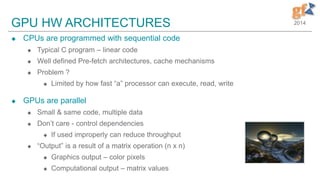
2014GPU HW ARCHITECTURES
 CPUs are programmed with sequential code
 Typical C program – linear code
 Well defined Pre-fetch architectures, cache mechanisms
 Problem ?
 Limited by how fast “a” processor can execute, read, write
 GPUs are parallel
 Small & same code, multiple data
 Don’t care - control dependencies
 If used improperly can reduce throughput
 “Output” is a result of a matrix operation (n x n)
 Graphics output – color pixels
 Computational output – matrix values
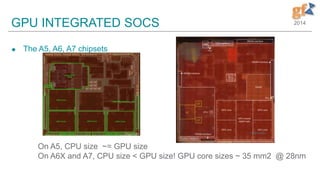
2014GPU INTEGRATED SOCS
 The A5, A6, A7 chipsets
On A5, CPU size ~= GPU size
On A6X and A7, CPU size < GPU size! GPU core sizes ~ 35 mm2 @ 28nm
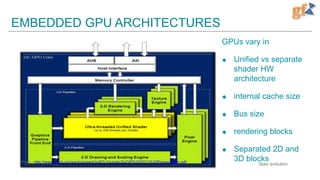
EMBEDDED GPU ARCHITECTURES
GPUs vary in
 Unified vs separate
shader HW
architecture
 internal cache size
 Bus size
 rendering blocks
 Separated 2D and
3D blocksFrom - http://www.socip.org/socip/speech/pdf/2-Vivante-SoCIP%202011%20Presentation.pdf
Spec evolution
2014
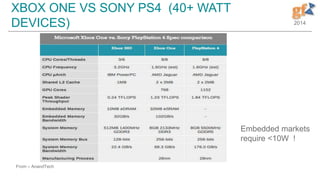
XBOX ONE VS SONY PS4 (40+ WATT
DEVICES)
From – AnandTech
Embedded markets
require <10W !
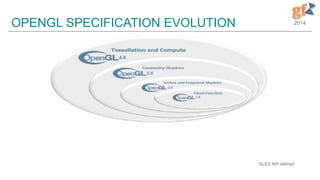
2014OPENGL SPECIFICATION EVOLUTION
GLES API defined
2014THE OPENGL ES API
 From the Khronos OpenGL ES Reference Card
 “OpenGL® ES is a software interface to graphics hardware.
 The interface consists of a set of procedures and functions that allow a
programmer to specify the objects and operations involved in producing high-
quality graphical images, specifically color images of three-dimensional
objects”
 API reference card
 http://www.khronos.org/opengles/sdk/docs/reference_cards/OpenGL-ES-2_0-
Reference-card.pdf
Dependencies
2014OPENGL DEPENDENCIES
 OpenGL depends on a number of external systems to run
 A Windowing system (abstracted by EGL/ WGL/ XGL …)
 External inputs – texture files, 3D modelling tools, shaders, sounds, …
 OpenGL is directly used by
 OS/ Driver developers (ofcourse!)
 HW IP designers
 Game studios (optimisation)
 Researchers (Modelling, Realism, ) …
 Tools developers
 Application developers do not generally program on OpenGL, but rather
do it on an Android API binding, or Java binding Extensions
2014WHAT ARE EXTENSIONS ?
 Extension types
 OES – Conformance tested by Khronos
 EXT – Extension supported by >1 IP vendor
 Proprietary (vendor_ prefix) – Extension from 1 IP vendor
 How to check for extensions ?
 getSupportedExtensions (WebGL), getExtension()
 glGetString (openGL ES)
 Number of extensions
 OpenGL  400 +
 OpenGL ES  100+
GLES 3
2014OPENGL ES 3.0
 Announced 4Q 2012
 New features
 ETC (ETC2) texture compression support (+Alpha)
 Additional objects for managing Uniforms, Pixel Buffers
 3D textures
 Geometry instancing
 Multiple Render Target support
 MSAA to texture
10
Client Server
2014THE GL CLIENT – SERVER MODEL
 Client (application on host), server (OpenGL on GPU)
 Server can have multiple rendering contexts, but has a global state
 Client will connect to one of the contexts at any point of time
 Client can set the states of the server by sending commands
 Further API calls will thus be affected by the previous states set by the client
 Server expects not-to-be interrupted by the client during operation
 Inherent nature of the parallel processor
GL,SL, EGL spec versions
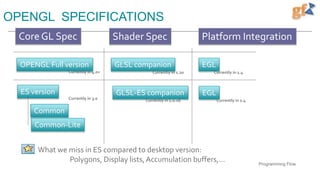
OPENGL SPECIFICATIONS
OPENGL Full version
ES version
Common
Common-Lite
GLSL companion
GLSL-ES companion
What we miss in ES compared to desktop version:
Polygons, Display lists,Accumulation buffers,…
Currently in 4.0+
Currently in 3.0 Currently in 1.0.16
Currently in 1.20
EGL
Currently in 1.4
Core GL Spec Shader Spec Platform Integration
EGL
Currently in 1.4
Programming Flow
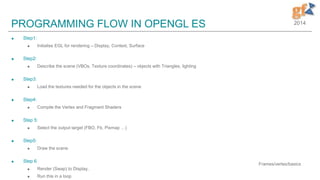
2014PROGRAMMING FLOW IN OPENGL ES
 Step1:
 Initialise EGL for rendering – Display, Context, Surface
 Step2:
 Describe the scene (VBOs, Texture coordinates) – objects with Triangles, lighting
 Step3:
 Load the textures needed for the objects in the scene
 Step4:
 Compile the Vertex and Fragment Shaders
 Step 5:
 Select the output target (FBO, Fb, Pixmap …)
 Step5:
 Draw the scene
 Step 6
 Render (Swap) to Display,
 Run this in a loop
Frames/vertex/basics
2014PRELIMINARIES
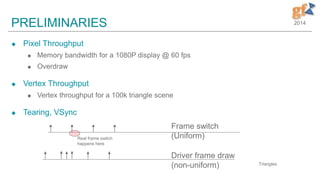
 Pixel Throughput
 Memory bandwidth for a 1080P display @ 60 fps
 Overdraw
 Vertex Throughput
 Vertex throughput for a 100k triangle scene
 Tearing, VSync
Frame switch
(Uniform)
Driver frame draw
(non-uniform)
Real frame switch
happens here
Triangles
2014WHY TRIANGLES ?
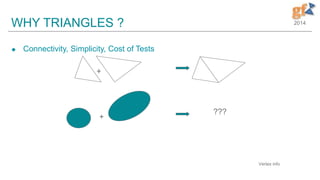
 Connectivity, Simplicity, Cost of Tests
+
+
???
Vertex info
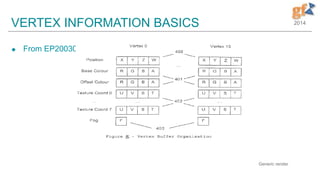
2014VERTEX INFORMATION BASICS
 From EP20030250715
16
Generic render
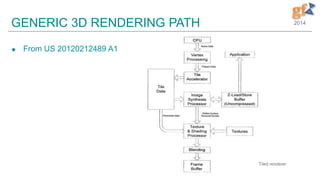
2014GENERIC 3D RENDERING PATH
 From US 20120212489 A1
17
Tiled renderer
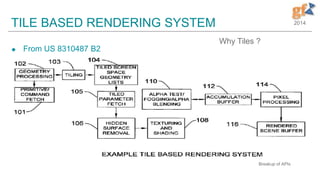
2014TILE BASED RENDERING SYSTEM
 From US 8310487 B2
18
Why Tiles ?
Breakup of APIs
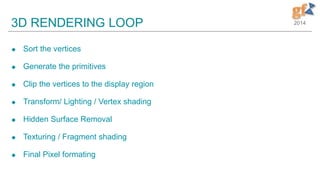
20143D RENDERING LOOP
 Sort the vertices
 Generate the primitives
 Clip the vertices to the display region
 Transform/ Lighting / Vertex shading
 Hidden Surface Removal
 Texturing / Fragment shading
 Final Pixel formating
19
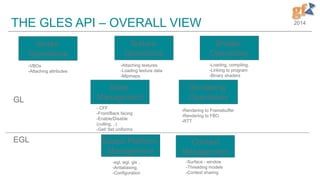
2014THE GLES API – OVERALL VIEW
Global Platform
Management
Texture
Operations
Shader
Operations
Rendering
Operations
-Attaching textures
-Loading texture data
-Mipmaps
-Loading, compiling,
-Linking to program
-Binary shaders
-Rendering to Framebuffer
-Rendering to FBO
-RTT
State
Management
- CFF
-Front/Back facing
-Enable/Disable
(culling, ..)
-Get/ Set uniforms
-egl, wgl, glx ..
-Antialiasing,
-Configuration
Context
Management
-Surface - window
-Threading models
-Context sharing
EGL
GL
Vertex
Operations
-VBOs
-Attaching attributes

GFX Part 1 - Introduction to GPU HW and OpenGL ES specifications

  • 1.
    INTRODUCTION TO GRAPHICS GFX2014Advanced Graphics Workshop, Bangalore 1
  • 2.
    2014GPU HW ARCHITECTURES CPUs are programmed with sequential code  Typical C program – linear code  Well defined Pre-fetch architectures, cache mechanisms  Problem ?  Limited by how fast “a” processor can execute, read, write  GPUs are parallel  Small & same code, multiple data  Don’t care - control dependencies  If used improperly can reduce throughput  “Output” is a result of a matrix operation (n x n)  Graphics output – color pixels  Computational output – matrix values
  • 3.
    2014GPU INTEGRATED SOCS The A5, A6, A7 chipsets On A5, CPU size ~= GPU size On A6X and A7, CPU size < GPU size! GPU core sizes ~ 35 mm2 @ 28nm
  • 4.
    EMBEDDED GPU ARCHITECTURES GPUsvary in  Unified vs separate shader HW architecture  internal cache size  Bus size  rendering blocks  Separated 2D and 3D blocksFrom - http://www.socip.org/socip/speech/pdf/2-Vivante-SoCIP%202011%20Presentation.pdf Spec evolution
  • 5.
    2014 XBOX ONE VSSONY PS4 (40+ WATT DEVICES) From – AnandTech Embedded markets require <10W !
  • 6.
  • 7.
    2014THE OPENGL ESAPI  From the Khronos OpenGL ES Reference Card  “OpenGL® ES is a software interface to graphics hardware.  The interface consists of a set of procedures and functions that allow a programmer to specify the objects and operations involved in producing high- quality graphical images, specifically color images of three-dimensional objects”  API reference card  http://www.khronos.org/opengles/sdk/docs/reference_cards/OpenGL-ES-2_0- Reference-card.pdf Dependencies
  • 8.
    2014OPENGL DEPENDENCIES  OpenGLdepends on a number of external systems to run  A Windowing system (abstracted by EGL/ WGL/ XGL …)  External inputs – texture files, 3D modelling tools, shaders, sounds, …  OpenGL is directly used by  OS/ Driver developers (ofcourse!)  HW IP designers  Game studios (optimisation)  Researchers (Modelling, Realism, ) …  Tools developers  Application developers do not generally program on OpenGL, but rather do it on an Android API binding, or Java binding Extensions
  • 9.
    2014WHAT ARE EXTENSIONS?  Extension types  OES – Conformance tested by Khronos  EXT – Extension supported by >1 IP vendor  Proprietary (vendor_ prefix) – Extension from 1 IP vendor  How to check for extensions ?  getSupportedExtensions (WebGL), getExtension()  glGetString (openGL ES)  Number of extensions  OpenGL  400 +  OpenGL ES  100+ GLES 3
  • 10.
    2014OPENGL ES 3.0 Announced 4Q 2012  New features  ETC (ETC2) texture compression support (+Alpha)  Additional objects for managing Uniforms, Pixel Buffers  3D textures  Geometry instancing  Multiple Render Target support  MSAA to texture 10 Client Server
  • 11.
    2014THE GL CLIENT– SERVER MODEL  Client (application on host), server (OpenGL on GPU)  Server can have multiple rendering contexts, but has a global state  Client will connect to one of the contexts at any point of time  Client can set the states of the server by sending commands  Further API calls will thus be affected by the previous states set by the client  Server expects not-to-be interrupted by the client during operation  Inherent nature of the parallel processor GL,SL, EGL spec versions
  • 12.
    OPENGL SPECIFICATIONS OPENGL Fullversion ES version Common Common-Lite GLSL companion GLSL-ES companion What we miss in ES compared to desktop version: Polygons, Display lists,Accumulation buffers,… Currently in 4.0+ Currently in 3.0 Currently in 1.0.16 Currently in 1.20 EGL Currently in 1.4 Core GL Spec Shader Spec Platform Integration EGL Currently in 1.4 Programming Flow
  • 13.
    2014PROGRAMMING FLOW INOPENGL ES  Step1:  Initialise EGL for rendering – Display, Context, Surface  Step2:  Describe the scene (VBOs, Texture coordinates) – objects with Triangles, lighting  Step3:  Load the textures needed for the objects in the scene  Step4:  Compile the Vertex and Fragment Shaders  Step 5:  Select the output target (FBO, Fb, Pixmap …)  Step5:  Draw the scene  Step 6  Render (Swap) to Display,  Run this in a loop Frames/vertex/basics
  • 14.
    2014PRELIMINARIES  Pixel Throughput Memory bandwidth for a 1080P display @ 60 fps  Overdraw  Vertex Throughput  Vertex throughput for a 100k triangle scene  Tearing, VSync Frame switch (Uniform) Driver frame draw (non-uniform) Real frame switch happens here Triangles
  • 15.
    2014WHY TRIANGLES ? Connectivity, Simplicity, Cost of Tests + + ??? Vertex info
  • 16.
    2014VERTEX INFORMATION BASICS From EP20030250715 16 Generic render
  • 17.
    2014GENERIC 3D RENDERINGPATH  From US 20120212489 A1 17 Tiled renderer
  • 18.
    2014TILE BASED RENDERINGSYSTEM  From US 8310487 B2 18 Why Tiles ? Breakup of APIs
  • 19.
    20143D RENDERING LOOP Sort the vertices  Generate the primitives  Clip the vertices to the display region  Transform/ Lighting / Vertex shading  Hidden Surface Removal  Texturing / Fragment shading  Final Pixel formating 19
  • 20.
    2014THE GLES API– OVERALL VIEW Global Platform Management Texture Operations Shader Operations Rendering Operations -Attaching textures -Loading texture data -Mipmaps -Loading, compiling, -Linking to program -Binary shaders -Rendering to Framebuffer -Rendering to FBO -RTT State Management - CFF -Front/Back facing -Enable/Disable (culling, ..) -Get/ Set uniforms -egl, wgl, glx .. -Antialiasing, -Configuration Context Management -Surface - window -Threading models -Context sharing EGL GL Vertex Operations -VBOs -Attaching attributes