2015
Trends and Opportunities in
Consumer Electronics
Prabindh Sundareson
prabindh@yahoo.com
@ Oxford College of Engineering
2015
About the IEEE Consumer Electronics Society
● Founder chair of the Bangalore Chapter, started in 2010
● Awarded “Best Chapter” of the year, 2014, by IEEE section
● Advanced Graphics (GFX) workshops being held every year, since 2011
● The goals of the chapter are to:
– 1. Help current CE practitioners improve their capabilities, and lead to further
fundamental CE research and development in the Bangalore area, and India in
general.
– 2. Mentor and groom the next generation of CE Engineers by working directly with local
and national Engineering Colleges and Universities.
– 3. Provide a common platform for CE organizations to share experiences and
knowledge, and create common India specific standards in the longer term.
● ==> Please plan to join IEEE CE Society as a volunteer, member !!
2015
Overview of Todays Talk
● What is a Consumer Electronics (CE) device ?
● Core components of Next-Gen Consumer Electronics
– Sensors
– Display & Graphics
– User Interfaces
– Machine Learning
– Cloud storage and Processing
● CE Applications
– CE in Automobiles
2015
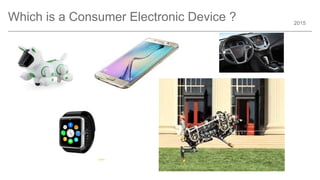
Which is a Consumer Electronic Device ?
2015
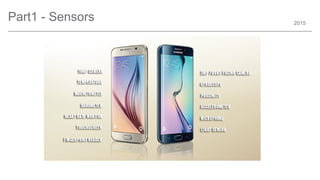
Part1 - Sensors
2015
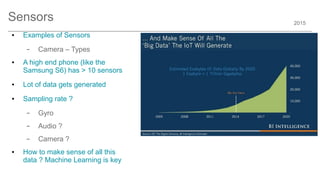
Sensors
● Examples of Sensors
– Camera – Types
● A high end phone (like the
Samsung S6) has > 10 sensors
● Lot of data gets generated
● Sampling rate ?
– Gyro
– Audio ?
– Camera ?
● How to make sense of all this
data ? Machine Learning is key
2015
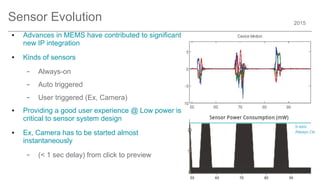
Sensor Evolution
● Advances in MEMS have contributed to significant
new IP integration
● Kinds of sensors
– Always-on
– Auto triggered
– User triggered (Ex, Camera)
● Providing a good user experience @ Low power is
critical to sensor system design
● Ex, Camera has to be started almost
instantaneously
– (< 1 sec delay) from click to preview
2015
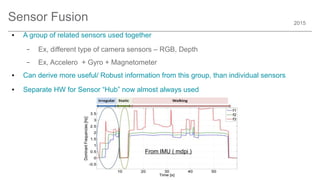
Sensor Fusion
● A group of related sensors used together
– Ex, different type of camera sensors – RGB, Depth
– Ex, Accelero + Gyro + Magnetometer
● Can derive more useful/ Robust information from this group, than individual sensors
● Separate HW for Sensor “Hub” now almost always used
From IMU ( mdpi )
2015
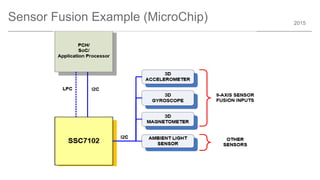
Sensor Fusion Example (MicroChip)
2015
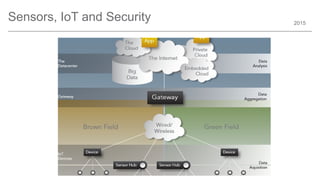
Sensors, IoT and Security
2015
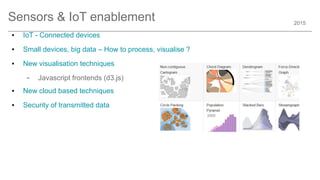
Sensors & IoT enablement
● IoT - Connected devices
● Small devices, big data – How to process, visualise ?
● New visualisation techniques
– Javascript frontends (d3.js)
● New cloud based techniques
● Security of transmitted data
2015
Sensors - Summary
● Hundreds of sensors will be carried by every one in the next couple of years
● Low power, Always-on designs for all sensors are still not feasible
● Making use of all this data, will require enormous amount of Machine Learning resources
● Discussion – Which new type of sensors will improve our quality of Life ?
2015
Display & Graphics
2015
Introduction
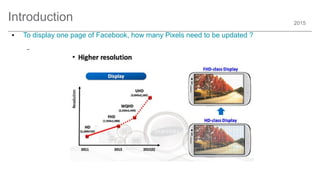
● To display one page of Facebook, how many Pixels need to be updated ?
–
2015
GPU HW Architectures
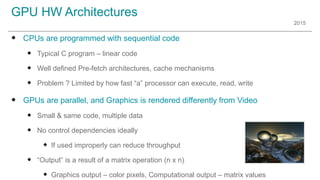
u CPUs are programmed with sequential code
u Typical C program – linear code
u Well defined Pre-fetch architectures, cache mechanisms
u Problem ? Limited by how fast “a” processor can execute, read, write
u GPUs are parallel, and Graphics is rendered differently from Video
u Small & same code, multiple data
u No control dependencies ideally
u If used improperly can reduce throughput
u “Output” is a result of a matrix operation (n x n)
u Graphics output – color pixels, Computational output – matrix values
2015
Video and Graphics
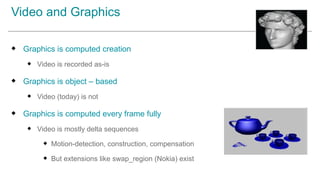
u Graphics is computed creation
u Video is recorded as-is
u Graphics is object – based
u Video (today) is not
u Graphics is computed every frame fully
u Video is mostly delta sequences
u Motion-detection, construction, compensation
u But extensions like swap_region (Nokia) exist
2015
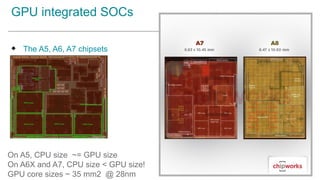
GPU integrated SOCs
u The A5, A6, A7 chipsets
On A5, CPU size ~= GPU size
On A6X and A7, CPU size < GPU size!
GPU core sizes ~ 35 mm2 @ 28nm
2015
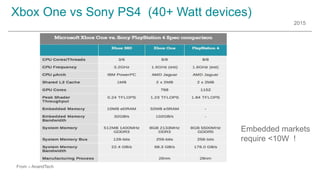
Xbox One vs Sony PS4 (40+ Watt devices)
From – AnandTech
Embedded markets
require <10W !
2015
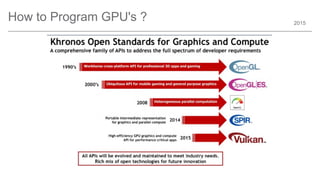
How to Program GPU's ?
2015
Graphics - Summary
● GPU is a critical portion of a Display based device
● GPU operates quite differently from a CPU
● A GPU programmer needs to know Graphics Oriented APIs (like OpenGL)
●
●
● Discussion – Is there a relation between a GPU and Usability of a Consumer Device ?
2015
User Interfaces
2015
User Interfaces
● Touch screen based interfaces considered to be on the way out
● More natural interfaces based on Gesture, Voice, Gaze … being rolled out
● Consider Virtual Reality based interfaces
2015
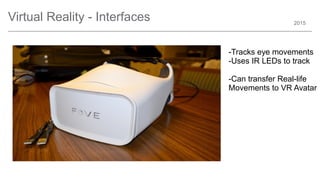
Virtual Reality - Interfaces
-Tracks eye movements
-Uses IR LEDs to track
-Can transfer Real-life
Movements to VR Avatar
2015
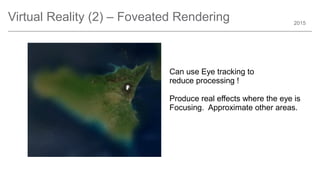
Virtual Reality (2) – Foveated Rendering
Can use Eye tracking to
reduce processing !
Produce real effects where the eye is
Focusing. Approximate other areas.
2015
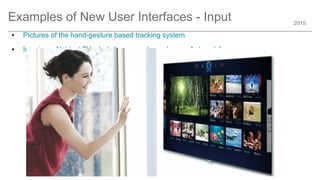
Examples of New User Interfaces - Input
● Pictures of the hand-gesture based tracking system
● Imagine – Not just TVs, but also computers, phones, Automobiles ….
2015
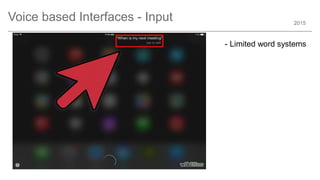
Voice based Interfaces - Input
- Limited word systems
2015
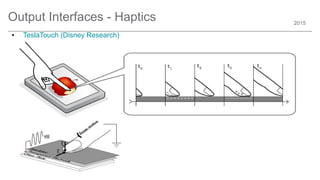
Output Interfaces - Haptics
● TeslaTouch (Disney Research)
2015
User Interfaces - Summary
● Interesting and more natural User Interfaces will be integrated across all categories of
devices – CE and Embedded …
● Speed of response, and Accuracy of recognition are key for input
● Natural response is key for Output (ex, Haptics)
● Discussion
– Which User Interface will you prefer, why ?
2015
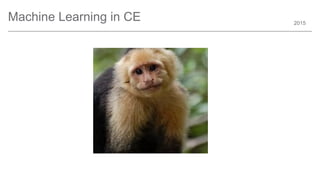
Machine Learning in CE
2015
Where is Machine Learning applied ?
● ML has been applied primarily in areas like automatic Image classification
● Ex, Gallery application in mobile phones
●
● Very soon, Machine Learning is planned to be applied in even more areas
– Robotics
– Power and Dynamic Memory reduction in Portable devices
– User adaptation
– Security (ex, Malware detection), Safety (Detection of unsafe environments)
– Health
2015
Where is Machine Learning applied ?
● ML has been applied primarily in areas like automatic Image classification
● Ex, Gallery application in mobile phones
●
● Very soon, Machine Learning is planned to be applied in even more areas
– Robotics
– Power and Dynamic Memory reduction in Portable devices
– User adaptation
– Security (ex, Malware detection), Safety (Detection of unsafe environments)
– Health
2015
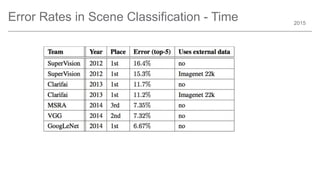
Error Rates in Scene Classification - Time
2015
Machine Learning in Simple Robotics
● Powerful processors now even in Educational Robots like LEGO EV3
● ARM9 processor with memory and storage
● Run an Ubuntu desktop on the EV3
– Ev3dev
● Can be used to apply Machine Vision in real-time
2015
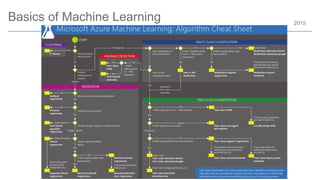
Basics of Machine Learning
2015
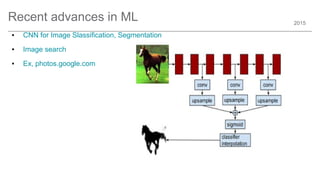
Recent advances in ML
● CNN for Image Slassification, Segmentation
● Image search
● Ex, photos.google.com
2015
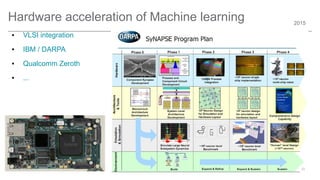
Hardware acceleration of Machine learning
● VLSI integration
● IBM / DARPA
● Qualcomm Zeroth
● ...
2015
Machine Learning summary
● Classic techniques like SVMs are still widely used – Fruit sorting, ...
● Recently new configurations of Neural Networks have been introduced
● Scene/ Image classification has made huge strides with Convolutional Neural Networks
●
●
● Discussion
– Where can ML be used more efficiently ?
2015
Use-cases – CE in Automobiles
2015
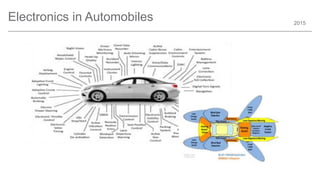
Electronics in Automobiles
2015
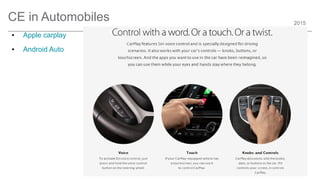
CE in Automobiles
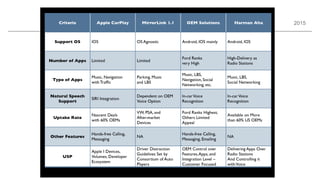
● Apple carplay
● Android Auto
2015
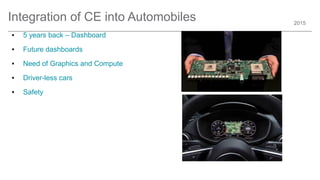
Integration of CE into Automobiles
● 5 years back – Dashboard
● Future dashboards
● Need of Graphics and Compute
● Driver-less cars
● Safety
2015
2015
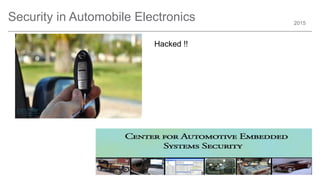
Security in Automobile Electronics
Hacked !!
2015
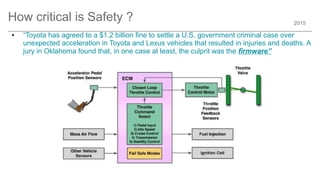
How critical is Safety ?
● “Toyota has agreed to a $1.2 billion fine to settle a U.S. government criminal case over
unexpected acceleration in Toyota and Lexus vehicles that resulted in injuries and deaths. A
jury in Oklahoma found that, in one case at least, the culprit was the firmware”
2015
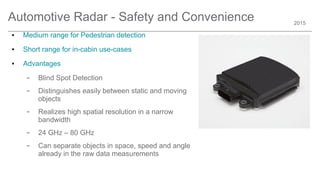
Automotive Radar - Safety and Convenience
● Medium range for Pedestrian detection
● Short range for in-cabin use-cases
● Advantages
– Blind Spot Detection
– Distinguishes easily between static and moving
objects
– Realizes high spatial resolution in a narrow
bandwidth
– 24 GHz – 80 GHz
– Can separate objects in space, speed and angle
already in the raw data measurements
2015
CE in Automobiles - Summary
● Machine Learning, Intuitive Graphics, and Safety – will determine which technologies win in
the automotive space
● In addition to pure computational throughput, Safe processing (including Redundancy) will
need to be enabled in Automobiles
2015
Research Trends in Consumer Electronics
● Camera and Sensors – Bringing them always on
● Sensor fusion to derive more use-cases (ex, 3D scanning using Color + Depth cameras)
● Low power HW architectures for CPUs and GPUs
● Battery chemistry - techniques
● CNN based Machine Learning for Recognition, Classification …
● Protocols for IoT networks
●
● How to keep ahead ?
– Use http://arxiv.org/ !!!
2015
Summary
● Covered top 5 important areas for Consumer Electronics and related fields
● Discussed new use-cases employing Sensors and User Interfaces
● Identified and discussed Research Trends in CE
2015
Thank you !!

IEEE - Consumer Electronics Trends Opportunities (2015)

  • 1.
    2015 Trends and Opportunitiesin Consumer Electronics Prabindh Sundareson prabindh@yahoo.com @ Oxford College of Engineering
  • 2.
    2015 About the IEEEConsumer Electronics Society ● Founder chair of the Bangalore Chapter, started in 2010 ● Awarded “Best Chapter” of the year, 2014, by IEEE section ● Advanced Graphics (GFX) workshops being held every year, since 2011 ● The goals of the chapter are to: – 1. Help current CE practitioners improve their capabilities, and lead to further fundamental CE research and development in the Bangalore area, and India in general. – 2. Mentor and groom the next generation of CE Engineers by working directly with local and national Engineering Colleges and Universities. – 3. Provide a common platform for CE organizations to share experiences and knowledge, and create common India specific standards in the longer term. ● ==> Please plan to join IEEE CE Society as a volunteer, member !!
  • 3.
    2015 Overview of TodaysTalk ● What is a Consumer Electronics (CE) device ? ● Core components of Next-Gen Consumer Electronics – Sensors – Display & Graphics – User Interfaces – Machine Learning – Cloud storage and Processing ● CE Applications – CE in Automobiles
  • 4.
    2015 Which is aConsumer Electronic Device ?
  • 5.
  • 6.
    2015 Sensors ● Examples ofSensors – Camera – Types ● A high end phone (like the Samsung S6) has > 10 sensors ● Lot of data gets generated ● Sampling rate ? – Gyro – Audio ? – Camera ? ● How to make sense of all this data ? Machine Learning is key
  • 7.
    2015 Sensor Evolution ● Advancesin MEMS have contributed to significant new IP integration ● Kinds of sensors – Always-on – Auto triggered – User triggered (Ex, Camera) ● Providing a good user experience @ Low power is critical to sensor system design ● Ex, Camera has to be started almost instantaneously – (< 1 sec delay) from click to preview
  • 8.
    2015 Sensor Fusion ● Agroup of related sensors used together – Ex, different type of camera sensors – RGB, Depth – Ex, Accelero + Gyro + Magnetometer ● Can derive more useful/ Robust information from this group, than individual sensors ● Separate HW for Sensor “Hub” now almost always used From IMU ( mdpi )
  • 9.
  • 10.
  • 11.
    2015 Sensors & IoTenablement ● IoT - Connected devices ● Small devices, big data – How to process, visualise ? ● New visualisation techniques – Javascript frontends (d3.js) ● New cloud based techniques ● Security of transmitted data
  • 12.
    2015 Sensors - Summary ●Hundreds of sensors will be carried by every one in the next couple of years ● Low power, Always-on designs for all sensors are still not feasible ● Making use of all this data, will require enormous amount of Machine Learning resources ● Discussion – Which new type of sensors will improve our quality of Life ?
  • 13.
  • 14.
    2015 Introduction ● To displayone page of Facebook, how many Pixels need to be updated ? –
  • 15.
    2015 GPU HW Architectures uCPUs are programmed with sequential code u Typical C program – linear code u Well defined Pre-fetch architectures, cache mechanisms u Problem ? Limited by how fast “a” processor can execute, read, write u GPUs are parallel, and Graphics is rendered differently from Video u Small & same code, multiple data u No control dependencies ideally u If used improperly can reduce throughput u “Output” is a result of a matrix operation (n x n) u Graphics output – color pixels, Computational output – matrix values
  • 16.
    2015 Video and Graphics uGraphics is computed creation u Video is recorded as-is u Graphics is object – based u Video (today) is not u Graphics is computed every frame fully u Video is mostly delta sequences u Motion-detection, construction, compensation u But extensions like swap_region (Nokia) exist
  • 17.
    2015 GPU integrated SOCs uThe A5, A6, A7 chipsets On A5, CPU size ~= GPU size On A6X and A7, CPU size < GPU size! GPU core sizes ~ 35 mm2 @ 28nm
  • 18.
    2015 Xbox One vsSony PS4 (40+ Watt devices) From – AnandTech Embedded markets require <10W !
  • 19.
  • 20.
    2015 Graphics - Summary ●GPU is a critical portion of a Display based device ● GPU operates quite differently from a CPU ● A GPU programmer needs to know Graphics Oriented APIs (like OpenGL) ● ● ● Discussion – Is there a relation between a GPU and Usability of a Consumer Device ?
  • 21.
  • 22.
    2015 User Interfaces ● Touchscreen based interfaces considered to be on the way out ● More natural interfaces based on Gesture, Voice, Gaze … being rolled out ● Consider Virtual Reality based interfaces
  • 23.
    2015 Virtual Reality -Interfaces -Tracks eye movements -Uses IR LEDs to track -Can transfer Real-life Movements to VR Avatar
  • 24.
    2015 Virtual Reality (2)– Foveated Rendering Can use Eye tracking to reduce processing ! Produce real effects where the eye is Focusing. Approximate other areas.
  • 25.
    2015 Examples of NewUser Interfaces - Input ● Pictures of the hand-gesture based tracking system ● Imagine – Not just TVs, but also computers, phones, Automobiles ….
  • 26.
    2015 Voice based Interfaces- Input - Limited word systems
  • 27.
    2015 Output Interfaces -Haptics ● TeslaTouch (Disney Research)
  • 28.
    2015 User Interfaces -Summary ● Interesting and more natural User Interfaces will be integrated across all categories of devices – CE and Embedded … ● Speed of response, and Accuracy of recognition are key for input ● Natural response is key for Output (ex, Haptics) ● Discussion – Which User Interface will you prefer, why ?
  • 29.
  • 30.
    2015 Where is MachineLearning applied ? ● ML has been applied primarily in areas like automatic Image classification ● Ex, Gallery application in mobile phones ● ● Very soon, Machine Learning is planned to be applied in even more areas – Robotics – Power and Dynamic Memory reduction in Portable devices – User adaptation – Security (ex, Malware detection), Safety (Detection of unsafe environments) – Health
  • 31.
    2015 Where is MachineLearning applied ? ● ML has been applied primarily in areas like automatic Image classification ● Ex, Gallery application in mobile phones ● ● Very soon, Machine Learning is planned to be applied in even more areas – Robotics – Power and Dynamic Memory reduction in Portable devices – User adaptation – Security (ex, Malware detection), Safety (Detection of unsafe environments) – Health
  • 32.
    2015 Error Rates inScene Classification - Time
  • 33.
    2015 Machine Learning inSimple Robotics ● Powerful processors now even in Educational Robots like LEGO EV3 ● ARM9 processor with memory and storage ● Run an Ubuntu desktop on the EV3 – Ev3dev ● Can be used to apply Machine Vision in real-time
  • 34.
  • 35.
    2015 Recent advances inML ● CNN for Image Slassification, Segmentation ● Image search ● Ex, photos.google.com
  • 36.
    2015 Hardware acceleration ofMachine learning ● VLSI integration ● IBM / DARPA ● Qualcomm Zeroth ● ...
  • 37.
    2015 Machine Learning summary ●Classic techniques like SVMs are still widely used – Fruit sorting, ... ● Recently new configurations of Neural Networks have been introduced ● Scene/ Image classification has made huge strides with Convolutional Neural Networks ● ● ● Discussion – Where can ML be used more efficiently ?
  • 38.
    2015 Use-cases – CEin Automobiles
  • 39.
  • 40.
    2015 CE in Automobiles ●Apple carplay ● Android Auto
  • 41.
    2015 Integration of CEinto Automobiles ● 5 years back – Dashboard ● Future dashboards ● Need of Graphics and Compute ● Driver-less cars ● Safety
  • 42.
  • 43.
    2015 Security in AutomobileElectronics Hacked !!
  • 44.
    2015 How critical isSafety ? ● “Toyota has agreed to a $1.2 billion fine to settle a U.S. government criminal case over unexpected acceleration in Toyota and Lexus vehicles that resulted in injuries and deaths. A jury in Oklahoma found that, in one case at least, the culprit was the firmware”
  • 45.
    2015 Automotive Radar -Safety and Convenience ● Medium range for Pedestrian detection ● Short range for in-cabin use-cases ● Advantages – Blind Spot Detection – Distinguishes easily between static and moving objects – Realizes high spatial resolution in a narrow bandwidth – 24 GHz – 80 GHz – Can separate objects in space, speed and angle already in the raw data measurements
  • 46.
    2015 CE in Automobiles- Summary ● Machine Learning, Intuitive Graphics, and Safety – will determine which technologies win in the automotive space ● In addition to pure computational throughput, Safe processing (including Redundancy) will need to be enabled in Automobiles
  • 47.
    2015 Research Trends inConsumer Electronics ● Camera and Sensors – Bringing them always on ● Sensor fusion to derive more use-cases (ex, 3D scanning using Color + Depth cameras) ● Low power HW architectures for CPUs and GPUs ● Battery chemistry - techniques ● CNN based Machine Learning for Recognition, Classification … ● Protocols for IoT networks ● ● How to keep ahead ? – Use http://arxiv.org/ !!!
  • 48.
    2015 Summary ● Covered top5 important areas for Consumer Electronics and related fields ● Discussed new use-cases employing Sensors and User Interfaces ● Identified and discussed Research Trends in CE
  • 49.