RAVAL JAIMIN M
(Wireless Mobile Computing)




Interface with computers using gestures of the
human body, typically hand movements. In
gesture recognition technology, a camera reads
the movements of the human body and
communicates the data to a computer that uses
the gestures as input to control devices or
applications
Gesture recognition can be conducted with
techniques from computer vision and image
processing.
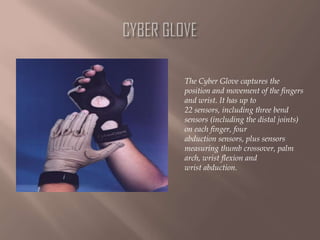
The Cyber Glove captures the
position and movement of the fingers
and wrist. It has up to
22 sensors, including three bend
sensors (including the distal joints)
on each finger, four
abduction sensors, plus sensors
measuring thumb crossover, palm
arch, wrist flexion and
wrist abduction.
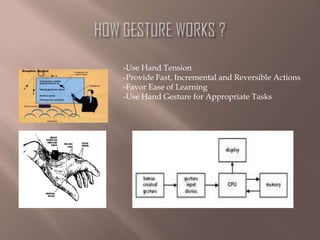
-Use Hand Tension
-Provide Fast, Incremental and Reversible Actions
-Favor Ease of Learning
-Use Hand Gesture for Appropriate Tasks
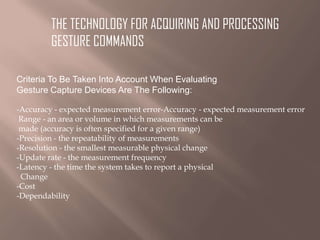
THE TECHNOLOGY FOR ACQUIRING AND PROCESSING
GESTURE COMMANDS
Criteria To Be Taken Into Account When Evaluating
Gesture Capture Devices Are The Following:
-Accuracy - expected measurement error-Accuracy - expected measurement error
Range - an area or volume in which measurements can be
made (accuracy is often specified for a given range)
-Precision - the repeatability of measurements
-Resolution - the smallest measurable physical change
-Update rate - the measurement frequency
-Latency - the time the system takes to report a physical
Change
-Cost
-Dependability
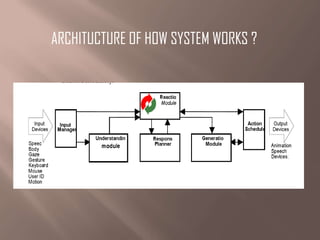
ARCHITUCTURE OF HOW SYSTEM WORKS ?
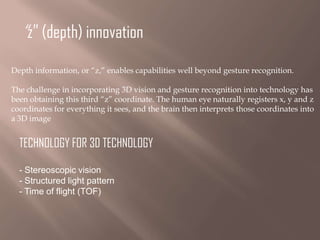
“z” (depth) innovation
Depth information, or “z,” enables capabilities well beyond gesture recognition.
The challenge in incorporating 3D vision and gesture recognition into technology has
been obtaining this third “z” coordinate. The human eye naturally registers x, y and z
coordinates for everything it sees, and the brain then interprets those coordinates into
a 3D image

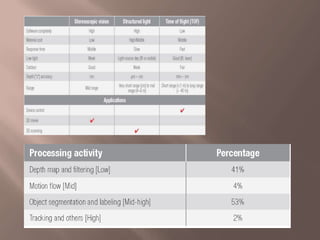
TECHNOLOGY FOR 3D TECHNOLOGY
- Stereoscopic vision
- Structured light pattern
- Time of flight (TOF)
Human gesture recognition for consumer applications
- Industrial
A majority of industrial applications for 3D vision, including industrial and
manufacturing sensors, integrate an imaging system from as few as 1 pixel to
several million pixels.

-Video conferencing
Today’s video conferencing systems offer high-definition images, and newer
systems leverage 3D sensors to deliver an even more realistic and interactive
experience. With integrated 2D and 3D sensors as well as a microphone array, this
enhanced video conferencing system can connect with other enhanced systems to
enable high-quality video processing, facial recognition, 3D imaging, noise
cancellation and content players, including Flash.
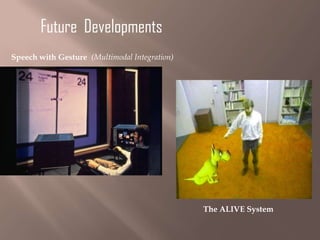
Future Developments
Speech with Gesture (Multimodal Integration)

The ALIVE System
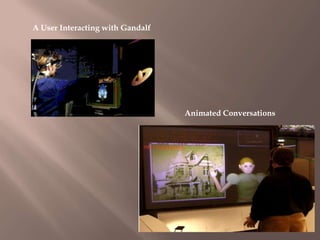
A User Interacting with Gandalf

Animated Conversations
Gesture recognition for computers

Gesture recognition for computers

  • 1.
    RAVAL JAIMIN M (WirelessMobile Computing)
  • 2.
      Interface with computersusing gestures of the human body, typically hand movements. In gesture recognition technology, a camera reads the movements of the human body and communicates the data to a computer that uses the gestures as input to control devices or applications Gesture recognition can be conducted with techniques from computer vision and image processing.
  • 3.
    The Cyber Glovecaptures the position and movement of the fingers and wrist. It has up to 22 sensors, including three bend sensors (including the distal joints) on each finger, four abduction sensors, plus sensors measuring thumb crossover, palm arch, wrist flexion and wrist abduction.
  • 4.
    -Use Hand Tension -ProvideFast, Incremental and Reversible Actions -Favor Ease of Learning -Use Hand Gesture for Appropriate Tasks
  • 5.
    THE TECHNOLOGY FORACQUIRING AND PROCESSING GESTURE COMMANDS Criteria To Be Taken Into Account When Evaluating Gesture Capture Devices Are The Following: -Accuracy - expected measurement error-Accuracy - expected measurement error Range - an area or volume in which measurements can be made (accuracy is often specified for a given range) -Precision - the repeatability of measurements -Resolution - the smallest measurable physical change -Update rate - the measurement frequency -Latency - the time the system takes to report a physical Change -Cost -Dependability
  • 6.
    ARCHITUCTURE OF HOWSYSTEM WORKS ?
  • 7.
    “z” (depth) innovation Depthinformation, or “z,” enables capabilities well beyond gesture recognition. The challenge in incorporating 3D vision and gesture recognition into technology has been obtaining this third “z” coordinate. The human eye naturally registers x, y and z coordinates for everything it sees, and the brain then interprets those coordinates into a 3D image TECHNOLOGY FOR 3D TECHNOLOGY - Stereoscopic vision - Structured light pattern - Time of flight (TOF)
  • 9.
    Human gesture recognitionfor consumer applications - Industrial A majority of industrial applications for 3D vision, including industrial and manufacturing sensors, integrate an imaging system from as few as 1 pixel to several million pixels. -Video conferencing Today’s video conferencing systems offer high-definition images, and newer systems leverage 3D sensors to deliver an even more realistic and interactive experience. With integrated 2D and 3D sensors as well as a microphone array, this enhanced video conferencing system can connect with other enhanced systems to enable high-quality video processing, facial recognition, 3D imaging, noise cancellation and content players, including Flash.
  • 10.
    Future Developments Speech withGesture (Multimodal Integration) The ALIVE System
  • 11.
    A User Interactingwith Gandalf Animated Conversations