Gerunds & infinitives
Gerunds and infinitives   can function as: A gerund is formed by adding – ing  a verb. An infinitive is the base form of the verb, with either the infinitive marker “ to ” or without it, which is called bare infinitive.
The gerund :   This always has the same function as a noun (although it looks like a verb), so it can be used: as the subject of the sentence: e.g.  Eating  people is wrong.   after prepositions: e.g.  She is good at painting. after certain verbs, e.g .  like ,  hate ,  admit ,  imagine   in compound nouns, e.g.  a  driving  lesson, a  swimming  pool, bird- watching , train- spotting   NOUNS ( subjects, objects, subject complements)  As subjects, they take a singular verb.  Only Gerunds can be  object of the preposition.
THE GERUND This  looks  exactly the same as a present participle, and for this reason it is now common to call both forms  'the -ing form'.     a. as the subject of the sentence: -  Eating people is wrong.   Hunting elephants is  dangerous.   -   Flying makes me nervous.
b. as the complement of the verb  'to be' :    -   One of his duties is  attending  meetings.   -  The hardest thing about  learning  English is  understanding the gerund.   -  One of life's pleasures is  having  breakfast in bed
c. after prepositions. The gerund  must  be used when a verb comes after a  preposition: -   Can you sneeze  without   opening  your mouth?   -   She is good at  painting .   -   They're keen  on   windsurfing .   -   She avoided him  by   walking  on the opposite side of the road.   -   We arrived in Madrid  after   driving  all night.   -   My father decided  against   postponing  his trip to Hungary.
This is also true of certain expressions ending in a preposition, e.g.  in spite of, there's no point in..: -   There's no point in  waiting .   -  In spite of  missing  the train, we arrived on  time.
d. after a number of  'phrasal verbs'  which are composed of a verb + preposition/adverb Example: to look forward to, to give up, to be for/against, to take to, to put off, to keep on: -  I  look forward to  hearing  from you soon. ( at the end of a letter)  - When are you going to give up  smoking ?   - She always puts off  goi n g  to the dentist.   - He kept on  asking  for money.
NOTE:  There are some phrasal verbs and other expressions that include the word  'to'  as a preposition,  not  as part of a  to-infinitive :  -  to look forward to, to take to, to be accustomed to, to be used to.  It is important to recognise that  'to'  is a preposition in these cases, as it must be followed by a gerund: - We are looking forward   to   seeing  you.   - I am used  to waiting  for buses.   - She  didnt really take  to studyin ' g  English.
e. in compound nouns   Example: -  a  driving  lesson, a  swimming  pool, bird- watching , train- spotting   It is clear that the meaning is that of a noun, not of a continuous verb. Example: - the pool is not swimming, it is a  pool for swimming in .
f. after the expressions: can't help, can't stand, it's no use/good,   and  the adjective  worth :        -    The elephant couldn't help  falling  in love with the mouse.         -   I can't stand  being  stuck in traffic jams.       -  It's no use/good  trying  to escape.          -   It might be worth  phoning  the station to check the time of the train.
GERUND OR INFINITIVE?   The two groups of verbs below can be followed either by the gerund or by the infinitive. Usually this has no effect on the meaning, but with some verbs there is a clear difference in meaning.  ( Verbs marked * can also be followed by a  that-clause. ) Example:   to prefer -  I prefer  to live  in an apartment.   -  I prefer  living  in an apartment.
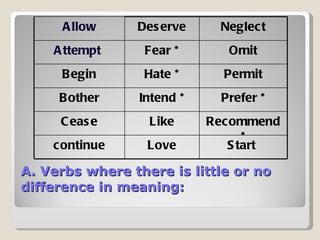
A. Verbs where there is little or no difference in meaning:  Allow Deserve Neglect Attempt   Fear * Omit Begin Hate * Permit Bother Intend * Prefer * Cease Like Recommend * continue Love Start
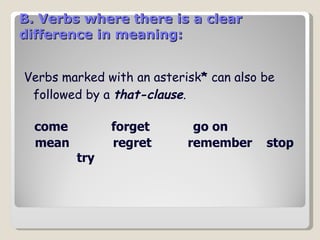
B. Verbs where there is a clear difference in meaning: Verbs marked with an asterisk *  can also be followed by a  that-clause .   come  forget  go on  mean  regret  remember   stop  try
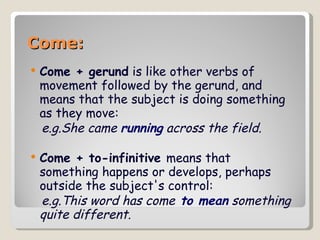
Come: Come + gerund  is like other verbs of movement followed by the gerund, and means that the subject is doing something as they move: e.g.She came  running  across the field.   Come + to-infinitive   means that something happens or develops, perhaps outside the subject's control: e.g.This word has come  to mean  something quite different.
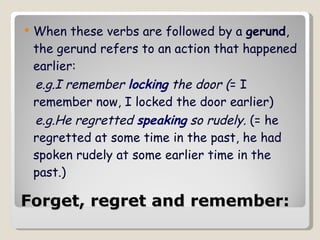
Forget, regret and remember:   When these verbs are followed by a  gerund , the gerund refers to an action that happened earlier: e.g.I remember  locking  the door ( = I remember now, I locked the door earlier)  e.g.He regretted  speaking  so rudely.  (= he regretted at some time in the past, he had spoken rudely at some earlier time in the past.)
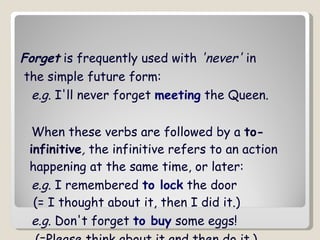
Forget  is frequently used with  'never'  in the simple future form: e.g . I'll never forget  meeting  the Queen.  When these verbs are followed by a  to-infinitive ,  the infinitive refers to an action happening at the same time, or later:  e.g . I remembered  to lock  the door   (= I thought about it, then I did it.)  e.g . Don't forget  to buy  some eggs!   (=Please think about it and then do it.)
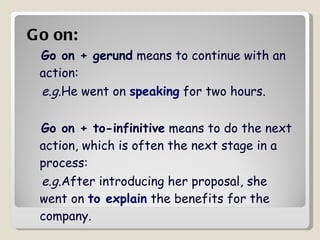
Go on:   Go on + gerund  means to continue with an action: e.g .He went on  speaking  for two hours.  Go on + to-infinitive  means to do the next action, which is often the next stage in a process: e.g .After introducing her proposal, she went on  to explain  the benefits for the company.
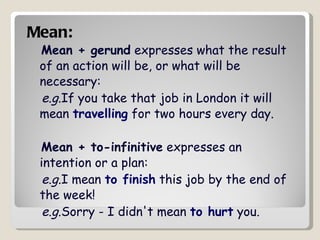
Mean:   Mean + gerund  expresses what the result of an action will be, or what will be necessary: e.g .If you take that job in London it will mean  travelling  for two hours every day.  Mean + to-infinitive  expresses an intention or a plan: e.g .I mean  to finish  this job by the end of the week!  e.g .Sorry - I didn't mean  to hurt  you.
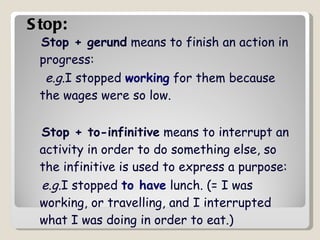
Stop:   Stop + gerund  means to finish an action in progress: e.g .I stopped  working  for them because the wages were so low.  Stop + to-infinitive  means to interrupt an activity in order to do something else, so the infinitive is used to express a purpose: e.g. I stopped  to have  lunch. (= I was working, or travelling, and I interrupted what I was doing in order to eat.)
Try:   Try + gerund  means to experiment with an action that might be a solution to your problem. e.g.  If you have problems sleeping, you could try  doing  some yoga before you go to bed, or you could try  drinking  some warm milk.  e.g.  I can't get in touch with Carl.' 'Have you tried  e-mailing  him?'
Try + to-infinitive  means to make an effort to do something. It may be something very difficult or even impossible: e.g.  We'll try  to phone  at 6 o'clock, but it might be hard to find a public telephone.  e.g . Elephants and mice have to try  to live  together in harmony .
VERBS FOLLOWED BY THE GERUND The gerund is used after certain verbs. Example: miss   : I miss living in England. Those marked can also be followed by a  that-clause
Example: VERB   She admitted...    She admitted...  GERUND   breaking the  window  THAT-CLAUSE  that she had broken the window.
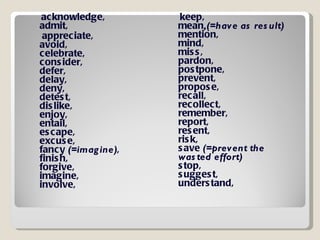
acknowledge, admit, appreciate, avoid, celebrate, consider,  defer, delay, deny, detest,  dislike, enjoy, entail, escape, excuse, fancy  (=imagine) , finish, forgive, imagine, involve,  keep, mean ,(=have as result) mention, mind, miss, pardon, postpone, prevent, propose, recall, recollect, remember, report, resent, risk, save  (=prevent the wasted effort) stop, suggest, understand,
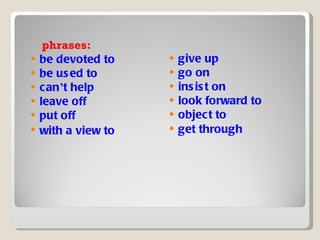
phrases: be devoted to be used to can ’ t help leave off put off with a view to   give up go on insist on look forward to object to get through
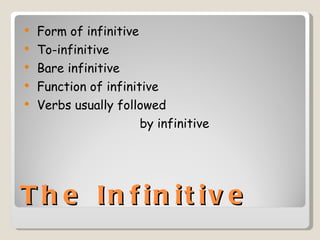
The Infinitive Form of infinitive To-infinitive Bare infinitive Function of infinitive Verbs usually followed  by infinitive
Form of infinitive The infinitive is the base form of a verb. It may be preceded by 'to' (the  to-infinitive) or stand alone  (the  base or zero infinitive).
To-infinitive The to-infinitive is used: after certain verbs. e.g.   want, wish, agree, fail, mean, decide, learn b. after the auxiliaries  to be to ,  to have to ,  and  ought to c. in the pattern  ‘   it is + adjective +  to-infinitive  ‘
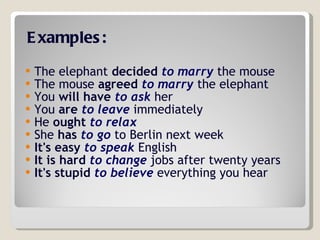
Examples: The elephant  decided   to marry  the mouse  The mouse  agreed   to marry  the elephant  You  will have   to ask  her  You  are   to leave  immediately  He  ought   to relax   She  has   to go  to Berlin next week  It's easy   to speak  English  It is hard   to change  jobs after twenty years  It's stupid   to believe  everything you hear
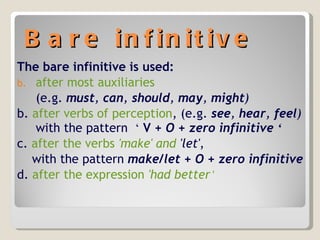
Bare infinitive The bare infinitive is used: after most auxiliaries   (e.g.  must ,  can ,  should ,  may ,  might )  b.  after verbs of perception , (e.g.  see ,  hear ,  feel )  with the pattern  ‘   V  + O + zero infinitive  ‘ c.  after the verbs  'make'  and  'let' , with the pattern  make/let + O + zero infinitive d.  after the expression  'had better ‘
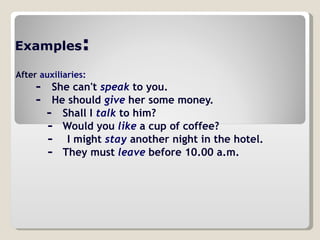
Examples :   After   auxiliaries:           -    She can't  speak  to you.             -    He should  give  her some money.            -  Shall I  talk  to him?        -  Would you  like  a cup of coffee?          -  I might  stay  another night in the hotel.             -  They must  leave  before 10.00 a.m.
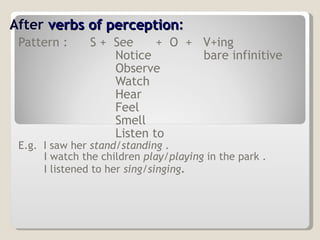
After  verbs of perception : Pattern :   S +  See  +  O  +  V+ing Notice  bare infinitive Observe Watch Hear  Feel Smell Listen to E.g.  I saw her  stand/standing  . I watch the children  play/playing  in the park . I listened to her  sing/singing .
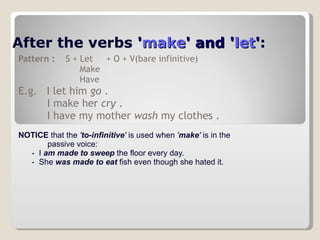
After the verbs  ' make ' and ' let ' :   Pattern :   S + Let  + O + V(bare infinitive) Make Have E.g.  I let him  go  . I make her  cry  . I have my mother  wash  my clothes . NOTICE  that the  ' to-infinitive '  is used when  ' make '  is in the  passive voice:        -  I  am made to sweep  the floor every day.         -  She  was made to eat  fish even though she hated it.
After   'had better' : We  had better   take  some warm clothing. - She  had better   ask  him not to come. - You 'd better   not   smile  at a crocodile! - We  had better   reserve  a room in the hotel. - You 'd better   give  me your address. - They  had better   work   harder   on their grammar!
Function of infinitive The most common uses of the infinitive are: ~ As a subject/object  –  noun e.g. To err is human, to forgive is divine. ( S ) I saw a dog cross the road. ( O ) ~ As an adjective e.g. Their offer to reduce your workload is quite attractive. ( acts as adjective to qualify  “ their offer ”  ) ~  As an adverb e.g. I stop to buy a tape. (acts as adverb to qualify  “ stop ”  )
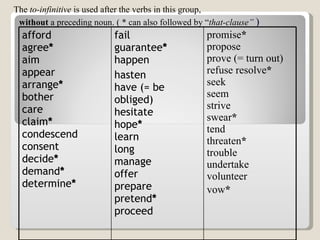
The  to-infinitive  is used after the verbs in this group, without  a preceding noun. ( * can also followed by “ that-clause ”   ) afford agree * aim appear arrange * bother care claim * condescend consent decide * demand * determine * fail guarantee * happen  hasten have (= be obliged) hesitate hope * learn long manage offer prepare pretend * proceed  promise * propose prove (= turn out) refuse resolve * seek seem   strive swear * tend threaten * trouble undertake volunteer vow *
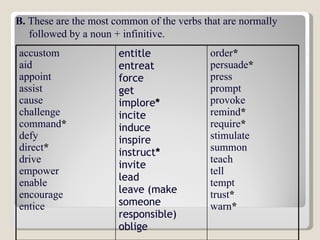
B.  These are the most common of the verbs that are normally  followed by a noun + infinitive.   accustom aid  appoint assist cause challenge command * defy direct * drive empower enable encourage entice  entitle entreat force get implore * incite induce inspire instruct * invite lead leave (make someone responsible) oblige  order * persuade * press prompt provoke remind * require * stimulate summon teach tell tempt trust * warn *
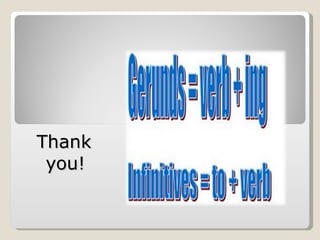
Thank you!

Gerund&infinitive

  • 1.
  • 2.
    Gerunds and infinitives can function as: A gerund is formed by adding – ing a verb. An infinitive is the base form of the verb, with either the infinitive marker “ to ” or without it, which is called bare infinitive.
  • 3.
    The gerund : This always has the same function as a noun (although it looks like a verb), so it can be used: as the subject of the sentence: e.g. Eating people is wrong. after prepositions: e.g. She is good at painting. after certain verbs, e.g . like , hate , admit , imagine in compound nouns, e.g. a driving lesson, a swimming pool, bird- watching , train- spotting NOUNS ( subjects, objects, subject complements) As subjects, they take a singular verb. Only Gerunds can be object of the preposition.
  • 4.
    THE GERUND This looks exactly the same as a present participle, and for this reason it is now common to call both forms 'the -ing form'.   a. as the subject of the sentence: - Eating people is wrong. Hunting elephants is dangerous. - Flying makes me nervous.
  • 5.
    b. as thecomplement of the verb 'to be' : - One of his duties is attending meetings. - The hardest thing about learning English is understanding the gerund. - One of life's pleasures is having breakfast in bed
  • 6.
    c. after prepositions.The gerund must be used when a verb comes after a preposition: - Can you sneeze without opening your mouth? - She is good at painting . - They're keen on windsurfing . - She avoided him by walking on the opposite side of the road. - We arrived in Madrid after driving all night. - My father decided against postponing his trip to Hungary.
  • 7.
    This is alsotrue of certain expressions ending in a preposition, e.g. in spite of, there's no point in..: - There's no point in waiting . - In spite of missing the train, we arrived on time.
  • 8.
    d. after anumber of 'phrasal verbs' which are composed of a verb + preposition/adverb Example: to look forward to, to give up, to be for/against, to take to, to put off, to keep on: - I look forward to hearing from you soon. ( at the end of a letter) - When are you going to give up smoking ? - She always puts off goi n g to the dentist. - He kept on asking for money.
  • 9.
    NOTE: Thereare some phrasal verbs and other expressions that include the word 'to' as a preposition, not as part of a to-infinitive : - to look forward to, to take to, to be accustomed to, to be used to. It is important to recognise that 'to' is a preposition in these cases, as it must be followed by a gerund: - We are looking forward to seeing you. - I am used to waiting for buses. - She didnt really take to studyin ' g English.
  • 10.
    e. in compoundnouns Example: - a driving lesson, a swimming pool, bird- watching , train- spotting It is clear that the meaning is that of a noun, not of a continuous verb. Example: - the pool is not swimming, it is a pool for swimming in .
  • 11.
    f. after theexpressions: can't help, can't stand, it's no use/good, and the adjective worth :        -   The elephant couldn't help falling in love with the mouse.       -  I can't stand being stuck in traffic jams.     - It's no use/good trying to escape.        -  It might be worth phoning the station to check the time of the train.
  • 12.
    GERUND OR INFINITIVE? The two groups of verbs below can be followed either by the gerund or by the infinitive. Usually this has no effect on the meaning, but with some verbs there is a clear difference in meaning. ( Verbs marked * can also be followed by a that-clause. ) Example: to prefer - I prefer to live in an apartment. - I prefer living in an apartment.
  • 13.
    A. Verbs wherethere is little or no difference in meaning: Allow Deserve Neglect Attempt Fear * Omit Begin Hate * Permit Bother Intend * Prefer * Cease Like Recommend * continue Love Start
  • 14.
    B. Verbs wherethere is a clear difference in meaning: Verbs marked with an asterisk * can also be followed by a that-clause . come forget go on mean regret remember stop try
  • 15.
    Come: Come +gerund is like other verbs of movement followed by the gerund, and means that the subject is doing something as they move: e.g.She came running across the field. Come + to-infinitive means that something happens or develops, perhaps outside the subject's control: e.g.This word has come to mean something quite different.
  • 16.
    Forget, regret andremember: When these verbs are followed by a gerund , the gerund refers to an action that happened earlier: e.g.I remember locking the door ( = I remember now, I locked the door earlier) e.g.He regretted speaking so rudely. (= he regretted at some time in the past, he had spoken rudely at some earlier time in the past.)
  • 17.
    Forget isfrequently used with 'never' in the simple future form: e.g . I'll never forget meeting the Queen. When these verbs are followed by a to-infinitive , the infinitive refers to an action happening at the same time, or later: e.g . I remembered to lock the door (= I thought about it, then I did it.) e.g . Don't forget to buy some eggs! (=Please think about it and then do it.)
  • 18.
    Go on: Go on + gerund means to continue with an action: e.g .He went on speaking for two hours. Go on + to-infinitive means to do the next action, which is often the next stage in a process: e.g .After introducing her proposal, she went on to explain the benefits for the company.
  • 19.
    Mean: Mean + gerund expresses what the result of an action will be, or what will be necessary: e.g .If you take that job in London it will mean travelling for two hours every day. Mean + to-infinitive expresses an intention or a plan: e.g .I mean to finish this job by the end of the week! e.g .Sorry - I didn't mean to hurt you.
  • 20.
    Stop: Stop + gerund means to finish an action in progress: e.g .I stopped working for them because the wages were so low. Stop + to-infinitive means to interrupt an activity in order to do something else, so the infinitive is used to express a purpose: e.g. I stopped to have lunch. (= I was working, or travelling, and I interrupted what I was doing in order to eat.)
  • 21.
    Try: Try + gerund means to experiment with an action that might be a solution to your problem. e.g. If you have problems sleeping, you could try doing some yoga before you go to bed, or you could try drinking some warm milk. e.g. I can't get in touch with Carl.' 'Have you tried e-mailing him?'
  • 22.
    Try + to-infinitive means to make an effort to do something. It may be something very difficult or even impossible: e.g. We'll try to phone at 6 o'clock, but it might be hard to find a public telephone. e.g . Elephants and mice have to try to live together in harmony .
  • 23.
    VERBS FOLLOWED BYTHE GERUND The gerund is used after certain verbs. Example: miss : I miss living in England. Those marked can also be followed by a that-clause
  • 24.
    Example: VERB She admitted...   She admitted... GERUND breaking the window THAT-CLAUSE that she had broken the window.
  • 25.
    acknowledge, admit, appreciate,avoid, celebrate, consider, defer, delay, deny, detest, dislike, enjoy, entail, escape, excuse, fancy (=imagine) , finish, forgive, imagine, involve, keep, mean ,(=have as result) mention, mind, miss, pardon, postpone, prevent, propose, recall, recollect, remember, report, resent, risk, save (=prevent the wasted effort) stop, suggest, understand,
  • 26.
    phrases: be devotedto be used to can ’ t help leave off put off with a view to give up go on insist on look forward to object to get through
  • 27.
    The Infinitive Formof infinitive To-infinitive Bare infinitive Function of infinitive Verbs usually followed by infinitive
  • 28.
    Form of infinitiveThe infinitive is the base form of a verb. It may be preceded by 'to' (the to-infinitive) or stand alone (the base or zero infinitive).
  • 29.
    To-infinitive The to-infinitiveis used: after certain verbs. e.g. want, wish, agree, fail, mean, decide, learn b. after the auxiliaries to be to , to have to , and ought to c. in the pattern ‘ it is + adjective + to-infinitive ‘
  • 30.
    Examples: The elephant decided to marry the mouse The mouse agreed to marry the elephant You will have to ask her You are to leave immediately He ought to relax She has to go to Berlin next week It's easy to speak English It is hard to change jobs after twenty years It's stupid to believe everything you hear
  • 31.
    Bare infinitive Thebare infinitive is used: after most auxiliaries (e.g. must , can , should , may , might ) b. after verbs of perception , (e.g. see , hear , feel ) with the pattern ‘ V + O + zero infinitive ‘ c. after the verbs 'make' and 'let' , with the pattern make/let + O + zero infinitive d. after the expression 'had better ‘
  • 32.
    Examples : After auxiliaries:         -   She can't speak to you.         -   He should give her some money.         - Shall I talk to him?      - Would you like a cup of coffee?        - I might stay another night in the hotel.          - They must leave before 10.00 a.m.
  • 33.
    After verbsof perception : Pattern : S + See + O + V+ing Notice bare infinitive Observe Watch Hear Feel Smell Listen to E.g. I saw her stand/standing . I watch the children play/playing in the park . I listened to her sing/singing .
  • 34.
    After the verbs ' make ' and ' let ' : Pattern : S + Let + O + V(bare infinitive) Make Have E.g. I let him go . I make her cry . I have my mother wash my clothes . NOTICE that the ' to-infinitive ' is used when ' make ' is in the passive voice:        -  I am made to sweep the floor every day.        -  She was made to eat fish even though she hated it.
  • 35.
    After 'had better' : We had better take some warm clothing. - She had better ask him not to come. - You 'd better not smile at a crocodile! - We had better reserve a room in the hotel. - You 'd better give me your address. - They had better work harder on their grammar!
  • 36.
    Function of infinitiveThe most common uses of the infinitive are: ~ As a subject/object – noun e.g. To err is human, to forgive is divine. ( S ) I saw a dog cross the road. ( O ) ~ As an adjective e.g. Their offer to reduce your workload is quite attractive. ( acts as adjective to qualify “ their offer ” ) ~ As an adverb e.g. I stop to buy a tape. (acts as adverb to qualify “ stop ” )
  • 37.
    The to-infinitive is used after the verbs in this group, without a preceding noun. ( * can also followed by “ that-clause ” ) afford agree * aim appear arrange * bother care claim * condescend consent decide * demand * determine * fail guarantee * happen hasten have (= be obliged) hesitate hope * learn long manage offer prepare pretend * proceed promise * propose prove (= turn out) refuse resolve * seek seem strive swear * tend threaten * trouble undertake volunteer vow *
  • 38.
    B. Theseare the most common of the verbs that are normally followed by a noun + infinitive. accustom aid appoint assist cause challenge command * defy direct * drive empower enable encourage entice entitle entreat force get implore * incite induce inspire instruct * invite lead leave (make someone responsible) oblige order * persuade * press prompt provoke remind * require * stimulate summon teach tell tempt trust * warn *
  • 39.