GERUNDS &
INFINITIVES
GERUNDS
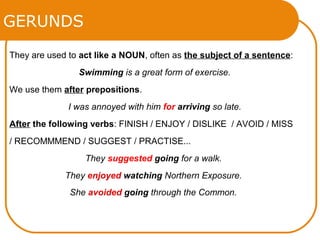
They are used to act like a NOUN, often as the subject of a sentence:
Swimming is a great form of exercise.
We use them after prepositions.
I was annoyed with him for arriving so late.
After the following verbs: FINISH / ENJOY / DISLIKE / AVOID / MISS
/ RECOMMMEND / SUGGEST / PRACTISE...
They suggested going for a walk.
They enjoyed watching Northern Exposure.
She avoided going through the Common.
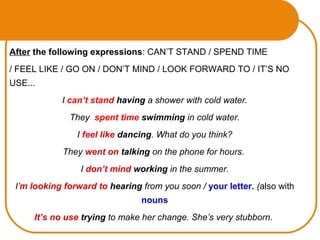
After the following expressions: CAN’T STAND / SPEND TIME
/ FEEL LIKE / GO ON / DON’T MIND / LOOK FORWARD TO / IT’S NO
USE...
I can’t stand having a shower with cold water.
They spent time swimming in cold water.
I feel like dancing. What do you think?
They went on talking on the phone for hours.
I don’t mind working in the summer.
I’m looking forward to hearing from you soon / your letter. (also with
nouns
It’s no use trying to make her change. She’s very stubborn.
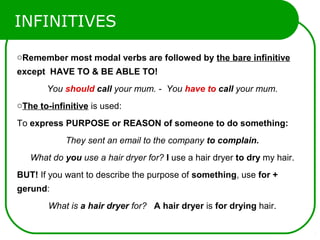
INFINITIVES
oRemember most modal verbs are followed by the bare infinitive
except HAVE TO & BE ABLE TO!
You should call your mum. - You have to call your mum.
oThe to-infinitive is used:
To express PURPOSE or REASON of someone to do something:
They sent an email to the company to complain.
What do you use a hair dryer for? I use a hair dryer to dry my hair.
BUT! If you want to describe the purpose of something, use for +
gerund:
What is a hair dryer for? A hair dryer is for drying hair.
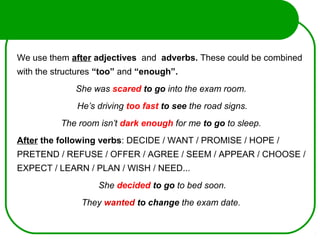
We use them after adjectives and adverbs. These could be combined
with the structures “too” and “enough”.
She was scared to go into the exam room.
He’s driving too fast to see the road signs.
The room isn’t dark enough for me to go to sleep.
After the following verbs: DECIDE / WANT / PROMISE / HOPE /
PRETEND / REFUSE / OFFER / AGREE / SEEM / APPEAR / CHOOSE /
EXPECT / LEARN / PLAN / WISH / NEED...
She decided to go to bed soon.
They wanted to change the exam date.
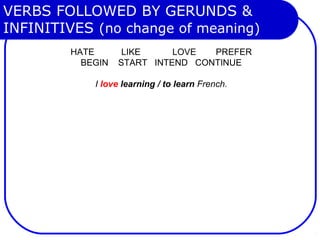
VERBS FOLLOWED BY GERUNDS &
INFINITIVES (no change of meaning)
HATE LIKE LOVE PREFER
BEGIN START INTEND CONTINUE
I love learning / to learn French.
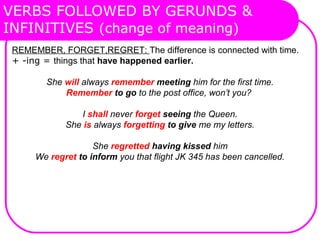
VERBS FOLLOWED BY GERUNDS &
INFINITIVES (change of meaning)
REMEMBER, FORGET,REGRET: The difference is connected with time.
+ -ing = things that have happened earlier.
She will always remember meeting him for the first time.
Remember to go to the post office, won’t you?
I shall never forget seeing the Queen.
She is always forgetting to give me my letters.
She regretted having kissed him
We regret to inform you that flight JK 345 has been cancelled.
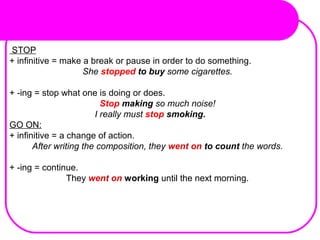
STOP
+ infinitive = make a break or pause in order to do something.
She stopped to buy some cigarettes.
+ -ing = stop what one is doing or does.
Stop making so much noise!
I really must stop smoking.
GO ON:
+ infinitive = a change of action.
After writing the composition, they went on to count the words.
+ -ing = continue.
They went on working until the next morning.
SEE, HEAR, FEEL, SMELL , WATCH :
+ –ing = we observe part of a complete action.
When I walked past his house, I heard him practising the piano.
+ bare infinitive: we want to suggest that we observe the whole action from
beginning to end.
I heard Charles play the Beethoven violin concerto last week.
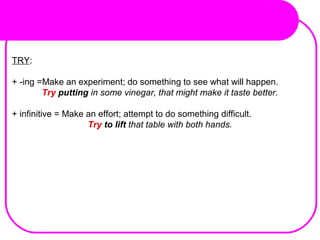
TRY:
 
+ -ing =Make an experiment; do something to see what will happen. 
Try putting in some vinegar, that might make it taste better.
+ infinitive = Make an effort; attempt to do something difficult. 
Try to lift that table with both hands.
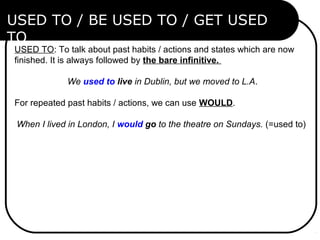
USED TO: To talk about past habits / actions and states which are now 
finished. It is always followed by the bare infinitive.
We used to live in Dublin, but we moved to L.A.
For repeated past habits / actions, we can use WOULD.
When I lived in London, I would go to the theatre on Sundays. (=used to)
USED TO / BE USED TO / GET USED
TO
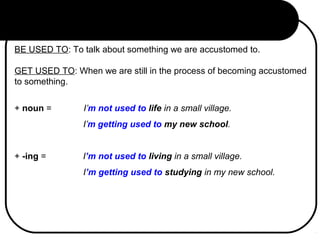
BE USED TO: To talk about something we are accustomed to. 
GET USED TO: When we are still in the process of becoming accustomed 
to something. 
+ noun =             I’m not used to life in a small village.
I’m getting used to my new school.
+ -ing =               I’m not used to living in a small village.
I’m getting used to studying in my new school.

Infinitives & gerunds eso

  • 1.
  • 2.
    GERUNDS They are usedto act like a NOUN, often as the subject of a sentence: Swimming is a great form of exercise. We use them after prepositions. I was annoyed with him for arriving so late. After the following verbs: FINISH / ENJOY / DISLIKE / AVOID / MISS / RECOMMMEND / SUGGEST / PRACTISE... They suggested going for a walk. They enjoyed watching Northern Exposure. She avoided going through the Common.
  • 3.
    After the followingexpressions: CAN’T STAND / SPEND TIME / FEEL LIKE / GO ON / DON’T MIND / LOOK FORWARD TO / IT’S NO USE... I can’t stand having a shower with cold water. They spent time swimming in cold water. I feel like dancing. What do you think? They went on talking on the phone for hours. I don’t mind working in the summer. I’m looking forward to hearing from you soon / your letter. (also with nouns It’s no use trying to make her change. She’s very stubborn.
  • 4.
    INFINITIVES oRemember most modalverbs are followed by the bare infinitive except HAVE TO & BE ABLE TO! You should call your mum. - You have to call your mum. oThe to-infinitive is used: To express PURPOSE or REASON of someone to do something: They sent an email to the company to complain. What do you use a hair dryer for? I use a hair dryer to dry my hair. BUT! If you want to describe the purpose of something, use for + gerund: What is a hair dryer for? A hair dryer is for drying hair.
  • 5.
    We use themafter adjectives and adverbs. These could be combined with the structures “too” and “enough”. She was scared to go into the exam room. He’s driving too fast to see the road signs. The room isn’t dark enough for me to go to sleep. After the following verbs: DECIDE / WANT / PROMISE / HOPE / PRETEND / REFUSE / OFFER / AGREE / SEEM / APPEAR / CHOOSE / EXPECT / LEARN / PLAN / WISH / NEED... She decided to go to bed soon. They wanted to change the exam date.
  • 6.
    VERBS FOLLOWED BYGERUNDS & INFINITIVES (no change of meaning) HATE LIKE LOVE PREFER BEGIN START INTEND CONTINUE I love learning / to learn French.
  • 7.
    VERBS FOLLOWED BYGERUNDS & INFINITIVES (change of meaning) REMEMBER, FORGET,REGRET: The difference is connected with time. + -ing = things that have happened earlier. She will always remember meeting him for the first time. Remember to go to the post office, won’t you? I shall never forget seeing the Queen. She is always forgetting to give me my letters. She regretted having kissed him We regret to inform you that flight JK 345 has been cancelled.
  • 8.
    STOP + infinitive =make a break or pause in order to do something. She stopped to buy some cigarettes. + -ing = stop what one is doing or does. Stop making so much noise! I really must stop smoking. GO ON: + infinitive = a change of action. After writing the composition, they went on to count the words. + -ing = continue. They went on working until the next morning.
  • 9.
    SEE, HEAR, FEEL,SMELL , WATCH : + –ing = we observe part of a complete action. When I walked past his house, I heard him practising the piano. + bare infinitive: we want to suggest that we observe the whole action from beginning to end. I heard Charles play the Beethoven violin concerto last week.
  • 10.
    TRY:   + -ing =Make an experiment; do something to see what will happen.  Try putting insome vinegar, that might make it taste better. + infinitive = Make an effort; attempt to do something difficult.  Try to lift that table with both hands.
  • 11.
    USED TO: To talk about past habits / actions and states which are now  finished. It is always followed by the bare infinitive. Weused to live in Dublin, but we moved to L.A. For repeated past habits / actions, we can use WOULD. When I lived in London, I would go to the theatre on Sundays. (=used to) USED TO / BE USED TO / GET USED TO
  • 12.
    BE USED TO: To talk about something we are accustomed to.  GET USED TO: When we are still in the process of becoming accustomed  to something.  + noun =             I’mnot used to life in a small village. I’m getting used to my new school. + -ing =               I’m not used to living in a small village. I’m getting used to studying in my new school.