

INFINITIVE  vs  GERUND
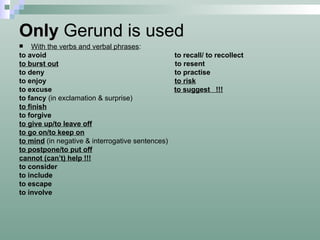
Only  Gerund is used With the verbs and verbal phrases :  to avoid  to recall/ to recollect to burst out   to resent to deny  to practise to enjoy  to risk to excuse  to suggest  !!! to fancy  (in exclamation & surprise) to finish to forgive to give up/to leave off to go on/to keep on to mind   (in negative & interrogative sentences) to postpone/to put off cannot (can’t) help !!! to consider to include to escape to involve
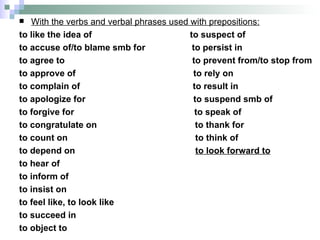
With the verbs and verbal phrases used with prepositions: to like the idea of  to suspect of to accuse of/to blame smb for  to persist in to agree to  to prevent from/to stop from to approve of  to rely on  to complain of  to result in to apologize for  to suspend smb of to forgive for  to speak of  to congratulate on  to thank for to count on  to think of to depend on  to look forward to to hear of  to inform of  to insist on  to feel like, to look like to succeed in  to object to
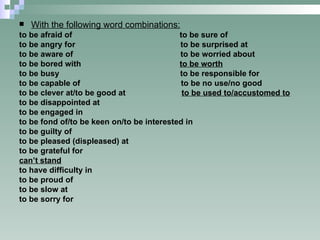
With the following word combinations: to be afraid of  to be sure of to be angry for  to be surprised at to be aware of  to be worried about to be bored with  to be worth to be busy  to be responsible for to be capable of  to be no use/no good to be clever at/to be good at  to be used to/accustomed to to be disappointed at to be engaged in to be fond of/to be keen on/to be interested in to be guilty of to be pleased (displeased) at to be grateful for can’t stand to have difficulty in to be proud of to be slow at to be sorry for
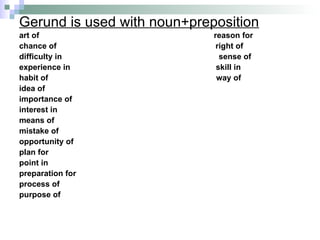
Gerund is used with noun+preposition art of  reason for chance of  right of difficulty in  sense of experience in  skill in habit of  way of idea of importance of interest in means of mistake of opportunity of plan for point in preparation for process of purpose of
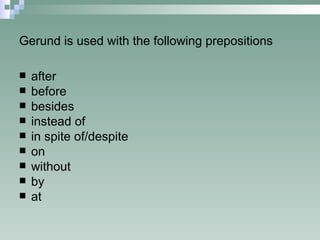
Gerund is used with the following prepositions after before besides instead of in spite of/despite on without by at
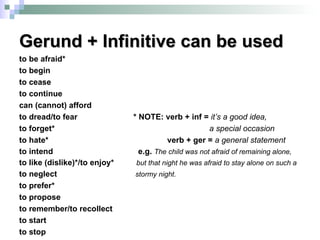
Gerund + Infinitive can be used to be afraid* to begin to cease to continue can (cannot) afford to dread/to fear  * NOTE: verb + inf =  it’s a good idea, to forget*  a special occasion to hate*  verb + ger =  a general statement   to intend  e.g.  The child was not afraid of remaining alone, to like (dislike)*/to enjoy*  but that night he was afraid to stay alone on such a   to neglect  stormy night. to prefer* to propose to remember/to recollect to start to stop
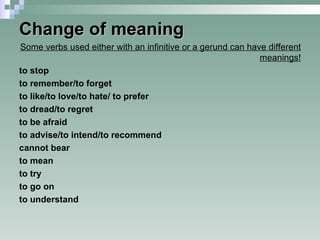
Change of meaning Some verbs used either with an infinitive or a gerund can have different meanings! to stop to remember/to forget to like/to love/to hate/ to prefer to dread/to regret to be afraid to advise/to intend/to recommend cannot bear to mean to try to go on to understand
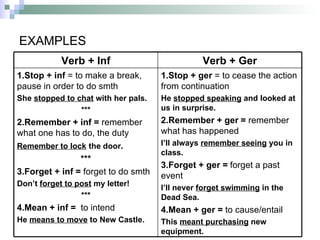
EXAMPLES 1.Stop + ger  = to cease the action from continuation He  stopped speaking  and looked at us in surprise. 2.Remember + ger   =  remember what has happened I’ll always  remember seeing  you in class. 3.Forget + ger  =   forget a past event I’ll never  forget swimming  in the Dead Sea. 4.Mean + ger =  to cause/entail This  meant purchasing  new equipment.   1.Stop  +  inf  = to make a break, pause in order to do smth She  stopped to chat  with her pals. *** 2.Remember + inf =  remember what one has to do, the duty Remember to lock   the door . *** 3.Forget + inf =  forget to do smth Don’t  forget to post  my letter! *** 4.Mean + inf =  to intend He  means to move  to New Castle. Verb + Ger Verb + Inf
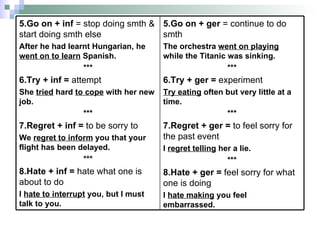
5.Go on + ger  = continue to do smth The orchestra  went on playing  while the Titanic was sinking. *** 6.Try + ger =  experiment Try eating  often but very little at a time. *** 7.Regret  +  ger  =   to feel sorry for the past event   I  regret telling  her a lie. *** 8.Hate + ger =  feel sorry for what one is doing I  hate making  you feel embarrassed.  5.Go on + inf  = stop doing smth & start doing smth else After he had learnt Hungarian, he  went on to learn  Spanish. *** 6.Try  +  inf =  attempt She  tried  hard  to cope  with her new job. *** 7.Regret + inf =  to be sorry to We  regret to inform  you that your flight has been delayed.  *** 8.Hate + inf =  hate what one is about to do I  hate to interrupt  you, but I must talk to you.
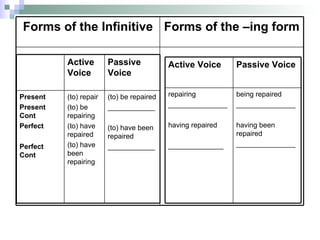
Forms of the –ing form Forms of the Infinitive (to) be repaired ____________ (to) have been repaired ____________ (to) repair (to) be repairing (to) have repaired (to) have been repairing Present Present Cont Perfect Perfect Cont Passive Voice Active Voice being repaired _______________ having been repaired _______________ repairing _______________ having repaired  ______________ Passive Voice Active Voice

Infinitive vs Gerund

  • 1.
  • 2.
    Only Gerundis used With the verbs and verbal phrases : to avoid to recall/ to recollect to burst out to resent to deny to practise to enjoy to risk to excuse to suggest !!! to fancy (in exclamation & surprise) to finish to forgive to give up/to leave off to go on/to keep on to mind (in negative & interrogative sentences) to postpone/to put off cannot (can’t) help !!! to consider to include to escape to involve
  • 3.
    With the verbsand verbal phrases used with prepositions: to like the idea of to suspect of to accuse of/to blame smb for to persist in to agree to to prevent from/to stop from to approve of to rely on to complain of to result in to apologize for to suspend smb of to forgive for to speak of to congratulate on to thank for to count on to think of to depend on to look forward to to hear of to inform of to insist on to feel like, to look like to succeed in to object to
  • 4.
    With the followingword combinations: to be afraid of to be sure of to be angry for to be surprised at to be aware of to be worried about to be bored with to be worth to be busy to be responsible for to be capable of to be no use/no good to be clever at/to be good at to be used to/accustomed to to be disappointed at to be engaged in to be fond of/to be keen on/to be interested in to be guilty of to be pleased (displeased) at to be grateful for can’t stand to have difficulty in to be proud of to be slow at to be sorry for
  • 5.
    Gerund is usedwith noun+preposition art of reason for chance of right of difficulty in sense of experience in skill in habit of way of idea of importance of interest in means of mistake of opportunity of plan for point in preparation for process of purpose of
  • 6.
    Gerund is usedwith the following prepositions after before besides instead of in spite of/despite on without by at
  • 7.
    Gerund + Infinitivecan be used to be afraid* to begin to cease to continue can (cannot) afford to dread/to fear * NOTE: verb + inf = it’s a good idea, to forget* a special occasion to hate* verb + ger = a general statement to intend e.g. The child was not afraid of remaining alone, to like (dislike)*/to enjoy* but that night he was afraid to stay alone on such a to neglect stormy night. to prefer* to propose to remember/to recollect to start to stop
  • 8.
    Change of meaningSome verbs used either with an infinitive or a gerund can have different meanings! to stop to remember/to forget to like/to love/to hate/ to prefer to dread/to regret to be afraid to advise/to intend/to recommend cannot bear to mean to try to go on to understand
  • 9.
    EXAMPLES 1.Stop +ger = to cease the action from continuation He stopped speaking and looked at us in surprise. 2.Remember + ger = remember what has happened I’ll always remember seeing you in class. 3.Forget + ger = forget a past event I’ll never forget swimming in the Dead Sea. 4.Mean + ger = to cause/entail This meant purchasing new equipment. 1.Stop + inf = to make a break, pause in order to do smth She stopped to chat with her pals. *** 2.Remember + inf = remember what one has to do, the duty Remember to lock the door . *** 3.Forget + inf = forget to do smth Don’t forget to post my letter! *** 4.Mean + inf = to intend He means to move to New Castle. Verb + Ger Verb + Inf
  • 10.
    5.Go on +ger = continue to do smth The orchestra went on playing while the Titanic was sinking. *** 6.Try + ger = experiment Try eating often but very little at a time. *** 7.Regret + ger = to feel sorry for the past event I regret telling her a lie. *** 8.Hate + ger = feel sorry for what one is doing I hate making you feel embarrassed. 5.Go on + inf = stop doing smth & start doing smth else After he had learnt Hungarian, he went on to learn Spanish. *** 6.Try + inf = attempt She tried hard to cope with her new job. *** 7.Regret + inf = to be sorry to We regret to inform you that your flight has been delayed. *** 8.Hate + inf = hate what one is about to do I hate to interrupt you, but I must talk to you.
  • 11.
    Forms of the–ing form Forms of the Infinitive (to) be repaired ____________ (to) have been repaired ____________ (to) repair (to) be repairing (to) have repaired (to) have been repairing Present Present Cont Perfect Perfect Cont Passive Voice Active Voice being repaired _______________ having been repaired _______________ repairing _______________ having repaired ______________ Passive Voice Active Voice