To-infinitive GERUND
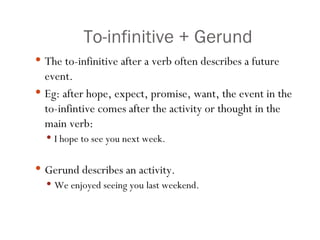
To-infinitive + Gerund The to-infinitive after a verb often describes a future event. Eg: after hope, expect, promise, want, the event in the to-infintive comes after the activity or thought in the main verb: I hope to see you next week. Gerund describes an activity.  We enjoyed seeing you last weekend.
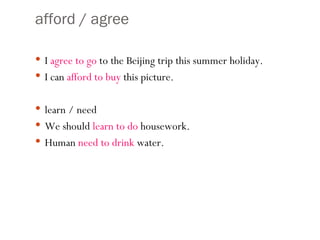
afford / agree I  agree to   go  to the Beijing trip this summer holiday.  I can  afford to buy  this picture. learn / need We should  learn to do  housework. Human  need to drink  water.
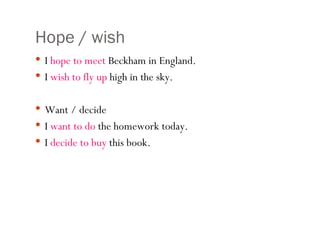
Hope / wish I  hope to meet  Beckham in England. I  wish to fly up  high in the sky. Want / decide I  want to do  the homework today. I  decide to buy  this book.
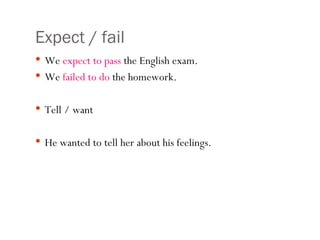
Expect / fail We  expect   to pass  the English exam. We  failed to do  the homework. Tell / want He wanted to tell her about his feelings.
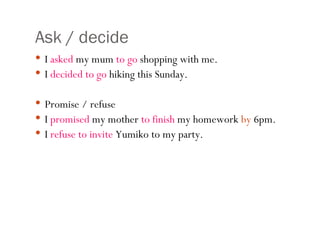
Ask / decide I  asked  my mum  to go  shopping with me. I  decided   to go  hiking this Sunday. Promise / refuse I  promised  my mother  to finish  my homework  by  6pm. I  refuse to invite  Yumiko to my party.
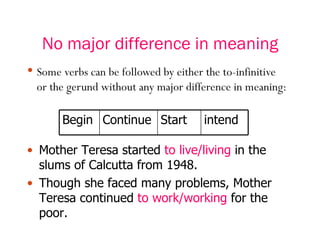
No major difference in meaning Some verbs can be followed by either the to-infinitive or the gerund without any major difference in meaning: Mother Teresa started  to live/living  in the slums of Calcutta from 1948. Though she faced many problems, Mother Teresa continued  to work/working  for the poor. Begin Continue Start intend
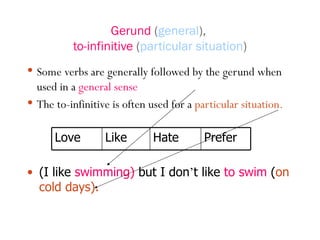
Gerund  ( general ),  to-infinitive  ( particular situation ) Some verbs are generally followed by the gerund when used in a  general sense The to-infinitive is often used for a  particular   situation. (I like  swimming)  but I don ’ t like  to swim  ( on cold days). Love Like Hate Prefer
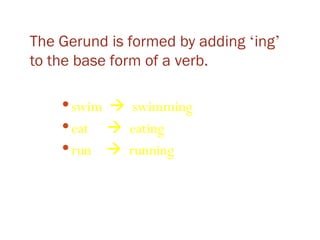
The Gerund is formed by adding  ‘ ing ’  to the base form of a verb. swim     swimming eat     eating run     running
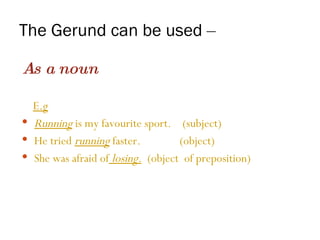
The Gerund can be used  –   As a noun E.g   Running  is my favourite sport.  (subject) He tried  running  faster.  (object) She was afraid of   losing .   (object  of preposition)
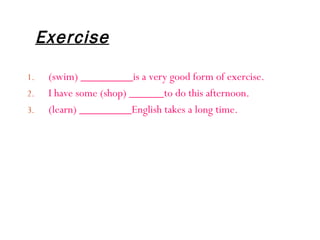
Exercise   (swim) _________is a very good form of exercise. I have some (shop) ______to do this afternoon. (learn) _________English takes a long time.
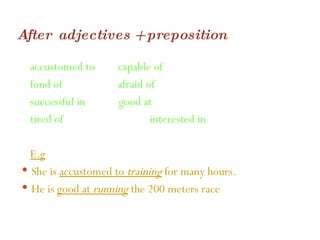
After  adjectives + preposition accustomed to  capable of fond of  afraid of  successful in  good at  tired of  interested in E.g She is  accustomed to  training   for many hours. He is  good at  running  the 200 meters race
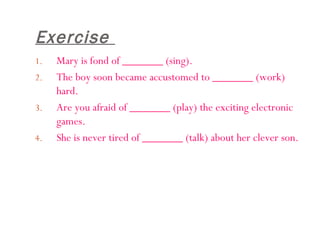
Exercise  Mary is fond of _______ (sing). The boy soon became accustomed to _______ (work) hard. Are you afraid of _______ (play) the exciting electronic games.  She is never tired of _______ (talk) about her clever son.
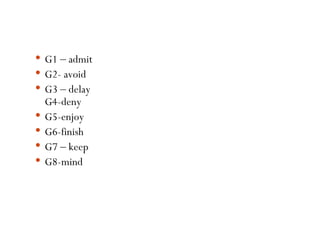
G1  –  admit G2- avoid G3  –  delay G4-deny G5-enjoy G6-finish G7  –  keep G8-mind
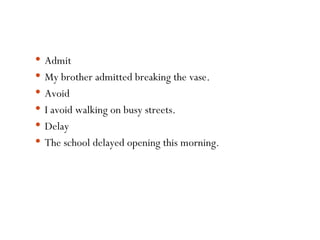
Admit My brother admitted breaking the vase. Avoid I avoid walking on busy streets. Delay The school delayed opening this morning.
finish I  finish doing  my homework. Keep After 4 hours, he keeps standing there. Mind Would you  mind lending  your pen to me.
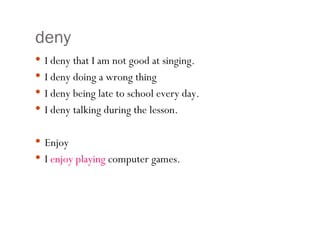
deny I deny that I am not good at singing. I deny doing a wrong thing I deny being late to school every day. I deny talking during the lesson. Enjoy I  enjoy playing  computer games.
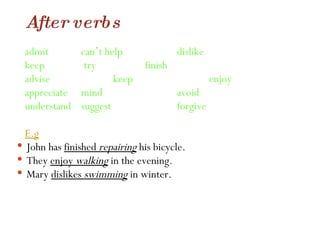
After verbs admit can ’ t help dislike keep  try  finish advise keep enjoy appreciate mind avoid understand  suggest  forgive E.g John has  finished  repairing  his bicycle. They  enjoy  walking  in the evening.  Mary  dislikes  swimming  in winter.
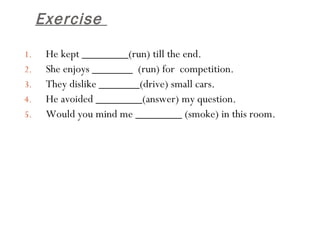
Exercise  He kept ________(run) till the end.  She enjoys _______  (run) for  competition.  They dislike _______(drive) small cars.  He avoided ________(answer) my question.  Would you mind me ________ (smoke) in this room.
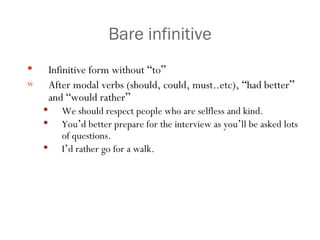
Bare infinitive Infinitive form without  “ to ” After modal verbs (should, could, must..etc),  “ had better ”  and  “ would rather ” We should respect people who are selfless and kind. You ’ d better prepare for the interview as you ’ ll be asked lots of questions. I ’ d rather go for a walk.
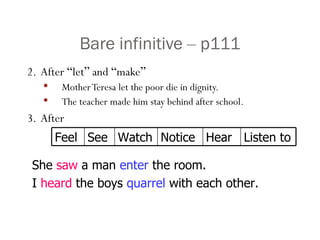
Bare infinitive  –  p111 2.  After  “ let ”  and  “ make ” Mother Teresa let the poor die in dignity. The teacher made him stay behind after school. 3.  After  She  saw  a man  enter  the room. I  heard  the boys  quarrel  with each other. Feel See Watch Notice Hear Listen to
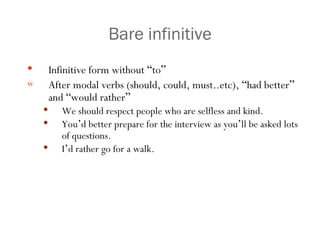
Bare infinitive Infinitive form without  “ to ” After modal verbs (should, could, must..etc),  “ had better ”  and  “ would rather ” We should respect people who are selfless and kind. You ’ d better prepare for the interview as you ’ ll be asked lots of questions. I ’ d rather go for a walk.
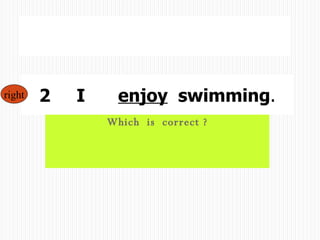
Which  is  correct ? 1  I  enjoy   to  swim. 2  I    enjoy   swimming . right
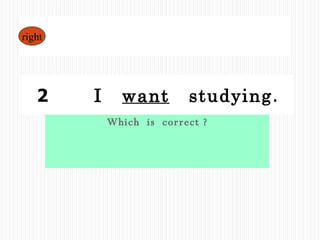
Which  is  correct ? 1  I  want  to  study . 2     I  want   studying . right
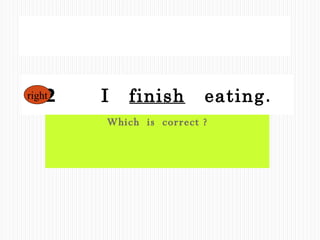
Which  is  correct ? 1  I  finish  to  eat . 2     I  finish   eating . right
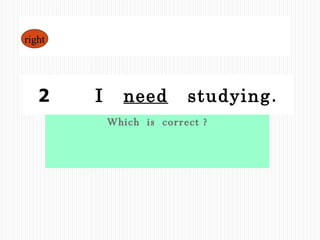
Which  is  correct ? 1  I  need  to  study . 2     I  need   studying . right
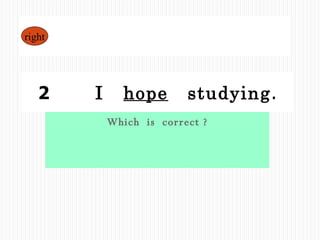
Which  is  correct ? 1  I  hope  to  study . 2     I  hope   studying . right
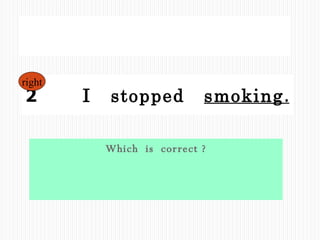
Which  is  correct ? 1  I  stopped  to  smoke . 2     I  stopped  smoking . right
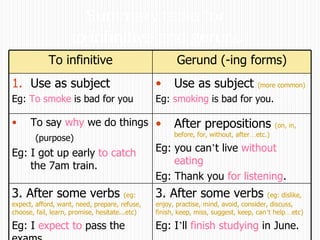
Summary table for  to-infinitive and gerund To infinitive Gerund (-ing forms) Use as subject Eg:  To smoke  is bad for you Use as subject  (more common) Eg:  smoking  is bad for you. To say  why  we do things (purpose) Eg: I got up early  to catch  the 7am train.  After prepositions  (on, in, before, for, without, after … etc.) Eg: you can ’ t live  without eating Eg: Thank you  for listening . 3. After some verbs  (eg: expect, afford, want, need, prepare, refuse, choose, fail, learn, promise, hesitate...etc) Eg: I  expect to  pass the exams. 3. After some verbs  (eg: dislike, enjoy, practise, mind, avoid, consider, discuss, finish, keep, miss, suggest, keep, can ’ t help … etc) Eg: I ’ ll  finish studying  in June.
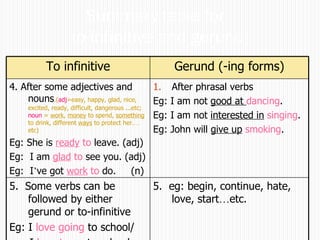
Summary table for  to-infinitive and gerund To infinitive Gerund (-ing forms) 4. After some adjectives and nouns .( adj =easy, happy, glad, nice, excited, ready, difficult, dangerous ...etc;  noun  =  work ,  money  to spend,  something  to drink, different  ways  to protect her. … etc) Eg: She is  ready  to  leave. (adj) Eg:  I am  glad  to  see you. (adj) Eg:  I ’ ve got  work  to  do.  (n) After phrasal verbs Eg: I am not  good at  dancing . Eg: I am not  interested in   singing . Eg: John will  give up   smoking . 5.  Some verbs can be followed by either gerund or to-infinitive Eg: I  love going  to school/ I  love to   go  to school 5.  eg: begin, continue, hate, love, start … etc.
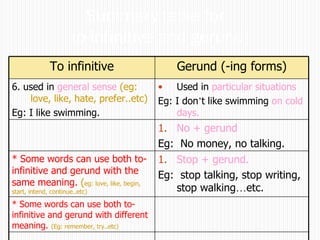
Summary table for  to-infinitive and gerund To infinitive Gerund (-ing forms) 6. used in  general sense  (eg: love, like, hate, prefer..etc) Eg: I like swimming. Used in  particular situations Eg: I don ’ t like swimming  on cold days. No + gerund Eg:  No money, no talking. * Some words can use both to-infinitive and gerund with the same meaning.  ( eg: love, like, begin, start, intend, continue..etc) Stop + gerund. Eg:  stop talking, stop writing, stop walking … etc. * Some words can use both to-infinitive and gerund with different meaning.  (Eg: remember, try..etc)

Precentacion gerund3 and toinfinitive

  • 1.
  • 2.
    To-infinitive + GerundThe to-infinitive after a verb often describes a future event. Eg: after hope, expect, promise, want, the event in the to-infintive comes after the activity or thought in the main verb: I hope to see you next week. Gerund describes an activity. We enjoyed seeing you last weekend.
  • 3.
    afford / agreeI agree to go to the Beijing trip this summer holiday. I can afford to buy this picture. learn / need We should learn to do housework. Human need to drink water.
  • 4.
    Hope / wishI hope to meet Beckham in England. I wish to fly up high in the sky. Want / decide I want to do the homework today. I decide to buy this book.
  • 5.
    Expect / failWe expect to pass the English exam. We failed to do the homework. Tell / want He wanted to tell her about his feelings.
  • 6.
    Ask / decideI asked my mum to go shopping with me. I decided to go hiking this Sunday. Promise / refuse I promised my mother to finish my homework by 6pm. I refuse to invite Yumiko to my party.
  • 7.
    No major differencein meaning Some verbs can be followed by either the to-infinitive or the gerund without any major difference in meaning: Mother Teresa started to live/living in the slums of Calcutta from 1948. Though she faced many problems, Mother Teresa continued to work/working for the poor. Begin Continue Start intend
  • 8.
    Gerund (general ), to-infinitive ( particular situation ) Some verbs are generally followed by the gerund when used in a general sense The to-infinitive is often used for a particular situation. (I like swimming) but I don ’ t like to swim ( on cold days). Love Like Hate Prefer
  • 9.
    The Gerund isformed by adding ‘ ing ’ to the base form of a verb. swim  swimming eat  eating run  running
  • 10.
    The Gerund canbe used – As a noun E.g Running is my favourite sport. (subject) He tried running faster. (object) She was afraid of losing . (object of preposition)
  • 11.
    Exercise (swim) _________is a very good form of exercise. I have some (shop) ______to do this afternoon. (learn) _________English takes a long time.
  • 12.
    After adjectives+ preposition accustomed to capable of fond of afraid of successful in good at tired of interested in E.g She is accustomed to training for many hours. He is good at running the 200 meters race
  • 13.
    Exercise Maryis fond of _______ (sing). The boy soon became accustomed to _______ (work) hard. Are you afraid of _______ (play) the exciting electronic games. She is never tired of _______ (talk) about her clever son.
  • 14.
    G1 – admit G2- avoid G3 – delay G4-deny G5-enjoy G6-finish G7 – keep G8-mind
  • 15.
    Admit My brotheradmitted breaking the vase. Avoid I avoid walking on busy streets. Delay The school delayed opening this morning.
  • 16.
    finish I finish doing my homework. Keep After 4 hours, he keeps standing there. Mind Would you mind lending your pen to me.
  • 17.
    deny I denythat I am not good at singing. I deny doing a wrong thing I deny being late to school every day. I deny talking during the lesson. Enjoy I enjoy playing computer games.
  • 18.
    After verbs admitcan ’ t help dislike keep try finish advise keep enjoy appreciate mind avoid understand suggest forgive E.g John has finished repairing his bicycle. They enjoy walking in the evening. Mary dislikes swimming in winter.
  • 19.
    Exercise Hekept ________(run) till the end. She enjoys _______ (run) for competition. They dislike _______(drive) small cars. He avoided ________(answer) my question. Would you mind me ________ (smoke) in this room.
  • 20.
    Bare infinitive Infinitiveform without “ to ” After modal verbs (should, could, must..etc), “ had better ” and “ would rather ” We should respect people who are selfless and kind. You ’ d better prepare for the interview as you ’ ll be asked lots of questions. I ’ d rather go for a walk.
  • 21.
    Bare infinitive – p111 2. After “ let ” and “ make ” Mother Teresa let the poor die in dignity. The teacher made him stay behind after school. 3. After She saw a man enter the room. I heard the boys quarrel with each other. Feel See Watch Notice Hear Listen to
  • 22.
    Bare infinitive Infinitiveform without “ to ” After modal verbs (should, could, must..etc), “ had better ” and “ would rather ” We should respect people who are selfless and kind. You ’ d better prepare for the interview as you ’ ll be asked lots of questions. I ’ d rather go for a walk.
  • 23.
    Which is correct ? 1 I enjoy to swim. 2 I   enjoy swimming . right
  • 24.
    Which is correct ? 1 I want to study . 2   I want studying . right
  • 25.
    Which is correct ? 1 I finish to eat . 2   I finish eating . right
  • 26.
    Which is correct ? 1 I need to study . 2   I need studying . right
  • 27.
    Which is correct ? 1 I hope to study . 2   I hope studying . right
  • 28.
    Which is correct ? 1 I stopped to smoke . 2   I stopped smoking . right
  • 29.
    Summary table for to-infinitive and gerund To infinitive Gerund (-ing forms) Use as subject Eg: To smoke is bad for you Use as subject (more common) Eg: smoking is bad for you. To say why we do things (purpose) Eg: I got up early to catch the 7am train. After prepositions (on, in, before, for, without, after … etc.) Eg: you can ’ t live without eating Eg: Thank you for listening . 3. After some verbs (eg: expect, afford, want, need, prepare, refuse, choose, fail, learn, promise, hesitate...etc) Eg: I expect to pass the exams. 3. After some verbs (eg: dislike, enjoy, practise, mind, avoid, consider, discuss, finish, keep, miss, suggest, keep, can ’ t help … etc) Eg: I ’ ll finish studying in June.
  • 30.
    Summary table for to-infinitive and gerund To infinitive Gerund (-ing forms) 4. After some adjectives and nouns .( adj =easy, happy, glad, nice, excited, ready, difficult, dangerous ...etc; noun = work , money to spend, something to drink, different ways to protect her. … etc) Eg: She is ready to leave. (adj) Eg: I am glad to see you. (adj) Eg: I ’ ve got work to do. (n) After phrasal verbs Eg: I am not good at dancing . Eg: I am not interested in singing . Eg: John will give up smoking . 5. Some verbs can be followed by either gerund or to-infinitive Eg: I love going to school/ I love to go to school 5. eg: begin, continue, hate, love, start … etc.
  • 31.
    Summary table for to-infinitive and gerund To infinitive Gerund (-ing forms) 6. used in general sense (eg: love, like, hate, prefer..etc) Eg: I like swimming. Used in particular situations Eg: I don ’ t like swimming on cold days. No + gerund Eg: No money, no talking. * Some words can use both to-infinitive and gerund with the same meaning. ( eg: love, like, begin, start, intend, continue..etc) Stop + gerund. Eg: stop talking, stop writing, stop walking … etc. * Some words can use both to-infinitive and gerund with different meaning. (Eg: remember, try..etc)