Gastroesophageal Reflux Disease;
Atypical Presentations..!?
By
Prof. El-Sayed Tharwa, M.D.
Professor of Internal Medicine
Hepatology and Gastroenterology Department
NLI – Menoufia University
11th December 2020
Definition
◼ Symptoms or mucosal damage produced by the
abnormal reflux of gastric contents into the
esophagus.
◼ Often chronic and relapsing.
◼ May see complications of GERD in patients who
lack typical symptoms.
The classic symptom is frequent and persistent
heartburn.
44 % of Americans experience heartburn at
least once per month.
7 % have daily symptoms.



Physiologic GERD
 Postprandial
 Short lived
 Asymptomatic
 No nocturnal sx
Pathologic GERD
 Symptoms
 Mucosal injury
 Nocturnal sx


GERD occurs in all ages but, most common in those older
than 40 years of age.
About 10-20% of people in Western countries suffer from
GERD symptoms on a weekly basis.



About 7% have symptoms daily.
Except for NERD and pregnancy , no much
difference in incidence between men and women.
But for Barrett’s esophagus, prevalence is more in
males particularly white adult males.
Normal Function
Esophagus
◼ Transports food from mouth to stomach through
peristaltic contractions.
Lower esophageal sphincter (LES)
◼ Relaxes, on swallowing, to allow food to enter
stomach and then contracts to prevent reflux.
Normal to have some amount of reflux multiple
times each day (transient relaxation of LES – not
associated with swallowing).
http://www.gerd.com/intro/noframe/grossovw.htm
Pathogenesis
3 lines of defense must be impaired for
GERD to develop
◼ LES barrier impairment
Relaxation of LES
Low resting LES pressure
Increased gastric pressure
◼ Decreased clearance of refluxed materials
from esophagus
◼ Decreased esophageal mucosal resistance
Contributing Factors
Decrease LES
pressure
◼ Chocolate
◼ Alcohol
◼ Fatty meals
◼ Coffee, cola, tea
◼ Garlic
◼ Onions
◼ Smoking
Directly irritate the gastric
mucosa
◼ Tomato-based products
◼ Coffee
◼ Spicy foods
◼ Citrus juices
◼ Meds: NSAIDS, aspirin, iron,
KCl, alendronate
Stimulate acid secretions
◼ Soda
◼ Beer
◼ Smoking
Contributing Factors
Drugs that decrease LES pressure
◼ Alpha-adrenergic agonists
◼ Anti-cholinergic agents (e.g. TCA’s, antihistamines)
◼ Beta-adrenergic agonists
◼ Calcium channel antagonists (nifedipine most reduction)
◼ Diazepam
◼ Dopamine
◼ Meperidine
◼ Nitrates/Other vasodilators
◼ Estrogens/progesterones (including oral contraceptives)
◼ Prostaglandins
◼ Theophylline
Lines of Defense
Clearance of refluxed materials from
esophagus
◼ Primary peristalsis from swallowing – increases
salivary flow
◼ Secondary peristalsis from esophageal distension
◼ Gravitational effects
Esophageal mucosal resistance
◼ Mucus production in esophagus
◼ Bicarbonate movement from blood to mucosa
Amount of esophageal damage seen dependent on:
◼ Composition of refluxed material
Which is worse: acid or alkaline refluxed material?
◼ Volume of refluxed material
◼ Length of contact time
◼ Natural sensitivity of esophageal mucosa
◼ Rate of gastric emptying
6) COMPOSITION OF REFLUXATE
 If the pH of the refluxate is less than 2,
nietorp ot yradnoces poleved yam sitigahpose
noitarutaned
 Also pepsinogen activated to pepsin at this pH may
cause esophagitis.

Erosive esophagitis
 Responsible for 40-60% of GERD symptoms
 Severity of symptoms often fail to match severity
of erosive esophagitis
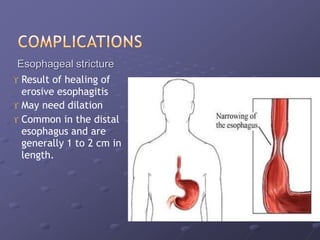
 Esophageal stricture
 Result of healing of
erosive esophagitis
 May need dilation
 Common in the distal
esophagus and are
generally 1 to 2 cm in
length.
 Barrett’s Esophagus
 Columnar metaplasia of the esophagus,i.e
replacement of the squamous epithelial lining of
the esophagus by specialized columnar- type
epithelium
 Associated with the development of
adenocarcinoma
 Have a greater chance) 30%) of developing
esophageal stricture
 Barrett’s Esophagus
 Acid damages lining of
esophagus and causes
chronic esophagitis
 Damaged area heals in a
metaplastic process and
abnormal columnar cells
replace squamous cells
 This specialized intestinal
metaplasia can progress to
dysplasia and
adenocarcinoma
Typical Symptoms
Common symptoms:
most common when pH<4
◼ Heartburn
◼ Belching and regurgitation
◼ Hypersalivation
May be episodic or nocturnal
May be aggravated by meals and reclining
position
Atypical Symptoms
Non-allergic asthma
Chronic cough
Hoarseness
Pharyngitis
Chest pain (mimics angina)
May be only symptoms – “PPI test”
Non cardiac chest pain NCCP
▪When patients complain of recurring chest pain that varies in
intensity , a careful history and a simple testing help us to sort out
if cardiac etiology is to blame.
▪Because coronary artery disease is such a critical diagnosis, it
should be excluded in all patients complaining of chest pain. This
can be done by a cardiologist.
▪It is also important to note that women may report atypical chest
pain symptoms that are due to cardiac disease more often than
men and this cause has to be excluded before assuming the
symptoms are from an atypical presentation of GERD.
Alarming Signs & Symptoms
• Dysphagia
• Early satiety
• GI bleeding
• Odynophagia
• Vomiting
• Weight loss
• Iron deficiency anemia
Symptom Predominance (%)
Heartburn 80
Regurgitation 54
Abdominal Pain 29
Cough 27
Dysphagia for solids 23
Hoarseness 21
Belching 15
Aspiration 14
Wheezing 7
Globus 4
Montreal Classification of GERD
From Vakil N et al. Am J Gastroenterol 2006;101:1900-20.
 Two mechanisms:
-Microaspiration of gastric acid.
-Vagally mediated events.
Pulmonary manifestations
1 )Chronic cough :GERD one of three
most common cause along with PND & asthma.
 Predominantly day time & standing position.
 Non productive & long standing nature.
 > 50 % cases sole manifestation.
 Chest X-ray –normal.
 No evidence of asthma.
2) asthma :- GERD is a potential trigger in many cases of asthma.
 Pneumonia
 Chronic bronchitis
 Chronic obstructive pulmonary disease.
 Idiopathic pulmonary fibrosis.
ENT manifestations
1) Reflux laryngitis :
• Gastric contents in larynx , pharynx and upper
aerodigestive tract.
• Mucosal damage.
• Direct effect on mucocilliary cleareance.
• Vagally mediated reflex.
 4 – 10 % GERD.
 SYMPTOMS :-
 hoarsness
 Globus sensation
 Chronic throat clearing
 Vocal fatigue , break
 Sore throat
 Neck pain
 Excessive throat mucus
 PND
Signs:- edema , erythema , increase vascularity .
Red , inflammed larynx.( posterior larynx).
Thickening of posterior laryngeal mucosa with hyperkeratosis
(pachyderma laryngeus(
Increase mucosal thickening with increase granularity & rough
cobbelstone appeareance –granular mucositis.
Increse mucus formationsilacov suclusoduesP .
 Ulceration
 Granuloma
 Polyp
 Leukoplakia
 Subglottic stenosis
 Cancer.
2) Recurrent otitis media ( pepsin & pepsinogen
effusion).
GERD nasopharyngeal inflammation
obstruction of eustachian tube
3) chronic sinusitis – direct effect on mucociliary
cleareance.
4) dental erosions :- oral ulcers , halitosis.
 Heartburn & regurgitation- 66%
 Cervical dysphagia – 33%
 Globus pharyngeus – 19%
 Sore throat – 17%
 Chronic throat clearing – 4%
NEONATES/ INFANTS
OLDER CHILDREN/
ADOLESCENT
 Regurgitation –post
prandially
 Signs of esophagitis –
irritability, arching ,
gagging , chocking ,
feeding aversion.
 Failure to thrive.
 Poor weight gain.
 Early morning nausea
 Abdominal discomfort.
 Substernal pain.
 Recurrent vomiting.
 Heartburn.
Pulmonary
 Asthma
 Recurrent pneumonia
 Chronic cough
 Apnoea
 Chronic otitis media
 Hoarsness
 Globus sensation
 Sore throat
 Irritability
 Poor appetite
 Sleep disturbance
Diagnosis
Clinical symptoms and history.
Give empiric therapy and look for
improvement.
Endoscopy if warning signs present.
Diagnostic Tests for
GERD
• Barium swallow
• Endoscopy
• Ambulatory pH monitoring
• Impedance-pH monitoring
• Esophageal manometry
Barium Swallow
• Useful first diagnostic test for
patients with dysphagia
– Stricture (location, length(
– Mass (location, length(
– Hiatal hernia (size, type(
• Limitations
– Detailed mucosal exam for
erosive esophagitis, Barrett’s
esophagus
Endoscopy
• Indications
– Alarm symptoms
– Empiric therapy
failure
– Preoperative
evaluation
– Detection of Barrett’s
esophagus
Esophago-gastro-duodenoscopy
• Endoscopy (with biopsy if needed(
– In patients with alarm
signs/symptoms
– Those who fail a medication trial
– Those who require long-term tx
• Absence of endoscopic features
does not exclude a GERD diagnosis
• Allows for
detection, stratification, and
management of esophageal
manisfestations or complications of
GERD
pH
• 24-hour pH monitoring-----Physiologic study
–Accepted standard for establishing or
excluding presence of GERD for those
patients who do not have mucosal changes
–Trans-nasal catheter or a wireless, capsule
shaped device
Ambulatory 24 hr. pH Monitoring
Normal
GERD
Esophageal Manometry
• Assess LES pressure,
location and relaxation
• Assess peristalsis
– Prior to antireflux
surgery
Counseling Questions
Before recommending a therapy, ask:
◼ Duration and frequency of symptoms
◼ Quality and timing of symptoms
◼ Use of alcohol and tobacco
◼ Dietary choices
◼ Medications already tried to treat symptoms
◼ Other disease states present and medications
being used
◼ Cooperation with other specialties when the
atypical symptoms and signs are the
predominant .
Treatment
Three phases in treatment
◼ Phase I: Lifestyle changes – 2 weeks
Lifestyle modifications
Patient-directed therapy with OTC medications
◼ Phase II: Pharmacologic intervention
Standard/high-dose antisecretory therapy
◼ Phase III: Surgical intervention
Patients who fail pharmacologic treatment or have severe
complications of GERD
LES positioned within the abdomen where it is under positive
pressure
• Postsurgery
– 10% have solid food dysphagia
– 2-3% have permanent symptoms
– 7-10% have bloating, diarrhea, nausea, early
satiety
Special Populations
Infants can experience a form of GERD
◼ Postmeal regurgitation or small volume vomiting
◼ Occurs due to a poorly functioning sphincter
◼ Treatment
Supportive therapy
◼ Diet adjustments – smaller, more frequent feedings;
thickened feedings
◼ Postural management
H2RA’s (e.g. ranitidine 2 mg/kg) , PPIs, and antacids
have been used.
Special Populations
Pregnancy
◼ Common, due to decreased LES pressure
and increased abdominal pressure.
◼ Nearly half of all pregnant women experience.
◼ Antacids other than sodium bicarbonate
generally considered safe, but avoid chronic
high doses
GERD in the Elderly
In the US, 20% report acid reflux.
Worldwide, 3X prevalence in > 70 y of patients younger
than 39 y.
More likely to develop severe disease
More likely to be poorly diagnosed or underdiagnosed
◼ Due to atypical symptoms
Always look for medication causes
GERD in the elderly
Symptoms
◼ Dysphagia
◼ Vomiting
◼ Weight loss
◼ Anemia
◼ Anorexia
Typical symptoms are less frequent
GERD in the Elderly
Diagnosis should always include endoscopy.
Prokinetic agents should be avoided.
PPI’s are medications of choice for acute episodes
and prevention of recurrence due to efficacy, safety,
and tolerability.
Step down approach is preferred – more clinically
effective and more cost effective
Thank You

Unusual GERD

  • 1.
    Gastroesophageal Reflux Disease; AtypicalPresentations..!? By Prof. El-Sayed Tharwa, M.D. Professor of Internal Medicine Hepatology and Gastroenterology Department NLI – Menoufia University 11th December 2020
  • 2.
    Definition ◼ Symptoms ormucosal damage produced by the abnormal reflux of gastric contents into the esophagus. ◼ Often chronic and relapsing. ◼ May see complications of GERD in patients who lack typical symptoms. The classic symptom is frequent and persistent heartburn. 44 % of Americans experience heartburn at least once per month. 7 % have daily symptoms.
  • 3.
  • 4.
    Physiologic GERD  Postprandial Short lived  Asymptomatic  No nocturnal sx Pathologic GERD  Symptoms  Mucosal injury  Nocturnal sx
  • 5.
      GERD occurs inall ages but, most common in those older than 40 years of age. About 10-20% of people in Western countries suffer from GERD symptoms on a weekly basis.    About 7% have symptoms daily. Except for NERD and pregnancy , no much difference in incidence between men and women. But for Barrett’s esophagus, prevalence is more in males particularly white adult males.
  • 6.
    Normal Function Esophagus ◼ Transportsfood from mouth to stomach through peristaltic contractions. Lower esophageal sphincter (LES) ◼ Relaxes, on swallowing, to allow food to enter stomach and then contracts to prevent reflux. Normal to have some amount of reflux multiple times each day (transient relaxation of LES – not associated with swallowing).
  • 7.
  • 8.
    Pathogenesis 3 lines ofdefense must be impaired for GERD to develop ◼ LES barrier impairment Relaxation of LES Low resting LES pressure Increased gastric pressure ◼ Decreased clearance of refluxed materials from esophagus ◼ Decreased esophageal mucosal resistance
  • 9.
    Contributing Factors Decrease LES pressure ◼Chocolate ◼ Alcohol ◼ Fatty meals ◼ Coffee, cola, tea ◼ Garlic ◼ Onions ◼ Smoking Directly irritate the gastric mucosa ◼ Tomato-based products ◼ Coffee ◼ Spicy foods ◼ Citrus juices ◼ Meds: NSAIDS, aspirin, iron, KCl, alendronate Stimulate acid secretions ◼ Soda ◼ Beer ◼ Smoking
  • 10.
    Contributing Factors Drugs thatdecrease LES pressure ◼ Alpha-adrenergic agonists ◼ Anti-cholinergic agents (e.g. TCA’s, antihistamines) ◼ Beta-adrenergic agonists ◼ Calcium channel antagonists (nifedipine most reduction) ◼ Diazepam ◼ Dopamine ◼ Meperidine ◼ Nitrates/Other vasodilators ◼ Estrogens/progesterones (including oral contraceptives) ◼ Prostaglandins ◼ Theophylline
  • 11.
    Lines of Defense Clearanceof refluxed materials from esophagus ◼ Primary peristalsis from swallowing – increases salivary flow ◼ Secondary peristalsis from esophageal distension ◼ Gravitational effects Esophageal mucosal resistance ◼ Mucus production in esophagus ◼ Bicarbonate movement from blood to mucosa
  • 12.
    Amount of esophagealdamage seen dependent on: ◼ Composition of refluxed material Which is worse: acid or alkaline refluxed material? ◼ Volume of refluxed material ◼ Length of contact time ◼ Natural sensitivity of esophageal mucosa ◼ Rate of gastric emptying
  • 13.
    6) COMPOSITION OFREFLUXATE  If the pH of the refluxate is less than 2, nietorp ot yradnoces poleved yam sitigahpose noitarutaned  Also pepsinogen activated to pepsin at this pH may cause esophagitis.
  • 14.
     Erosive esophagitis  Responsiblefor 40-60% of GERD symptoms  Severity of symptoms often fail to match severity of erosive esophagitis
  • 15.
     Esophageal stricture Result of healing of erosive esophagitis  May need dilation  Common in the distal esophagus and are generally 1 to 2 cm in length.
  • 16.
     Barrett’s Esophagus Columnar metaplasia of the esophagus,i.e replacement of the squamous epithelial lining of the esophagus by specialized columnar- type epithelium  Associated with the development of adenocarcinoma  Have a greater chance) 30%) of developing esophageal stricture
  • 17.
     Barrett’s Esophagus Acid damages lining of esophagus and causes chronic esophagitis  Damaged area heals in a metaplastic process and abnormal columnar cells replace squamous cells  This specialized intestinal metaplasia can progress to dysplasia and adenocarcinoma
  • 18.
    Typical Symptoms Common symptoms: mostcommon when pH<4 ◼ Heartburn ◼ Belching and regurgitation ◼ Hypersalivation May be episodic or nocturnal May be aggravated by meals and reclining position
  • 19.
    Atypical Symptoms Non-allergic asthma Chroniccough Hoarseness Pharyngitis Chest pain (mimics angina) May be only symptoms – “PPI test”
  • 20.
    Non cardiac chestpain NCCP ▪When patients complain of recurring chest pain that varies in intensity , a careful history and a simple testing help us to sort out if cardiac etiology is to blame. ▪Because coronary artery disease is such a critical diagnosis, it should be excluded in all patients complaining of chest pain. This can be done by a cardiologist. ▪It is also important to note that women may report atypical chest pain symptoms that are due to cardiac disease more often than men and this cause has to be excluded before assuming the symptoms are from an atypical presentation of GERD.
  • 21.
    Alarming Signs &Symptoms • Dysphagia • Early satiety • GI bleeding • Odynophagia • Vomiting • Weight loss • Iron deficiency anemia
  • 22.
    Symptom Predominance (%) Heartburn80 Regurgitation 54 Abdominal Pain 29 Cough 27 Dysphagia for solids 23 Hoarseness 21 Belching 15 Aspiration 14 Wheezing 7 Globus 4
  • 23.
    Montreal Classification ofGERD From Vakil N et al. Am J Gastroenterol 2006;101:1900-20.
  • 24.
     Two mechanisms: -Microaspirationof gastric acid. -Vagally mediated events. Pulmonary manifestations 1 )Chronic cough :GERD one of three most common cause along with PND & asthma.  Predominantly day time & standing position.  Non productive & long standing nature.  > 50 % cases sole manifestation.  Chest X-ray –normal.  No evidence of asthma.
  • 25.
    2) asthma :-GERD is a potential trigger in many cases of asthma.
  • 26.
     Pneumonia  Chronicbronchitis  Chronic obstructive pulmonary disease.  Idiopathic pulmonary fibrosis.
  • 27.
    ENT manifestations 1) Refluxlaryngitis : • Gastric contents in larynx , pharynx and upper aerodigestive tract. • Mucosal damage. • Direct effect on mucocilliary cleareance. • Vagally mediated reflex.  4 – 10 % GERD.  SYMPTOMS :-  hoarsness  Globus sensation  Chronic throat clearing  Vocal fatigue , break  Sore throat  Neck pain  Excessive throat mucus  PND
  • 28.
    Signs:- edema ,erythema , increase vascularity . Red , inflammed larynx.( posterior larynx). Thickening of posterior laryngeal mucosa with hyperkeratosis (pachyderma laryngeus( Increase mucosal thickening with increase granularity & rough cobbelstone appeareance –granular mucositis. Increse mucus formationsilacov suclusoduesP .
  • 29.
     Ulceration  Granuloma Polyp  Leukoplakia  Subglottic stenosis  Cancer.
  • 30.
    2) Recurrent otitismedia ( pepsin & pepsinogen effusion). GERD nasopharyngeal inflammation obstruction of eustachian tube 3) chronic sinusitis – direct effect on mucociliary cleareance. 4) dental erosions :- oral ulcers , halitosis.
  • 31.
     Heartburn &regurgitation- 66%  Cervical dysphagia – 33%  Globus pharyngeus – 19%  Sore throat – 17%  Chronic throat clearing – 4%
  • 32.
    NEONATES/ INFANTS OLDER CHILDREN/ ADOLESCENT Regurgitation –post prandially  Signs of esophagitis – irritability, arching , gagging , chocking , feeding aversion.  Failure to thrive.  Poor weight gain.  Early morning nausea  Abdominal discomfort.  Substernal pain.  Recurrent vomiting.  Heartburn.
  • 33.
    Pulmonary  Asthma  Recurrentpneumonia  Chronic cough  Apnoea  Chronic otitis media  Hoarsness  Globus sensation  Sore throat  Irritability  Poor appetite  Sleep disturbance
  • 34.
    Diagnosis Clinical symptoms andhistory. Give empiric therapy and look for improvement. Endoscopy if warning signs present.
  • 35.
    Diagnostic Tests for GERD •Barium swallow • Endoscopy • Ambulatory pH monitoring • Impedance-pH monitoring • Esophageal manometry
  • 36.
    Barium Swallow • Usefulfirst diagnostic test for patients with dysphagia – Stricture (location, length( – Mass (location, length( – Hiatal hernia (size, type( • Limitations – Detailed mucosal exam for erosive esophagitis, Barrett’s esophagus
  • 37.
    Endoscopy • Indications – Alarmsymptoms – Empiric therapy failure – Preoperative evaluation – Detection of Barrett’s esophagus
  • 38.
    Esophago-gastro-duodenoscopy • Endoscopy (withbiopsy if needed( – In patients with alarm signs/symptoms – Those who fail a medication trial – Those who require long-term tx • Absence of endoscopic features does not exclude a GERD diagnosis • Allows for detection, stratification, and management of esophageal manisfestations or complications of GERD
  • 39.
    pH • 24-hour pHmonitoring-----Physiologic study –Accepted standard for establishing or excluding presence of GERD for those patients who do not have mucosal changes –Trans-nasal catheter or a wireless, capsule shaped device
  • 40.
    Ambulatory 24 hr.pH Monitoring Normal GERD
  • 41.
    Esophageal Manometry • AssessLES pressure, location and relaxation • Assess peristalsis – Prior to antireflux surgery
  • 42.
    Counseling Questions Before recommendinga therapy, ask: ◼ Duration and frequency of symptoms ◼ Quality and timing of symptoms ◼ Use of alcohol and tobacco ◼ Dietary choices ◼ Medications already tried to treat symptoms ◼ Other disease states present and medications being used ◼ Cooperation with other specialties when the atypical symptoms and signs are the predominant .
  • 43.
    Treatment Three phases intreatment ◼ Phase I: Lifestyle changes – 2 weeks Lifestyle modifications Patient-directed therapy with OTC medications ◼ Phase II: Pharmacologic intervention Standard/high-dose antisecretory therapy ◼ Phase III: Surgical intervention Patients who fail pharmacologic treatment or have severe complications of GERD LES positioned within the abdomen where it is under positive pressure
  • 44.
    • Postsurgery – 10%have solid food dysphagia – 2-3% have permanent symptoms – 7-10% have bloating, diarrhea, nausea, early satiety
  • 45.
    Special Populations Infants canexperience a form of GERD ◼ Postmeal regurgitation or small volume vomiting ◼ Occurs due to a poorly functioning sphincter ◼ Treatment Supportive therapy ◼ Diet adjustments – smaller, more frequent feedings; thickened feedings ◼ Postural management H2RA’s (e.g. ranitidine 2 mg/kg) , PPIs, and antacids have been used.
  • 46.
    Special Populations Pregnancy ◼ Common,due to decreased LES pressure and increased abdominal pressure. ◼ Nearly half of all pregnant women experience. ◼ Antacids other than sodium bicarbonate generally considered safe, but avoid chronic high doses
  • 47.
    GERD in theElderly In the US, 20% report acid reflux. Worldwide, 3X prevalence in > 70 y of patients younger than 39 y. More likely to develop severe disease More likely to be poorly diagnosed or underdiagnosed ◼ Due to atypical symptoms Always look for medication causes
  • 48.
    GERD in theelderly Symptoms ◼ Dysphagia ◼ Vomiting ◼ Weight loss ◼ Anemia ◼ Anorexia Typical symptoms are less frequent
  • 49.
    GERD in theElderly Diagnosis should always include endoscopy. Prokinetic agents should be avoided. PPI’s are medications of choice for acute episodes and prevention of recurrence due to efficacy, safety, and tolerability. Step down approach is preferred – more clinically effective and more cost effective
  • 50.