Gastroesophageal Reflux Disease and Exercise
DONE BY: EMAN AL-ZAWWAD
FN 530
Content
 What is GERD
 Pathophysiology of GERD
 Causes
 Clinical manifestation
 Diagnostic tests
 Complications
 Treatment
 Literature review
Definition of Gastroesophageal reflux disease
(GERD)
 It is a digestive disorder which caused by flowing of gastric acid from the
stomach into the esophagus.
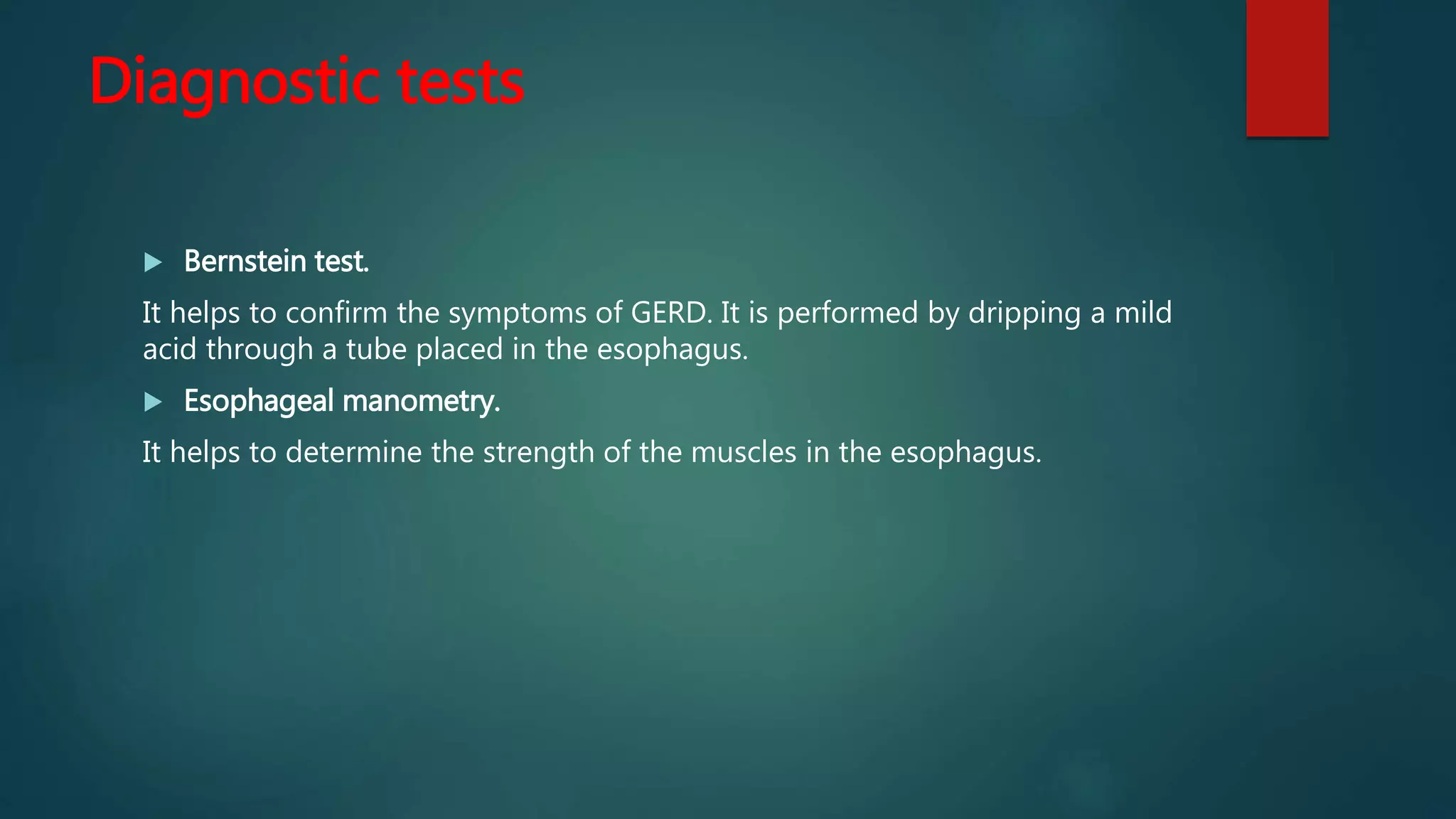
Causes
1- Dietary factor
Cont.
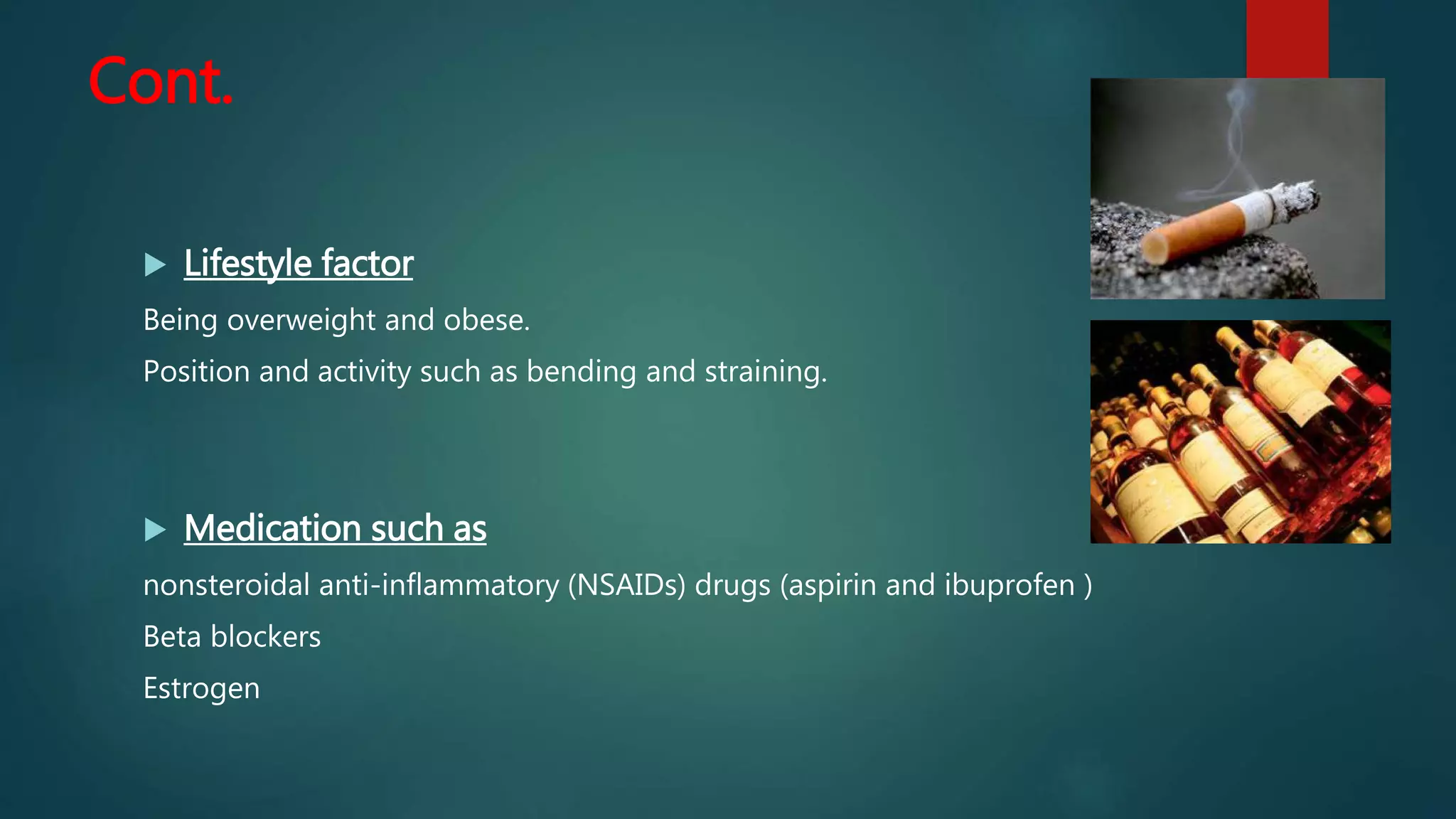
 Lifestyle factor
Being overweight and obese.
Position and activity such as bending and straining.
 Medication such as
nonsteroidal anti-inflammatory (NSAIDs) drugs (aspirin and ibuprofen )
Beta blockers
Estrogen
People who are at risk
 Pregnant women because during pregnancy, as the uterus grows, it pushes
on the stomach and then forces stomach acid up into the esophagus.
 Hiatal hernia.
Pathophysiology
 Typically When The lower esophageal sphincter (LES) muscle relaxes too
often or for too long, the acid from the stomach refluxes back into the
esophagus, causing heartburn.
LES relaxation, decreased gastric emptying, high secretion of acid in
the stomach, impaired mobility of the esophageal and increase the
pressure in the abdomen
Gastric and intestinal enzymes (pepsin, trypsin, bile
salts) also reflux up into the esophagus
The flow back of the gastric acid secretion
into the esophagus
Irritation and erosion in the mucosal lining of the the esophagus
Esophagitis
GERD
Hiatal hernia
LES relaxation
Esophageal sphincter above
diaphragm
The flow back of the
gastric acid secretion
into the esophagus
Because diaphragm is
reduced, pressure develops
on the LES
Part of stomach lies
with esophagus
GERD
Clinical manifestation
 Heartburn
 Vomiting of food or sour liquid.
 Discomfort when swallowing
 Hoarseness
 Sore throat
 Asthma
 Chest pain
Complications
Uncontrolled or untreated GERD can cause serious health issues.
 Ulcers.
 Barrett’s esophagus esophageal cancer.
Diagnostic tests
 Barium swallow
It examines the organs of the upper part of the digestive system to look for a
hiatal hernia or other problems that may be contributing to reflux symptoms.
 upper Endoscopy
It examines the lining of the esophagus for signs of GERD-related injury. This
endoscope allows doctors to see the inside of upper digestive system and
also to insert instruments for biopsy purposes.
Diagnostic tests
 Bernstein test.
It helps to confirm the symptoms of GERD. It is performed by dripping a mild
acid through a tube placed in the esophagus.
 Esophageal manometry.
It helps to determine the strength of the muscles in the esophagus.
Diagnostic tests
 pH monitoring.
It measures the acidity inside the esophagus and evaluate (GERD).
This test is performed by a thin, plastic tube is placed into a nostril, guided
down the throat, and then into the esophagus just above the lower
esophageal sphincter. There is a sensor at the end of the tube inside the
esophagus to measure pH, or acidity. Also, there is a monitor at The other
end of the tube outside the body to records the pH levels for a 24 to 48 hours
.
Treatment
Nutritional Therapy and Lifestyle Modification
 Watch the food intake and limit fried and fatty foods…etc.
 Eat smaller portions.
 Avoid overeating.
 Loss weight
 Decrease consumption of alcohol.
 Do not lie down or go to bed right after a meal. Instead, wait a couple of
hours.
 Elevate the head when you lie down by placing another pillow
 Use medication such as Antacid , H2 receptors antagonist.
 Exercise?
Literature review
 Title of the study: The relationship between gastroesophageal reflux disease and the
level of physical activity.
 Authors: Jóźków P1, Waśko-Czopnik D, Dunajska K, Medraś M, Paradowski L.
 Date published: 2007 Aug 25
 Purpose : to examine the association between the level of everyday physical activity
and parameters of the disease (pH-metry, symptoms) in patients diagnosed with
GERD.
Method
1- By using the international physical activity questionnaire (7-day recall), they
assessed the level of physical activity of 100 GERD patients and identified them
as groups.
 Group 1 =low level physical activity.
 Group 2 = moderate physical activity.
 Group 3 = high physical activity.
 The amount of physical activity was expressed as multiples of resting
metabolic rate and minutes of performance during a week (METs-
minute/week).
 To find the relationships between everyday physical activity and pH-metric
indices of GERD, they used a multivariate regression for analysis.
 The covariates in the study were (age, BMI, smoking and gender).
Cont.
2- PH monitoring for studied subjects
 It was performed by using a dual electrode catheter with antimony
electrodes with standard 10 cm spacing between Them.
 there were two spots for monitoring the distal and proximal pH.
 The distal electrode was placed 5 cm above the proximal Border of
LES and the proximal electrode was placed 15 cm above LES.
The pH probe and the pH recorder were retained For a 24 hour period.
 Inclusion criteria :
 all GERD patient who had undergone 24-h pH monitoring in a clinical
setting.
 Patients who experience symptoms daily.
 Exclusion criteria:
 Patients who use medication for GERD and can effect the symptoms and
PH measurements.
 Patients with restricted locomotor abilities.
Results
 There were weak association between the amount of everyday physical
activity and pH-metric parameters of GERD when was evaluated 5 cm and
15 cm above the lower esophageal sphincter (LES).
 This is because the number of the self-reported GERD symptoms was 6
symptoms in groups 1, 2 and 7 symptoms in group 3. therefore, There was
no significant difference among the three group of physical activity.
Results
 However, they only found significant correlations between pH-metric
parameters and covariates.
 between the number of reflux episodes 15 cm above LES and gender (beta
-0.25; p <0.05)
 between the number of reflux episodes 5 cm above LES and age (beta -
0.24; p <0.05).
Conclusion/discussion
 There is no association between the level of daily physical activity and the
symptoms of GERD.
 Although there was no notable difference in the numbers of symptoms
between the three levels of physical activity, more studies are needed.
Strength/ limitation of the study
 Strength:
Large sample size
Limitation:
Age and gender were unknown for those patients who obtained significant
correlation with number of reflux episodes.
Relevance to the field(s) of nutrition
and exercise science
 Nutritional therapy play an important roles in treating patients with GERD.
by Watching food intake and limiting fried and fatty foods GERD can be
prevented as well.
 Maintaining healthy weight can help.
 Exercise is good for health but it may not by helpful with GERD especially
the heavy one.
Reference
 Józków, P., Wasko-Czopnik, D., Dunajska, K., Medras, M., &
Paradowski, L. (2007). The relationship between gastroesophageal
reflux disease and the level of physical activity. Swiss Medical
Weekly, 137(33-34), 465-471. retrieved from
http://www.smw.ch/docs/pdf200x/2007/33/smw-11887.pdf
 Granderath, F., & Pointner, R. (2006). Chapter 2: The Pathophysiology
Of Gerd. In Gastroesophageal reflux disease: Principles of disease,
diagnosis, and treatment (pp. 13-22). Stefan: Springer New York.

Gastroesophageal Reflux Disease and Exercise (GERD)

  • 1.
    Gastroesophageal Reflux Diseaseand Exercise DONE BY: EMAN AL-ZAWWAD FN 530
  • 2.
    Content  What isGERD  Pathophysiology of GERD  Causes  Clinical manifestation  Diagnostic tests  Complications  Treatment  Literature review
  • 3.
    Definition of Gastroesophagealreflux disease (GERD)  It is a digestive disorder which caused by flowing of gastric acid from the stomach into the esophagus.
  • 4.
  • 5.
    Cont.  Lifestyle factor Beingoverweight and obese. Position and activity such as bending and straining.  Medication such as nonsteroidal anti-inflammatory (NSAIDs) drugs (aspirin and ibuprofen ) Beta blockers Estrogen
  • 6.
    People who areat risk  Pregnant women because during pregnancy, as the uterus grows, it pushes on the stomach and then forces stomach acid up into the esophagus.  Hiatal hernia.
  • 7.
    Pathophysiology  Typically WhenThe lower esophageal sphincter (LES) muscle relaxes too often or for too long, the acid from the stomach refluxes back into the esophagus, causing heartburn.
  • 8.
    LES relaxation, decreasedgastric emptying, high secretion of acid in the stomach, impaired mobility of the esophageal and increase the pressure in the abdomen Gastric and intestinal enzymes (pepsin, trypsin, bile salts) also reflux up into the esophagus The flow back of the gastric acid secretion into the esophagus Irritation and erosion in the mucosal lining of the the esophagus Esophagitis GERD
  • 9.
    Hiatal hernia LES relaxation Esophagealsphincter above diaphragm The flow back of the gastric acid secretion into the esophagus Because diaphragm is reduced, pressure develops on the LES Part of stomach lies with esophagus GERD
  • 10.
    Clinical manifestation  Heartburn Vomiting of food or sour liquid.  Discomfort when swallowing  Hoarseness  Sore throat  Asthma  Chest pain
  • 11.
    Complications Uncontrolled or untreatedGERD can cause serious health issues.  Ulcers.  Barrett’s esophagus esophageal cancer.
  • 12.
    Diagnostic tests  Bariumswallow It examines the organs of the upper part of the digestive system to look for a hiatal hernia or other problems that may be contributing to reflux symptoms.  upper Endoscopy It examines the lining of the esophagus for signs of GERD-related injury. This endoscope allows doctors to see the inside of upper digestive system and also to insert instruments for biopsy purposes.
  • 13.
    Diagnostic tests  Bernsteintest. It helps to confirm the symptoms of GERD. It is performed by dripping a mild acid through a tube placed in the esophagus.  Esophageal manometry. It helps to determine the strength of the muscles in the esophagus.
  • 14.
    Diagnostic tests  pHmonitoring. It measures the acidity inside the esophagus and evaluate (GERD). This test is performed by a thin, plastic tube is placed into a nostril, guided down the throat, and then into the esophagus just above the lower esophageal sphincter. There is a sensor at the end of the tube inside the esophagus to measure pH, or acidity. Also, there is a monitor at The other end of the tube outside the body to records the pH levels for a 24 to 48 hours .
  • 15.
    Treatment Nutritional Therapy andLifestyle Modification  Watch the food intake and limit fried and fatty foods…etc.  Eat smaller portions.  Avoid overeating.  Loss weight  Decrease consumption of alcohol.  Do not lie down or go to bed right after a meal. Instead, wait a couple of hours.  Elevate the head when you lie down by placing another pillow  Use medication such as Antacid , H2 receptors antagonist.  Exercise?
  • 16.
    Literature review  Titleof the study: The relationship between gastroesophageal reflux disease and the level of physical activity.  Authors: Jóźków P1, Waśko-Czopnik D, Dunajska K, Medraś M, Paradowski L.  Date published: 2007 Aug 25  Purpose : to examine the association between the level of everyday physical activity and parameters of the disease (pH-metry, symptoms) in patients diagnosed with GERD.
  • 17.
    Method 1- By usingthe international physical activity questionnaire (7-day recall), they assessed the level of physical activity of 100 GERD patients and identified them as groups.  Group 1 =low level physical activity.  Group 2 = moderate physical activity.  Group 3 = high physical activity.  The amount of physical activity was expressed as multiples of resting metabolic rate and minutes of performance during a week (METs- minute/week).  To find the relationships between everyday physical activity and pH-metric indices of GERD, they used a multivariate regression for analysis.  The covariates in the study were (age, BMI, smoking and gender).
  • 18.
    Cont. 2- PH monitoringfor studied subjects  It was performed by using a dual electrode catheter with antimony electrodes with standard 10 cm spacing between Them.  there were two spots for monitoring the distal and proximal pH.  The distal electrode was placed 5 cm above the proximal Border of LES and the proximal electrode was placed 15 cm above LES. The pH probe and the pH recorder were retained For a 24 hour period.
  • 19.
     Inclusion criteria:  all GERD patient who had undergone 24-h pH monitoring in a clinical setting.  Patients who experience symptoms daily.  Exclusion criteria:  Patients who use medication for GERD and can effect the symptoms and PH measurements.  Patients with restricted locomotor abilities.
  • 20.
    Results  There wereweak association between the amount of everyday physical activity and pH-metric parameters of GERD when was evaluated 5 cm and 15 cm above the lower esophageal sphincter (LES).  This is because the number of the self-reported GERD symptoms was 6 symptoms in groups 1, 2 and 7 symptoms in group 3. therefore, There was no significant difference among the three group of physical activity.
  • 21.
    Results  However, theyonly found significant correlations between pH-metric parameters and covariates.  between the number of reflux episodes 15 cm above LES and gender (beta -0.25; p <0.05)  between the number of reflux episodes 5 cm above LES and age (beta - 0.24; p <0.05).
  • 22.
    Conclusion/discussion  There isno association between the level of daily physical activity and the symptoms of GERD.  Although there was no notable difference in the numbers of symptoms between the three levels of physical activity, more studies are needed.
  • 23.
    Strength/ limitation ofthe study  Strength: Large sample size Limitation: Age and gender were unknown for those patients who obtained significant correlation with number of reflux episodes.
  • 24.
    Relevance to thefield(s) of nutrition and exercise science  Nutritional therapy play an important roles in treating patients with GERD. by Watching food intake and limiting fried and fatty foods GERD can be prevented as well.  Maintaining healthy weight can help.  Exercise is good for health but it may not by helpful with GERD especially the heavy one.
  • 25.
    Reference  Józków, P.,Wasko-Czopnik, D., Dunajska, K., Medras, M., & Paradowski, L. (2007). The relationship between gastroesophageal reflux disease and the level of physical activity. Swiss Medical Weekly, 137(33-34), 465-471. retrieved from http://www.smw.ch/docs/pdf200x/2007/33/smw-11887.pdf  Granderath, F., & Pointner, R. (2006). Chapter 2: The Pathophysiology Of Gerd. In Gastroesophageal reflux disease: Principles of disease, diagnosis, and treatment (pp. 13-22). Stefan: Springer New York.