GEOTHERMAL ENERGY
• AMAR NATH SINGHA
• ROLL-D113052006
• NO-65684
• DEE-3rd 6th sem
I.C.V.P. JHARGRAM
• SESSION-2016-2017
INTRODUCTON
HOW HEAT IS GENERATE
WHAT IS MAGMA & LAVA
SOURCES
GEOTHERMAL RESERVOIRS
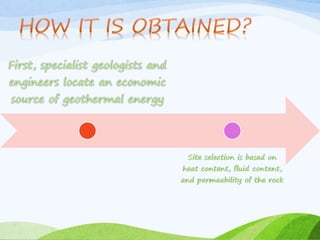
EXPLORATION
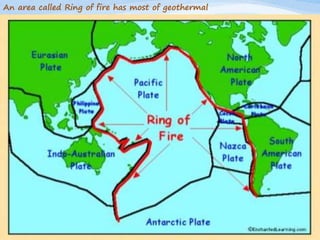
RING OF FIRE
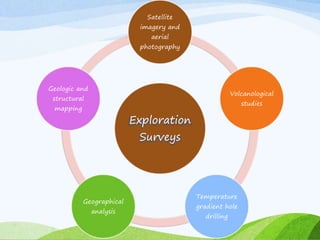
EXPLORATION SURVEYS
DIRECT USES
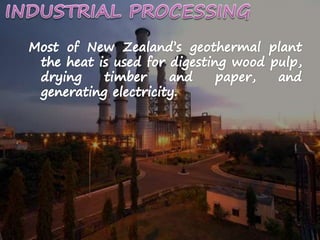
 INDUSTRIAL PROCESSING
 FARMING
 GREENHOUSE HEATING
 DISTRICT HEATING
 RESIDENTIAL HEATING
INDIRECT USE OF GEOTHERMAL ENERGY
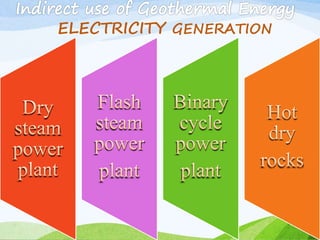
ELECTRICITY GENERATION
DRY STEAM POWER PLANT
FLASH STEAM POWER PLANT
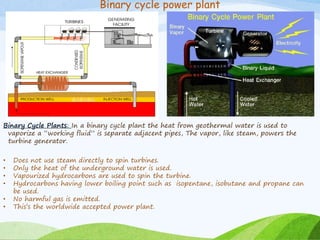
BINARY CYCLE POWER PLANT
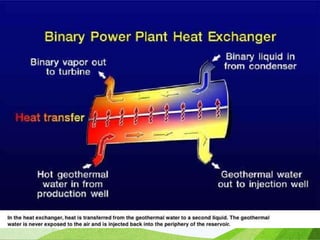
HEAT EXCHANGER
COST
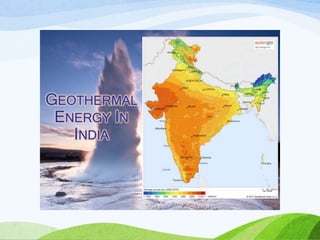
GEOTHERMAL ENERGY IN INDIAN SENERIO
GEOTHERMAL POTENTIAL IN INDIA
GEOTHERMAL PROVINCES IN INDIA
GEOTHERMAL FIELD IN INDIA
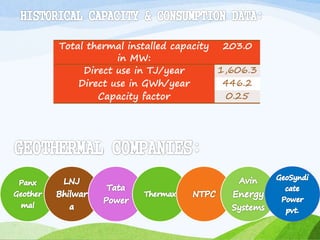
HISTORICAL CAPACITY & CONSUMPTION DATA
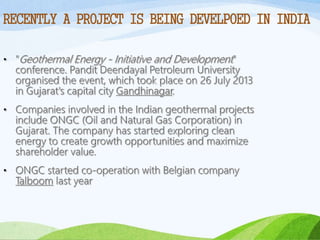
GEOTHERMAL COMPANIES:
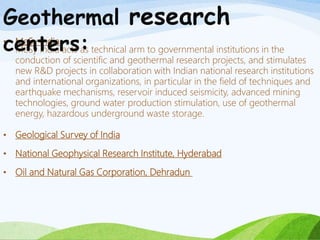
RECENTLY A PROJECT IS BEING DEVELPOED
IN INDIA
GEOTHERMAL RESEARCH CENTERS:
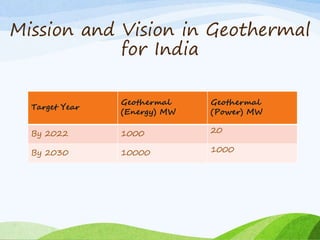
MISSION AND VISION IN GEOTHERMAL FOR
INDIA
ADVANTAGES
DISADVANTAGES
FUTURE OF GEOTHERMAL ENERGY
INTRODUCTON
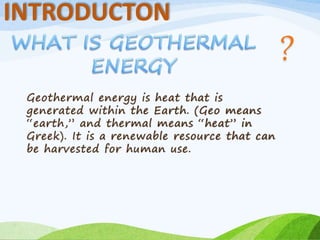
Geothermal energy is heat that is
generated within the Earth. (Geo means
“earth,” and thermal means “heat” in
Greek). It is a renewable resource that can
be harvested for human use.
HOW HEAT IS GENERATE
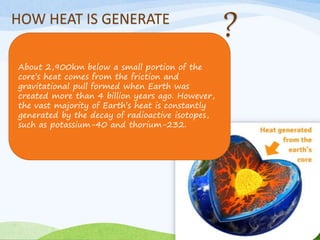
About 2,900km below a small portion of the
core’s heat comes from the friction and
gravitational pull formed when Earth was
created more than 4 billion years ago. However,
the vast majority of Earth’s heat is constantly
generated by the decay of radioactive isotopes,
such as potassium-40 and thorium-232.
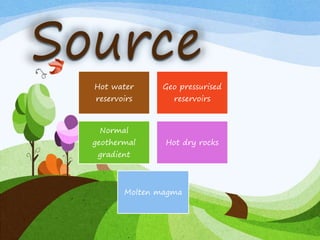
Source
Hot water
reservoirs
Geo pressurised
reservoirs
Normal
geothermal
gradient
Hot dry rocks
Molten magma
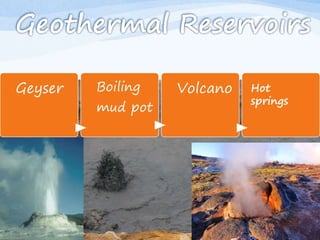
Geyser Boiling
mud pot
Volcano Hot
springs
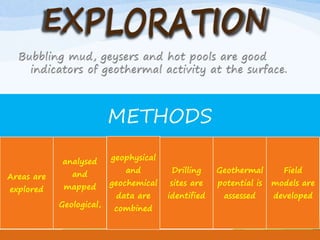
METHODS
Areas are
explored
analysed
and
mapped
Geological,
geophysical
and
geochemical
data are
combined
Drilling
sites are
identified
Geothermal
potential is
assessed
Field
models are
developed
An area called Ring of fire has most of geothermal
Exploration
Surveys
Satellite
imagery and
aerial
photography
Volcanological
studies
Temperature
gradient hole
drilling
Geographical
analysis
Geologic and
structural
mapping
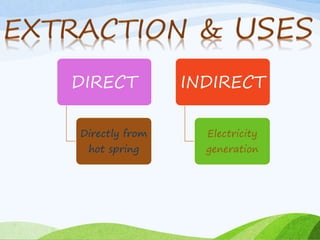
DIRECT
Directly from
hot spring
INDIRECT
Electricity
generation
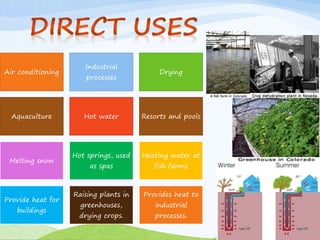
Air conditioning
Industrial
processes
Drying
Aquaculture Hot water Resorts and pools
Melting snow
Hot springs, used
as spas
Heating water at
fish farms
Provide heat for
buildings
Raising plants in
greenhouses,
drying crops.
Provides heat to
industrial
processes.
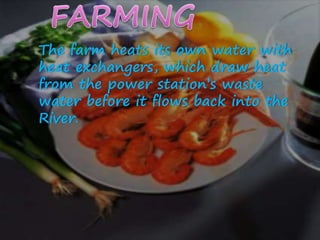
The farm heats its own water with
heat exchangers, which draw heat
from the power station’s waste
water before it flows back into the
River.
GREENHOUSE HEATING
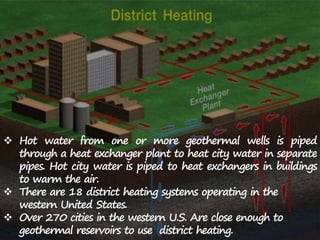
 Hot water from one or more geothermal wells is piped
through a heat exchanger plant to heat city water in separate
pipes. Hot city water is piped to heat exchangers in buildings
to warm the air.
 There are 18 district heating systems operating in the
western United States.
 Over 270 cities in the western U.S. Are close enough to
geothermal reservoirs to use district heating.
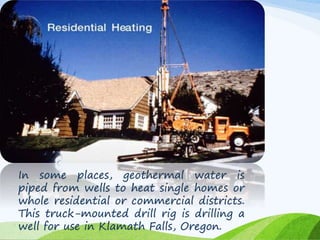
In some places, geothermal water is
piped from wells to heat single homes or
whole residential or commercial districts.
This truck-mounted drill rig is drilling a
well for use in Klamath Falls, Oregon.
ELECTRICITY GENERATION
Dry Steam power plant
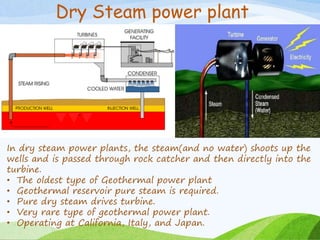
In dry steam power plants, the steam(and no water) shoots up the
wells and is passed through rock catcher and then directly into the
turbine.
• The oldest type of Geothermal power plant
• Geothermal reservoir pure steam is required.
• Pure dry steam drives turbine.
• Very rare type of geothermal power plant.
• Operating at California, Italy, and Japan.
Flash steam power plant
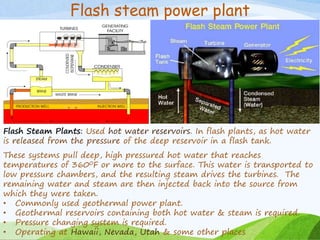
Flash Steam Plants: Used hot water reservoirs. In flash plants, as hot water

is released from the pressure of the deep reservoir in a flash tank.
These systems pull deep, high pressured hot water that reaches
temperatures of 3600F or more to the surface. This water is transported to
low pressure chambers, and the resulting steam drives the turbines. The
remaining water and steam are then injected back into the source from
which they were taken.
• Commonly used geothermal power plant.
• Geothermal reservoirs containing both hot water & steam is required.
• Pressure changing system is required.
• Operating at Hawaii, Nevada, Utah & some other places
Binary cycle power plant
Binary Cycle Plants: In a binary cycle plant the heat from geothermal water is used to
vaporize a “working fluid” is separate adjacent pipes, The vapor, like steam, powers the
turbine generator.
• Does not use steam directly to spin turbines.
• Only the heat of the underground water is used.
• Vapourized hydrocarbons are used to spin the turbine.
• Hydrocarbons having lower boiling point such as isopentane, isobutane and propane can
be used.
• No harmful gas is emitted.
• This’s the worldwide accepted power plant.
Cost
• Direct use of geothermal energy is absolutely cheaper than
other energy sources.
• Cost of electricity generation depends upon certain factors:
 Temperature and depth of resource
 Type of resource (steam, liquid, mix)
 Size and technology of plant
• The initial investment is high.
• They cost around US $0.05 to $0.08 (Rs. 2.772 to Rs.
4.4352) per kWh
• Once the capital cost is recovered, the price can decrease to
below US $0.05 (Rs 2.2772) per kWh
GEOTHERMAL
ENERGY IN
INDIA
Renewable energy in India is growing leaps and
bound under government ambitious plan of
enhancing renewable capacity to 175 GW by
2022. While solar and wind continue to drive
this initiative, new and upcoming technologies
such as geothermal, ocean and tidal are being
promoted to enhance renewable share to 25 % in
energy mix, from current 7 %.
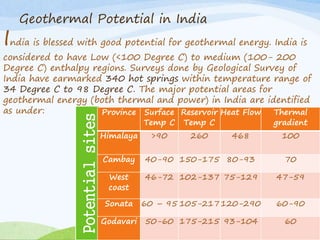
Potentialsites
Province Surface
Temp C
Reservoir
Temp C
Heat Flow Thermal
gradient
Himalaya >90 260 468 100
Cambay 40-90 150-175 80-93 70
West
coast
46-72 102-137 75-129 47-59
Sonata 60 – 95 105-217120-290 60-90
Godavari 50-60 175-215 93-104 60
India is blessed with good potential for geothermal energy. India is
considered to have Low (<100 Degree C) to medium (100- 200
Degree C) enthalpy regions. Surveys done by Geological Survey of
India have earmarked 340 hot springs within temperature range of
34 Degree C to 98 Degree C. The major potential areas for
geothermal energy (both thermal and power) in India are identified
as under:
Geothermal Potential in India
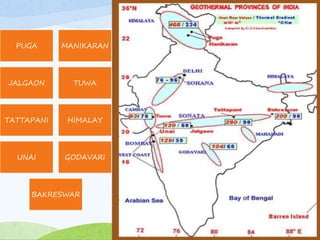
PUGA MANIKARAN
JALGAON TUWA
TATTAPANI HIMALAY
UNAI GODAVARI
BAKRESWAR
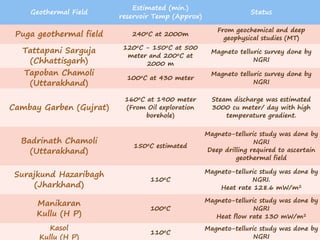
Geothermal Field
Estimated (min.)
reservoir Temp (Approx)
Status
Puga geothermal field 240oC at 2000m
From geochemical and deep
geophysical studies (MT)
Tattapani Sarguja
(Chhattisgarh)
120oC - 150oC at 500
meter and 200oC at
2000 m
Magneto telluric survey done by
NGRI
Tapoban Chamoli
(Uttarakhand)
100oC at 430 meter
Magneto telluric survey done by
NGRI
Cambay Garben (Gujrat)
160oC at 1900 meter
(From Oil exploration
borehole)
Steam discharge was estimated
3000 cu meter/ day with high
temperature gradient.
Badrinath Chamoli
(Uttarakhand)
150oC estimated
Magneto-telluric study was done by
NGRI
Deep drilling required to ascertain
geothermal field
Surajkund Hazaribagh
(Jharkhand)
110oC
Magneto-telluric study was done by
NGRI.
Heat rate 128.6 mW/m2
Manikaran
Kullu (H P)
100oC
Magneto-telluric study was done by
NGRI
Heat flow rate 130 mW/m2
Kasol
Kullu (H P)
110oC
Magneto-telluric study was done by
NGRI
Total thermal installed capacity
in MW:
203.0
Direct use in TJ/year 1,606.3
Direct use in GWh/year 446.2
Capacity factor 0.25
RECENTLY A PROJECT IS BEING DEVELPOED IN INDIA
• MeSy India
MeSy India acts as technical arm to governmental institutions in the
conduction of scientific and geothermal research projects, and stimulates
new R&D projects in collaboration with Indian national research institutions
and international organizations, in particular in the field of techniques and
earthquake mechanisms, reservoir induced seismicity, advanced mining
technologies, ground water production stimulation, use of geothermal
energy, hazardous underground waste storage.
• Geological Survey of India
• National Geophysical Research Institute, Hyderabad
• Oil and Natural Gas Corporation, Dehradun
Geothermal research
centers:
Mission and Vision in Geothermal
for India
Target Year
Geothermal
(Energy) MW
Geothermal
(Power) MW
By 2022 1000 20
By 2030 10000 1000
Advantages
• Available all the year around.
• Direct use
• Low running cost, it saves 80% costs over fossil
fuels.
• It is free from global warming as does not involve
any combustion of fuel.
• Unlike solar energy it is independent of weather
condition.
• Clean Resource – Very little emissions or overall
environmental impact.
• maintenance cost of geothermal plants very less
• Overall, geothermal energy is a sustainable
resource.
Disadvantages
• Not widespread source of energy
• High installation costs
• Can run out of steam
• May release harmful gases, poisonous
gases that can escape through the holes
during construction.
• Geothermal energy can not be easily
transported
• Total generation potential of this
source is too small.
• There is always danger of eruption of
volcano .
FUTURE OF EOTHERMAL ENERGY
 The first geothermal power plant is established in 1911 in Larderello, Italy.
 Currently only 24 countries are able to produce electricity from
geothermal energy in large scale producing a total of 11,700 MW of
electricity.
 But it only comprises for about less than 0.4% of the worlds electricity
consumption.
 This is mainly due to the fact that there is 75-80% chance of failure for
exploratory well digging and geothermal energy is not available at all
places.
 Due to these facts developing countries like India is unable to install a
geothermal power plant due to high risk and unavailability of geothermal
energy.
 To support the establishment of geothermal power plants the International
Geothermal Association(IGA) and International Renewable Energy
Alliance(REN alliance) has funded more than 10 projects and more than
65 countries are its members
 So in order to overcome these limitations research is going on at
IGA,Bocham,Germany to produce geothermal power more efficiently at low
installation costs
GEOTHERMAL POWER PLANT AND ITS INDIAN SCENARIO

GEOTHERMAL POWER PLANT AND ITS INDIAN SCENARIO

  • 1.
    GEOTHERMAL ENERGY • AMARNATH SINGHA • ROLL-D113052006 • NO-65684 • DEE-3rd 6th sem I.C.V.P. JHARGRAM • SESSION-2016-2017
  • 2.
    INTRODUCTON HOW HEAT ISGENERATE WHAT IS MAGMA & LAVA SOURCES GEOTHERMAL RESERVOIRS EXPLORATION RING OF FIRE EXPLORATION SURVEYS DIRECT USES  INDUSTRIAL PROCESSING  FARMING  GREENHOUSE HEATING  DISTRICT HEATING  RESIDENTIAL HEATING INDIRECT USE OF GEOTHERMAL ENERGY ELECTRICITY GENERATION DRY STEAM POWER PLANT FLASH STEAM POWER PLANT BINARY CYCLE POWER PLANT HEAT EXCHANGER COST GEOTHERMAL ENERGY IN INDIAN SENERIO GEOTHERMAL POTENTIAL IN INDIA GEOTHERMAL PROVINCES IN INDIA GEOTHERMAL FIELD IN INDIA HISTORICAL CAPACITY & CONSUMPTION DATA GEOTHERMAL COMPANIES: RECENTLY A PROJECT IS BEING DEVELPOED IN INDIA GEOTHERMAL RESEARCH CENTERS: MISSION AND VISION IN GEOTHERMAL FOR INDIA ADVANTAGES DISADVANTAGES FUTURE OF GEOTHERMAL ENERGY
  • 3.
    INTRODUCTON Geothermal energy isheat that is generated within the Earth. (Geo means “earth,” and thermal means “heat” in Greek). It is a renewable resource that can be harvested for human use.
  • 4.
    HOW HEAT ISGENERATE About 2,900km below a small portion of the core’s heat comes from the friction and gravitational pull formed when Earth was created more than 4 billion years ago. However, the vast majority of Earth’s heat is constantly generated by the decay of radioactive isotopes, such as potassium-40 and thorium-232.
  • 6.
  • 7.
  • 8.
  • 9.
    An area calledRing of fire has most of geothermal
  • 11.
  • 12.
  • 13.
    Air conditioning Industrial processes Drying Aquaculture Hotwater Resorts and pools Melting snow Hot springs, used as spas Heating water at fish farms Provide heat for buildings Raising plants in greenhouses, drying crops. Provides heat to industrial processes.
  • 15.
    The farm heatsits own water with heat exchangers, which draw heat from the power station’s waste water before it flows back into the River.
  • 16.
  • 17.
     Hot waterfrom one or more geothermal wells is piped through a heat exchanger plant to heat city water in separate pipes. Hot city water is piped to heat exchangers in buildings to warm the air.  There are 18 district heating systems operating in the western United States.  Over 270 cities in the western U.S. Are close enough to geothermal reservoirs to use district heating.
  • 18.
    In some places,geothermal water is piped from wells to heat single homes or whole residential or commercial districts. This truck-mounted drill rig is drilling a well for use in Klamath Falls, Oregon.
  • 19.
  • 20.
    Dry Steam powerplant In dry steam power plants, the steam(and no water) shoots up the wells and is passed through rock catcher and then directly into the turbine. • The oldest type of Geothermal power plant • Geothermal reservoir pure steam is required. • Pure dry steam drives turbine. • Very rare type of geothermal power plant. • Operating at California, Italy, and Japan.
  • 21.
    Flash steam powerplant Flash Steam Plants: Used hot water reservoirs. In flash plants, as hot water is released from the pressure of the deep reservoir in a flash tank. These systems pull deep, high pressured hot water that reaches temperatures of 3600F or more to the surface. This water is transported to low pressure chambers, and the resulting steam drives the turbines. The remaining water and steam are then injected back into the source from which they were taken. • Commonly used geothermal power plant. • Geothermal reservoirs containing both hot water & steam is required. • Pressure changing system is required. • Operating at Hawaii, Nevada, Utah & some other places
  • 22.
    Binary cycle powerplant Binary Cycle Plants: In a binary cycle plant the heat from geothermal water is used to vaporize a “working fluid” is separate adjacent pipes, The vapor, like steam, powers the turbine generator. • Does not use steam directly to spin turbines. • Only the heat of the underground water is used. • Vapourized hydrocarbons are used to spin the turbine. • Hydrocarbons having lower boiling point such as isopentane, isobutane and propane can be used. • No harmful gas is emitted. • This’s the worldwide accepted power plant.
  • 24.
    Cost • Direct useof geothermal energy is absolutely cheaper than other energy sources. • Cost of electricity generation depends upon certain factors:  Temperature and depth of resource  Type of resource (steam, liquid, mix)  Size and technology of plant • The initial investment is high. • They cost around US $0.05 to $0.08 (Rs. 2.772 to Rs. 4.4352) per kWh • Once the capital cost is recovered, the price can decrease to below US $0.05 (Rs 2.2772) per kWh
  • 25.
  • 26.
    Renewable energy inIndia is growing leaps and bound under government ambitious plan of enhancing renewable capacity to 175 GW by 2022. While solar and wind continue to drive this initiative, new and upcoming technologies such as geothermal, ocean and tidal are being promoted to enhance renewable share to 25 % in energy mix, from current 7 %.
  • 27.
    Potentialsites Province Surface Temp C Reservoir TempC Heat Flow Thermal gradient Himalaya >90 260 468 100 Cambay 40-90 150-175 80-93 70 West coast 46-72 102-137 75-129 47-59 Sonata 60 – 95 105-217120-290 60-90 Godavari 50-60 175-215 93-104 60 India is blessed with good potential for geothermal energy. India is considered to have Low (<100 Degree C) to medium (100- 200 Degree C) enthalpy regions. Surveys done by Geological Survey of India have earmarked 340 hot springs within temperature range of 34 Degree C to 98 Degree C. The major potential areas for geothermal energy (both thermal and power) in India are identified as under: Geothermal Potential in India
  • 28.
    PUGA MANIKARAN JALGAON TUWA TATTAPANIHIMALAY UNAI GODAVARI BAKRESWAR
  • 29.
    Geothermal Field Estimated (min.) reservoirTemp (Approx) Status Puga geothermal field 240oC at 2000m From geochemical and deep geophysical studies (MT) Tattapani Sarguja (Chhattisgarh) 120oC - 150oC at 500 meter and 200oC at 2000 m Magneto telluric survey done by NGRI Tapoban Chamoli (Uttarakhand) 100oC at 430 meter Magneto telluric survey done by NGRI Cambay Garben (Gujrat) 160oC at 1900 meter (From Oil exploration borehole) Steam discharge was estimated 3000 cu meter/ day with high temperature gradient. Badrinath Chamoli (Uttarakhand) 150oC estimated Magneto-telluric study was done by NGRI Deep drilling required to ascertain geothermal field Surajkund Hazaribagh (Jharkhand) 110oC Magneto-telluric study was done by NGRI. Heat rate 128.6 mW/m2 Manikaran Kullu (H P) 100oC Magneto-telluric study was done by NGRI Heat flow rate 130 mW/m2 Kasol Kullu (H P) 110oC Magneto-telluric study was done by NGRI
  • 30.
    Total thermal installedcapacity in MW: 203.0 Direct use in TJ/year 1,606.3 Direct use in GWh/year 446.2 Capacity factor 0.25
  • 31.
    RECENTLY A PROJECTIS BEING DEVELPOED IN INDIA
  • 32.
    • MeSy India MeSyIndia acts as technical arm to governmental institutions in the conduction of scientific and geothermal research projects, and stimulates new R&D projects in collaboration with Indian national research institutions and international organizations, in particular in the field of techniques and earthquake mechanisms, reservoir induced seismicity, advanced mining technologies, ground water production stimulation, use of geothermal energy, hazardous underground waste storage. • Geological Survey of India • National Geophysical Research Institute, Hyderabad • Oil and Natural Gas Corporation, Dehradun Geothermal research centers:
  • 33.
    Mission and Visionin Geothermal for India Target Year Geothermal (Energy) MW Geothermal (Power) MW By 2022 1000 20 By 2030 10000 1000
  • 34.
    Advantages • Available allthe year around. • Direct use • Low running cost, it saves 80% costs over fossil fuels. • It is free from global warming as does not involve any combustion of fuel. • Unlike solar energy it is independent of weather condition. • Clean Resource – Very little emissions or overall environmental impact. • maintenance cost of geothermal plants very less • Overall, geothermal energy is a sustainable resource.
  • 35.
    Disadvantages • Not widespreadsource of energy • High installation costs • Can run out of steam • May release harmful gases, poisonous gases that can escape through the holes during construction. • Geothermal energy can not be easily transported • Total generation potential of this source is too small. • There is always danger of eruption of volcano .
  • 36.
    FUTURE OF EOTHERMALENERGY  The first geothermal power plant is established in 1911 in Larderello, Italy.  Currently only 24 countries are able to produce electricity from geothermal energy in large scale producing a total of 11,700 MW of electricity.  But it only comprises for about less than 0.4% of the worlds electricity consumption.  This is mainly due to the fact that there is 75-80% chance of failure for exploratory well digging and geothermal energy is not available at all places.  Due to these facts developing countries like India is unable to install a geothermal power plant due to high risk and unavailability of geothermal energy.  To support the establishment of geothermal power plants the International Geothermal Association(IGA) and International Renewable Energy Alliance(REN alliance) has funded more than 10 projects and more than 65 countries are its members  So in order to overcome these limitations research is going on at IGA,Bocham,Germany to produce geothermal power more efficiently at low installation costs