* ABOUT THIS PRESENTATION
INTRODUCTION
SOURCES
OVERVIEW
16.5 BENEFITS &
DISADVANTAGES
CONCLUSION
HISTRY
060306
GEOTHERMAL ENERGY:
INTRODUCTION
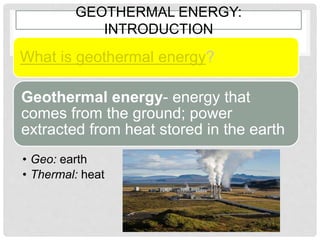
What is geothermal energy?
Geothermal energy- energy that
comes from the ground; power
extracted from heat stored in the earth
• Geo: earth
• Thermal: heat
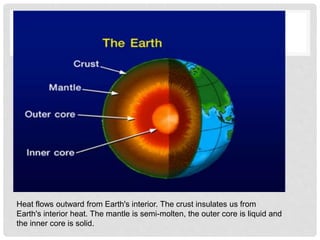
Heat flows outward from Earth's interior. The crust insulates us from
Earth's interior heat. The mantle is semi-molten, the outer core is liquid and
the inner core is solid.
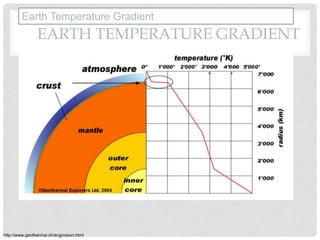
EARTH TEMPERATURE GRADIENT
http://www.geothermal.ch/eng/vision.html
Earth Temperature Gradient
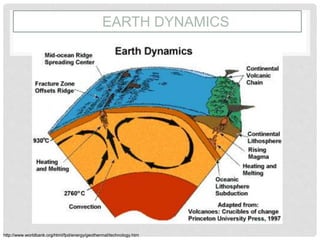
EARTH DYNAMICS
http://www.worldbank.org/html/fpd/energy/geothermal/technology.htm
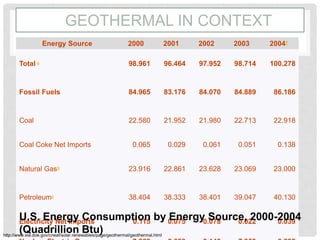
GEOTHERMAL IN CONTEXT
Energy Source 2000 2001 2002 2003 2004P
Total a 98.961 96.464 97.952 98.714 100.278
Fossil Fuels 84.965 83.176 84.070 84.889 86.186
Coal 22.580 21.952 21.980 22.713 22.918
Coal Coke Net Imports 0.065 0.029 0.061 0.051 0.138
Natural Gasb 23.916 22.861 23.628 23.069 23.000
Petroleumc 38.404 38.333 38.401 39.047 40.130
Electricity Net Imports 0.115 0.075 0.078 0.022 0.039
http://www.eia.doe.gov/cneaf/solar.renewables/page/geothermal/geothermal.html
U.S. Energy Consumption by Energy Source, 2000-2004
(Quadrillion Btu)
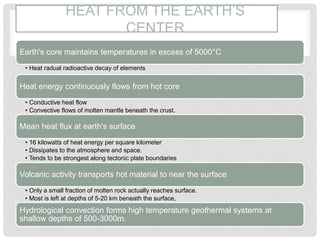
HEAT FROM THE EARTH’S
CENTER
Earth's core maintains temperatures in excess of 5000°C
• Heat radual radioactive decay of elements
Heat energy continuously flows from hot core
• Conductive heat flow
• Convective flows of molten mantle beneath the crust.
Mean heat flux at earth's surface
• 16 kilowatts of heat energy per square kilometer
• Dissipates to the atmosphere and space.
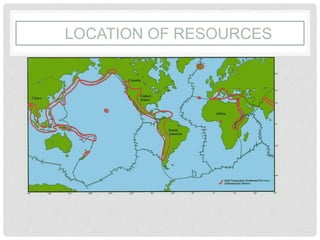
• Tends to be strongest along tectonic plate boundaries
Volcanic activity transports hot material to near the surface
• Only a small fraction of molten rock actually reaches surface.
• Most is left at depths of 5-20 km beneath the surface,
Hydrological convection forms high temperature geothermal systems at
shallow depths of 500-3000m.
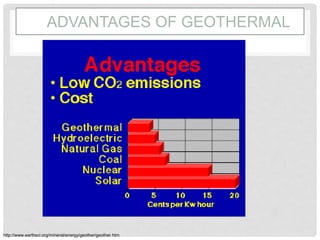
ADVANTAGES OF GEOTHERMAL
http://www.earthsci.org/mineral/energy/geother/geother.htm
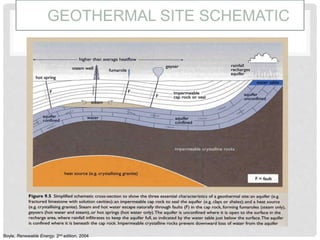
GEOTHERMAL SITE SCHEMATIC
Boyle, Renewable Energy, 2nd edition, 2004
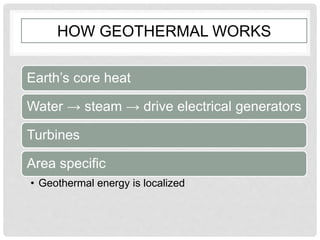
HOW GEOTHERMAL WORKS
Earth’s core heat
Water → steam → drive electrical generators
Turbines
Area specific
• Geothermal energy is localized
GEOTHERMAL ENERGY:
HISTORY
Used for bathing in Paleolithic times
Ancient Romans used it as a central heating
system for bathing and heating homes and
floors
1892: America’s first district heating system
was put into place
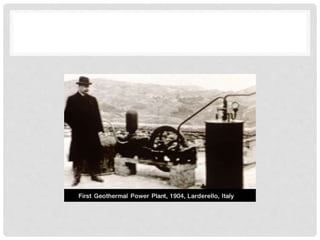
GEOTHERMAL ENERGY: HISTORY
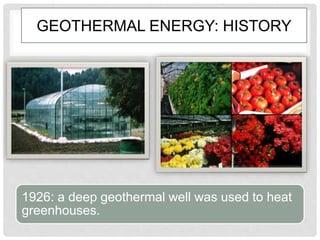
1926: a deep geothermal well was used to heat
greenhouses.
GEOTHERMAL ENERGY: HISTORY
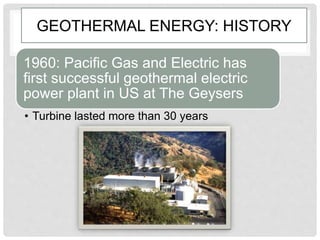
1960: Pacific Gas and Electric has
first successful geothermal electric
power plant in US at The Geysers
• Turbine lasted more than 30 years
* OVERVIEW: GEOTHERMAL
Geothermal energy is present within the land and the sea
• Internal heat is from initial world accretion from gathering dust and compression of the earth
and from radioactive decay
This energy can be useful in heating and cooling of air and water, but is
somewhat costly to use
Active geyser areas are limited in area, but provide much hotter water or
steam
The energy is inexhaustible in principle, yet local extraction will cool the
immediate area in a few years
Extraction of energy from deep (~20,000 ft) hot rock is not economic yet
080317
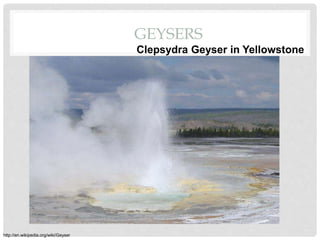
GEYSERS
http://en.wikipedia.org/wiki/Geyser
Clepsydra Geyser in Yellowstone
* GEOTHERMAL ENERGY
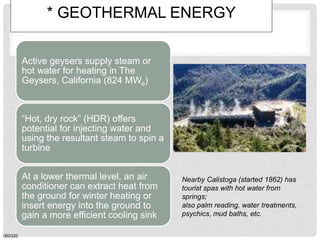
Active geysers supply steam or
hot water for heating in The
Geysers, California (824 MWe)
“Hot, dry rock” (HDR) offers
potential for injecting water and
using the resultant steam to spin a
turbine
At a lower thermal level, an air
conditioner can extract heat from
the ground for winter heating or
insert energy into the ground to
gain a more efficient cooling sink
060320
Nearby Calistoga (started 1862) has
tourist spas with hot water from
springs;
also palm reading, water treatments,
psychics, mud baths, etc.
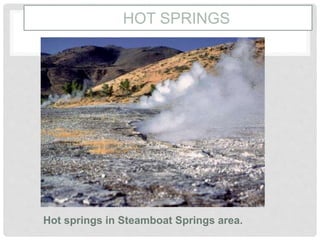
HOT SPRINGS
Hot springs in Steamboat Springs area.
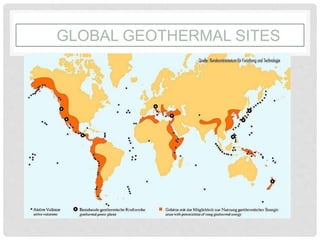
GLOBAL GEOTHERMAL SITES
LOCATION OF RESOURCES
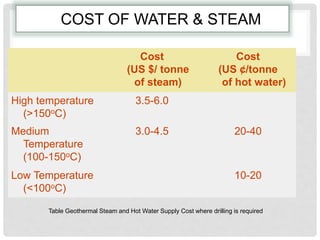
COST OF WATER & STEAM
Cost
(US $/ tonne
of steam)
Cost
(US ¢/tonne
of hot water)
High temperature
(>150oC)
3.5-6.0
Medium
Temperature
(100-150oC)
3.0-4.5 20-40
Low Temperature
(<100oC)
10-20
Table Geothermal Steam and Hot Water Supply Cost where drilling is required
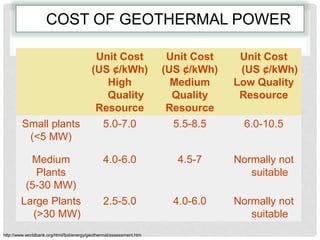
COST OF GEOTHERMAL POWER
Unit Cost
(US ¢/kWh)
High
Quality
Resource
Unit Cost
(US ¢/kWh)
Medium
Quality
Resource
Unit Cost
(US ¢/kWh)
Low Quality
Resource
Small plants
(<5 MW)
5.0-7.0 5.5-8.5 6.0-10.5
Medium
Plants
(5-30 MW)
4.0-6.0 4.5-7 Normally not
suitable
Large Plants
(>30 MW)
2.5-5.0 4.0-6.0 Normally not
suitable
http://www.worldbank.org/html/fpd/energy/geothermal/assessment.htm
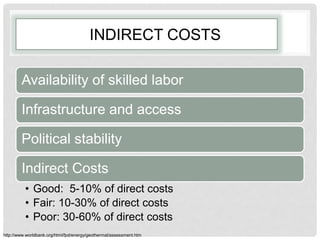
INDIRECT COSTS
Availability of skilled labor
Infrastructure and access
Political stability
Indirect Costs
• Good: 5-10% of direct costs
• Fair: 10-30% of direct costs
• Poor: 30-60% of direct costs
http://www.worldbank.org/html/fpd/energy/geothermal/assessment.htm
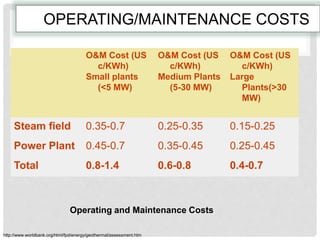
OPERATING/MAINTENANCE COSTS
O&M Cost (US
c/KWh)
Small plants
(<5 MW)
O&M Cost (US
c/KWh)
Medium Plants
(5-30 MW)
O&M Cost (US
c/KWh)
Large
Plants(>30
MW)
Steam field 0.35-0.7 0.25-0.35 0.15-0.25
Power Plant 0.45-0.7 0.35-0.45 0.25-0.45
Total 0.8-1.4 0.6-0.8 0.4-0.7
Operating and Maintenance Costs
http://www.worldbank.org/html/fpd/energy/geothermal/assessment.htm
GENERATION OF
ELECTRICITY
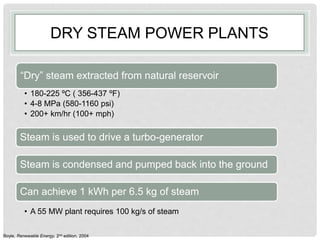
DRY STEAM POWER PLANTS
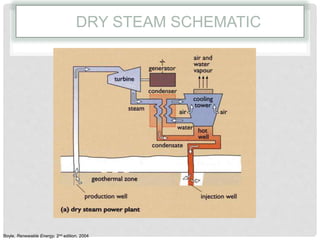
“Dry” steam extracted from natural reservoir
• 180-225 ºC ( 356-437 ºF)
• 4-8 MPa (580-1160 psi)
• 200+ km/hr (100+ mph)
Steam is used to drive a turbo-generator
Steam is condensed and pumped back into the ground
Can achieve 1 kWh per 6.5 kg of steam
• A 55 MW plant requires 100 kg/s of steam
Boyle, Renewable Energy, 2nd edition, 2004
DRY STEAM SCHEMATIC
Boyle, Renewable Energy, 2nd edition, 2004
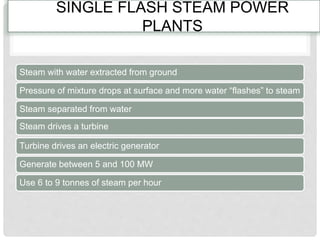
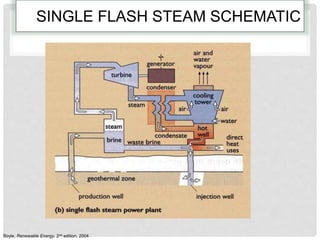
SINGLE FLASH STEAM POWER
PLANTS
Steam with water extracted from ground
Pressure of mixture drops at surface and more water “flashes” to steam
Steam separated from water
Steam drives a turbine
Turbine drives an electric generator
Generate between 5 and 100 MW
Use 6 to 9 tonnes of steam per hour
SINGLE FLASH STEAM SCHEMATIC
Boyle, Renewable Energy, 2nd edition, 2004
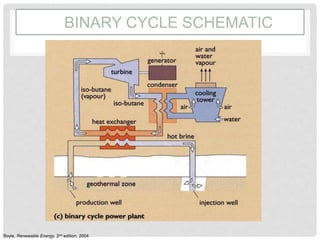
BINARY CYCLE POWER PLANTS
Low temps – 100o and 150oC
Use heat to vaporize organic liquid
• E.g., iso-butane, iso-pentane
Use vapor to drive turbine
• Causes vapor to condense
• Recycle continuously
Typically 7 to 12 % efficient
0.1 – 40 MW units common
http://www.worldenergy.org/wec-geis/publications/reports/ser/geo/geo.asp
BINARY CYCLE SCHEMATIC
Boyle, Renewable Energy, 2nd edition, 2004
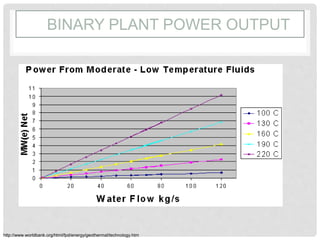
BINARY PLANT POWER OUTPUT
http://www.worldbank.org/html/fpd/energy/geothermal/technology.htm
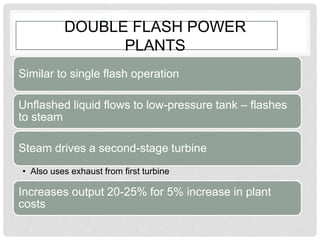
DOUBLE FLASH POWER
PLANTS
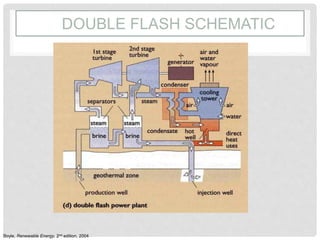
Similar to single flash operation
Unflashed liquid flows to low-pressure tank – flashes
to steam
Steam drives a second-stage turbine
• Also uses exhaust from first turbine
Increases output 20-25% for 5% increase in plant
costs
DOUBLE FLASH SCHEMATIC
Boyle, Renewable Energy, 2nd edition, 2004
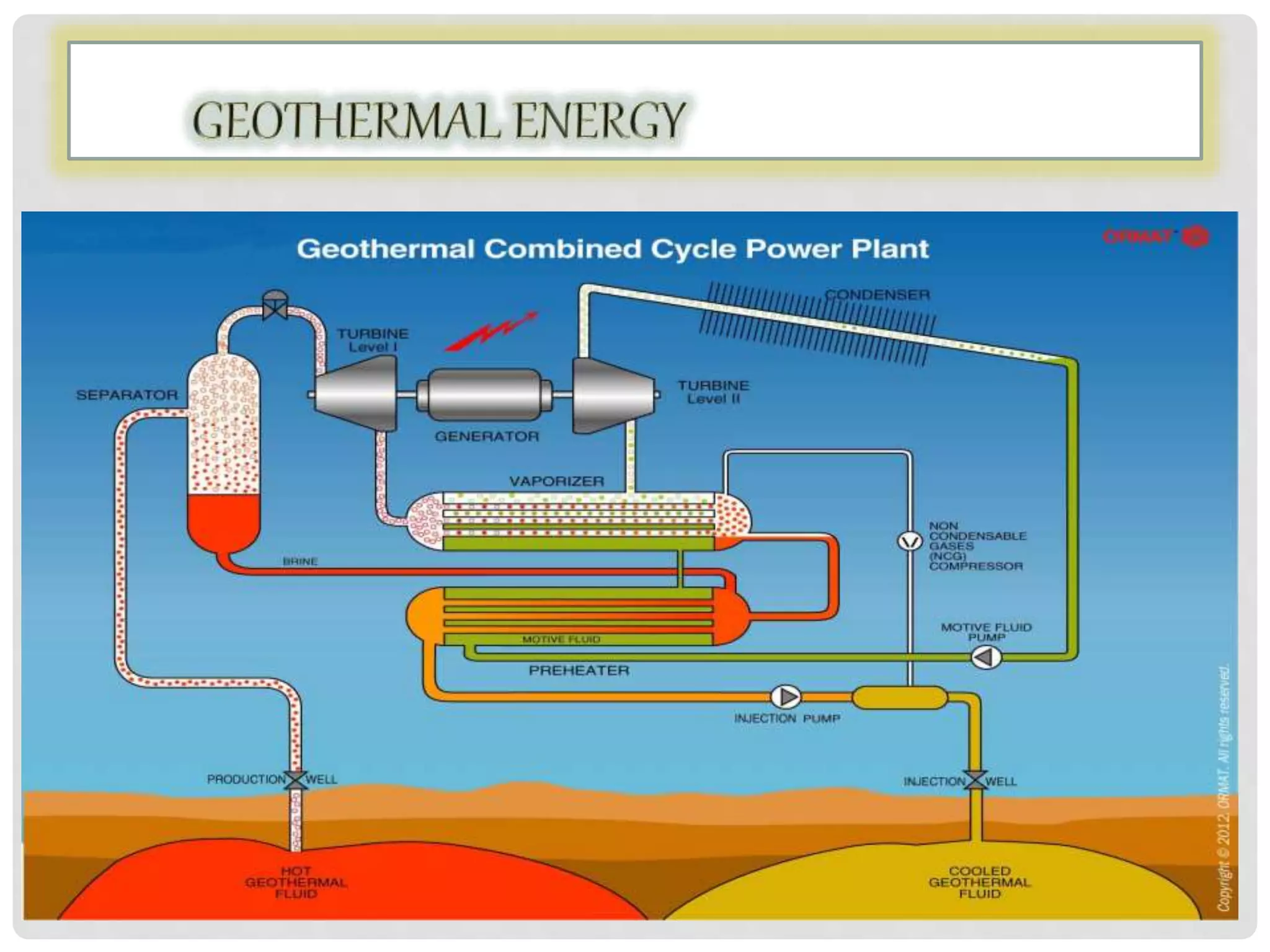
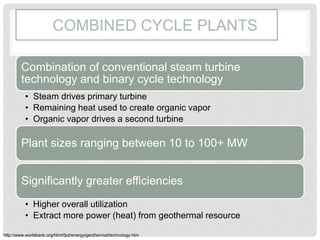
COMBINED CYCLE PLANTS
Combination of conventional steam turbine
technology and binary cycle technology
• Steam drives primary turbine
• Remaining heat used to create organic vapor
• Organic vapor drives a second turbine
Plant sizes ranging between 10 to 100+ MW
Significantly greater efficiencies
• Higher overall utilization
• Extract more power (heat) from geothermal resource
http://www.worldbank.org/html/fpd/energy/geothermal/technology.htm
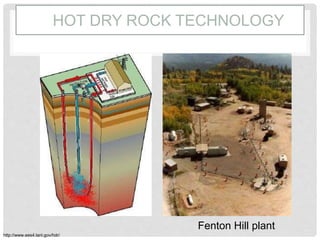
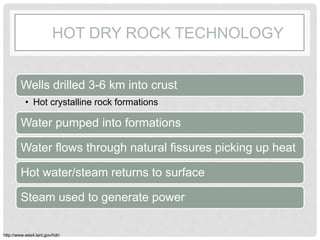
HOT DRY ROCK TECHNOLOGY
Wells drilled 3-6 km into crust
• Hot crystalline rock formations
Water pumped into formations
Water flows through natural fissures picking up heat
Hot water/steam returns to surface
Steam used to generate power
http://www.ees4.lanl.gov/hdr/
HOT DRY ROCK TECHNOLOGY
Fenton Hill plant
http://www.ees4.lanl.gov/hdr/
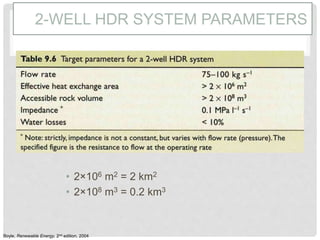
2-WELL HDR SYSTEM PARAMETERS
• 2×10⁶ m2 = 2 km2
• 2×10⁸ m3 = 0.2 km3
Boyle, Renewable Energy, 2nd edition, 2004
PROMISE OF HDR
1 km3 of hot rock has the energy content of
70,000 tones of coal
• If cooled by 1 ºC
Upper 10 km of crust in US has 600,000 times
annual US energy (USGS)
Between 19-138 GW power available at
existing hydrothermal sites
• Using enhanced technology
Boyle, Renewable Energy, 2nd edition, 2004
DIRECT USE TECHNOLOGIES
Geothermal heat is used directly rather than
for power generation
Extract heat from low temperature
geothermal resources
• < 150 oC or 300 oF.
Applications sited near source (<10 km)
http://www.worldbank.org/html/fpd/energy/geothermal/technology.htm
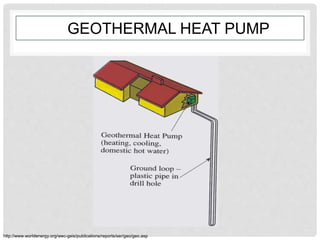
GEOTHERMAL HEAT PUMP
http://www.worldenergy.org/wec-geis/publications/reports/ser/geo/geo.asp
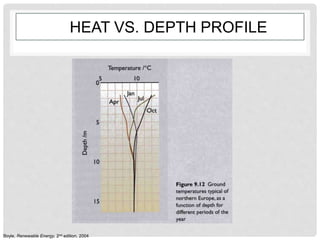
HEAT VS. DEPTH PROFILE
Boyle, Renewable Energy, 2nd edition, 2004
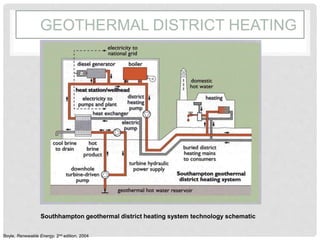
GEOTHERMAL DISTRICT HEATING
Boyle, Renewable Energy, 2nd edition, 2004
Southhampton geothermal district heating system technology schematic
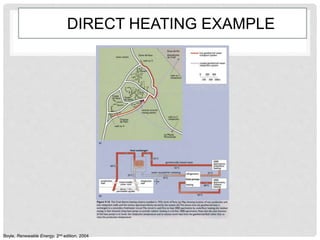
DIRECT HEATING EXAMPLE
Boyle, Renewable Energy, 2nd edition, 2004
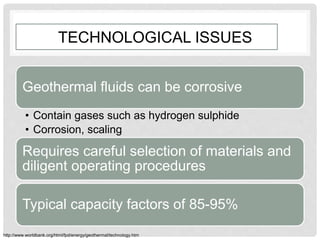
TECHNOLOGICAL ISSUES
Geothermal fluids can be corrosive
• Contain gases such as hydrogen sulphide
• Corrosion, scaling
Requires careful selection of materials and
diligent operating procedures
Typical capacity factors of 85-95%
http://www.worldbank.org/html/fpd/energy/geothermal/technology.htm
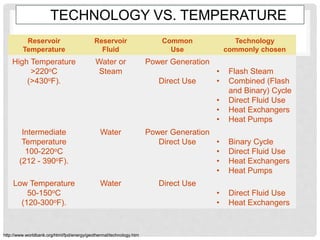
TECHNOLOGY VS. TEMPERATURE
Reservoir
Temperature
Reservoir
Fluid
Common
Use
Technology
commonly chosen
High Temperature
>220oC
(>430oF).
Water or
Steam
Power Generation
Direct Use
• Flash Steam
• Combined (Flash
and Binary) Cycle
• Direct Fluid Use
• Heat Exchangers
• Heat Pumps
Intermediate
Temperature
100-220oC
(212 - 390oF).
Water Power Generation
Direct Use • Binary Cycle
• Direct Fluid Use
• Heat Exchangers
• Heat Pumps
Low Temperature
50-150oC
(120-300oF).
Water Direct Use
• Direct Fluid Use
• Heat Exchangers
http://www.worldbank.org/html/fpd/energy/geothermal/technology.htm
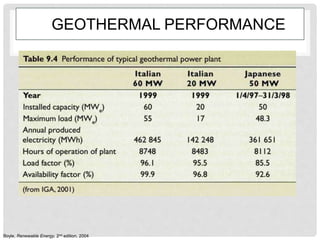
GEOTHERMAL PERFORMANCE
Boyle, Renewable Energy, 2nd edition, 2004
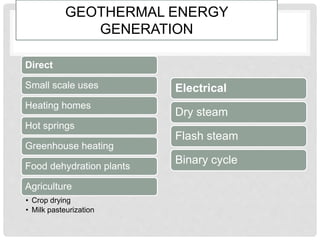
GEOTHERMAL ENERGY
GENERATION
Direct
Small scale uses
Heating homes
Hot springs
Greenhouse heating
Food dehydration plants
Agriculture
• Crop drying
• Milk pasteurization
Electrical
Dry steam
Flash steam
Binary cycle
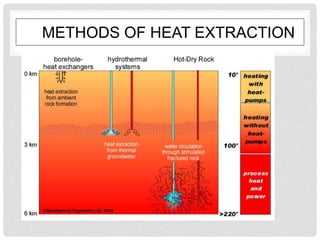
METHODS OF HEAT EXTRACTION
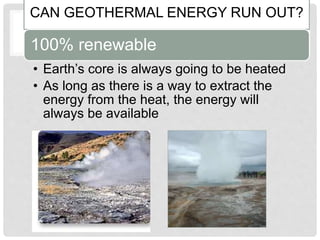
CAN GEOTHERMAL ENERGY RUN OUT?
100% renewable
• Earth’s core is always going to be heated
• As long as there is a way to extract the
energy from the heat, the energy will
always be available
* SOURCE OF GEOTHERMAL ENERGY
Heat stems from radioactive
disintegrations of atomic nuclei
[Sorensen, 2000], initial cooling
from agglomeration in planet
formation, and other various
processes
Hot spots occur where strong
convective magma circulation is
occurring, usually near
continental plate boundaries and
mountainous regions
Hot dry rock, the most common
type, retains convective heat
Storage in a developed area
may be depleted in 50 years
040322
Geothermal Installations
E X A M P L E S
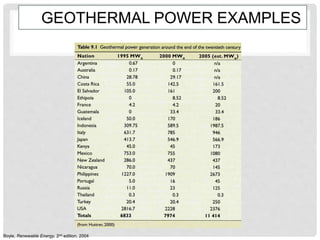
GEOTHERMAL POWER EXAMPLES
Boyle, Renewable Energy, 2nd edition, 2004
GEOTHERMAL POWER GENERATION
World production of 8 GW
• 2.7 GW in US
The Geyers (US) is world’s largest site
• Produces 2 GW
Other attractive sites
• Rift region of Kenya, Iceland, Italy, France, New
Zealand, Mexico, Nicaragua, Russia, Phillippines,
Indonesia, Japan
http://en.wikipedia.org/wiki/Geothermal
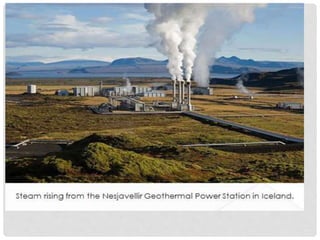
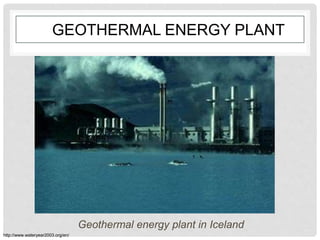
GEOTHERMAL ENERGY PLANT
Geothermal energy plant in Iceland
http://www.wateryear2003.org/en/
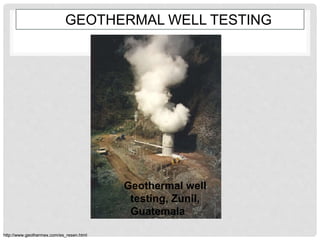
GEOTHERMAL WELL TESTING
http://www.geothermex.com/es_resen.html
Geothermal well
testing, Zunil,
Guatemala
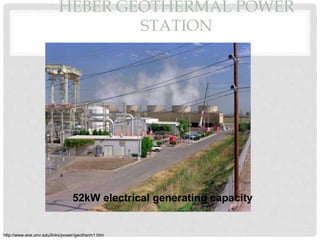
HEBER GEOTHERMAL POWER
STATION
http://www.ece.umr.edu/links/power/geotherm1.htm
52kW electrical generating capacity
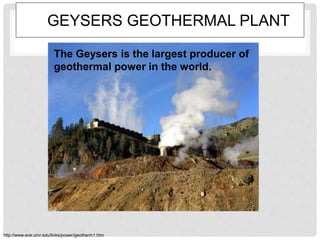
GEYSERS GEOTHERMAL PLANT
The Geysers is the largest producer of
geothermal power in the world.
http://www.ece.umr.edu/links/power/geotherm1.htm
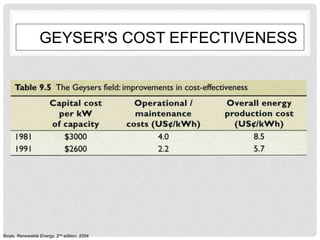
GEYSER'S COST EFFECTIVENESS
Boyle, Renewable Energy, 2nd edition, 2004
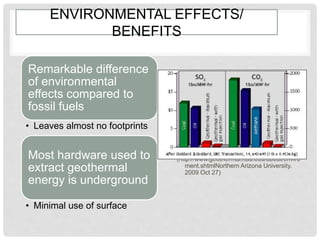
ENVIRONMENTAL EFFECTS/
BENEFITS
Remarkable difference
of environmental
effects compared to
fossil fuels
• Leaves almost no footprints
Most hardware used to
extract geothermal
energy is underground
• Minimal use of surface
(http://www.geothermal.nau.edu/about/enviro
ment.shtmlNorthern Arizona University.
2009 Oct 27)
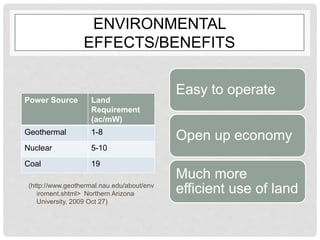
ENVIRONMENTAL
EFFECTS/BENEFITS
(http://www.geothermal.nau.edu/about/env
iroment.shtml> Northern Arizona
University. 2009 Oct 27)
Easy to operate
Open up economy
Much more
efficient use of land
Power Source Land
Requirement
(ac/mW)
Geothermal 1-8
Nuclear 5-10
Coal 19
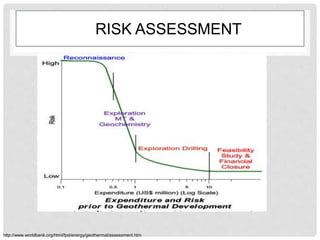
RISK ASSESSMENT
http://www.worldbank.org/html/fpd/energy/geothermal/assessment.htm
ENVIRONMENTAL EFFECTS/
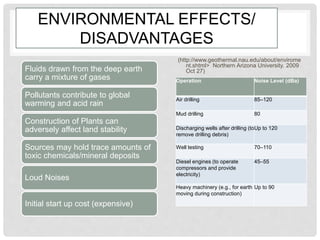
DISADVANTAGES
Fluids drawn from the deep earth
carry a mixture of gases
Pollutants contribute to global
warming and acid rain
Construction of Plants can
adversely affect land stability
Sources may hold trace amounts of
toxic chemicals/mineral deposits
Loud Noises
Initial start up cost (expensive)
(http://www.geothermal.nau.edu/about/envirome
nt.shtml> Northern Arizona University. 2009
Oct 27)
Operation Noise Level (dBa)
Air drilling 85–120
Mud drilling 80
Discharging wells after drilling (to
remove drilling debris)
Up to 120
Well testing 70–110
Diesel engines (to operate
compressors and provide
electricity)
45–55
Heavy machinery (e.g., for earth
moving during construction)
Up to 90
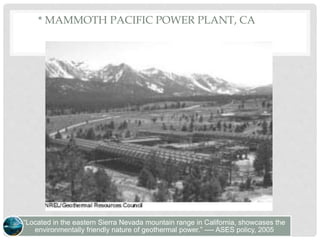
* MAMMOTH PACIFIC POWER PLANT, CA
“Located in the eastern Sierra Nevada mountain range in California, showcases the
environmentally friendly nature of geothermal power.” ---- ASES policy, 2005
WHAT SOCIAL/POLITICAL
PROBLEMS ARE POSED?
Social Problems
• Aesthetics
Political Problems
• Another funding
avenue for
government
• Initial start up cost is
costly
• Regulation
• Dispersion
DO ANY LAWS OR REGULATIONS
PREVENT THE DEPLOYMENT OF
GEOTHERMAL ENERGY?
Depends on state and specific
community: not any federal laws
Factors to consider
• Noise
• Aesthetics
• Proximity to houses
• Waste regulation (some use coolants)
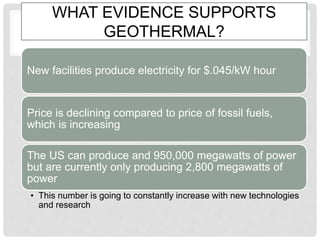
WHAT EVIDENCE SUPPORTS
GEOTHERMAL?
New facilities produce electricity for $.045/kW hour
Price is declining compared to price of fossil fuels,
which is increasing
The US can produce and 950,000 megawatts of power
but are currently only producing 2,800 megawatts of
power
• This number is going to constantly increase with new technologies
and research
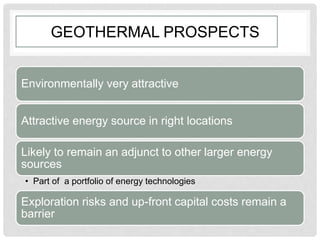
GEOTHERMAL PROSPECTS
Environmentally very attractive
Attractive energy source in right locations
Likely to remain an adjunct to other larger energy
sources
• Part of a portfolio of energy technologies
Exploration risks and up-front capital costs remain a
barrier
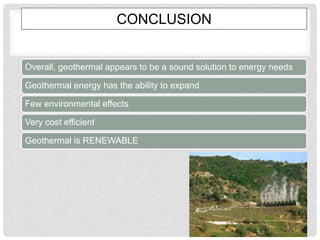
CONCLUSION
Overall, geothermal appears to be a sound solution to energy needs
Geothermal energy has the ability to expand
Few environmental effects
Very cost efficient
Geothermal is RENEWABLE
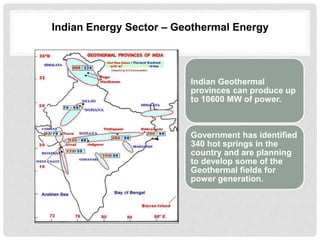
Indian Energy Sector – Geothermal Energy
Indian Geothermal
provinces can produce up
to 10600 MW of power.
Government has identified
340 hot springs in the
country and are planning
to develop some of the
Geothermal fields for
power generation.
Indian Energy Sector – Geothermal Energy
International consultant, GeothermEx Inc., USA has identified
has identified 6 most promising Geothermal sites for
development in order of the following ranking:
• Tattapani in Chhatisgarh
• Puga in Jammu & Kashmir
• Cambay Graben in Gujarat
• Manikaran in Himachal Pradesh
• Surajkund in Jharkhand
• Chhumanthang in Jammu & Kashmir
National Hydro Power Corporation (NHPC) has been appointed
by the government as the nodal agency to promote geothermal
energy in India. NHPC plans to develop 2 to 5 MW geothermal
power plant at Puga.
Chhatisgarh Renewable Energy Development Agency (CREDA)
is currently developing the Tattapani geothermal site.
73
Puga Project (UNDP drilling)
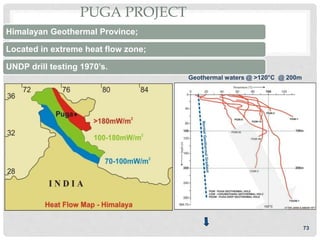
PUGA PROJECT
Himalayan Geothermal Province;
Located in extreme heat flow zone;
UNDP drill testing 1970’s.
Geothermal waters @ >120°C @ 200m
74
PUGA PROJECT - HIMALAYAN
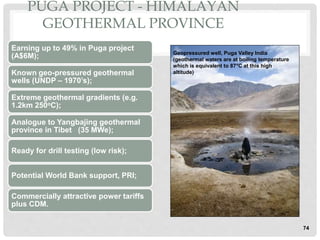
GEOTHERMAL PROVINCE
Earning up to 49% in Puga project
(A$6M);
Known geo-pressured geothermal
wells (UNDP – 1970’s);
Extreme geothermal gradients (e.g.
1.2km 250oC);
Analogue to Yangbajing geothermal
province in Tibet (35 MWe);
Ready for drill testing (low risk);
Potential World Bank support, PRI;
Commercially attractive power tariffs
plus CDM.
Geopressured well, Puga Valley India
(geothermal waters are at boiling temperature
which is equivalent to 87°C at this high
altitude)
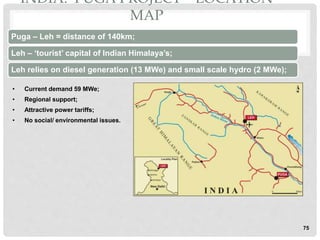
INDIA: PUGA PROJECT – LOCATION
MAP
Puga – Leh = distance of 140km;
Leh – ‘tourist’ capital of Indian Himalaya’s;
Leh relies on diesel generation (13 MWe) and small scale hydro (2 MWe);
75
• Current demand 59 MWe;
• Regional support;
• Attractive power tariffs;
• No social/ environmental issues.
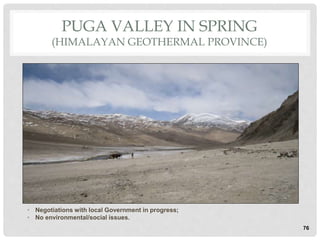
PUGA VALLEY IN SPRING
(HIMALAYAN GEOTHERMAL PROVINCE)
• Negotiations with local Government in progress;
• No environmental/social issues.
76
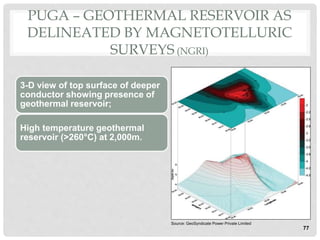
PUGA – GEOTHERMAL RESERVOIR AS
DELINEATED BY MAGNETOTELLURIC
SURVEYS (NGRI)
77
Source: GeoSyndicate Power Private Limited
3-D view of top surface of deeper
conductor showing presence of
geothermal reservoir;
High temperature geothermal
reservoir (>260°C) at 2,000m.
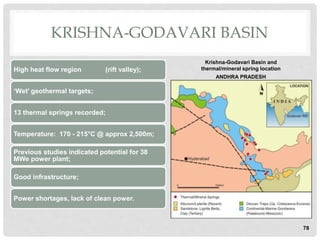
KRISHNA-GODAVARI BASIN
High heat flow region (rift valley);
‘Wet’ geothermal targets;
13 thermal springs recorded;
Temperature: 170 - 215°C @ approx 2,500m;
Previous studies indicated potential for 38
MWe power plant;
Good infrastructure;
Power shortages, lack of clean power.
78
Krishna-Godavari Basin and
thermal/mineral spring location
ANDHRA PRADESH
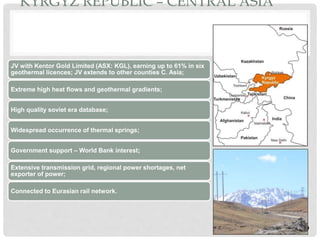
KYRGYZ REPUBLIC – CENTRAL ASIA
JV with Kentor Gold Limited (ASX: KGL), earning up to 61% in six
geothermal licences; JV extends to other counties C. Asia;
Extreme high heat flows and geothermal gradients;
High quality soviet era database;
Widespread occurrence of thermal springs;
Government support – World Bank interest;
Extensive transmission grid, regional power shortages, net
exporter of power;
Connected to Eurasian rail network.
79
Geothermal

Geothermal

  • 2.
    * ABOUT THISPRESENTATION INTRODUCTION SOURCES OVERVIEW 16.5 BENEFITS & DISADVANTAGES CONCLUSION HISTRY 060306
  • 3.
    GEOTHERMAL ENERGY: INTRODUCTION What isgeothermal energy? Geothermal energy- energy that comes from the ground; power extracted from heat stored in the earth • Geo: earth • Thermal: heat
  • 4.
    Heat flows outwardfrom Earth's interior. The crust insulates us from Earth's interior heat. The mantle is semi-molten, the outer core is liquid and the inner core is solid.
  • 5.
  • 6.
  • 7.
    GEOTHERMAL IN CONTEXT EnergySource 2000 2001 2002 2003 2004P Total a 98.961 96.464 97.952 98.714 100.278 Fossil Fuels 84.965 83.176 84.070 84.889 86.186 Coal 22.580 21.952 21.980 22.713 22.918 Coal Coke Net Imports 0.065 0.029 0.061 0.051 0.138 Natural Gasb 23.916 22.861 23.628 23.069 23.000 Petroleumc 38.404 38.333 38.401 39.047 40.130 Electricity Net Imports 0.115 0.075 0.078 0.022 0.039 http://www.eia.doe.gov/cneaf/solar.renewables/page/geothermal/geothermal.html U.S. Energy Consumption by Energy Source, 2000-2004 (Quadrillion Btu)
  • 8.
    HEAT FROM THEEARTH’S CENTER Earth's core maintains temperatures in excess of 5000°C • Heat radual radioactive decay of elements Heat energy continuously flows from hot core • Conductive heat flow • Convective flows of molten mantle beneath the crust. Mean heat flux at earth's surface • 16 kilowatts of heat energy per square kilometer • Dissipates to the atmosphere and space. • Tends to be strongest along tectonic plate boundaries Volcanic activity transports hot material to near the surface • Only a small fraction of molten rock actually reaches surface. • Most is left at depths of 5-20 km beneath the surface, Hydrological convection forms high temperature geothermal systems at shallow depths of 500-3000m.
  • 9.
  • 10.
    GEOTHERMAL SITE SCHEMATIC Boyle,Renewable Energy, 2nd edition, 2004
  • 11.
    HOW GEOTHERMAL WORKS Earth’score heat Water → steam → drive electrical generators Turbines Area specific • Geothermal energy is localized
  • 12.
    GEOTHERMAL ENERGY: HISTORY Used forbathing in Paleolithic times Ancient Romans used it as a central heating system for bathing and heating homes and floors 1892: America’s first district heating system was put into place
  • 14.
    GEOTHERMAL ENERGY: HISTORY 1926:a deep geothermal well was used to heat greenhouses.
  • 15.
    GEOTHERMAL ENERGY: HISTORY 1960:Pacific Gas and Electric has first successful geothermal electric power plant in US at The Geysers • Turbine lasted more than 30 years
  • 16.
    * OVERVIEW: GEOTHERMAL Geothermalenergy is present within the land and the sea • Internal heat is from initial world accretion from gathering dust and compression of the earth and from radioactive decay This energy can be useful in heating and cooling of air and water, but is somewhat costly to use Active geyser areas are limited in area, but provide much hotter water or steam The energy is inexhaustible in principle, yet local extraction will cool the immediate area in a few years Extraction of energy from deep (~20,000 ft) hot rock is not economic yet 080317
  • 17.
  • 18.
    * GEOTHERMAL ENERGY Activegeysers supply steam or hot water for heating in The Geysers, California (824 MWe) “Hot, dry rock” (HDR) offers potential for injecting water and using the resultant steam to spin a turbine At a lower thermal level, an air conditioner can extract heat from the ground for winter heating or insert energy into the ground to gain a more efficient cooling sink 060320 Nearby Calistoga (started 1862) has tourist spas with hot water from springs; also palm reading, water treatments, psychics, mud baths, etc.
  • 19.
    HOT SPRINGS Hot springsin Steamboat Springs area.
  • 21.
  • 22.
  • 23.
    COST OF WATER& STEAM Cost (US $/ tonne of steam) Cost (US ¢/tonne of hot water) High temperature (>150oC) 3.5-6.0 Medium Temperature (100-150oC) 3.0-4.5 20-40 Low Temperature (<100oC) 10-20 Table Geothermal Steam and Hot Water Supply Cost where drilling is required
  • 24.
    COST OF GEOTHERMALPOWER Unit Cost (US ¢/kWh) High Quality Resource Unit Cost (US ¢/kWh) Medium Quality Resource Unit Cost (US ¢/kWh) Low Quality Resource Small plants (<5 MW) 5.0-7.0 5.5-8.5 6.0-10.5 Medium Plants (5-30 MW) 4.0-6.0 4.5-7 Normally not suitable Large Plants (>30 MW) 2.5-5.0 4.0-6.0 Normally not suitable http://www.worldbank.org/html/fpd/energy/geothermal/assessment.htm
  • 25.
    INDIRECT COSTS Availability ofskilled labor Infrastructure and access Political stability Indirect Costs • Good: 5-10% of direct costs • Fair: 10-30% of direct costs • Poor: 30-60% of direct costs http://www.worldbank.org/html/fpd/energy/geothermal/assessment.htm
  • 26.
    OPERATING/MAINTENANCE COSTS O&M Cost(US c/KWh) Small plants (<5 MW) O&M Cost (US c/KWh) Medium Plants (5-30 MW) O&M Cost (US c/KWh) Large Plants(>30 MW) Steam field 0.35-0.7 0.25-0.35 0.15-0.25 Power Plant 0.45-0.7 0.35-0.45 0.25-0.45 Total 0.8-1.4 0.6-0.8 0.4-0.7 Operating and Maintenance Costs http://www.worldbank.org/html/fpd/energy/geothermal/assessment.htm
  • 27.
  • 28.
    DRY STEAM POWERPLANTS “Dry” steam extracted from natural reservoir • 180-225 ºC ( 356-437 ºF) • 4-8 MPa (580-1160 psi) • 200+ km/hr (100+ mph) Steam is used to drive a turbo-generator Steam is condensed and pumped back into the ground Can achieve 1 kWh per 6.5 kg of steam • A 55 MW plant requires 100 kg/s of steam Boyle, Renewable Energy, 2nd edition, 2004
  • 29.
    DRY STEAM SCHEMATIC Boyle,Renewable Energy, 2nd edition, 2004
  • 30.
    SINGLE FLASH STEAMPOWER PLANTS Steam with water extracted from ground Pressure of mixture drops at surface and more water “flashes” to steam Steam separated from water Steam drives a turbine Turbine drives an electric generator Generate between 5 and 100 MW Use 6 to 9 tonnes of steam per hour
  • 31.
    SINGLE FLASH STEAMSCHEMATIC Boyle, Renewable Energy, 2nd edition, 2004
  • 32.
    BINARY CYCLE POWERPLANTS Low temps – 100o and 150oC Use heat to vaporize organic liquid • E.g., iso-butane, iso-pentane Use vapor to drive turbine • Causes vapor to condense • Recycle continuously Typically 7 to 12 % efficient 0.1 – 40 MW units common http://www.worldenergy.org/wec-geis/publications/reports/ser/geo/geo.asp
  • 33.
    BINARY CYCLE SCHEMATIC Boyle,Renewable Energy, 2nd edition, 2004
  • 34.
    BINARY PLANT POWEROUTPUT http://www.worldbank.org/html/fpd/energy/geothermal/technology.htm
  • 35.
    DOUBLE FLASH POWER PLANTS Similarto single flash operation Unflashed liquid flows to low-pressure tank – flashes to steam Steam drives a second-stage turbine • Also uses exhaust from first turbine Increases output 20-25% for 5% increase in plant costs
  • 36.
    DOUBLE FLASH SCHEMATIC Boyle,Renewable Energy, 2nd edition, 2004
  • 37.
    COMBINED CYCLE PLANTS Combinationof conventional steam turbine technology and binary cycle technology • Steam drives primary turbine • Remaining heat used to create organic vapor • Organic vapor drives a second turbine Plant sizes ranging between 10 to 100+ MW Significantly greater efficiencies • Higher overall utilization • Extract more power (heat) from geothermal resource http://www.worldbank.org/html/fpd/energy/geothermal/technology.htm
  • 38.
    HOT DRY ROCKTECHNOLOGY Wells drilled 3-6 km into crust • Hot crystalline rock formations Water pumped into formations Water flows through natural fissures picking up heat Hot water/steam returns to surface Steam used to generate power http://www.ees4.lanl.gov/hdr/
  • 39.
    HOT DRY ROCKTECHNOLOGY Fenton Hill plant http://www.ees4.lanl.gov/hdr/
  • 40.
    2-WELL HDR SYSTEMPARAMETERS • 2×10⁶ m2 = 2 km2 • 2×10⁸ m3 = 0.2 km3 Boyle, Renewable Energy, 2nd edition, 2004
  • 41.
    PROMISE OF HDR 1km3 of hot rock has the energy content of 70,000 tones of coal • If cooled by 1 ºC Upper 10 km of crust in US has 600,000 times annual US energy (USGS) Between 19-138 GW power available at existing hydrothermal sites • Using enhanced technology Boyle, Renewable Energy, 2nd edition, 2004
  • 42.
    DIRECT USE TECHNOLOGIES Geothermalheat is used directly rather than for power generation Extract heat from low temperature geothermal resources • < 150 oC or 300 oF. Applications sited near source (<10 km) http://www.worldbank.org/html/fpd/energy/geothermal/technology.htm
  • 43.
  • 44.
    HEAT VS. DEPTHPROFILE Boyle, Renewable Energy, 2nd edition, 2004
  • 45.
    GEOTHERMAL DISTRICT HEATING Boyle,Renewable Energy, 2nd edition, 2004 Southhampton geothermal district heating system technology schematic
  • 46.
    DIRECT HEATING EXAMPLE Boyle,Renewable Energy, 2nd edition, 2004
  • 47.
    TECHNOLOGICAL ISSUES Geothermal fluidscan be corrosive • Contain gases such as hydrogen sulphide • Corrosion, scaling Requires careful selection of materials and diligent operating procedures Typical capacity factors of 85-95% http://www.worldbank.org/html/fpd/energy/geothermal/technology.htm
  • 48.
    TECHNOLOGY VS. TEMPERATURE Reservoir Temperature Reservoir Fluid Common Use Technology commonlychosen High Temperature >220oC (>430oF). Water or Steam Power Generation Direct Use • Flash Steam • Combined (Flash and Binary) Cycle • Direct Fluid Use • Heat Exchangers • Heat Pumps Intermediate Temperature 100-220oC (212 - 390oF). Water Power Generation Direct Use • Binary Cycle • Direct Fluid Use • Heat Exchangers • Heat Pumps Low Temperature 50-150oC (120-300oF). Water Direct Use • Direct Fluid Use • Heat Exchangers http://www.worldbank.org/html/fpd/energy/geothermal/technology.htm
  • 49.
    GEOTHERMAL PERFORMANCE Boyle, RenewableEnergy, 2nd edition, 2004
  • 50.
    GEOTHERMAL ENERGY GENERATION Direct Small scaleuses Heating homes Hot springs Greenhouse heating Food dehydration plants Agriculture • Crop drying • Milk pasteurization Electrical Dry steam Flash steam Binary cycle
  • 51.
    METHODS OF HEATEXTRACTION
  • 52.
    CAN GEOTHERMAL ENERGYRUN OUT? 100% renewable • Earth’s core is always going to be heated • As long as there is a way to extract the energy from the heat, the energy will always be available
  • 53.
    * SOURCE OFGEOTHERMAL ENERGY Heat stems from radioactive disintegrations of atomic nuclei [Sorensen, 2000], initial cooling from agglomeration in planet formation, and other various processes Hot spots occur where strong convective magma circulation is occurring, usually near continental plate boundaries and mountainous regions Hot dry rock, the most common type, retains convective heat Storage in a developed area may be depleted in 50 years 040322
  • 54.
  • 55.
    GEOTHERMAL POWER EXAMPLES Boyle,Renewable Energy, 2nd edition, 2004
  • 56.
    GEOTHERMAL POWER GENERATION Worldproduction of 8 GW • 2.7 GW in US The Geyers (US) is world’s largest site • Produces 2 GW Other attractive sites • Rift region of Kenya, Iceland, Italy, France, New Zealand, Mexico, Nicaragua, Russia, Phillippines, Indonesia, Japan http://en.wikipedia.org/wiki/Geothermal
  • 57.
    GEOTHERMAL ENERGY PLANT Geothermalenergy plant in Iceland http://www.wateryear2003.org/en/
  • 58.
  • 59.
  • 60.
    GEYSERS GEOTHERMAL PLANT TheGeysers is the largest producer of geothermal power in the world. http://www.ece.umr.edu/links/power/geotherm1.htm
  • 61.
    GEYSER'S COST EFFECTIVENESS Boyle,Renewable Energy, 2nd edition, 2004
  • 62.
    ENVIRONMENTAL EFFECTS/ BENEFITS Remarkable difference ofenvironmental effects compared to fossil fuels • Leaves almost no footprints Most hardware used to extract geothermal energy is underground • Minimal use of surface (http://www.geothermal.nau.edu/about/enviro ment.shtmlNorthern Arizona University. 2009 Oct 27)
  • 63.
    ENVIRONMENTAL EFFECTS/BENEFITS (http://www.geothermal.nau.edu/about/env iroment.shtml> Northern Arizona University.2009 Oct 27) Easy to operate Open up economy Much more efficient use of land Power Source Land Requirement (ac/mW) Geothermal 1-8 Nuclear 5-10 Coal 19
  • 64.
  • 65.
    ENVIRONMENTAL EFFECTS/ DISADVANTAGES Fluids drawnfrom the deep earth carry a mixture of gases Pollutants contribute to global warming and acid rain Construction of Plants can adversely affect land stability Sources may hold trace amounts of toxic chemicals/mineral deposits Loud Noises Initial start up cost (expensive) (http://www.geothermal.nau.edu/about/envirome nt.shtml> Northern Arizona University. 2009 Oct 27) Operation Noise Level (dBa) Air drilling 85–120 Mud drilling 80 Discharging wells after drilling (to remove drilling debris) Up to 120 Well testing 70–110 Diesel engines (to operate compressors and provide electricity) 45–55 Heavy machinery (e.g., for earth moving during construction) Up to 90
  • 66.
    * MAMMOTH PACIFICPOWER PLANT, CA “Located in the eastern Sierra Nevada mountain range in California, showcases the environmentally friendly nature of geothermal power.” ---- ASES policy, 2005
  • 67.
    WHAT SOCIAL/POLITICAL PROBLEMS AREPOSED? Social Problems • Aesthetics Political Problems • Another funding avenue for government • Initial start up cost is costly • Regulation • Dispersion
  • 68.
    DO ANY LAWSOR REGULATIONS PREVENT THE DEPLOYMENT OF GEOTHERMAL ENERGY? Depends on state and specific community: not any federal laws Factors to consider • Noise • Aesthetics • Proximity to houses • Waste regulation (some use coolants)
  • 69.
    WHAT EVIDENCE SUPPORTS GEOTHERMAL? Newfacilities produce electricity for $.045/kW hour Price is declining compared to price of fossil fuels, which is increasing The US can produce and 950,000 megawatts of power but are currently only producing 2,800 megawatts of power • This number is going to constantly increase with new technologies and research
  • 70.
    GEOTHERMAL PROSPECTS Environmentally veryattractive Attractive energy source in right locations Likely to remain an adjunct to other larger energy sources • Part of a portfolio of energy technologies Exploration risks and up-front capital costs remain a barrier
  • 71.
    CONCLUSION Overall, geothermal appearsto be a sound solution to energy needs Geothermal energy has the ability to expand Few environmental effects Very cost efficient Geothermal is RENEWABLE
  • 72.
    Indian Energy Sector– Geothermal Energy Indian Geothermal provinces can produce up to 10600 MW of power. Government has identified 340 hot springs in the country and are planning to develop some of the Geothermal fields for power generation.
  • 73.
    Indian Energy Sector– Geothermal Energy International consultant, GeothermEx Inc., USA has identified has identified 6 most promising Geothermal sites for development in order of the following ranking: • Tattapani in Chhatisgarh • Puga in Jammu & Kashmir • Cambay Graben in Gujarat • Manikaran in Himachal Pradesh • Surajkund in Jharkhand • Chhumanthang in Jammu & Kashmir National Hydro Power Corporation (NHPC) has been appointed by the government as the nodal agency to promote geothermal energy in India. NHPC plans to develop 2 to 5 MW geothermal power plant at Puga. Chhatisgarh Renewable Energy Development Agency (CREDA) is currently developing the Tattapani geothermal site.
  • 74.
    73 Puga Project (UNDPdrilling) PUGA PROJECT Himalayan Geothermal Province; Located in extreme heat flow zone; UNDP drill testing 1970’s. Geothermal waters @ >120°C @ 200m
  • 75.
    74 PUGA PROJECT -HIMALAYAN GEOTHERMAL PROVINCE Earning up to 49% in Puga project (A$6M); Known geo-pressured geothermal wells (UNDP – 1970’s); Extreme geothermal gradients (e.g. 1.2km 250oC); Analogue to Yangbajing geothermal province in Tibet (35 MWe); Ready for drill testing (low risk); Potential World Bank support, PRI; Commercially attractive power tariffs plus CDM. Geopressured well, Puga Valley India (geothermal waters are at boiling temperature which is equivalent to 87°C at this high altitude)
  • 76.
    INDIA: PUGA PROJECT– LOCATION MAP Puga – Leh = distance of 140km; Leh – ‘tourist’ capital of Indian Himalaya’s; Leh relies on diesel generation (13 MWe) and small scale hydro (2 MWe); 75 • Current demand 59 MWe; • Regional support; • Attractive power tariffs; • No social/ environmental issues.
  • 77.
    PUGA VALLEY INSPRING (HIMALAYAN GEOTHERMAL PROVINCE) • Negotiations with local Government in progress; • No environmental/social issues. 76
  • 78.
    PUGA – GEOTHERMALRESERVOIR AS DELINEATED BY MAGNETOTELLURIC SURVEYS (NGRI) 77 Source: GeoSyndicate Power Private Limited 3-D view of top surface of deeper conductor showing presence of geothermal reservoir; High temperature geothermal reservoir (>260°C) at 2,000m.
  • 79.
    KRISHNA-GODAVARI BASIN High heatflow region (rift valley); ‘Wet’ geothermal targets; 13 thermal springs recorded; Temperature: 170 - 215°C @ approx 2,500m; Previous studies indicated potential for 38 MWe power plant; Good infrastructure; Power shortages, lack of clean power. 78 Krishna-Godavari Basin and thermal/mineral spring location ANDHRA PRADESH
  • 80.
    KYRGYZ REPUBLIC –CENTRAL ASIA JV with Kentor Gold Limited (ASX: KGL), earning up to 61% in six geothermal licences; JV extends to other counties C. Asia; Extreme high heat flows and geothermal gradients; High quality soviet era database; Widespread occurrence of thermal springs; Government support – World Bank interest; Extensive transmission grid, regional power shortages, net exporter of power; Connected to Eurasian rail network. 79