
Magnetic and Gravity Methods for Geothermal Exploration Dr. Hendra Grandis Geophysics - ITB
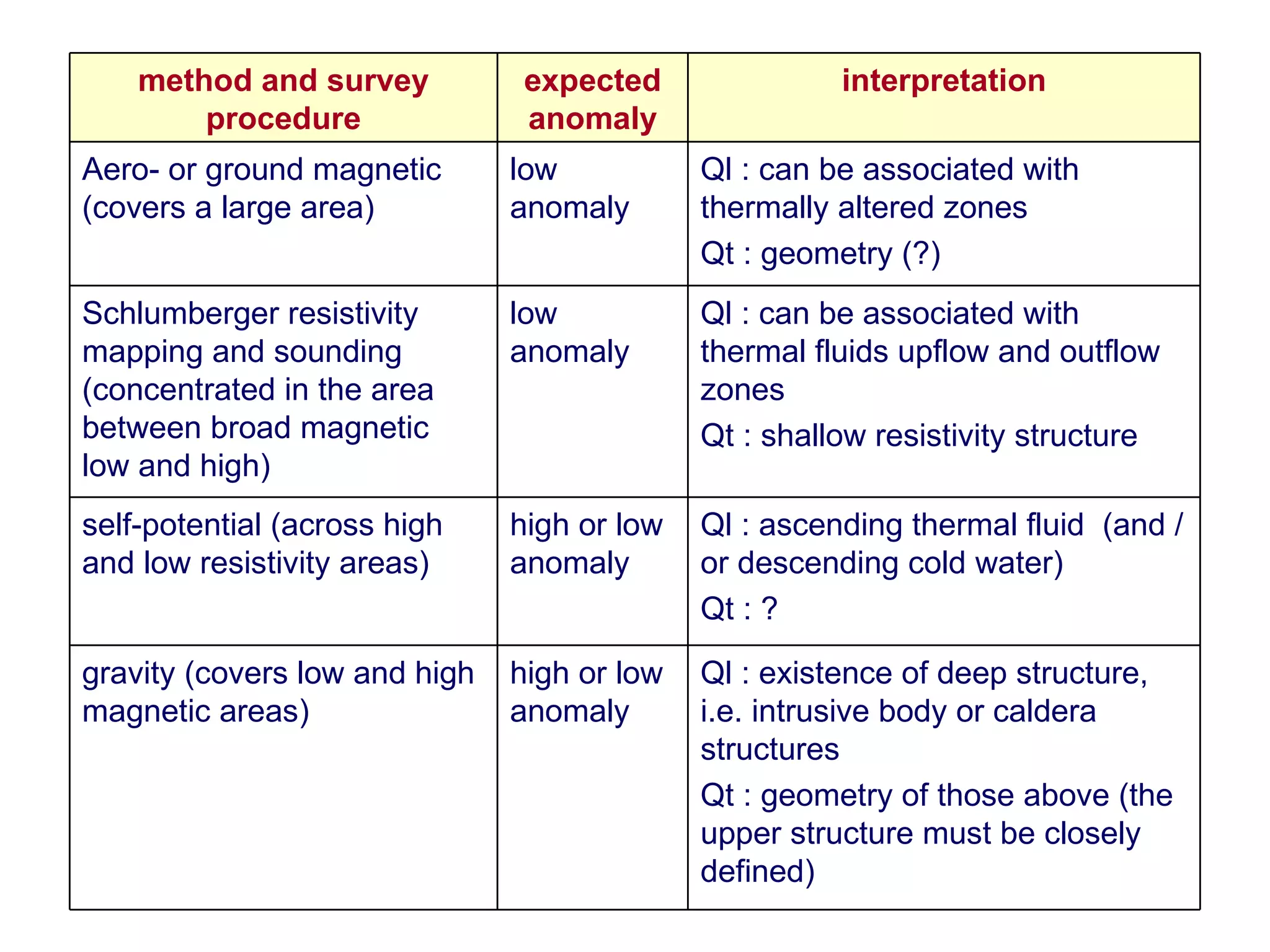
Ql : existence of deep structure, i.e. intrusive body or caldera structures Qt : geometry of those above (the upper structure must be closely defined) high or low anomaly gravity (covers low and high magnetic areas) Ql : ascending thermal fluid  (and / or descending cold water) Qt : ? high or low  anomaly self-potential (across high and low resistivity areas) Ql : can be associated with thermal fluids upflow and outflow zones Qt : shallow resistivity structure low anomaly Schlumberger resistivity mapping and sounding (concentrated in the area between broad magnetic low and high) Ql : can be associated with thermally altered zones Qt : geometry (?) low anomaly Aero- or ground magnetic (covers a large area) interpretation expected anomaly method and survey procedure
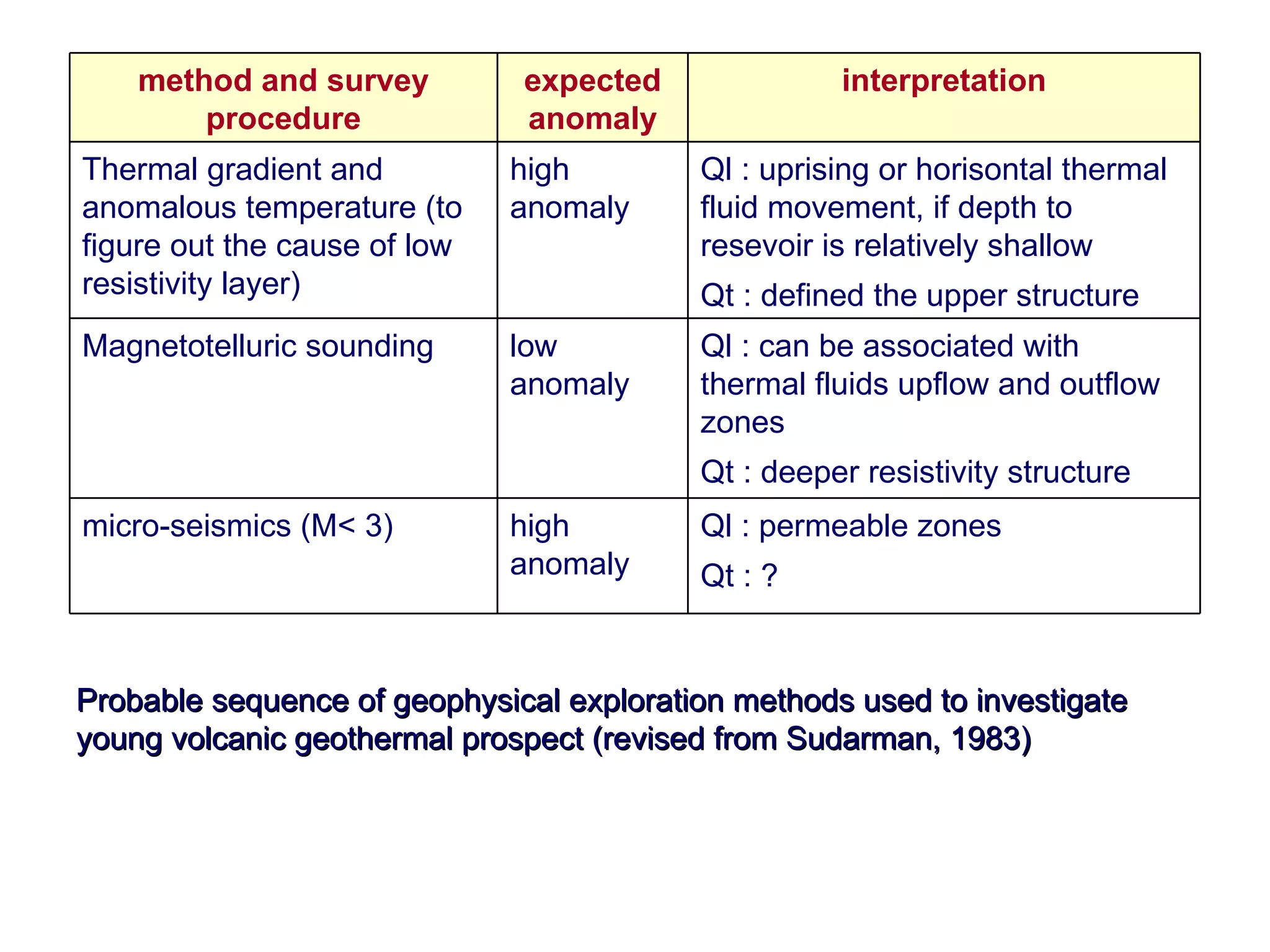
Probable sequence of geophysical exploration methods used to investigate young volcanic geothermal prospect (revised from Sudarman, 1983) Ql : permeable zones Qt : ? high anomaly micro-seismics (M< 3) Ql : can be associated with thermal fluids upflow and outflow zones Qt : deeper resistivity structure low anomaly Magnetotelluric sounding  Ql : uprising or horisontal thermal fluid movement, if depth to resevoir is relatively shallow Qt : defined the upper structure high anomaly Thermal gradient and anomalous temperature (to figure out the cause of low resistivity layer) interpretation expected anomaly method and survey procedure
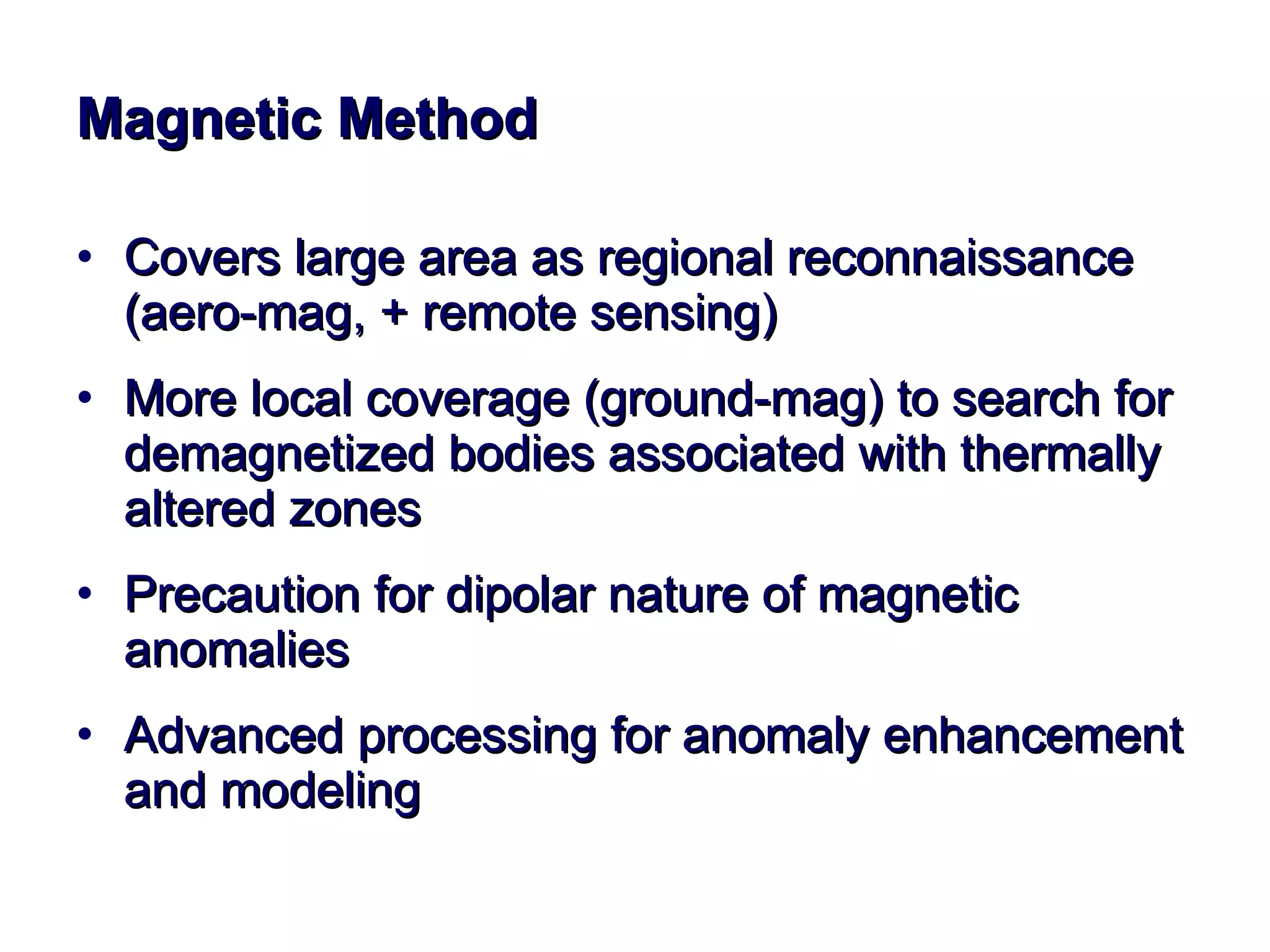
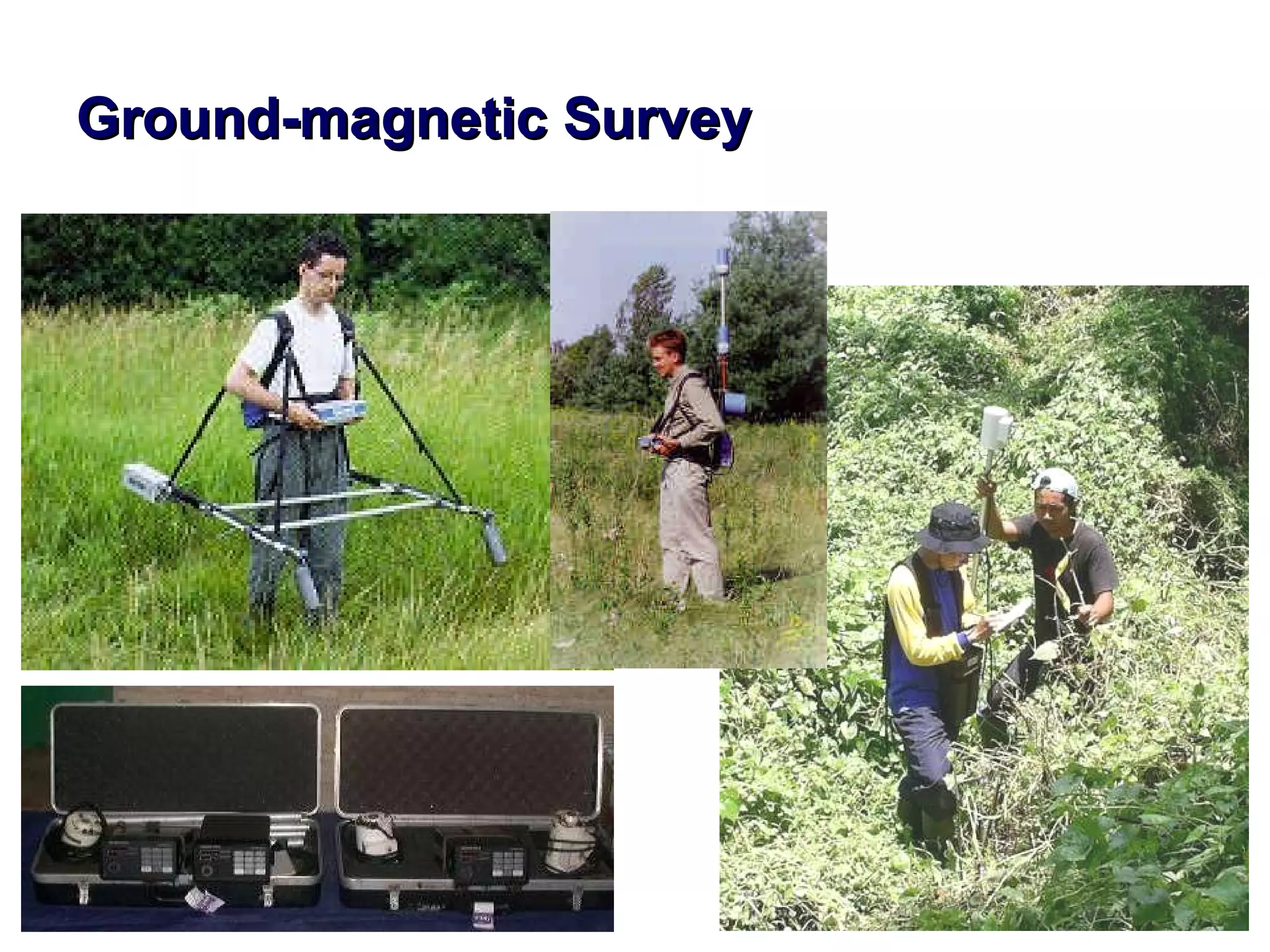
Magnetic Method Covers large area as regional reconnaissance (aero-mag, + remote sensing)  More local coverage (ground-mag) to search for demagnetized bodies associated with thermally altered zones Precaution for dipolar nature of magnetic anomalies Advanced processing for anomaly enhancement and modeling
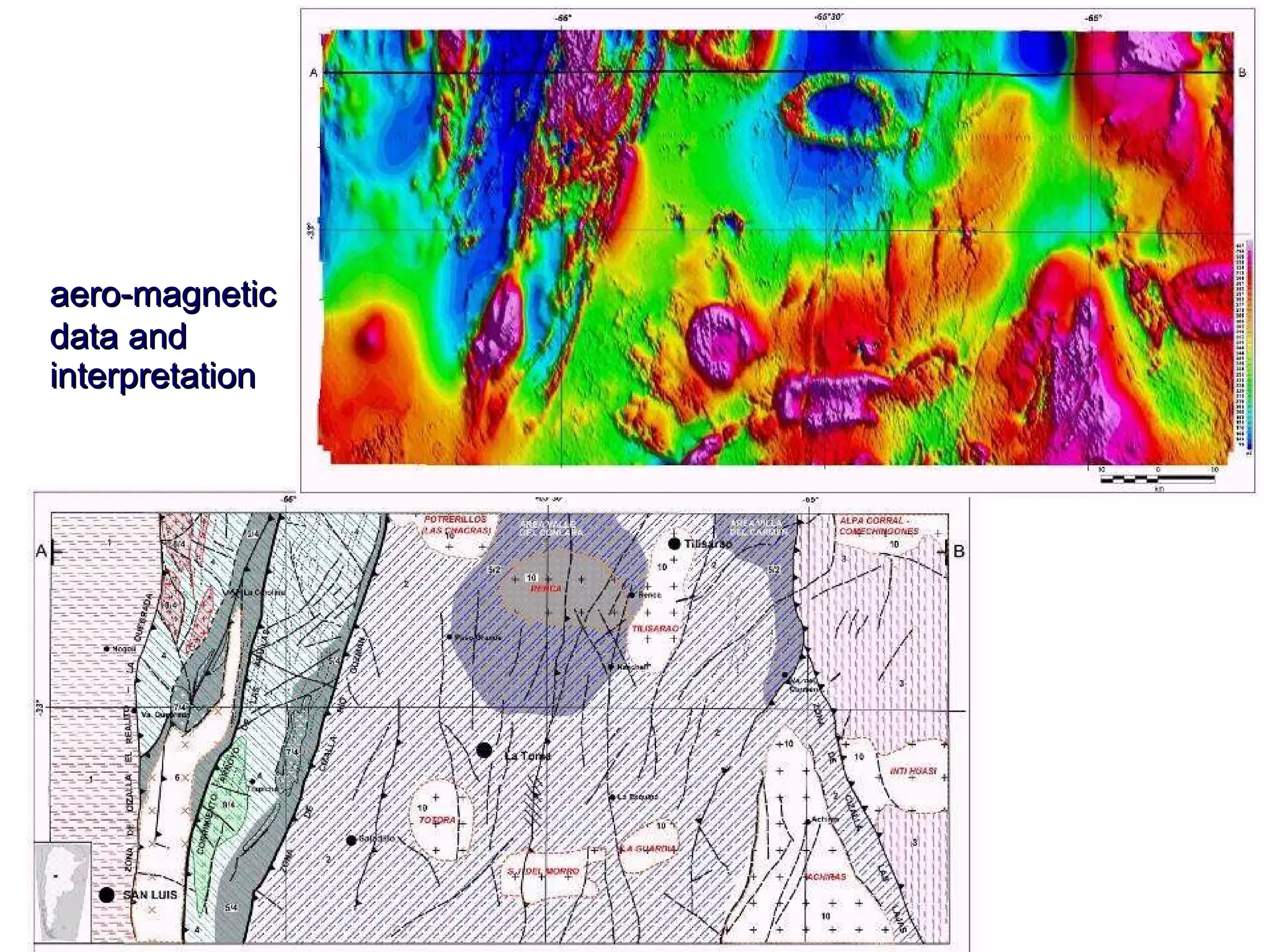
Aero-magnetic Survey
aero-magnetic data and interpretation
Ground-magnetic Survey
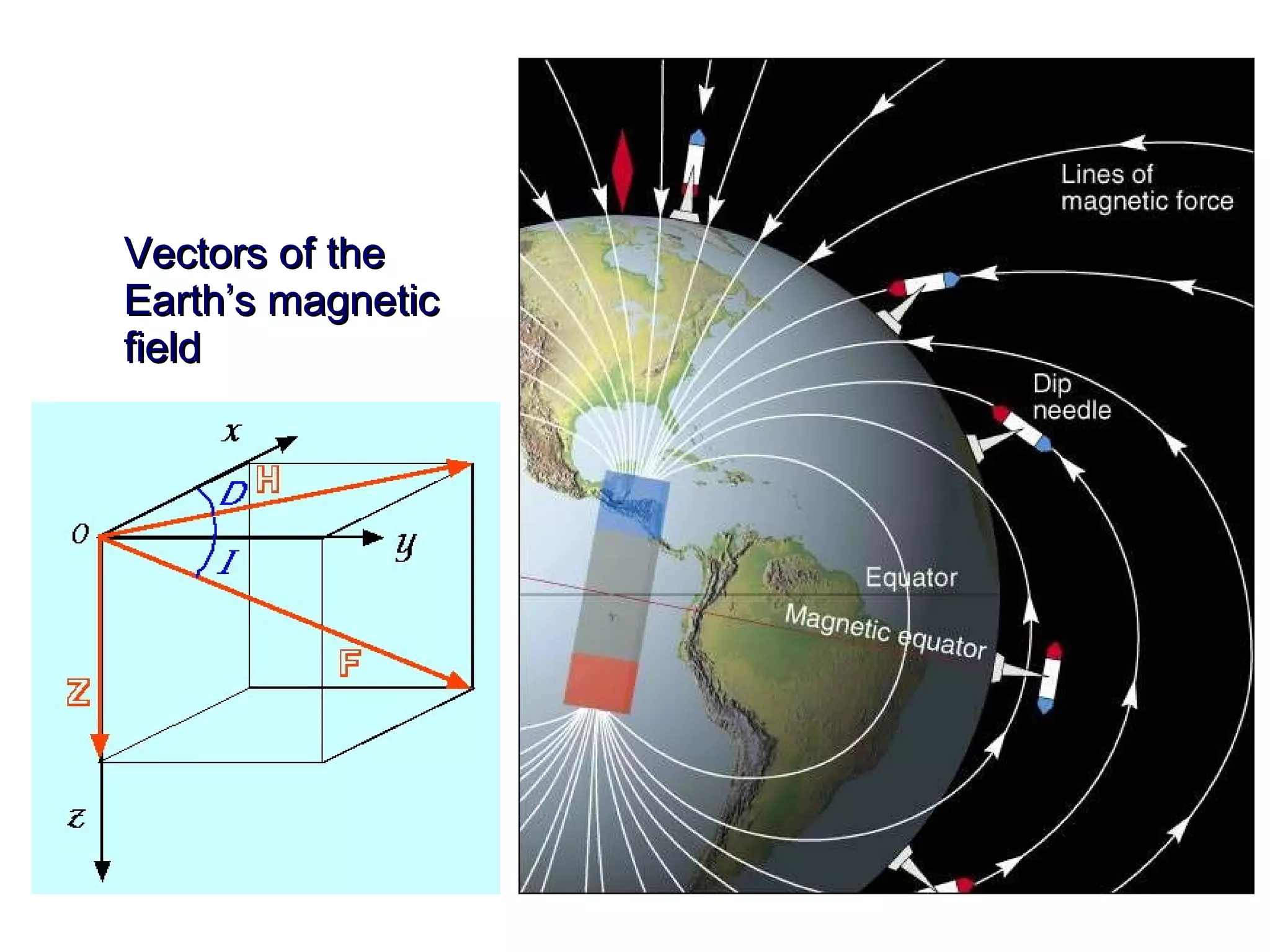
Vectors of the Earth’s magnetic field
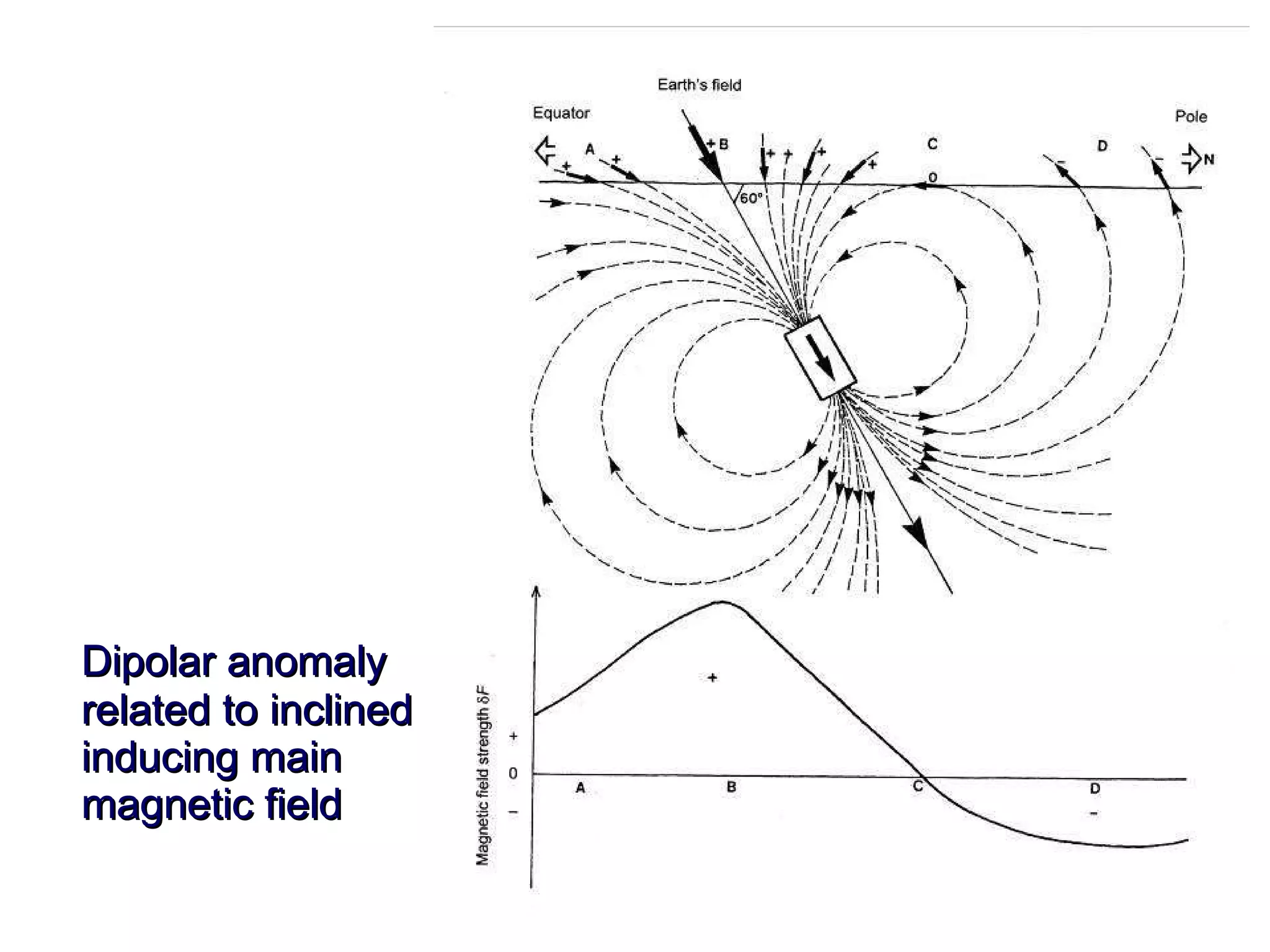
Dipolar anomaly related to inclined inducing main magnetic field
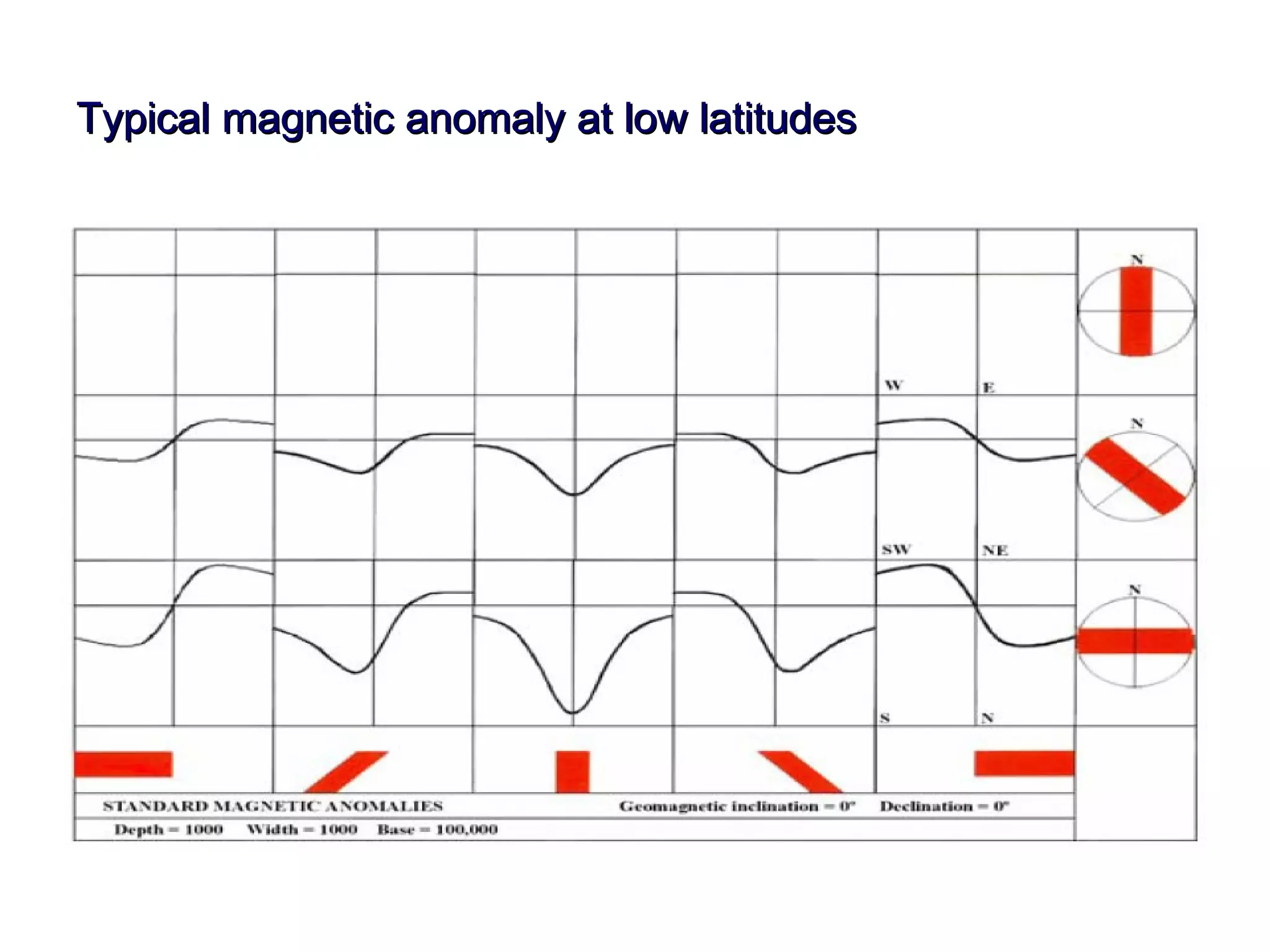
Typical magnetic anomaly at low latitudes
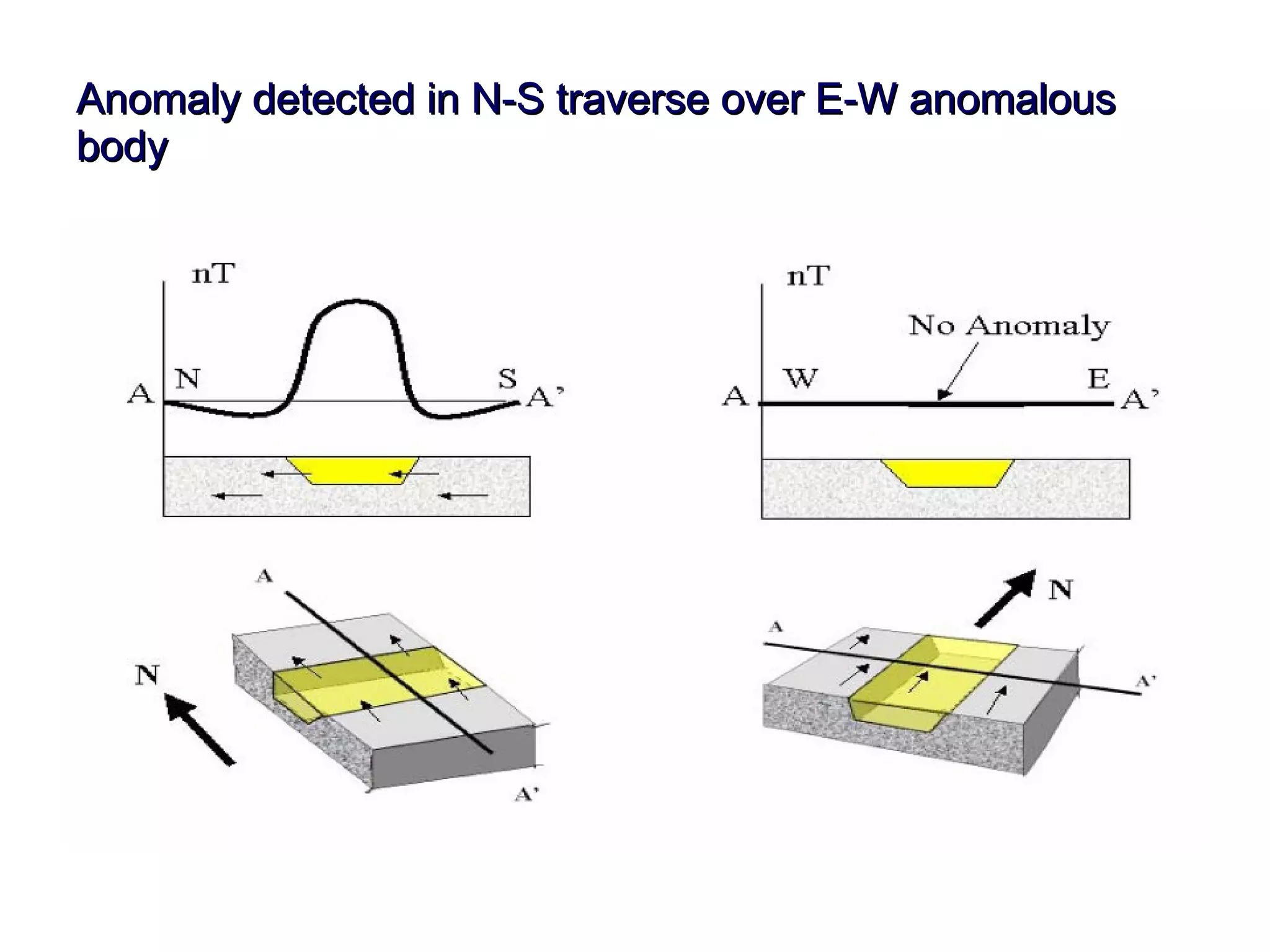
Anomaly detected in N-S traverse over E-W anomalous body
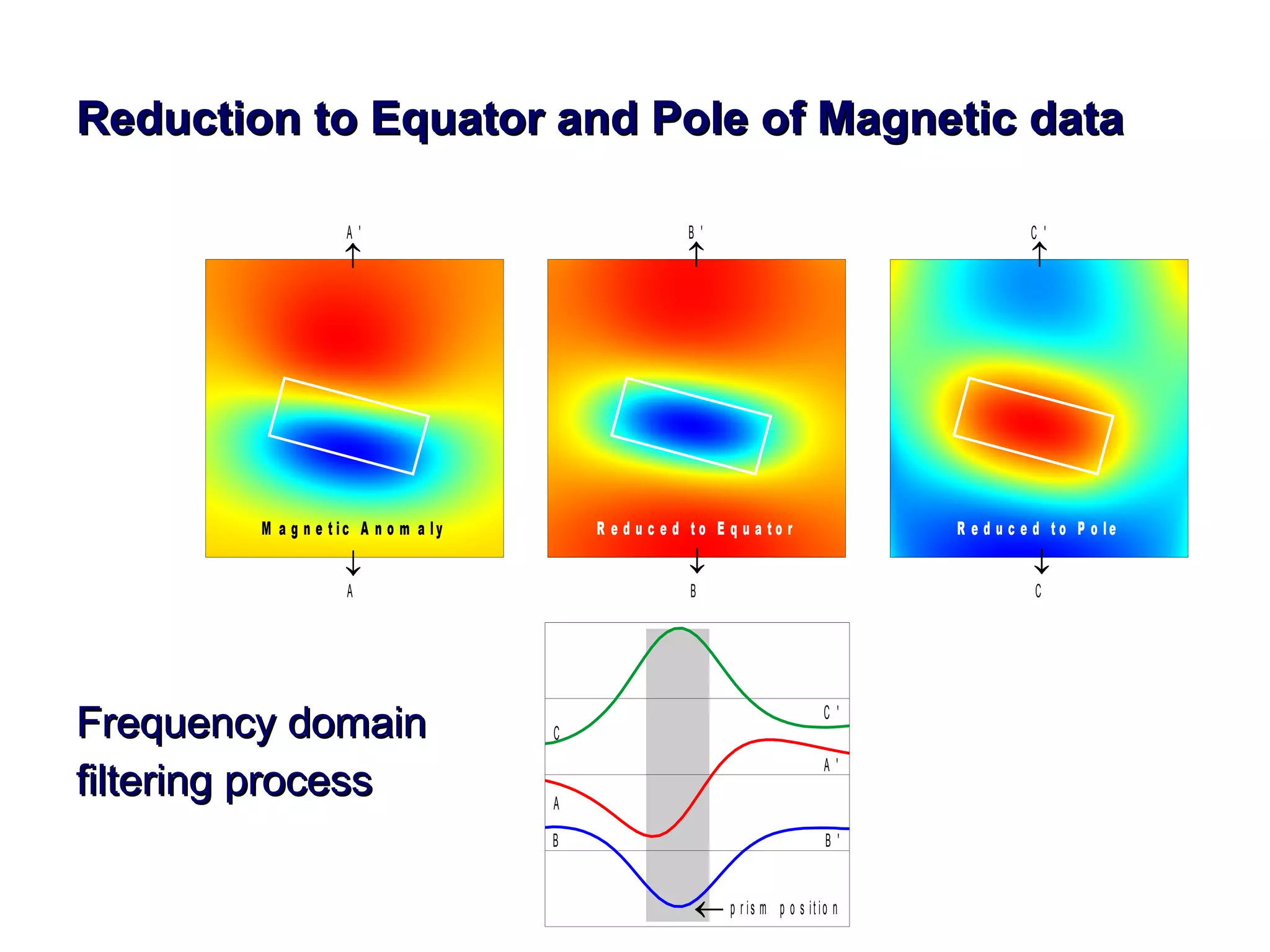
Reduction to Equator and Pole of Magnetic data Frequency domain  filtering process
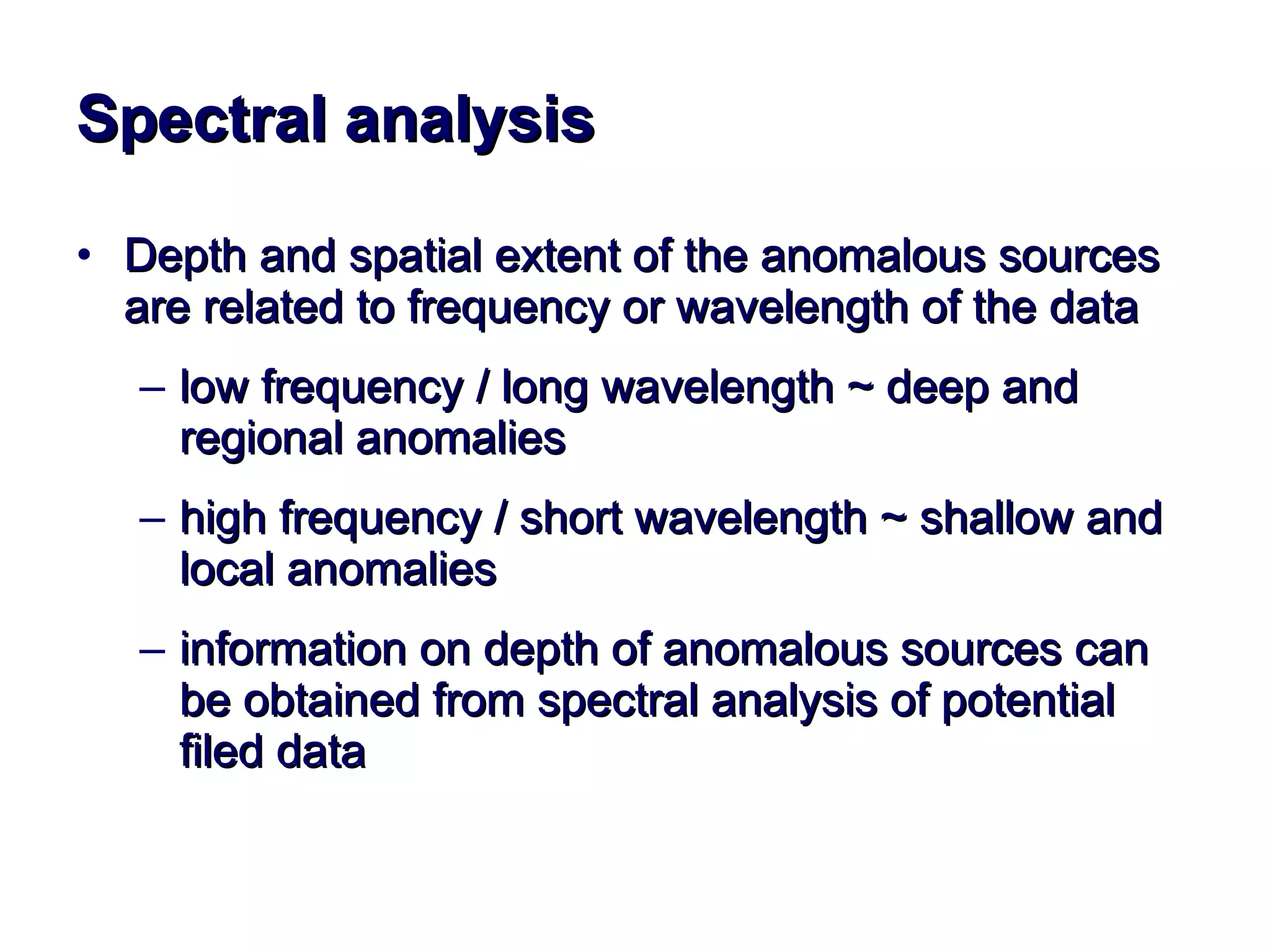
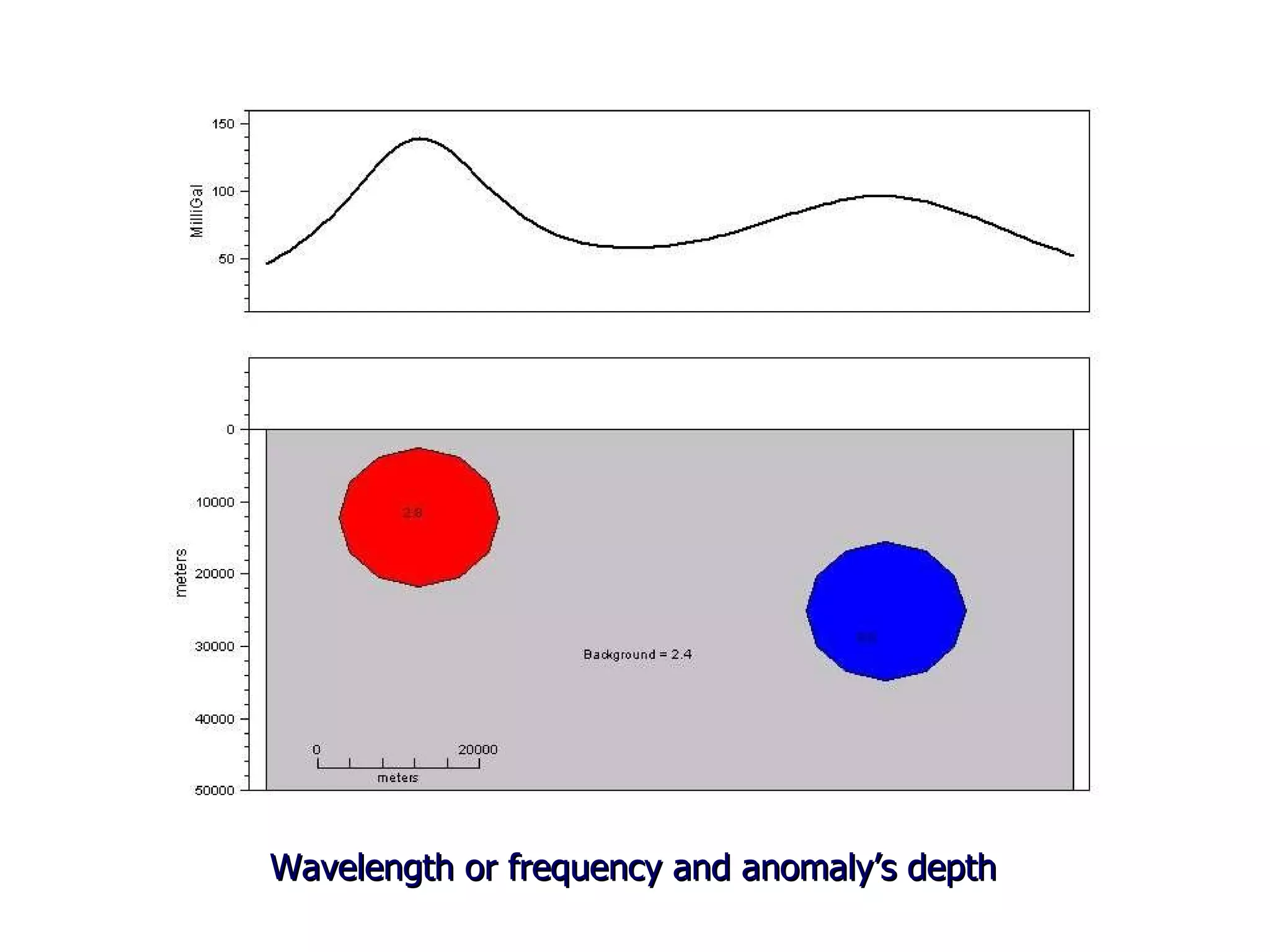
Spectral analysis Depth and spatial extent of the anomalous sources are related to frequency or wavelength of the data low frequency / long wavelength ~ deep and regional anomalies  high frequency / short wavelength ~ shallow and local anomalies information on depth of anomalous sources can be obtained from spectral analysis of potential filed data
Wavelength or frequency and anomaly’s depth
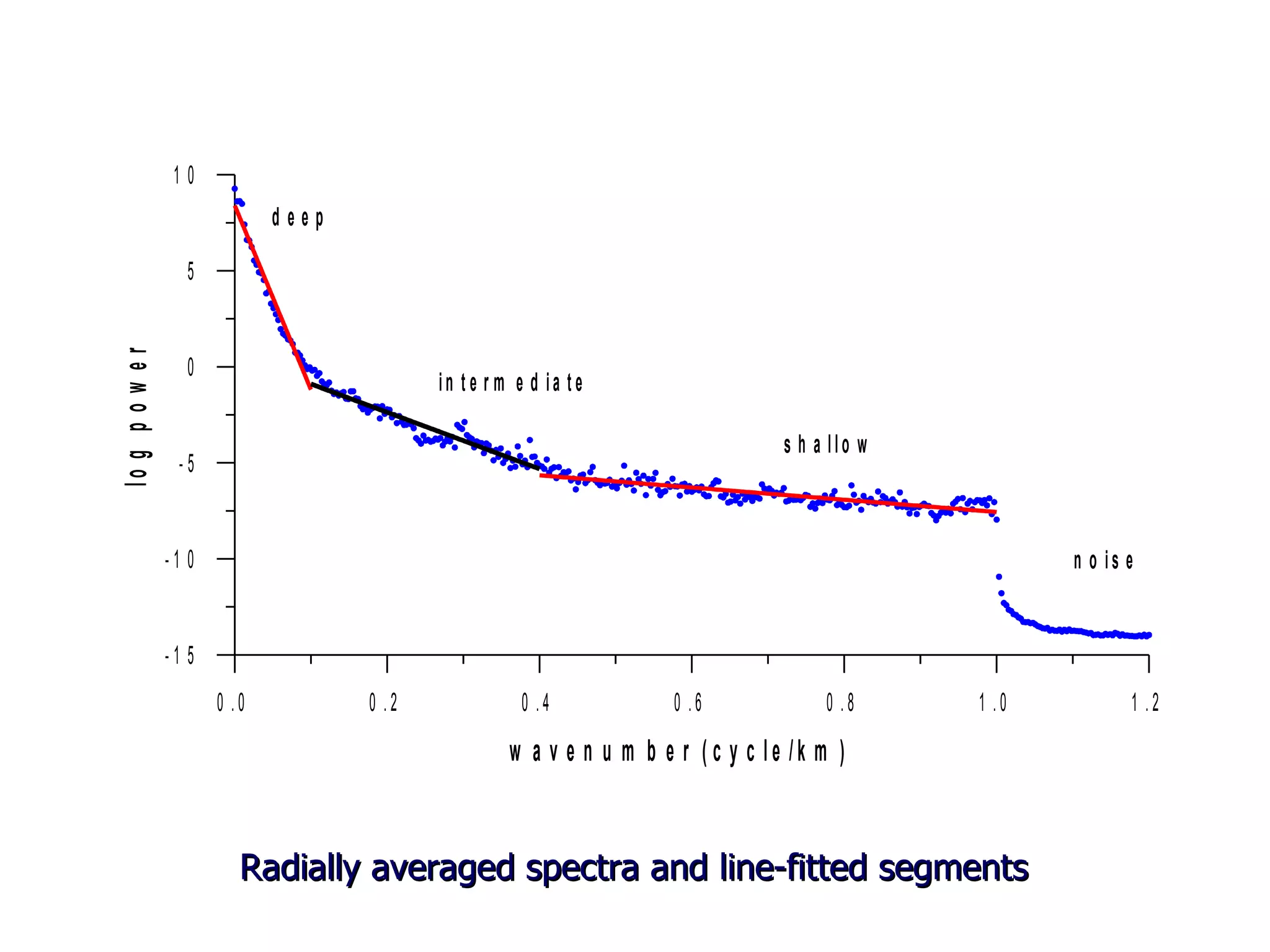
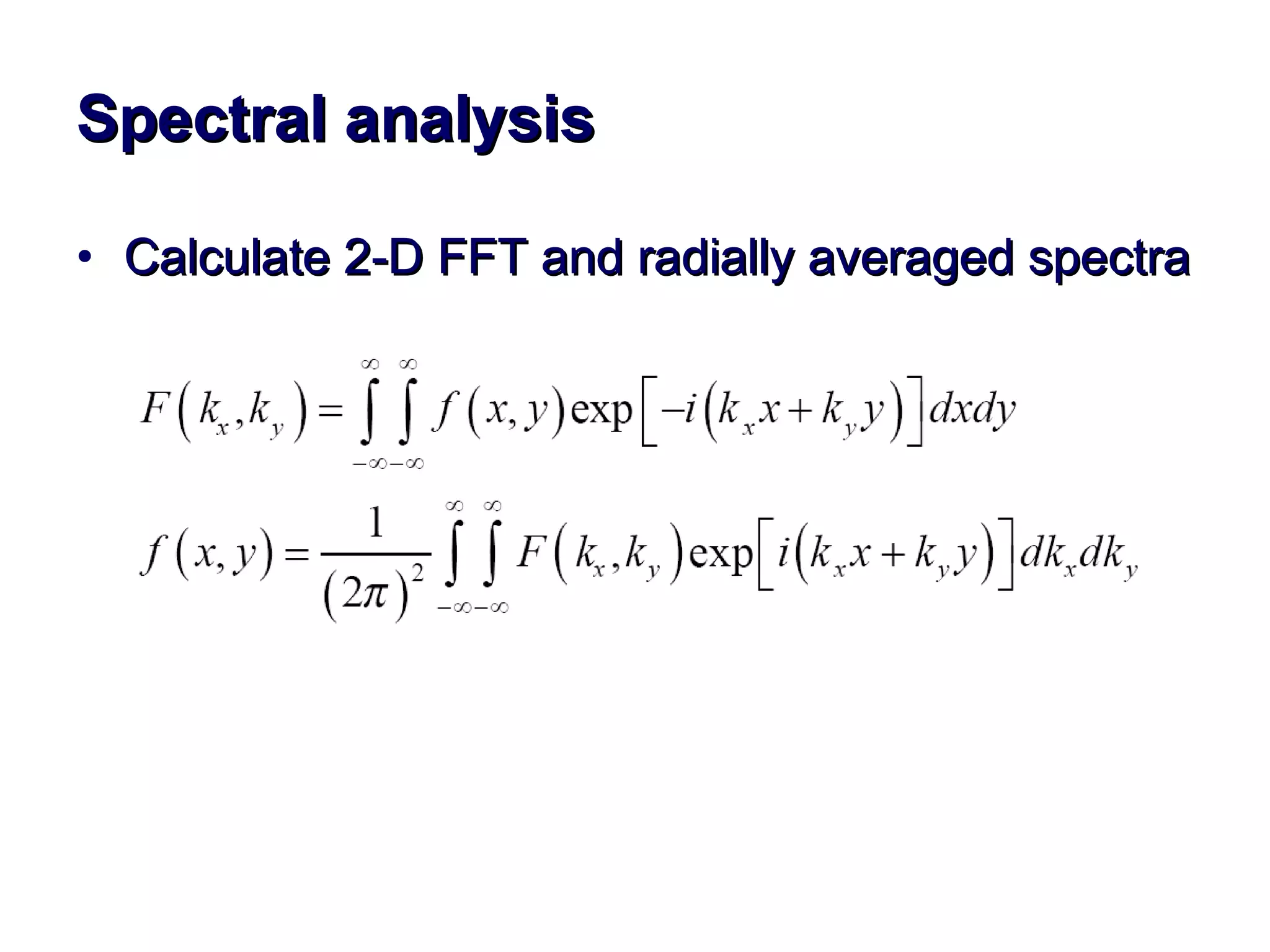
Spectral analysis Calculate 2-D FFT and radially averaged spectra relationship between slope of power spectrum with depth filtering (low-pass, high-pass, band-pass) regional – residual anomaly separation  pseudo-depth slicing
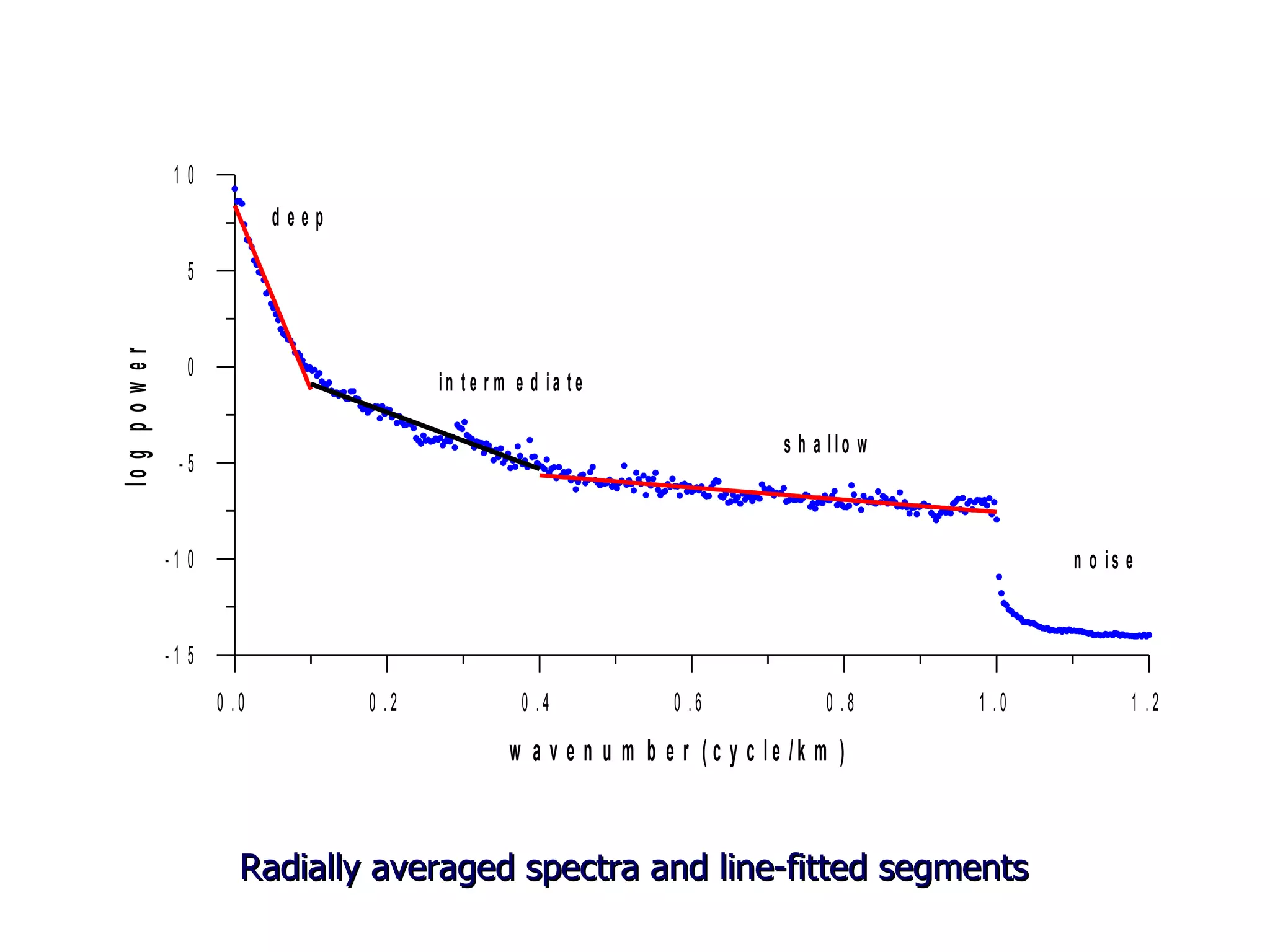
Radially averaged spectra and line-fitted segments
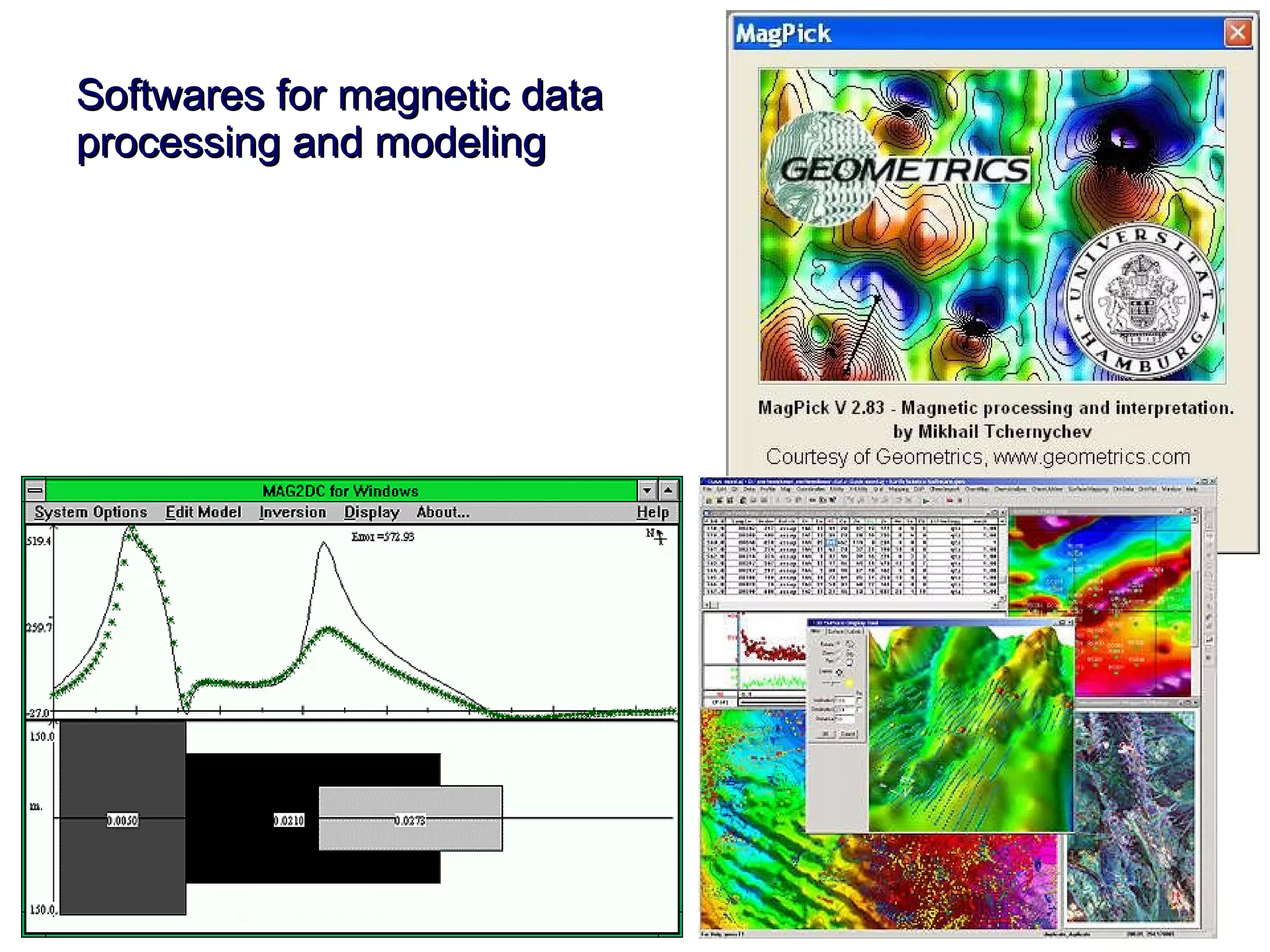
Softwares for magnetic data processing and modeling
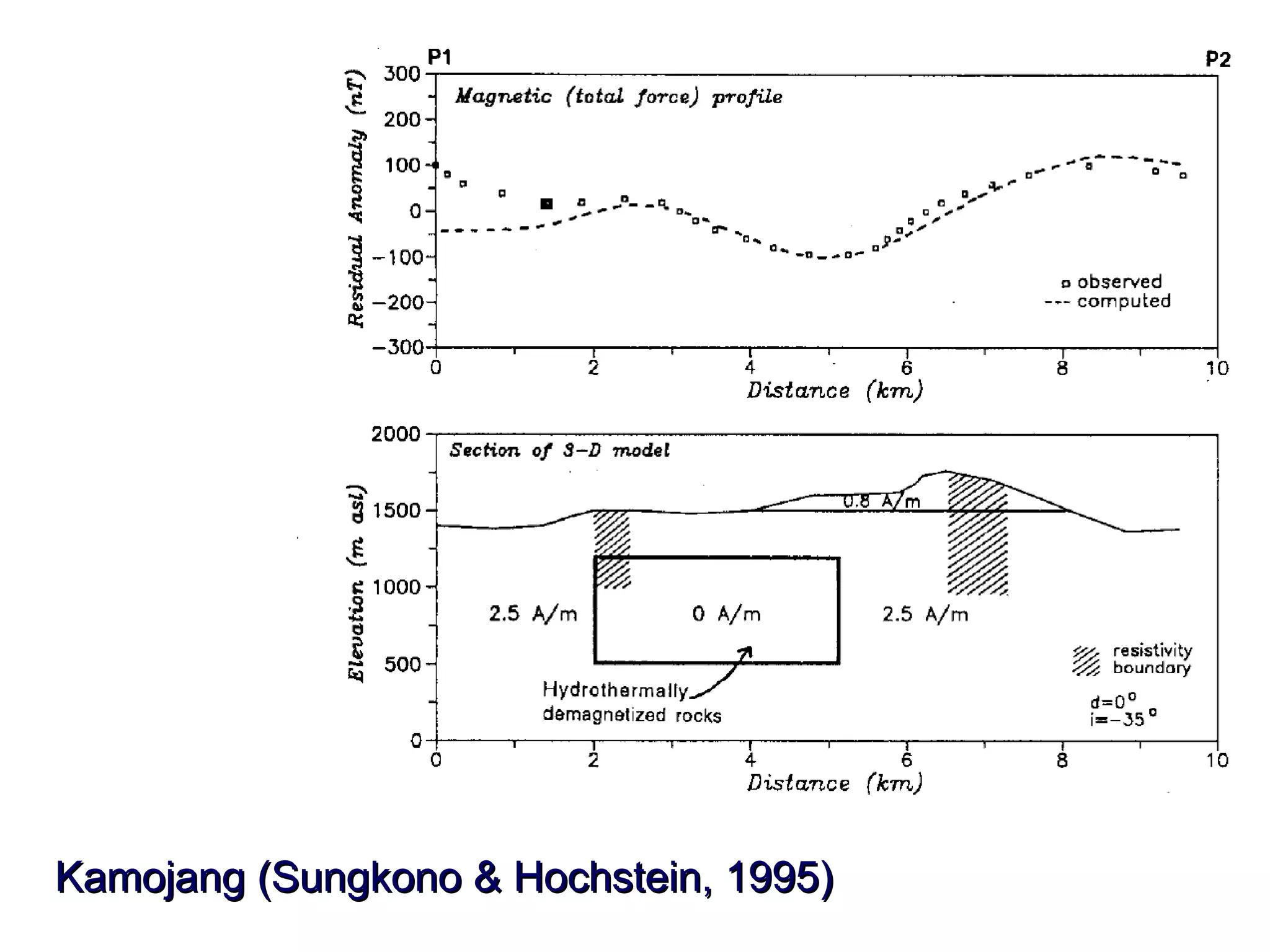
Kamojang (Sungkono & Hochstein, 1995)
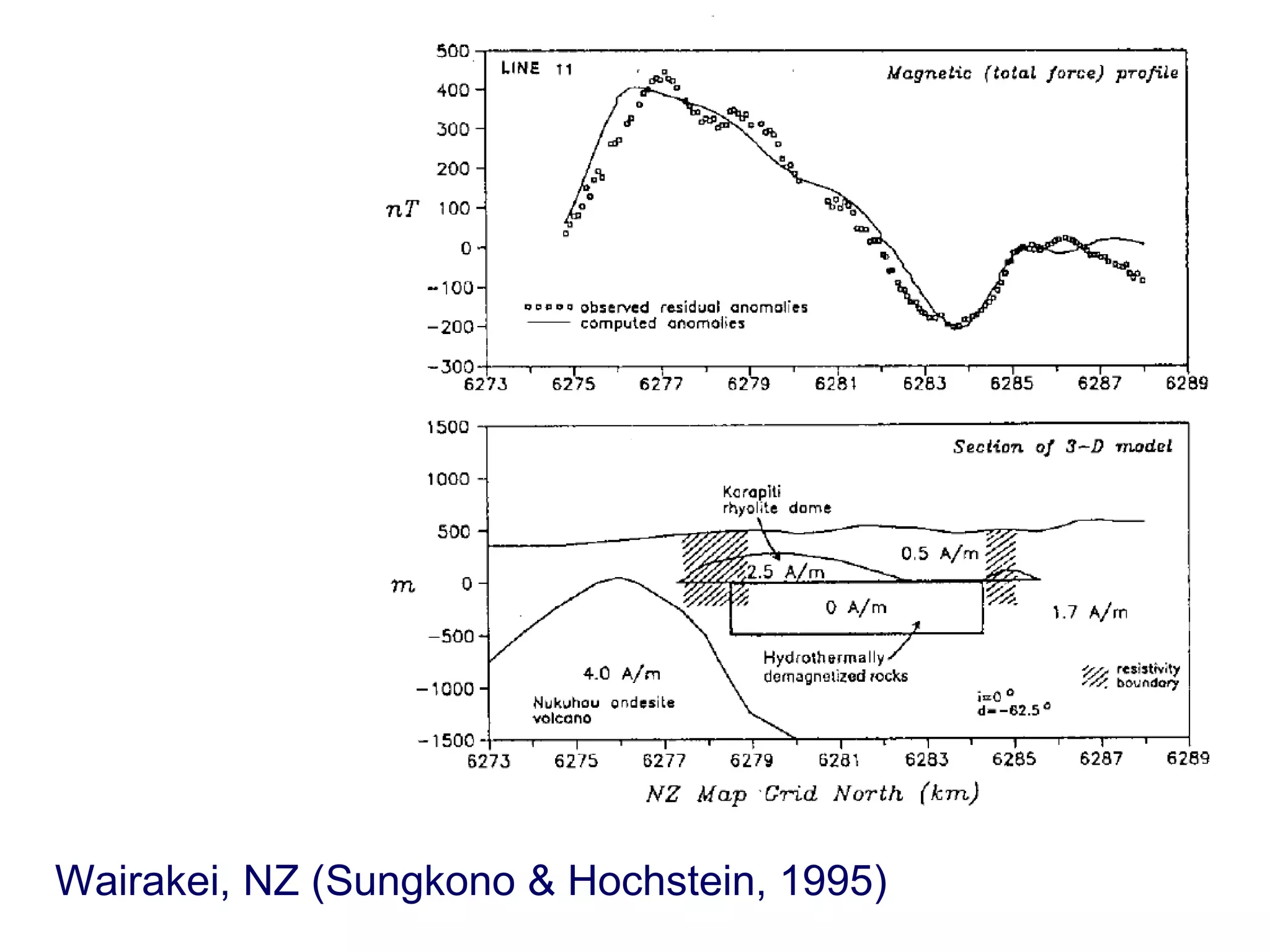
Wairakei, NZ (Sungkono & Hochstein, 1995)
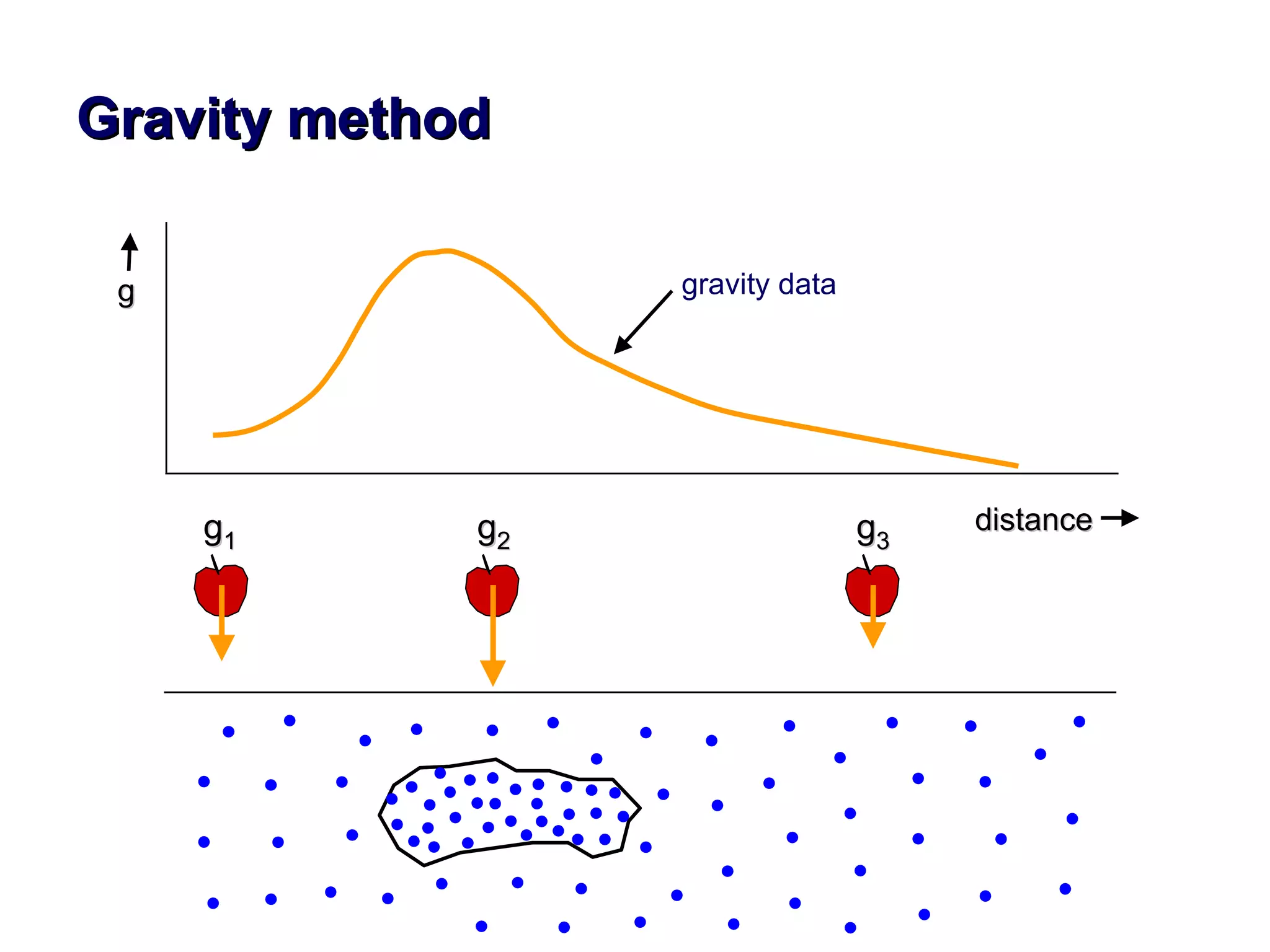
Gravity method g 1 g 2 g 3 distance g gravity data
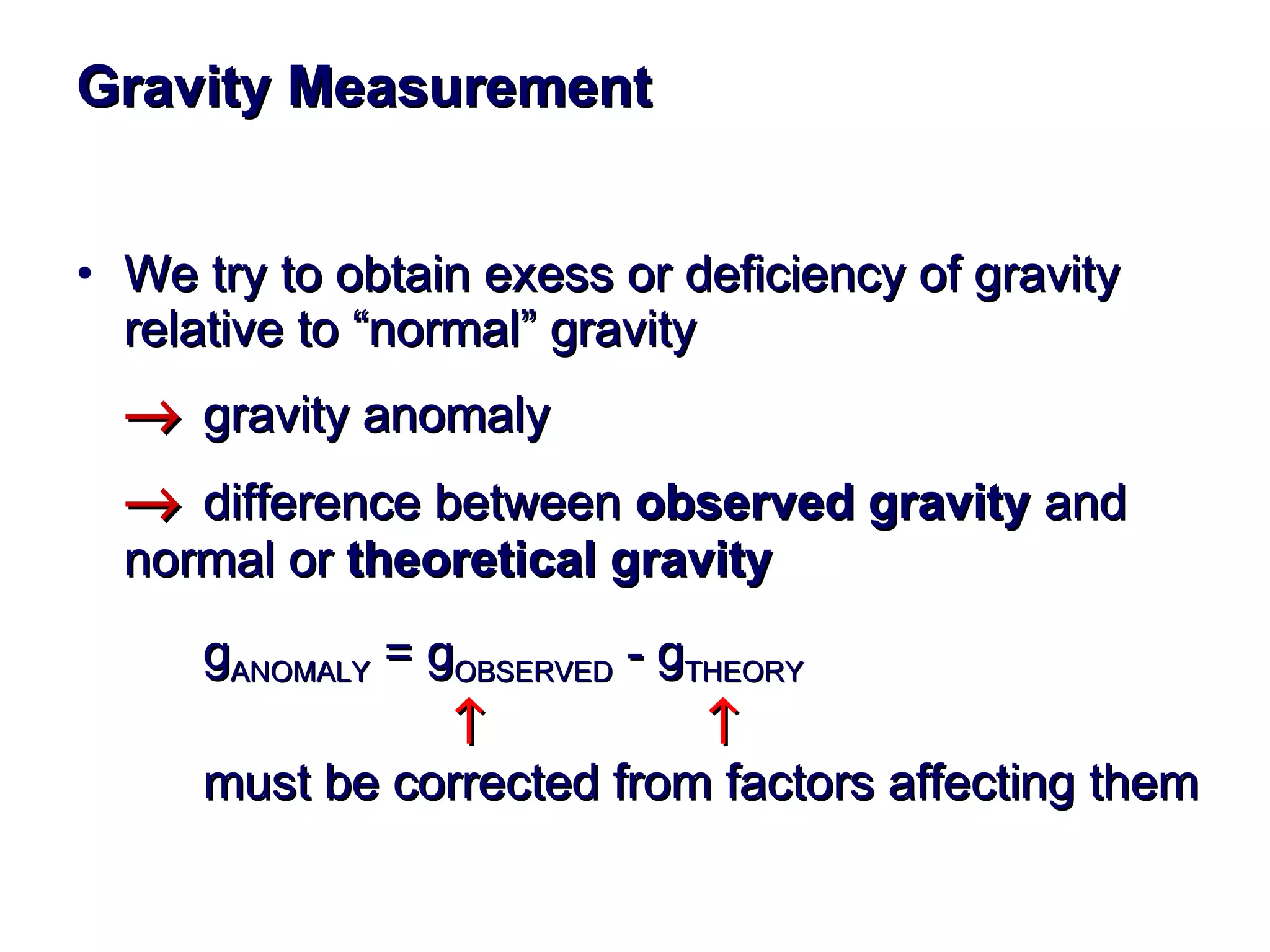
Gravity Measurement We try to obtain exess or deficiency of gravity relative to “normal” gravity   gravity anomaly  difference between  observed gravity  and  normal or  theoretical gravity g ANOMALY  = g OBSERVED  - g THEORY       must be corrected from factors affecting them
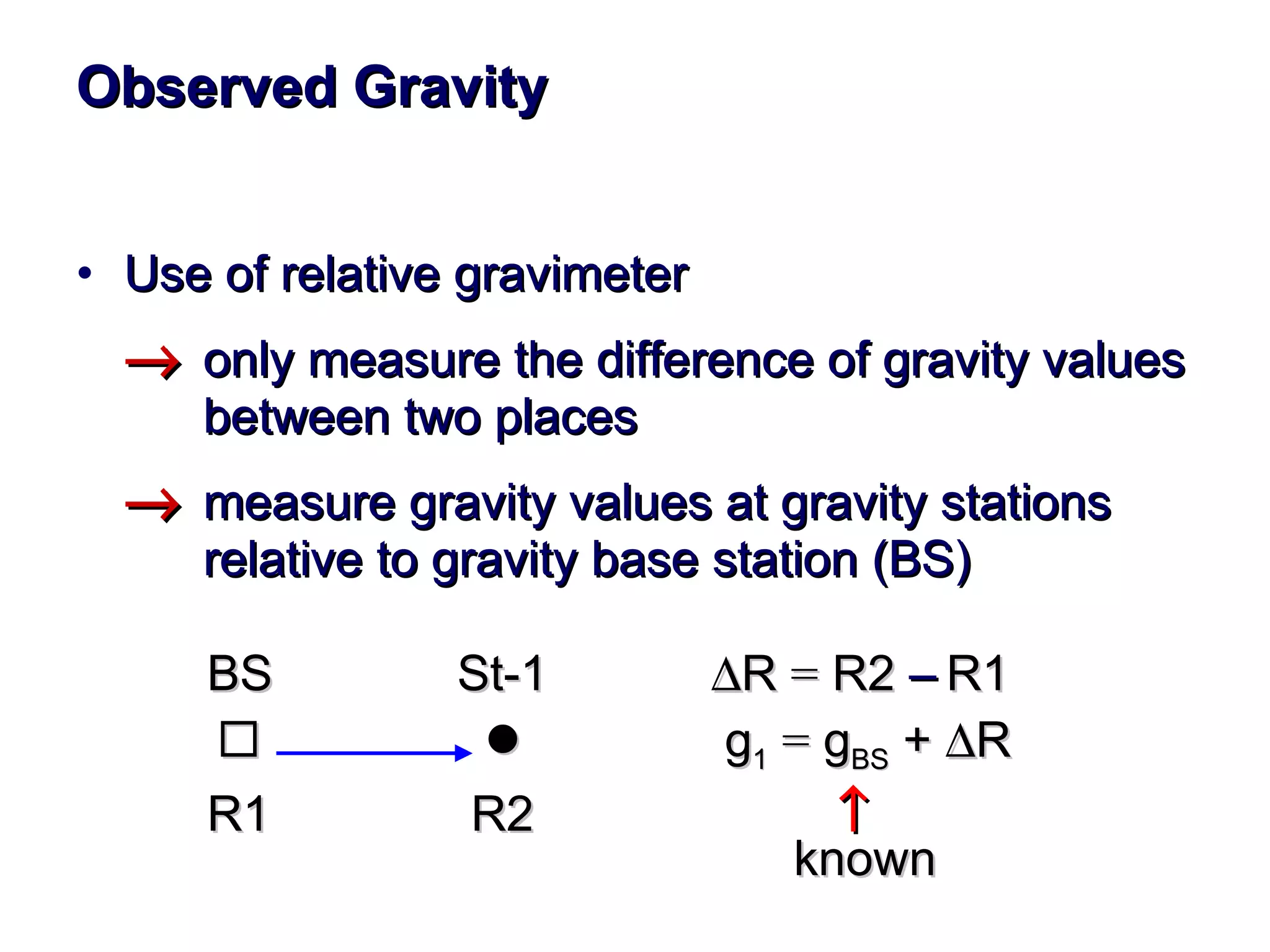
Observed Gravity Use of relative gravimeter   only measure the difference of gravity  values between two places  measure gravity values at gravity stations  relative to gravity base station (BS)    BS St-1  R  =  R2   –   R1           g 1   =  g BS  +   R   R1  R2    known
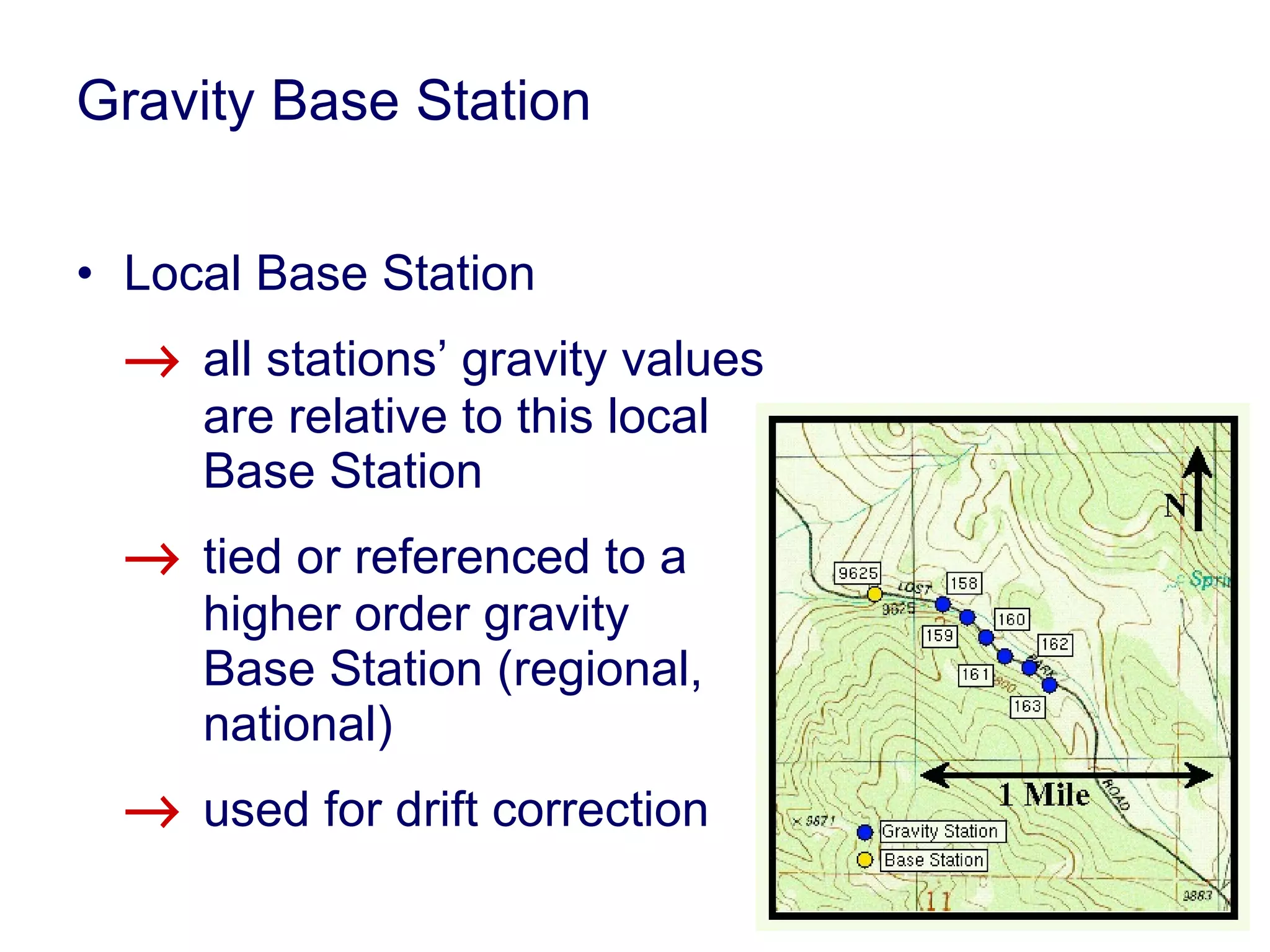
Gravity  Base Station Local Base Station  all stations’ gravity values are relative to this local Base Station  tied or referenced to a  higher order gravity  Base Station (regional, national)  used for drift correction
 
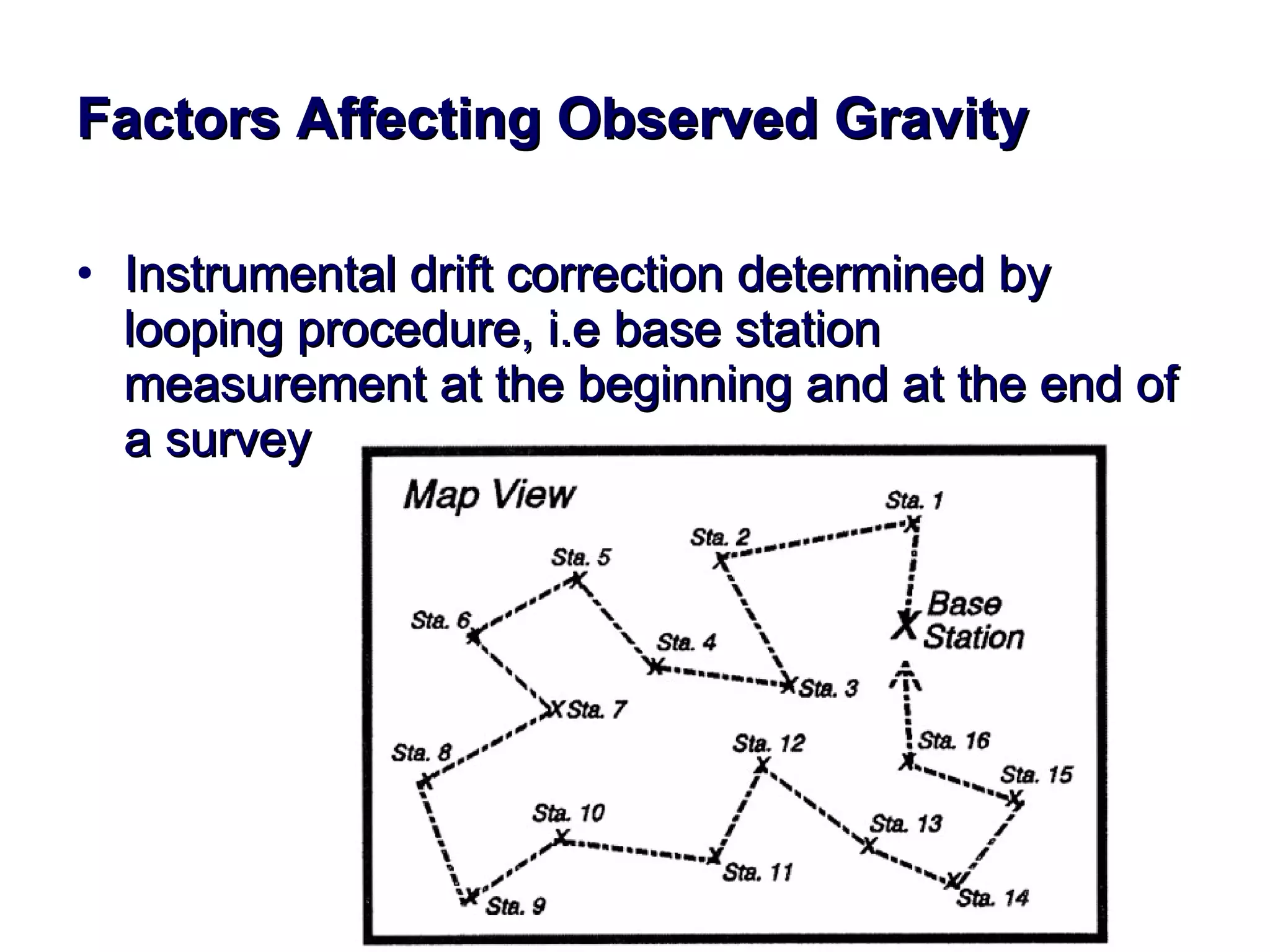
Factors Affecting Observed Gravity Instrumental drift  correction  determined by looping procedure, i.e base station measurement at the beginning and  at  the end of a survey
Gravity  Anomaly g ANOMALY   =  g OBSERVED   –  g THEORY g OBSERVED    gravity value relative to a known base station  g THEORY  Gravity Reference Field (GRF)  corrected to  meet the observation condition  ( elevation      MSL )  corrections: Free-Air, Bouguer, Terrain
 
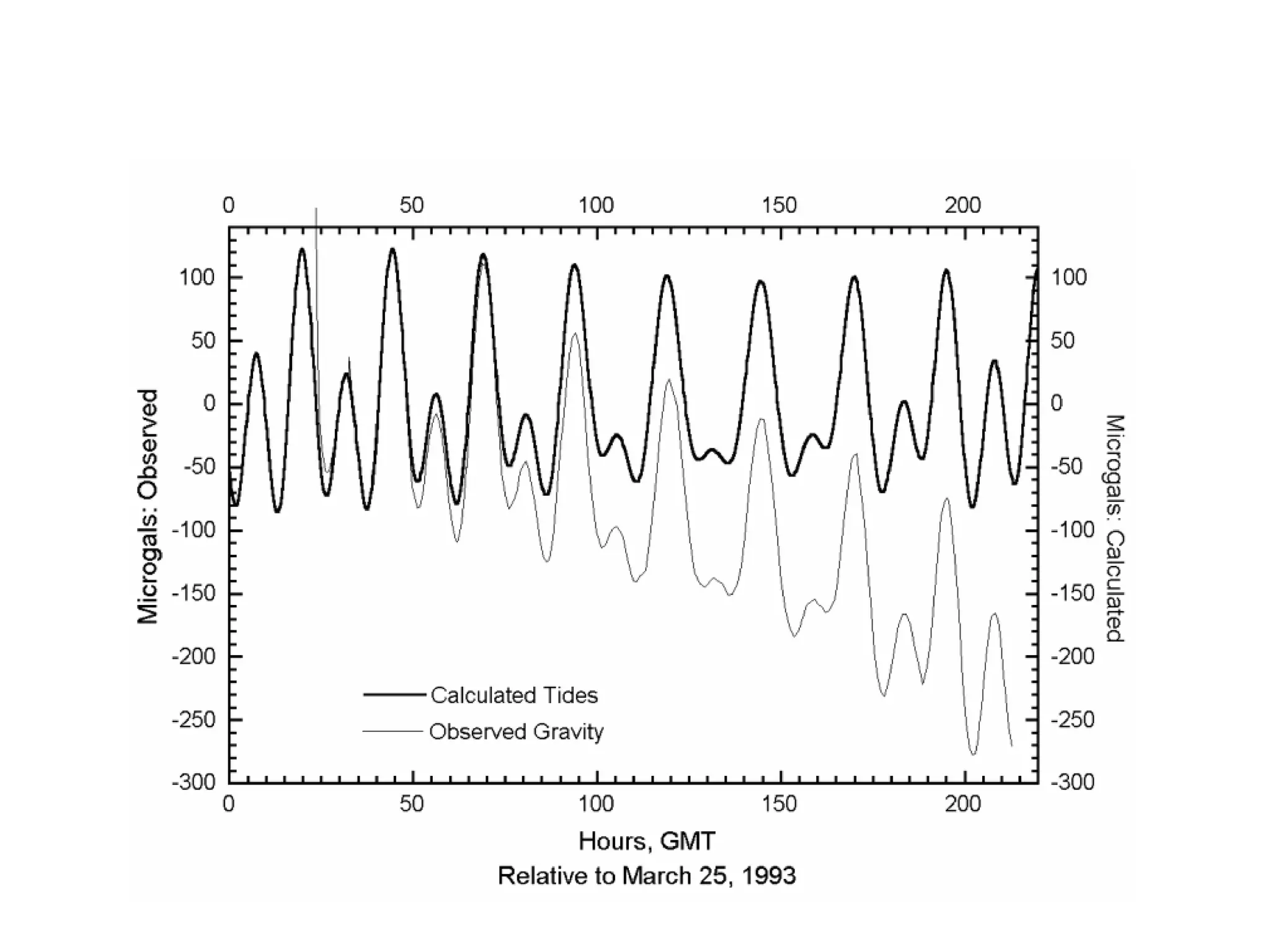
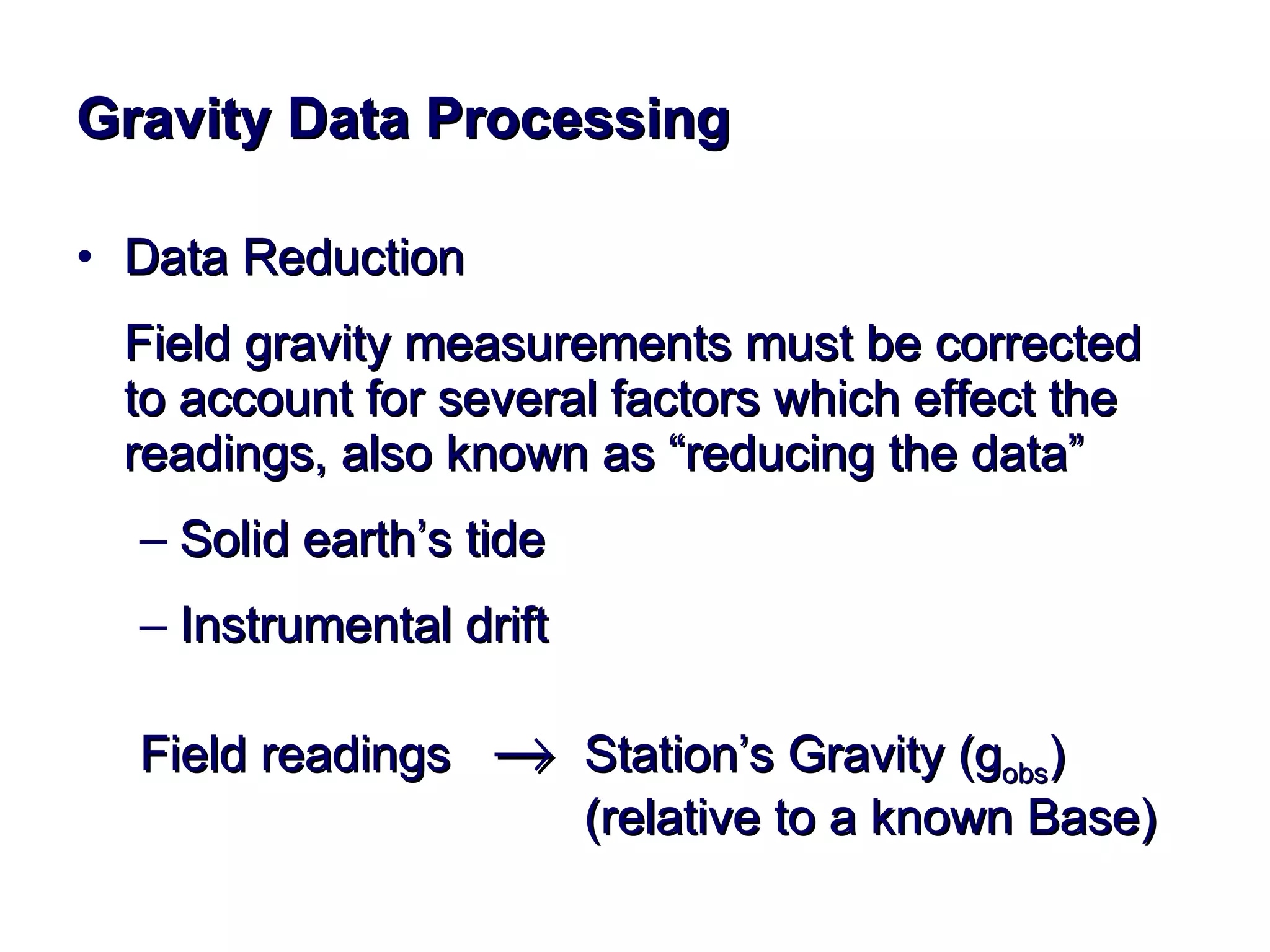
Gravity Data Processing Data Reduction Field gravity measurements must be corrected to account for several factors which effect the readings, also known as “reducing the data” Solid earth’s tide Instrumental drift  Field readings     Station’s Gravity (g obs ) (relative to a known Base)
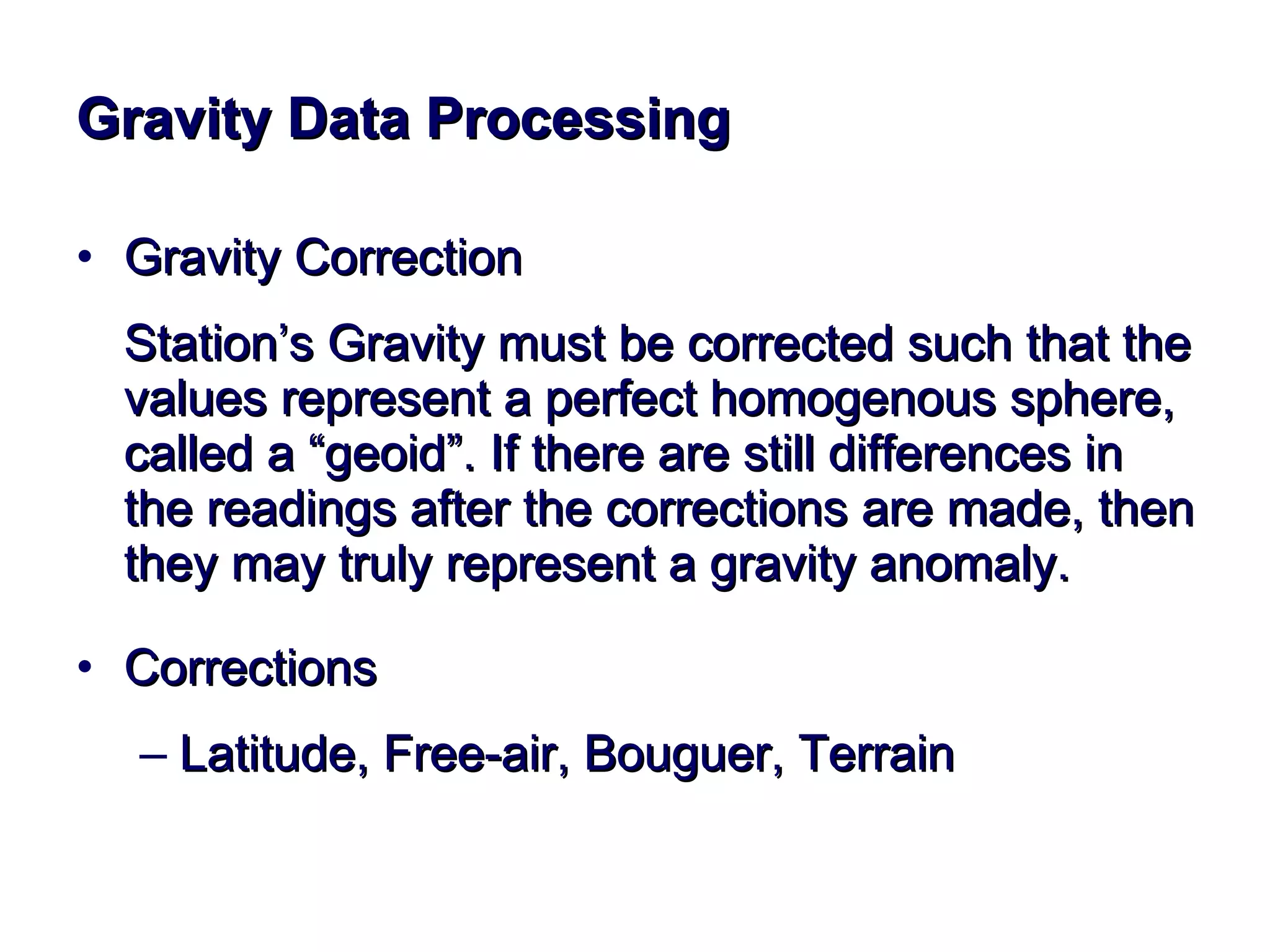
G r a v i t y   D a t a   P r o c e s s i n g Gravity Correction Station’s Gravity must be corrected such that the values represent a perfect homogenous sphere, called a “geoid”. If there are still differences in the readings after the corrections are made, then they may truly represent a gravity anomaly. Corrections  Latitude, Free-air, Bouguer, Terrain
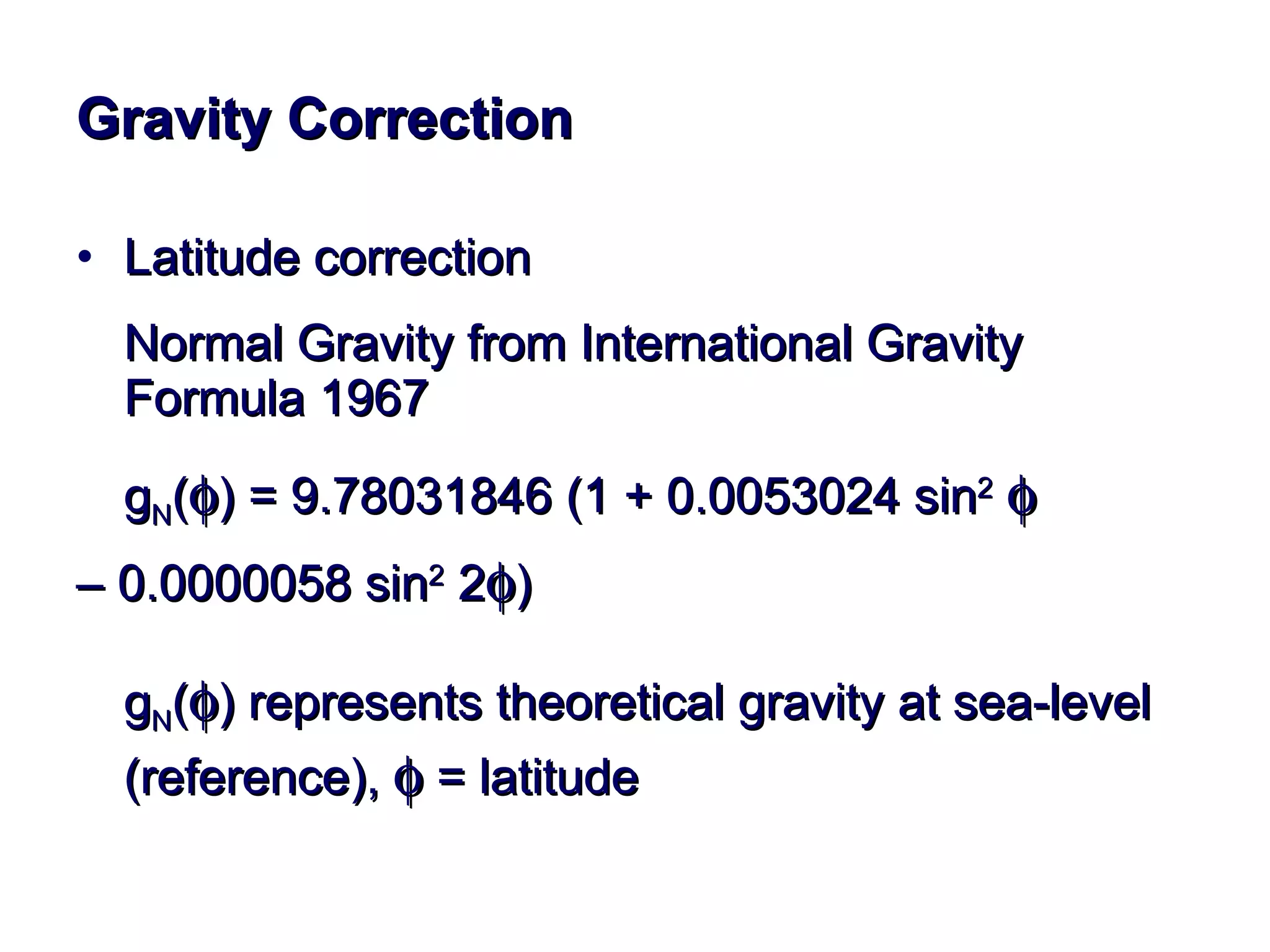
Gravity Correction Latitude correction  Normal Gravity from International Gravity Formula 1967 g N (  ) = 9.78031846 (1 + 0.0053024 sin 2      –  0.0000058 sin 2  2  ) g N (  ) represents theoretical gravity at sea-level (reference),    = latitude
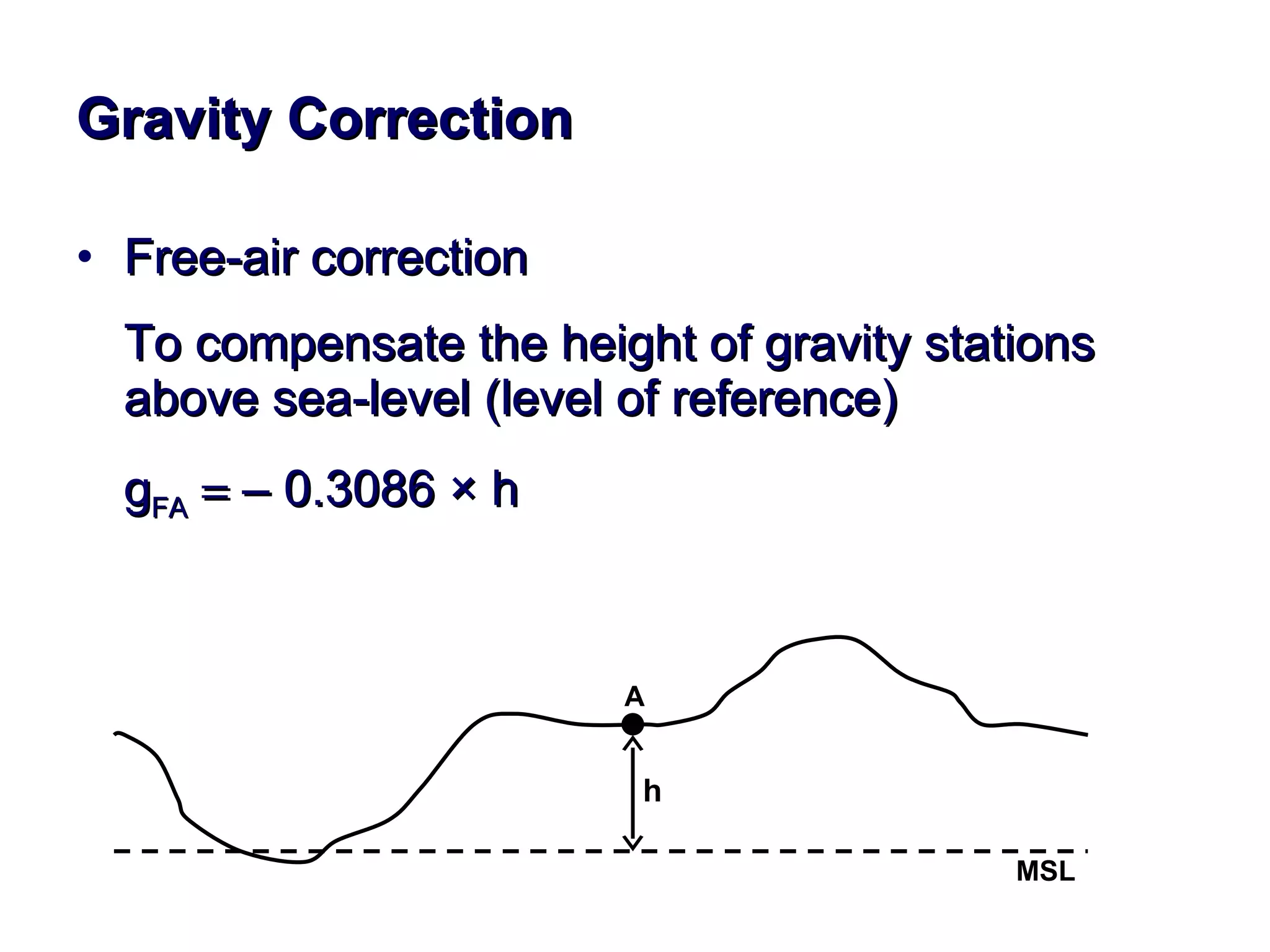
Gravity Correction Free-air correction  To compensate the height of gravity stations above sea-level (level of reference)  g FA     – 0.3086  ×  h A MSL h
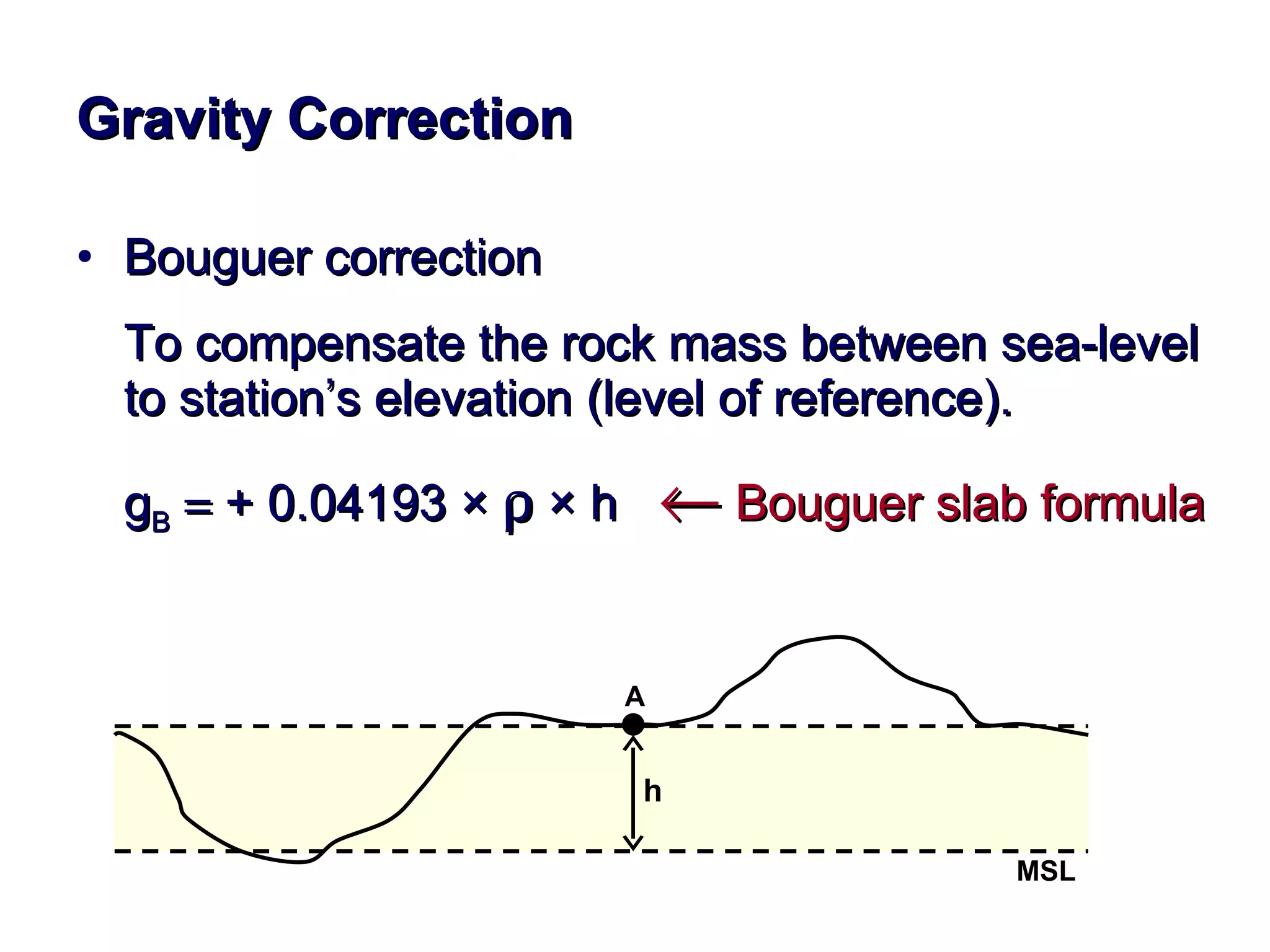
Gravity Correction Bouguer correction  To compensate the rock mass between sea-level to station’s elevation (level of reference).  g B     + 0.04193  ×      ×  h    Bouguer slab formula A MSL h
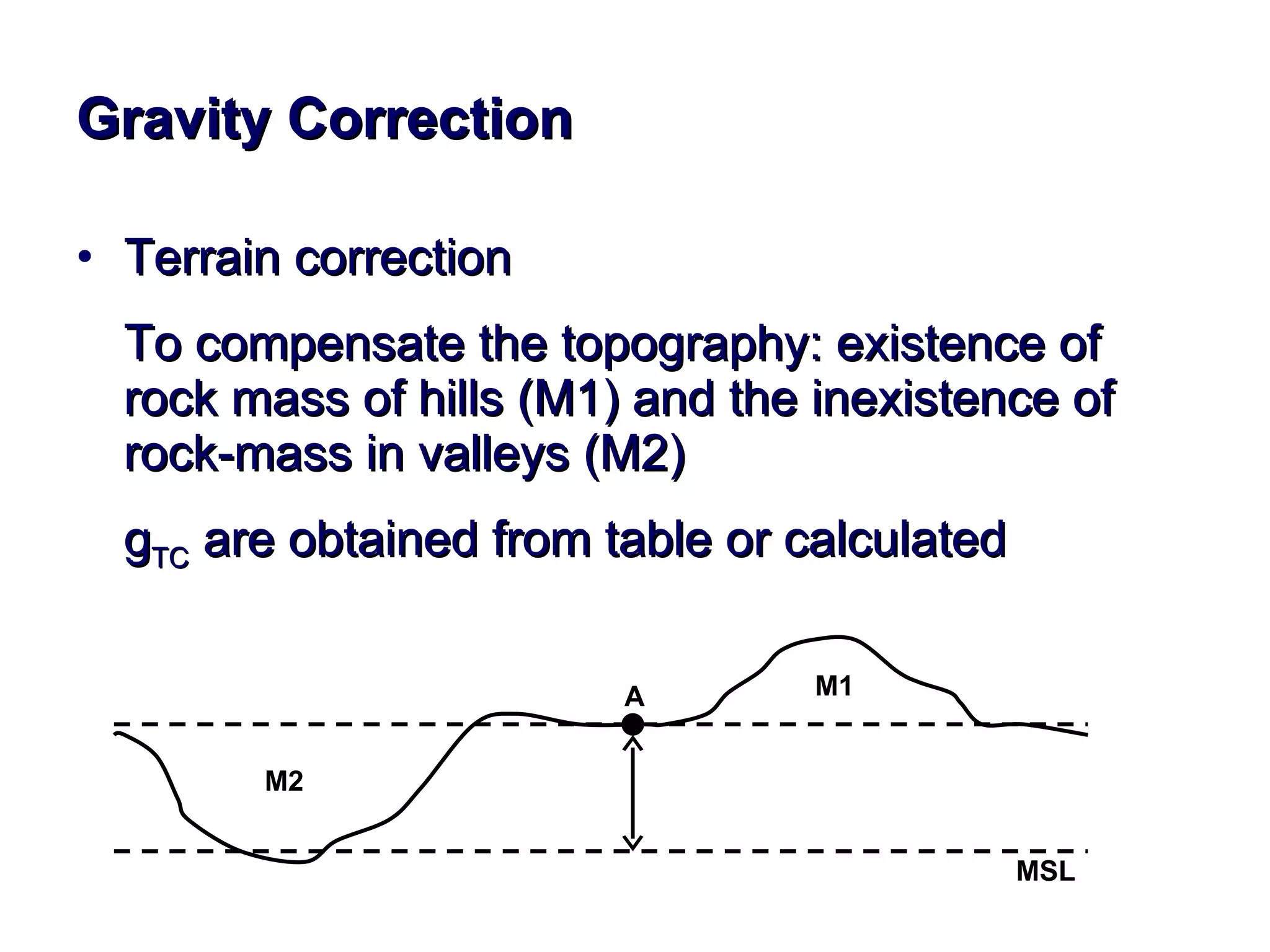
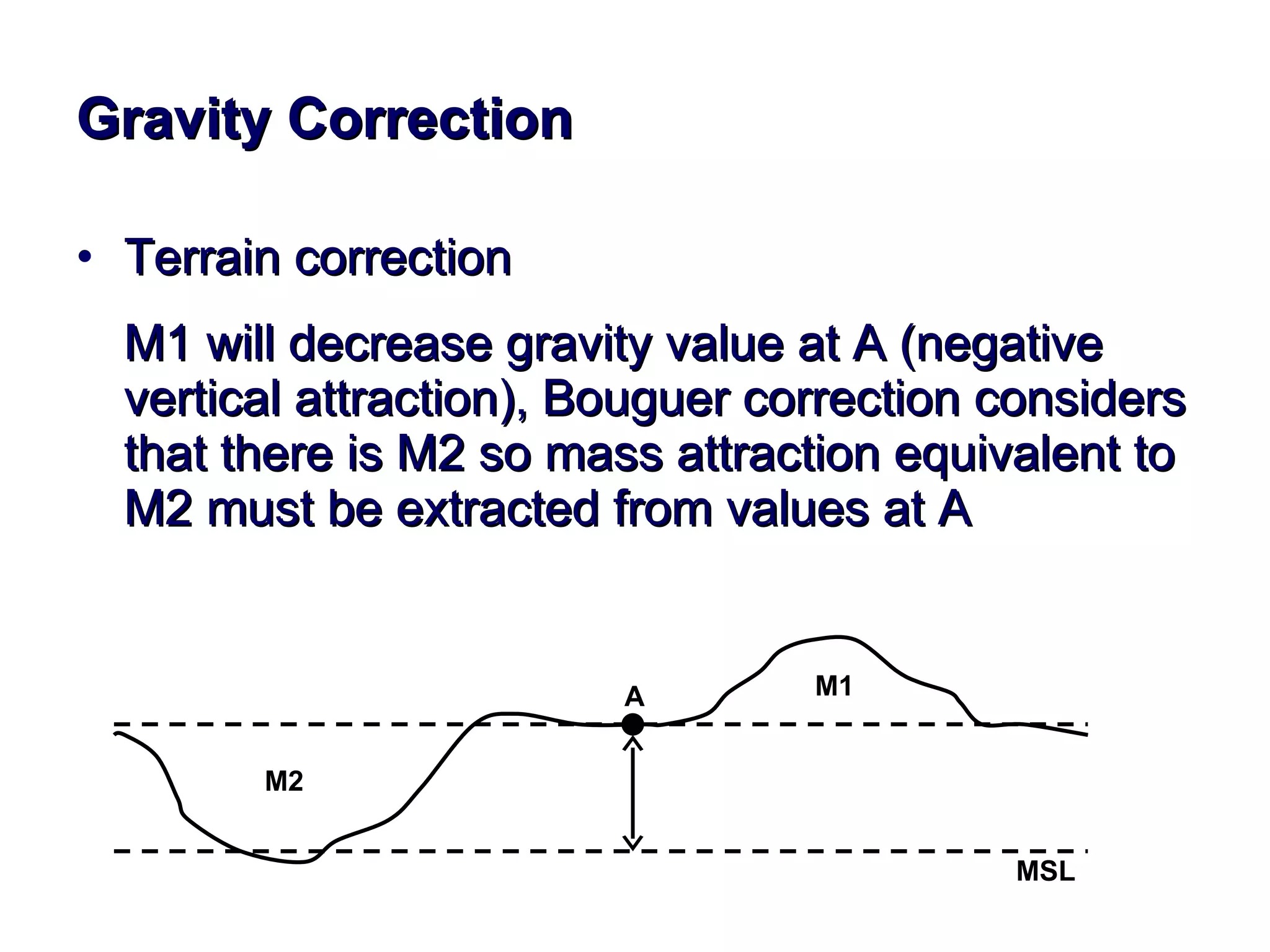
Gravity Correction Terrain correction To compensate the topography: existence of rock mass of hills (M1) and the inexistence of rock-mass in valleys (M2) g TC  are obtained from table or calculated A M1 M2 MSL
Gravity Correction Terrain correction M1 will decrease gravity value at A (negative vertical attraction), Bouguer correction considers that there is M2 so mass attraction equivalent to M2 must be extracted from values at A A M1 M2 MSL
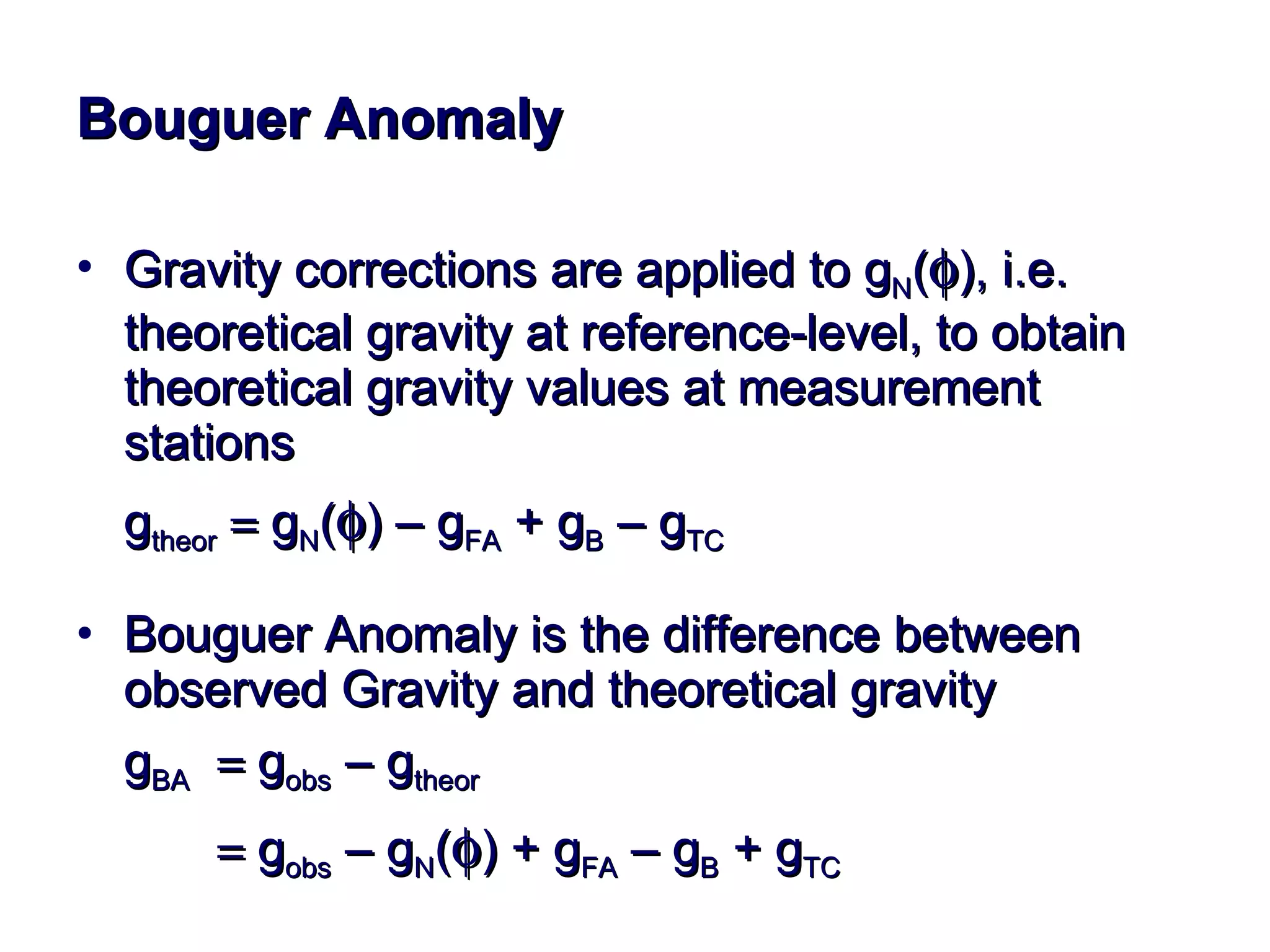
Bouguer Anomaly Gravity corrections are applied to g N (  ), i.e. theoretical gravity at reference-level, to obtain theoretical gravity values at measurement stations g theor     g N (  ) – g FA  + g B  – g TC Bouguer Anomaly is the difference between observed Gravity and theoretical gravity g BA     g obs  – g theor        g obs  – g N (  ) + g FA  – g B  + g TC
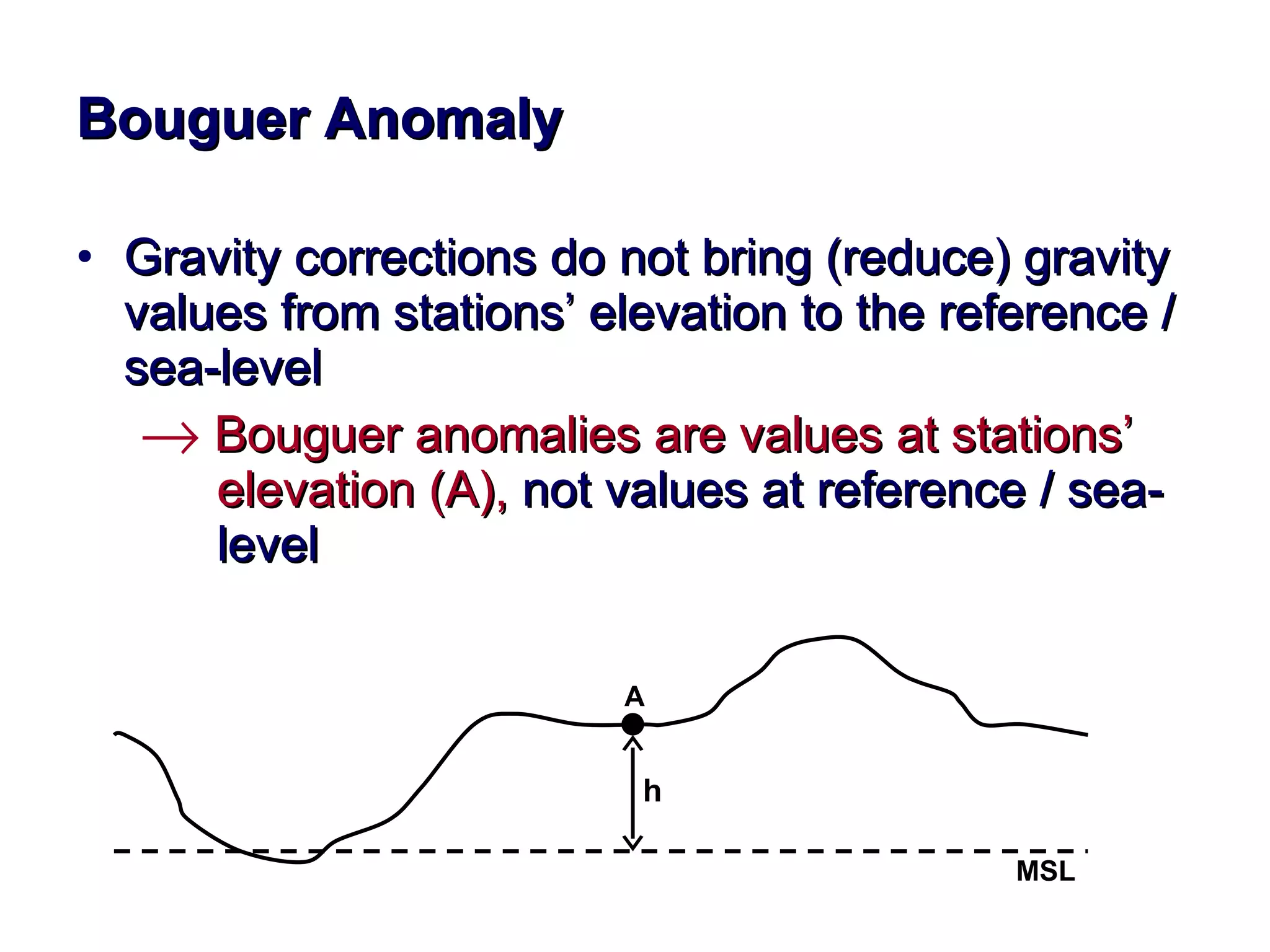
Bouguer Anomaly Gravity corrections do not bring (reduce) gravity values from stations’ elevation to the reference / sea-level  Bouguer anomalies are values at stations’   elevation (A),  not values at reference / sea-  level A MSL h
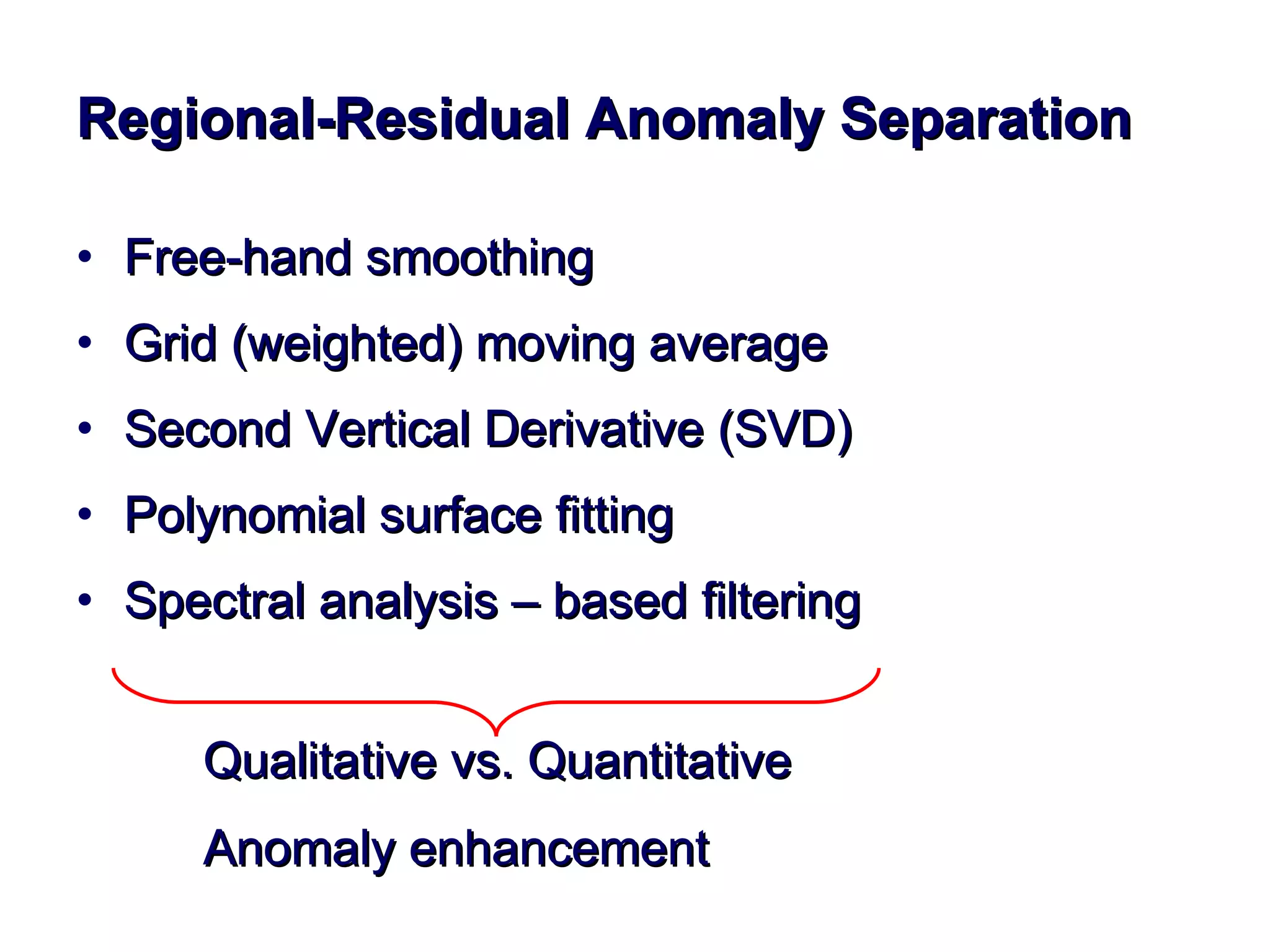
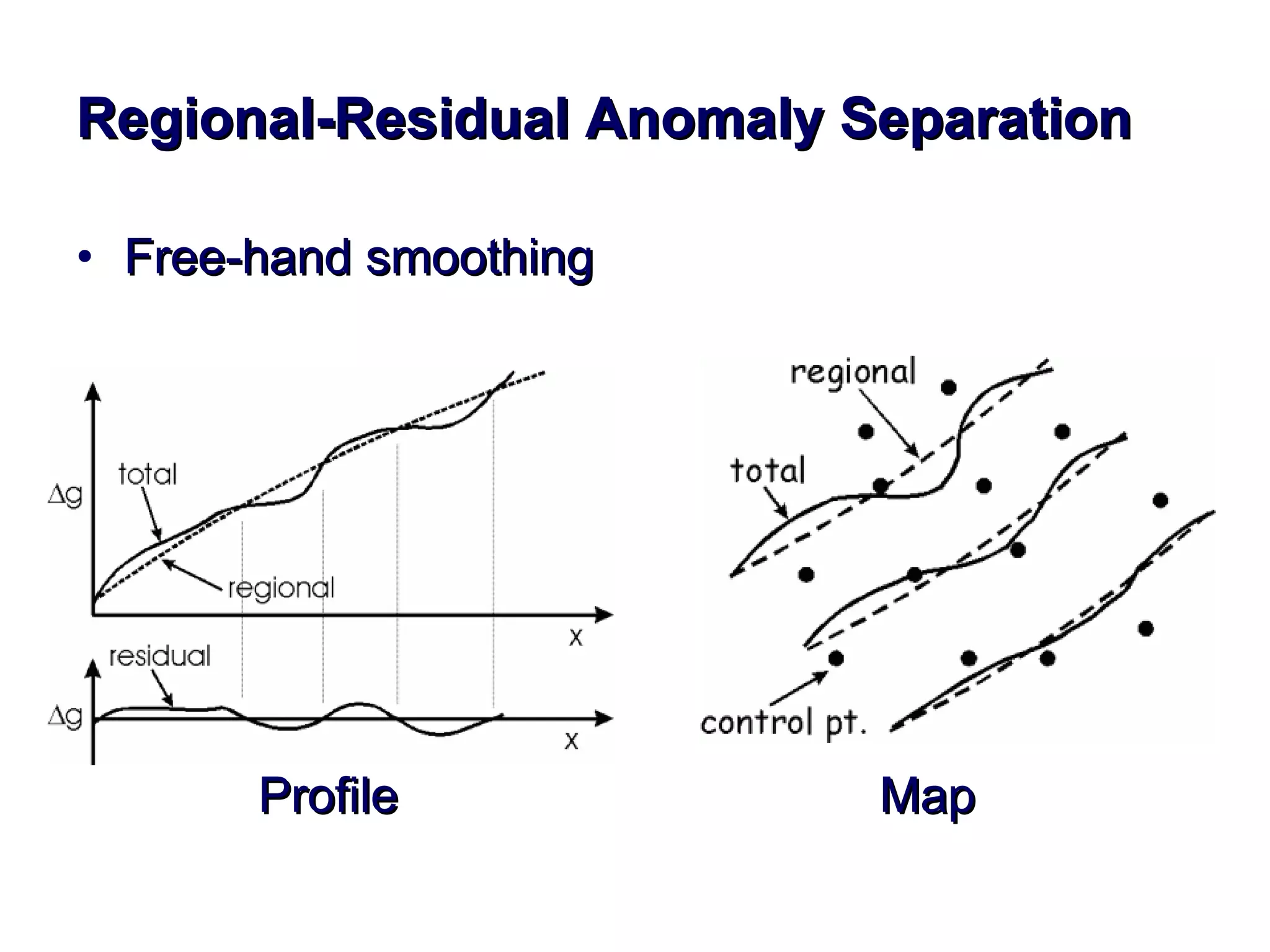
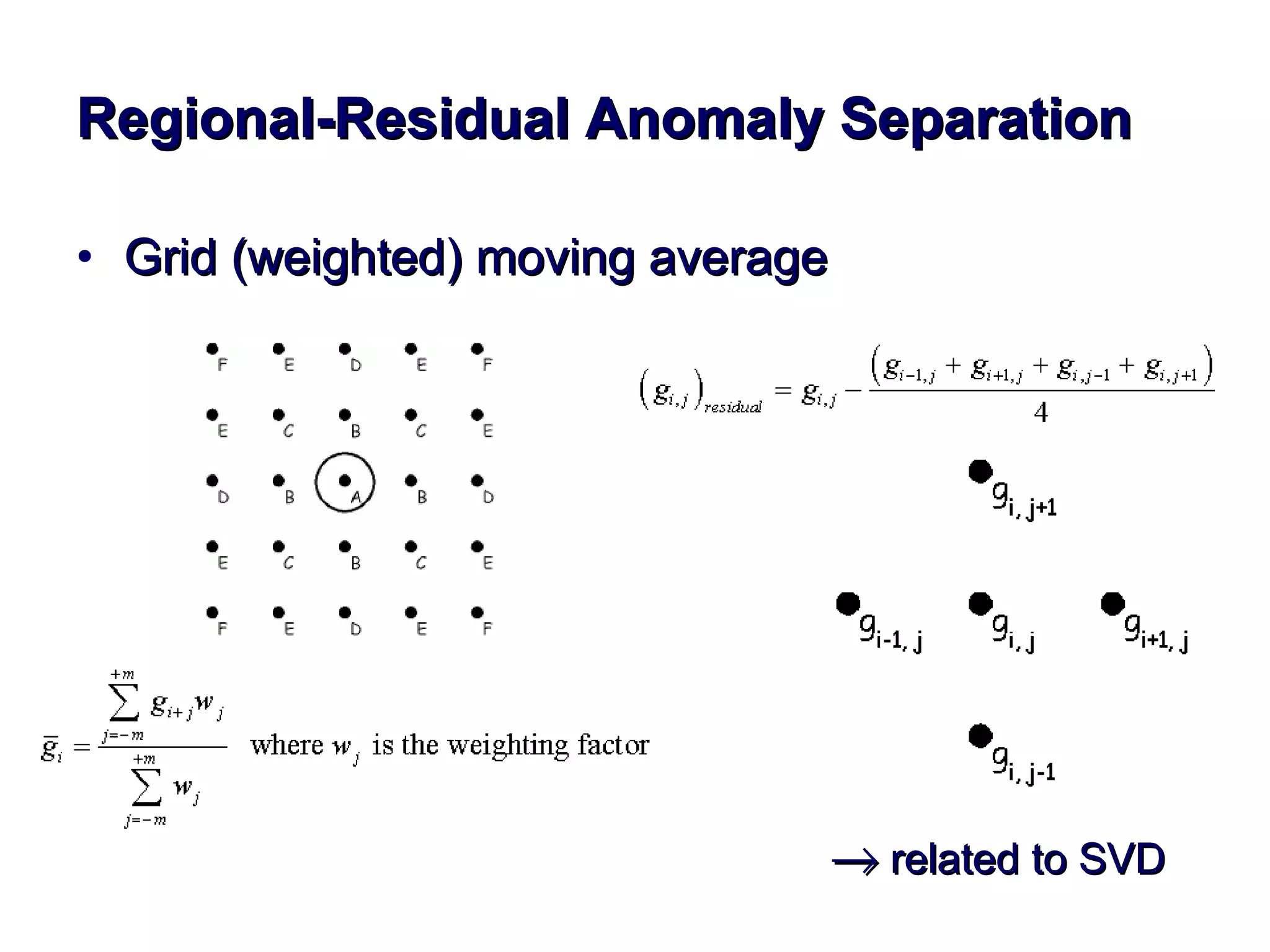
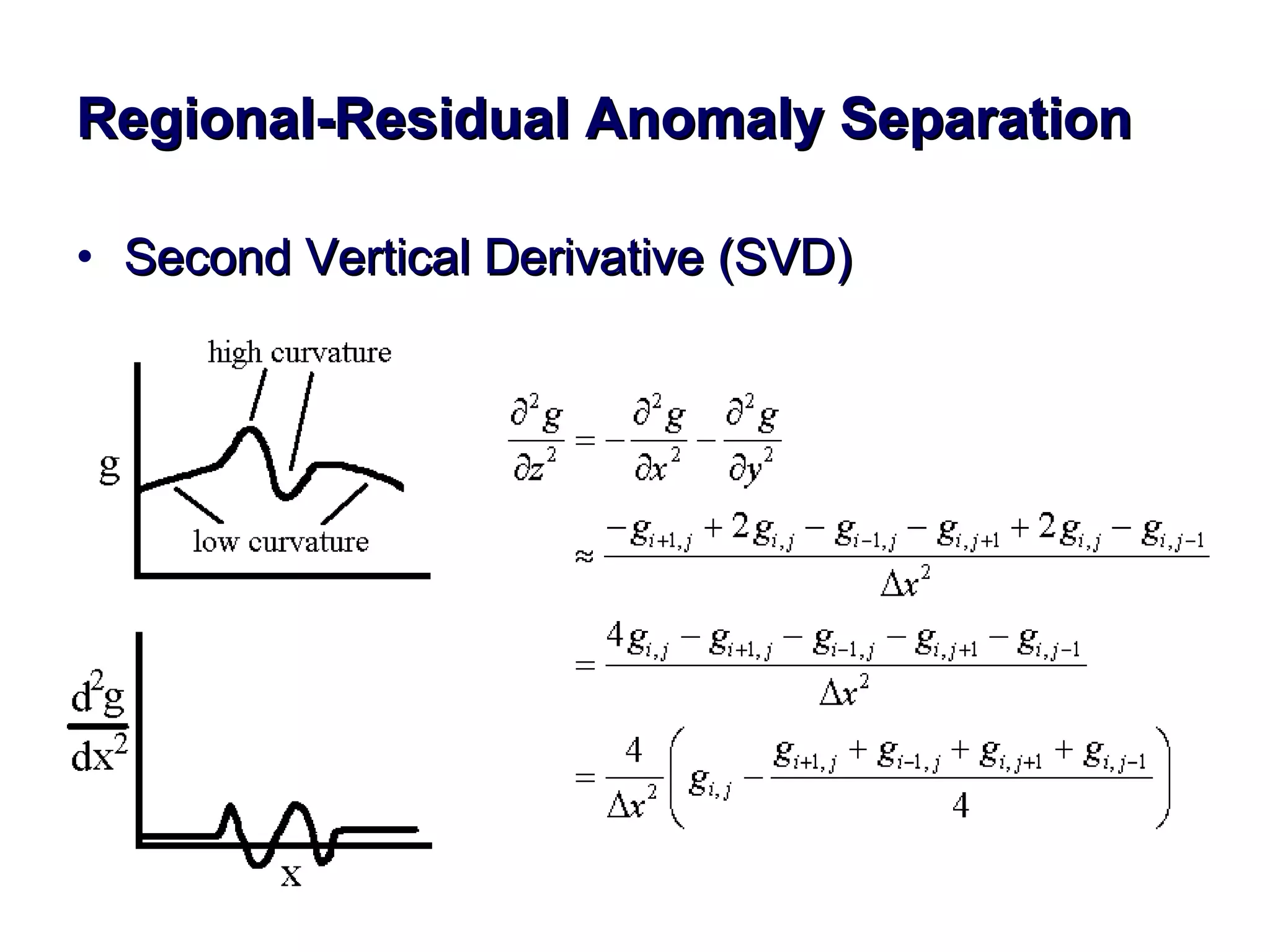
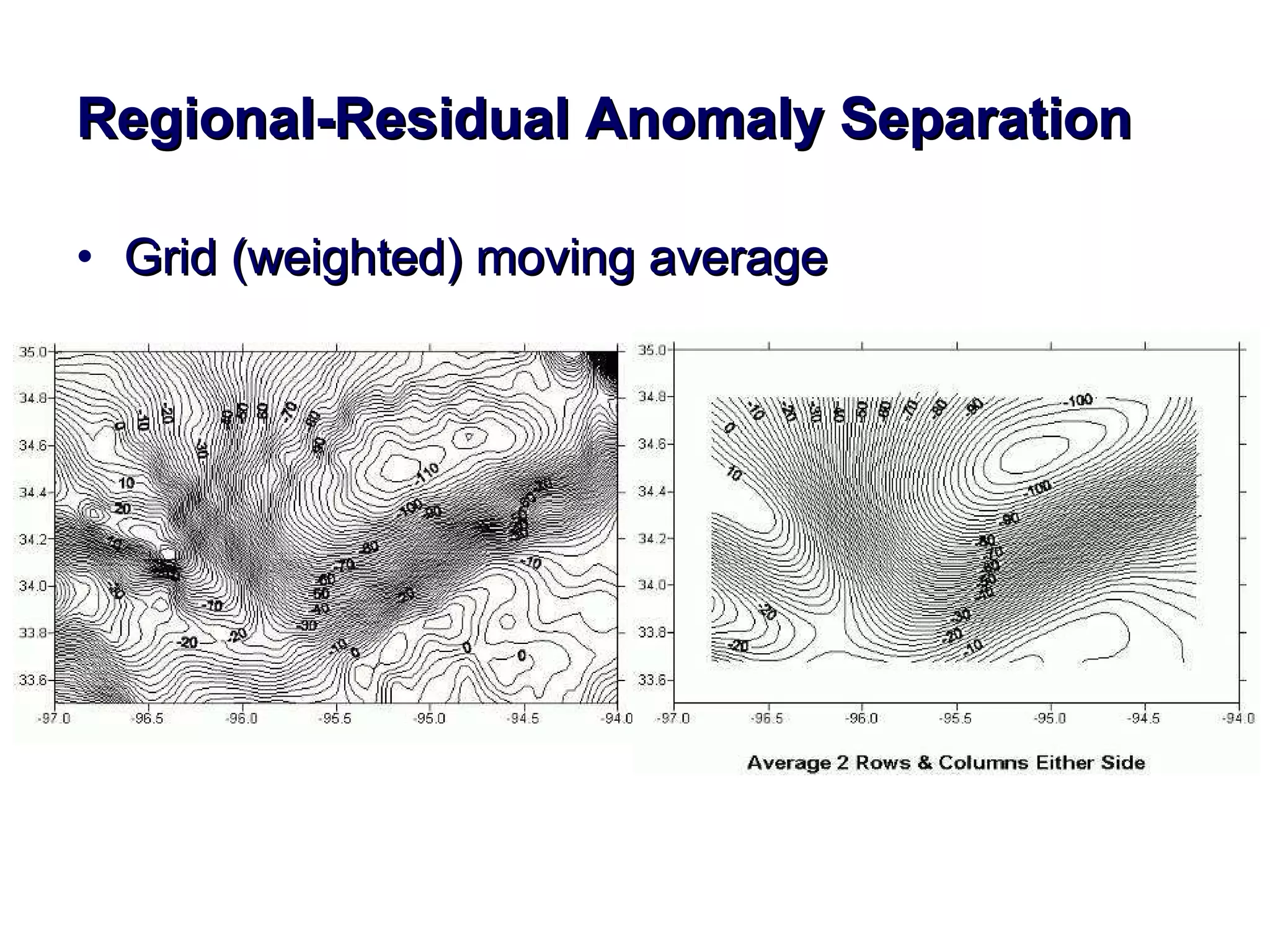
Regional-Residual Anomaly Separation Free-hand smoothing Grid (weighted) moving average  Second Vertical Derivative (SVD) Polynomial surface fitting Spectral analysis – based filtering Qualitative vs. Quantitative Anomaly enhancement
Regional-Residual Anomaly Separation Free-hand smoothing   Profile   Map
Regional-Residual Anomaly Separation Grid (weighted) moving average       related to SVD
Regional-Residual Anomaly Separation Second Vertical Derivative (SVD)
Regional-Residual Anomaly Separation Grid (weighted) moving average
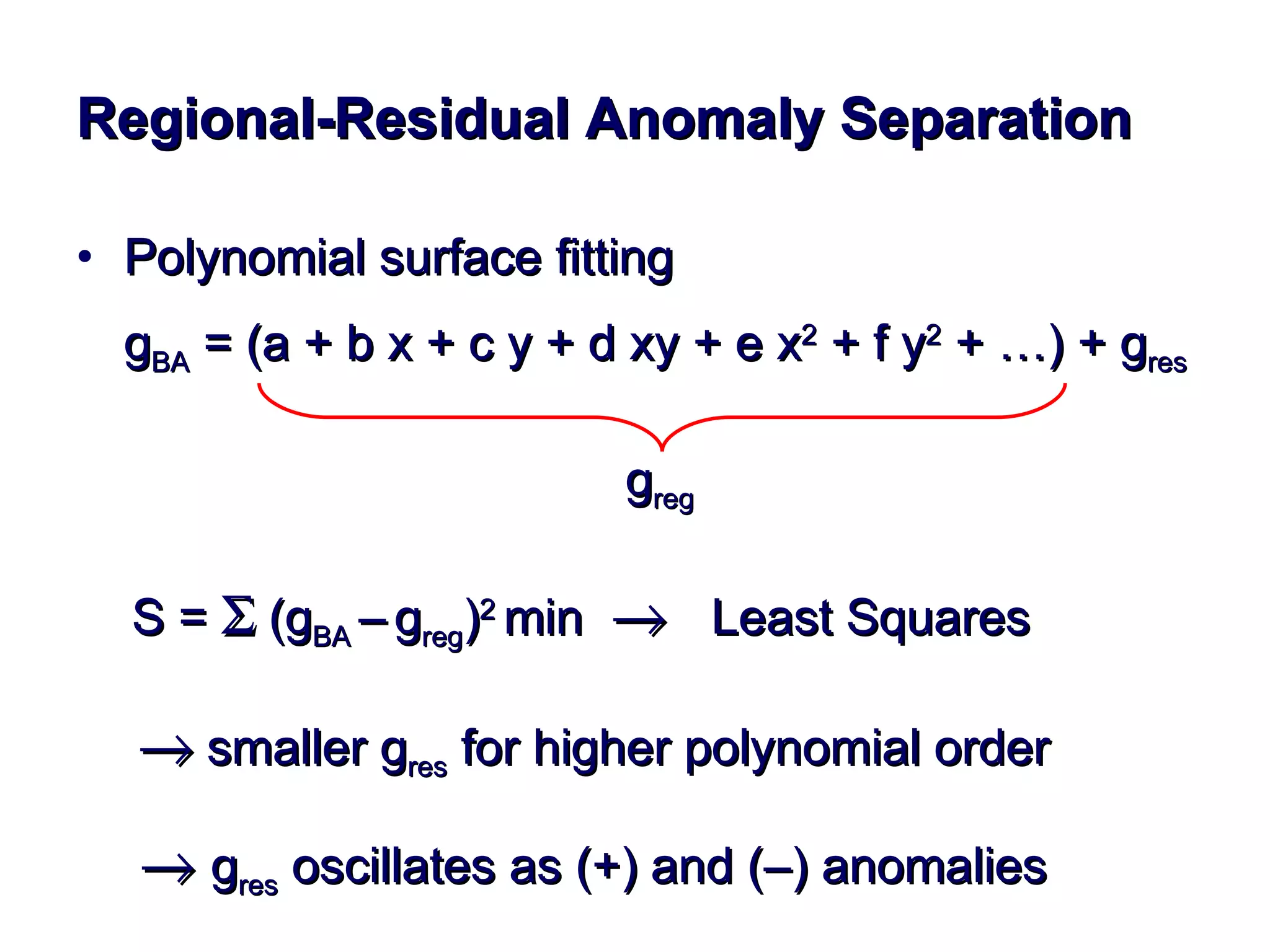
Regional-Residual Anomaly Separation Polynomial surface fitting g BA  = (a + b x + c y + d xy + e x 2  + f y 2  + …) + g res   g reg   S =   (g BA  –   g reg ) 2  min     Least Squares      smaller g res  for higher polynomial order       g res  oscillates as (+) and (–) anomalies
Spectral analysis Calculate 2-D FFT and radially averaged spectra
Radially averaged spectra and line-fitted segments
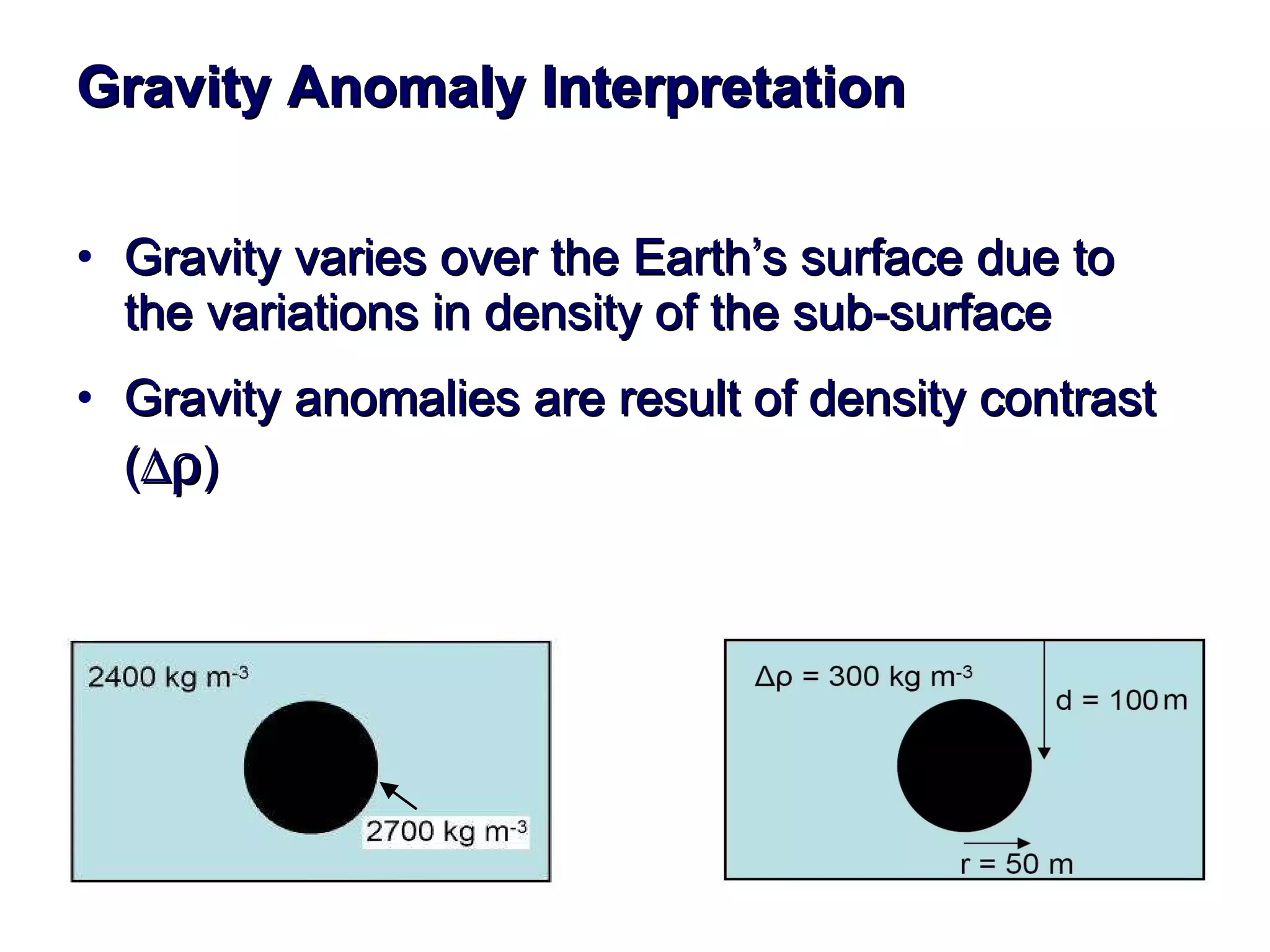
Gravity Anomaly Interpretation Gravity varies over the Earth’s surface due to the variations in density of the sub-surface Gravity anomalies are result of density contrast (   )
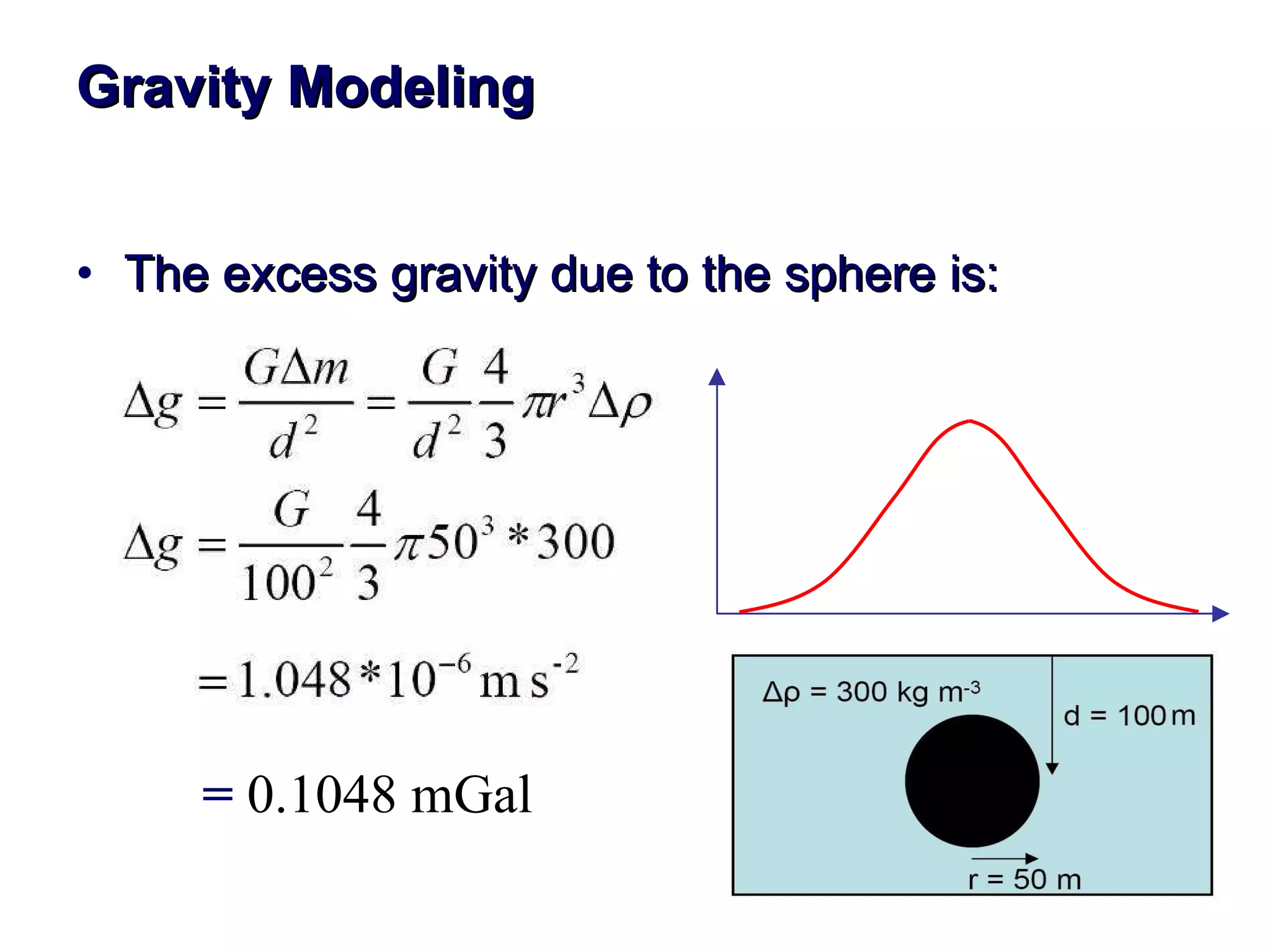
Gravity Modeling The excess gravity due to the sphere is:   =   0.1048 mGal
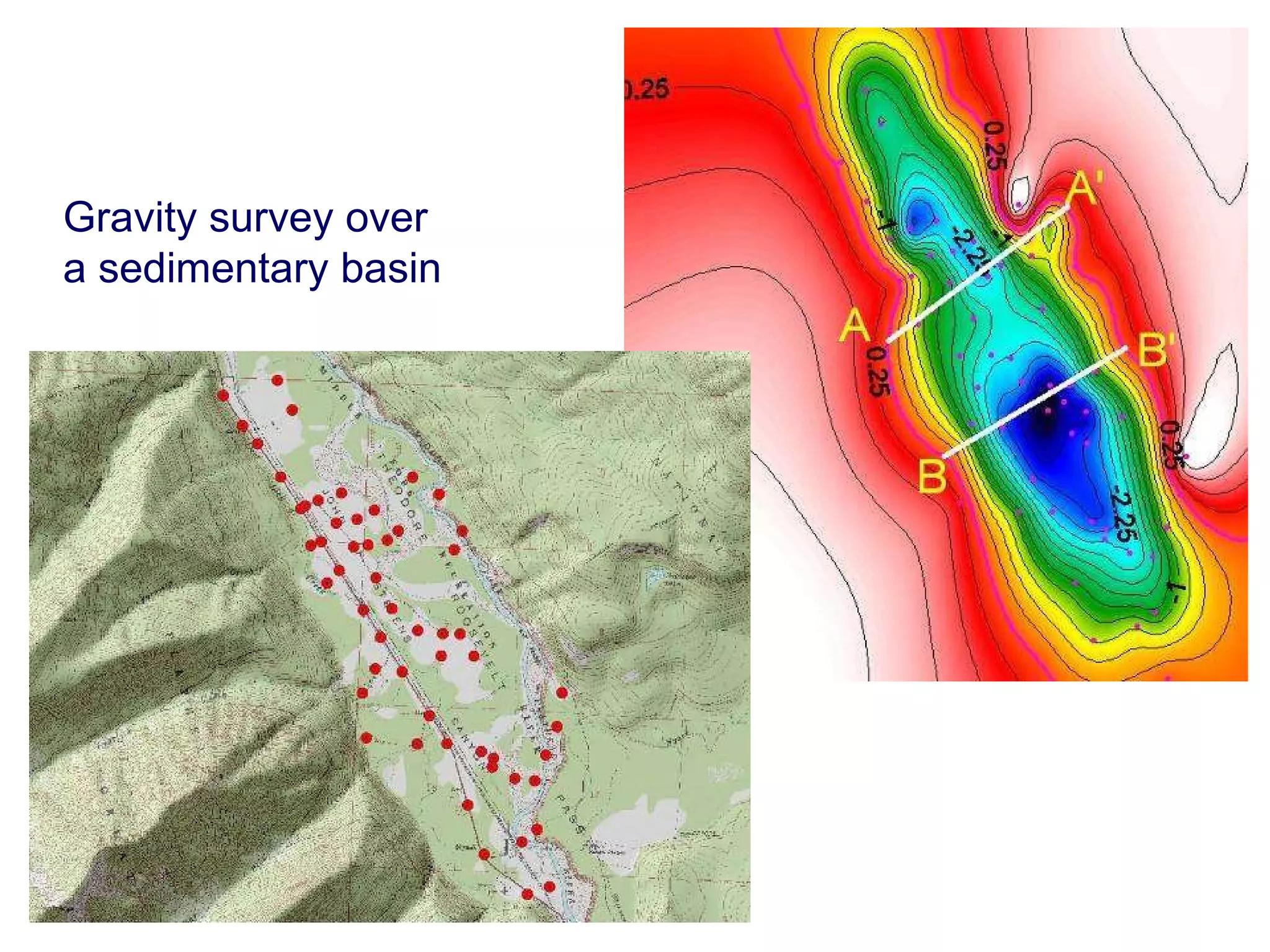
Gravity survey over  a sedimentary basin
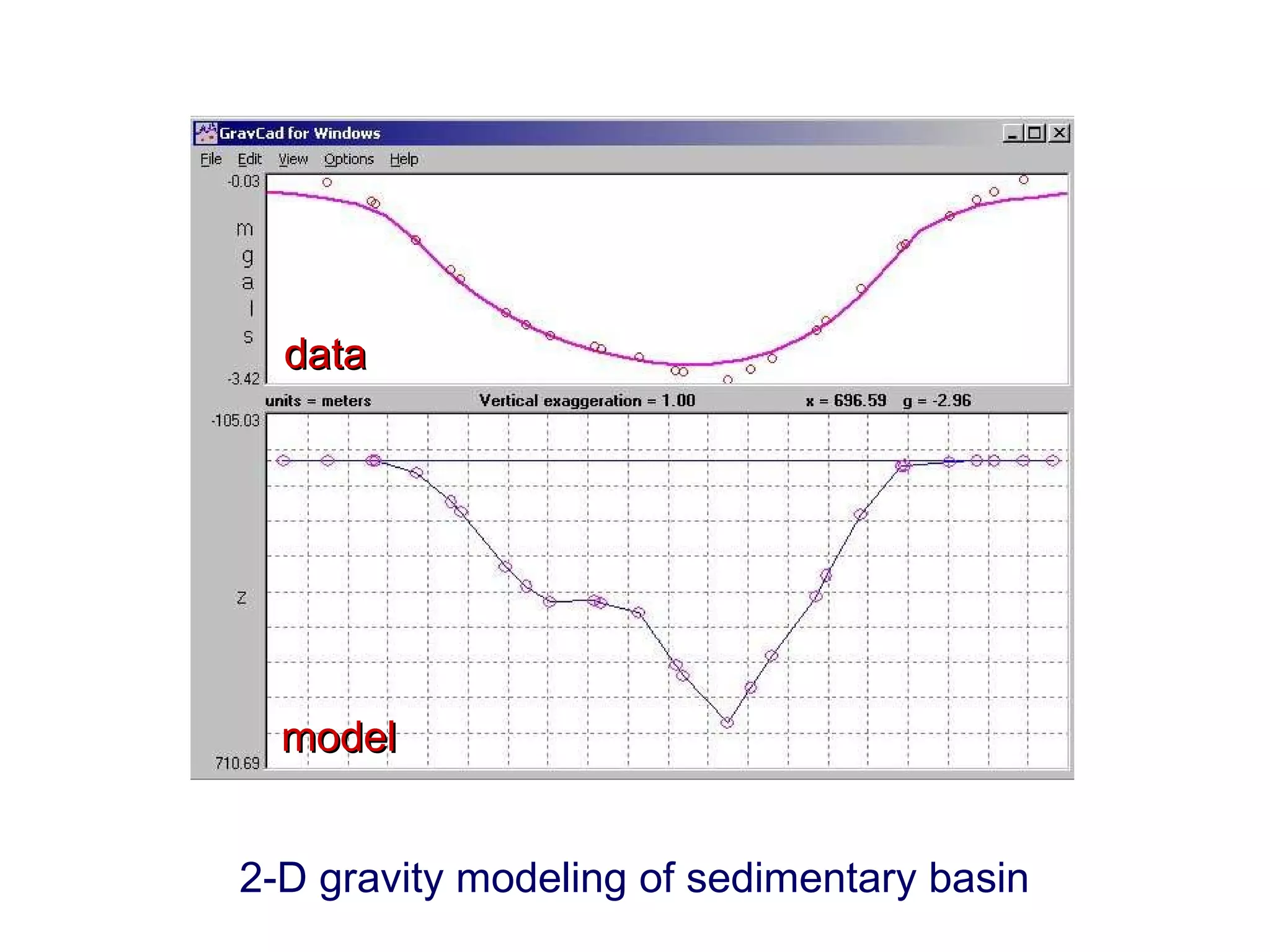
2-D gravity modeling of sedimentary basin data model
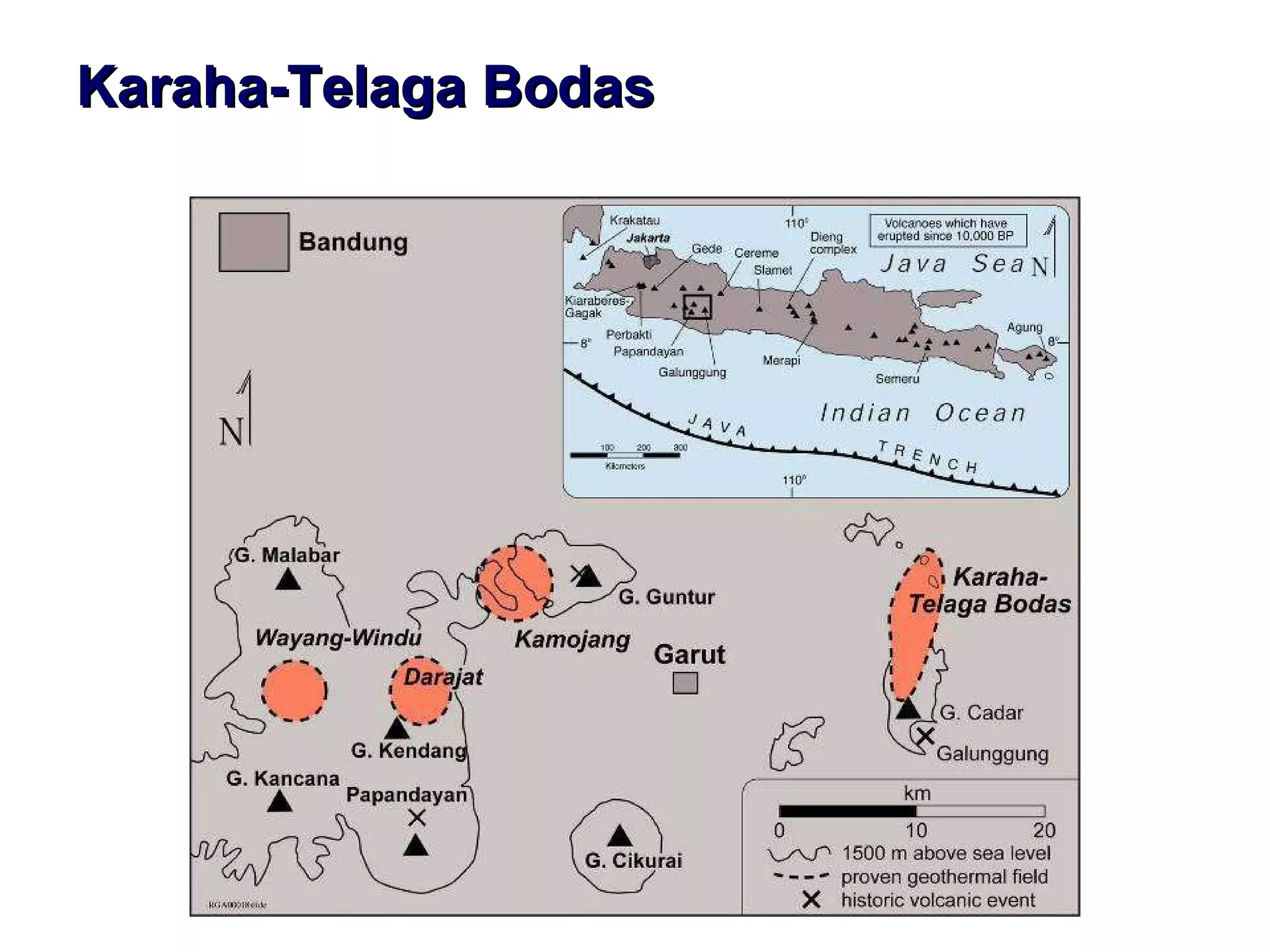
Karaha-Telaga Bodas
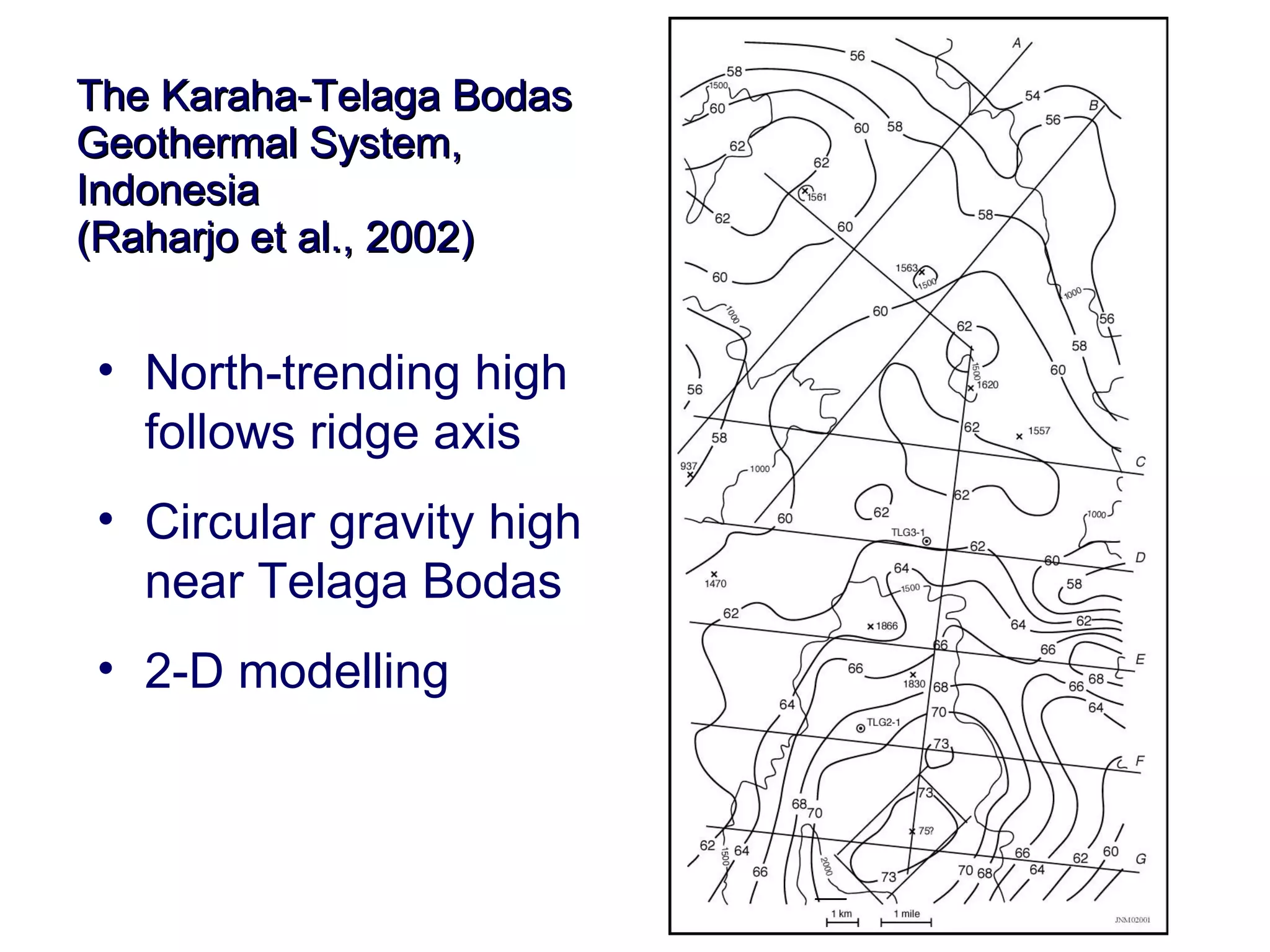
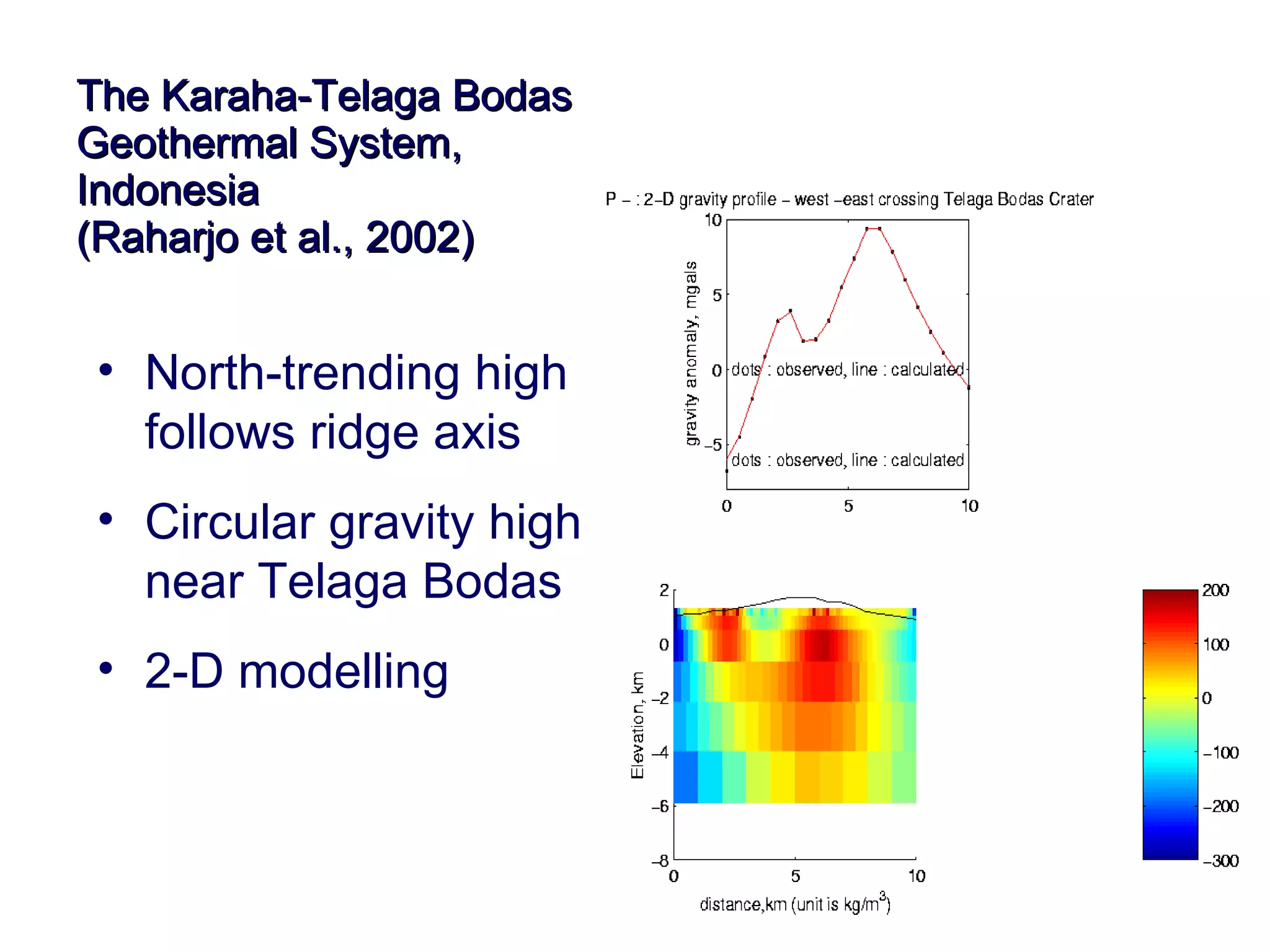
The Karaha-Telaga Bodas  Geothermal System,  Indonesia  (Raharjo et al., 2002) North-trending high follows ridge axis Circular gravity high near Telaga Bodas 2-D modelling

Geotermal 1

  • 1.
    Magnetic and GravityMethods for Geothermal Exploration Dr. Hendra Grandis Geophysics - ITB
  • 2.
    Ql : existenceof deep structure, i.e. intrusive body or caldera structures Qt : geometry of those above (the upper structure must be closely defined) high or low anomaly gravity (covers low and high magnetic areas) Ql : ascending thermal fluid (and / or descending cold water) Qt : ? high or low anomaly self-potential (across high and low resistivity areas) Ql : can be associated with thermal fluids upflow and outflow zones Qt : shallow resistivity structure low anomaly Schlumberger resistivity mapping and sounding (concentrated in the area between broad magnetic low and high) Ql : can be associated with thermally altered zones Qt : geometry (?) low anomaly Aero- or ground magnetic (covers a large area) interpretation expected anomaly method and survey procedure
  • 3.
    Probable sequence ofgeophysical exploration methods used to investigate young volcanic geothermal prospect (revised from Sudarman, 1983) Ql : permeable zones Qt : ? high anomaly micro-seismics (M< 3) Ql : can be associated with thermal fluids upflow and outflow zones Qt : deeper resistivity structure low anomaly Magnetotelluric sounding Ql : uprising or horisontal thermal fluid movement, if depth to resevoir is relatively shallow Qt : defined the upper structure high anomaly Thermal gradient and anomalous temperature (to figure out the cause of low resistivity layer) interpretation expected anomaly method and survey procedure
  • 4.
    Magnetic Method Coverslarge area as regional reconnaissance (aero-mag, + remote sensing) More local coverage (ground-mag) to search for demagnetized bodies associated with thermally altered zones Precaution for dipolar nature of magnetic anomalies Advanced processing for anomaly enhancement and modeling
  • 5.
  • 6.
    aero-magnetic data andinterpretation
  • 7.
  • 8.
    Vectors of theEarth’s magnetic field
  • 9.
    Dipolar anomaly relatedto inclined inducing main magnetic field
  • 10.
    Typical magnetic anomalyat low latitudes
  • 11.
    Anomaly detected inN-S traverse over E-W anomalous body
  • 12.
    Reduction to Equatorand Pole of Magnetic data Frequency domain filtering process
  • 13.
    Spectral analysis Depthand spatial extent of the anomalous sources are related to frequency or wavelength of the data low frequency / long wavelength ~ deep and regional anomalies high frequency / short wavelength ~ shallow and local anomalies information on depth of anomalous sources can be obtained from spectral analysis of potential filed data
  • 14.
    Wavelength or frequencyand anomaly’s depth
  • 15.
    Spectral analysis Calculate2-D FFT and radially averaged spectra relationship between slope of power spectrum with depth filtering (low-pass, high-pass, band-pass) regional – residual anomaly separation pseudo-depth slicing
  • 16.
    Radially averaged spectraand line-fitted segments
  • 17.
    Softwares for magneticdata processing and modeling
  • 18.
    Kamojang (Sungkono &Hochstein, 1995)
  • 19.
    Wairakei, NZ (Sungkono& Hochstein, 1995)
  • 20.
    Gravity method g1 g 2 g 3 distance g gravity data
  • 21.
    Gravity Measurement Wetry to obtain exess or deficiency of gravity relative to “normal” gravity  gravity anomaly  difference between observed gravity and normal or theoretical gravity g ANOMALY = g OBSERVED - g THEORY   must be corrected from factors affecting them
  • 22.
    Observed Gravity Useof relative gravimeter  only measure the difference of gravity values between two places  measure gravity values at gravity stations relative to gravity base station (BS) BS St-1  R = R2 – R1   g 1 = g BS +  R R1 R2  known
  • 23.
    Gravity BaseStation Local Base Station  all stations’ gravity values are relative to this local Base Station  tied or referenced to a higher order gravity Base Station (regional, national)  used for drift correction
  • 24.
  • 25.
    Factors Affecting ObservedGravity Instrumental drift correction determined by looping procedure, i.e base station measurement at the beginning and at the end of a survey
  • 26.
    Gravity Anomalyg ANOMALY = g OBSERVED – g THEORY g OBSERVED  gravity value relative to a known base station g THEORY  Gravity Reference Field (GRF) corrected to meet the observation condition ( elevation  MSL )  corrections: Free-Air, Bouguer, Terrain
  • 27.
  • 28.
    Gravity Data ProcessingData Reduction Field gravity measurements must be corrected to account for several factors which effect the readings, also known as “reducing the data” Solid earth’s tide Instrumental drift Field readings  Station’s Gravity (g obs ) (relative to a known Base)
  • 29.
    G r av i t y D a t a P r o c e s s i n g Gravity Correction Station’s Gravity must be corrected such that the values represent a perfect homogenous sphere, called a “geoid”. If there are still differences in the readings after the corrections are made, then they may truly represent a gravity anomaly. Corrections Latitude, Free-air, Bouguer, Terrain
  • 30.
    Gravity Correction Latitudecorrection Normal Gravity from International Gravity Formula 1967 g N (  ) = 9.78031846 (1 + 0.0053024 sin 2    – 0.0000058 sin 2 2  ) g N (  ) represents theoretical gravity at sea-level (reference),  = latitude
  • 31.
    Gravity Correction Free-aircorrection To compensate the height of gravity stations above sea-level (level of reference) g FA  – 0.3086 × h A MSL h
  • 32.
    Gravity Correction Bouguercorrection To compensate the rock mass between sea-level to station’s elevation (level of reference). g B  + 0.04193 ×  × h  Bouguer slab formula A MSL h
  • 33.
    Gravity Correction Terraincorrection To compensate the topography: existence of rock mass of hills (M1) and the inexistence of rock-mass in valleys (M2) g TC are obtained from table or calculated A M1 M2 MSL
  • 34.
    Gravity Correction Terraincorrection M1 will decrease gravity value at A (negative vertical attraction), Bouguer correction considers that there is M2 so mass attraction equivalent to M2 must be extracted from values at A A M1 M2 MSL
  • 35.
    Bouguer Anomaly Gravitycorrections are applied to g N (  ), i.e. theoretical gravity at reference-level, to obtain theoretical gravity values at measurement stations g theor  g N (  ) – g FA + g B – g TC Bouguer Anomaly is the difference between observed Gravity and theoretical gravity g BA  g obs – g theor  g obs – g N (  ) + g FA – g B + g TC
  • 36.
    Bouguer Anomaly Gravitycorrections do not bring (reduce) gravity values from stations’ elevation to the reference / sea-level Bouguer anomalies are values at stations’ elevation (A), not values at reference / sea- level A MSL h
  • 37.
    Regional-Residual Anomaly SeparationFree-hand smoothing Grid (weighted) moving average Second Vertical Derivative (SVD) Polynomial surface fitting Spectral analysis – based filtering Qualitative vs. Quantitative Anomaly enhancement
  • 38.
    Regional-Residual Anomaly SeparationFree-hand smoothing Profile Map
  • 39.
    Regional-Residual Anomaly SeparationGrid (weighted) moving average  related to SVD
  • 40.
    Regional-Residual Anomaly SeparationSecond Vertical Derivative (SVD)
  • 41.
    Regional-Residual Anomaly SeparationGrid (weighted) moving average
  • 42.
    Regional-Residual Anomaly SeparationPolynomial surface fitting g BA = (a + b x + c y + d xy + e x 2 + f y 2 + …) + g res g reg S =  (g BA – g reg ) 2 min  Least Squares  smaller g res for higher polynomial order  g res oscillates as (+) and (–) anomalies
  • 43.
    Spectral analysis Calculate2-D FFT and radially averaged spectra
  • 44.
    Radially averaged spectraand line-fitted segments
  • 45.
    Gravity Anomaly InterpretationGravity varies over the Earth’s surface due to the variations in density of the sub-surface Gravity anomalies are result of density contrast (   )
  • 46.
    Gravity Modeling Theexcess gravity due to the sphere is: = 0.1048 mGal
  • 47.
    Gravity survey over a sedimentary basin
  • 48.
    2-D gravity modelingof sedimentary basin data model
  • 49.
  • 50.
    The Karaha-Telaga Bodas Geothermal System, Indonesia (Raharjo et al., 2002) North-trending high follows ridge axis Circular gravity high near Telaga Bodas 2-D modelling
  • 51.
    The Karaha-Telaga Bodas Geothermal System, Indonesia (Raharjo et al., 2002) North-trending high follows ridge axis Circular gravity high near Telaga Bodas 2-D modelling

Editor's Notes

  • #51 The gravity data generally follow the trend of topography. The most prominent feature is the presence of a large elliptical high located about 2 km southeast of the lake, modeled by Tripp et al. (2002), suggested it represent shallow granodiorite.
  • #52 The gravity data generally follow the trend of topography. The most prominent feature is the presence of a large elliptical high located about 2 km southeast of the lake, modeled by Tripp et al. (2002), suggested it represent shallow granodiorite.