MAGNETOTELLURIC (MT) METHOD
Dependence of the electric and magnetic phenomena on conductivity of the medium can be exploited to the study of the solid earth  MT method employs naturally existing electromagnetic (EM) fields to infer the conductivity (or resistivity) distribution of the subsurface  Natural EM fields are generated by interaction of Earth’s permanent magnetic field with particles from the solar wind and with atmospheric lightning  MT method was developed independently in the 50s by Cagniard (France), Tikhonov (Russia), Wait (USA) Kato and Kikuchi (Japan) Magnetotellurics (MT ), background
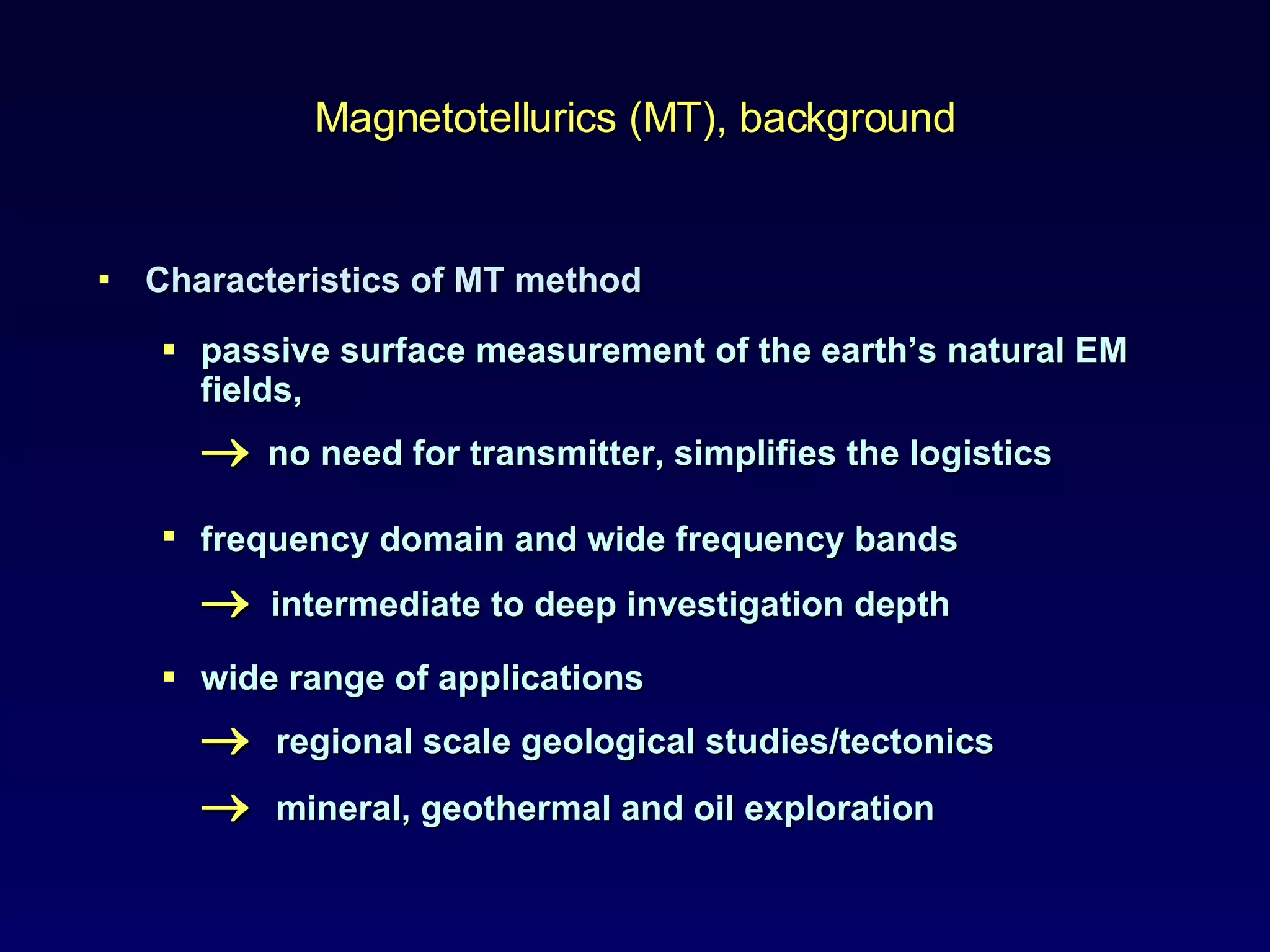
Characteristics of MT method passive surface measurement of the earth’s natural EM fields,     no need for transmitter, simplifies the logistics  frequency domain and wide frequency bands      intermediate to deep investigation depth  wide range of applications    regional scale geological studies/tectonics    mineral, geothermal and oil exploration Magnetotellurics (MT ), background
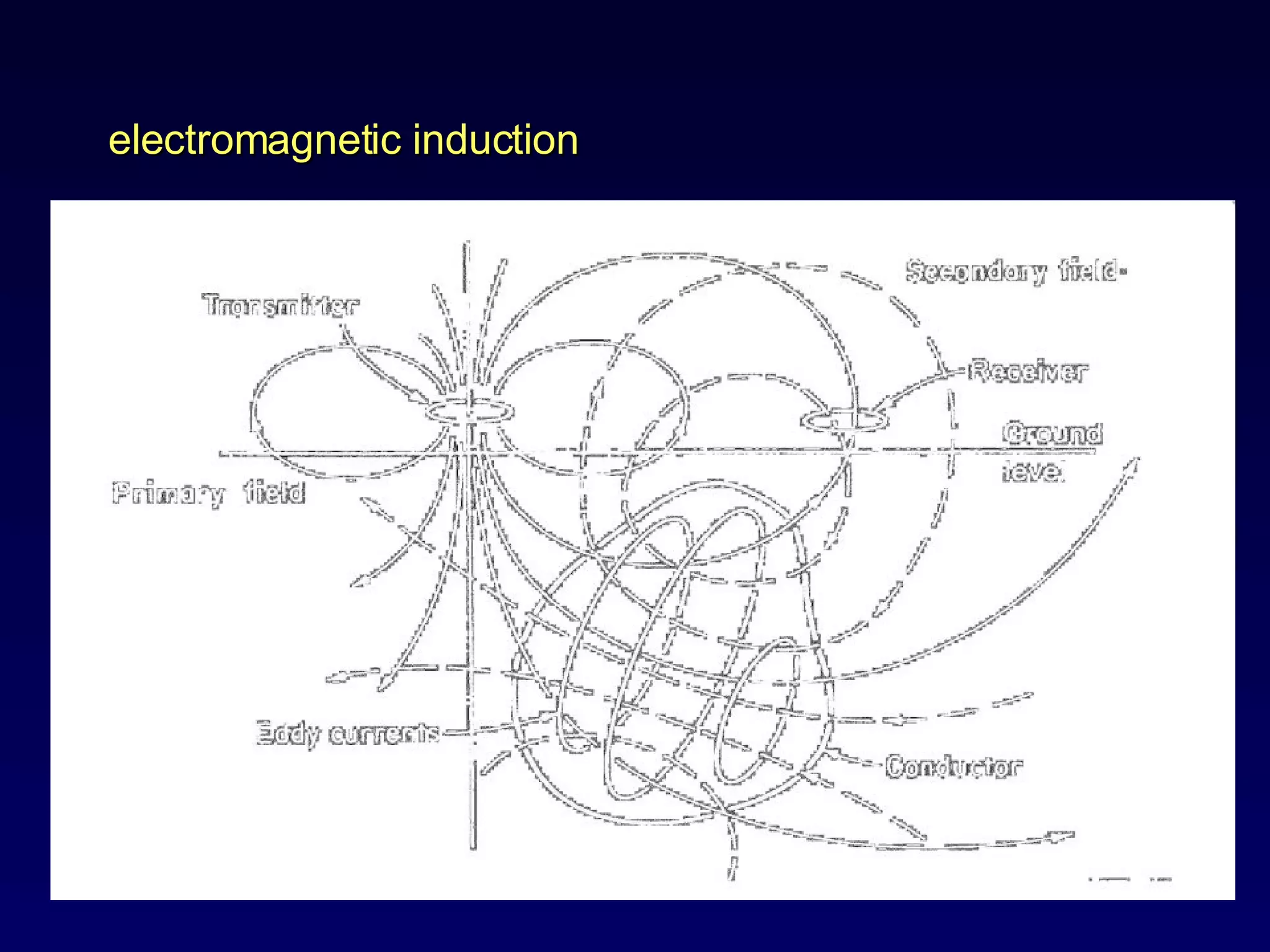
electromagnetic induction
natural electromagnetic field
   B ( t ) _______    t E ( t ) electric - magnetic phenomena represented by the Maxwell’s equations
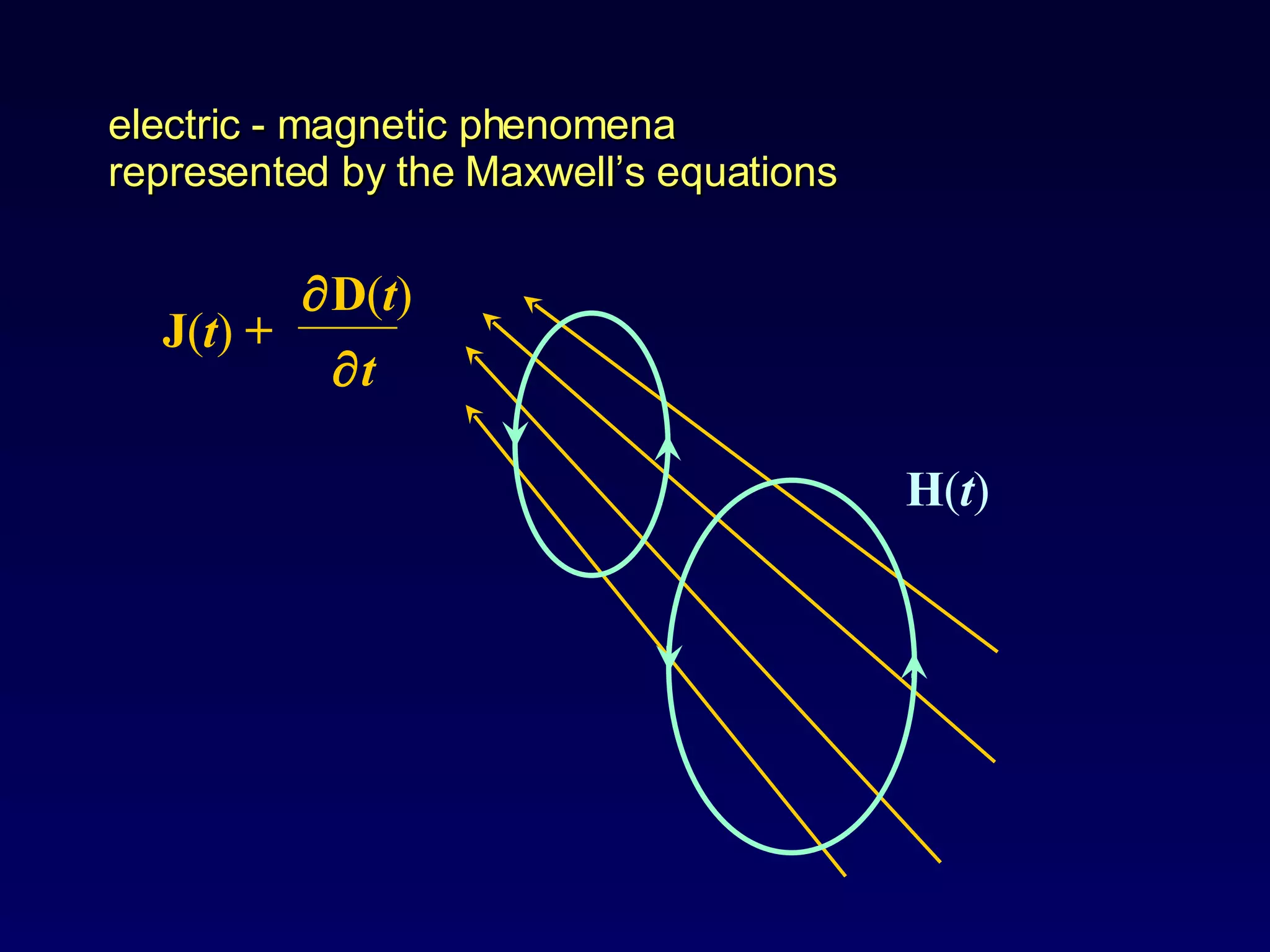
H ( t ) electric - magnetic phenomena represented by the Maxwell’s equations    D ( t ) _______    t J ( t )  +
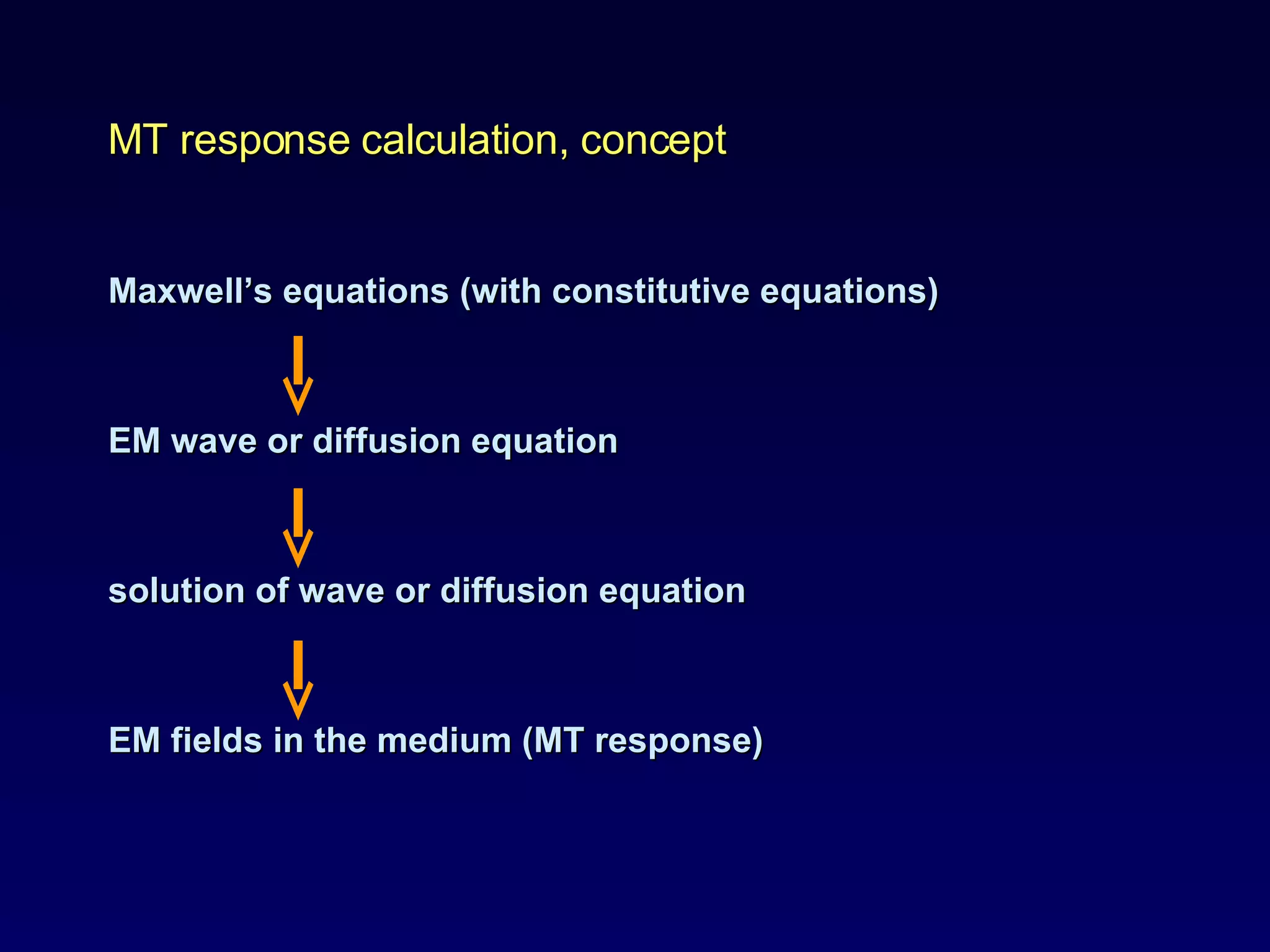
Maxwell’s equations (with constitutive equations) EM wave or diffusion equation  solution of wave   or diffusion equation    EM fields in the medium (MT response)    MT response calculation, concept
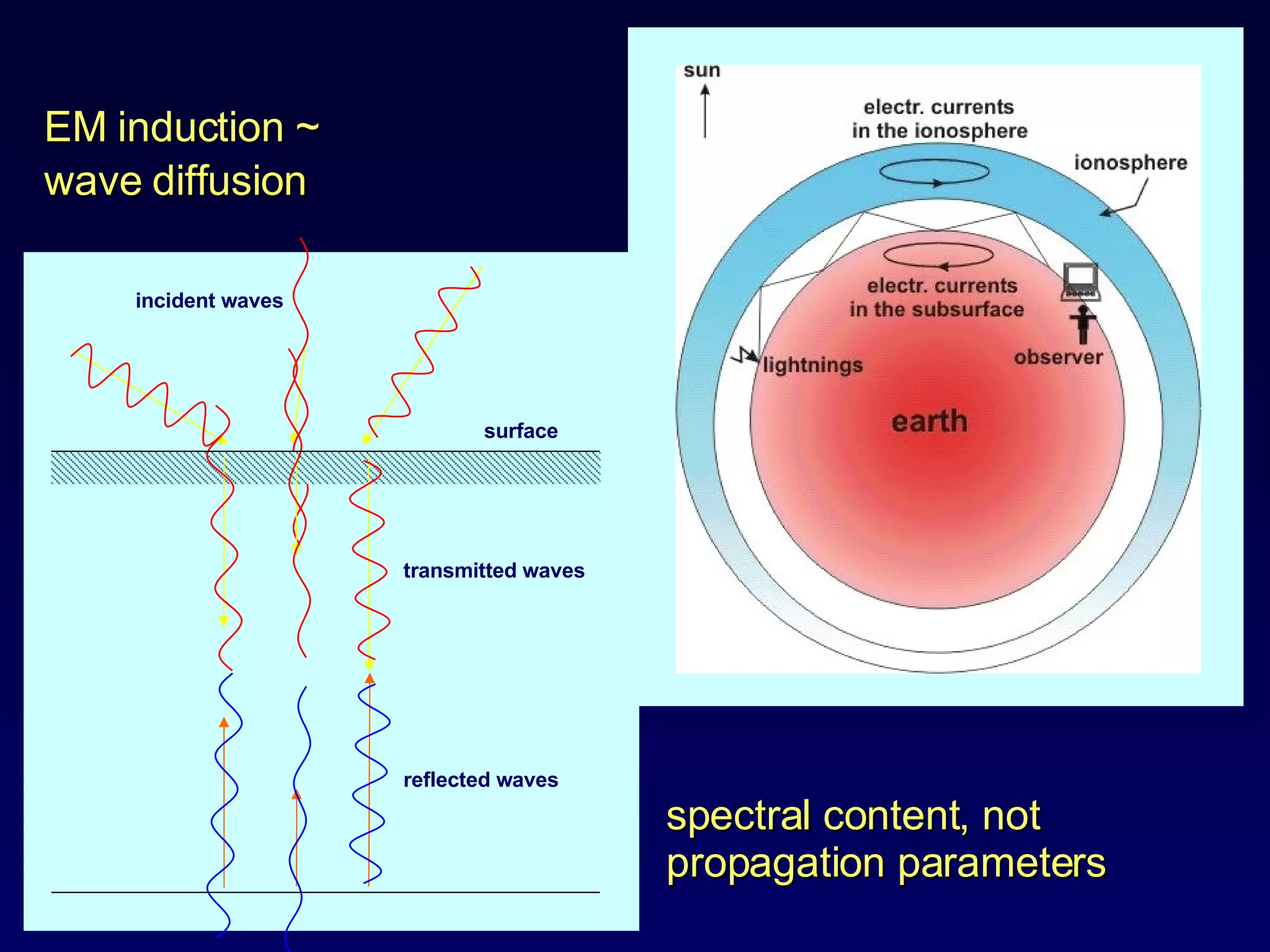
EM induction ~  wave diffusion   spectral content, not  propagation parameters incident waves transmitted waves surface reflected waves
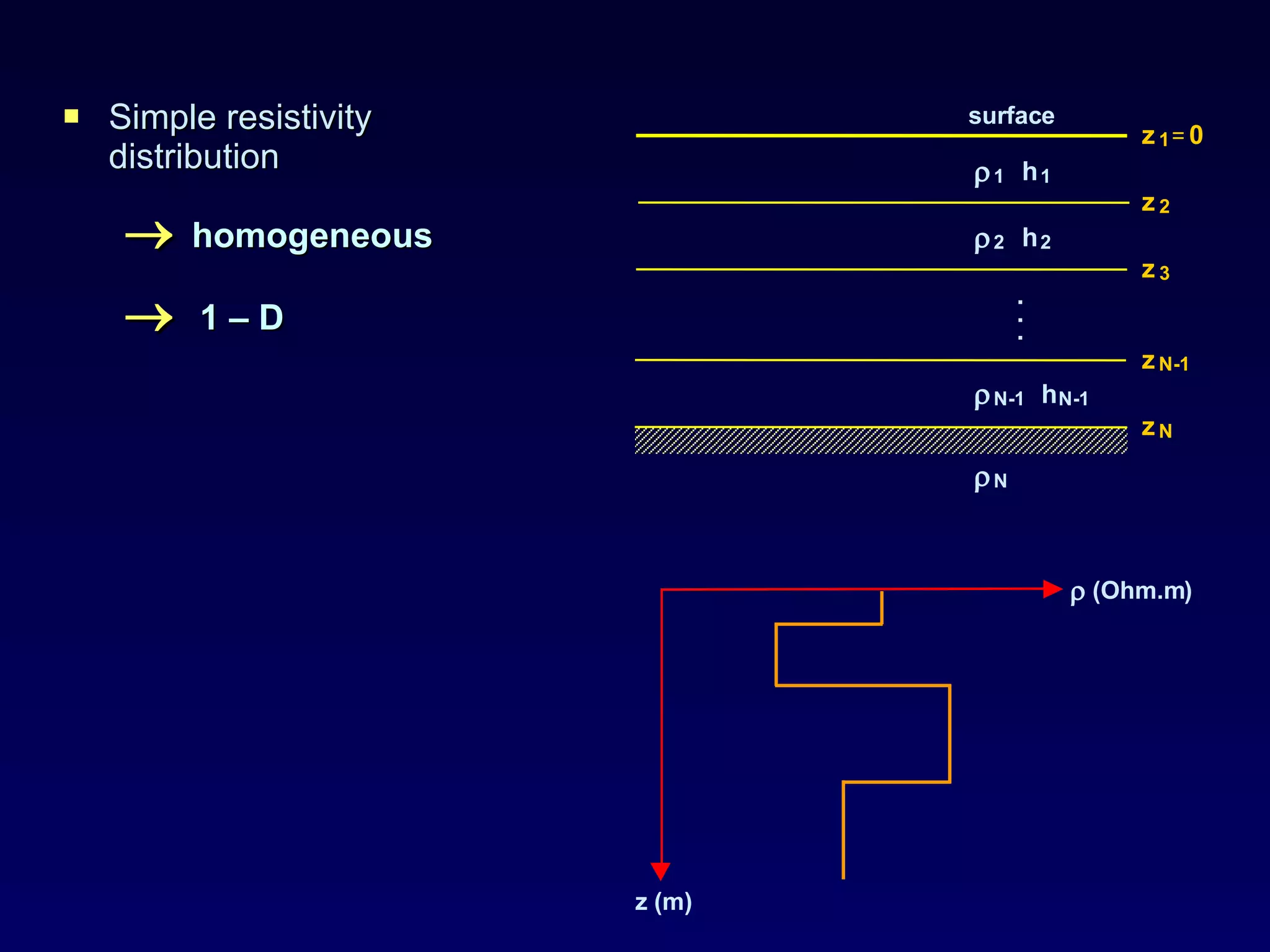
Simple resistivity  distribution    homogeneous     1  –  D     surface  1 h 1 z 1 =   0 . . . z  2 z 3 z N - 1 z N  2 h 2  N - 1 h N - 1  N  (Ohm.m) z (m)
  __________ E x   =  A  exp (- k   z ) k  =  √   i      0   /  H y   =   ( A  exp (- k   z )) z  =  depth k ________ i       1  –  D  homogeneous solution to Maxwell’s equations in simple medium E x   =  A  exp (- k   z )   +  B  exp ( + k   z ) H y   =   ( A  exp (- k   z )  - B  exp ( + k   z )) k ________ i      
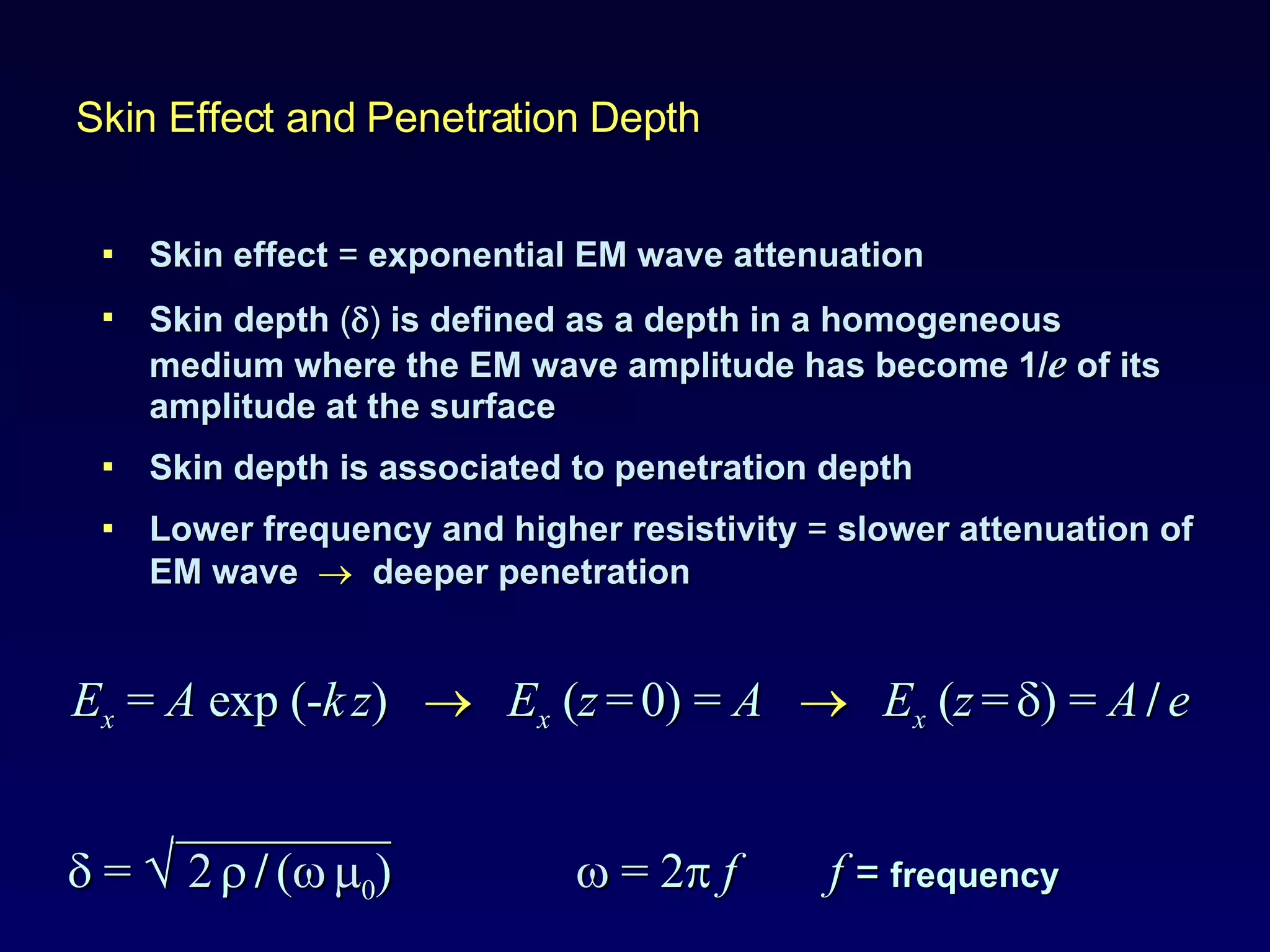
Skin effect  =  exponential EM wave attenuation Skin depth  (  )   is defined as a depth in a homogeneous medium where the EM wave amplitude has become 1/ e  of its amplitude at the surface  Skin depth is associated to penetration depth Lower frequency and higher resistivity  =  slower attenuation of EM wave     deeper penetration Skin Effect and Penetration Depth E x   =  A  exp (- k   z )     E x   ( z   =   0)   =  A      E x   ( z   =    )   =  A   /   e   _________    =  √  2      /   (     0 )     = 2    f   f  =  frequency
Lower frequency and higher resistivity  =  slower attenuation of EM wave     deeper penetration Principles of MT sounding     wide frequency band    measurement probes   different parts (depths)   of the subsurface Skin Effect and Penetration Depth
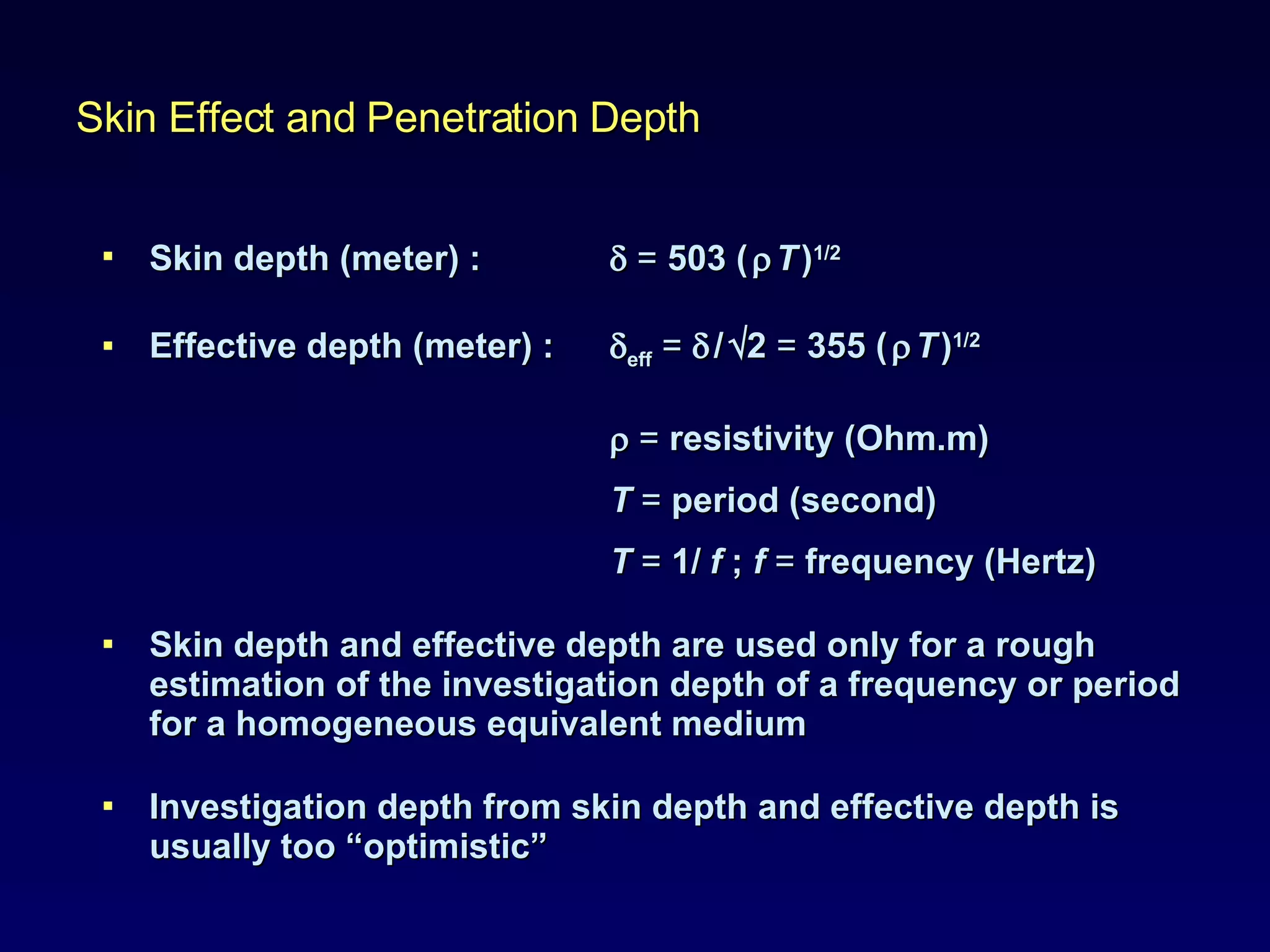
Skin depth (meter) :      =  503 (      T   ) 1/2 Effective depth (meter) :   eff   =      /    2  =  355 (      T   ) 1/2    =  resistivity (Ohm.m)  T   =  period (second) T   =  1/   f  ;  f   =  frequency (Hertz) Skin depth and effective depth are used only for a rough estimation of the investigation depth of a frequency or period for a homogeneous equivalent medium Investigation depth from skin depth and effective depth is usually too “optimistic”  Skin Effect and Penetration Depth
Skin Effect and Penetration Depth
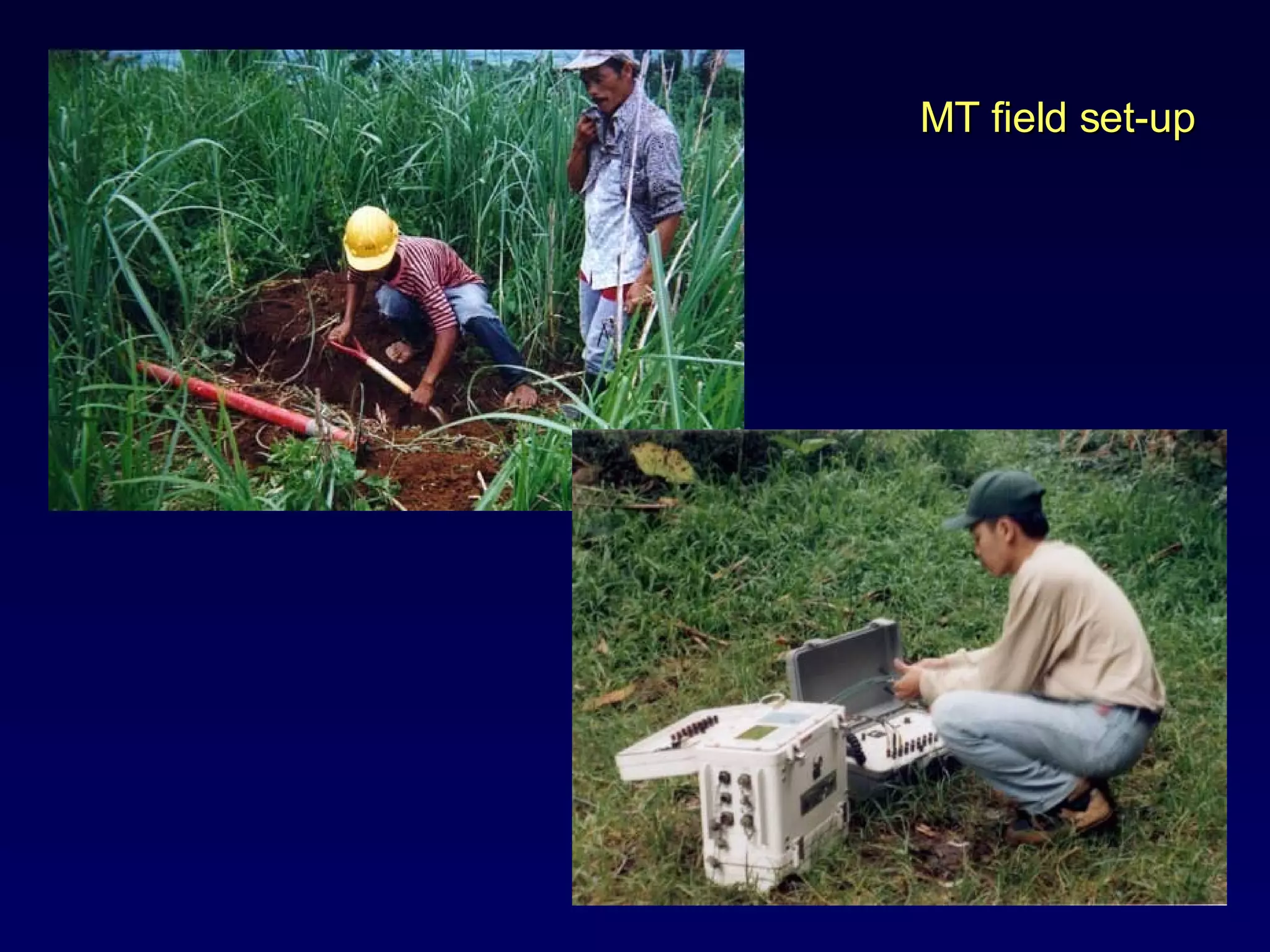
MT  field set-up
MT  field set-up
MT Time series data
Data processing  sequence
E x  =   Z xx   H x   +   Z xy   H y  E y  =   Z yx   H x   +   Z yy   H y     E  =   Z  H    sounding curves Data Processing (Frequency Domain)  a   =   0.2  T  |   Z   |   2    =   atan  Im  Z _______ Re  Z
Modeling and Interpretation
Recursive formula connecting the impedance at the surface of two successive layers  Z I, j   =   ( i       0    j ) 1/2   =  intrinsic   impedance    impedance at  j –th layer as function of the layer’s parameters   (  j  ,   h j  ) and impedance at the  subsequent layer  Z j+ 1  Impedance at the surface of a 1-D Earth model is calculated  from the surface at the last layer and recursively upward 1-D MT modeling 1   –   R j  exp ( –   2 k j   h j )   _____________________     1   +  R j  exp ( –   2 k j   h j )   Z j   =  Z I,j   R j   = Z I,j   –  Z j + 1 __________ Z I,j   +  Z j + 1
Impedance at the surface of the Earth   . . . Impedance at the ( N -1) th  layer    impedance at the surface of the last ( N th ) layer, intrinsic  impedance   1-D MT modeling, algorithm  surface  1 h 1 z 1 =   0  z  2  2 h 2 . . .  z N - 1  N - 1 h N - 1 z N  N
 
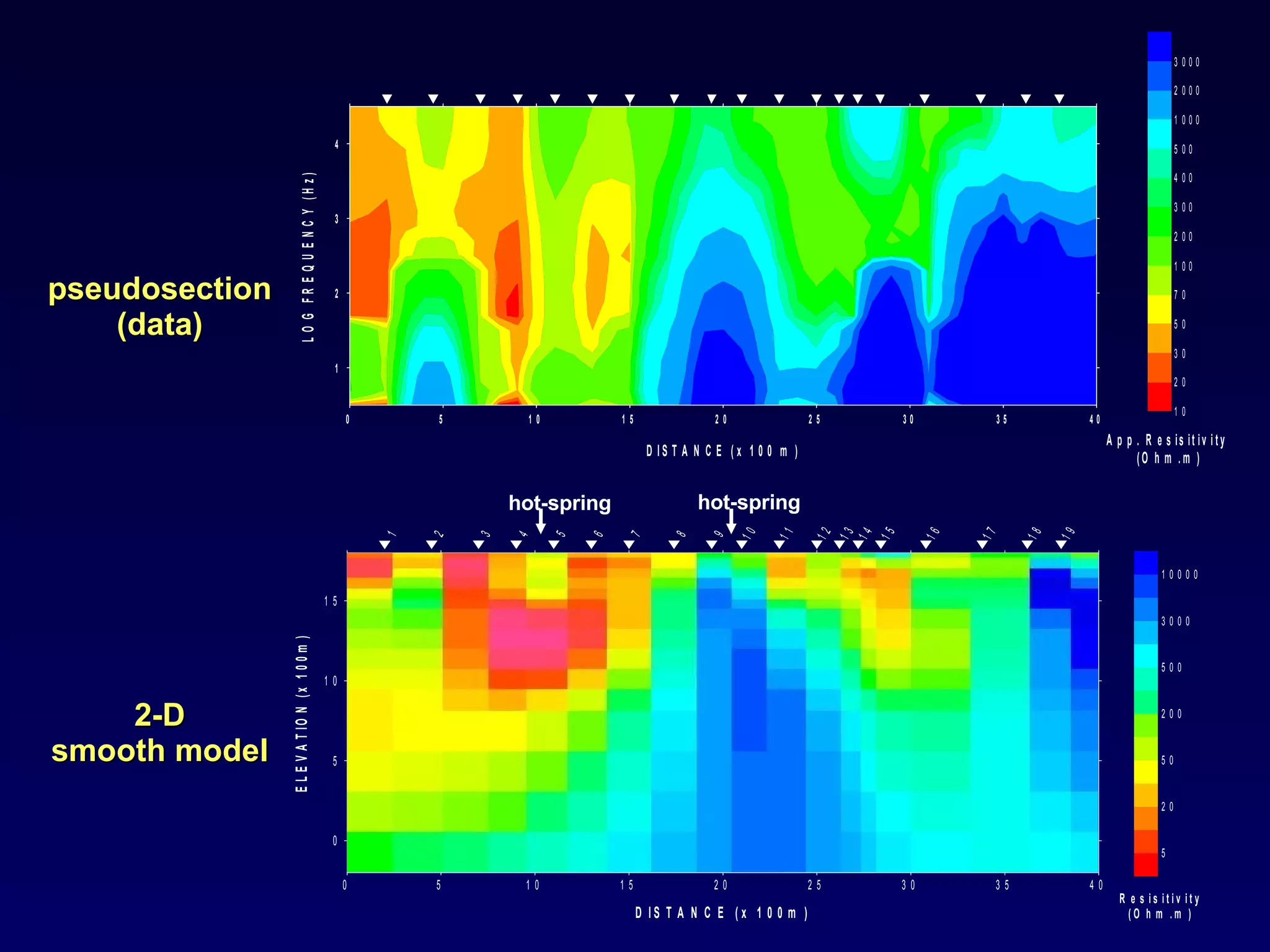
2-D resistivity section from 1-D models on  a profile    correlation of    resistivity units from    station to station    correlation of    resistivity units with    geology and    lithology
pseudosection (data) 2-D smooth model hot-spring hot-spring

Mt 1

  • 1.
  • 2.
    Dependence of theelectric and magnetic phenomena on conductivity of the medium can be exploited to the study of the solid earth MT method employs naturally existing electromagnetic (EM) fields to infer the conductivity (or resistivity) distribution of the subsurface Natural EM fields are generated by interaction of Earth’s permanent magnetic field with particles from the solar wind and with atmospheric lightning MT method was developed independently in the 50s by Cagniard (France), Tikhonov (Russia), Wait (USA) Kato and Kikuchi (Japan) Magnetotellurics (MT ), background
  • 3.
    Characteristics of MTmethod passive surface measurement of the earth’s natural EM fields,  no need for transmitter, simplifies the logistics frequency domain and wide frequency bands  intermediate to deep investigation depth wide range of applications  regional scale geological studies/tectonics  mineral, geothermal and oil exploration Magnetotellurics (MT ), background
  • 4.
  • 5.
  • 6.
    B ( t ) _______  t E ( t ) electric - magnetic phenomena represented by the Maxwell’s equations
  • 7.
    H ( t) electric - magnetic phenomena represented by the Maxwell’s equations  D ( t ) _______  t J ( t ) +
  • 8.
    Maxwell’s equations (withconstitutive equations) EM wave or diffusion equation solution of wave or diffusion equation EM fields in the medium (MT response) MT response calculation, concept
  • 9.
    EM induction ~ wave diffusion spectral content, not propagation parameters incident waves transmitted waves surface reflected waves
  • 10.
    Simple resistivity distribution  homogeneous  1 – D    surface  1 h 1 z 1 = 0 . . . z 2 z 3 z N - 1 z N  2 h 2  N - 1 h N - 1  N  (Ohm.m) z (m)
  • 11.
    __________E x = A exp (- k z ) k = √ i   0 /  H y = ( A exp (- k z )) z = depth k ________ i    1 – D homogeneous solution to Maxwell’s equations in simple medium E x = A exp (- k z ) + B exp ( + k z ) H y = ( A exp (- k z ) - B exp ( + k z )) k ________ i   
  • 12.
    Skin effect = exponential EM wave attenuation Skin depth (  ) is defined as a depth in a homogeneous medium where the EM wave amplitude has become 1/ e of its amplitude at the surface Skin depth is associated to penetration depth Lower frequency and higher resistivity = slower attenuation of EM wave  deeper penetration Skin Effect and Penetration Depth E x = A exp (- k z )  E x ( z = 0) = A  E x ( z =  ) = A / e _________  = √ 2  / (   0 )  = 2  f f = frequency
  • 13.
    Lower frequency andhigher resistivity = slower attenuation of EM wave  deeper penetration Principles of MT sounding  wide frequency band measurement probes different parts (depths) of the subsurface Skin Effect and Penetration Depth
  • 14.
    Skin depth (meter):  = 503 (  T ) 1/2 Effective depth (meter) :  eff =  /  2 = 355 (  T ) 1/2  = resistivity (Ohm.m) T = period (second) T = 1/ f ; f = frequency (Hertz) Skin depth and effective depth are used only for a rough estimation of the investigation depth of a frequency or period for a homogeneous equivalent medium Investigation depth from skin depth and effective depth is usually too “optimistic” Skin Effect and Penetration Depth
  • 15.
    Skin Effect andPenetration Depth
  • 16.
    MT fieldset-up
  • 17.
    MT fieldset-up
  • 18.
  • 19.
  • 20.
    E x = Z xx H x + Z xy H y E y = Z yx H x + Z yy H y  E = Z H  sounding curves Data Processing (Frequency Domain)  a = 0.2 T | Z | 2  = atan Im Z _______ Re Z
  • 21.
  • 22.
    Recursive formula connectingthe impedance at the surface of two successive layers  Z I, j = ( i   0  j ) 1/2 = intrinsic impedance  impedance at j –th layer as function of the layer’s parameters (  j  , h j ) and impedance at the subsequent layer Z j+ 1  Impedance at the surface of a 1-D Earth model is calculated from the surface at the last layer and recursively upward 1-D MT modeling 1 – R j exp ( – 2 k j h j ) _____________________ 1 + R j exp ( – 2 k j h j ) Z j = Z I,j R j = Z I,j – Z j + 1 __________ Z I,j + Z j + 1
  • 23.
    Impedance at thesurface of the Earth . . . Impedance at the ( N -1) th layer impedance at the surface of the last ( N th ) layer, intrinsic impedance 1-D MT modeling, algorithm  surface  1 h 1 z 1 = 0  z 2  2 h 2 . . .  z N - 1  N - 1 h N - 1 z N  N
  • 24.
  • 25.
    2-D resistivity sectionfrom 1-D models on a profile  correlation of resistivity units from station to station  correlation of resistivity units with geology and lithology
  • 26.
    pseudosection (data) 2-Dsmooth model hot-spring hot-spring