Metodologi Penelitian Dr. Hendra Grandis Program Pasca-Sarjana  Geofisika Terapan FTTM - ITB
Agenda Research and R e s e a r c h   Met h odolog y Report  /  Paper writing Communication Skills Presenta tion
Research Components & Processes Research  Topic Literature  Review Conceptual  Framework Data  Acquisition Data  Analysis Report  Writing Scientific  Publication
Research an  activity  that contributes to the  understanding  of   a  phenomenon   [Kuhn, 1962; Lakatos, 1978] the  systematic  process of collecting and analyzing  information  (data) in order to increase our  understanding  of the  phenomenon  about which we are concerned or interested [ Leedy and Ormrod,  2001]
Research phenomenon  a  set of behaviors of some entity (ies) that is found  interesting  by a research community u nderstanding knowledge that allows prediction  of the behavior of some aspect of the phenomenon activities  process  appropriate to the production of understanding (knowledge)  i.e.,  research  methods
What Research Is Not Research isn’t information gathering Gathering information from resources such  books or magazines isn’t research. No contribution to new knowledge (although this might make  existing knowledge more  accessible).
Motivation Motivation for research pure research : enhance understanding of   phenomena instrumentalist research :  a problem needs  a solution applied research : a solution needs  application  fields
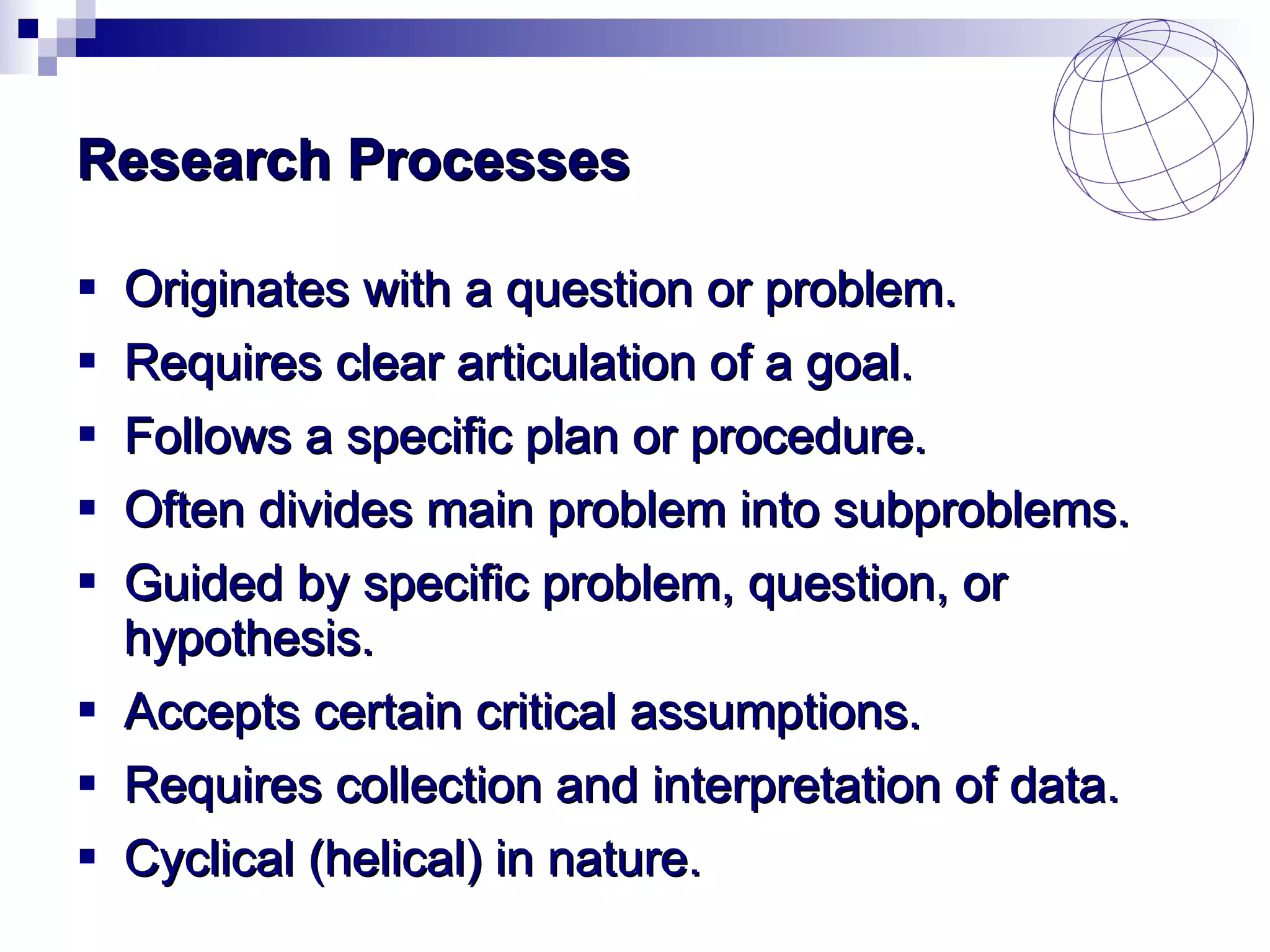
Research Processes Originates with a question or problem. Requires clear articulation of a goal. Follows a specific plan or procedure. Often divides main problem into subproblems. Guided by specific problem, question, or hypothesis. Accepts certain critical assumptions. Requires collection and interpretation of data. Cyclical (helical) in nature.
 
Method vs. Methodology Method how to make something or to achieve results technique Example: Scientific method a series of steps taken to acquire knowledge
Method vs. Methodology Methodology   the analysis of the principles of methods,  rules, and postulates   employed by a discipline the systematic study of methods within a  discipline a particular procedure or set of procedures
Method vs. Methodology Methodology  includes the following concepts as they relate to a particular discipline   : a collection of theories, concepts or ideas  comparative study of different approaches critique of the individual methods
Method vs. Methodology Method Techniques for gathering evidence The various ways of proceeding in gathering information Methodology The underlying theory and analysis of how research does or should proceed, often influenced by discipline (Sandra Harding)
Motivation Motivation for research  methodology (qualitatively) control research process validate research results compare research approaches respect rules of good scientific practice
Research Projects Research begins with a problem. This problem need not be Earth-shaking. Identifying this problem can actually be the hardest part of research. In general, good research projects should: Address an important question. Advance knowledge.
Research Project Pitfalls The following kinds of projects usually don’t make for good research Self-enlightenment. Comparing data sets. Correlating data sets. Problems with yes / no answers.
Sources of Research Problems Observation. Literature reviews. Professional conferences. Experts.
Research Proposal Descri ption of  the intended research ,  including: Problem and subproblems. Hypotheses. Delimitations. Definitions. Assumptions. Importance. Literature review.
Stating the Research Problem Once a research problem identified: State that problem clearly and completely. Determine the feasibility of the research.
Stating the Research Problem Identify subproblems: Completely researchable units. Small in number. Add up to the total problem. Must be clearly tied to the interpretation of  the data.
Hypotheses Hypotheses are tentative, intelligent guesses as to the solution of the problem. There is often a 1-1 correspondence  between a subproblem and a hypothesis. Hypotheses can direct later research  activities since they can help determine the  nature of the research and methods applied.
Delimitations All research has limitations and thus certain work  will   not  be performed. The work that will not be undertaken is described as the  delimitations   of the research.
Definitions Define each technical term as it is used in relation to your research project. This helps remove significant ambiguity from  the research itself by ensuring that  reviewers, while they may not agree with  your definitions, at least know what you’re  talking about.
Assumptions Assumptions are those things that the researcher is taking for granted. For example: a given test instrument  accurately and consistently measures the  phenomenon in question. As a general rule you’re better off documenting an assumption than ignoring it. Overlooked assumptions provide a prime  source of debate about a research project’s  results.
Importance of the Study Many research problems have a kind of theoretical feel about them. Such projects often need to be justified: What is the research project’s practical  value? Without this justification, it will prove difficult to convince others that the problem in question is worth study.
Literature Review A literature review is a necessity. Without this step, you won’t know if your  problem has been solved or what related  research is already underway. Don’t be discouraged if work on the topic is  already underway.
Literature Review Start searching professional  ( peer reviewed )  journals Begin with the most recent articles you can  find. Keep track of relevant articles in a  bibliography.
Research Process Research is an extremely cyclic process. Later stages might necessitate a review of  earlier work. This isn’t a weakness of the process but is part of the built-in error correction machinery. Because of the cyclic nature of research, it can be difficult to determine where to start and when to stop.
 
Step 1: A Question Is Raised A question occurs to or is posed to the researcher for which that researcher has no answer. This doesn’t mean that someone else  doesn’t already have an answer. The question needs to be converted to an appropriate  problem statement  like that documented in a research proposal.
Step 2: Suggest Hypotheses The researcher generates intermediate hypotheses to describe a solution to the problem. This is at best a temporary solution since  there is as yet no evidence to support either  the acceptance or rejection of these  hypotheses.
Step 3: Literature Review The available literature is reviewed to determine if there is already a solution to the problem. Existing solutions do not always explain new  observations. The existing solution might require some  revision or even be discarded.
Step 4: Literature Evaluation It’s possible that the literature review has yielded a solution to the proposed problem. This means that you haven’t really done  research. On the other hand, if the literature review turns up nothing, then additional research activities are justified.
Step 5: Acquire Data The researcher now begins to gather data relating to the research problem. The means of data acquisition will often  change based on the type of the research  problem. This might entail only data gathering, but it  could also require the creation of new  measurement instruments.
Step 6: Data Analysis The data that were gathered in the previous step are analyzed as a first step in ascertaining their meaning. As before, the analysis of the data does not constitute research. This is basic number crunching. It might be necessary to make a data modelling approach.
Step 7: Data Interpretation The researcher interprets the newly analyzed data and suggests a conclusion. This can be difficult. Keep in mind that data analysis that  suggests a correlation between two variables  can’t automatically be interpreted as  suggesting causality between those variables.
Step 8: Hypothesis Support The data will either support the hypotheses or they won’t. This may lead the researcher to cycle back  to an earlier step in the process and begin  again with a new hypothesis. This is one of the self-correcting mechanisms  associated with the scientific method.
High-Quality Research Good research requires: The scope and limitations of the work to be  clearly defined. The process to be clearly explained so that it  can be reproduced and verified by other  researchers. A thoroughly planned design that is as  objective as possible.
High-Quality Research Good research requires: Highly ethical standards be applied. All limitations be documented. Data be adequately analyzed and explained. All findings be presented unambiguously and  all conclusions be justified by sufficient  evidence.
What Makes Research Good? Validity Reliability Replicability Consistent application/analysis “ Trustworthiness” Rigor
Validity in Research Refers to whether the research actually measures what it says it’ll measure.  Validity is the strength of our conclusions, inferences or propositions. Internal Validity :  the difference in the  dependent variable is actually a result of the  independent variable External Validity :  the results of the study are  generalizable to other groups and environments  outside the experimental setting
Validity in Research Refers to whether the research actually measures what it says it’ll measure.  Validity is the strength of our conclusions, inferences or propositions. Conclusion Validity : we can identify a  relationship between treatment and observed  outcome Construct Validity :  we can  generalize our  conceptualized treatment and outcomes to  broader constructs of the same concepts
Reliability in Research The consistency of a measurement, or the degree to which an instrument measures the same way each time it is used under the same condition with the same subjects. In short, it is the repeatability of your measurement. A measure is considered reliable if a person's score on the same test given twice is similar. It is important to remember that reliability is not measured, it is  estimated . Measured by test/retest and internal consistency.
Validity and Reliability A  measurement can be reliable, but not valid.  However, a measurement must first be reliable before it can be valid. Thus reliability is a necessary, but not sufficient, condition of validity.  In other words, a measurement may consistently assess a phenomena (or outcome), but unless that measurement tests what you want it to, it is not valid.
Rigor in Research Validity and Reliability in conducting research Adequate presentation of findings:  consistency, trustworthiness Appropriate representation of study for a particular field:  disciplinary rigor Rhetorical Rigor:  how  you represent your research for a particular audience

Metodologi 1

  • 1.
    Metodologi Penelitian Dr.Hendra Grandis Program Pasca-Sarjana Geofisika Terapan FTTM - ITB
  • 2.
    Agenda Research andR e s e a r c h Met h odolog y Report / Paper writing Communication Skills Presenta tion
  • 3.
    Research Components &Processes Research Topic Literature Review Conceptual Framework Data Acquisition Data Analysis Report Writing Scientific Publication
  • 4.
    Research an activity that contributes to the understanding of a phenomenon [Kuhn, 1962; Lakatos, 1978] the systematic process of collecting and analyzing information (data) in order to increase our understanding of the phenomenon about which we are concerned or interested [ Leedy and Ormrod, 2001]
  • 5.
    Research phenomenon a set of behaviors of some entity (ies) that is found interesting by a research community u nderstanding knowledge that allows prediction of the behavior of some aspect of the phenomenon activities process appropriate to the production of understanding (knowledge) i.e., research methods
  • 6.
    What Research IsNot Research isn’t information gathering Gathering information from resources such books or magazines isn’t research. No contribution to new knowledge (although this might make existing knowledge more accessible).
  • 7.
    Motivation Motivation forresearch pure research : enhance understanding of phenomena instrumentalist research : a problem needs a solution applied research : a solution needs application fields
  • 8.
    Research Processes Originateswith a question or problem. Requires clear articulation of a goal. Follows a specific plan or procedure. Often divides main problem into subproblems. Guided by specific problem, question, or hypothesis. Accepts certain critical assumptions. Requires collection and interpretation of data. Cyclical (helical) in nature.
  • 9.
  • 10.
    Method vs. MethodologyMethod how to make something or to achieve results technique Example: Scientific method a series of steps taken to acquire knowledge
  • 11.
    Method vs. MethodologyMethodology the analysis of the principles of methods, rules, and postulates employed by a discipline the systematic study of methods within a discipline a particular procedure or set of procedures
  • 12.
    Method vs. MethodologyMethodology includes the following concepts as they relate to a particular discipline : a collection of theories, concepts or ideas comparative study of different approaches critique of the individual methods
  • 13.
    Method vs. MethodologyMethod Techniques for gathering evidence The various ways of proceeding in gathering information Methodology The underlying theory and analysis of how research does or should proceed, often influenced by discipline (Sandra Harding)
  • 14.
    Motivation Motivation forresearch methodology (qualitatively) control research process validate research results compare research approaches respect rules of good scientific practice
  • 15.
    Research Projects Researchbegins with a problem. This problem need not be Earth-shaking. Identifying this problem can actually be the hardest part of research. In general, good research projects should: Address an important question. Advance knowledge.
  • 16.
    Research Project PitfallsThe following kinds of projects usually don’t make for good research Self-enlightenment. Comparing data sets. Correlating data sets. Problems with yes / no answers.
  • 17.
    Sources of ResearchProblems Observation. Literature reviews. Professional conferences. Experts.
  • 18.
    Research Proposal Description of the intended research , including: Problem and subproblems. Hypotheses. Delimitations. Definitions. Assumptions. Importance. Literature review.
  • 19.
    Stating the ResearchProblem Once a research problem identified: State that problem clearly and completely. Determine the feasibility of the research.
  • 20.
    Stating the ResearchProblem Identify subproblems: Completely researchable units. Small in number. Add up to the total problem. Must be clearly tied to the interpretation of the data.
  • 21.
    Hypotheses Hypotheses aretentative, intelligent guesses as to the solution of the problem. There is often a 1-1 correspondence between a subproblem and a hypothesis. Hypotheses can direct later research activities since they can help determine the nature of the research and methods applied.
  • 22.
    Delimitations All researchhas limitations and thus certain work will not be performed. The work that will not be undertaken is described as the delimitations of the research.
  • 23.
    Definitions Define eachtechnical term as it is used in relation to your research project. This helps remove significant ambiguity from the research itself by ensuring that reviewers, while they may not agree with your definitions, at least know what you’re talking about.
  • 24.
    Assumptions Assumptions arethose things that the researcher is taking for granted. For example: a given test instrument accurately and consistently measures the phenomenon in question. As a general rule you’re better off documenting an assumption than ignoring it. Overlooked assumptions provide a prime source of debate about a research project’s results.
  • 25.
    Importance of theStudy Many research problems have a kind of theoretical feel about them. Such projects often need to be justified: What is the research project’s practical value? Without this justification, it will prove difficult to convince others that the problem in question is worth study.
  • 26.
    Literature Review Aliterature review is a necessity. Without this step, you won’t know if your problem has been solved or what related research is already underway. Don’t be discouraged if work on the topic is already underway.
  • 27.
    Literature Review Startsearching professional ( peer reviewed ) journals Begin with the most recent articles you can find. Keep track of relevant articles in a bibliography.
  • 28.
    Research Process Researchis an extremely cyclic process. Later stages might necessitate a review of earlier work. This isn’t a weakness of the process but is part of the built-in error correction machinery. Because of the cyclic nature of research, it can be difficult to determine where to start and when to stop.
  • 29.
  • 30.
    Step 1: AQuestion Is Raised A question occurs to or is posed to the researcher for which that researcher has no answer. This doesn’t mean that someone else doesn’t already have an answer. The question needs to be converted to an appropriate problem statement like that documented in a research proposal.
  • 31.
    Step 2: SuggestHypotheses The researcher generates intermediate hypotheses to describe a solution to the problem. This is at best a temporary solution since there is as yet no evidence to support either the acceptance or rejection of these hypotheses.
  • 32.
    Step 3: LiteratureReview The available literature is reviewed to determine if there is already a solution to the problem. Existing solutions do not always explain new observations. The existing solution might require some revision or even be discarded.
  • 33.
    Step 4: LiteratureEvaluation It’s possible that the literature review has yielded a solution to the proposed problem. This means that you haven’t really done research. On the other hand, if the literature review turns up nothing, then additional research activities are justified.
  • 34.
    Step 5: AcquireData The researcher now begins to gather data relating to the research problem. The means of data acquisition will often change based on the type of the research problem. This might entail only data gathering, but it could also require the creation of new measurement instruments.
  • 35.
    Step 6: DataAnalysis The data that were gathered in the previous step are analyzed as a first step in ascertaining their meaning. As before, the analysis of the data does not constitute research. This is basic number crunching. It might be necessary to make a data modelling approach.
  • 36.
    Step 7: DataInterpretation The researcher interprets the newly analyzed data and suggests a conclusion. This can be difficult. Keep in mind that data analysis that suggests a correlation between two variables can’t automatically be interpreted as suggesting causality between those variables.
  • 37.
    Step 8: HypothesisSupport The data will either support the hypotheses or they won’t. This may lead the researcher to cycle back to an earlier step in the process and begin again with a new hypothesis. This is one of the self-correcting mechanisms associated with the scientific method.
  • 38.
    High-Quality Research Goodresearch requires: The scope and limitations of the work to be clearly defined. The process to be clearly explained so that it can be reproduced and verified by other researchers. A thoroughly planned design that is as objective as possible.
  • 39.
    High-Quality Research Goodresearch requires: Highly ethical standards be applied. All limitations be documented. Data be adequately analyzed and explained. All findings be presented unambiguously and all conclusions be justified by sufficient evidence.
  • 40.
    What Makes ResearchGood? Validity Reliability Replicability Consistent application/analysis “ Trustworthiness” Rigor
  • 41.
    Validity in ResearchRefers to whether the research actually measures what it says it’ll measure. Validity is the strength of our conclusions, inferences or propositions. Internal Validity : the difference in the dependent variable is actually a result of the independent variable External Validity : the results of the study are generalizable to other groups and environments outside the experimental setting
  • 42.
    Validity in ResearchRefers to whether the research actually measures what it says it’ll measure. Validity is the strength of our conclusions, inferences or propositions. Conclusion Validity : we can identify a relationship between treatment and observed outcome Construct Validity : we can generalize our conceptualized treatment and outcomes to broader constructs of the same concepts
  • 43.
    Reliability in ResearchThe consistency of a measurement, or the degree to which an instrument measures the same way each time it is used under the same condition with the same subjects. In short, it is the repeatability of your measurement. A measure is considered reliable if a person's score on the same test given twice is similar. It is important to remember that reliability is not measured, it is estimated . Measured by test/retest and internal consistency.
  • 44.
    Validity and ReliabilityA measurement can be reliable, but not valid. However, a measurement must first be reliable before it can be valid. Thus reliability is a necessary, but not sufficient, condition of validity. In other words, a measurement may consistently assess a phenomena (or outcome), but unless that measurement tests what you want it to, it is not valid.
  • 45.
    Rigor in ResearchValidity and Reliability in conducting research Adequate presentation of findings: consistency, trustworthiness Appropriate representation of study for a particular field: disciplinary rigor Rhetorical Rigor: how you represent your research for a particular audience