GEORGE HERBERT MEAD
The Social Self Theory
•American philosopher prominent in both
social psychology and the development
of PRAGMATISM.
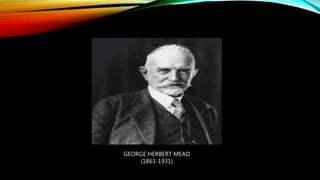
GEORGE HERBERT MEAD
(1863-1931)
•Mead describes how the individual mind
and self arises out of the social process.
•Self consciousness comes about a result
of the organism’s interaction with it’s
environment.
• He believe that the self is not present at birth but is a
social product the develops through socialization.
• He thought that spoken language played a central role in
this development. Through language the child can take
the role of other persons and guide his behaviour in
terms of the effect his contemplated behaviour will have
upon others.
“I AND ME THEORY”
•“I” represents the unorganized, undirected
tendencies of the self
•“Me” is the socialized self which consists of
the internalized social attitudes of tohers, the
insividual acts toward himself formt he
perspective of the community.
• Father of Social Behaviorism
• human beings are distinguished from other animals by
their ability to imagine themselves in the place of the
other
• Language, gesture, communication, and role-taking are
thus central to the symbolic interaction by which the self
is constructed, and which forms the basis of social life.
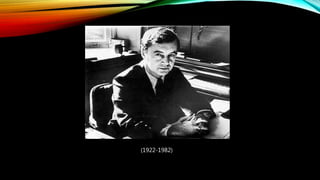
ERVING GOFFMAN
THE DRAMATURGICAL APPROACH
(1922-1982)
• was a major Canadian-American sociologist who played a
significant role in the development of modern American
sociology. He is considered by some to be the most
influential sociologist of the 20th century, thanks to his
many significant and lasting contributions to the field. He
is widely known and celebrated as a major figure in the
development of symbolic interaction theory and for
developing the dramaturgical perspective.
• In his classic work, “The Presentation Of Self In Everyday Life
Stresses” that it is only by influencing other’s idea of us that we
expect or even control what happen to us.
• Goffman views social life as a stage where people interact with
one another. People are viewed as members of the audience and
as actors.
• Dramaturgical approach- Goffman compares the behavior of
people in a society to acting on a stage.
•People are acting out on a script on society’s (real
life) expectation and even making improvements in
order to impress the audience.
•In short, people are “social actors” who do not have
a “real self”,but many “real selves”.
•Father of Dramaturgy.

George herbert mead & erving goffman

  • 1.
    GEORGE HERBERT MEAD TheSocial Self Theory
  • 2.
    •American philosopher prominentin both social psychology and the development of PRAGMATISM.
  • 3.
  • 4.
    •Mead describes howthe individual mind and self arises out of the social process. •Self consciousness comes about a result of the organism’s interaction with it’s environment.
  • 5.
    • He believethat the self is not present at birth but is a social product the develops through socialization. • He thought that spoken language played a central role in this development. Through language the child can take the role of other persons and guide his behaviour in terms of the effect his contemplated behaviour will have upon others.
  • 6.
    “I AND METHEORY” •“I” represents the unorganized, undirected tendencies of the self •“Me” is the socialized self which consists of the internalized social attitudes of tohers, the insividual acts toward himself formt he perspective of the community.
  • 7.
    • Father ofSocial Behaviorism • human beings are distinguished from other animals by their ability to imagine themselves in the place of the other • Language, gesture, communication, and role-taking are thus central to the symbolic interaction by which the self is constructed, and which forms the basis of social life.
  • 8.
  • 9.
  • 10.
    • was amajor Canadian-American sociologist who played a significant role in the development of modern American sociology. He is considered by some to be the most influential sociologist of the 20th century, thanks to his many significant and lasting contributions to the field. He is widely known and celebrated as a major figure in the development of symbolic interaction theory and for developing the dramaturgical perspective.
  • 11.
    • In hisclassic work, “The Presentation Of Self In Everyday Life Stresses” that it is only by influencing other’s idea of us that we expect or even control what happen to us. • Goffman views social life as a stage where people interact with one another. People are viewed as members of the audience and as actors. • Dramaturgical approach- Goffman compares the behavior of people in a society to acting on a stage.
  • 12.
    •People are actingout on a script on society’s (real life) expectation and even making improvements in order to impress the audience. •In short, people are “social actors” who do not have a “real self”,but many “real selves”. •Father of Dramaturgy.