INTERACTIONIST
THEORY
Exploring the Dynamics of Symbolic Interactions
Mahima Mahat
Rajeshwari Prajapati
Shiwani Mahat
MSW 1st Semester
Introduction
Explanation and Example
Principle
02
04
01
Purpose
Purpose of
Interactionism Theory
Symbolic Interactionism
03
Dramaturgical Theory
Founder
Explanation
References
05
Table of contents
Interaction
Interactionism
Interactionist Theory
Interactionism Perspective
Introduction
01
INTERACTION
● A face-to-face process
consisting of actions, reactions,
and mutual adaptation between
two or more individuals.
● Also includes animal interaction
such as mating.
● Includes all language (including
body language) and
mannerisms.
• Process where the ability to think is both developed
and expressed.
• In most interaction, actors must take others into
consideration and decide if and how to fit their
activities to others.
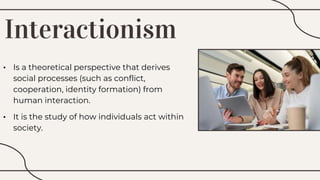
Interactionism
• Is a theoretical perspective that derives
social processes (such as conflict,
cooperation, identity formation) from
human interaction.
• It is the study of how individuals act within
society.
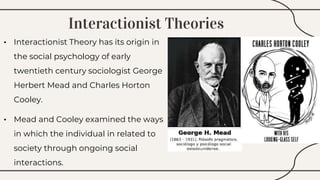
Interactionist Theories
• Interactionist Theory has its origin in
the social psychology of early
twentieth century sociologist George
Herbert Mead and Charles Horton
Cooley.
• Mead and Cooley examined the ways
in which the individual in related to
society through ongoing social
interactions.
Purpose
02
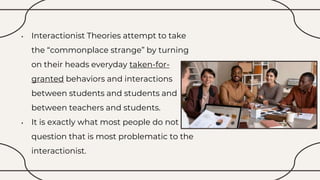
• Interactionist Theories attempt to take
the “commonplace strange” by turning
on their heads everyday taken-for-
granted behaviors and interactions
between students and students and
between teachers and students.
• It is exactly what most people do not
question that is most problematic to the
interactionist.
For example, the processes by which students
are labelled “gifted” or “learning disabled” are,
from an interactionist point of view, important
to analyze because such processes carry with
them many implicit assumptions about
learning and children.
Symbolic Interactionism
03
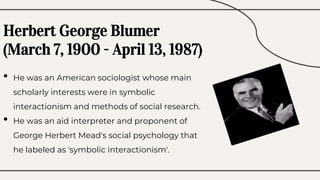
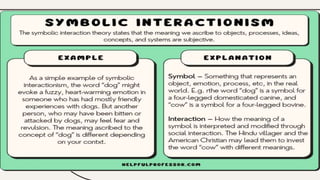
• He was an American sociologist whose main
scholarly interests were in symbolic
interactionism and methods of social research.
• He was an aid interpreter and proponent of
George Herbert Mead's social psychology that
he labeled as 'symbolic interactionism'.
Herbert George Blumer
(March 7, 1900 - April 13, 1987)
Blumer’s Three Basic Premise
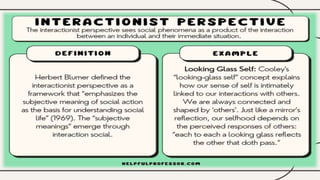
Herbert Blumer (1969) set out three basic premises of the perspective:
• “Humans act toward things on the basis of the meaning they ascribe to
those things”.
• “ The meaning of such things is derived from or arises out of the social
interaction that one has with others and the society.” (same thing could
have different meaning to different people.)
• “ These meaning are handled in, and modified through, an interpretation
process used by the person in dealing with the things he/she encounters”.
(The meaning we give to something is not permanent)
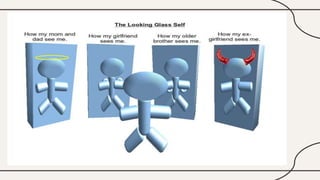
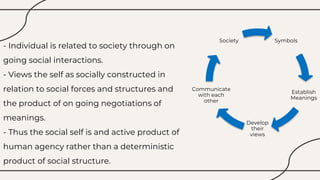
- Individual is related to society through on
going social interactions.
- Views the self as socially constructed in
relation to social forces and structures and
the product of on going negotiations of
meanings.
- Thus the social self is and active product of
human agency rather than a deterministic
product of social structure.
Symbols
Establish
Meanings
Develop
their
views
Communicate
with each
other
Society
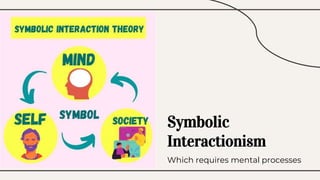
Symbolic
Interactionism
Which requires mental processes
Principles of Symbolic Interactionism
● Human beings unlike lower animals are endowed with a capacity for
thought.
● The capacity for thought is shaped by social interaction.
● In social interaction, people learn the meanings and symbols that allow
them to exercise their distinctively human capacity for thought.
● Meanings and symbols allow people to carry on distinctive human action
and interaction.
● People are able to modify or alter meanings and symbols that they use in
action and interaction on the basis of their interpretation of the situation.
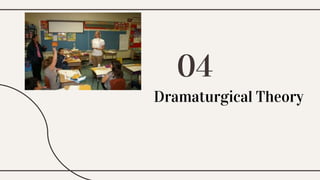
Dramaturgical Theory
04
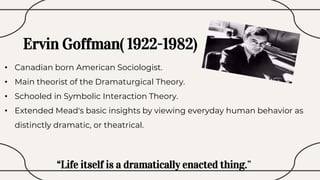
Ervin Goffman( 1922-1982)
• Canadian born American Sociologist.
• Main theorist of the Dramaturgical Theory.
• Schooled in Symbolic Interaction Theory.
• Extended Mead's basic insights by viewing everyday human behavior as
distinctly dramatic, or theatrical.
“Life itself is a dramatically enacted thing.”
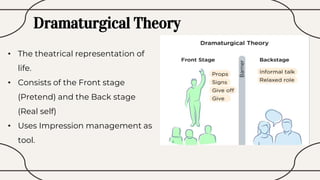
Dramaturgical Theory
• The theatrical representation of
life.
• Consists of the Front stage
(Pretend) and the Back stage
(Real self)
• Uses Impression management as
tool.
● Ahillon, B. (2023). Interactionist theory. SlideShare.
https://www.slideshare.net/badongahillon/interactionist-theory
● Blumer, H. (2017). The nature of symbolic interactions. In Communication
theory (pp. 102-120). Routledge.
● Carter, M. J., & Fuller, C. (2015). Symbolic interactionism. Sociopedia.isa, 1(1),
1-17.
References
References
● LibreTexts. (n.d.). 1.3D: The symbolic interactionist perspective. In
Introduction to sociology (Boundless). LibreTexts.
https://socialsci.libretexts.org/Bookshelves/Sociology/Introduction_to_Soci
ology/Sociology_(Boundless)/01%3A_Sociology/1.03%3A_Theoretical_Persp
ectives_in_Sociology/1.3D%3A_The_Symbolic_Interactionist_Perspective
● Smith, J. A. (2020). Understanding social work practices. Journal of
Sociology and Social Work, 15(2), 123-145.
https://scholarworks.wmich.edu/cgi/viewcontent.cgi?article=1295&context
=jssw
References
• Stebbins, R. A. (2013). Interactionist theories. In C. D. Bryant & D. L. Peck
(Eds.), 21st century sociology: A reference handbook (Vol. 2, pp. 148-155).
SAGE Publications. Retrieved from
https://www.researchgate.net/publication/272151465_Interactionist_theorie
s
• Utzumi, F. C., Lacerda, M. R., Bernardino, E., Gomes, I. M., Aued, G. K., &
Sousa, S. M. D. (2018). Continuity of care and the symbolic interactionism: a
possible understanding. Texto & Contexto-Enfermagem, 27(2).
● Võsu, E. (2010). Metaphorical analogies in approaches of Victor Turner and
Erving Goffman: Dramaturgy in social interaction and dramas of social
life. Σημειωτκή-Sign Systems Studies, 38(1-4), 130-166.
References

Interactionist Theory, Symbolic Interaction.pptx

  • 1.
    INTERACTIONIST THEORY Exploring the Dynamicsof Symbolic Interactions Mahima Mahat Rajeshwari Prajapati Shiwani Mahat MSW 1st Semester
  • 2.
    Introduction Explanation and Example Principle 02 04 01 Purpose Purposeof Interactionism Theory Symbolic Interactionism 03 Dramaturgical Theory Founder Explanation References 05 Table of contents Interaction Interactionism Interactionist Theory Interactionism Perspective
  • 3.
  • 4.
    INTERACTION ● A face-to-faceprocess consisting of actions, reactions, and mutual adaptation between two or more individuals. ● Also includes animal interaction such as mating. ● Includes all language (including body language) and mannerisms.
  • 5.
    • Process wherethe ability to think is both developed and expressed. • In most interaction, actors must take others into consideration and decide if and how to fit their activities to others.
  • 6.
    Interactionism • Is atheoretical perspective that derives social processes (such as conflict, cooperation, identity formation) from human interaction. • It is the study of how individuals act within society.
  • 7.
    Interactionist Theories • InteractionistTheory has its origin in the social psychology of early twentieth century sociologist George Herbert Mead and Charles Horton Cooley. • Mead and Cooley examined the ways in which the individual in related to society through ongoing social interactions.
  • 10.
  • 11.
    • Interactionist Theoriesattempt to take the “commonplace strange” by turning on their heads everyday taken-for- granted behaviors and interactions between students and students and between teachers and students. • It is exactly what most people do not question that is most problematic to the interactionist.
  • 12.
    For example, theprocesses by which students are labelled “gifted” or “learning disabled” are, from an interactionist point of view, important to analyze because such processes carry with them many implicit assumptions about learning and children.
  • 13.
  • 14.
    • He wasan American sociologist whose main scholarly interests were in symbolic interactionism and methods of social research. • He was an aid interpreter and proponent of George Herbert Mead's social psychology that he labeled as 'symbolic interactionism'. Herbert George Blumer (March 7, 1900 - April 13, 1987)
  • 15.
    Blumer’s Three BasicPremise Herbert Blumer (1969) set out three basic premises of the perspective: • “Humans act toward things on the basis of the meaning they ascribe to those things”. • “ The meaning of such things is derived from or arises out of the social interaction that one has with others and the society.” (same thing could have different meaning to different people.) • “ These meaning are handled in, and modified through, an interpretation process used by the person in dealing with the things he/she encounters”. (The meaning we give to something is not permanent)
  • 17.
    - Individual isrelated to society through on going social interactions. - Views the self as socially constructed in relation to social forces and structures and the product of on going negotiations of meanings. - Thus the social self is and active product of human agency rather than a deterministic product of social structure. Symbols Establish Meanings Develop their views Communicate with each other Society
  • 18.
  • 19.
    Principles of SymbolicInteractionism ● Human beings unlike lower animals are endowed with a capacity for thought. ● The capacity for thought is shaped by social interaction. ● In social interaction, people learn the meanings and symbols that allow them to exercise their distinctively human capacity for thought. ● Meanings and symbols allow people to carry on distinctive human action and interaction. ● People are able to modify or alter meanings and symbols that they use in action and interaction on the basis of their interpretation of the situation.
  • 20.
  • 21.
    Ervin Goffman( 1922-1982) •Canadian born American Sociologist. • Main theorist of the Dramaturgical Theory. • Schooled in Symbolic Interaction Theory. • Extended Mead's basic insights by viewing everyday human behavior as distinctly dramatic, or theatrical. “Life itself is a dramatically enacted thing.”
  • 22.
    Dramaturgical Theory • Thetheatrical representation of life. • Consists of the Front stage (Pretend) and the Back stage (Real self) • Uses Impression management as tool.
  • 23.
    ● Ahillon, B.(2023). Interactionist theory. SlideShare. https://www.slideshare.net/badongahillon/interactionist-theory ● Blumer, H. (2017). The nature of symbolic interactions. In Communication theory (pp. 102-120). Routledge. ● Carter, M. J., & Fuller, C. (2015). Symbolic interactionism. Sociopedia.isa, 1(1), 1-17. References
  • 24.
    References ● LibreTexts. (n.d.).1.3D: The symbolic interactionist perspective. In Introduction to sociology (Boundless). LibreTexts. https://socialsci.libretexts.org/Bookshelves/Sociology/Introduction_to_Soci ology/Sociology_(Boundless)/01%3A_Sociology/1.03%3A_Theoretical_Persp ectives_in_Sociology/1.3D%3A_The_Symbolic_Interactionist_Perspective ● Smith, J. A. (2020). Understanding social work practices. Journal of Sociology and Social Work, 15(2), 123-145. https://scholarworks.wmich.edu/cgi/viewcontent.cgi?article=1295&context =jssw
  • 25.
    References • Stebbins, R.A. (2013). Interactionist theories. In C. D. Bryant & D. L. Peck (Eds.), 21st century sociology: A reference handbook (Vol. 2, pp. 148-155). SAGE Publications. Retrieved from https://www.researchgate.net/publication/272151465_Interactionist_theorie s • Utzumi, F. C., Lacerda, M. R., Bernardino, E., Gomes, I. M., Aued, G. K., & Sousa, S. M. D. (2018). Continuity of care and the symbolic interactionism: a possible understanding. Texto & Contexto-Enfermagem, 27(2).
  • 26.
    ● Võsu, E.(2010). Metaphorical analogies in approaches of Victor Turner and Erving Goffman: Dramaturgy in social interaction and dramas of social life. Σημειωτκή-Sign Systems Studies, 38(1-4), 130-166. References