In philosophy, the term ‘phenomenon’ is used
to describe things as they appear to our
senses.
Some philosophers argue that we can never have
definite knowledge of what the world outside or
minds is really like ‘in itself’- we only know what our
senses tell us and we cannot determine whether or
not our senses see, smell etc. the true picture.
This is the starting point for a philosophy known as
phenomenology, developed by Edmund Husserl
(1859-1938)
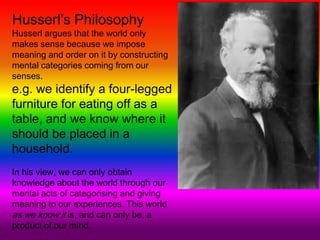
Husserl’s Philosophy
Husserl argues that the world only
makes sense because we impose
meaning and order on it by constructing
mental categories coming from our
senses.
e.g. we identify a four-legged
furniture for eating off as a
table, and we know where it
should be placed in a
household.
In his view, we can only obtain
knowledge about the world through our
mental acts of categorising and giving
meaning to our experiences. This world
as we know it is, and can only be, a
product of our mind.
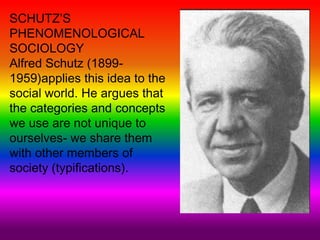
SCHUTZ’S
PHENOMENOLOGICAL
SOCIOLOGY
Alfred Schutz (1899-
1959)applies this idea to the
social world. He argues that
the categories and concepts
we use are not unique to
ourselves- we share them
with other members of
society (typifications).
Typifications
Schutz calls these shared categories typifications. These enable
us to organise or experiences into a shared world of meaning.
In his view, the meaning of any given experience varies
according to its social context. For example, raising you arm
means answering a question in class, it is also the infamous
symbol of Adolf Hitler and it means bidding on an item in an
auction. For this reason, meanings are potentially unclear and
unstable- especially if others classify the action in a different way
from oneself.
Fortunately, typifications stabilise and clarify meanings by
ensuring that we are all ‘speaking the same language’- all
agreeing on the meanings of things. This makes it possible to
communicate and achieve goals.
Without typifications, social order would become impossible.
For example, if you see a certain object like a desk (for writing at),
while it is also used at an altar (for worshipping at), considerable
problems may occur.
However, in Schutz’s view, members of society to a large extent have
a shared ‘life world’- a stock of shared typifications or commonsense
knowledge that we use to make sense of our experience.
It includes shared assumptions about the way things are, what certain
situations may mean etc. Schutz calls this ‘recipe knowledge’- we can
follow it without thinking too much and still get the desired results. For
example, we all ‘know’ that a red light means we should stop, and we
follow it to be safe. This isn’t simply knowledge about the world. For
Schutz, the social world is a shared, inter-subjective world that can
only exist when we share the same meanings. For example, the red
light only works to mean ‘stop ‘ because we all agree that it does.
The Natural Attitude
However, society appears to us as a real, objective
thing existing outside of us. To illustrate this, Schutz
gives the example of posting a letter to a bookshop to
order a book. In doing so, he says, we assume that
some unknown and unseen individuals (postal workers,
a bookshop owner) will perform a whole series of
operations in a particular sequence- and that all of this
will result in receiving a book.
The fact that we receive the book at the end of this
encourages us to adopt a ‘natural attitude’- that is, it
leads us to assume that the social world is a solid,
natural thing out there.
However, for Schutz, this example just proves that all of those
involved share the same meanings, so this has allowed people
to cooperate and achieve goals.
However, Peter Berger and Thomas Luckerman (1971) argue
that while Schutz may focus on commonsense knowledge, they
rejecthis view that society is merely an inter-subjective reality.
Although reality is socially constructed, as Schutz believes, once
it has been constructed, it takes a life of its own and becomes an
external reality that reflects back to us. For example, religion
may start off in our consciousness, but they become embodied in
powerful structures such as churches, which then change laws
and expectations around us, such as influencing laws about
sexual relationships and influencing how certain sexes and
people should behave, which completely changes what we view
as right or wrong.

Phenomonology

  • 2.
    In philosophy, theterm ‘phenomenon’ is used to describe things as they appear to our senses. Some philosophers argue that we can never have definite knowledge of what the world outside or minds is really like ‘in itself’- we only know what our senses tell us and we cannot determine whether or not our senses see, smell etc. the true picture. This is the starting point for a philosophy known as phenomenology, developed by Edmund Husserl (1859-1938)
  • 3.
    Husserl’s Philosophy Husserl arguesthat the world only makes sense because we impose meaning and order on it by constructing mental categories coming from our senses. e.g. we identify a four-legged furniture for eating off as a table, and we know where it should be placed in a household. In his view, we can only obtain knowledge about the world through our mental acts of categorising and giving meaning to our experiences. This world as we know it is, and can only be, a product of our mind.
  • 4.
    SCHUTZ’S PHENOMENOLOGICAL SOCIOLOGY Alfred Schutz (1899- 1959)appliesthis idea to the social world. He argues that the categories and concepts we use are not unique to ourselves- we share them with other members of society (typifications).
  • 5.
    Typifications Schutz calls theseshared categories typifications. These enable us to organise or experiences into a shared world of meaning. In his view, the meaning of any given experience varies according to its social context. For example, raising you arm means answering a question in class, it is also the infamous symbol of Adolf Hitler and it means bidding on an item in an auction. For this reason, meanings are potentially unclear and unstable- especially if others classify the action in a different way from oneself. Fortunately, typifications stabilise and clarify meanings by ensuring that we are all ‘speaking the same language’- all agreeing on the meanings of things. This makes it possible to communicate and achieve goals. Without typifications, social order would become impossible.
  • 6.
    For example, ifyou see a certain object like a desk (for writing at), while it is also used at an altar (for worshipping at), considerable problems may occur. However, in Schutz’s view, members of society to a large extent have a shared ‘life world’- a stock of shared typifications or commonsense knowledge that we use to make sense of our experience. It includes shared assumptions about the way things are, what certain situations may mean etc. Schutz calls this ‘recipe knowledge’- we can follow it without thinking too much and still get the desired results. For example, we all ‘know’ that a red light means we should stop, and we follow it to be safe. This isn’t simply knowledge about the world. For Schutz, the social world is a shared, inter-subjective world that can only exist when we share the same meanings. For example, the red light only works to mean ‘stop ‘ because we all agree that it does.
  • 7.
    The Natural Attitude However,society appears to us as a real, objective thing existing outside of us. To illustrate this, Schutz gives the example of posting a letter to a bookshop to order a book. In doing so, he says, we assume that some unknown and unseen individuals (postal workers, a bookshop owner) will perform a whole series of operations in a particular sequence- and that all of this will result in receiving a book. The fact that we receive the book at the end of this encourages us to adopt a ‘natural attitude’- that is, it leads us to assume that the social world is a solid, natural thing out there.
  • 8.
    However, for Schutz,this example just proves that all of those involved share the same meanings, so this has allowed people to cooperate and achieve goals. However, Peter Berger and Thomas Luckerman (1971) argue that while Schutz may focus on commonsense knowledge, they rejecthis view that society is merely an inter-subjective reality. Although reality is socially constructed, as Schutz believes, once it has been constructed, it takes a life of its own and becomes an external reality that reflects back to us. For example, religion may start off in our consciousness, but they become embodied in powerful structures such as churches, which then change laws and expectations around us, such as influencing laws about sexual relationships and influencing how certain sexes and people should behave, which completely changes what we view as right or wrong.